The Anglian Chauffeured Shacker
Saturday 17th June 2017
Report by John Cameron
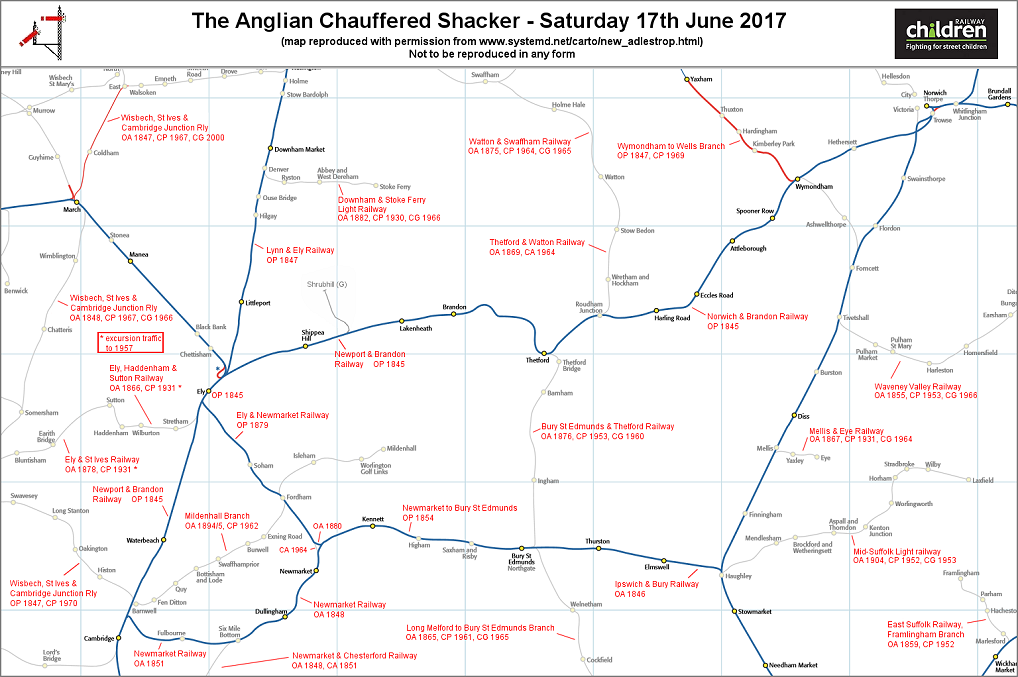
This fixture was the first of its kind, the idea being to allow participants to ‘do’ as many of the hardest to do East Anglian stations (or ‘shacks’ to some) as possible in one day. This activity requires either alighting or departing a train at the station in question – stepping off at a station and getting back on the same train is not allowed*. This requirement makes it difficult to use certain stations with very sparse train services, as waiting for the next train to call might take all day, and there is often no alternative public transport. With this in mind a plan was devised by member Ian Delgado to chauffeur drive a group between stations to allow maximum usage of the rare stations.
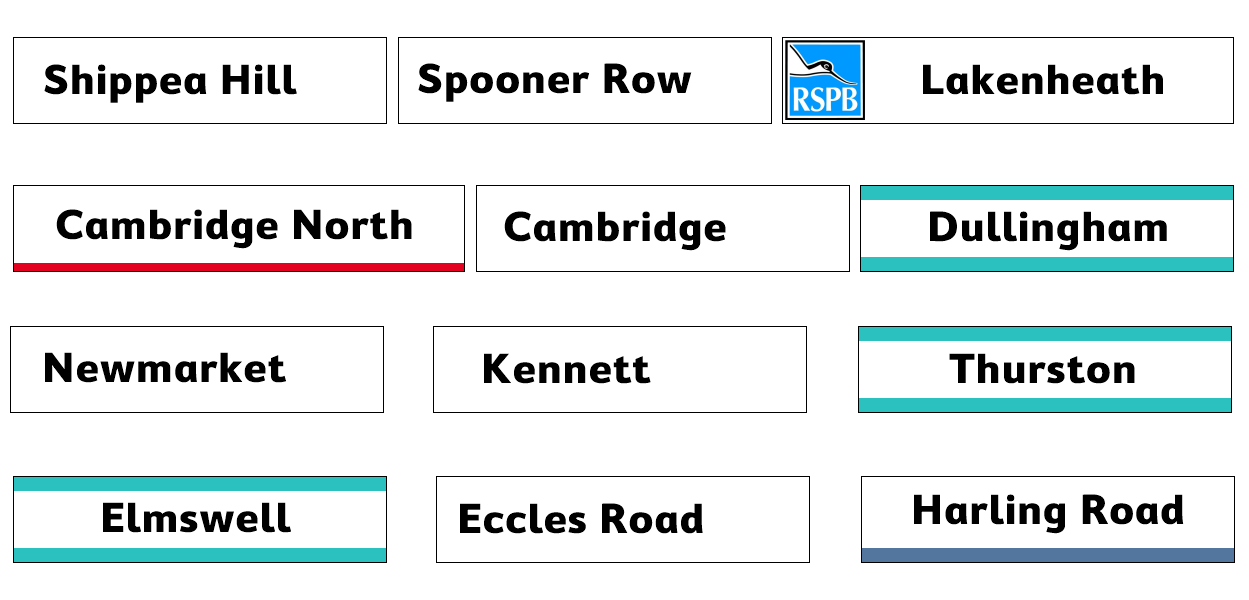
It was interesting to note a variation in the signs of the
stations visited. The imbalance on some of the signs
is down to the removal of the short-lived 'One' logo.
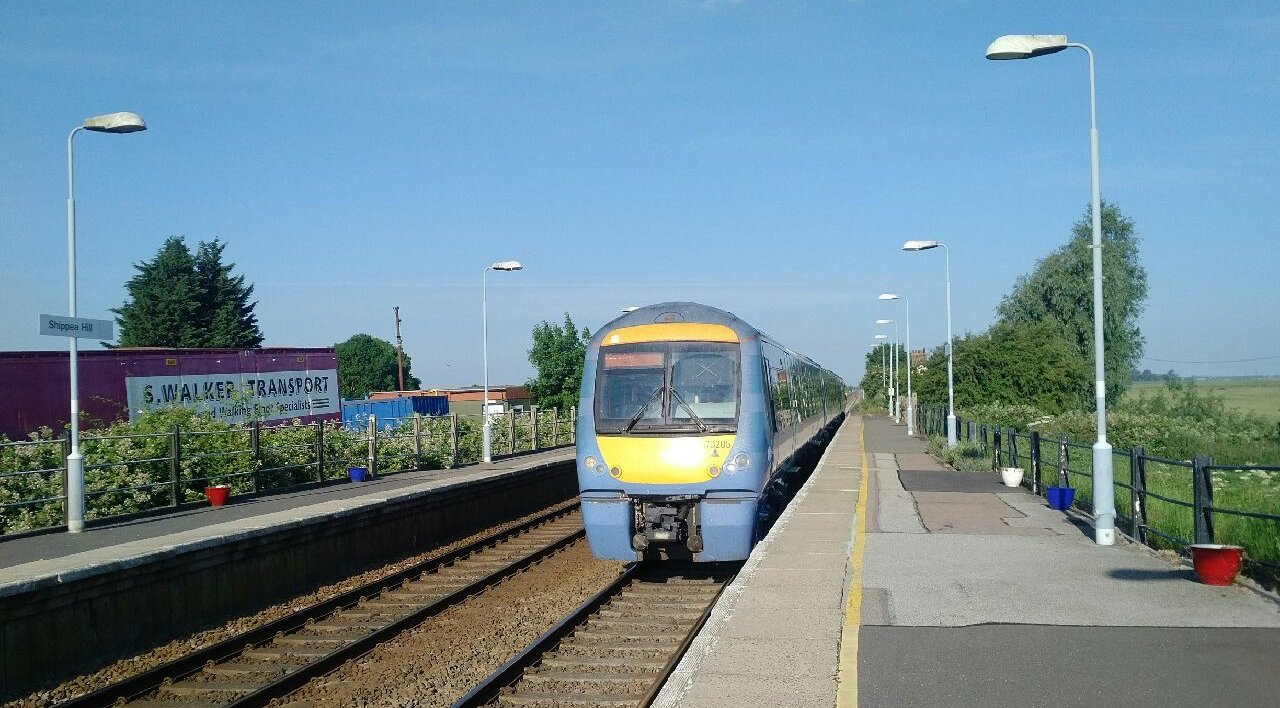
170205 arriving at Shippea Hill station for the first leg of the Shacker. Shippea Hill is a request stop.
[© John Cameron 2017]
The day started with an 06.55 pick-up from Ely. The first move of the itinerary being a very rare journey between Shippea Hill and Spooner Row. Shippea Hill is a request stop served by one train per day to Norwich, Monday to Saturday only, as well as one train per day to Cambridge on Saturdays only. Shippea Hill opened in 1845 as Mildenhall Road, the name being changed to Burnt Fen in 1885 and to Shippea Hill in 1904. In 2014/15 and 2015/16 Shippea Hill was the least used station in Britain with 22 and 12 recorded passengers respectively. This may change for 2016/17, as its status as Britain’s least used station prompted a finalist from The Great British Bake off to hand out free mince pies, attracting 16 additional passengers in December 2016. In June 2017 19 people travelled from Shippea Hill as part of the All The Stations documentary project. Today Shippea Hill has a bus shelter style waiting shelter on the down platform 1. The signal box next to the level crossing remains, albeit leaning visibly backwards. It was closed in 2012, when the signalling on the Ely-Norwich line was up-graded, the wooden crossing barriers being replaced by automatic barriers at the same time. Having been deposited by the chauffeur in good time, 2K58, the 0700 Cambridge-Norwich (0725 from Shippea Hill), formed of 170 205, was flagged down and boarded. The conductor was found and alerted that Spooner Row (another request stop) was the destination. The conductor was slightly surprised at the journey, stating that he had had a few passengers getting off at Shippea Hill before, but never any getting on! The explanation having been duly made he advised that the doors on the front two coaches only would be opened at Spooner Row, due to a short platform, which would result in a short delay as he had to go to the back and lock that coach’s doors out before releasing the others.
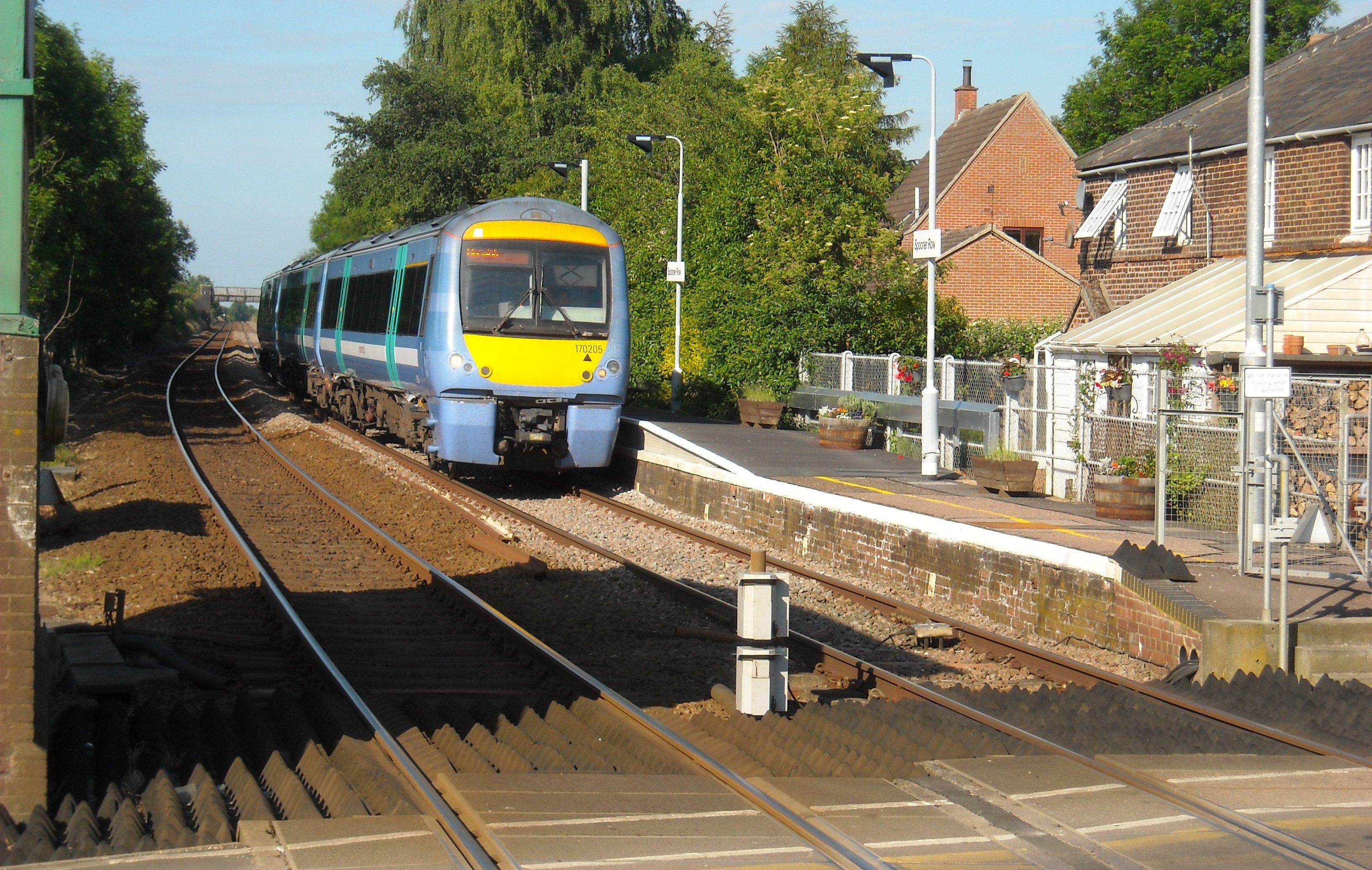
170205 arriving at Spooner Row, another request stop. Note the raised section because of the very low platform.
[© Ian Delgado 2017]
Spooner Row station was planned and built by the Norwich and Brandon Railway (N&BR). By the time it opened in 1845 the N&BR had amalgamated with the Yarmouth and Norwich Railway to form the Norfolk Railway. The NR closed Spooner Row in 1847. However, the Eastern Counties Railway, which absorbed the Norfolk Railway in 1848, re-opened it in 1855, only for it to close for a second time in 1860. The Great Eastern Railway absorbed the Eastern Counties in 1862 and the GER reopened Spooner Row for the third time in 1882. It has remained open since. In comparison with Shippea Hill, Spooner Row is a major hub, with passenger numbers of 664 in 2015/16, up from 490 in 2014/15. Spooner row also has more services, with two trains each morning to Norwich and one each afternoon to Cambridge on weekdays and one train in each direction on Saturdays, with no trains on Sundays. The down platform 1 is very low by today’s standards and has a short modern raised section for easier access. Considering the low usage the station is well kept, with lots of flowers on and beside the platforms. The signal box remains (again closed 2012) next to the now automatic crossing barriers.
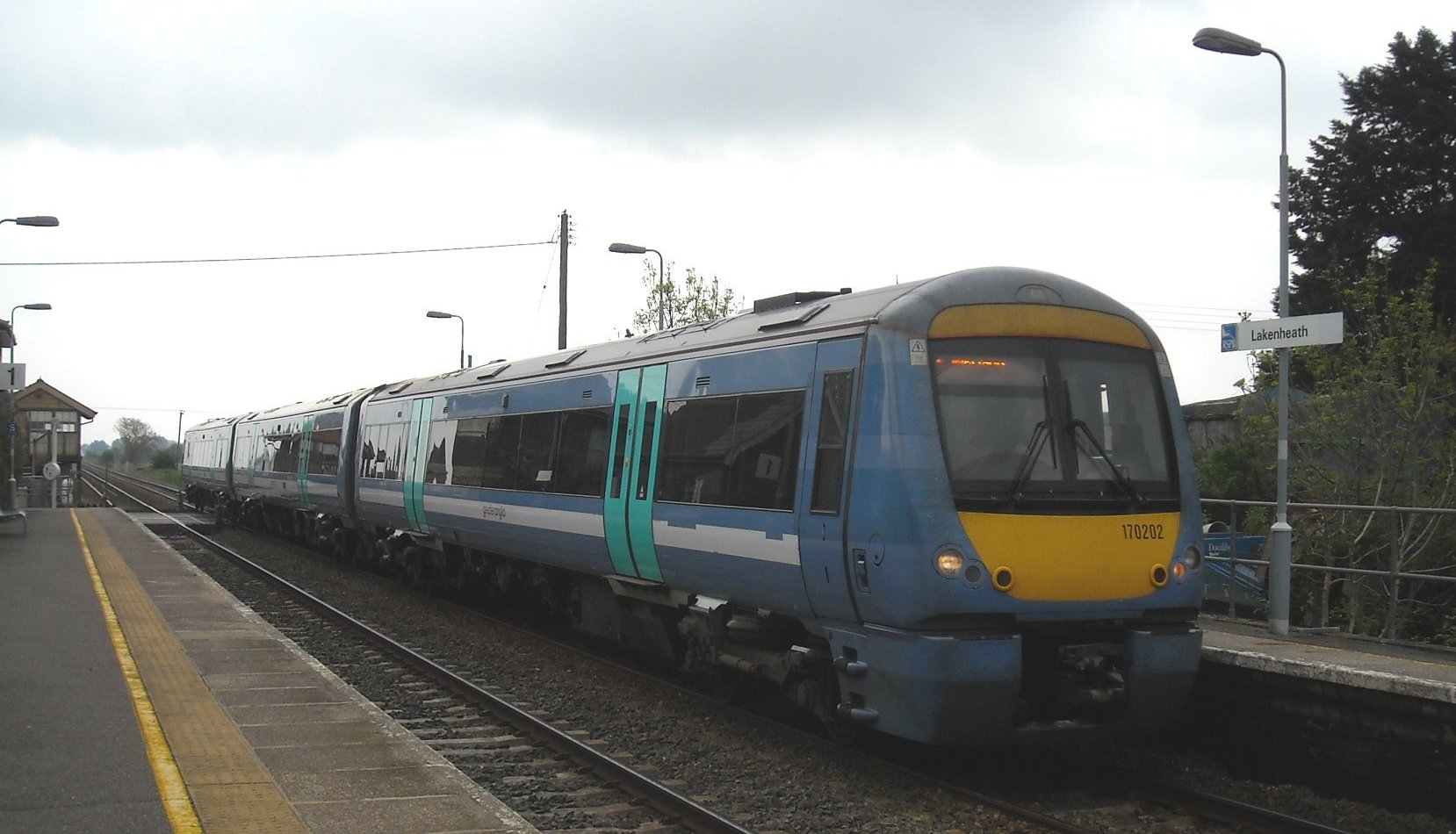
170202 arriving at Lakenheath, the only up train on a Saturday. The closed signal box is in the background.
[© Ian Delgado 2017]
From Spooner Row the chauffeuring element of the exercise resumed, with a journey by car to Lakenheath, the driver having driven to Spooner Row to meet the train. As Lakenheath is served by only one train in each direction on Saturdays (3 to Cambridge and 4 to Norwich on Sundays, no weekday service) there was plenty of time to enjoy some refreshments in the peaceful surroundings of a nearby Norfolk Wildlife Trust reserve (and a few rare birds spotted as well!) before continuing to Lakenheath station. Originally named ‘The Hiss’ after a local farm, Lakenheath only serves the nature reserve, with the RSPB logo appearing on the station signs. There is a bus stop style shelter on the up platform 2. A couple of station buildings survive on the down side, out of use, as does the obligatory signal box and now automatic crossing barriers at the country end. Lakenheath is among the bottom 30 British stations for passenger usage, with only 414 in 2015/16. The 0938 Norwich – Cambridge (1024 from Lakenheath) formed of 170202 was boarded and taken as far as the new station at Cambridge North (OP 21st May 2017).
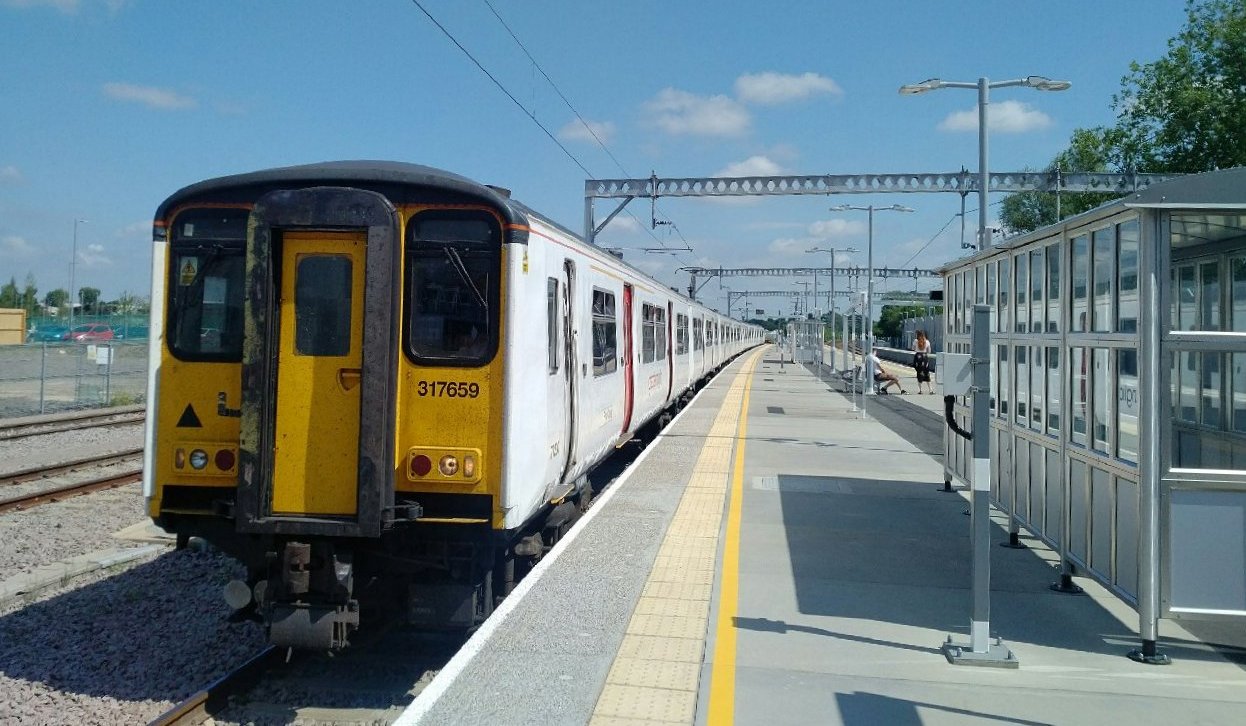
317659 and 317883 ready to depart Cambridge North platform 3 for Cambridge and Liverpool Street.
[© John Cameron 2017]
Cambridge North provides a contrast to the others in the itinerary, being of the most modern design and with regular services at least every hour to Ely, Cambridge, Kings Cross and Liverpool Street. The train conductor said that the station is already being used by over 3,000 passengers per day, and thus by no definition can be described as ‘rare’! However, it was included due to its newness. The opportunity was taken to take 2H27, the 1115 from Cambridge North bay platform 3, formed of 317659 and 317883, to Cambridge. Pleasingly, the train started from the furthest extent of the bay, near to the buffer stops. As well as the new bay, the crossover south of Cambridge North station was also enjoyed. After a quick refreshment at Cambridge (another staging point that is far from rare!), 2W15, 1144 Cambridge – Ipswich, formed of 170270 from p6, was taken as far as Dullingham.
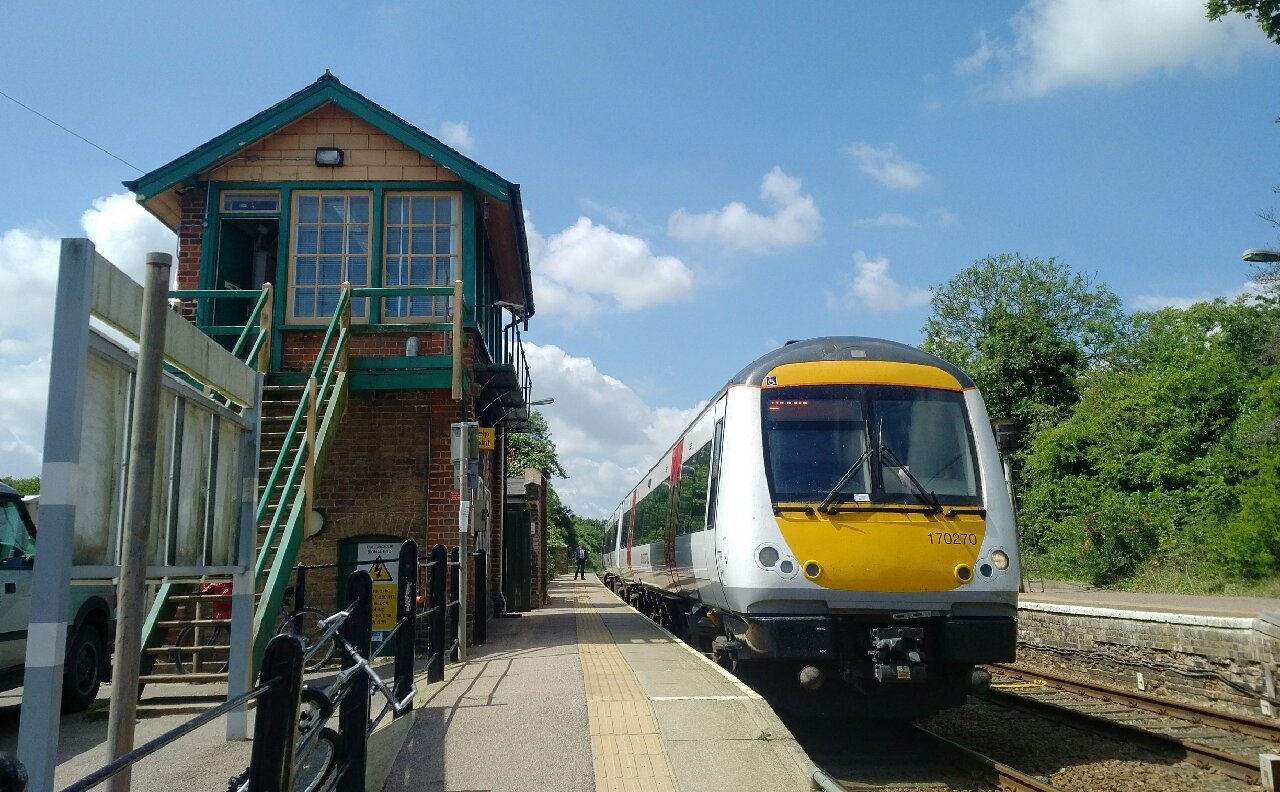
170270 having arrived at Dullingham in the up platform, which all down trains except one use.
[© John Cameron 2017]
Dullingham was opened in 1848 by the Newmarket and Chesterfield Railway (N&CR). It was closed in July 1850, but reopened again in September 1850. The station has a handsome signal box on p2 (still open on this line) and manually operated wooden crossing gates. Platform 2 is bi-directionally signalled and most trains in both directions call at this platform, which is closer to the village, with the other platform and loop only being used once a day when trains cross each other here, on the otherwise single line. Dullingham typically has a train every two hours, with half of the hourly Cambridge – Ipswich trains running through without stopping.
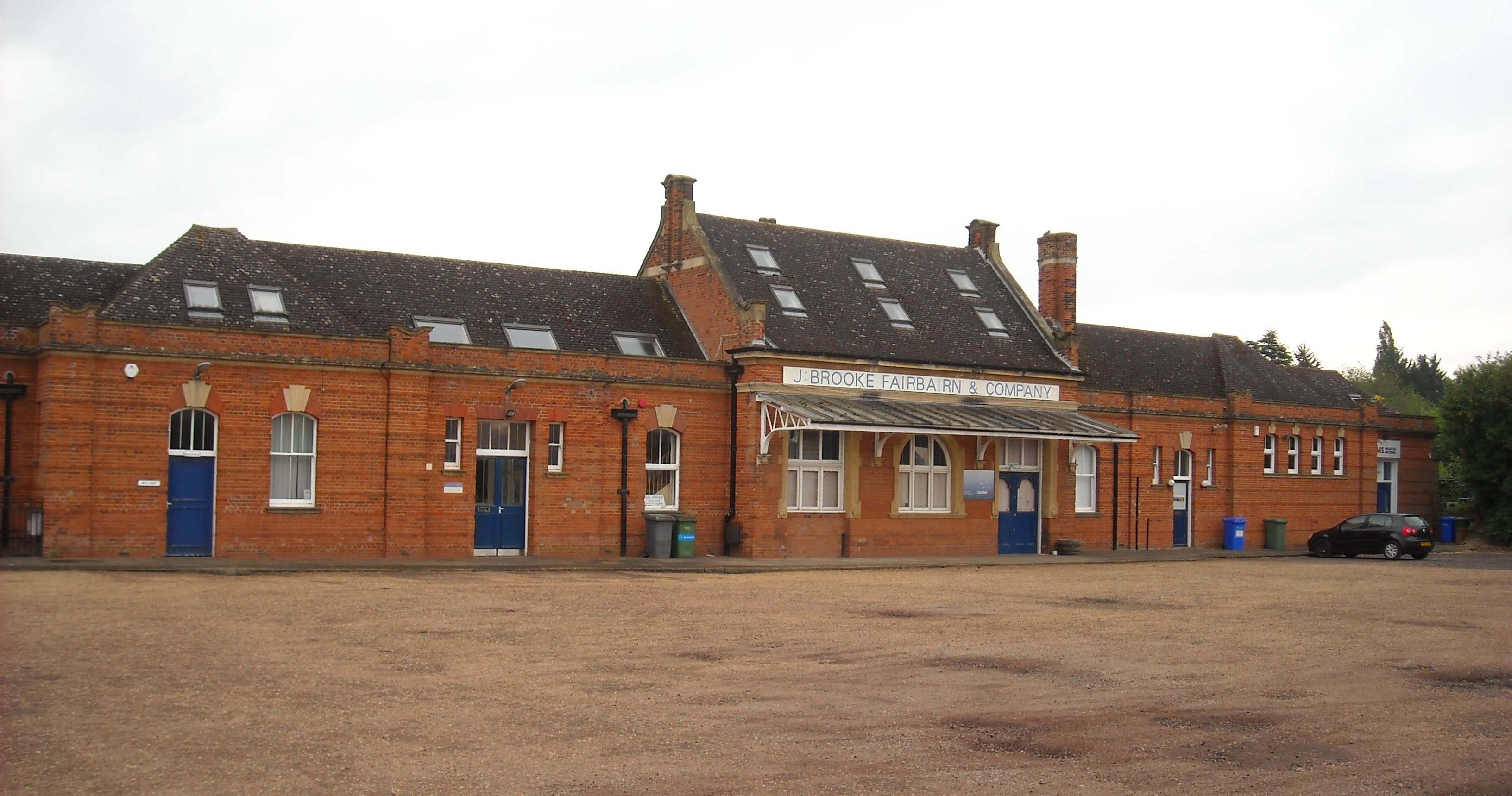
The old station down side buildings at Newmarket, sadly no longer in use for rail passengers. There were also extensive buildings
on the up side, but these were demolished in 1965. In addition to the two through lines, the station had an east-facing up side
bay
for passengers using the Ely line before that service - which used the Snailwell chord at Chippenham - was withdrawn in 1965.
[© Ian Delgado 2017]
The chauffeur was again on hand on arrival to whisk the party on to the next station of Newmarket. Newmarket’s large and very handsome station building of 1902 remains in good condition and was inspected. However, it now houses a range of horse related businesses and an art gallery, having been sold by Network Rail in 2011. The modern Newmarket station is a minimal affair by comparison, although it was improved in 2016 after complaints from local rail users, and now has two shelters and several wooden benches on the single platform. The original station was opened in 1848 as the terminus of the N&CR. 2W17, the 1244 from Cambridge to Ipswich (1304 from Newmarket), formed of 170208 was taken for the short journey to Kennett.
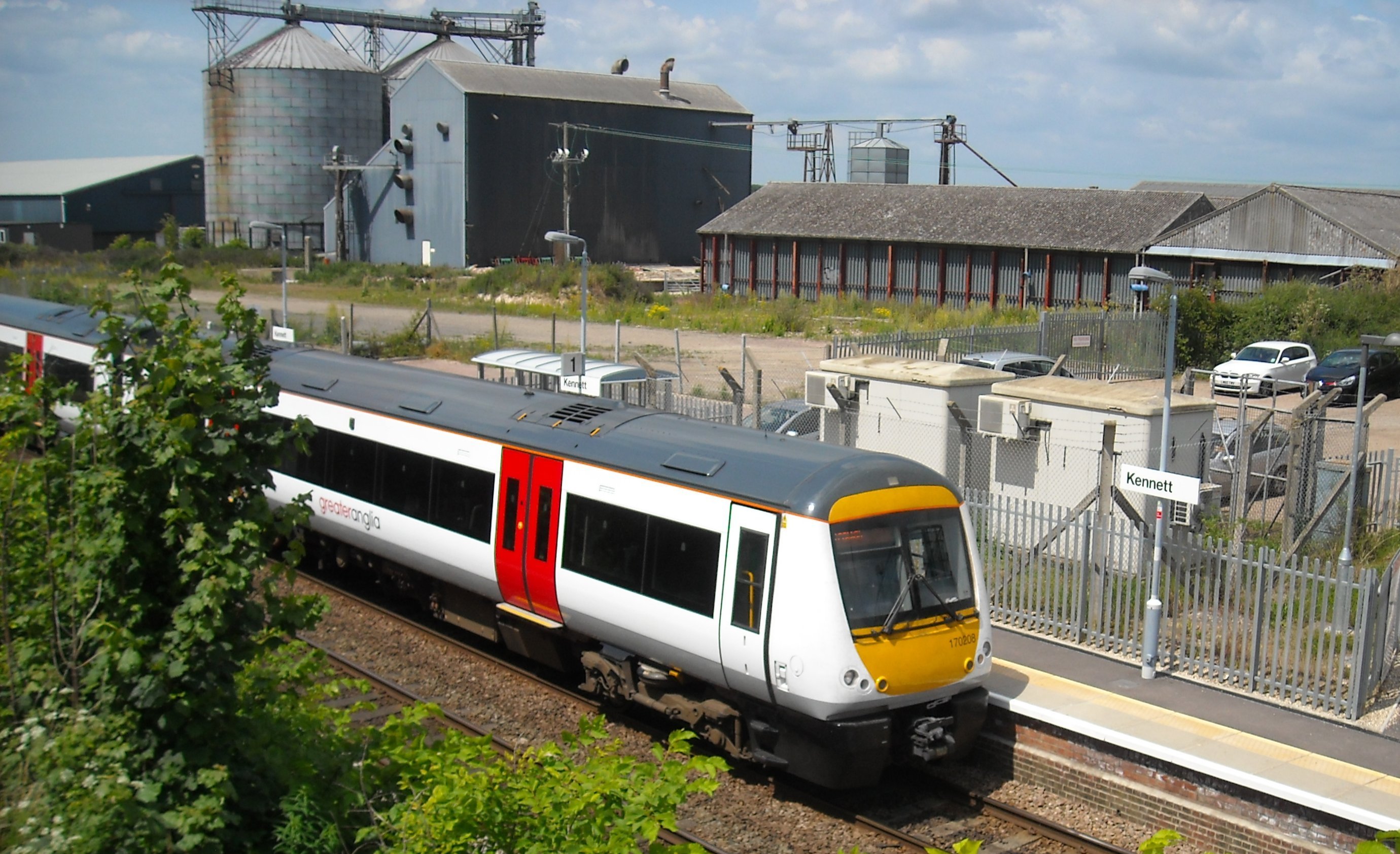
170208 arriving at Kennett with the formerly rail-connected granary dominating the background.
Freight trains - delivering sugar stone for British Sugar - still use the Lafarge Tarmac sidings which are one mile further on from the station.
[© Ian Delgado 2017]
Kennett is an unprepossessing station with two bare platforms linked by a monstrosity of a modern metal bridge which replaced the old barrow crossing in 2014, several years after the signal box (which was removed and transferred to the Colne Valley Railway) closed in 2011. It is overshadowed by the formerly rail connected granary, which was served by speedlink freight trains until the 1980s. It was opened by the N&CR in 1854, when the line was extended to Bury St Edmonds. Like Dullingham, it is served by 1 train every two hours in each direction.
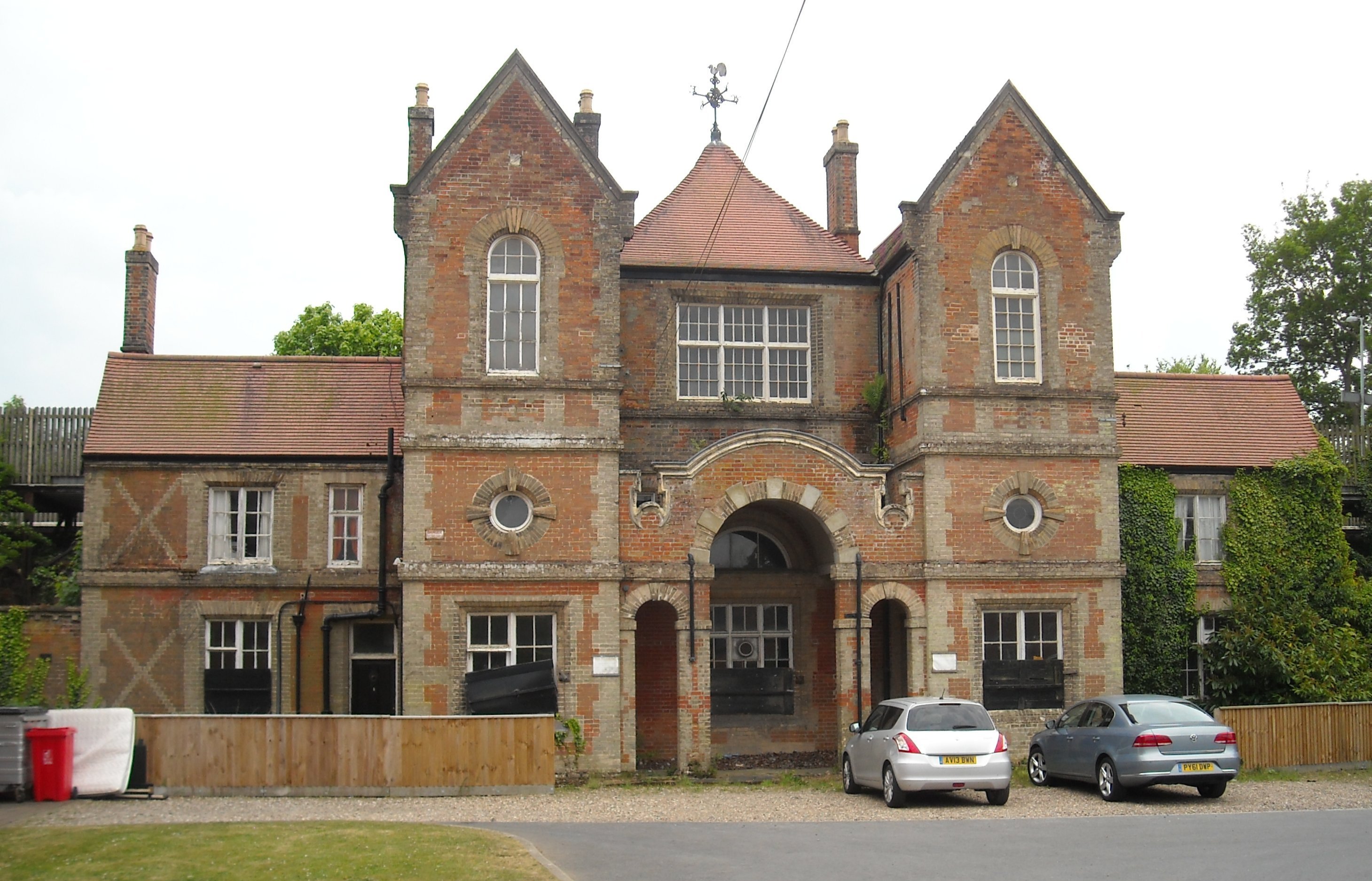
The magnificent station building at Thurston, sadly no longer in use. The down platform railings can just be seen to the left and right of the building.
[© Ian Delgado 2017]
Reunited with the chauffeur again, a brief refreshment break was made at Bury before the next station on the itinerary was reached at Thurston. Here, the magnificent station building, designed by Frederick Barnes in the Jacobean style, remains, seemingly out of use. It was opened in 1846 by the Ipswich and Bury Railway (I&BR). The entrance of the original building is on a much lower level than the platforms. Access is now via a road on a higher level at the top of a steep hill. Passengers cross between platforms via a barrow crossing with remotely controlled warning sirens and red and green lights indicating when it is safe to cross. On this occasion there were signalling problems and the next train on itinerary, the 2W19 1344 from Cambridge to Ipswich (1430 from Thurston), formed of 170204, passed through the signal at danger on departure, under instruction from signallers.
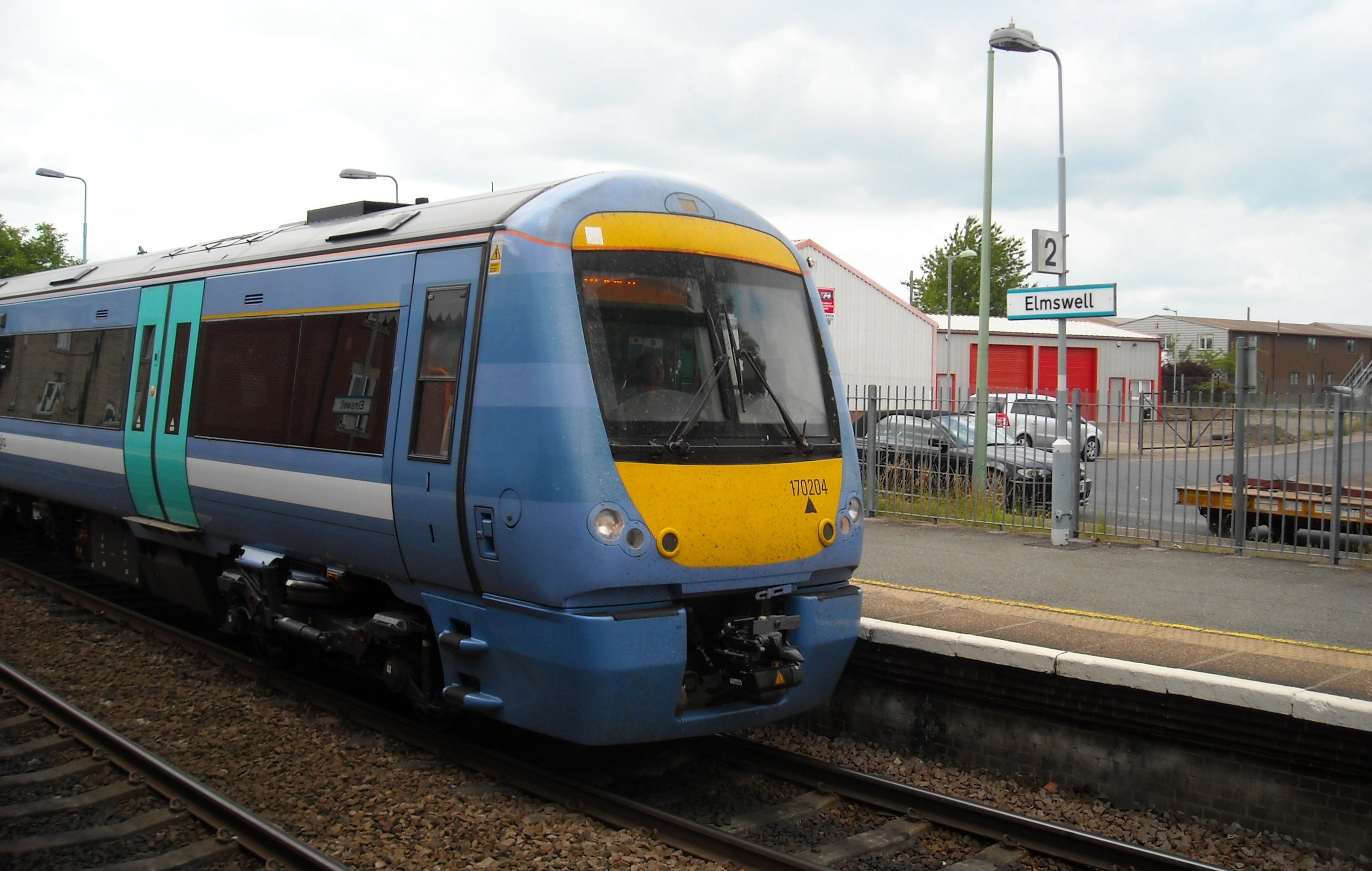
170204 arriving at Elmswell. Some of the original station buildings survive on the up platform
(where the photographer is standing) but part is in use by a travel agent.
[© Ian Delgado 2017]
The slightly late arrival into Elmswell (opened in 1846 by the I&BR, the Frederick Barnes designed station building surviving on the up platform 2), was not a problem, however, as our chauffeur and organiser had allowed plenty of time for the drive back up to the Ely-Norwich line at Eccles Road.
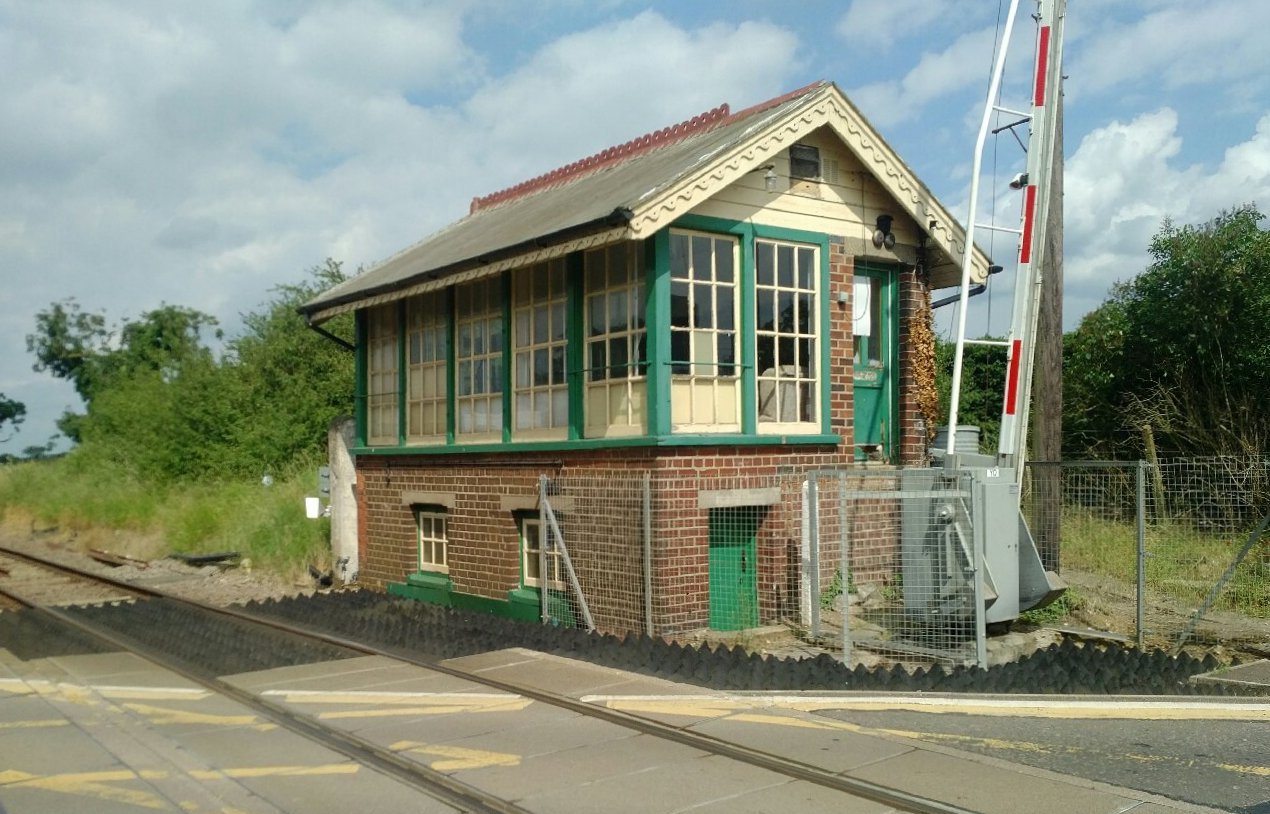
The signal box at Eccles Road, closed in 2012 and shortly to be demolished.
[© John Cameron 2017]
Eccles Road was opened by the N&BR in 1845. The signal box (closed since 2012) remains next to the level crossing at the country end, which now has automatic barriers. It is expected that the box will be demolished sometime this year. The original village of Eccles St Mary was situated about a mile from the station (hence the ‘road’ suffix), but this village was later abandoned and now only the church, with unusual round tower, remains there. A new village, named simply ‘Eccles’ has since grown up immediately around the station, but the suffix remains. Eccles Road has two services in each direction Monday to Saturday and none on Sundays. 824 passengers were recorded for 2015/16. The junction and exchange sidings of the Eccles Road Johnstons Logistics grain terminal, traversed by the ‘Four Triangles’ Charity Railtour in 2015, were observed at the London end of the station before 2K83, the 1535 Norwich-Cambridge (1559 from Eccles Road), formed of our old friend 170202, was boarded for the 3 mile journey to Harling Road.
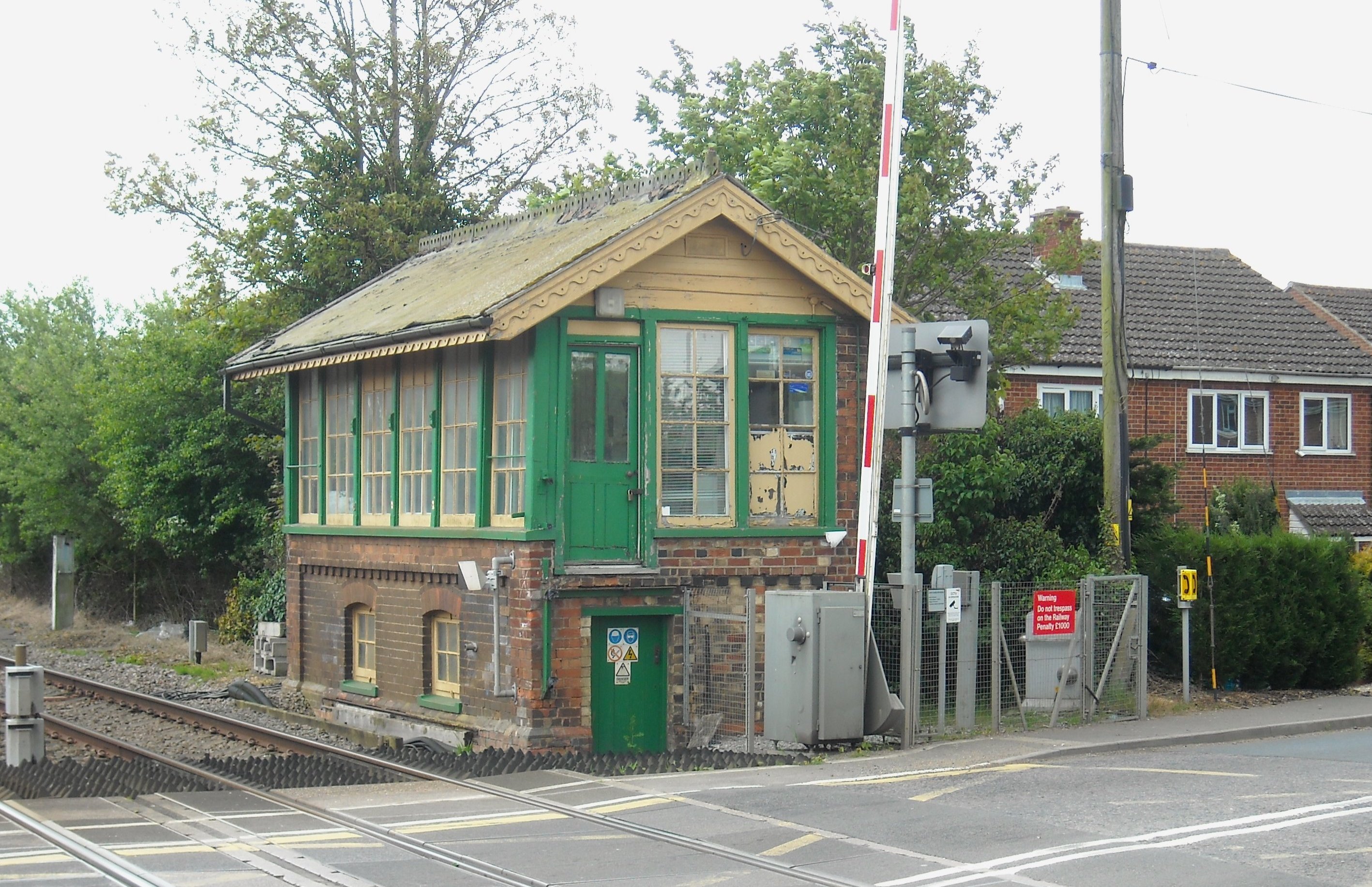
The signal box at Harling Road, another victim of the Ely–Norwich re-signalling programme of 2012 which involved the closure
of nine local mechanical signal boxes and the removal of the seven sets of manually-operated wooden gates at level crossings.
[© Ian Delgado 2017]
Harling Road was also opened in 1845 by the N&BR. Again, the signal box (closed 2012) stands next to the level crossing , with automatic barriers. There is a basic shelter on the down platform 2 only. There is a disused station building on up p1, with a To Let sign on it.
Thus the day’s rare station usage came to an end. The interest was not quite over yet, though, as remaining traces of the Cambridge – Mildenhall branch were observed on the (somewhat circuitous) driving route back to Ely station.
Here, Ian was thanked for arranging a highly imaginative and clever day out that proved to be very interesting and enjoyable as well. Also for his selfless driving which allowed all of those ‘rare’ stations to be covered in a single day. A charitable donation to the Railway Children was made in recognition of this, at Ian’s request.
*: different people have their own rules for this hobby, but most require that one must either alight or depart from that station on a new train and not just step onto the platform before re-boarding the same train.
Back to top