Chesterfield Roundabout Railway Walk
Wednesday 31st October 2018
Report by David Isherwood
The Branch Line Society (Test)
Guest

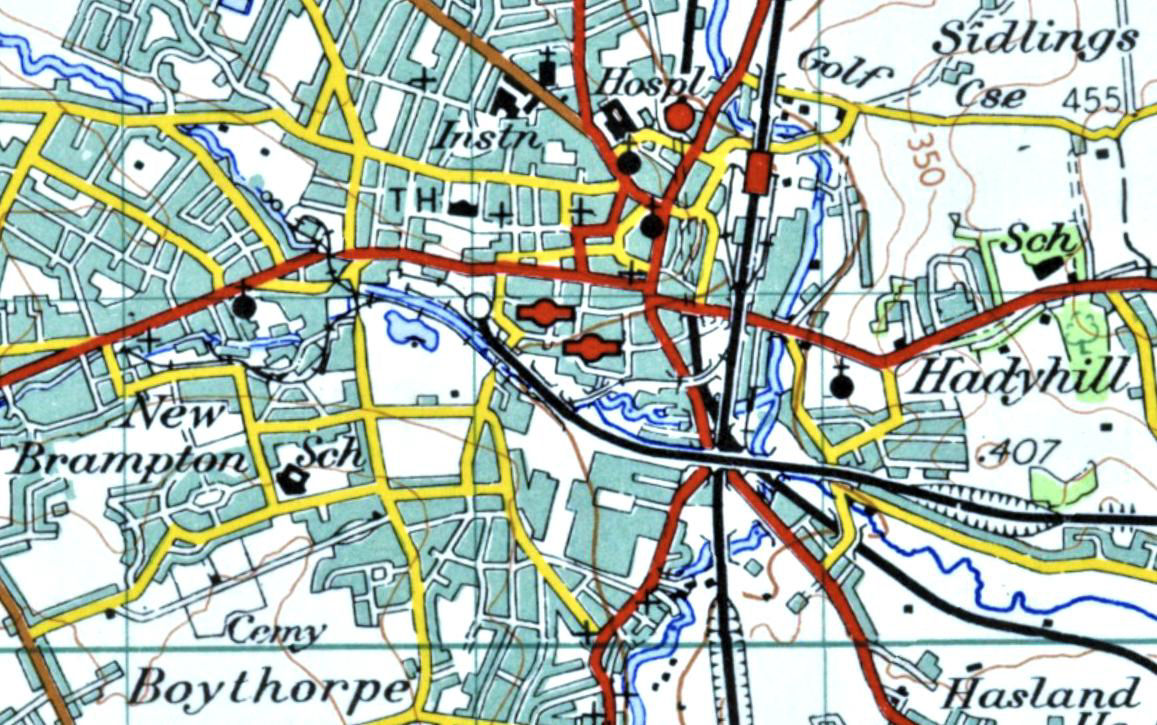
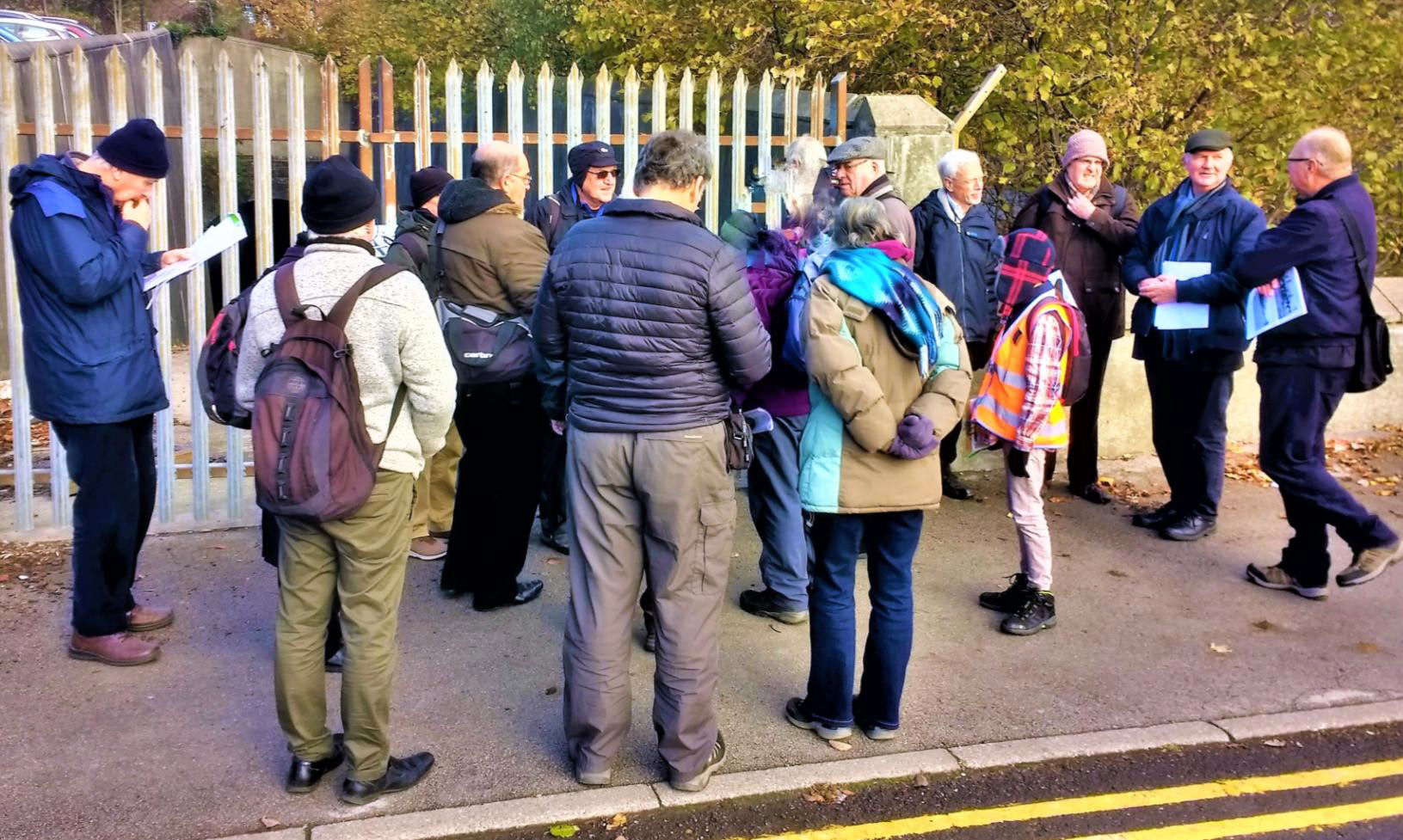
17 Society members gathered at Chesterfield (Midland) station on a beautiful crisp morning to be met by our guide for day, Neil Lewis, a local member brought up in the area and with much detailed knowledge of the current situation and the way things used to be. Chesterfield is a fascinating town; three companies built railway stations and goods facilities, with a further branch line serving mines, factories and mills. We looked forward to tracing the remains of each. Several maps were handed out for us to follow, and Neil had an album of old photographs, which proved fascinating as we tried to recreate the locations.
The group left the station, observing the site of the original North Midland station (1840-1870) just south of the present one - which incidentally does not have ticket gates - and the former goods yard (now a car park) and ascended a hill. An old railway building on the left, North Midland House, claims to be the sole surviving building from Chesterfield's first railway station (although sited some way from the railway!). The Masborough (Rotherham) to Derby line was opened by the North Midland Railway on 11 May 1840. We next saw the 1899 empty and boarded up former Station Hotel on the right, before peering over the parapet of the bridge at the bypass (A61) completed in 1985 that had swept away much of the Great Central Railway's (GCR) - originally the Manchester, Sheffield and Lincolnshire Railway's - 'Chesterfield Loop' and Chesterfield 'Central' station. OP 4 Jun 1892; CP 4 Mar 1963 (when there were about 5,000 passengers a week). The final through train was an excursion hauled by 'Flying Scotsman' on 15 Jun 1963 which called on the outward journey only. Goods traffic from the north lingered until 11 Sep 1967. Interestingly a small section of the GCR survived until as recently as 1985, the line accessed from the Midland line via the Dunston and Barlow branch, for opencast coal traffic.
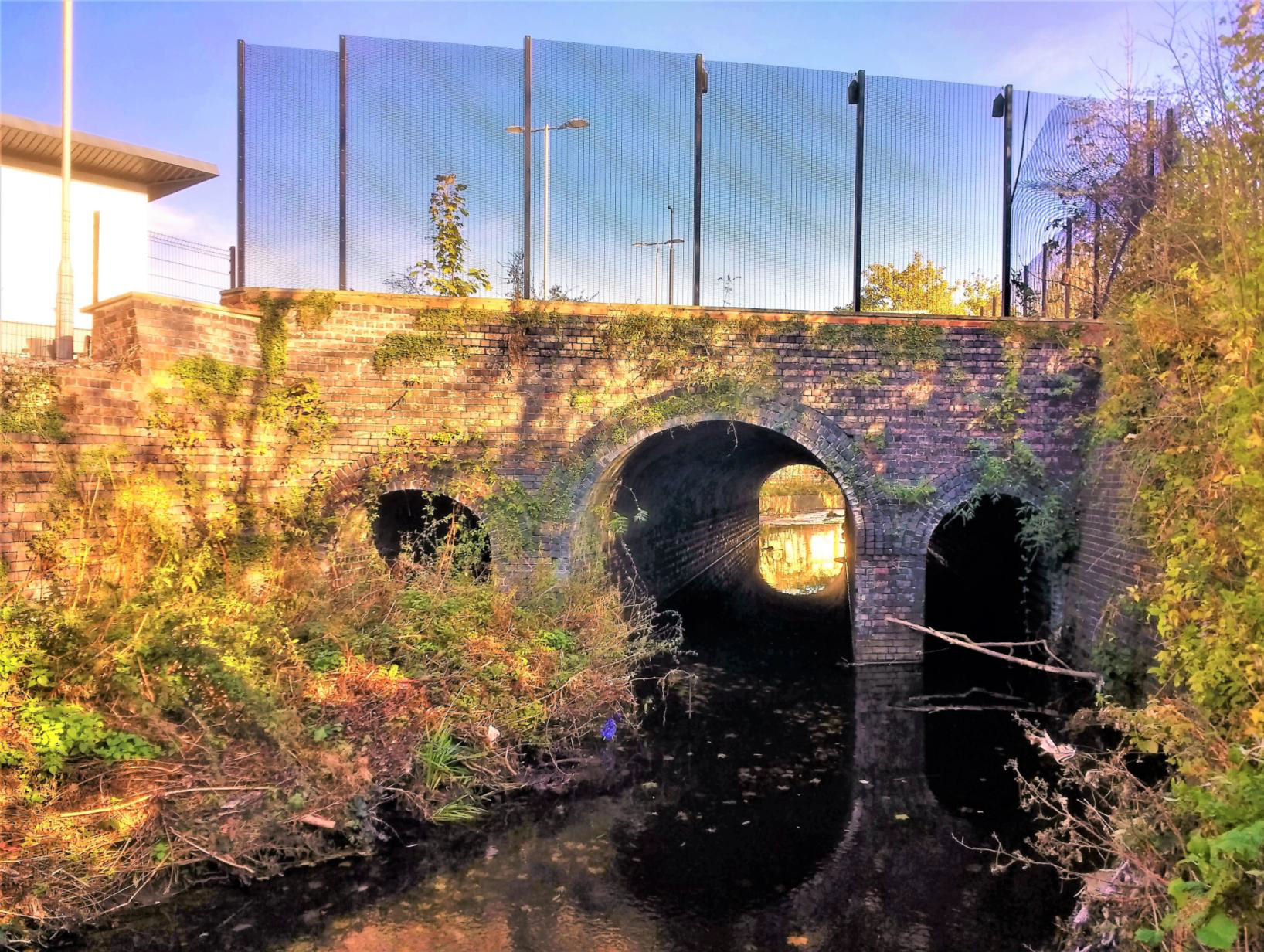
The Great Central had to run under the town in a 445yd tunnel and we walked to see the southern portal, now fenced off. Evidently there is video showing the tunnel is still in reasonable condition. We then journeyed through the surprisingly attractive town centre, noting the two open market areas and the elegant Victorian market hall. At the bottom of the hill was the site of the third railway; the Lancashire, Derbyshire and East Coast Railway, opened 8 Mar 1897 and absorbed by the Great Central in Jan 1907. The joke was that, despite its grand name, the line never reached Lancashire or the East Coast, but was built to tap into the riches of the local coalfields. Its Chesterfield Market Place, a generous four platform station, had quite a sparse passenger service, advertised as the 'Dukeries Route' running via Langwith Jn (Shirebrook) through Ollerton, Tuxford and on to Lincoln Central.
This line passed through the troublesome Bolsover tunnel, which became so dangerous that passenger trains ceased from 3 Dec 1951. Goods to Staveley via Duckmanton North Jn from the extensive yard at Chesterfield lasted until 1957. The station became a carpet warehouse then a paint store, until demolished to pave the way for a (General) Post Office administration building. A participant told us it was a good building as they sort out his pension! The goods yard is occupied by the current Post Office delivery depot. The neighbouring Portland Hotel built to serve the station is a Wetherspoons pub!
Neil took us by the impressive Town Hall (a similar design to Stormont in Belfast) and the Grade II listed (empty) Court House to find the remains of the Brampton branch. It was once extensive, serving many factories, mines and breweries and, at this point, the Gas Works. At the entrance where the railway crossed the road there is a fine piece of metalwork. A plaque marks where chains were placed across the road (pulled through worn holes in the walls still there) to stop road traffic for trains to run.
We retraced our steps and followed the line of the Brampton branch towards Queen's Park, where a 10¼" gauge railway is run by the Council (our 31 May 2014 Society trip covered the long shed branch in detail). Following the route east, old railway lines have been converted into footpaths and cycleways and we soon observed the remains of the LD&EC line out of Market Place which used to be carried on a viaduct over the Brampton branch including the Boythorpe incline to a colliery of the same name.
After skirting a retail park, we came to a trainspotter's heaven, Horns Bridge situated near Hasland Rd, the intersection of the three railways; the Dukeries line went over the Midland on a 700yd impressive viaduct, while the Loop Line dived under both on its way to Heath and the GCR main line. There is little left except bridge abutments and blue brick walls but Neil's old pictures helped us to imagine it all.
Finally, we observed the link known as Hydes Siding, between the former Broad Oaks (Markham) works and the GCR Loop Line, at Clayton St then walked over an extensive footbridge before picking up the cycle/footpath on the Brampton branch. Crossing over the A61 (bypass) the old branch joined the Midland Railway near the station. The Brampton Branch never had a passenger service, but Neil gave us a reproduction ticket dated 17 Jun 1961 reminding us of an RCTS railtour from Midland to Central stations via Brampton and a list of many other places you can only dream nostalgically about (BLN 1270.3045 has the route)! Archie, Neil's junior assistant clipped the tickets with his ticket punch.
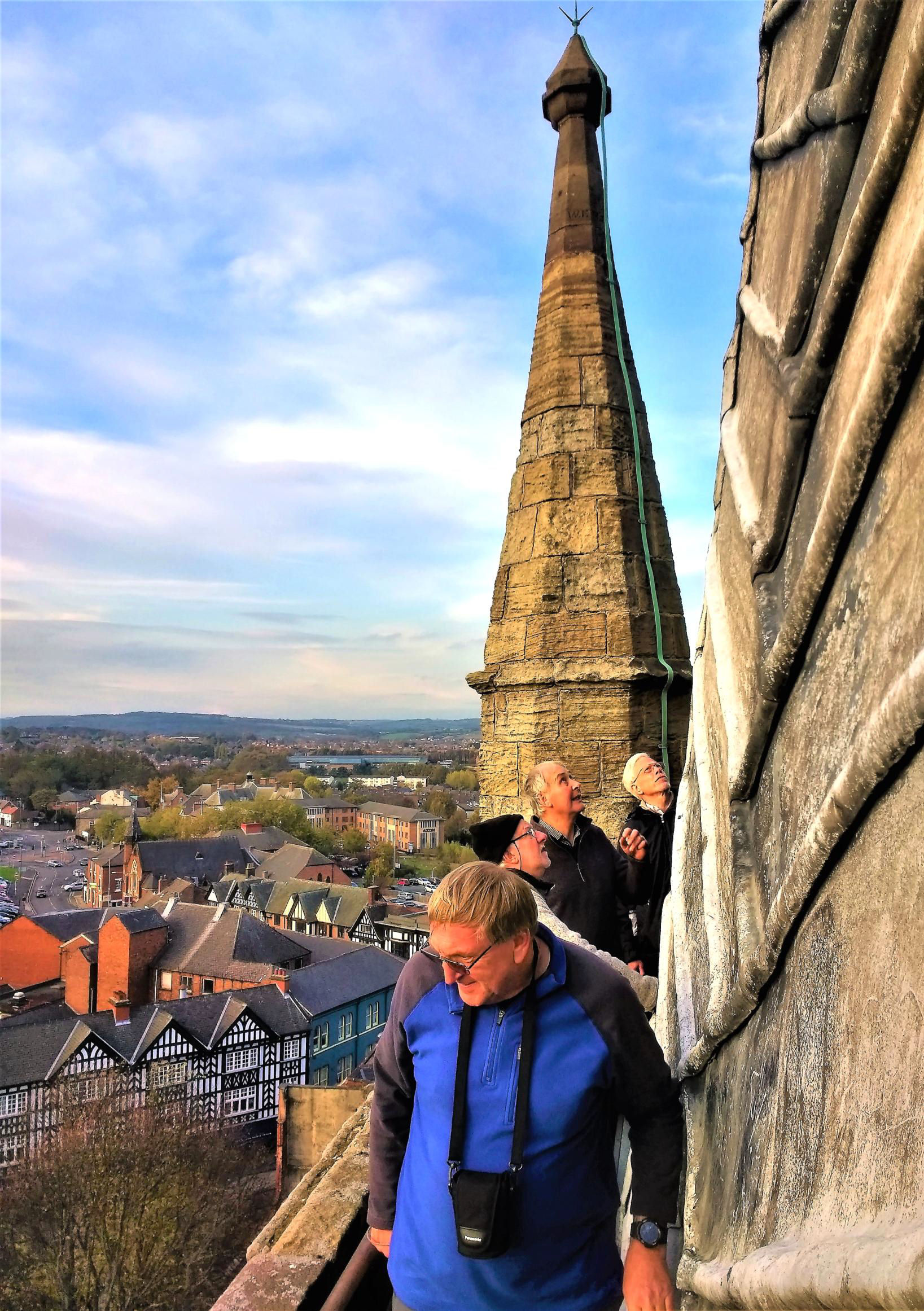
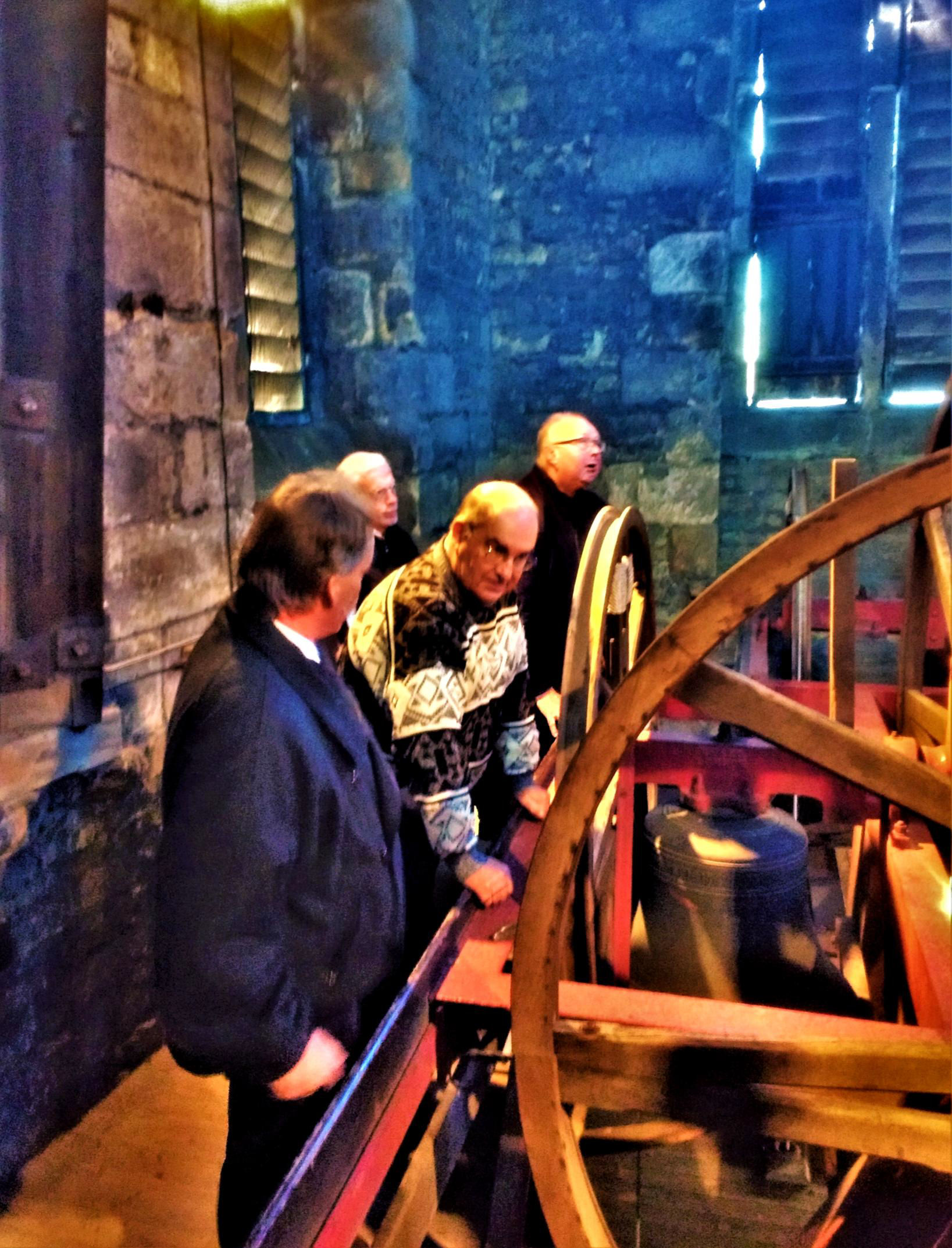
Back at the station, we saw George Stephenson' statue; he is buried in the town. After a lunch break most met up at the famous Grade I Listed church of St Mary & All Saints, with its crooked spire and we had a fascinating two hour guided visit, making it up to the top of the tower via very narrow 156 step spiral staircases (some participants were a bit out of gauge). It is the world's only true crooked spire (both bent and twisted but we were not joined by the local crooked man) and there were great views from the balcony on this lovely sunny warm day. We could see that Chesterfield is in a 'basin' and the various railway routes. The party saw the bells and learnt the real reason for the spire's crookedness.
Recovering from that exercise, we said our farewells. It was a very worthwhile, enjoyable and informative day. Although a lot has been swept away through re-development and road schemes, there was much interest in a town that once boasted three stations and a branch line too! Thanks again to Neil (& Archie) for arranging it, being such excellent guides and for the maps and pictures.
| Branch Line Society. A Company Limited by Guarantee - Company No 16743754. Registered in England and Wales. Registered address: 6th Floor, Derwent House, 150 Arundel Gate, SHEFFIELD S1 2FN |