I was really looking forward to this Adam Turner tour, as I knew there would be much great railway architecture and many structures to see. It would be the first tour over two days - would I and the participants survive‽ I should not have worried; it was a smashing two days with a great group.
We assembled for the first leg, a tour of the Victoria Tunnel, meeting at a building on Lime Street (Newcastle!), so I thought that we would be going down the tunnel there. However, curiously the Ouseburn Trust tour guide started by taking us on a walk down the road from their building, stopping on the way to show us an information board about the former Quayside Railway - one for another day!
Soon enough, we arrived in Ouse Street for the entrance to the Victoria Tunnel. First, participants were each equipped a hard hat and torch. The group then descended the entrance tunnel to reach Victoria Tunnel proper. It carried coal from Spital Tongues Colliery, half a mile west of Town Moor, for some 2½ miles beneath the city to staiths (North East spelling) on the quayside, near the foot of Ouse St, falling 222 feet on an average gradient of 1:90. Our guide told us stories of how people had survived WWII air raids in the tunnel. This included considerable hardship endured by people somehow living in such cramped and squalid conditions by all accounts - a testament to the hardy nature of northeastern folk! We walked a considerable distance north; the tunnel was split into distinct sections by blast protection barriers built at regular intervals. At the end of the tour, our guide explained how one prospective purchaser of the tunnel had been flattened by a runaway wagon - no sale!
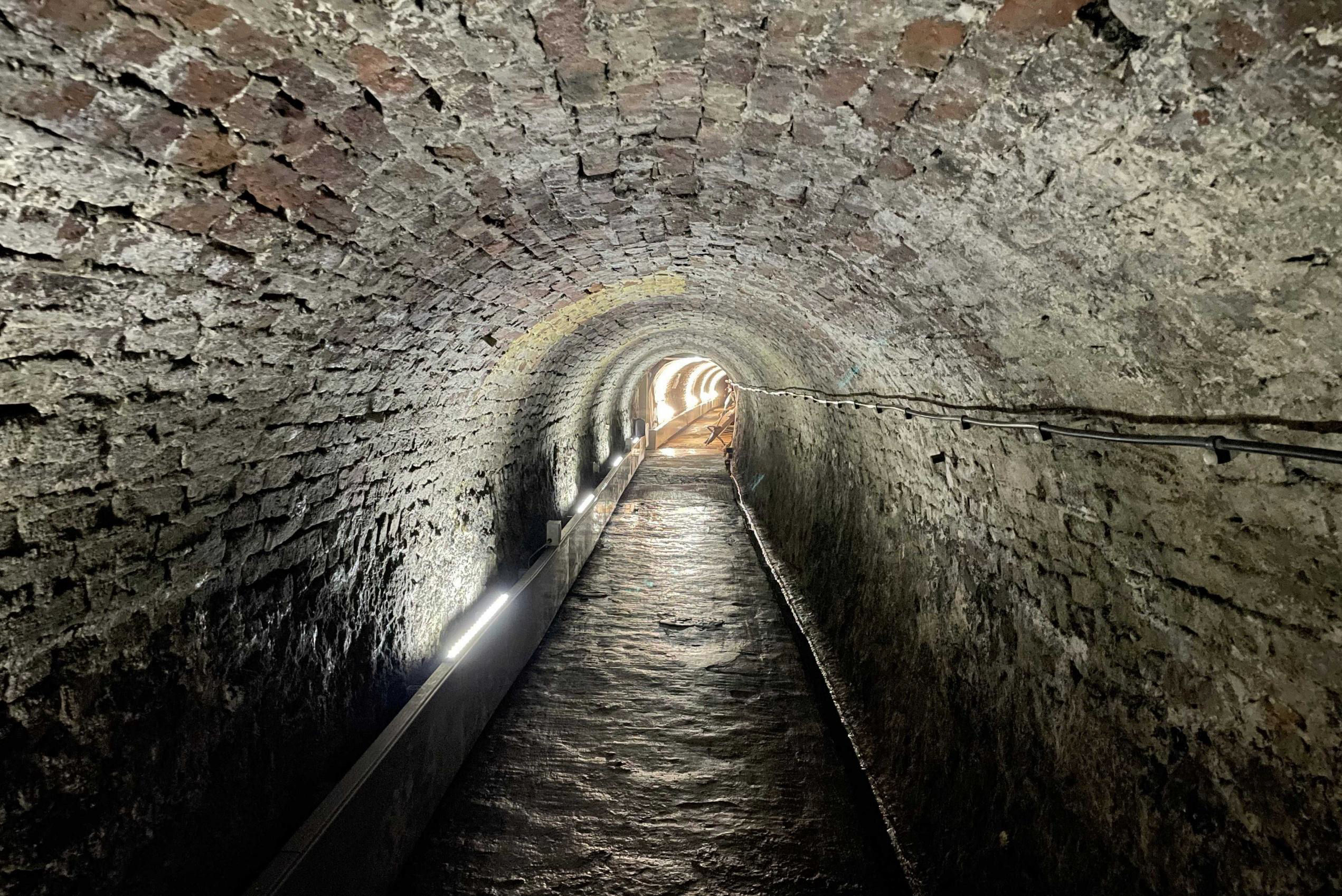
Victoria Tunnel.
[© Adam Turner 2025]We retraced our steps to street level and continued on the surface to see the first railway themed 'Likely Lads'* location, back on Lime Street, where there is a view from the end credits of the remnants of a chimney and the Ouseburn Viaduct (with its intricately patterned cross-bracing in the open spandrels) and the Byker Road Bridge carrying the A193 road.
https://en.wikipedia.org/wiki/The_Likely_Lads
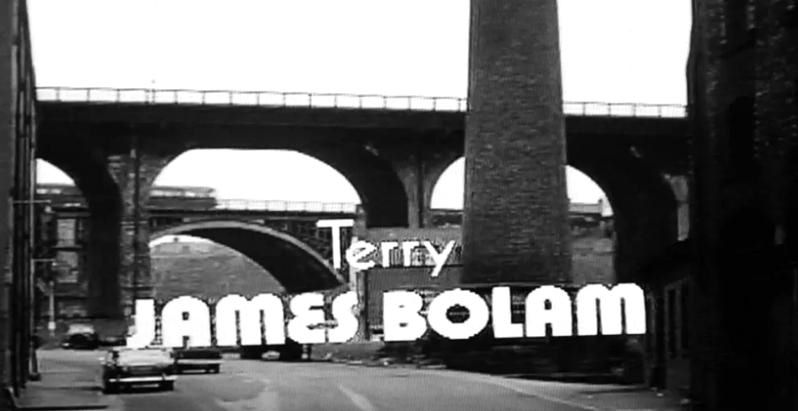
The first railway themed 'Likely Lads' locationFrom here, we walked past Ouseburn urban farm into a wooded area to see Ouseburn Viaduct up close, together with the slender concrete form of the T&W Metro's later Byker Viaduct, which threads its way between the railway viaduct and Byker Road Bridge. The 2,674ft long Byker Viaduct was constructed between 1976 and 1979, the first such structure in Britain to be built using cantilevered concrete sections, with joints glued with epoxy resin. We climbed a considerable slope to regain street level at Stepney Road. From here, we walked through residential streets to Manors Metro stop where, following a slight detour due to construction works, we used a footbridge to reach Trafalgar St.
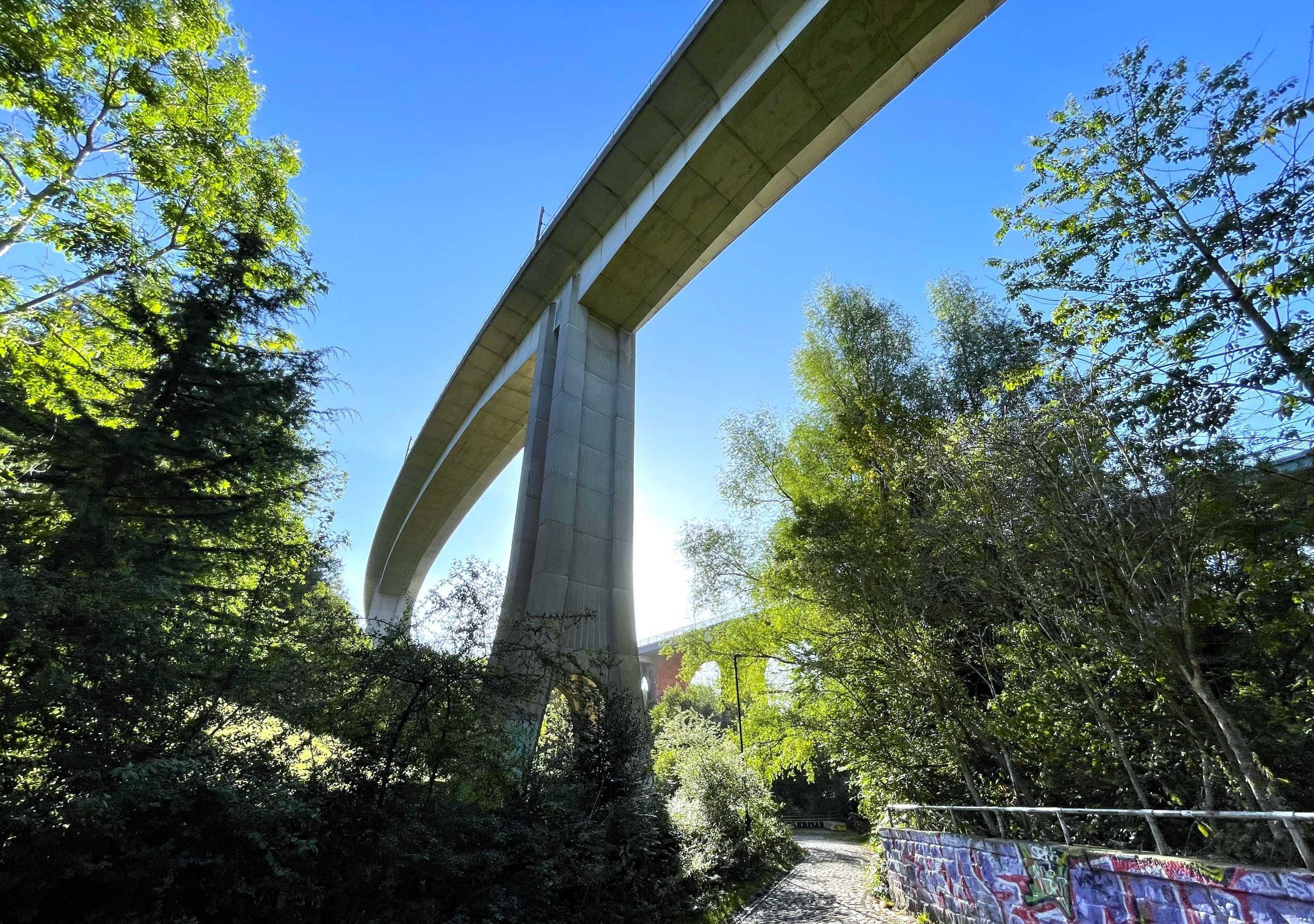
T&W Metro Byker Viaduct.
[© Adam Turner 2025]Trafalgar St is carried beneath the East Coast Main Line by a sloping, semicircular arched tunnel, built by the Newcastle & North Shields Railway (1839), with two pedestrian side tunnels linked to the main road by relieving arches. At the junction of Melbourne St and Trafalgar St, we found the first 'Get Carter' rail related location
https://tinyurl.com/r59xnw93 The former entrance to Manors mainline station at Trafalgar St featured in the film but is now closed and blocked up but this old entrance can still be made out in the façade.
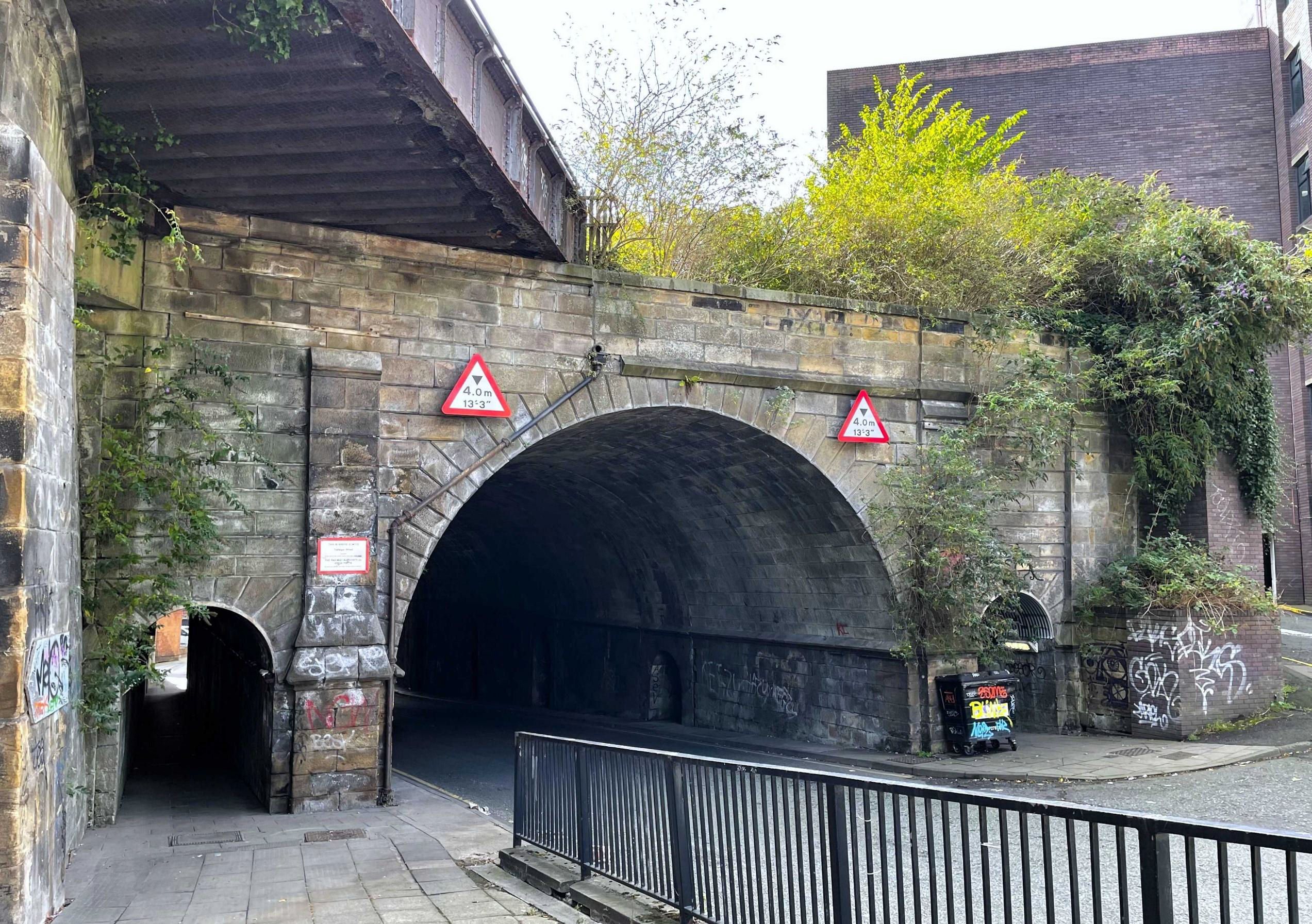
Trafalgar Street Bridge.
[© Adam Turner 2025]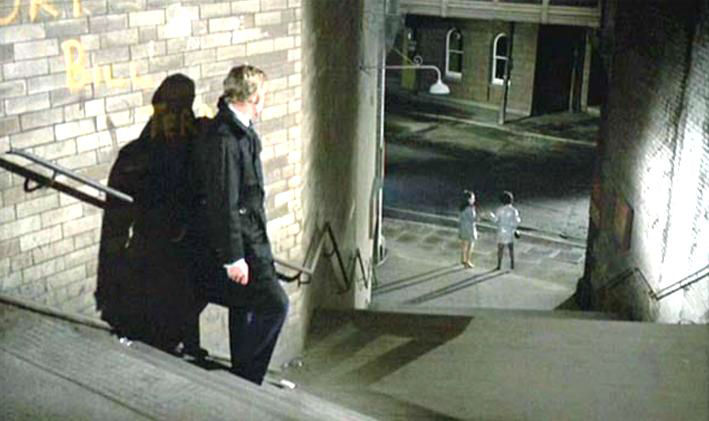
The first 'Get Carter' rail related location.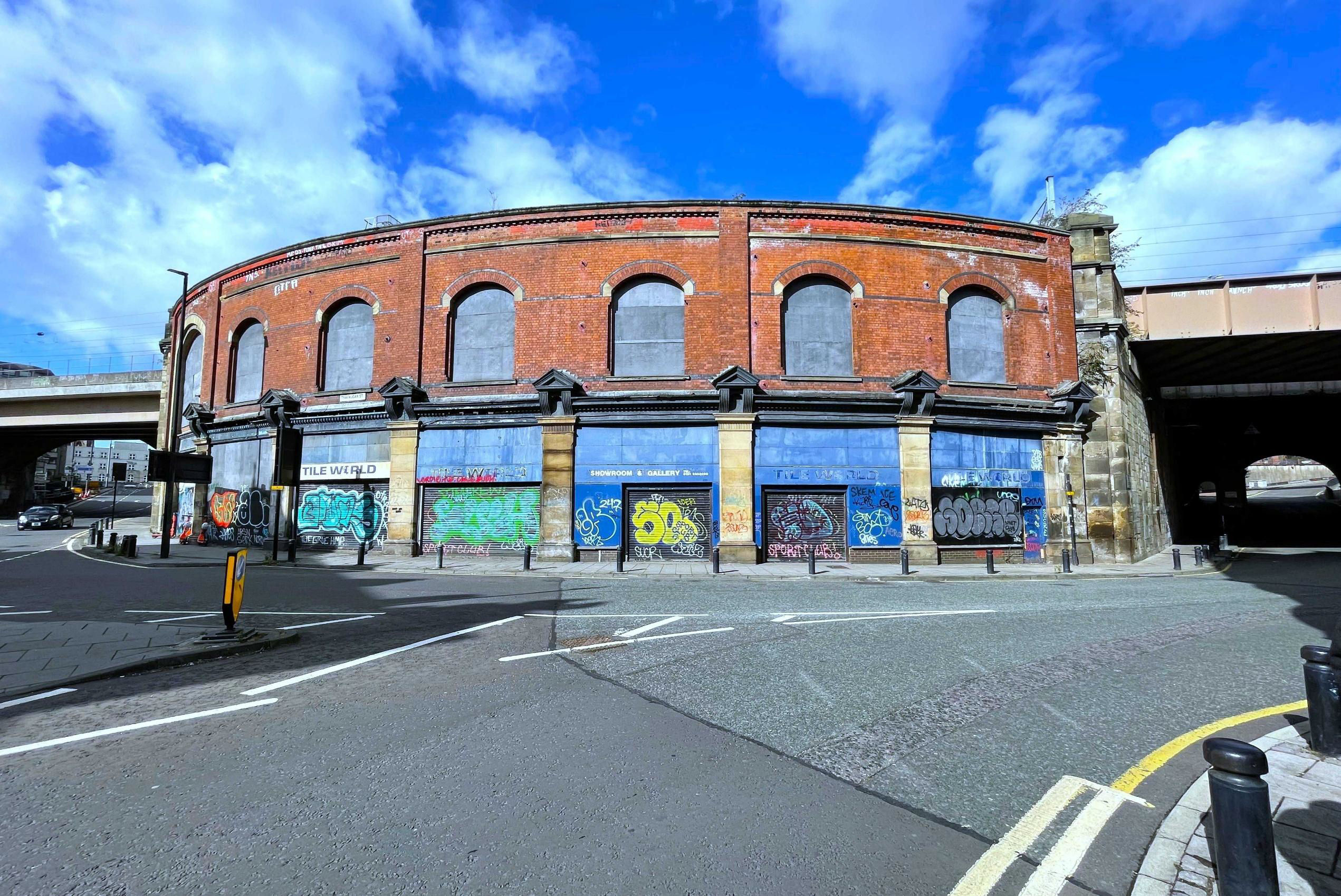
The former entrance façade for Manors station (which once had nine platforms).
[© Adam Turner 2025]Around the corner from here was the next 'Likely Lads' rail related location, between the spiral drum of Manors multistorey car park and the former Holy Jesus Hospital, where the East Coast Main Line can be seen in the middle. Leaving here, passing part of the original city wall, we retraced our steps to Manors metro stop for a connection to Newcastle Central station. In the Metro ticket hall at Central, we looked at photos from its construction below Neville St, noting the subsidence work caused to the mainline station's imposing portico.
Our group took the steps up to street level for a quick break before going on to explore around the outside of Central station. We saw the original location of the station clock, on a now blank tower above the hotel, the stone carving of the River God 'Tyne' on the station building, No1 Neville St that was the North Eastern Railway Accountants' Offices and, behind, the former carriage shed. At the junction of Westgate Rd and Neville St stands the Stephenson Monument (1862). Opposite is the Royal Station Hotel that has been expanded over the years. We went inside to see the grand staircase, via a lift to the top floor, noting the later chandeliers and Burmantofts tiling, that also features in the grand function room corridor, plus the sweep of the original building's first central staircase.
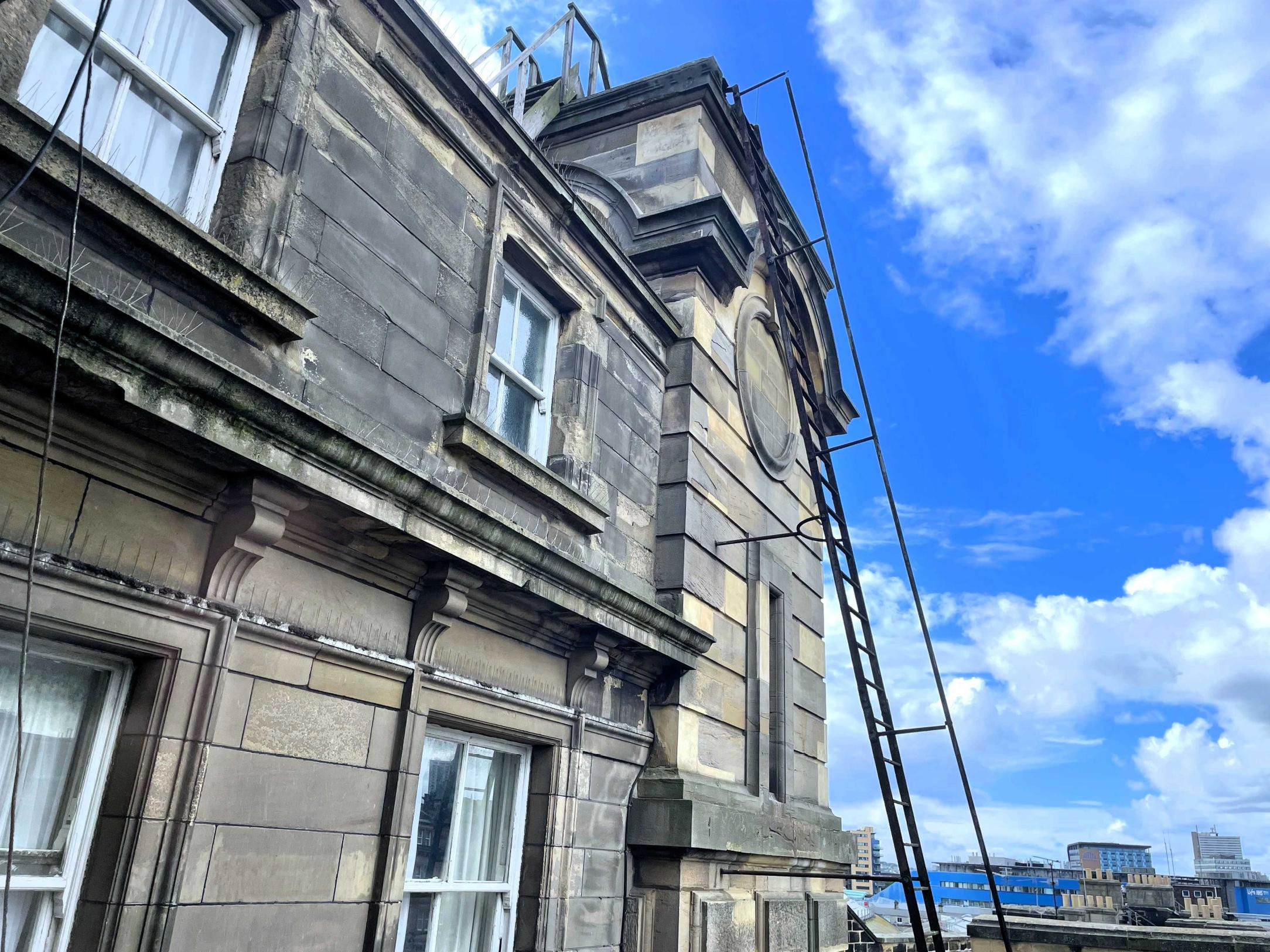
The former Newcastle Central clock face.
[© Adam Turner 2025]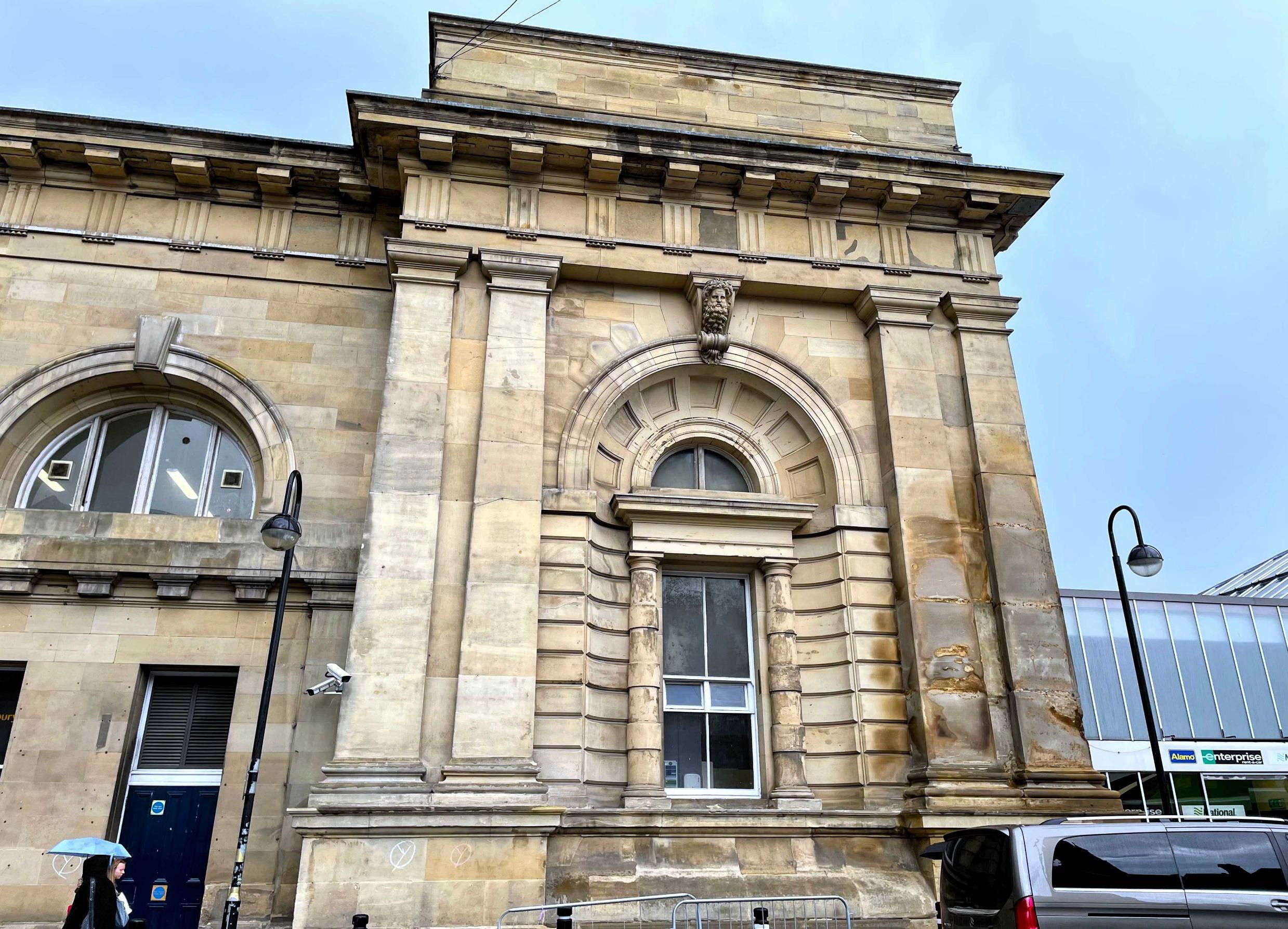
River God Tyne; Newcastle Central station façade.
[© Adam Turner 2025]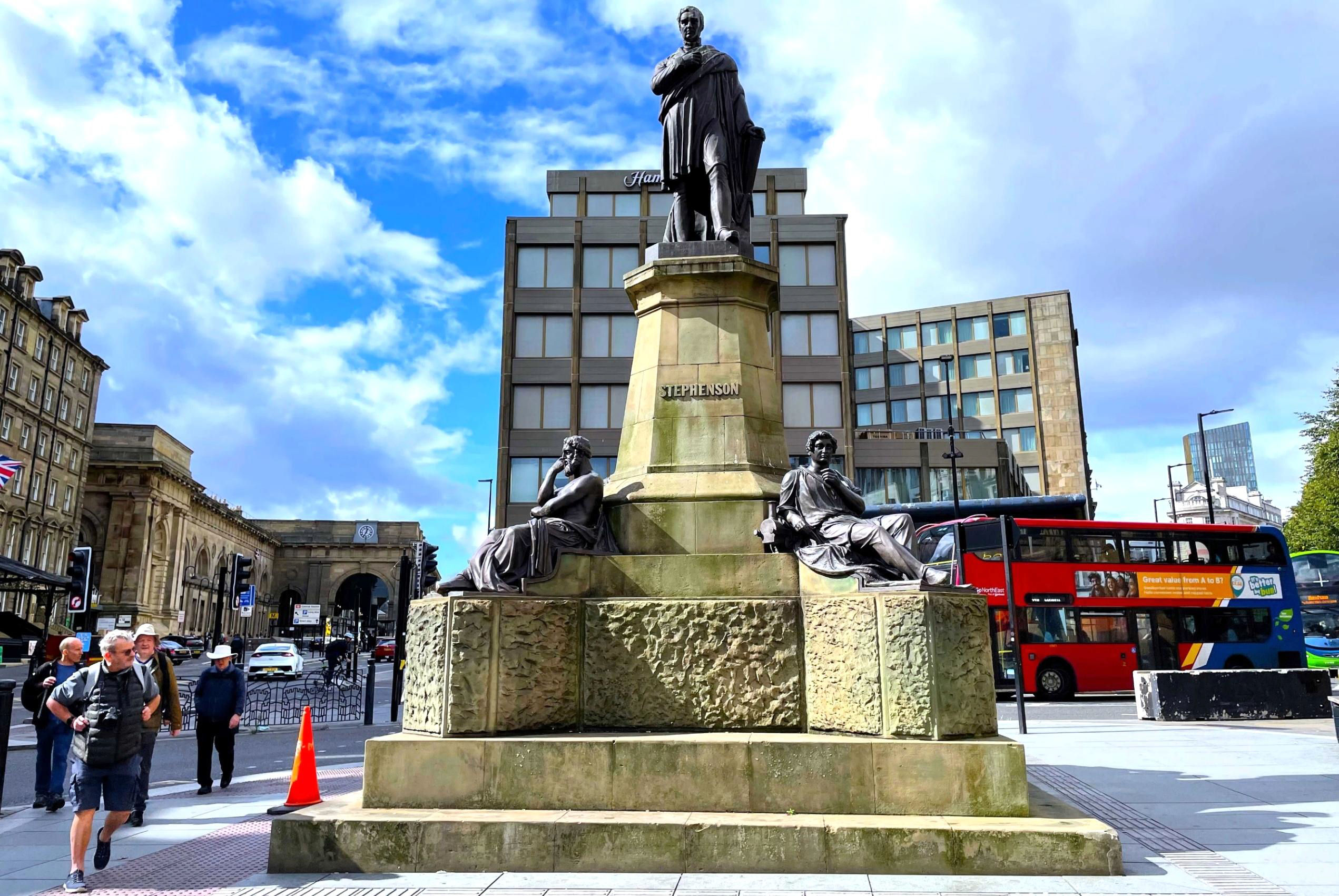
The Stephenson Monument.
[© Adam Turner 2025]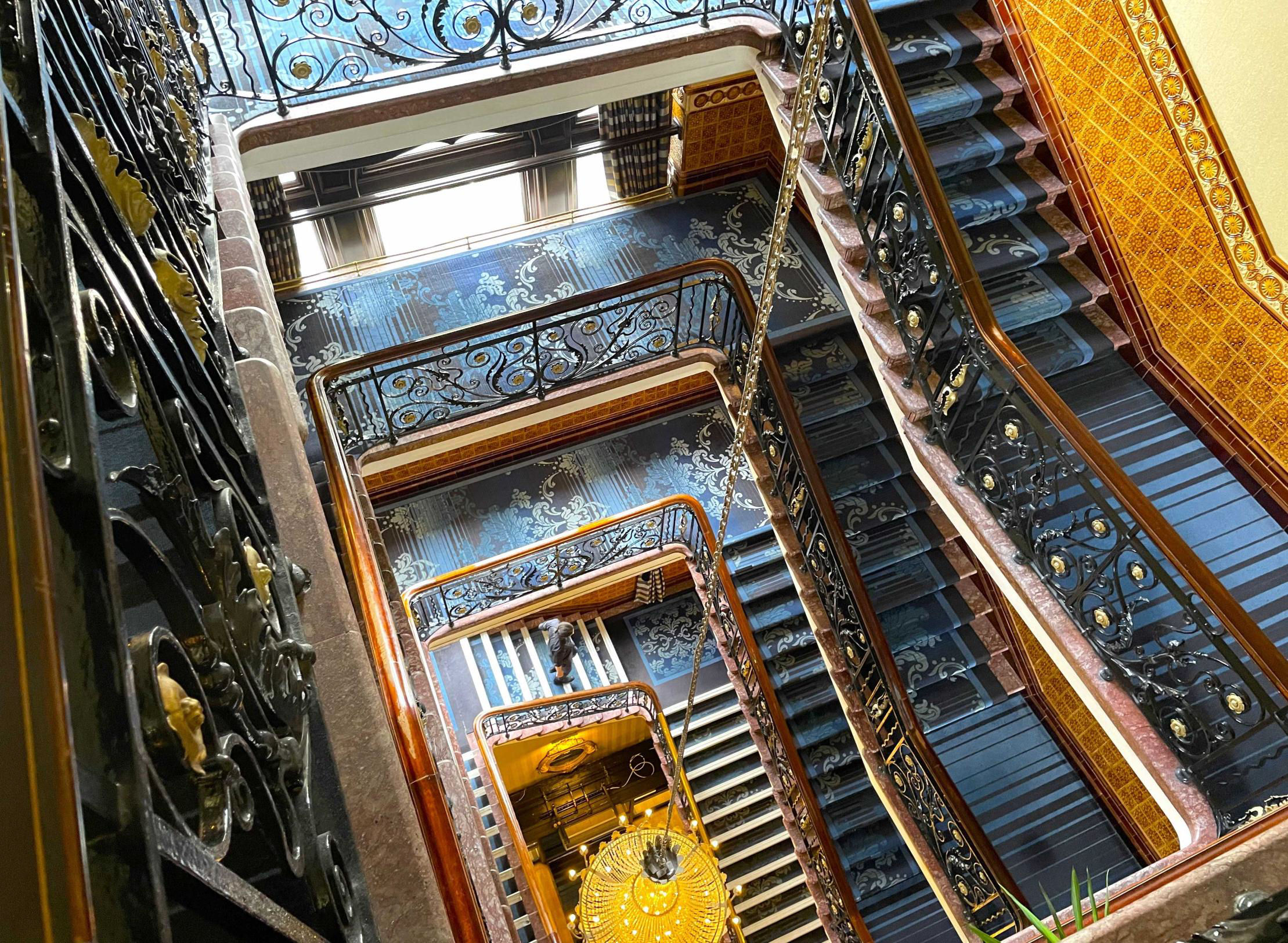
Royal Station Hotel grand staircase.
[© Adam Turner 2025]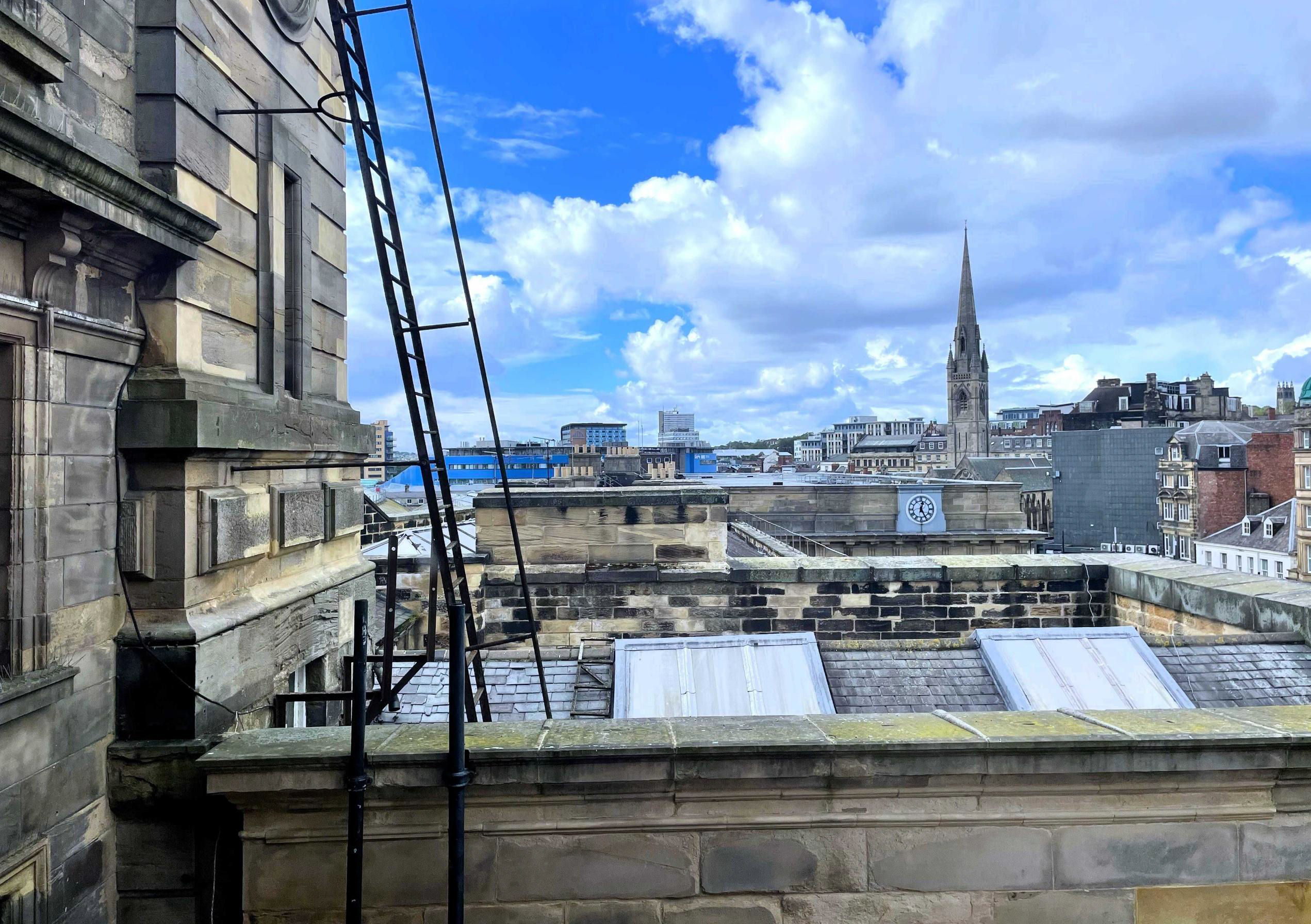
The roof of Newcastle Central from the Royal Station Hotel.
[© Adam Turner 2025]Next, Adam took us down Westgate Rd to the Black Gate to buy an entrance ticket to Newcastle Keep for the traditional view, to the west, of Newcastle station from its roof, once with a complex of bespoke diamond crossings We started the climb up the Keep, finding a splendid 'lunch space' and a welcome break to sit down and demolish lunch before venturing on up the Keep's spiral staircase. Soon after we had enjoyed sandwiches and crisps, we reached the top, with blue skies and fluffy clouds to watch trains in and out of Newcastle and also enjoy views across the High Level Bridge (1849), our next point of call.
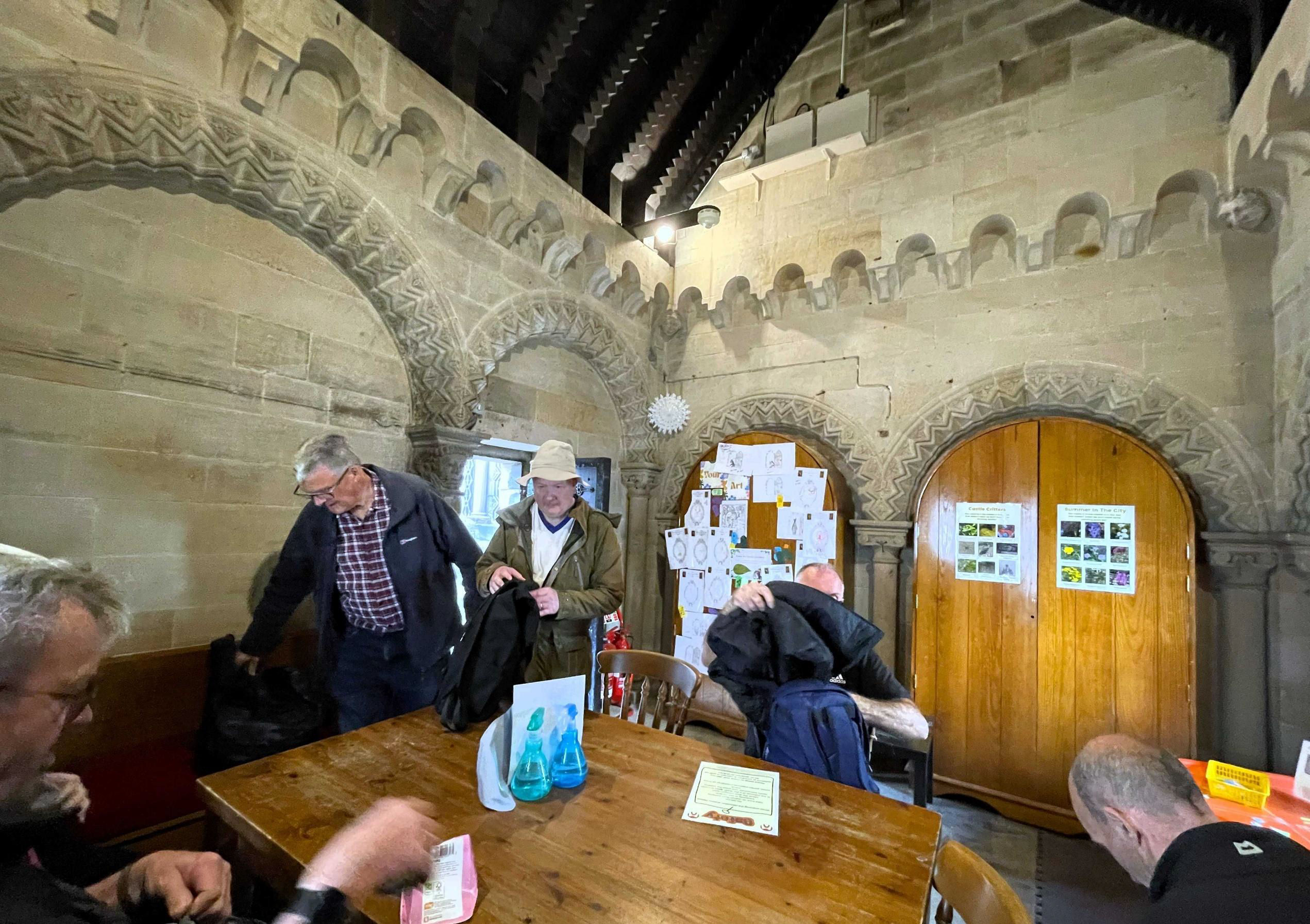
A spot of lunch in Newcastle Keep.
[© Adam Turner 2025]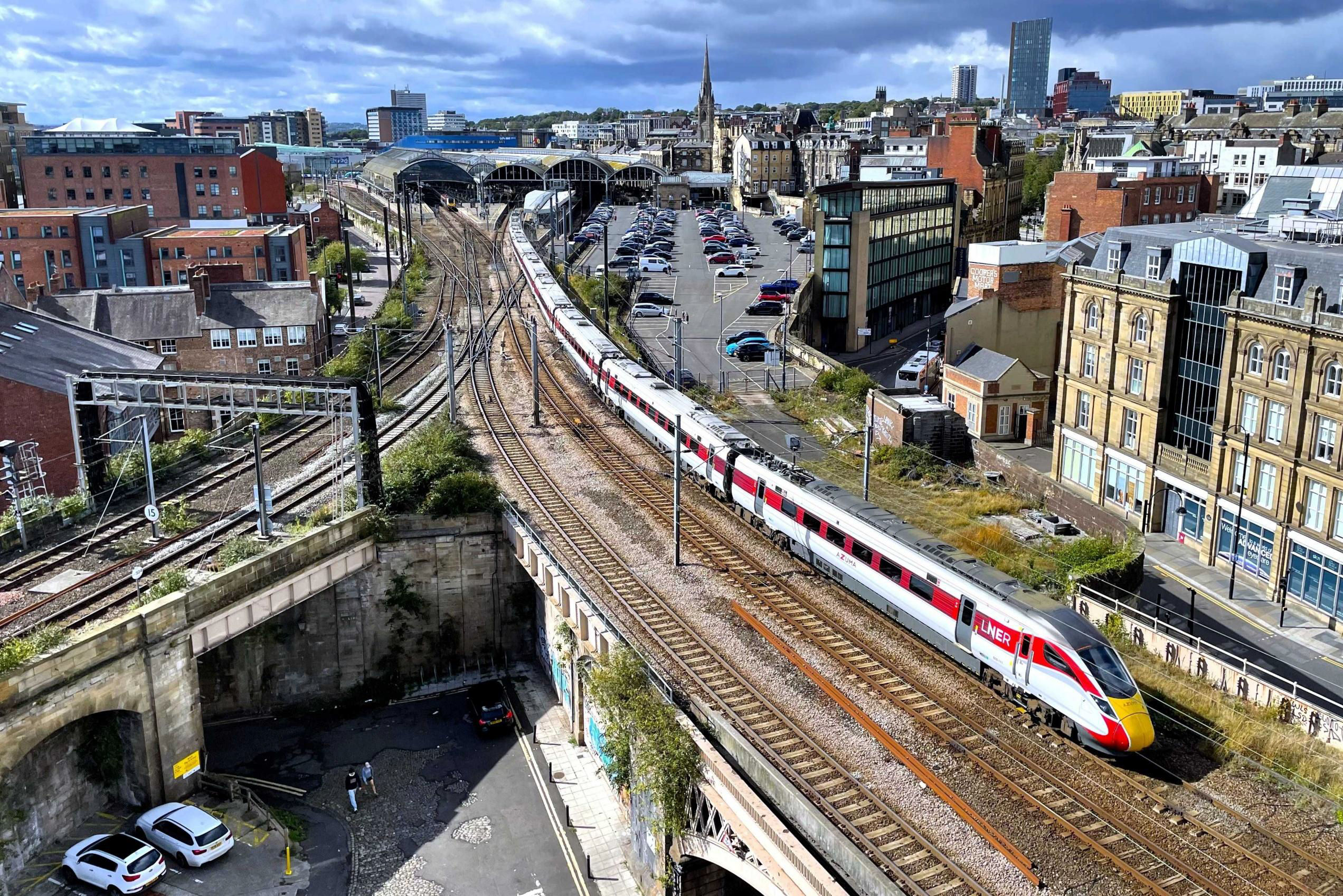
An Azuma leaving Newcastle Central northbound towards Edinburgh.
[© Adam Turner 2025]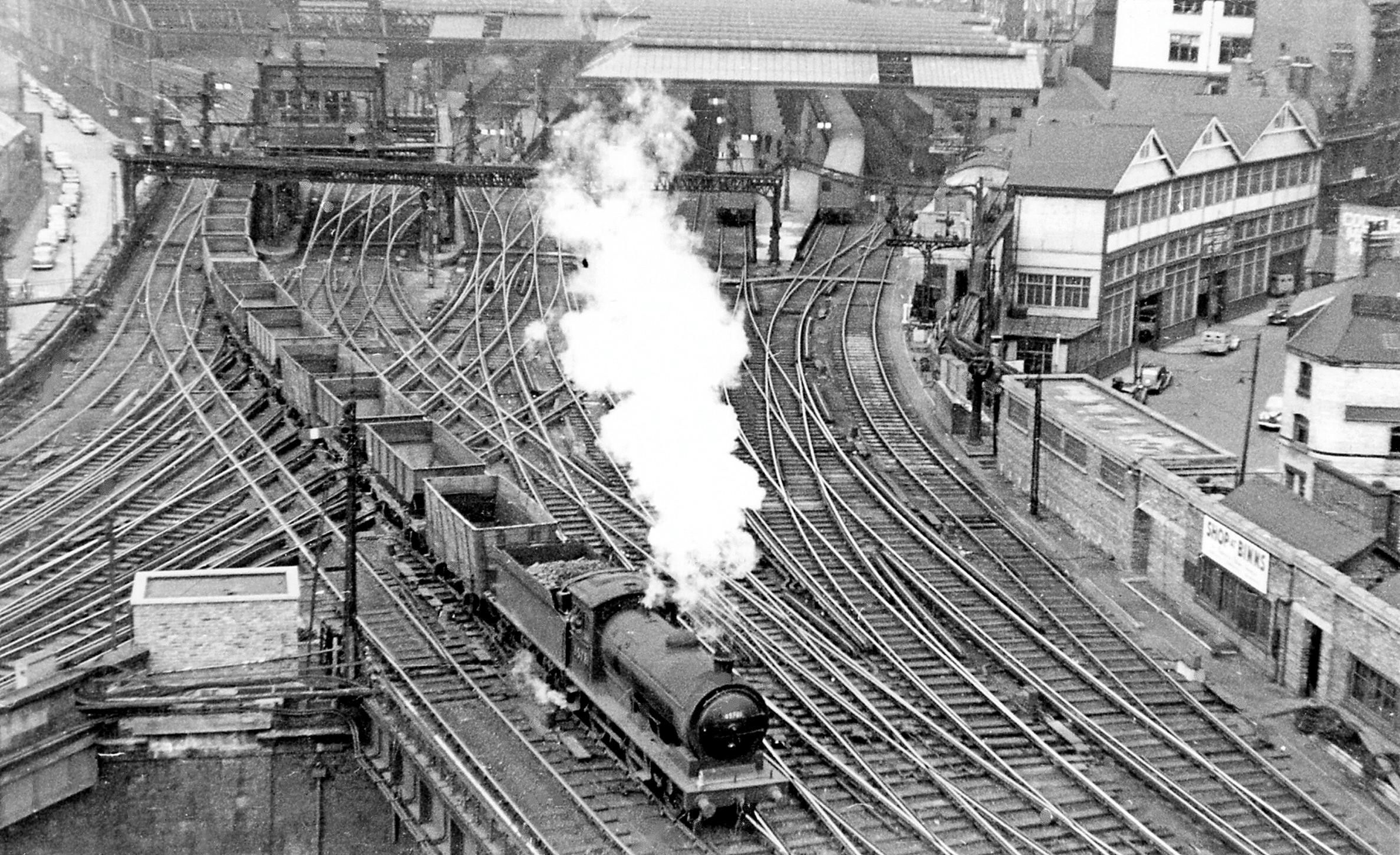
How it used to be, with Tyneside third rail suburban EMUs in the bay platforms (right) too. (12 Jun 1954.)
https://www.geograph.org.uk/photo/2355758
[© Ben Brooksbank 1954]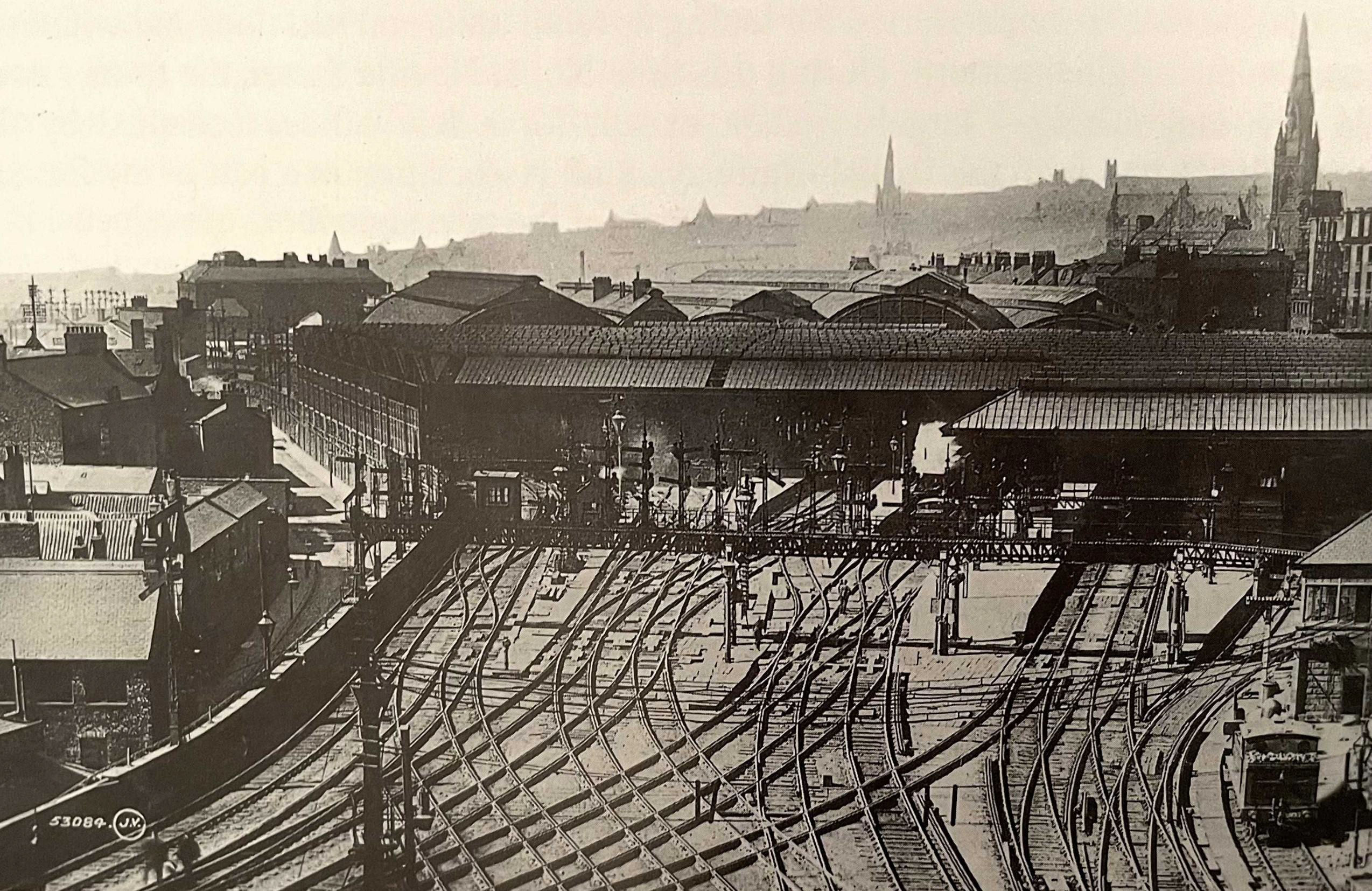
Said to have been taken after ''simplification in 1904 by the removal of the connections from the High Level Bridge to P1, 2 (right hand north end Down bays) and the Carriage Dock. The 1893 to 1909 Newcastle No1 box can be seen on the right".(Thanks to Adam Turner.)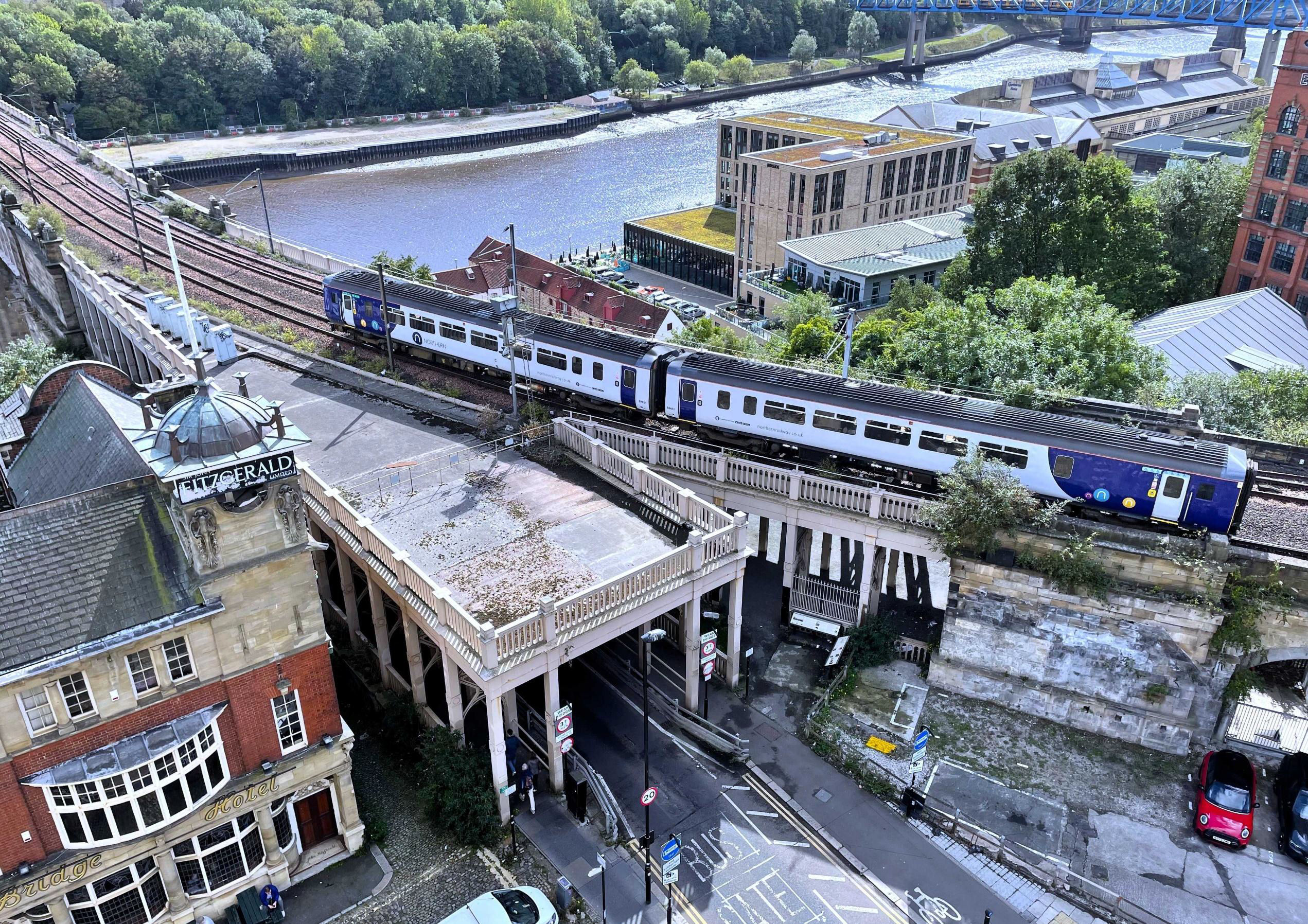
A Class 156 DMU departs Newcastle over the High Level Bridge.
[© Adam Turner 2025]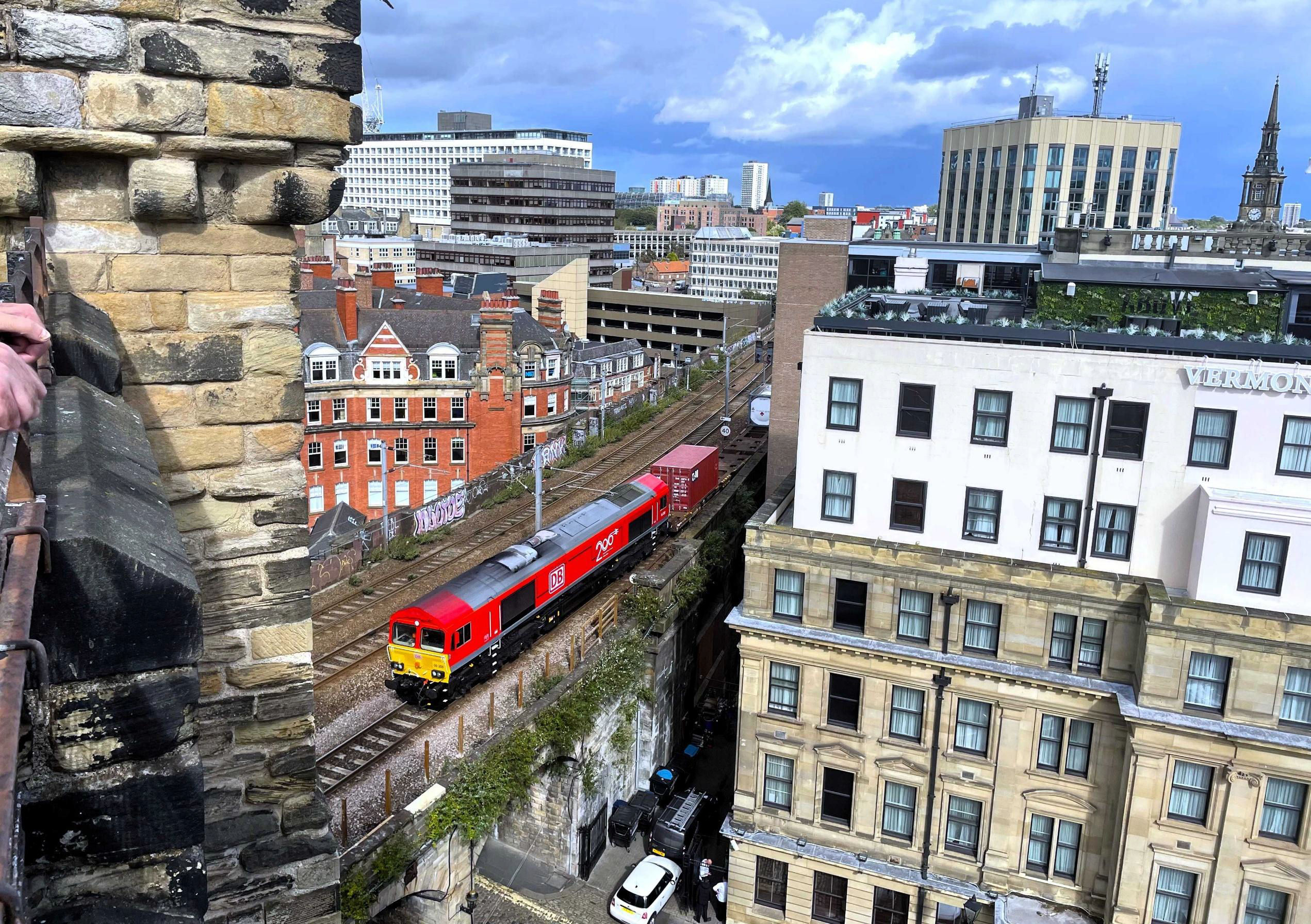
DB Cargo Class 66 66200 in Rail 200 livery on an intermodal service heading towards Newcastle.
[© Adam Turner 2025]On our way to the Grade I listed 5,050 ton cast iron High Level Bridge, a bystander, apparently discerning our interest in railway architecture, pointed out that a parapet above Queens Lane off St Nicholas St had been fortified to act as a pillbox to protect the area just in front of the entrance to the High Level Bridge and a high level gun slit could be seen. Today the bridge carries only buses and taxis below with trains above them. George Hudson was originally persuaded by the Newcastle authorities to build a high level bridge to carry road and rail - it later had to be strengthened with extra hangers for tram traffic (and was strengthened further recently). High Level Bridge also was the next 'Get Carter' rail related location, the chase sequence. It was curious to learn that Queen Victoria and Prince Albert had opened the bridge on their way south from Balmoral by stopping the Royal Train on the bridge.
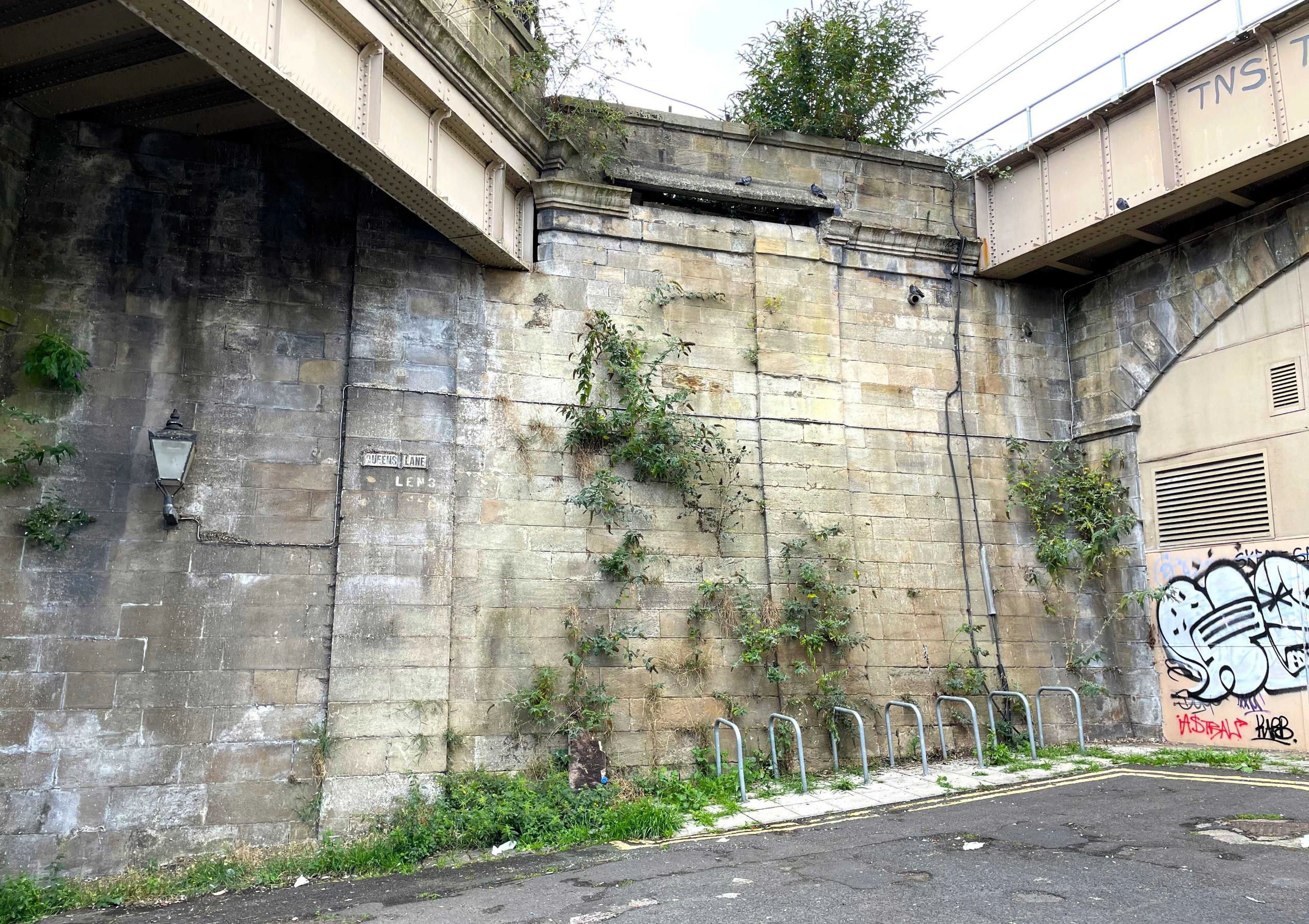
The pill box slit opposite the Newcastle side of High Level Bridge.
[© Adam Turner 2025]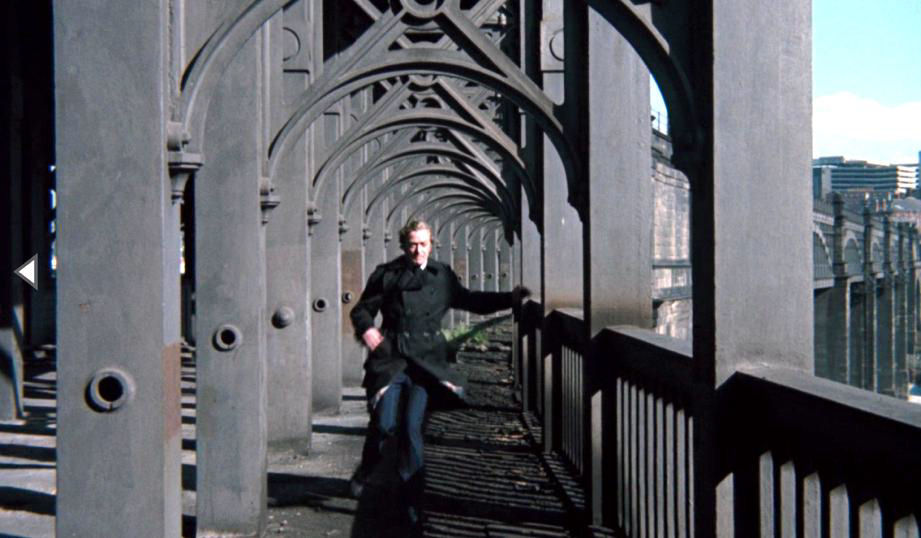
The next 'Get Carter' rail related location, the chase sequence..
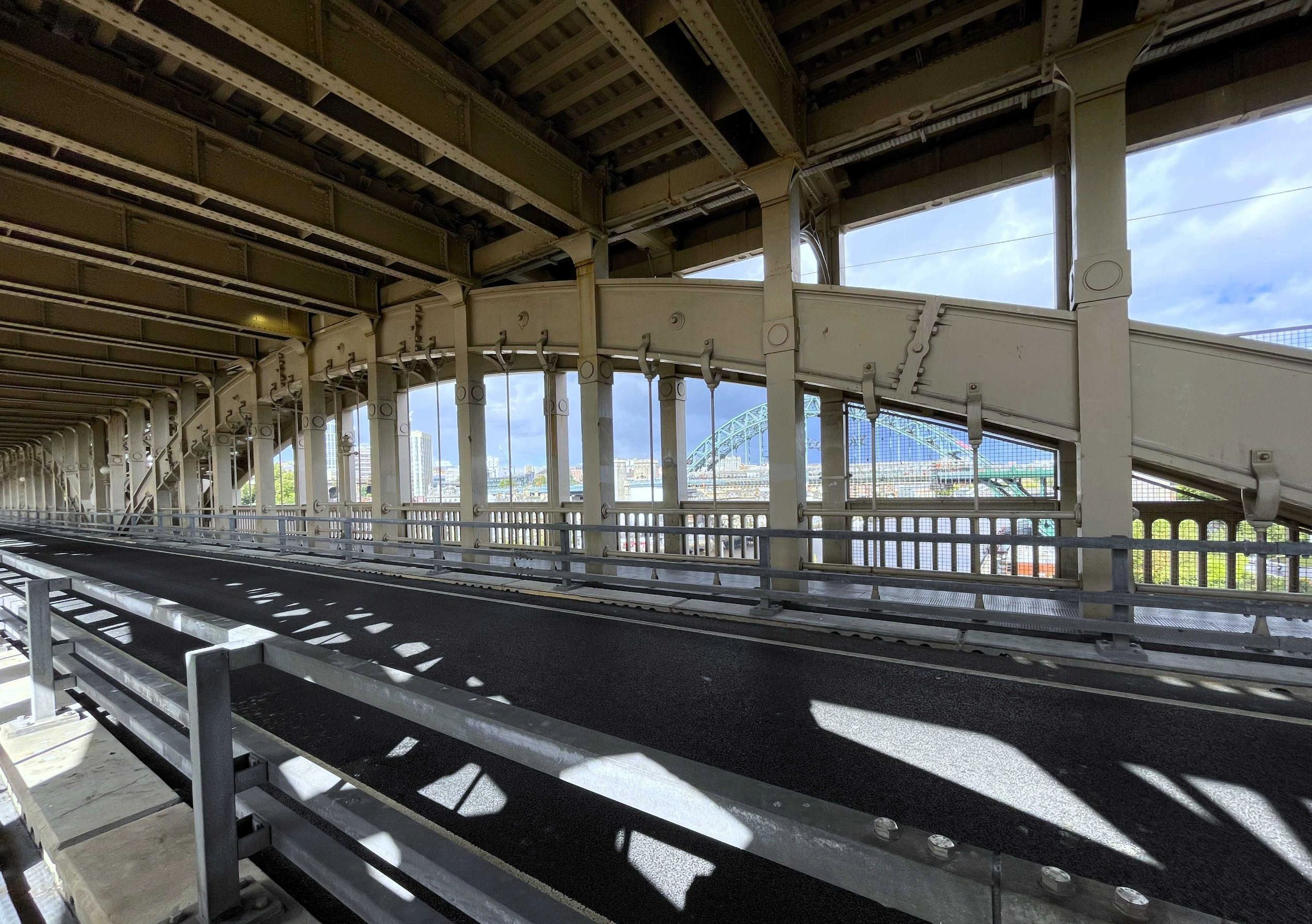
High Level Bridge with strengthening hangers and rods to take the weight of trams on the road and nowadays, buses.
[© Adam Turner 2025]Our group crossed the bridge via the quite busy pedestrian walkway into Gateshead, where there was much to see. We visited the elderly Hill St bridge and Half Moon Lane bridge near the former entrance to Gateshead East (station closed 23 Nov 1981). Passing around the corner off Hudson St, participants climbed the slope that originally led to the former Gateshead West station (closed 1 Nov 1965), where, over the track, we could see just a few remnants of the once great Gateshead Loco Works buildings.
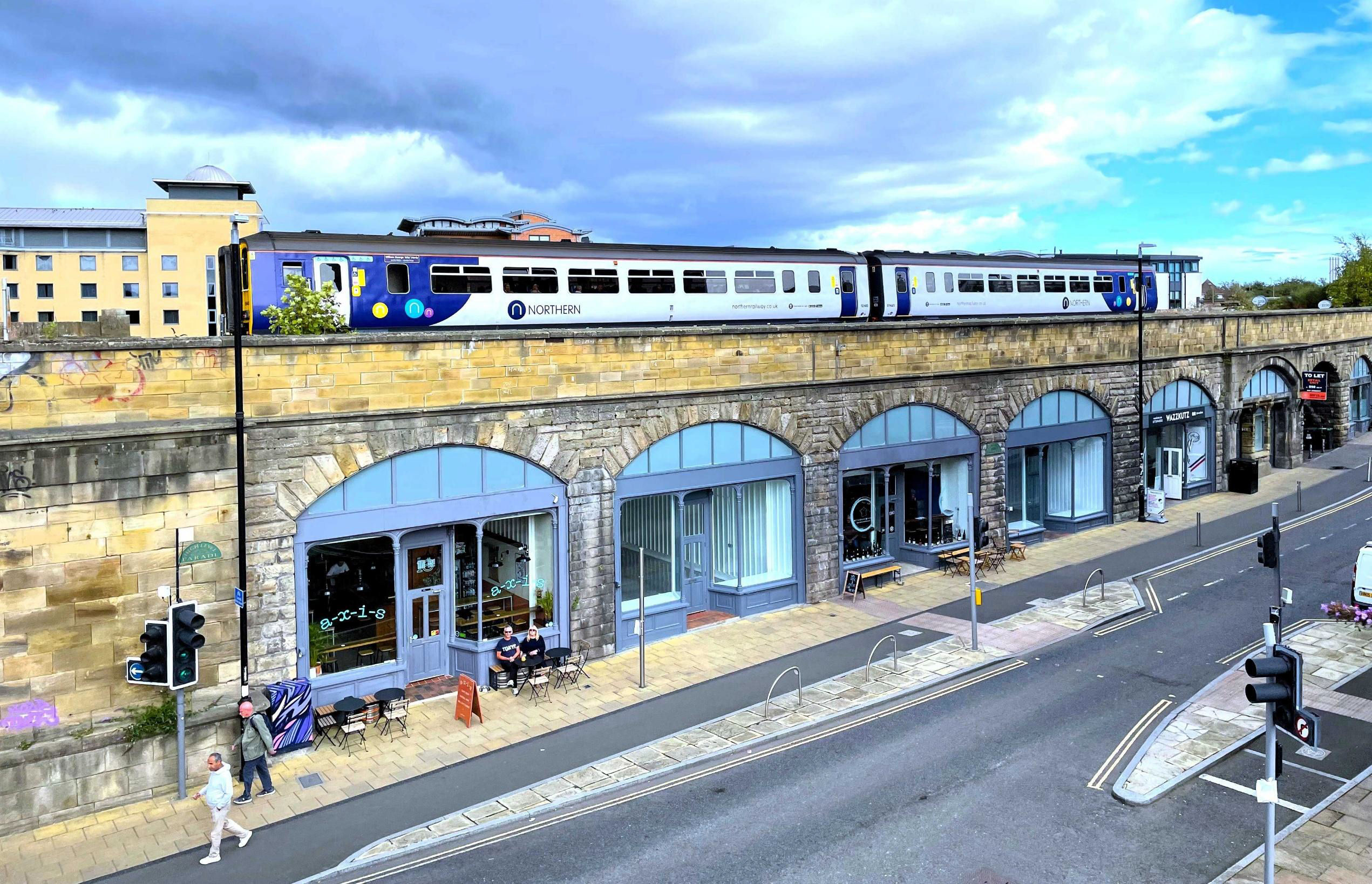
From the site of Gateshead West station. A DMU on the arches where Gateshead East station was - the entrance was near the right end of these arches.
[© Adam Turner 2025]With a few spots of rain felt, the group descended down to River Tyne level to cross the hydraulic Swing Bridge, opened to road traffic in 1876. It also gave a great position to gauge the imposing height of the adjacent High Level Bridge. Next a challenge, steps back up 150ft to the entrance of Newcastle Keep. We took a breather half way up, where there was thankfully somewhere to briefly sit. At street level in front of the Keep, a Friday afternoon wedding party had spilled out of the Vermont Hotel for a photo. However, we kept going to find Forth St, the end of our day in sight. Forth St passes under the tracks with a white glazed brick lining. We stopped to see another remnant of the city wall and also the former Royal Mail sorting office, where the group was shown photos of the surviving tunnel that linked the sorting office and the platforms, once used to move mail and parcels.
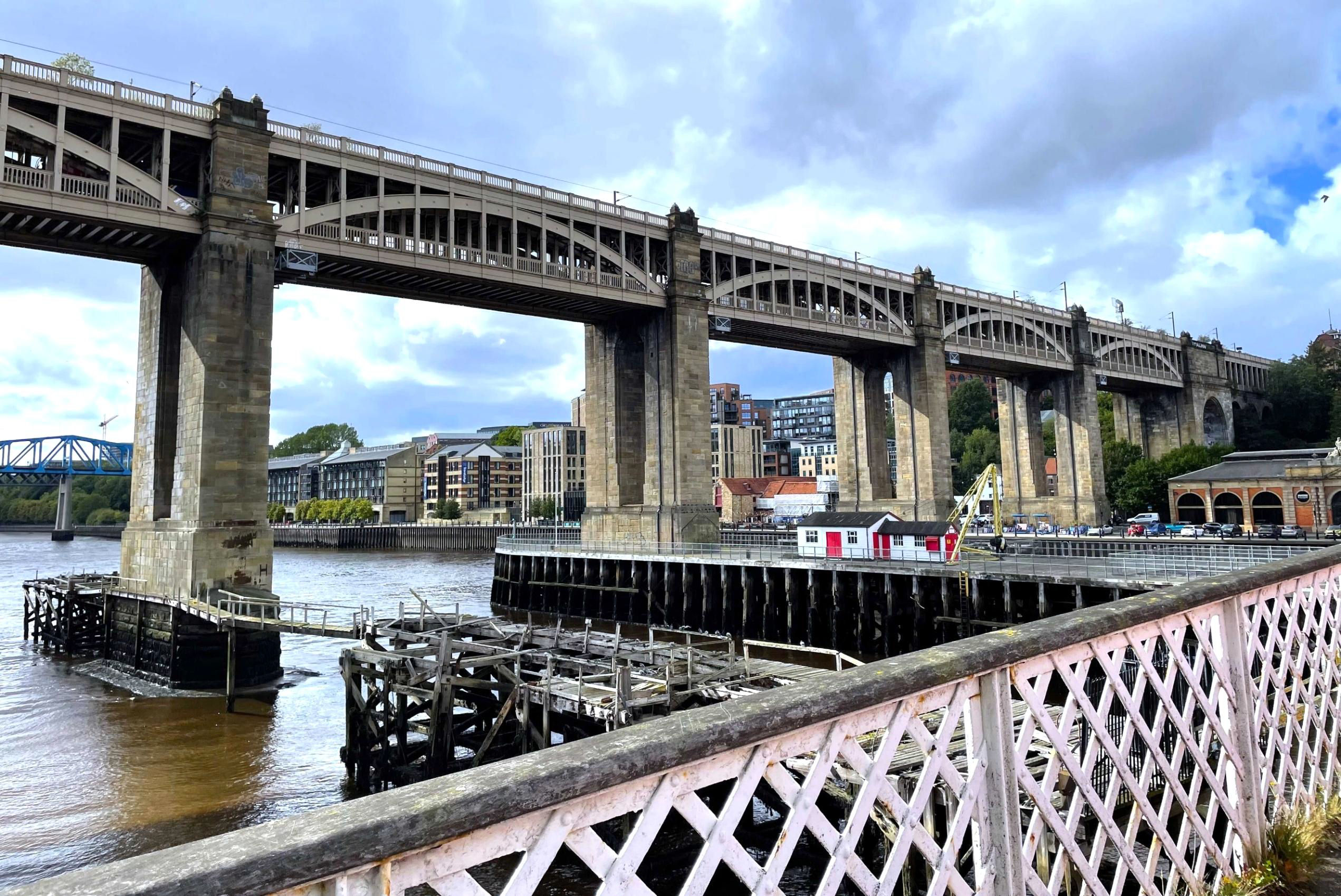
High Level Bridge from river level.
[© Adam Turner 2025]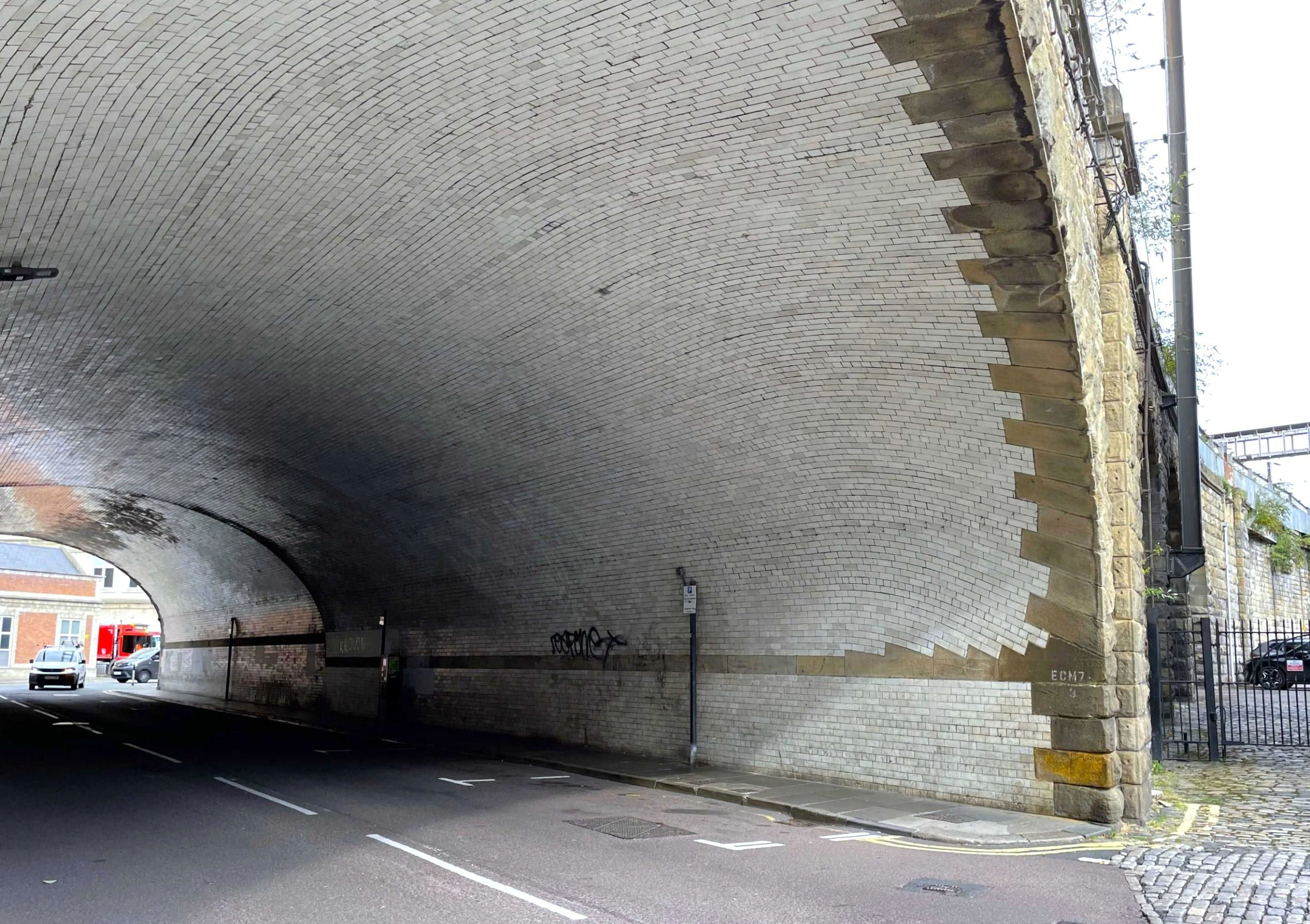
Tiled in white, Forth Street Underbridge on the East Coast Main Line, beneath Newcastle East Jn
[© Adam Turner 2025]Around the corner from here, with spits and spots of rain once more, was the former Robert Stephenson & Co's Forth Street Works. A security guard came to say 'hello' and spoke enthusiastically about the inside of the preserved building but without being able to facilitate a peek inside - one for next time! Back towards the station, we found the gated entry to the 1891 Newcastle Central water tower where track was still evident, pointing in the direction of the former Forth Street Works. We were on time for the last stop of the tour - the surviving galleried offices in Newcastle Central station.
Our group made its way to the front of the station via the Orchard St taxi subway and the Royal Station Hotel vehicle entrance - seeing the Art Deco style rear entrance of the hotel on the way. We entered the portico once more, where we met our friendly host from Northern Trains. He took us up through nondescript staircases into the railway offices above, to visit the original galleried offices now used by Northern. Our host showed us up via narrow staircases to reach the gallery levels, used for storage, the double height of the room in combination with large windows and a now-infilled central skylight helping to light the room naturally. He said that the offices were notorious for being boiling hot in the summer and cold in the winter, that I remember London Underground staff saying of working at 55 Broadway!
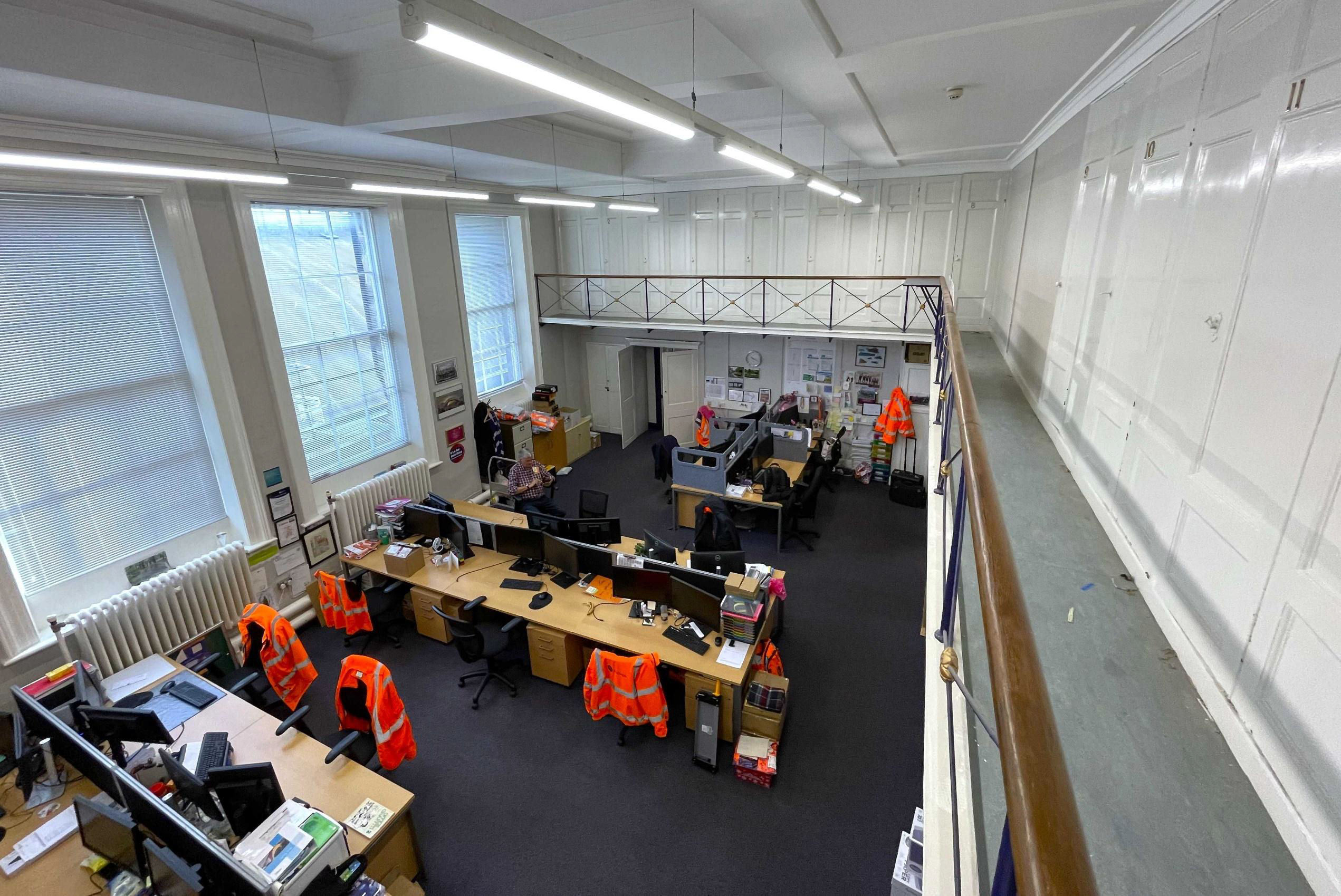
Newcastle station Northern offices from the high level walkway.
[© Adam Turner 2025]Through a large wooden door, we returned to the main broad passenger hallway, divided by two rows of columns, with curved ceilings. There was nothing left to do but collapse with a drink to enjoy the former First Class refreshment room, now the Centurion Bar, with columns, pilasters, coved ceiling, and (in an 1893 refurbishment) Burmantofts faience tiles - an apt, splendid location to end a magnificent day.
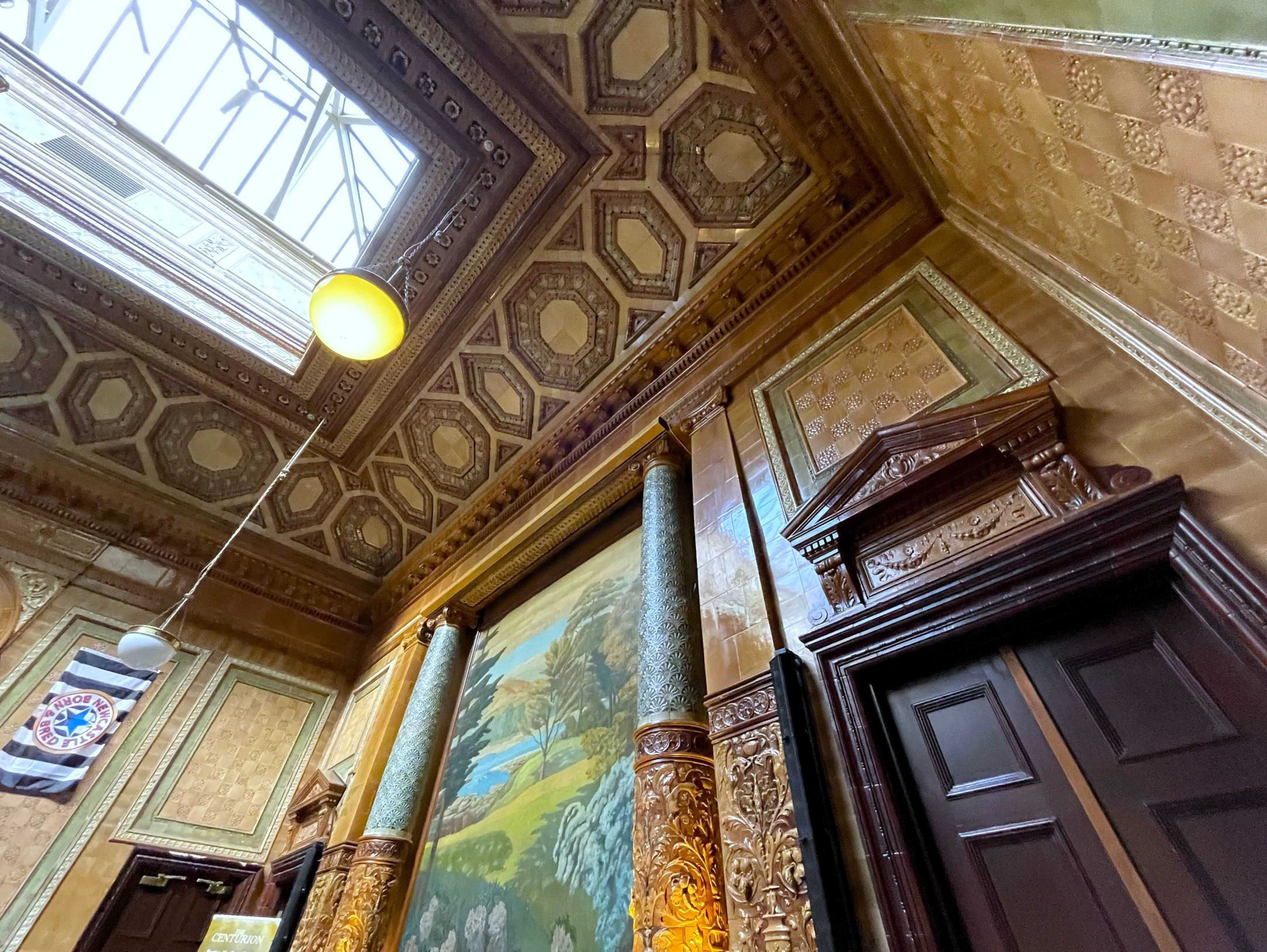
The Centurion Bar pilasters, coved ceiling, and (in an 1893 refurbishment) Burmantofts faience tiles.
[© Adam Turner 2025]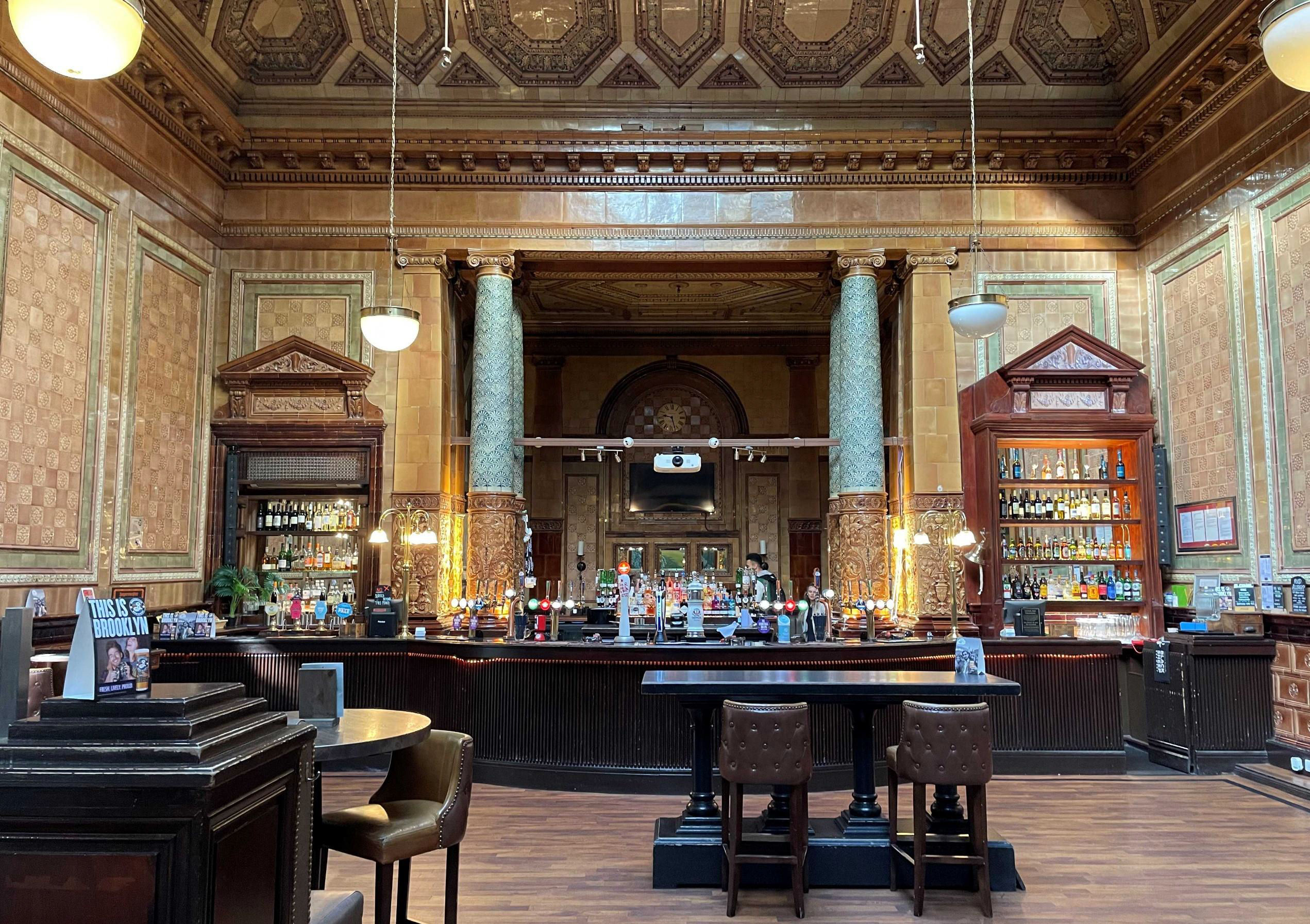
The Centurion Bar pilasters, coved ceiling, and (in an 1893 refurbishment) Burmantofts faience tiles.
[© Adam Turner 2025]After a rest and refresh, a few of the participants met at the former Jesmond station (CP 23 Jan 1978), now a pub and 'The Valley Junction 397' Indian restaurant, with a railway carriage for dining, said to be a 1912- Great Northern Railway build. It was a fantastic meal and, while we were enjoying the food, an ECS Metro unit passed our carriage. A perfect way to round off a smashing day; thanks to Adam Turner.
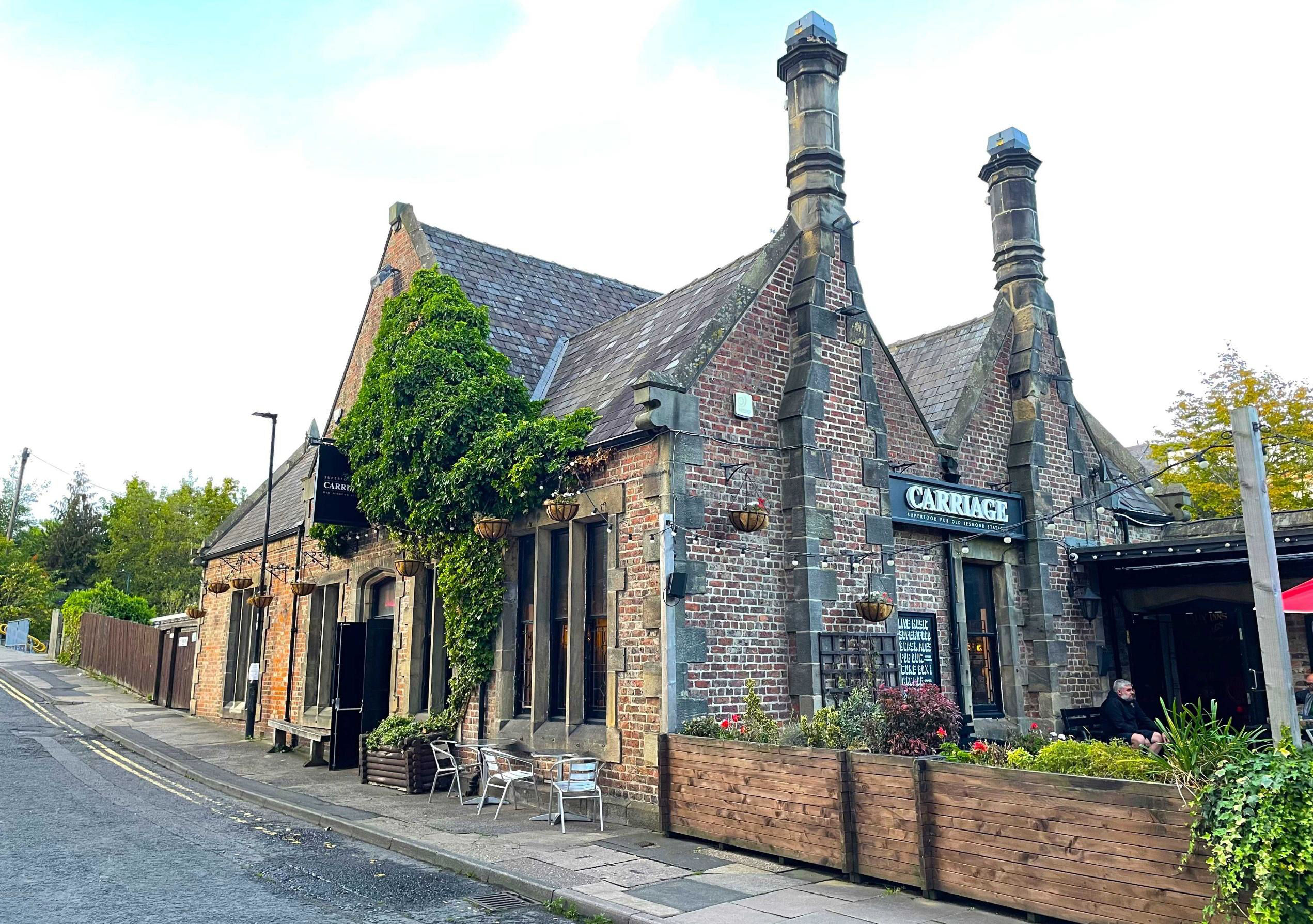
The former Jesmond station (CP 23 Feb 1978 for Metro conversion).
[© Adam Turner 2025]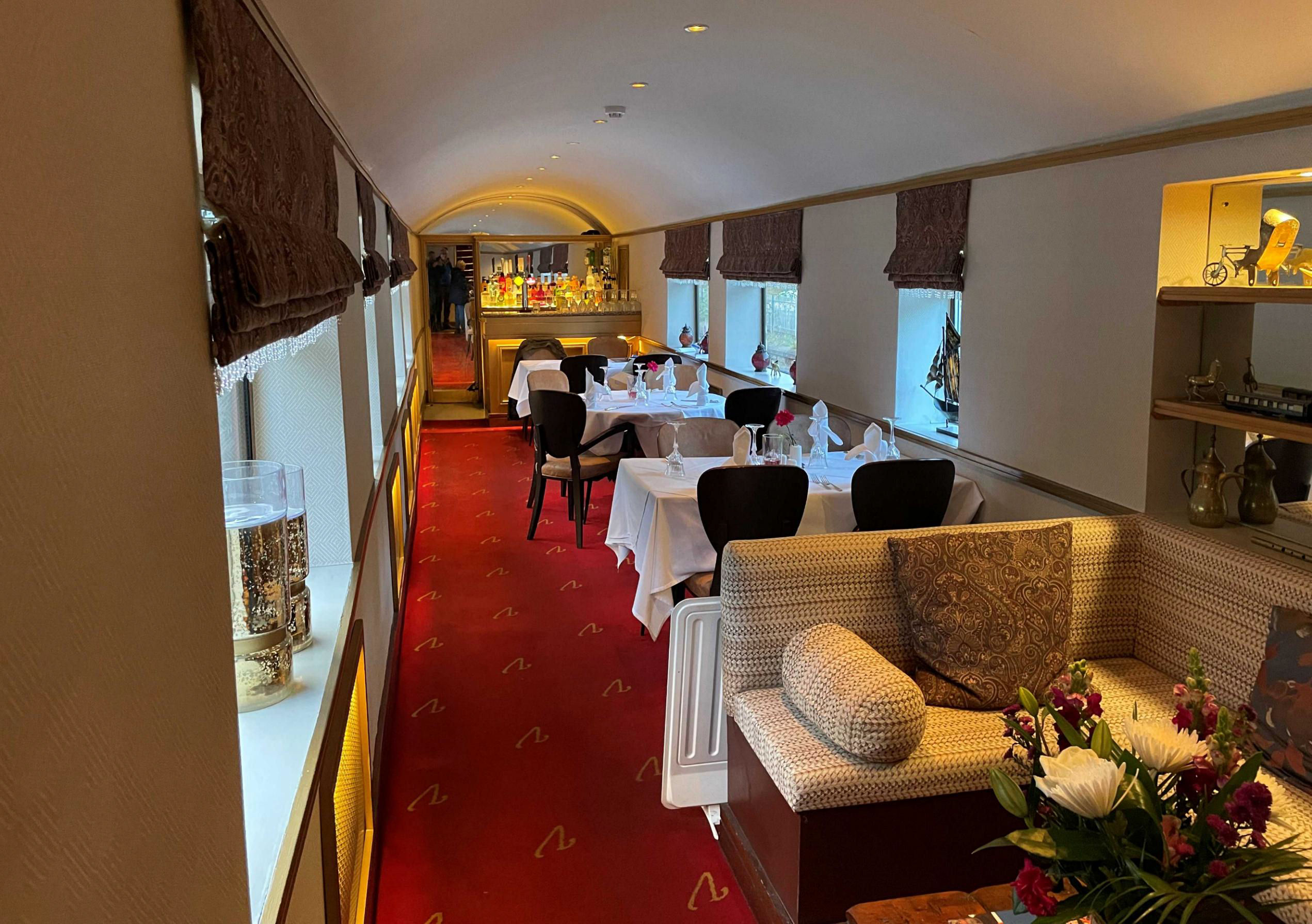
Indian restaurant carriage at the former Jesmond station.
[© Adam Turner 2025]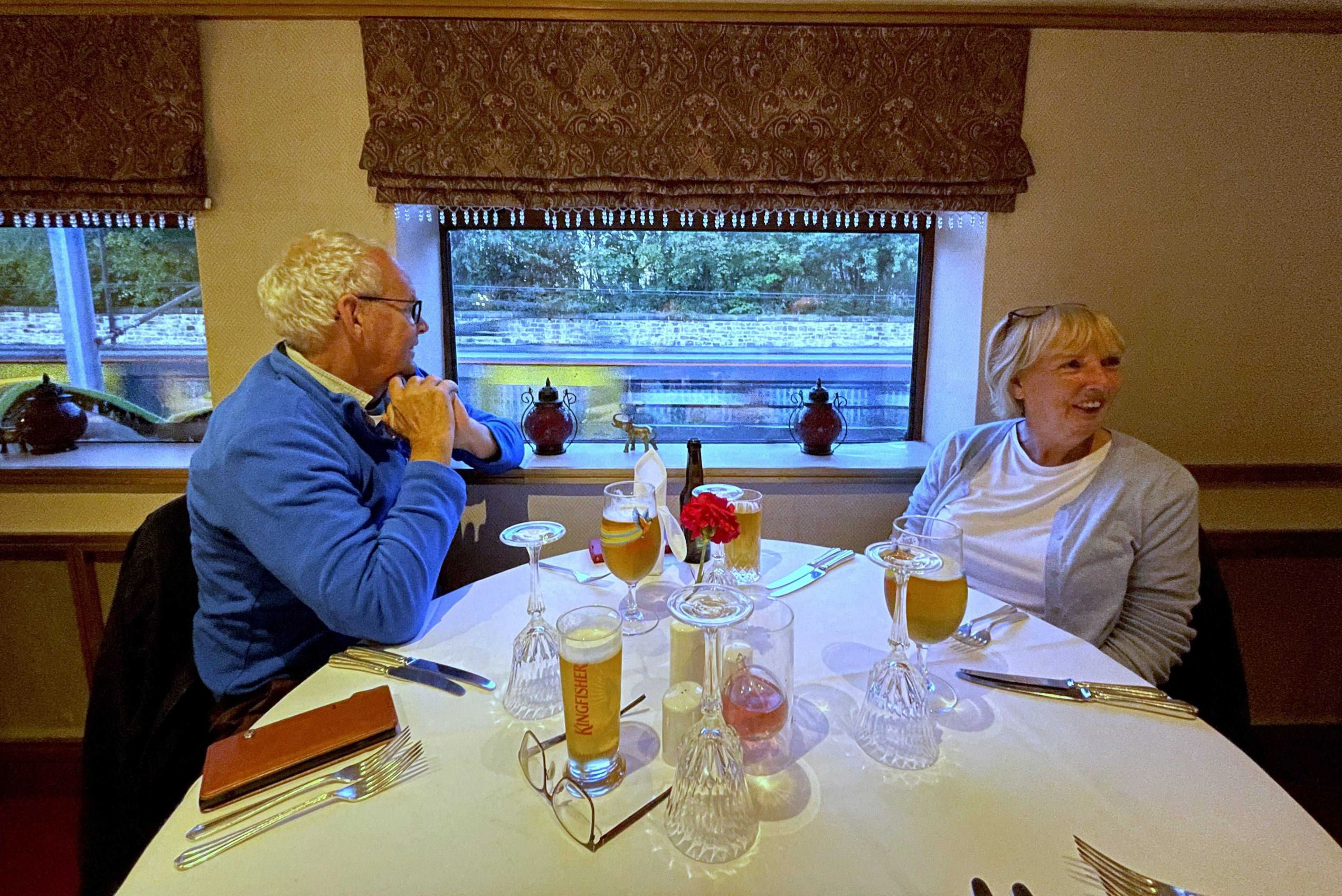
A T&W Metro ECS flashes past (this line is not used by passenger services).
[© Adam Turner 2025]