Photos taken at Korneuburg-Donaulände (at least it wasn't raining now!), we duly ran back along the branch, reversed again and opened both of the fully-opening windows to enjoy the sound of the locos, which let out a throaty roar as we accelerated towards our 100 km/h maximum speed.
Unfortunately, a highly desirable objective of the tour, the Floridsdorfer Hochbahn (Floridsdorf avoiding line) was one section denied. The reason given was that it was for 'emergency use only' but the rails each end were as shiny as any others. Another explanation, on the day, was that a local politician objected to the noise of diesel worked trains on the line. There can't be many but either way we reversed in Vienna (Wien) Floridsdorf station from 09.38 to 09.43, before heading towards Süßenbrunn S-bahn station.
Reversing, we passed Süßenbrunn Entseuchung Yard and went down the stub remains of a once through line to Verschiebebahnhof Breitenlee (Breitenlee Marshalling Yard), an abandoned transport project of Austria-Hungary and the early First Republic. The site is northeast of the city centre. Construction began in 1916 during WWI but was halted around 1925 due to the post-war economic crises. If completed, the Yard would have been one of the largest in Europe then. Back in 2025, we halted just before the single set of points for the now simple two road yard just before the line ends.
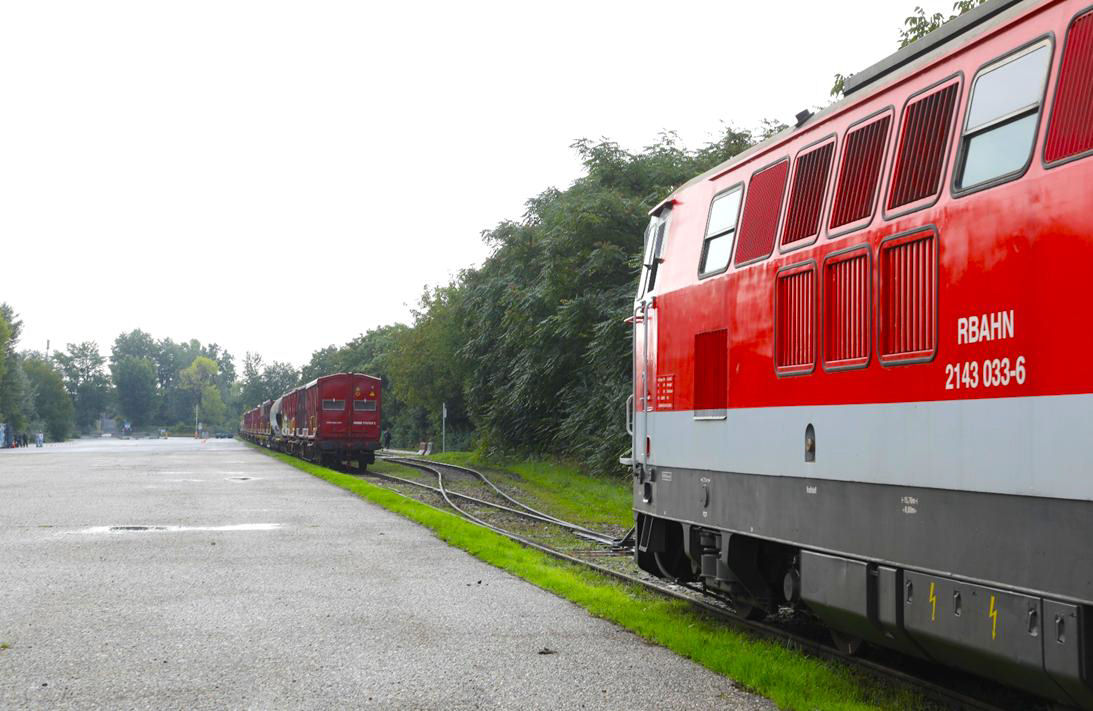
Breitenlee about 2.4km from the end of Süßenbrunn Entseuchung Yard is this little used operational siding. The once extensive site, years ago planned to have been one of the largest marshalling yards in Europe, is now one of the most important nature reserves near Vienna.
[© Iain Scotchman 2025]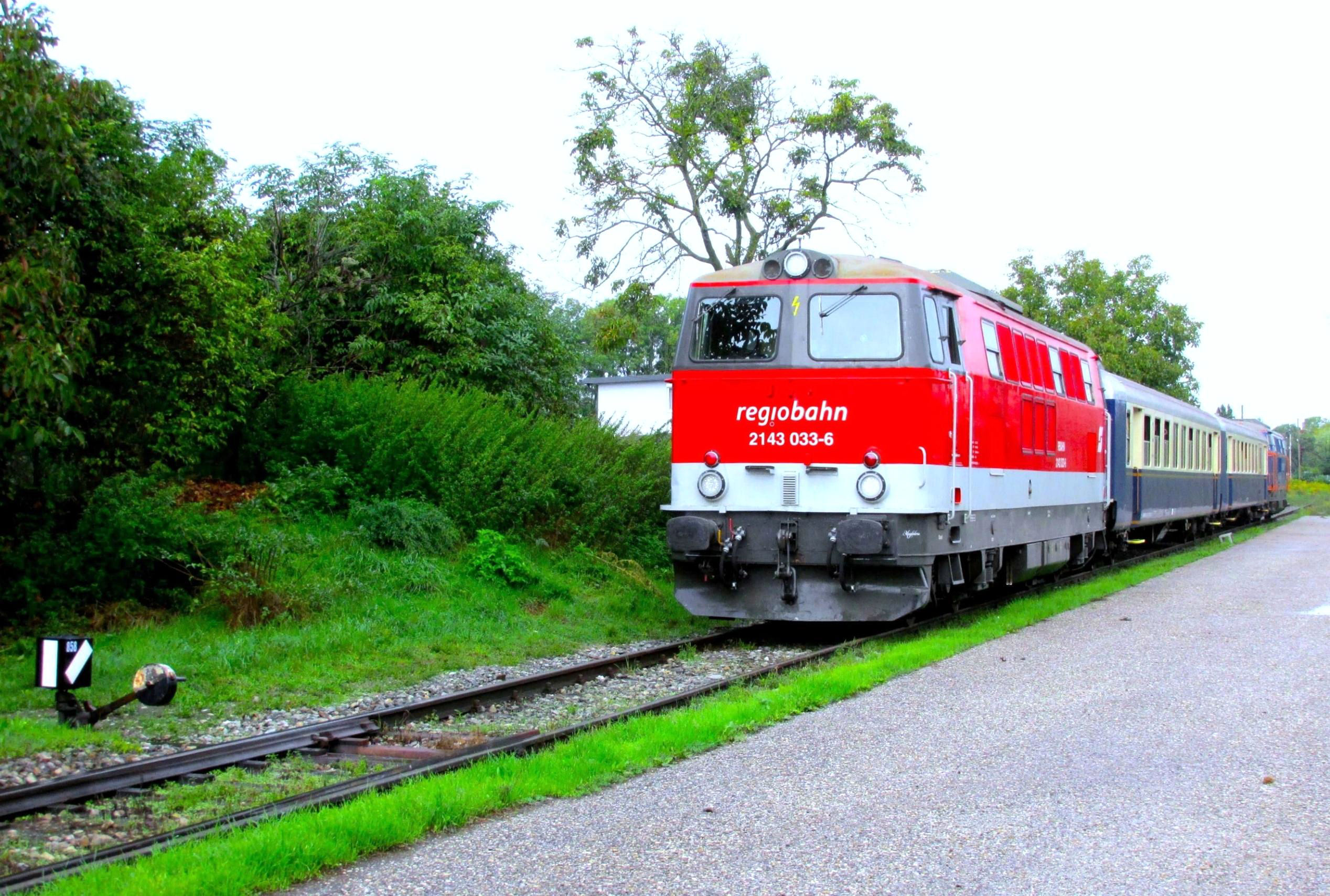
At the same location, looking back towards Süßenbrunn Entseuchung Yard (off right).
[© Simon Mortimer 2025]Breitenlee is retained as an operational siding by ÖBB but sees very little use. Just as well, as the majority of the extensive site is now one of the most important nature reserves near Vienna. We had covered about 2.4km from the end of Süßenbrunn Entseuchung Yard.
After the obligatory photo shoot, now a thing of distant memory on UK tours at such non-platform locations, we reversed at the south end of Süßenbrunn Entseuchung Yard, before progressing further south, threading Wien Stadlau Nord Yard, bypassing Wien Erzherzog-Karl-Straße station on a loop past the platforms and then entering Wien Stadlau Yard to access the branch towards Wien Lobau Hafen.
We made our way along the initial 4.4km from the junction to the yard and thought that this would be the limit of our travels. However, after a long pause, Peter gained permission from the dispatcher to progress about another 1.7km almost to the (very high security) gates of the Zentraltanklager Lobau, an enormous (oil etc) storage facility under heavy security. Our popping out from the short tunnel-like overbridge seemed to surprise a few staff, particularly with tour participants bailing out and taking photos. We were no doubt all recorded in return by the many cameras festooning the fence and gate!
It is many years, indeed decades, since a tour reached here. The branch continues 3.4km to industries around the Ölhafen (Oil Harbour) but we were assured that there was no way we were going any further!
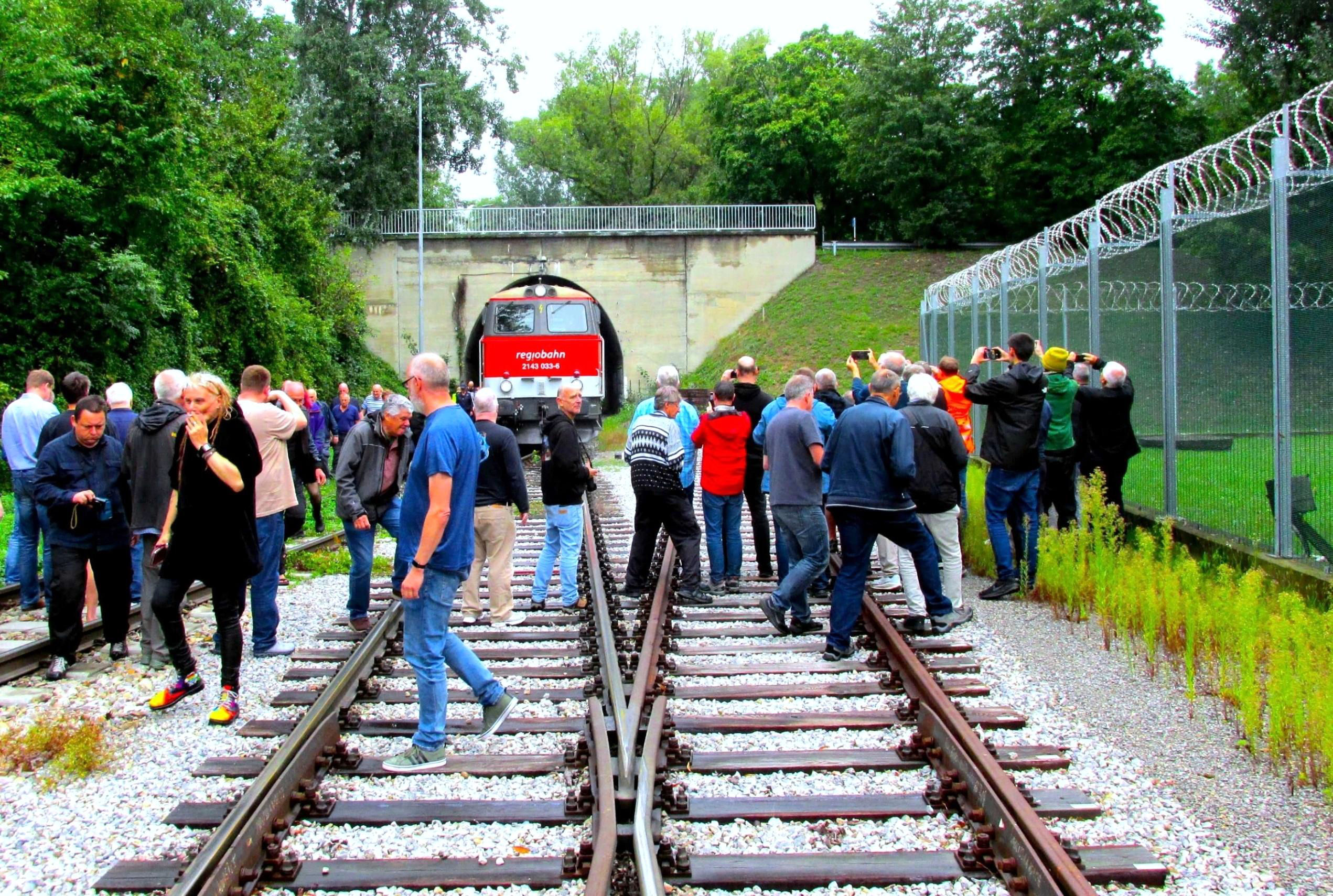
The tour pops out under a road overbridge shortly before the very high security Zentraltanklager Lobau oil storage terminal gates.
[© Simon Mortimer 2025]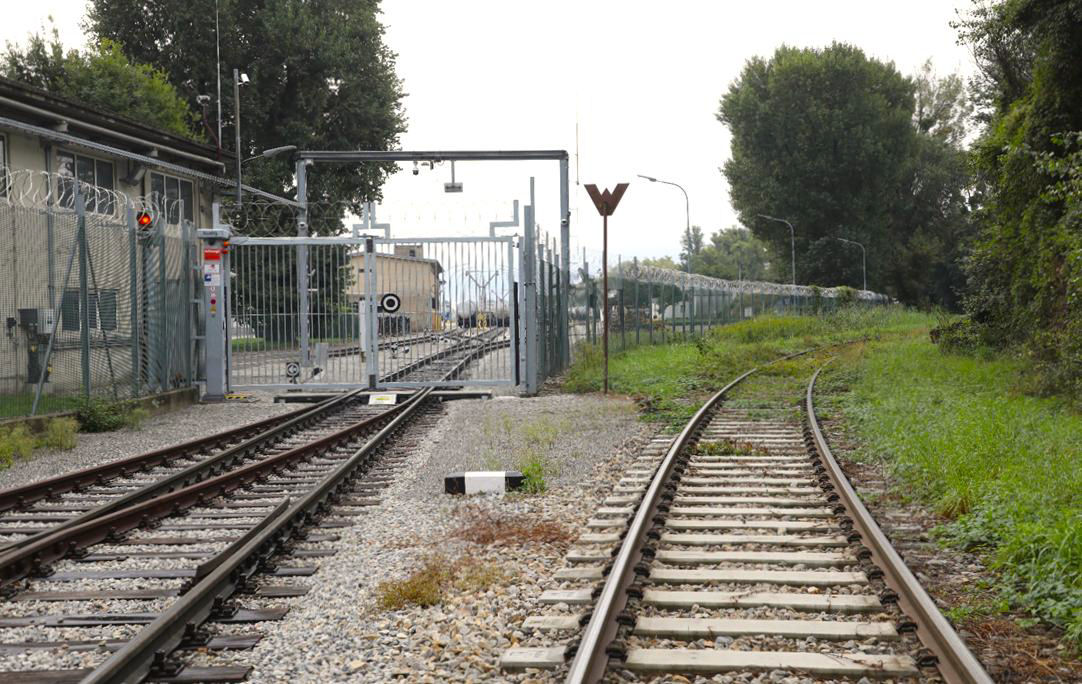
In the other direction - left through the gates, the line enters the enormous oil storage facility under very heavy security. The line curving right continues another 3.4km to serve industries around the Ölhafen (Oil Harbour). We were assured that there was no way we were going any further! It is many years, indeed decades, since a tour reached this far on the branch.
[© Iain Scotchman 2025]We left, retracing our steps parallel to the Neue Donau (New Danube), an elaborate flood prevention scheme paralleling the Danube, built over 16 years from 1972. It is normally isolated by flood gates making it nice for bathing as it is then only fed by natural springs. We reversed in Wien Stadlau Yard and ran south again, bypassing Wien Simmering station on adjacent lines, before curving around Line 13101 (the only one that is difficult to do on a passenger train in the early morning) into Wien Einfahrgruppe Yard, Road 203. Our tour then crossed the throat of Wien Zvbf [Zentralverschiebebf = Central Transfer] Yard onto Line 191-01. We passed immediately adjacent to the hump for this immense yard, before swinging left towards Kaiserbersdorf Yard and continuing around the back of Schwechat Yard, then regained the main passenger lines just off the east end of the new station's platforms.
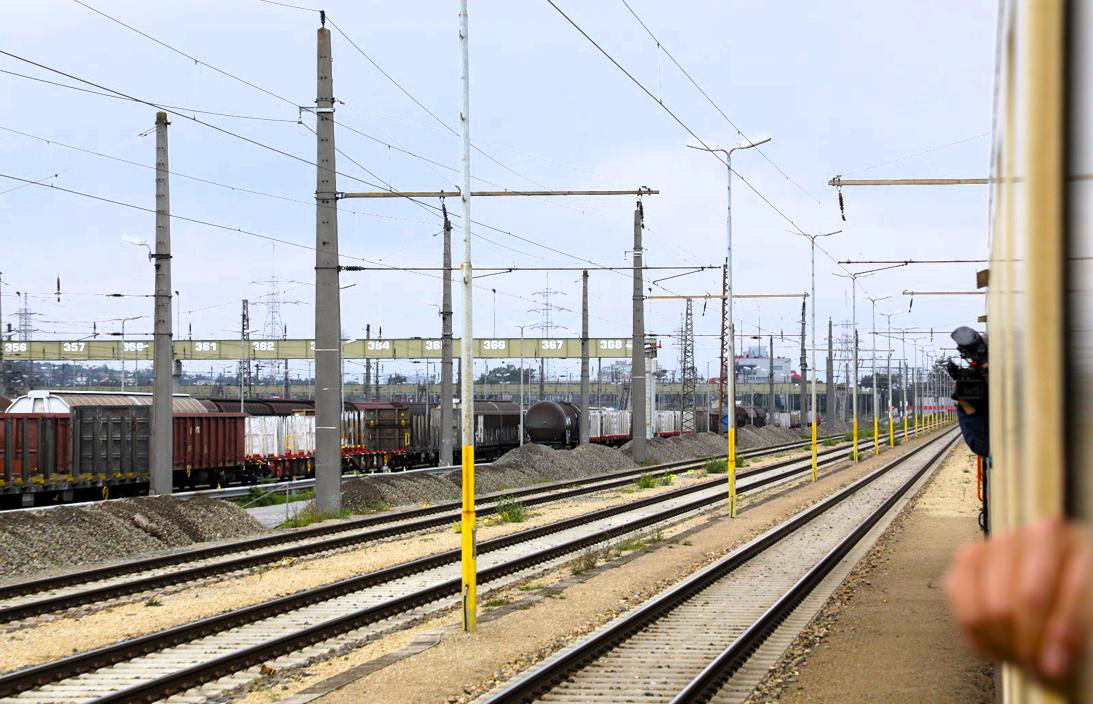
Wien Zentralverschiebebf Marshalling Yard. The tracks are numbered from 311, on the far side, to 368; the gantry sign for the latter is visible.
[© Iain Scotchman 2025]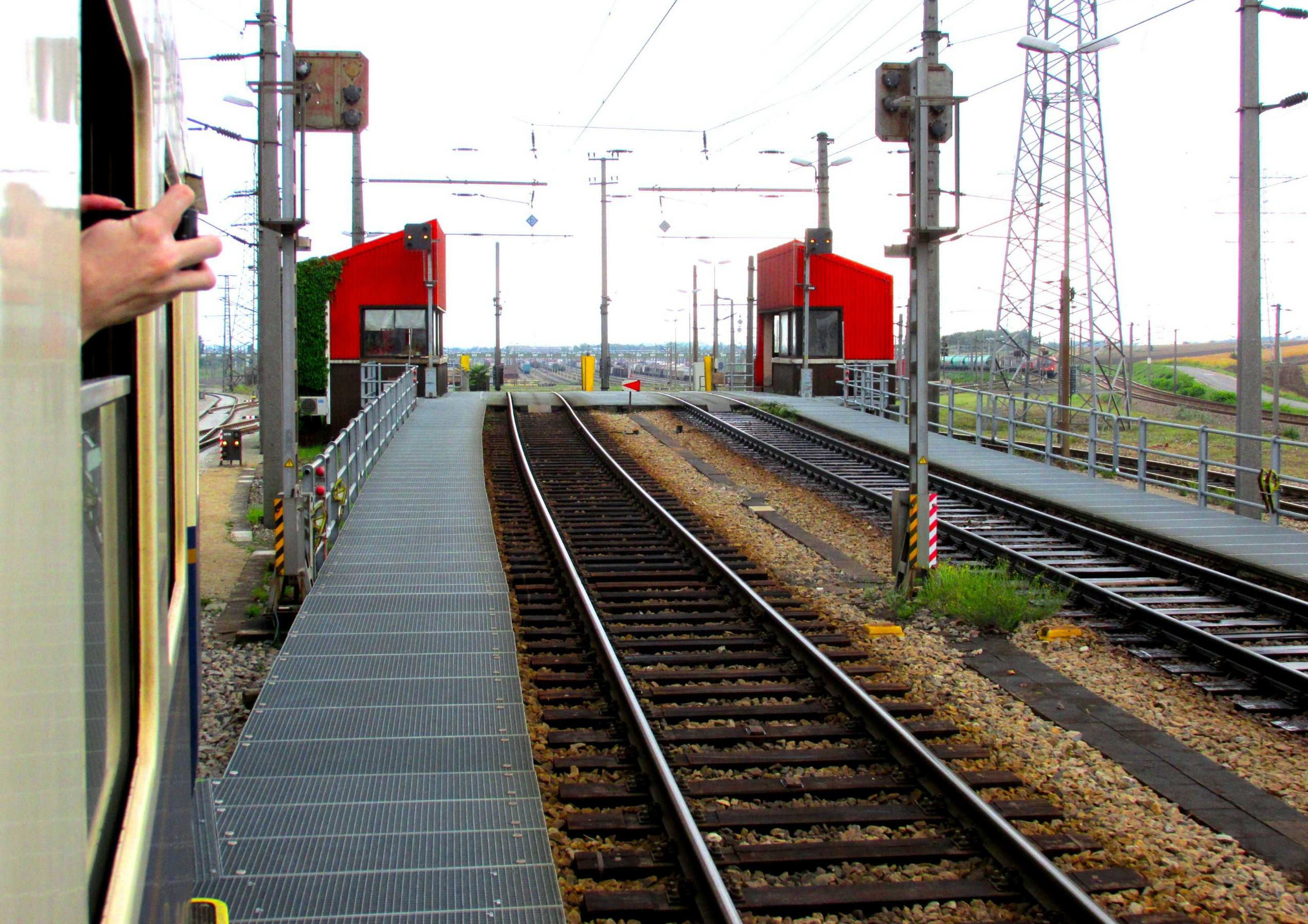
Not getting the hump… View forward passing the hump (right) at the north end of Wien Zentralverschiebebf Yard.
[© Simon Mortimer 2025]We gingerly passed through Wien Flughafen [Vienna Airport], carefully taking the gradient out of the platforms so as not to trigger any alarms. Apparently, a similar diesel hauled train thundering through Schipol Airport station in the Netherlands did, causing diesel trains to be banned! We enjoyed the sound resonating off the walls of Pisten Tunnel, with the windows fully down and tunnel walls flashing past. Amazingly everyone survived! Passenger services continue along the branch to Wolfsthal but at Abzweigweiche Strecke 192 [= Line 192 Junction], freight Line 192-01 diverges south. It initially runs around the Airport perimeter, where planes could be observed taking off at very frequent intervals.
This line used to run 16km to Götzendorf an der Leitha but it is out of use beyond the siding into AB EVVA about 9km (19.7km post) along the line, only to be open again less than a kilometre away from Margarethen am Moos for the last 2.5km to the junction at Götzendorf. There was a plan to do that bit too, from the other end but that was in another iteration of the plan! After a staged run-past at Meissel Level Crossing, the train suddenly stopped. We had already had a couple of other sharp stops before, one of which threw my unopened beer bottle across the bar car with such force the beer started to spurt out … they did replace it. On this occasion, we had stopped to save a … hose pipe! It appears someone in a house on one side of the line wanted to water something on the other side. Now, on a weekend they probably thought, with some justification, simply draping the hose across the rails wasn't an issue. The action of the driver saved the hose and presumably they didn't replace it until they saw us return.
We had a photo stop at Klein Neusiedl, although very little of the former station was evident, and another at the level crossing just before the station site at Schwadorf an der Fischa [= Schwadorf on the Fischa River]. At the latter, an elderly gentleman in full length overalls and ÖBB peaked hat appeared in charge of the hand cranked timber barriers, which duly protected the train from the road traffic and nearly crowned a photographer oblivious to its descent until several other photographers yelled at him!
This was supposed to be our limit but Peter told us we that had permission to 'go as far as they could'. Which turned out to be another 1.5 km… (Some interesting gricing exercises flashed through my head and I wondered, what's the criteria‽) We set off passing AB Welpa at 19.3km, already 0.3km further than the suggested 'bitter end' and onwards to the level crossing just before the AB EVVA terminal (19.7km). The line was becoming weed strewn by Austrian standards but nothing too jungle-like to the UK observer and finally a red rectangle on a pole could be seen a few hundred metres away among some small trees.
The whole train cleared the 19.7km post so we must have had a sniff at 19.8km, just 800m from the open section in southern Margarethen! If we had time, a railway ramble might have been in order but we had to return as time was pressing after this excellent exploration of the line. In fact, we were 45 mins late.
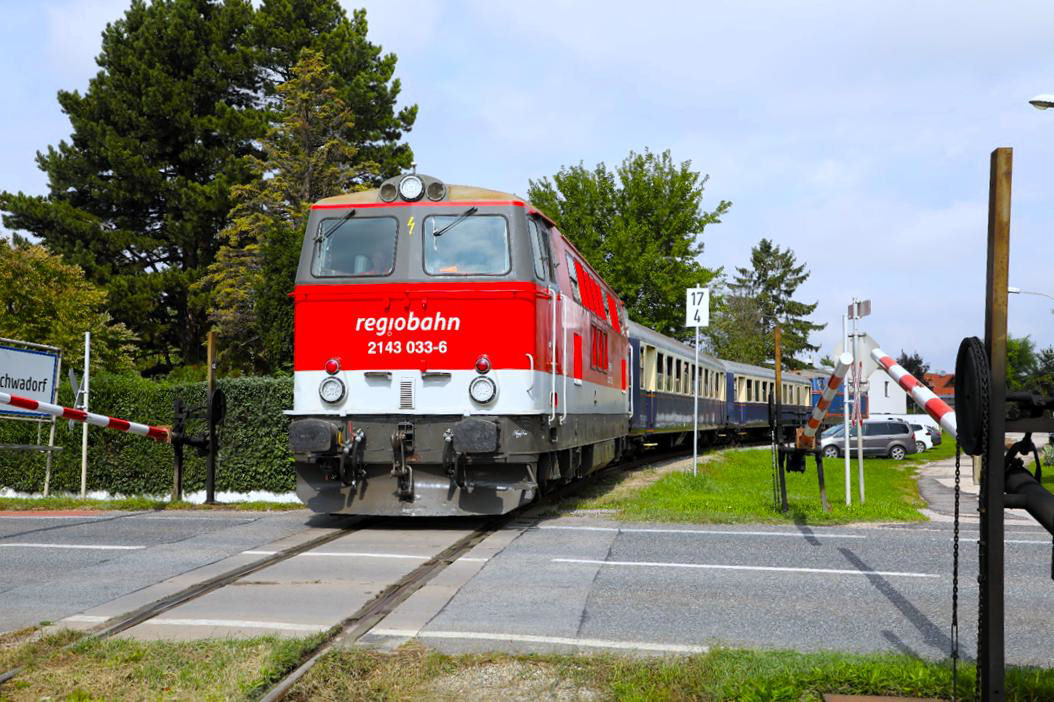
We were only supposed to go reach Schwadorf an der Fischa [= Schwadorf on the Fischa River] on this line but permission was obtained to go further.
[© Iain Scotchman 2025]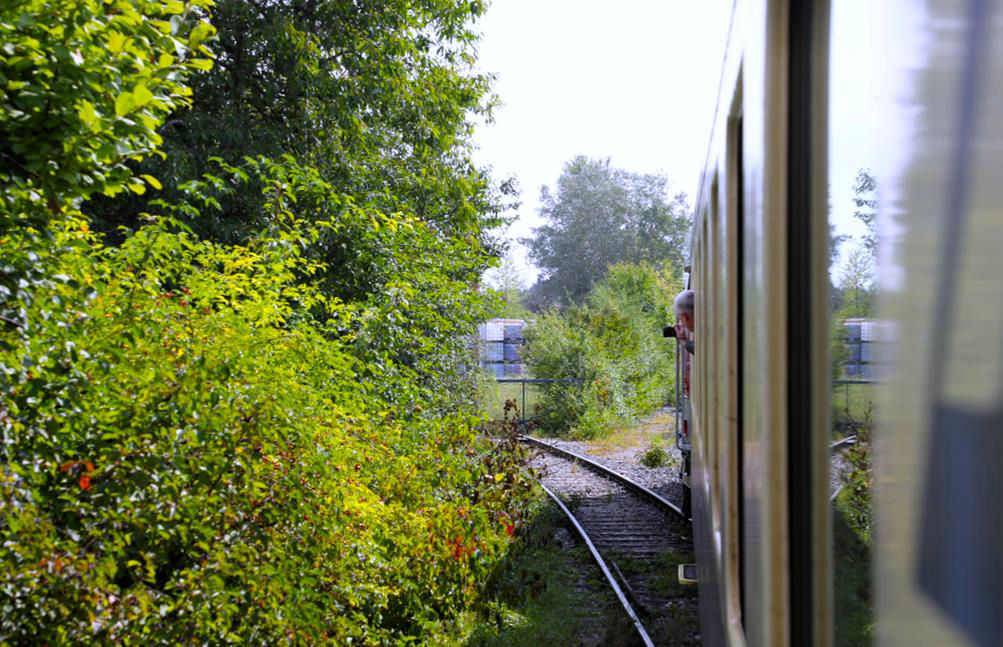
In the northern outskirts of Margarethen am Moos a short siding goes into AB EVVA. Beyond here is a red stop sign (not visible) stopping further progress towards Götzendorf. At this point, the tour train is only a kilometre away from the open section of line from the south.
[© Iain Scotchman 2025]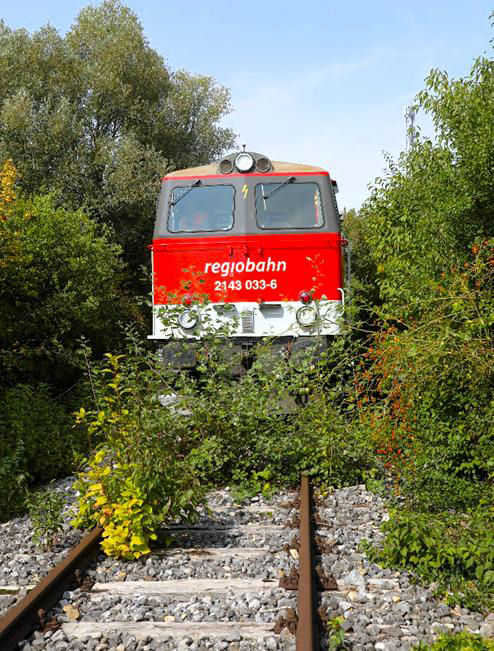
The vegetation wins!
[© Iain Scotchman 2025]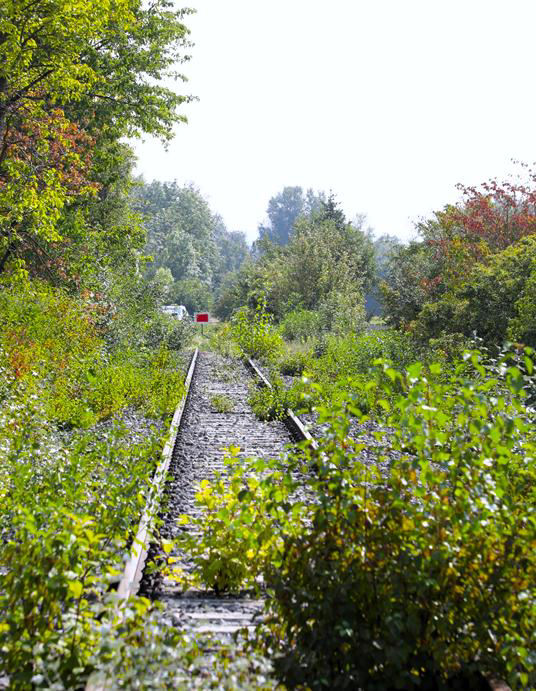
Stop Board in the distance towards Margarethen am Moos.
[© Iain Scotchman 2025]We returned (carefully again through the Flughafen (Airport) to the back Schwechat Yard and stopped in the platform of the intact but unused station, usurped by the new station of Kaiserebersdorf on the other side of the yard. This wait was punctuated by what we came to understand was a volunteer from the preservation society we were due to visit next day who parked his GBRf liveried Citroen 2CV right beside 2143-033, making an interesting contrast! During this now lengthening pause, it became clear all was not going to plan. Sure enough, Peter stood on a platform bench and, with the visual aid of a Scheers & Wall Atlas, announced that a freight train was blocking our proposed route. He explained, let's just call it today's original iteration and then outlined the iteration of the hour! The new route, hastily organised, was only possible as we had a signalman friend of Peters from Wien Zvbf box on the train to facilitate it.
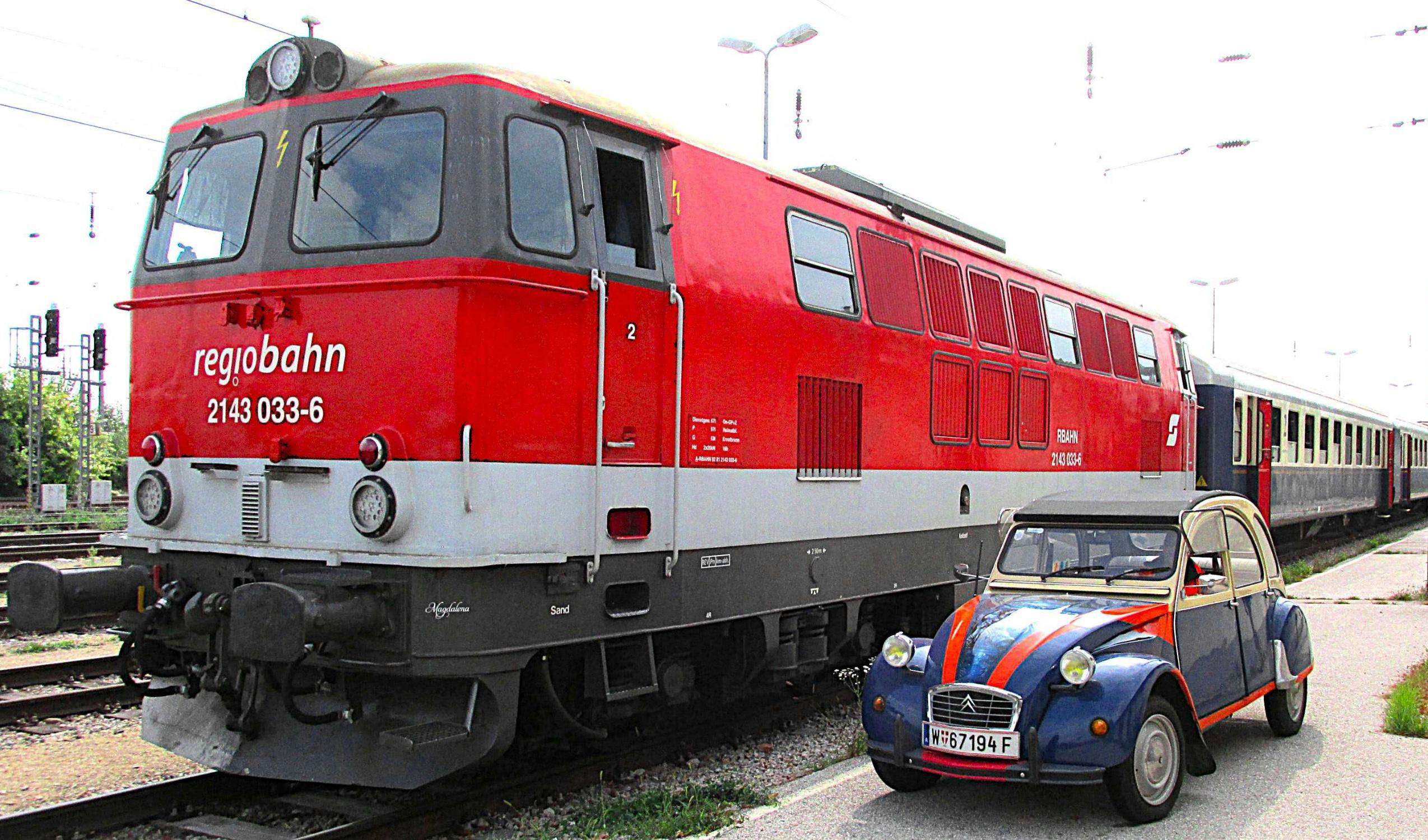
Schwechat; 2143 033 awaits developments ahead and a member of the local Eisenbahn Museum has parked his Citroen 2CV in GBRf livery alongside.
[© Simon Mortimer 2025]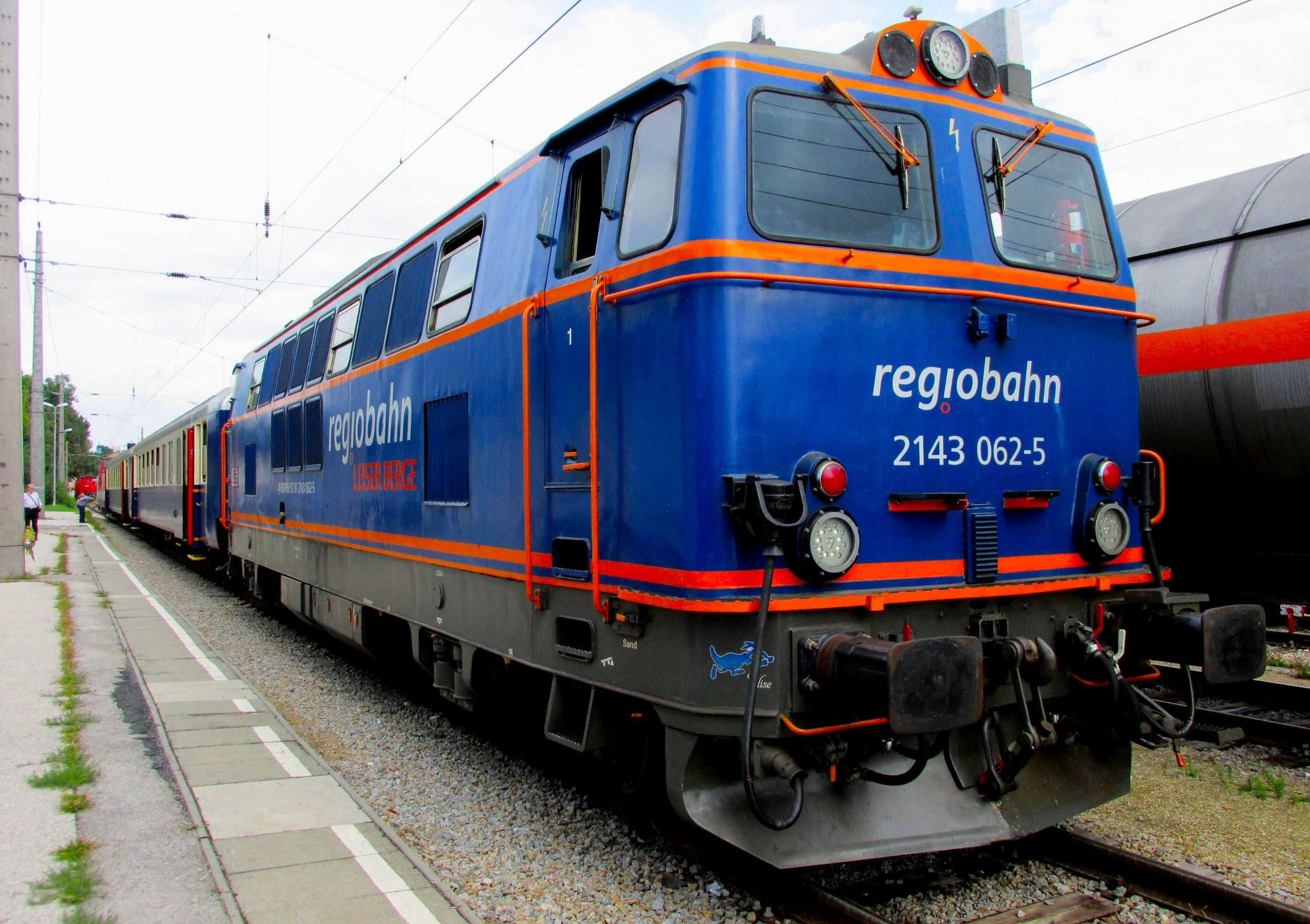
2143 062 at the other end of the train during the wait at the former Schwechat station platform (there was a failed freight train ahead) .
[© Simon Mortimer 2025]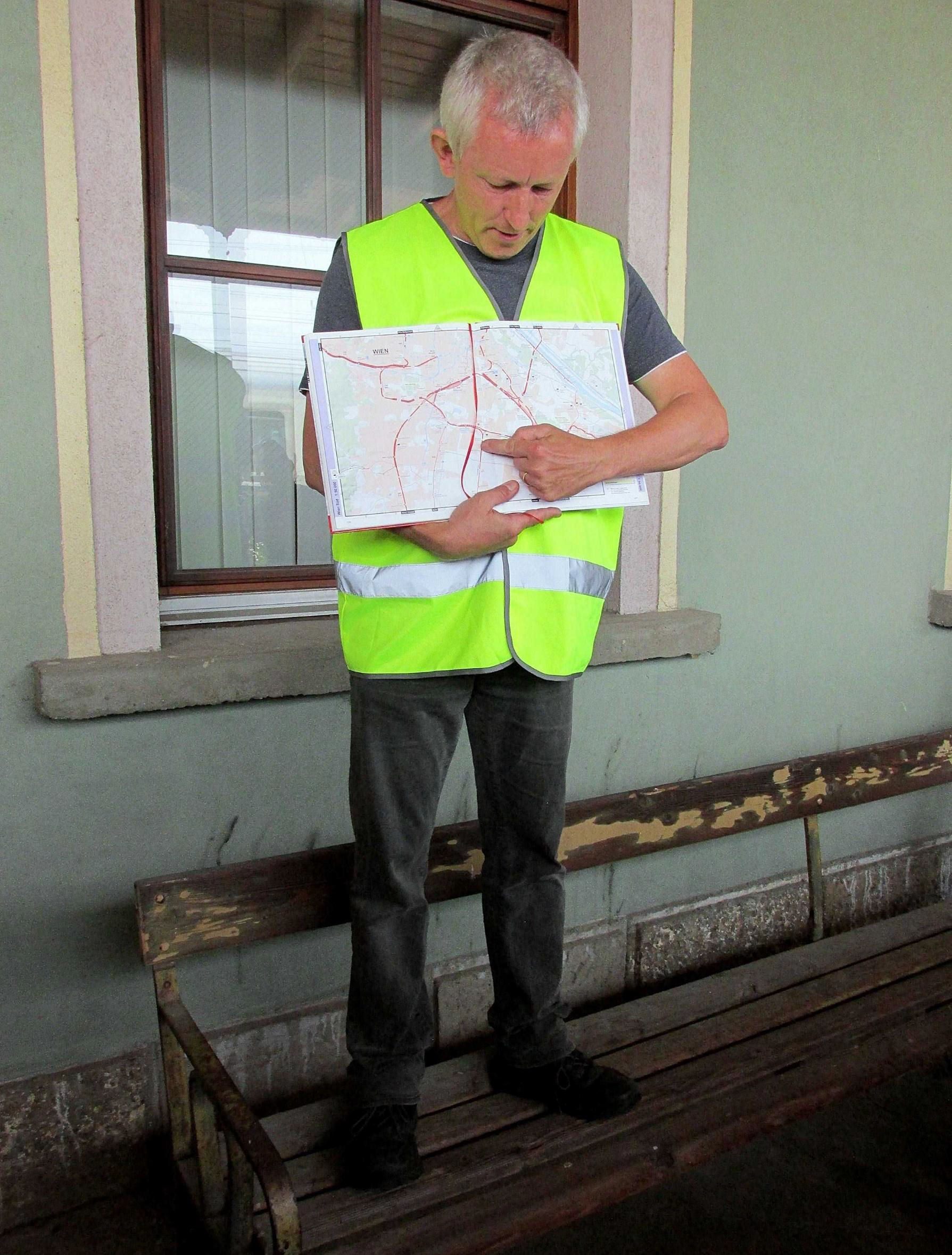
At Schwechat, Peter Lenhart explains our new, hastily reorganised, route. Only possible as we had a signalman friend of his from Wien Zvbf [Zentralverschiebebf] signal box on the train to facilitate it.
[© Simon Mortimer 2025]Consequently, we set off taking Line 136-01, the east to south part of the triangle leading to the horseshoe curve leading to Wien Ausfahrgruppe Zvbf (just before Kledering station). Here we reversed (a revision on the plan of an hour earlier!), as we then took part of the route originally planned via what looked like a ramp on Line 118-12 paralleling and rising over the main Line 118-01 but not passing through Wien Süd Verkehrsbahnhof (or vbf) [= Vienna South Traffic Yard]. Instead, we reversed back over the main line and took Curve 118-19 (not even in my 2005 Schweers & Wall Atlas!) towards Wien Zvbf Ost [Ost = East] to regain our original outbound route, which meant we had at least completed two sections otherwise subject to omission. Here, we reversed running again around the horseshoe curve towards Wien Zvbf Ausfahrgruppe Road 4. Now we regained the main line at around 6.8km and set off for Oberlaa. After passing through, we took the freight-only (another 2005 Schweers & Wall missing bit!) east to south curve Line 106-14 towards Wien Blumenthal [Michelin starred?], where we reversed on the non-platform lines by the station. We were late then and would have preferred to go back the same way to Oberlaa but the signaller insisted we stay with our booked route, leading to a lengthy delay.
Finally, we headed around the south to west part of the triangle to reverse again. This was three minutes after leaving the last reversal point (I can only hope the driver received a new pair of boots after all this exercise). There, we took the single chord line to Line 124-01 and then over the northern end of Kledering Yard but this time completed the third side of the triangle line west to south Line 118-11 to Zvbf Ost and around that horseshoe curve for the third time. Our international taxi procurement executive (see anon) said this was truly a tour that disappeared up its own fundament! This time, we made for the extreme back of Wien Ausfahrgruppe (Kledering) Yard behind the hump, Track 519.
Then our Vienna Explorer eventually crossed to Line 13101, where we paused for an impromptu demonstration of hump shunting (not with the tour train though). The retarders sang against the wheel flanges as the penny packets of wagons rolled down the numerous roads. It was like watching letters being placed in pigeon holes in a sorting room, except on a massive fan of lines, each missive weighing up to 100 tonnes! It was then back past Wien Simmering on Line 131-01 (opposite track to that traversed earlier), before continuing on Line 132-01 beyond Wien Erdbergerlande and travelling along the Danube embankment parallel with the (original) Danube as far as Abzweigung (Abzw) Wien Brigittenau Nord.
Here, our train took the very choice Line 12401 over the Donau Kanal directly to Wien Nussdorf (also known as the Wien Heiligenstadt Avoider) and onwards along the Franz-Josef Bahn to Tulln, little knowing how lucky we were - but more of that in the next BLN. We struck left on the secondary line to St Pölten. The original route was interrupted by construction of the Neue Westbahn high speed line, which it now runs alongside but with a connection into the new Tullnerfeld station. We reversed in the southernmost platform and watched a couple of loco hauled push pulls thrash through at 143mph (230km/h) powered by a Class 1116 loco. They are the fastest loco hauled passenger trains in the world! Next, we set off east to take the curve built to access the remains of the old St Pölten, line. Our train was the first to take this 'new' curve - a Branch Line Society first and new track for everyone on the tour.
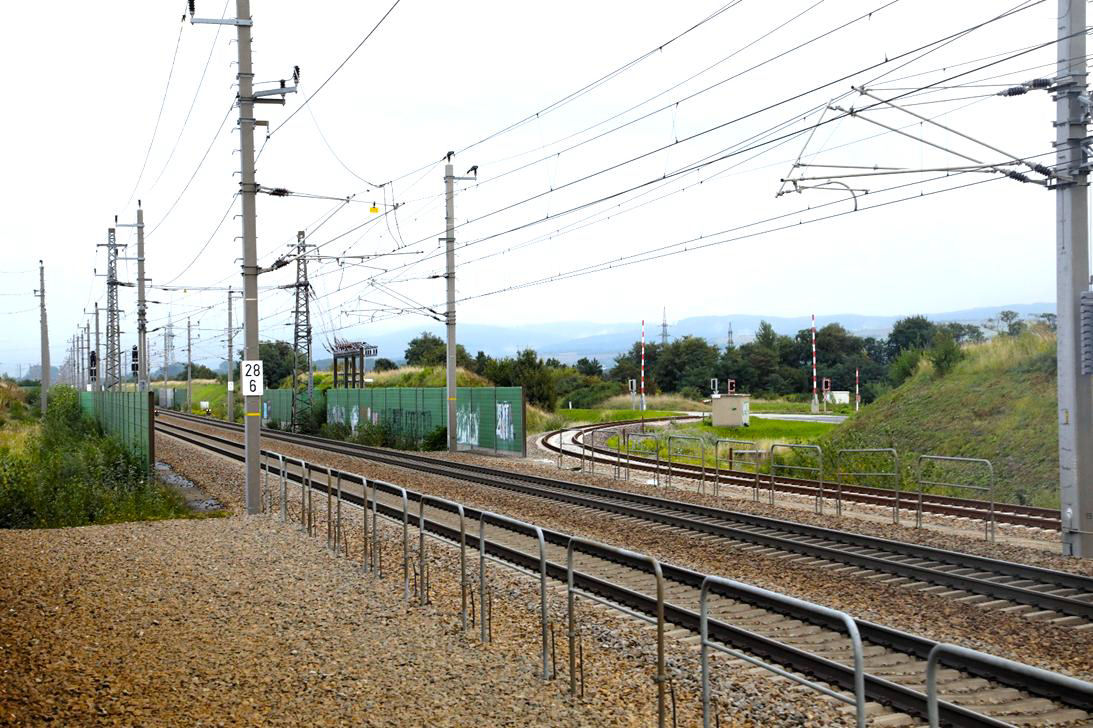
Arriving from Tulln to join the Neue Westbahn. Behind is the 'new' curve to access the stub of the old St Pölten line. New track for all on the train!
[© Iain Scotchman 2025]
The old line was dewired and retained for freight. An interesting feature was noted as we curled around the new connection as we suddenly picked up the electrification poles at an apparently random location but in reality, simply where the original route (now all but obliterated) came in from the east. In fact, on the return, eye attuned to the location, some small features like a different coloured tarmac strip across a road where there was a level crossing could be discerned. We trundled as far as some bushes just beyond the disused Michelhausen station, where the Neue Westbahn has severed the original route.
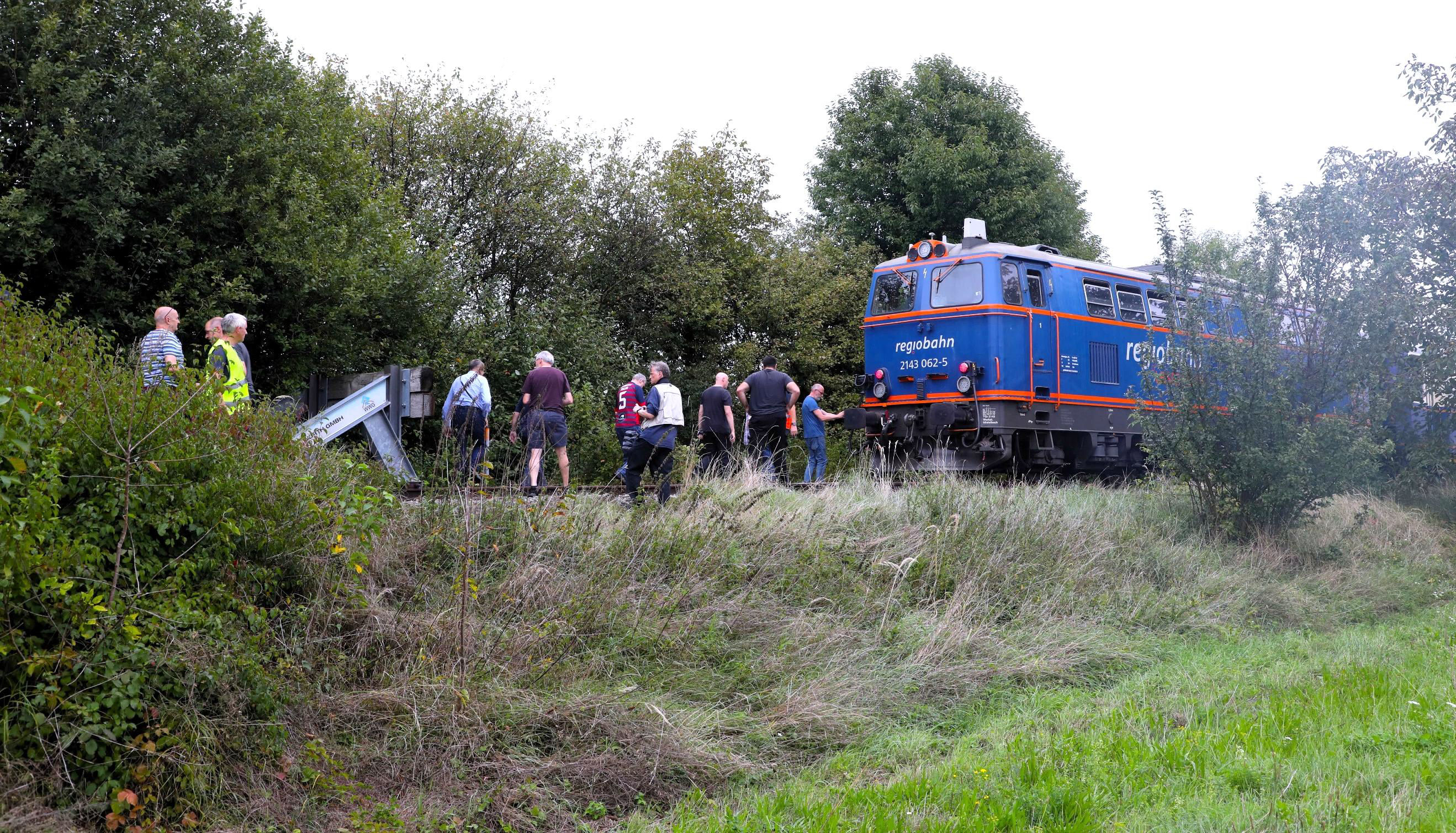
Beyond Michelhausen is the end of the old line to St Pölten, with the buffer stops; beyond the trackbed had been removed.
[© Iain Scotchman 2025]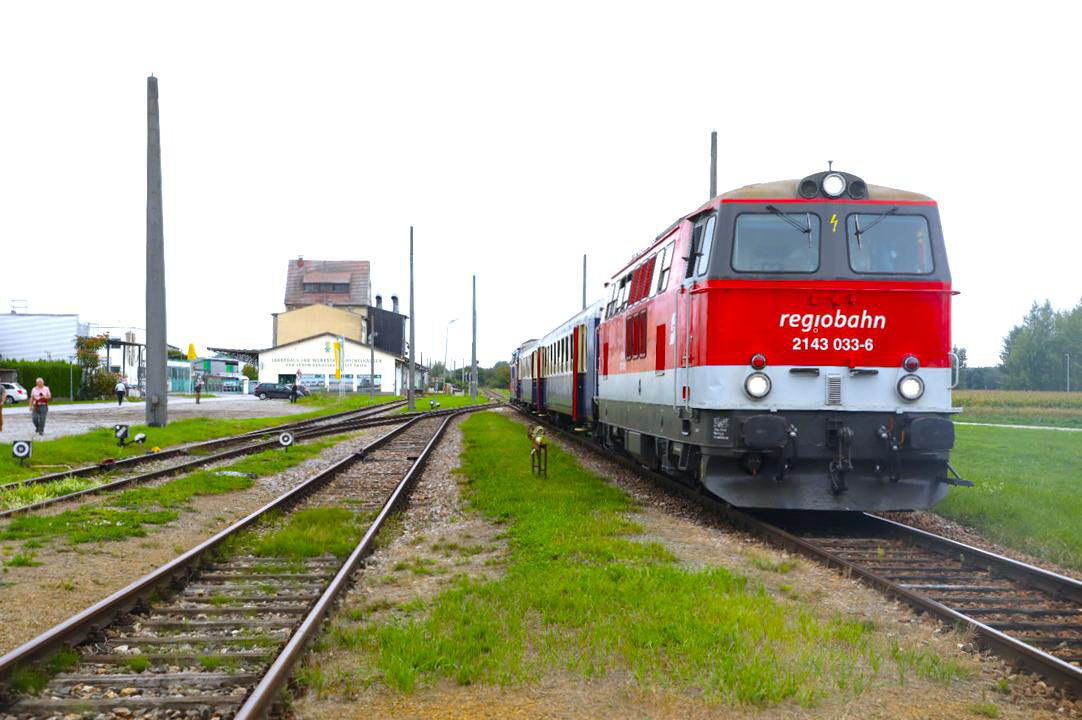
Our tour at Michelhausen station; disused but with sidings for a nearby industrial concern, the only source of traffic on the nearly 7km branch.
[© Iain Scotchman 2025]At the old station were sidings for a nearby industrial concern, the sole source of traffic on this almost 7km branch. All the way, people came out of their houses and preserved the occasion on their phones! We retraced our steps to Tullnerfeld, where the Passenger Information Screen declared us about 46 late. For pathing simplicity, we left 60 down and this time veered left around the Tulln Avoider (a relatively new line with some peak passenger services), before taking the right hander around the freight-only Absdorf-Hippersdorf Avoider (an earlier curve reinstated) at what seemed like full line speed. Finally, the train was pointed back to Korneuberg, rolling in 65 mins late at 19.17 in failing light!
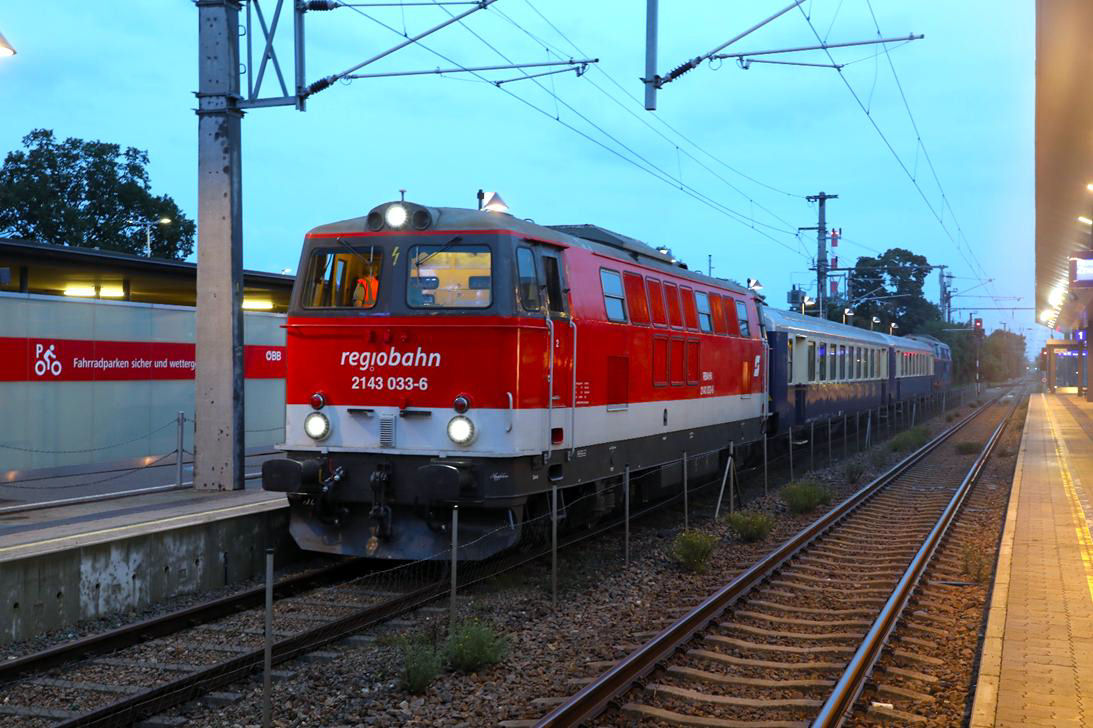
In failing light and with most passengers disembarked, our train awaits the signal at Korneuburg to return to its base at Ernstbrunn.
[© Iain Scotchman 2025]