Adam Turner's Manchester tours are always hugely popular, unsurprisingly this fixture sold out in only two hours. The plan was to visit historic or hidden features at or around the four historic principal Manchester stations: Piccadilly, Victoria, Central and Exchange. All except one had featured, to a greater or lesser extent, on previous tours but a visit to all in a day was not to be missed.
Despite the extreme wet and windy weather, 14 members assembled by the taxi rank on Fairfield Street, kitted out with the mandatory Hi-Viz vests, hard hats, boots and torches. The equipment specification suggested a promising itinerary. First, the bad news. As a result of the ongoing battering from Storm Claudia that day, the National Trust had understandably decided that it would be unsuitable for us to visit the currently undeveloped part of Castlefield Viaduct at the throat of the former Central Station. We could see rail and Metrolink service suspensions being progressively posted as the day progressed, due to deteriorating weather, and the suggestion of spending more time under cover at the other locations instead was decidedly more attractive. We can return to Castlefield another time.
Our NR hosts, Toby and Mike, welcomed us to NR reception at Piccadilly for our safety briefing. Despite many visits, I had never previously noticed this entrance tucked away on the lower mezzanine floor and dominated by an enormous original girder. Piccadilly was substantially refurbished in the late 1990s, with new expanded facilities opening in 2002 for the Commonwealth Games. Much of the previous 1960s development was replaced with a new expanded concourse fitted around the base of the existing tower block. Manchester Piccadilly Signalling Control Centre remains on the first floor of the tower.
Our route up to the concourse roof was via an external service door on the London Road side of the building. Steel steps led to two plant rooms, where there was a considerable amount of ventilation and refrigeration equipment necessary to support the retail units on the floors below. Rental income from retail units provides a valuable source of income for NR. From a walkway outside the plant rooms, we were able to look out at a rather unusual view across the wet concourse and trainshed roof. Back inside, a convenient route was via a closed retail unit, which had previously been a TGI Fridays. Seemingly out of use for some years but still fitted out and with menus still on the tables, covered in dust.
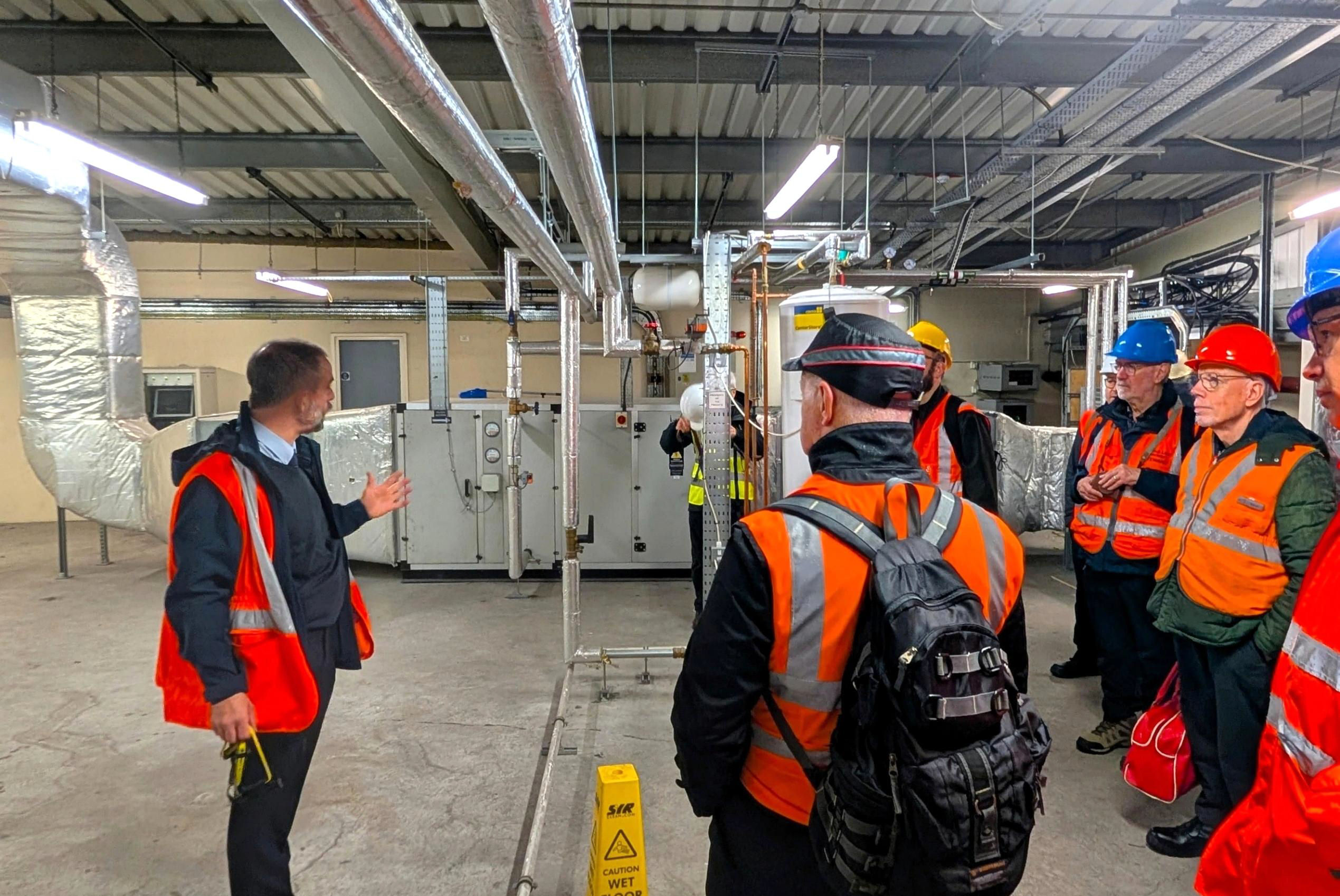
In the service area maze above the concourse at Piccadilly.
[© John Hampson 2025]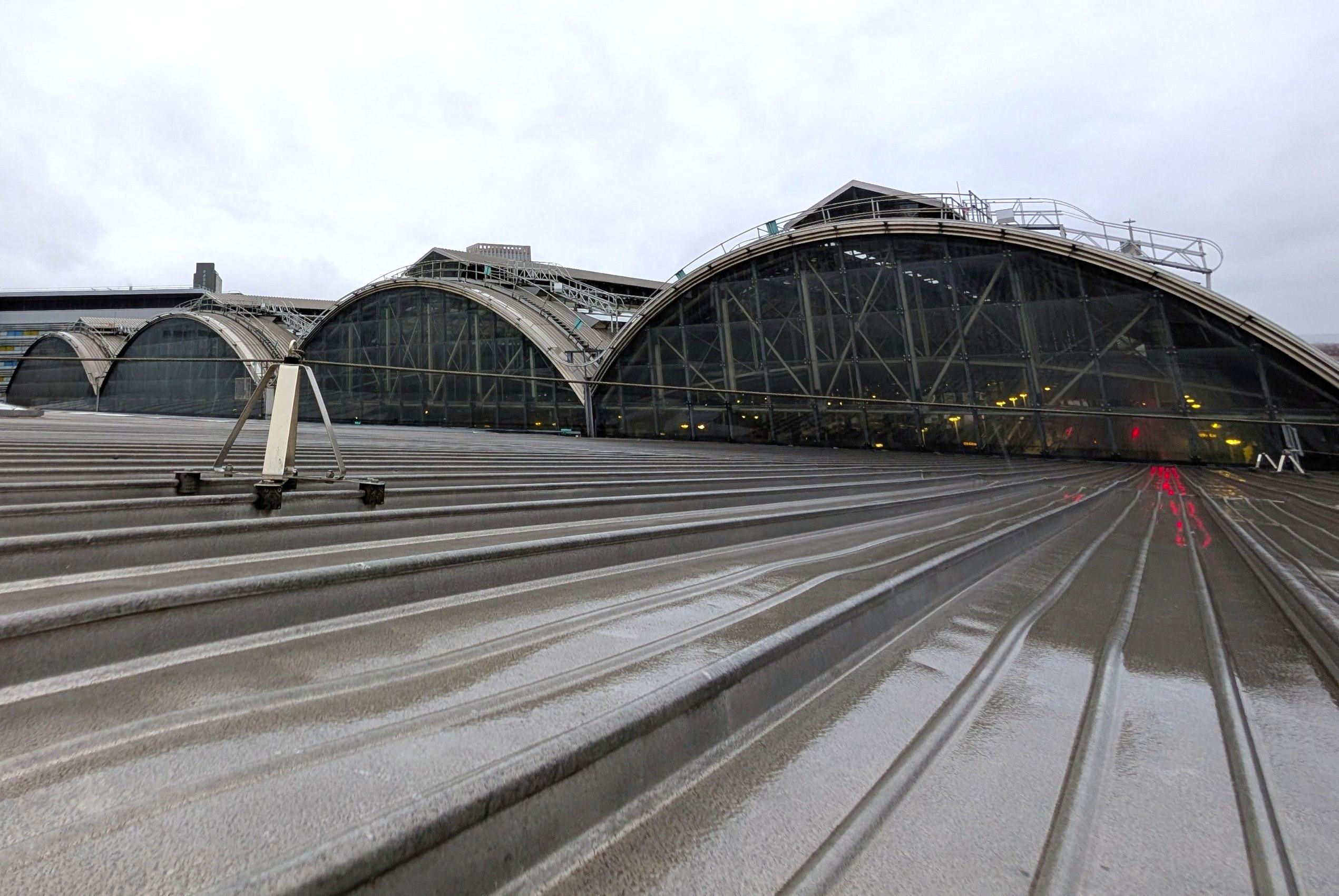
An unusual view of Manchester Piccadilly trainshed roof, the concourse is this end.
[© John Hampson 2025]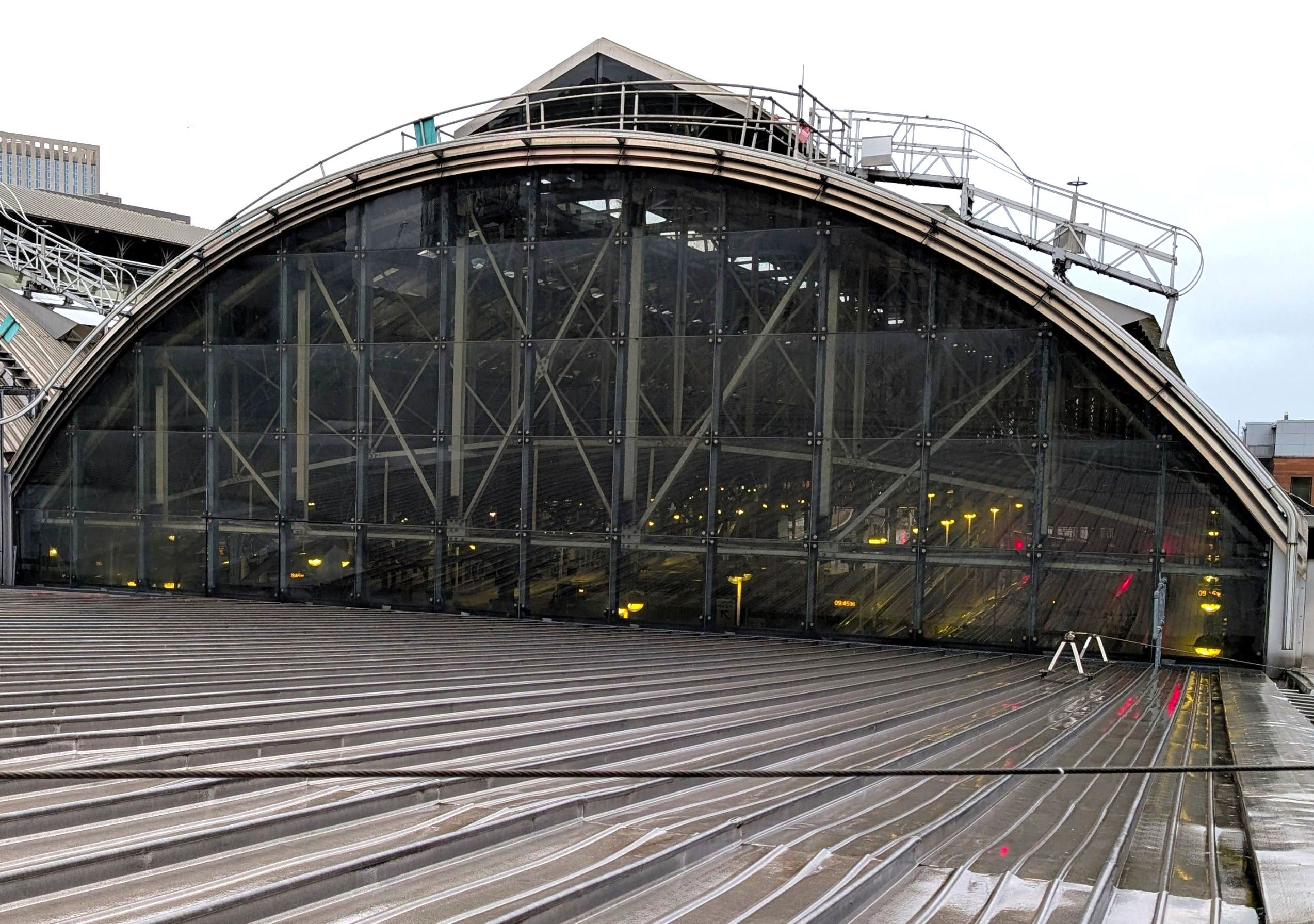
A closer view of the platforms through the trainshed roof,
[© John Hampson 2025]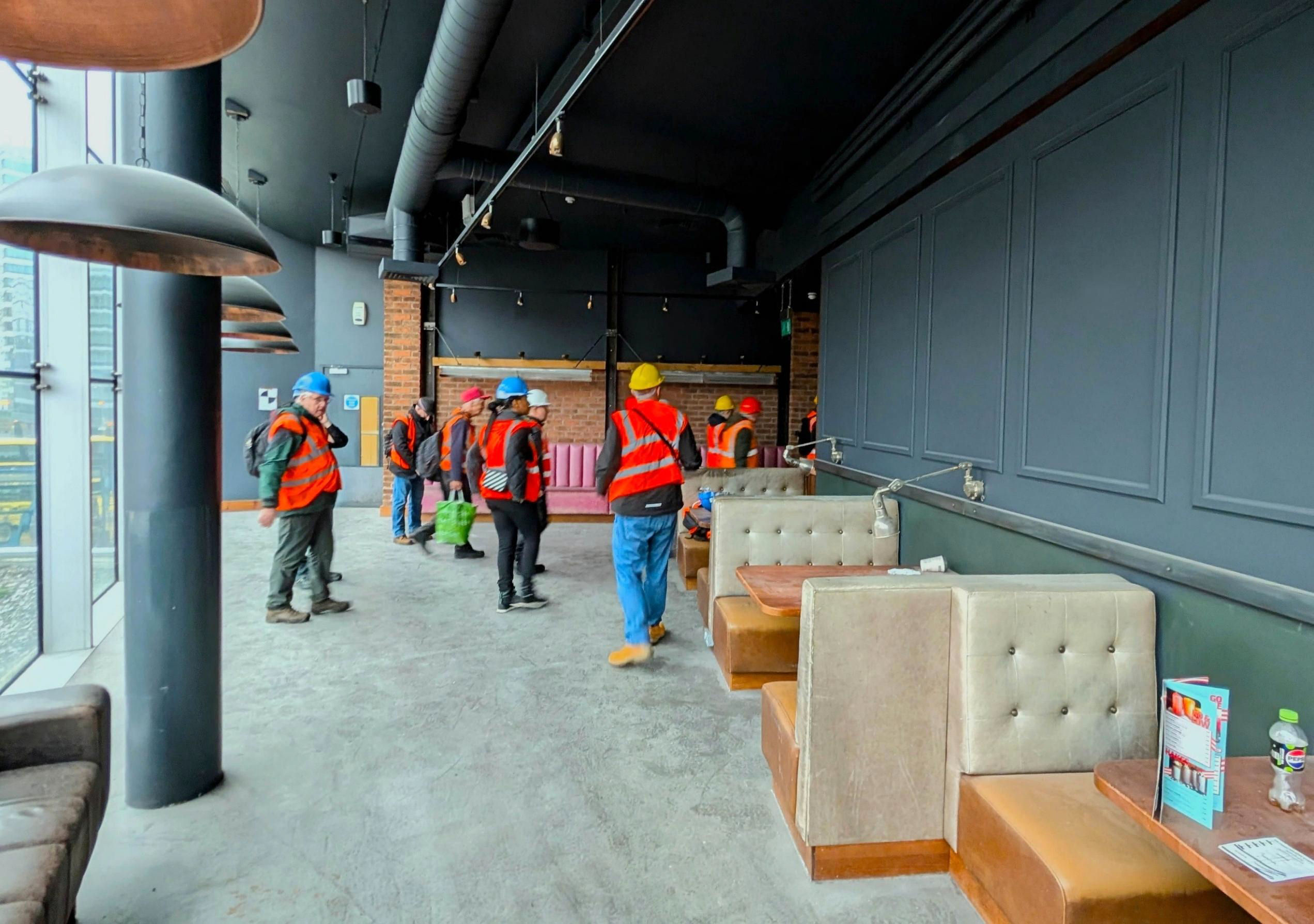
TGI Friday's closed suddenly in May 2023 due to large loses. It should have been stripped out but was abandoned. Menu bottom right.
[© John Hampson 2025]Piccadilly undercroft was our next target. Accessed through large iron gates on Fairfield Street, this is a vast area extending from Travis Street in the south to the Metrolink stop in the north and is largely under the station throat rather than the platformed area. It is currently undeveloped although it may have considerable potential due to the adjacent Mayfield station regeneration area. There is no lighting, and the floors are damp and uneven. In the past though, the arches would have been a busy transshipment area. Adam was able to show us fascinating archive diagrams which identified the previous function of some of the arches. One area was specifically for handling bananas, another for beer and another for cotton. The old plans showed many rail lines and turntables and there was a little evidence of these.
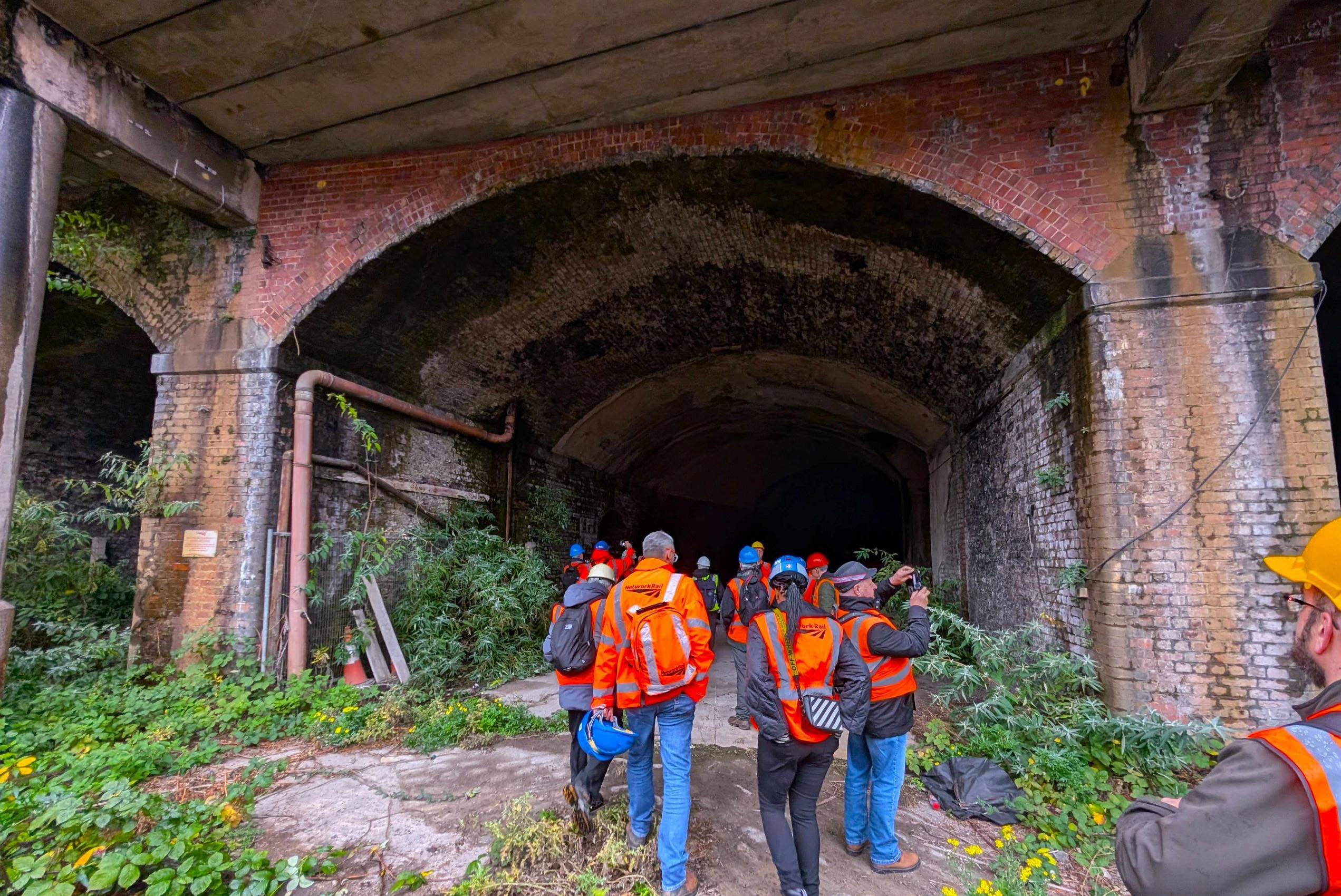
Our members enter Piccadilly undercroft, accessed from the gates in Fairfield Street (P13 & 14 are above). See also e-BLN 1446.1043.
[© John Hampson 2025]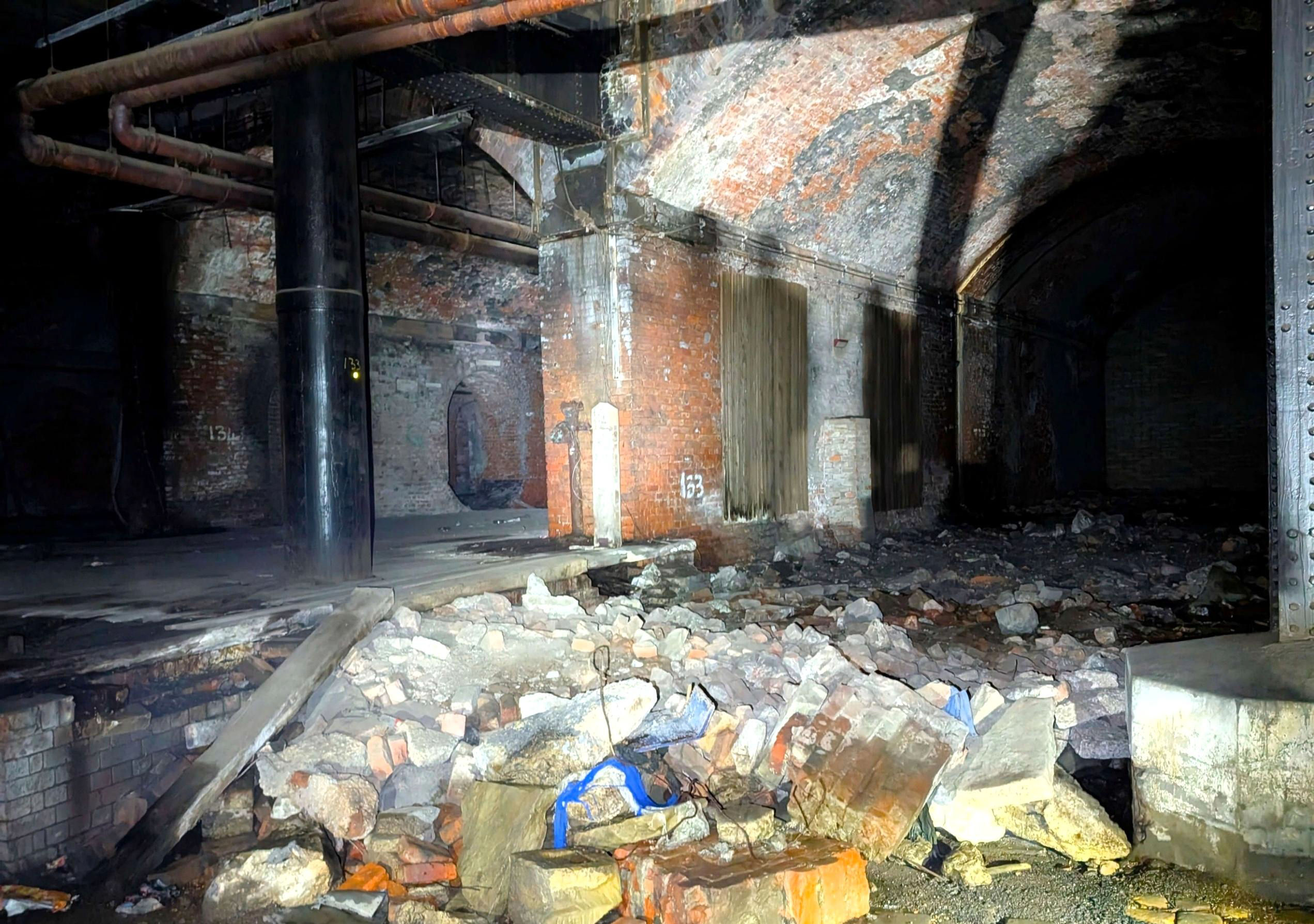
Part of Piccadilly undercroft.
[© John Hampson 2025]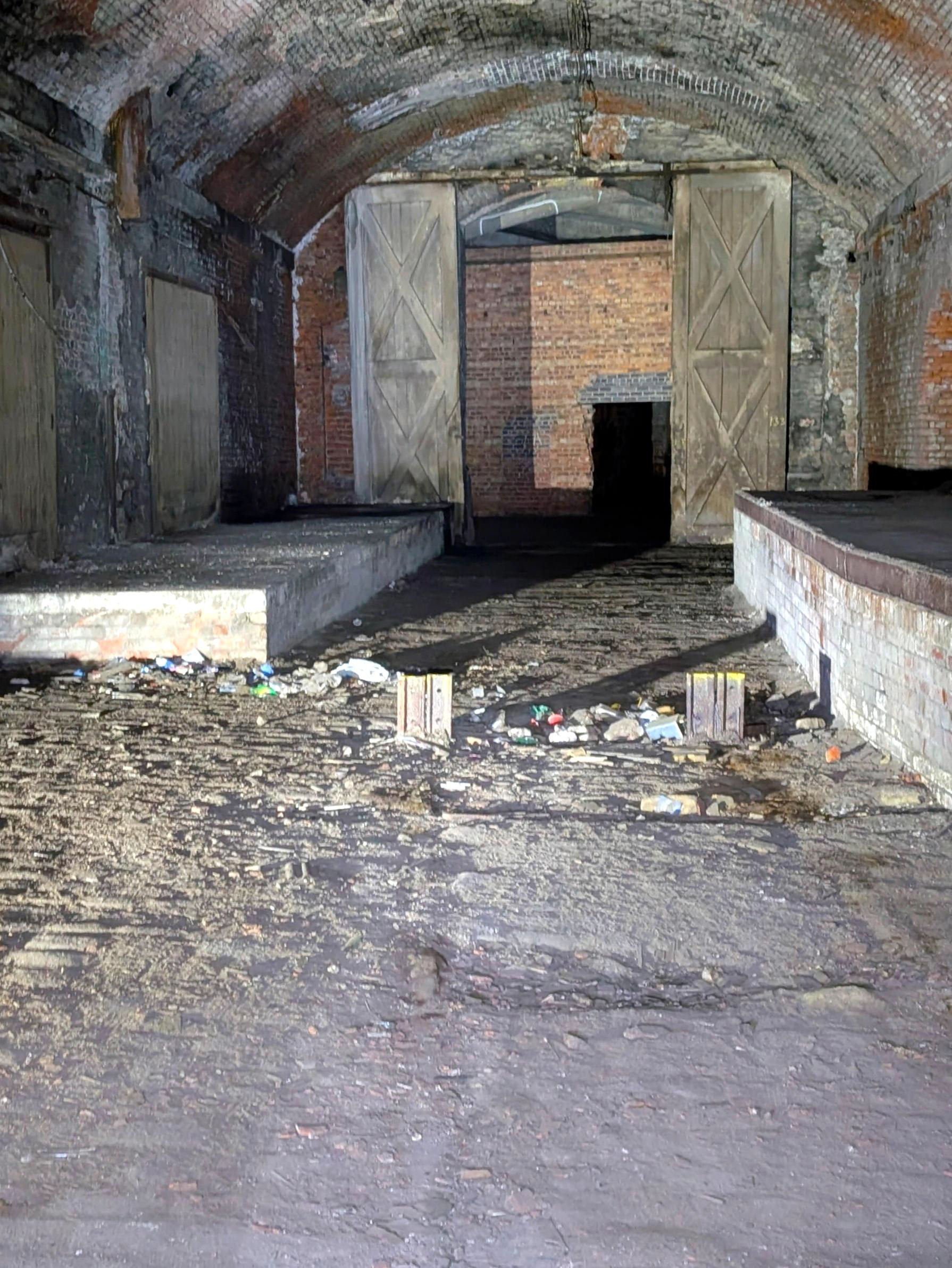
Part of Piccadilly undercroft.
[© John Hampson 2025]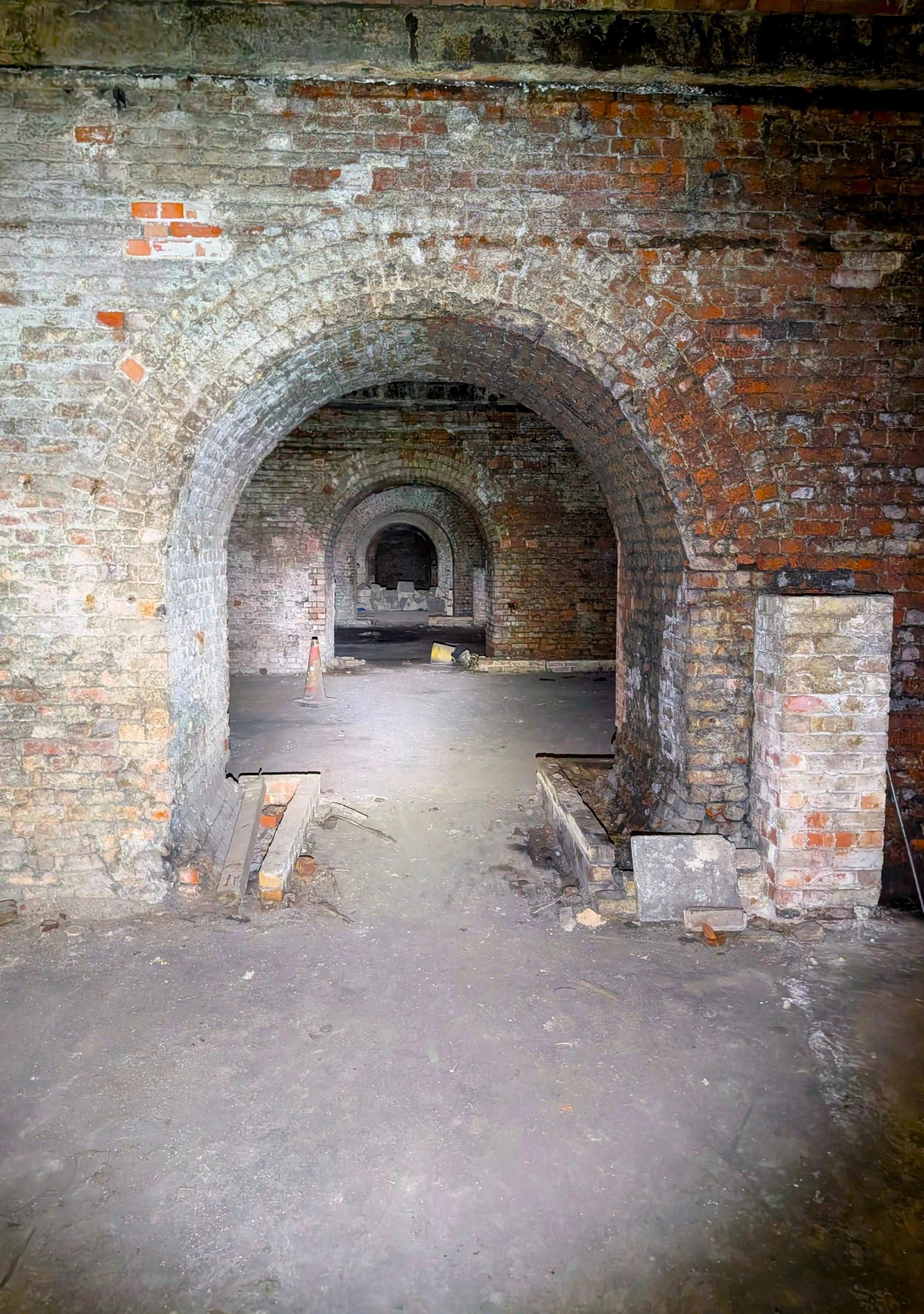
Part of Piccadilly undercroft.
[© John Hampson 2025]We passed to the north side of the undercroft via a door off the Metrolink platform into a car park area, revealing brick pointed gothic arches and, adjacent to Boad Street, maroon iron columns. The final point of call at Piccadilly was the old stairway between Store Street and the station approach. Toby just happened to have the key and thought we might be interested… Although out of service for many years and blocked up at the top, the original stairway and its balustrade still exists. We were able to climb right to the top in true BLS fashion. Several members of the group remembered using this route decades ago.
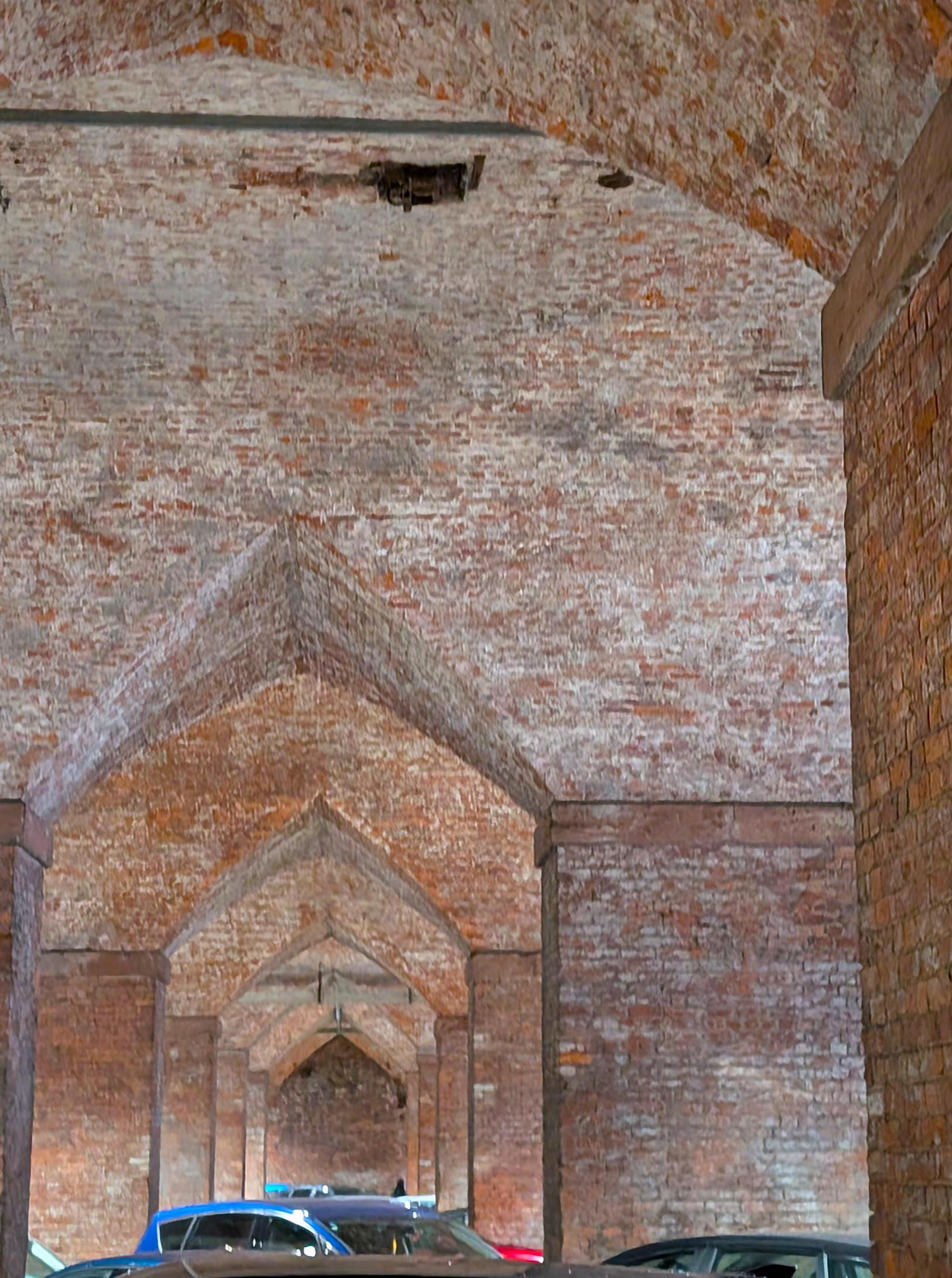
The separate car park on the north side for permit holders accessed from Boad St / Sheffield St.
[© John Hampson 2025]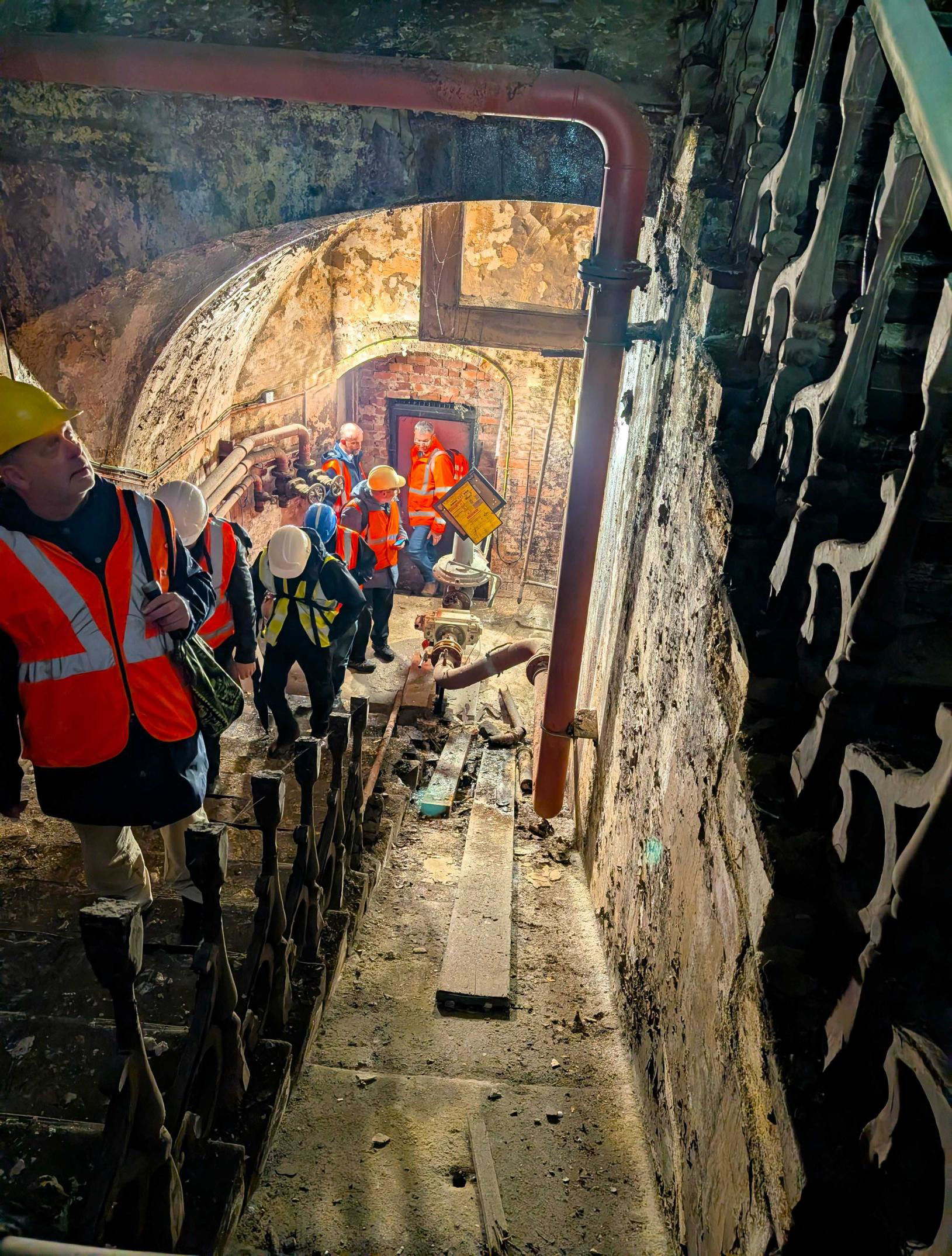
The former public stairs (minus banister on lower section) from Store St (the other side
of that red door) to the station approach - blocked at the top; older members will recall using them decades ago.
[© John Hampson 2025]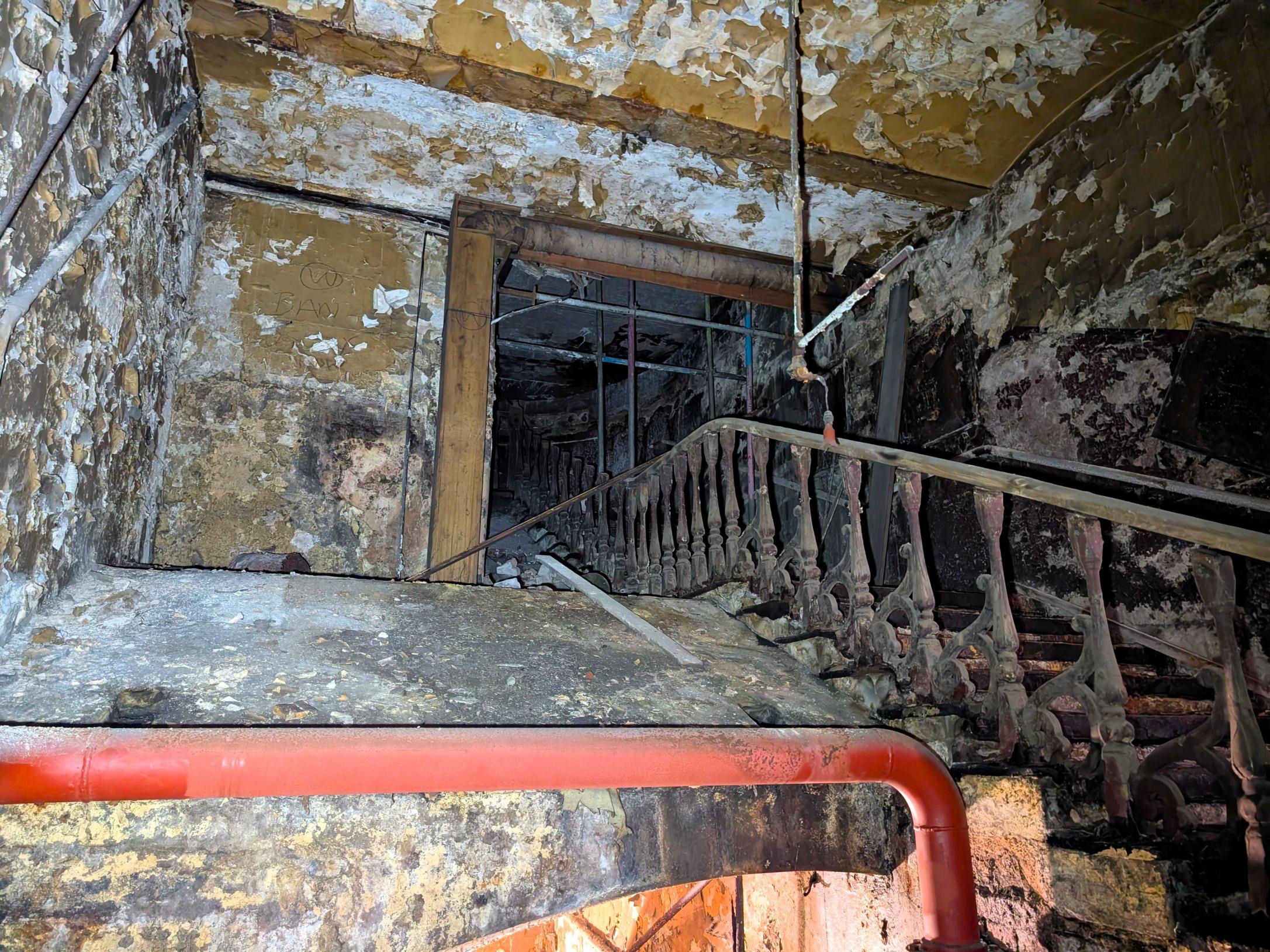
Looking up the former public stairs from Store St.
[© John Hampson 2025]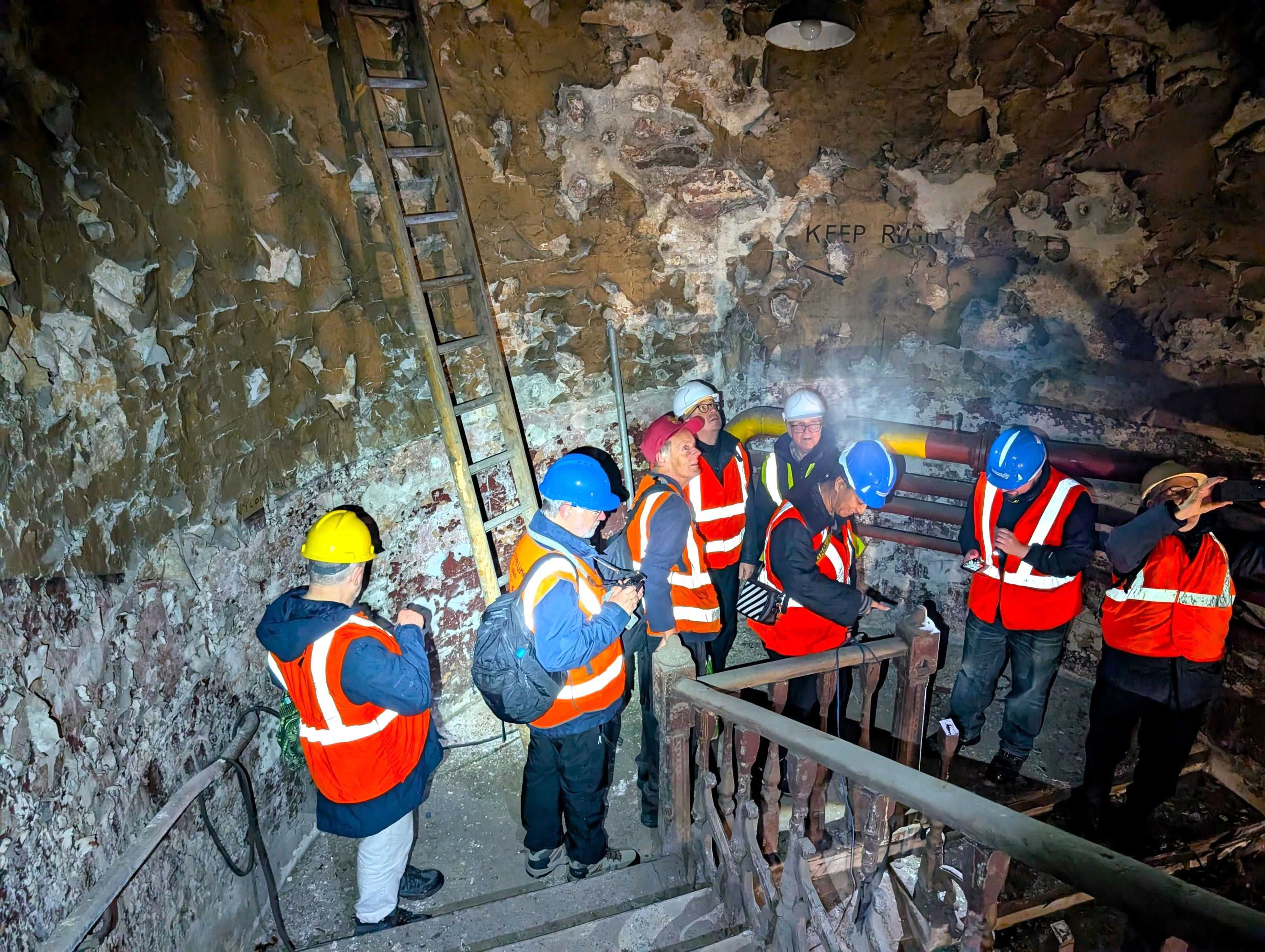
Part of the group gather on the landing on the former public stairs from Store St.
[© John Hampson 2025]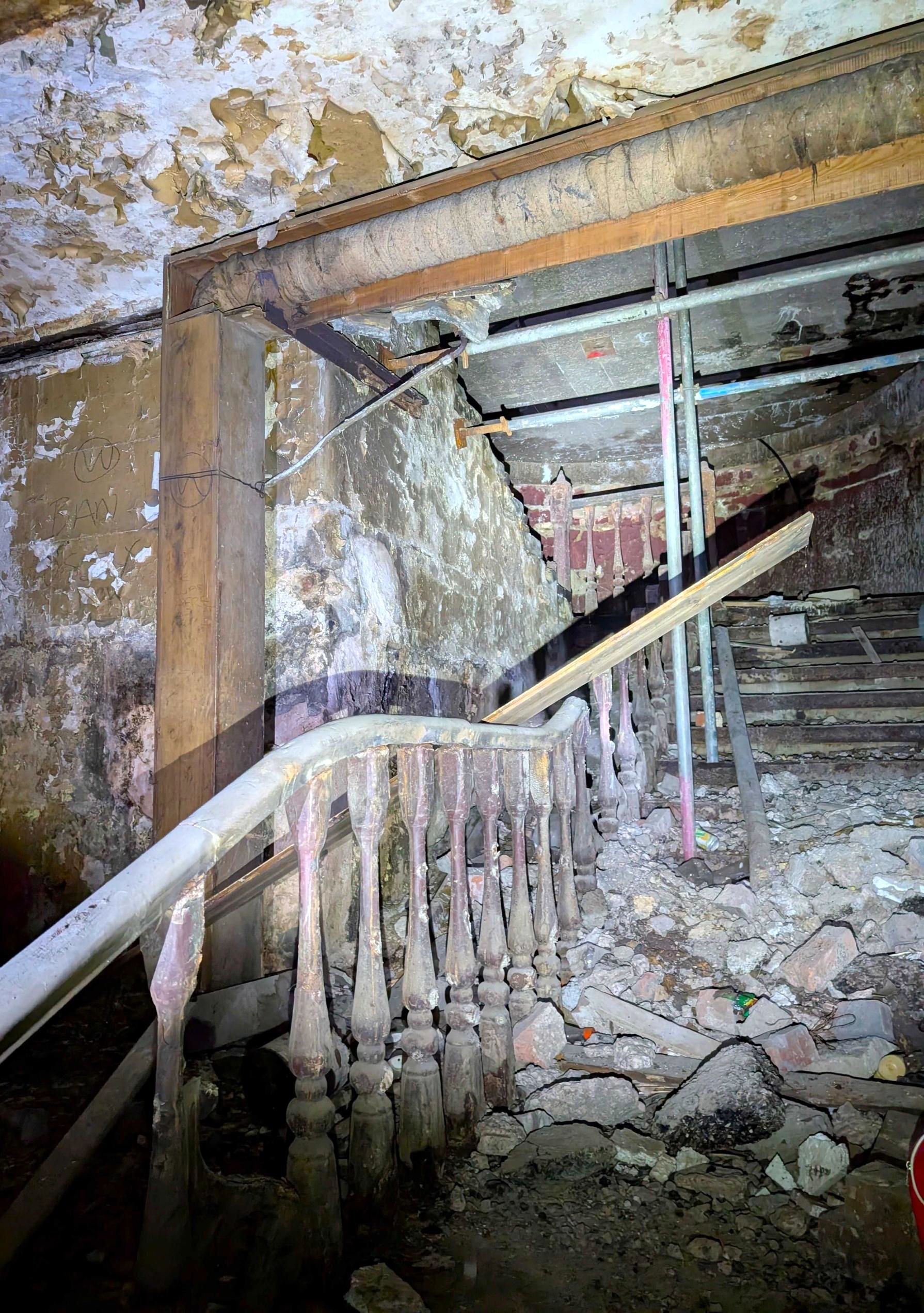
Looking towards the top of the former public stairs from Store St which are blocked at the top.
[© John Hampson 2025]Since we were no longer going to Castlefield Viaduct, the most direct route to Victoria was on a Bury tram. The destination displays at the stop showed Bury but the display on the tram showed Whitefield. A fallen tree on the line meant that trams were turning back at Whitefield via the rare crossover. Not one that I need though. I had a Manchester Central Zone (MCZ) rail ticket which includes Metrolink travel in Central Manchester but members from further afield tested the Metrolink contactless tap in and tap out functionality, which now accounts for the great majority of Metrolink ticket sales. We also later noticed that trams were turning back on the single track at Newton Heath due to problems beyond.
Victoria Offices building was constructed by the Lancashire & Yorkshire Railway in 1909, during the final enlargement of the station. Although a Grade II listed building, it has been vacant for several years and is deteriorating as it is unheated. NR had planned to refurbish the building to allow staff to be transferred from the Square One complex east of Piccadilly, as this was within the footprint of the HS2 development. Accordingly, preliminary work started last year on a 'soft demolition' of modern partitions and fittings to reveal the historic features which would need to be conserved. Unfortunately, earlier this year plans changed; NR now propose to stay at Square One. Work on developing Victoria Offices has ceased, pending the identification of a new use for the building which remains in its stripped out state.
We entered the building via a service door into the southern stairwell where a new lift has been installed. The first floor only extends across the southern part of the building to allow for the additional height of the foyer by the booking office. As modern partitions have been removed, many of the residual rooms are large with substantial transverse girders, earning the building its nickname as 'The battleship'. Adam had brought fascinating archive documents showing the historical function of some of the rooms.
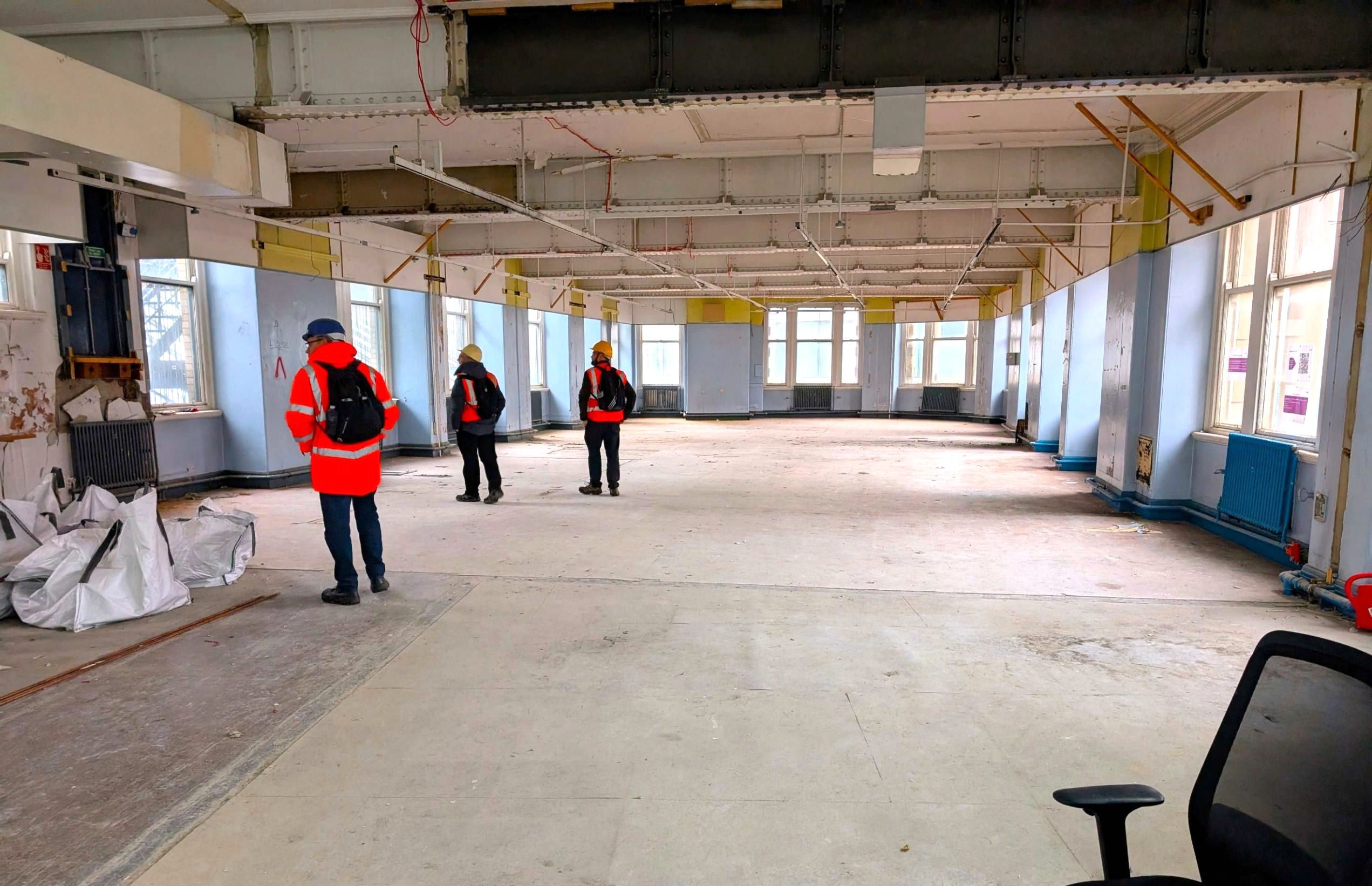
We can see why it was called 'the Battleship', rennovation started but has been paused; this is the southeast end of the building.
[© John Hampson 2025]Being cautious to avoid patches of slippery moss in the wet weather, we were able to walk to the northern end of the roof and inspect the mechanism of the now electric clock that is visible from Hunts Bank. There was an excellent panorama across the city centre and the lines converging at Deal St Jn. There had been a rifle range at the northern end of the roof in times past but no trace remained.
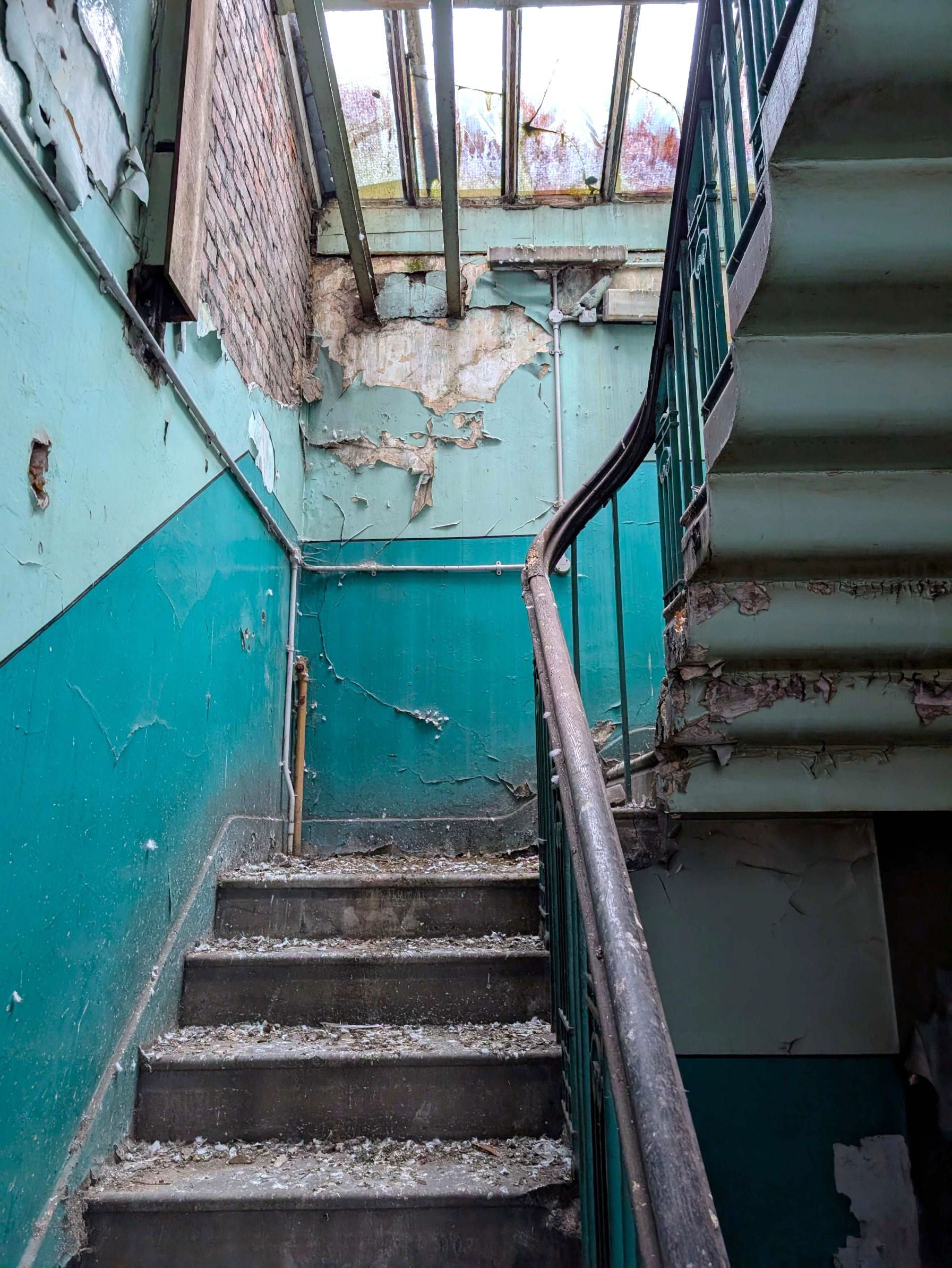
The top of the another staircase, this one is to access the roof of Manchester Victoria offices.
[© John Hampson 2025]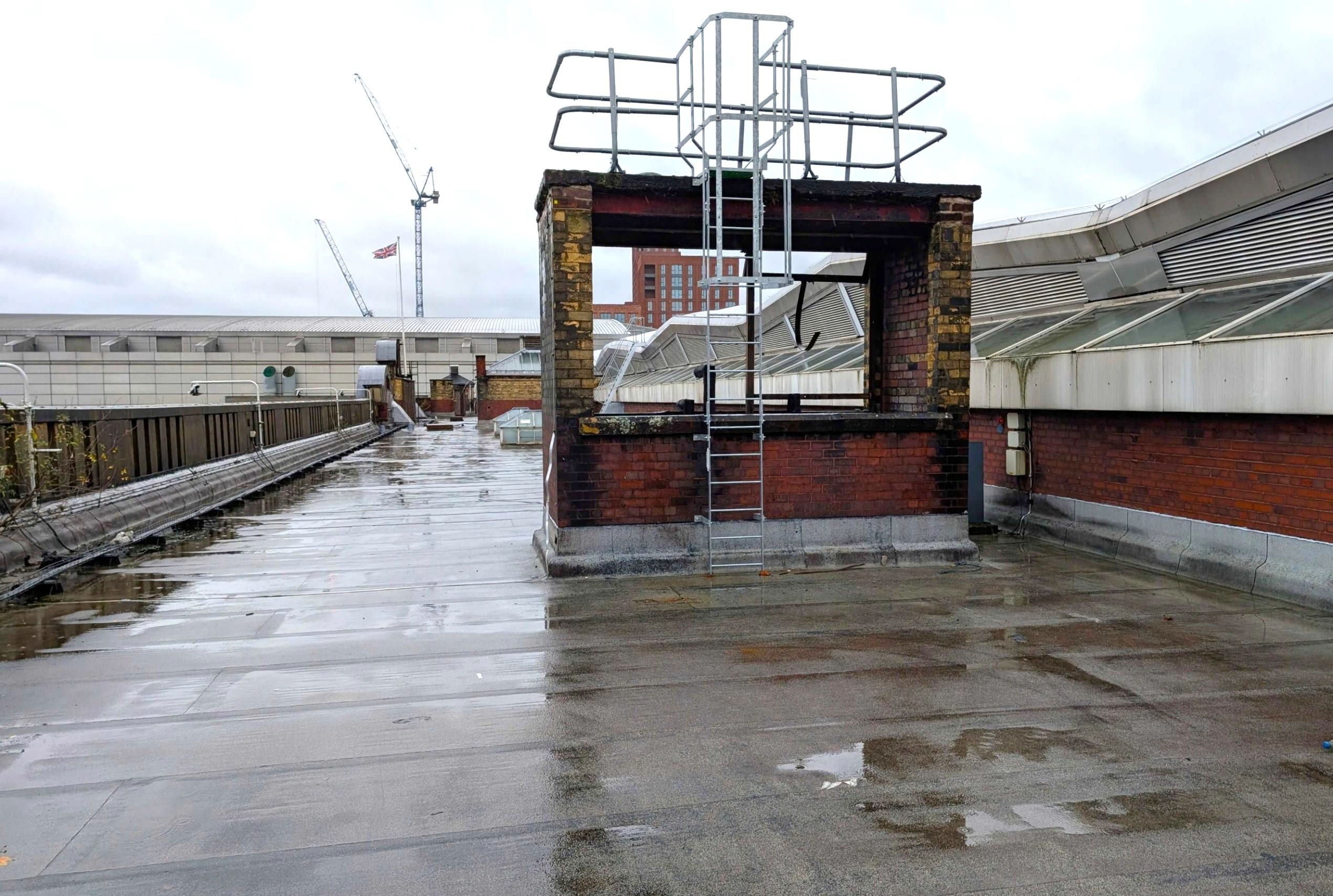
The rather wet roof of Manchester Victoria offices looking northwest; the clock is the taller structure on the parapet ahead left of the flagpole base.
[© John Hampson 2025]One of the largest rooms on the third floor was home to the Lancashire & Yorkshire Railway Signalling School. This featured a model railway connected to actual signalling equipment built by apprentices at Horwich Works in 1912 for signalling staff training and adapted over 80 years to include developments in signalling procedure and technology. In 1995, the entire model railway was donated to the National Railway Museum, where it has been restored and remains operational. Indeed, it is claimed to be the world's oldest complete working model railway. Some of the group remembered visiting the Signalling School when the model railway was operational. A video:
https://tinyurl.com/2vrxjy54 (1min 43sec).
At the northern end of the third floor were a number of smaller rooms which had originally been a residential area. The strip out had revealed period wallpaper when suspended ceilings were removed and this was hopefully to be conserved in accordance with the listed status. Similarly, impressive original glazed tiles in the stairwells had been revealed along with heritage ceramic fittings in the washrooms.
Next, the second floor, which extends the length of the building. We could look down from the corridor onto the concourse and Metrolink platforms below. Many of the rooms were fitted with a ducted ventilation system, which was state of the art when installed in the early 1900s.
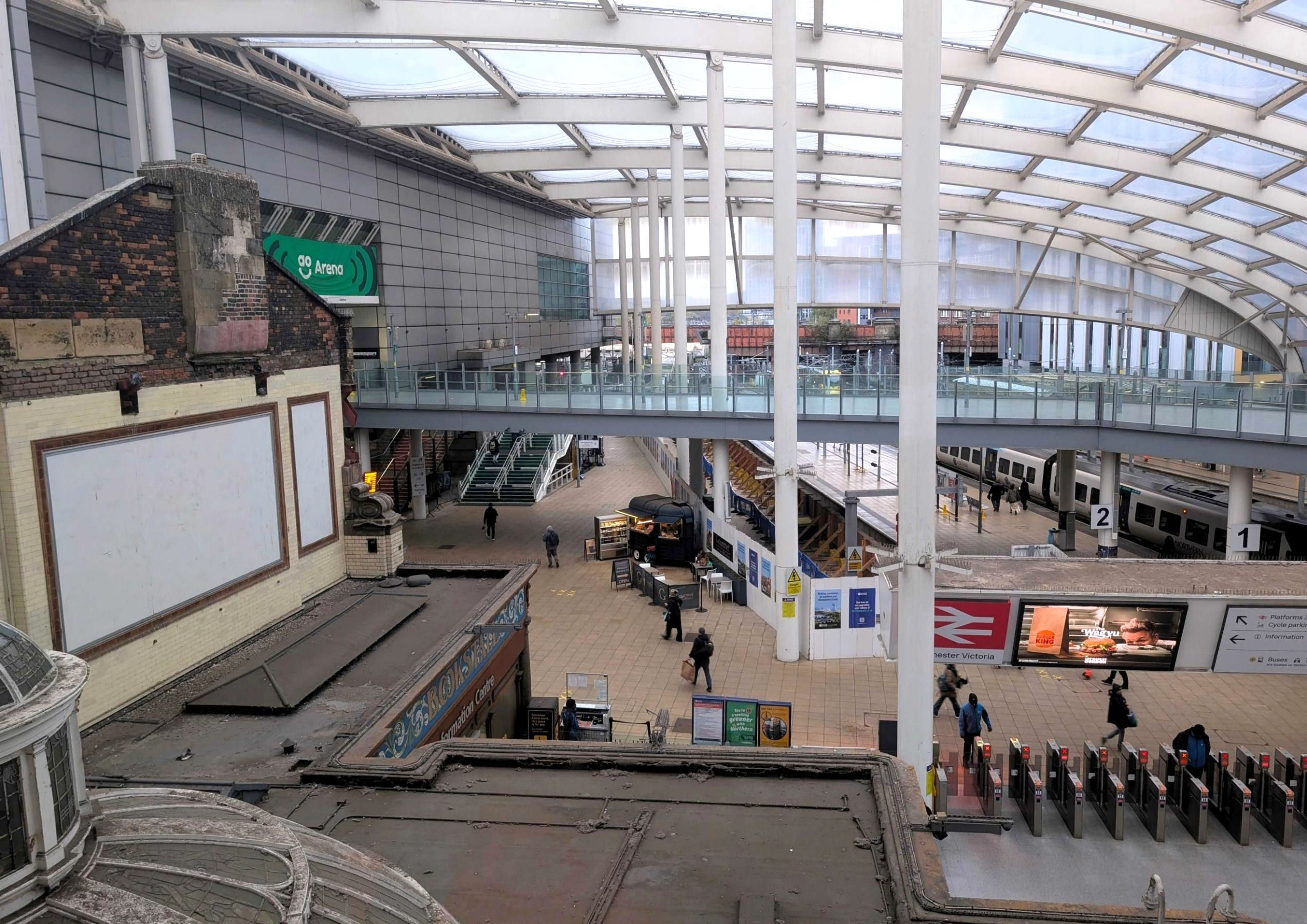
The concourse from the offices; centre left, on the original wall, are two rusty remains of the original station girders where they were cut off.
[© John Hampson 2025]After another safety briefing, we descended to the basement of the building. This area was not proposed to be refurbished as part of the NR scheme, so has not been stripped out. There is no fixed lighting but there was temporary lighting. The British Railways Staff Association Club, known colloquially as Vic Bars, occupied the upper basement floor at the southern end of the building. The club closed in 1992 and has been derelict since. A former entrance on the opposite side of Victoria Station Approach is now occupied by a hairdresser. The garish 1970s décor and features remain, including a DJ booth, bar area with parquet flooring throughout and a nicotine-stained ceiling (how tasteful).
Descending again, we reached the lower basement level, much of which consists of a series of arches under Victoria Station Approach which is itself a viaduct. The 1909 enlargement of the station involved culverting and building across the River Irk and these arches straddled the original sandstone river bank. We found the remains of a 'dumb waiter' and a staircase heading up which was blocked at the top.
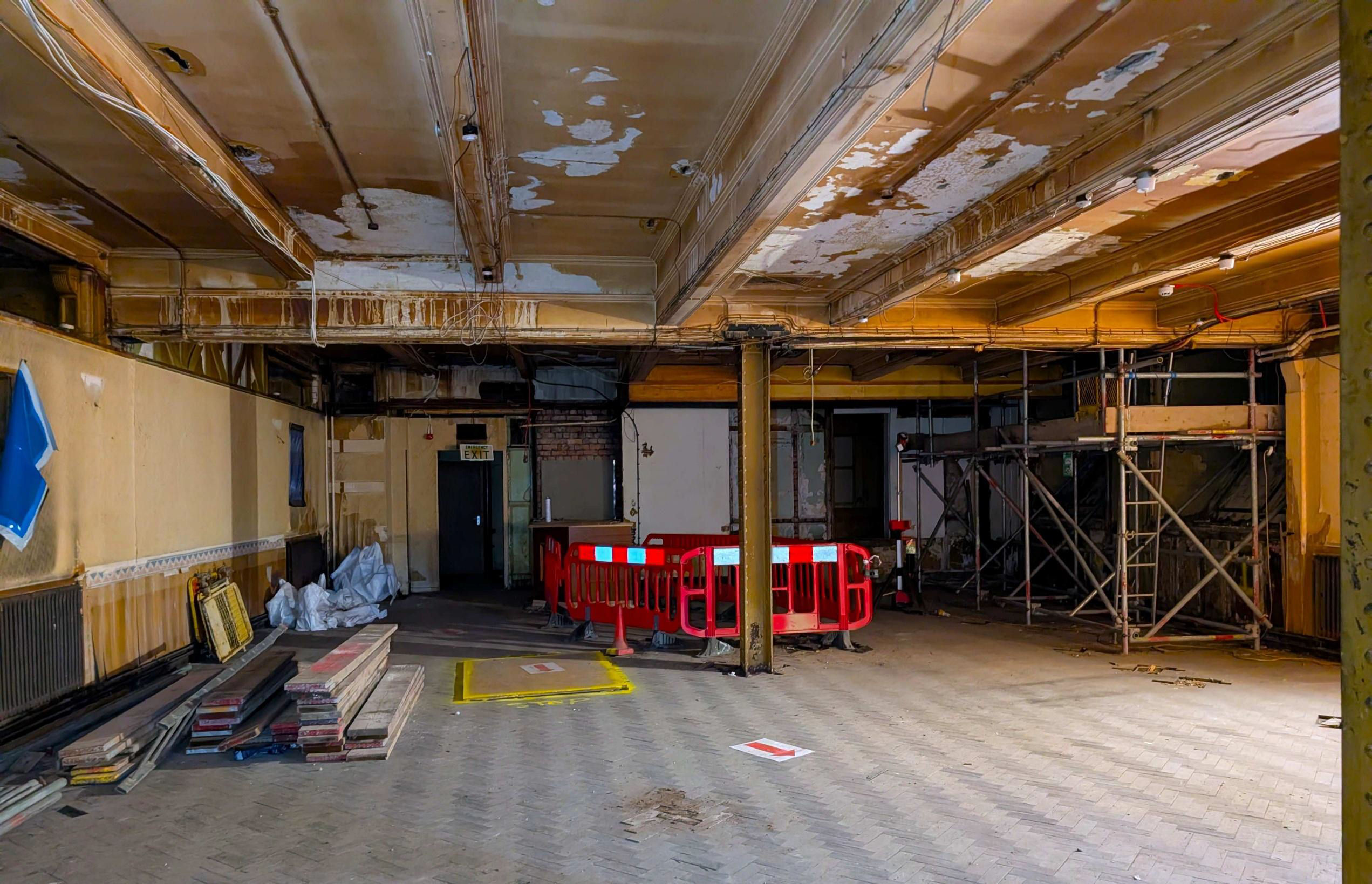
Part of the basement, note the parquet flooring, again work (on electrics for the new offices) had been paused.
[© John Hampson 2025]Moving northwards, a steel door led us onto the bridge over the River Irk. Although completely enclosed, we were able to look down onto (and hear the roar of) the very fast-flowing river below. The hatch is normally sealed but had been opened for access to scaffolding for an inspection of the bridge and had not been resealed yet - perfect timing! Over the doorways at either end of the bridge was historic but incomplete lettering, indicating past commercial use of the arches beneath Victoria Station Approach. One arch is thought to have 'bottling stores' and another arch 'John Brown & Co' (understood to be an historic Manchester based bottle manufacturer) - the bridge is now only used as a service tunnel.
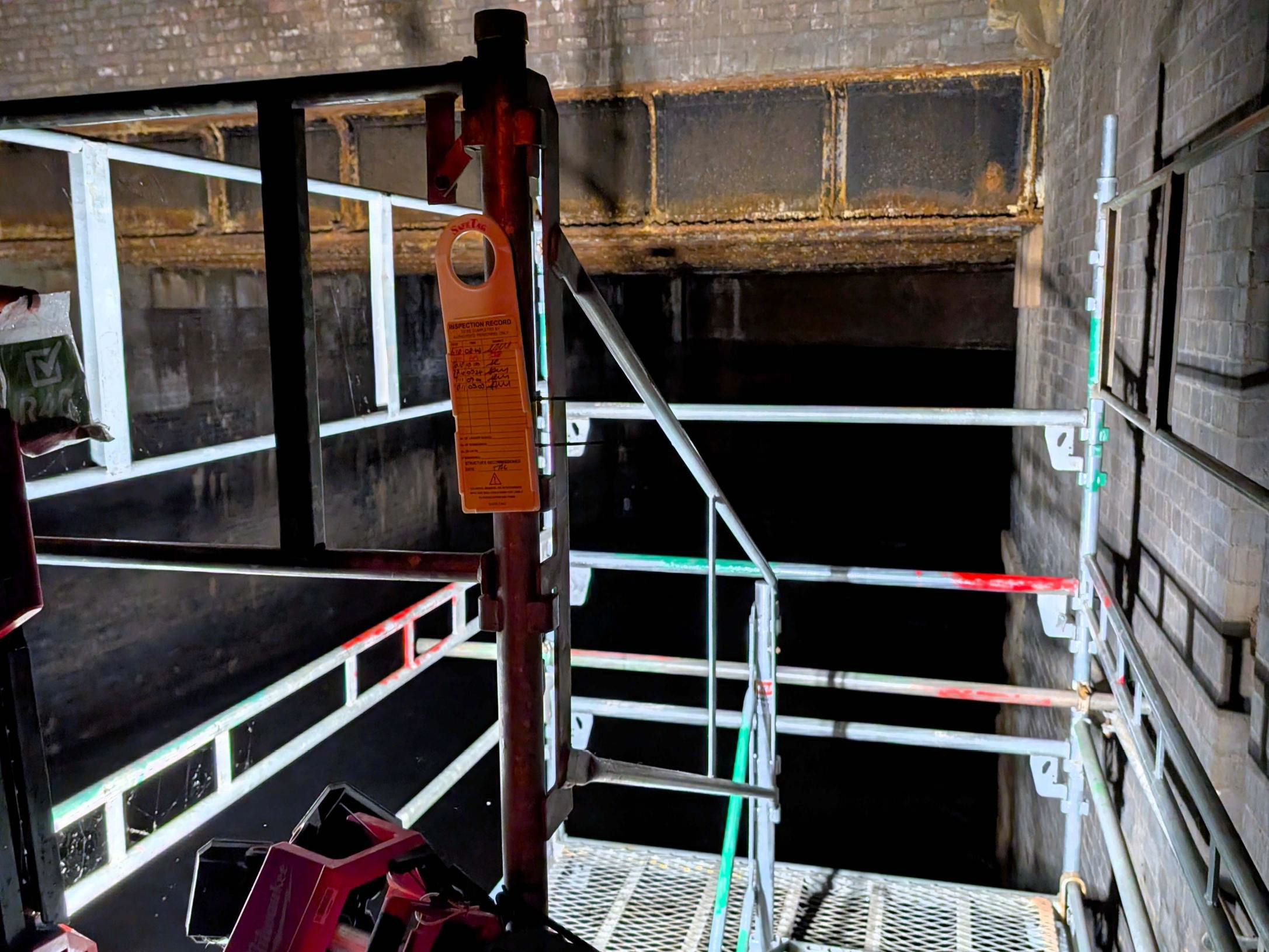
Through the vertical, normally sealed, hatch looking down at the River Irk underneath Victoria (the roar was impressive).
[© John Hampson 2025]Beyond the bridge, we emerged into daylight in Walkers Croft. Originally a street alongside the River Irk before the station was extended, the covered area is gated (how irksome) and extends under the concourse. Could there have ever been access to the concourse from here? If so, no evidence remains.
Our final visit was to Exchange undercroft. The station CP 5 May 1969 (along with Manchester Central) but remained open for newspaper traffic. The last newspaper trains ran on the night of 9-10 Jul 1988 and were the final dedicated such trains. No surface features remain; the track was lifted in 1993 with Victoria remodelling and the footbridge was finally removed in 2014. The curved former cab road is now a service road to the new development on the site. Original retaining walls and a bridge to one of the former platform lines still stand. The site of Exchange is in the City of Salford rather than Manchester; the boundary is the River Irwell and a crest featuring elements of the City of Salford coat of arms has been restored over an archway in Greengate. Perhaps it should have been 'Salford Exchange' after all‽
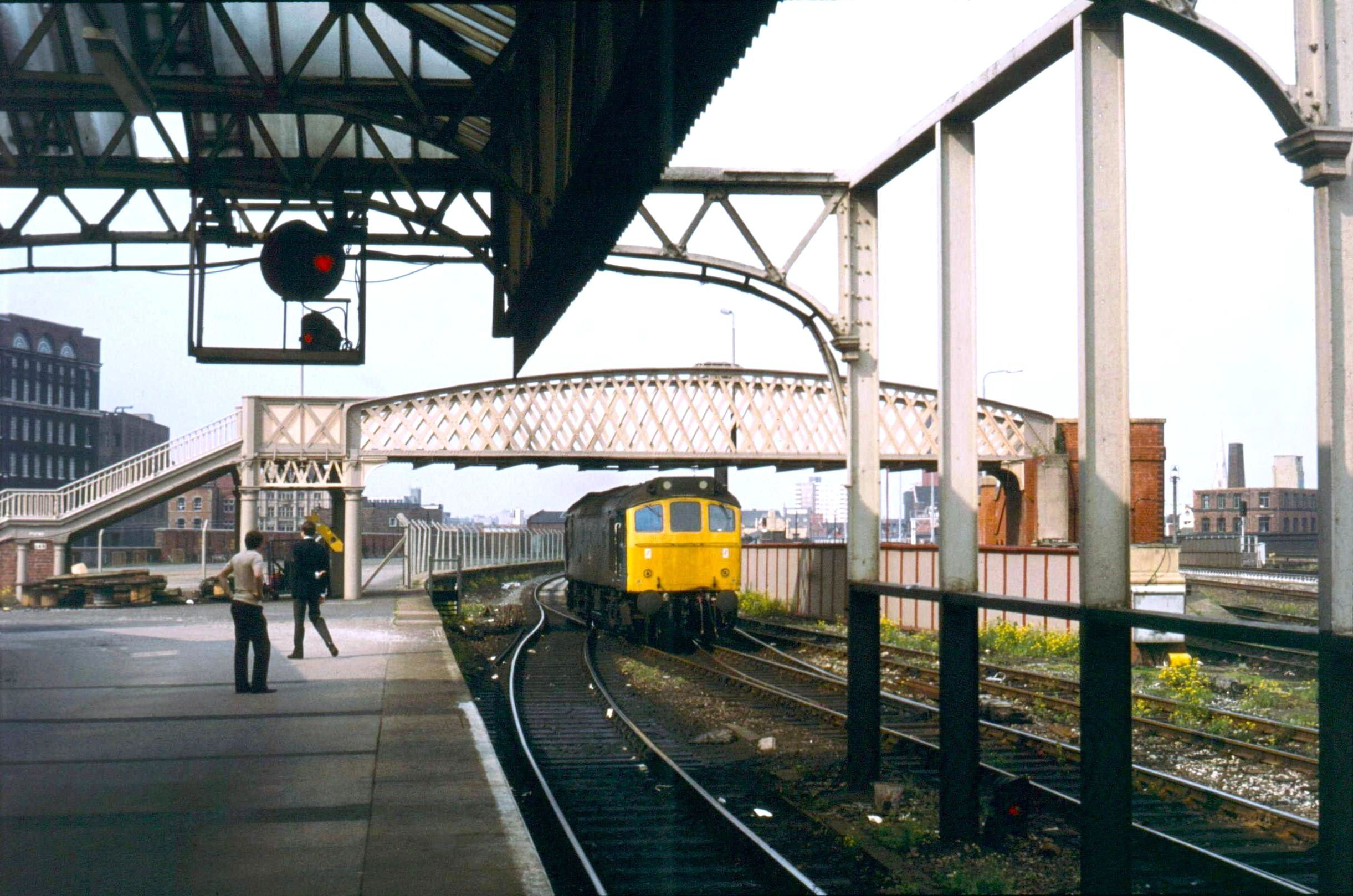
From Manchester Exchange southweast towards Salford (now Central) on 18 Jun 1983, that footbridge survived until 2014
[© Angus McDougall 1983]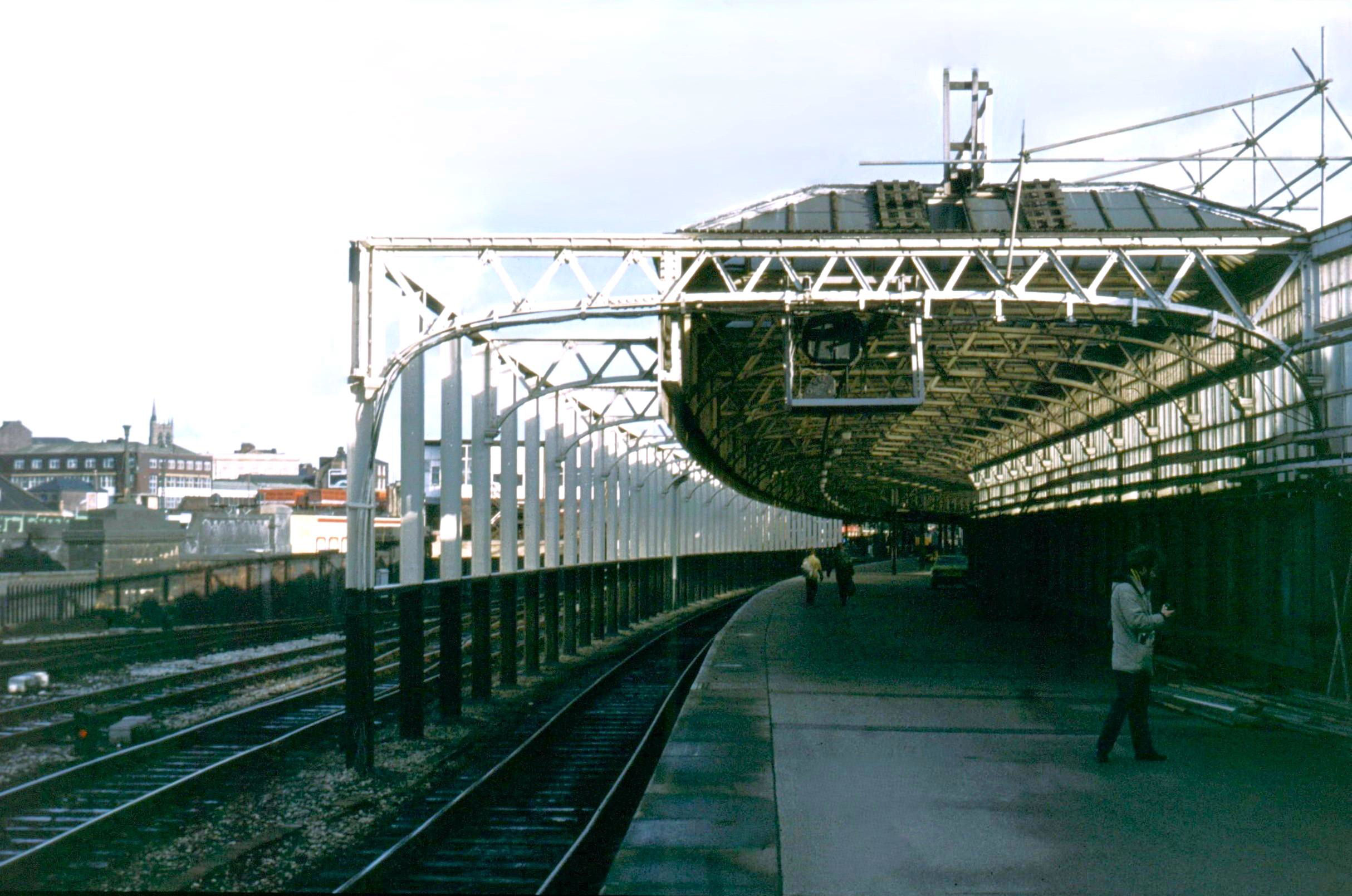
Exchange looking towards Victoria on 4 Jan 1981, almost 12 years after passenger closure, the present lines to Victoria are left.
[© Angus McDougall 1981]The station originally had two approaches: Firstly, by way of a bridge across the River Irwell directly from Manchester, known as the Cathedral Approach, and secondly from Salford via the Salford Approach. A privately owned car park operates in Harding Street undercroft arches at the western end of the former Exchange site, accessed from the former Salford Approach. We were able to explore the extent of this area, which consisted of several high arches that would have been under part of the original station and are perhaps the only part of the site which have not significantly changed in recent years.
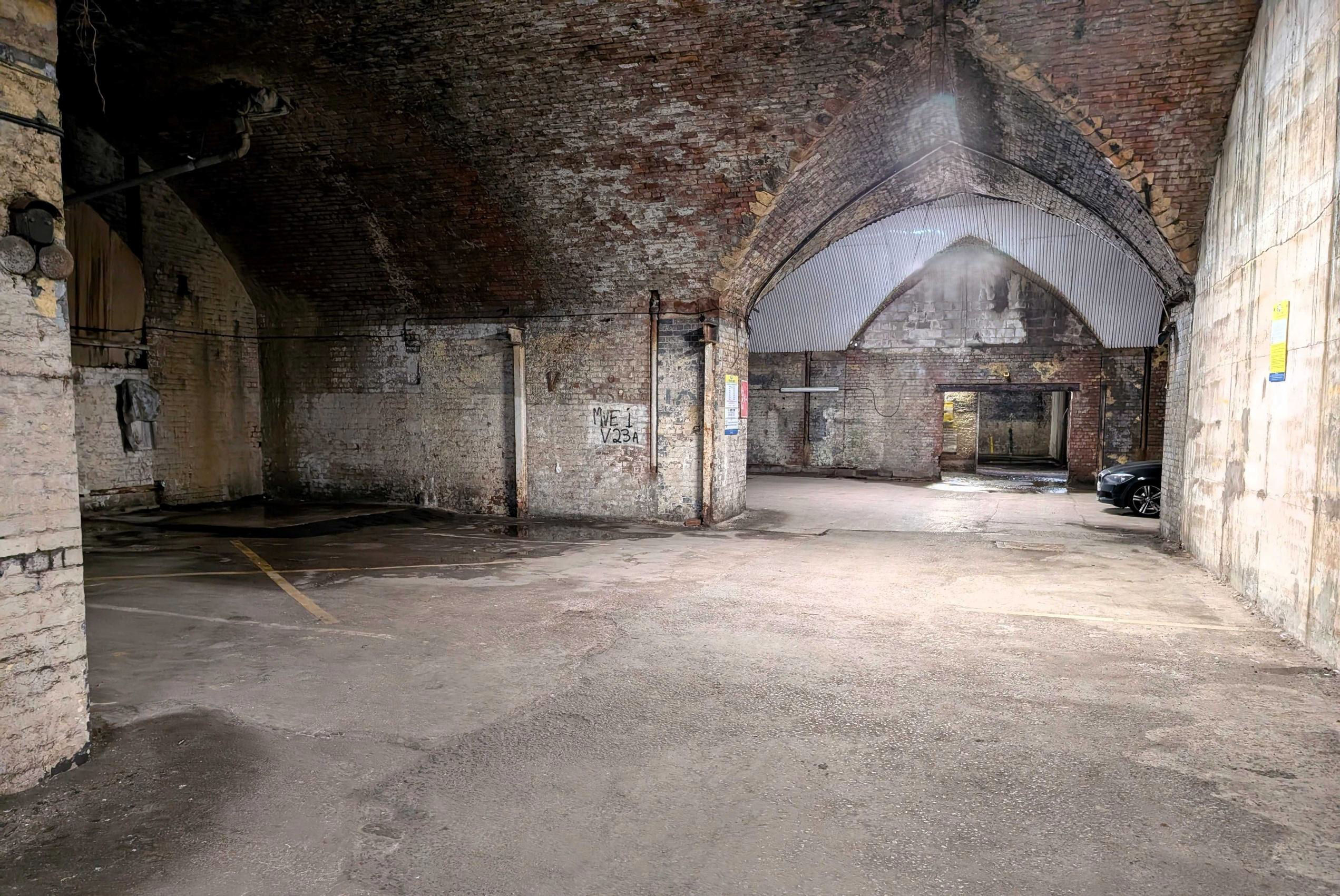
Part of Exchange undercroft is a public car park in Harding St. https://tinyurl.com/48kmrh4n is a video about Exchange (22 min).
[© John Hampson 2025]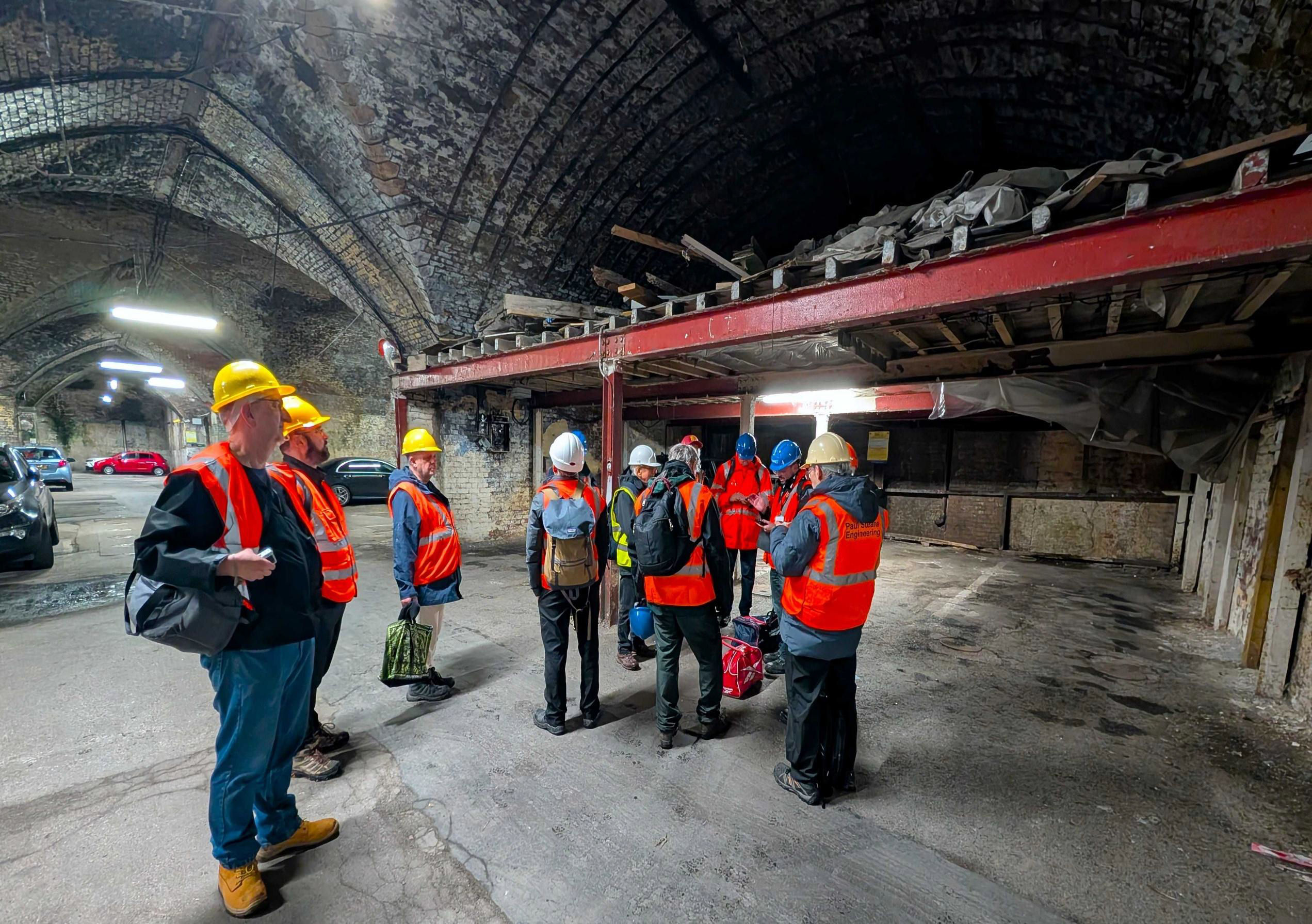
Part of Exchange undercroft.
[© John Hampson 2025]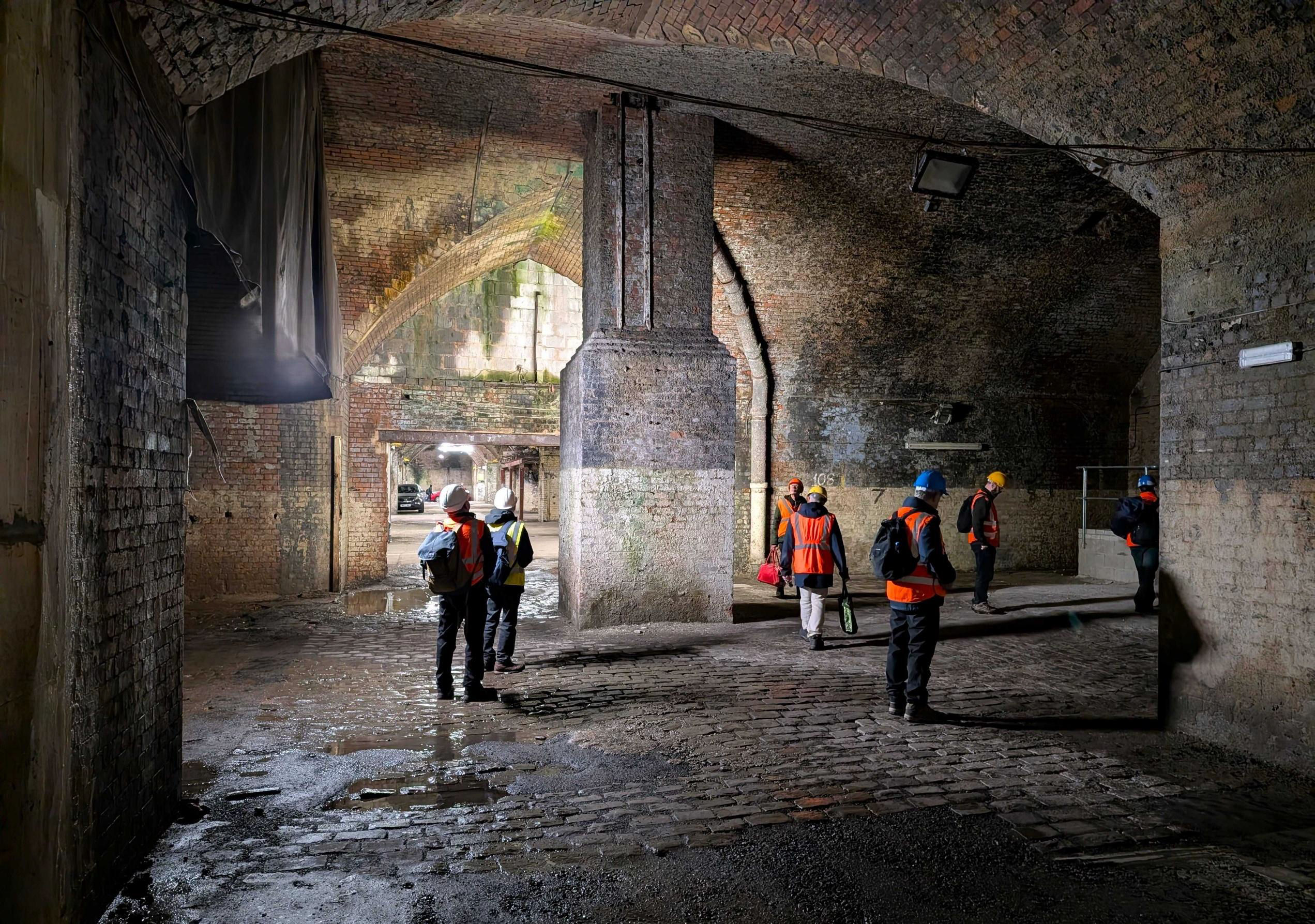
Part of Exchange undercroft.
[© John Hampson 2025]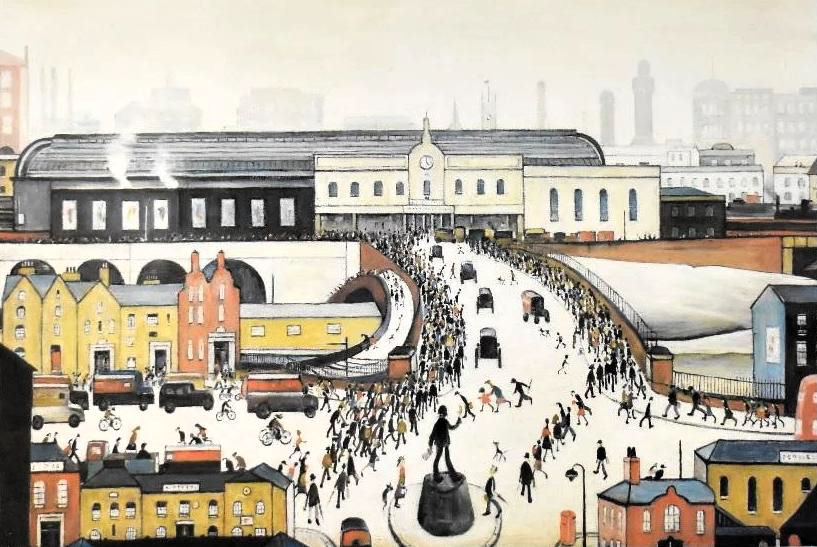
No, it's not another 'Turner' but Manchester Exchange by LS Lowry in 1962 (with artistic licence, the actual building was quite different).
[© LS Lowry 1962]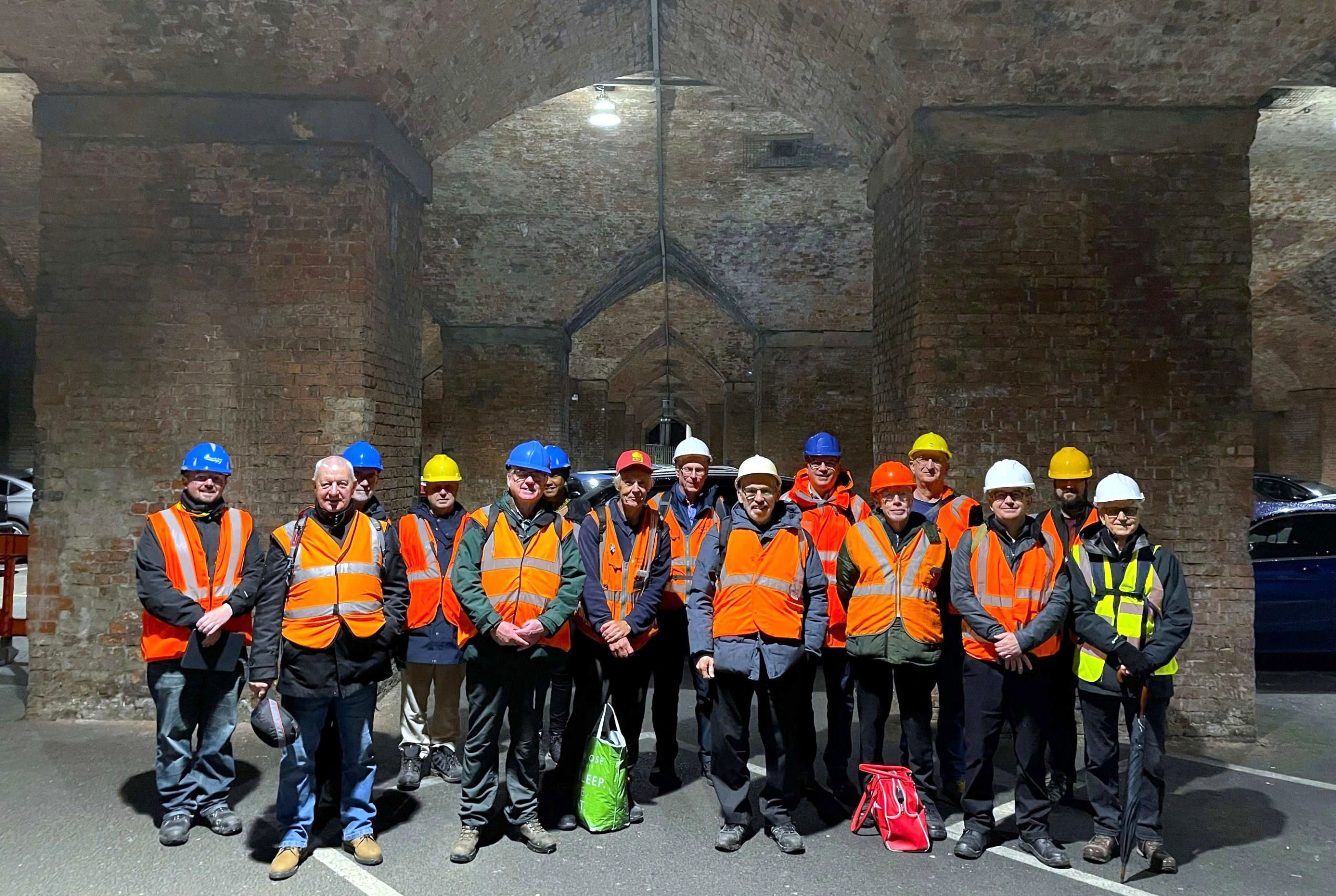
Finally, rogues' gallery group photo in the car park section of Piccadilly undercroft. (Thanks to Adam Turner who is far left, positionally speaking.)
[© John Hampson 2025]This was another excellent and informative tour. Enormous thanks are due to Adam for organising and leading the tour and to Toby and Mike from Network Rail for allowing us access to the facilities and for sharing their extensive knowledge with us. Proceeds from the tour amounting to £470 have been donated to Mustard Tree and Embassy, both charities working with the homeless in Manchester.