Crewe Sorting Sidings North: The original Crewe Sorting Sidings boxes were opened circa 1901 along with the Independent Lines and Basford Hall Yard. There were three boxes, 'Crewe Sorting Sidings South', 'Crewe Sorting Sidings Middle' and 'Crewe Sorting Sidings North'. In the early 1960s the yard was upgraded (also adding a hump for the Down side) following the British Rail (BR) Modernisation Plan.
In 1961, the Middle box was replaced by two separate new boxes 'Crewe Sorting Sidings Middle Up' and 'Crewe Sorting Sidings Middle Down', both believed to have been BR (LMR*) Type 15 boxes. The North box was similarly replaced in 1962 with a BR (LMR) Type 15 box; this remained in operation and was the subject of our visit. All the other Crewe Sorting Sidings boxes had long since closed, although 'Middle Up' still stood, after it had been derelict for many years. [*London Midland Region]
The terminology is a little confusing; the old Sorting Sidings Middle boxes were at the south end of the 'Sorting Sidings' proper, north of the 'Reception Sidings'. Pure speculation but may this just have been a matter of someone's taste to have called the boxes 'Crewe Sorting Sidings X' where 'X' has four different values? Reassuringly, Crewe Sorting Sidings North box was indeed at the north end of the Sorting Sidings! Its official name, as carried on the BR(LMR) maroon nameboard above the box steps was quite a mouthful; it seemed to have been shortened to 'Sorting Sidings North' or simply 'North Box'.
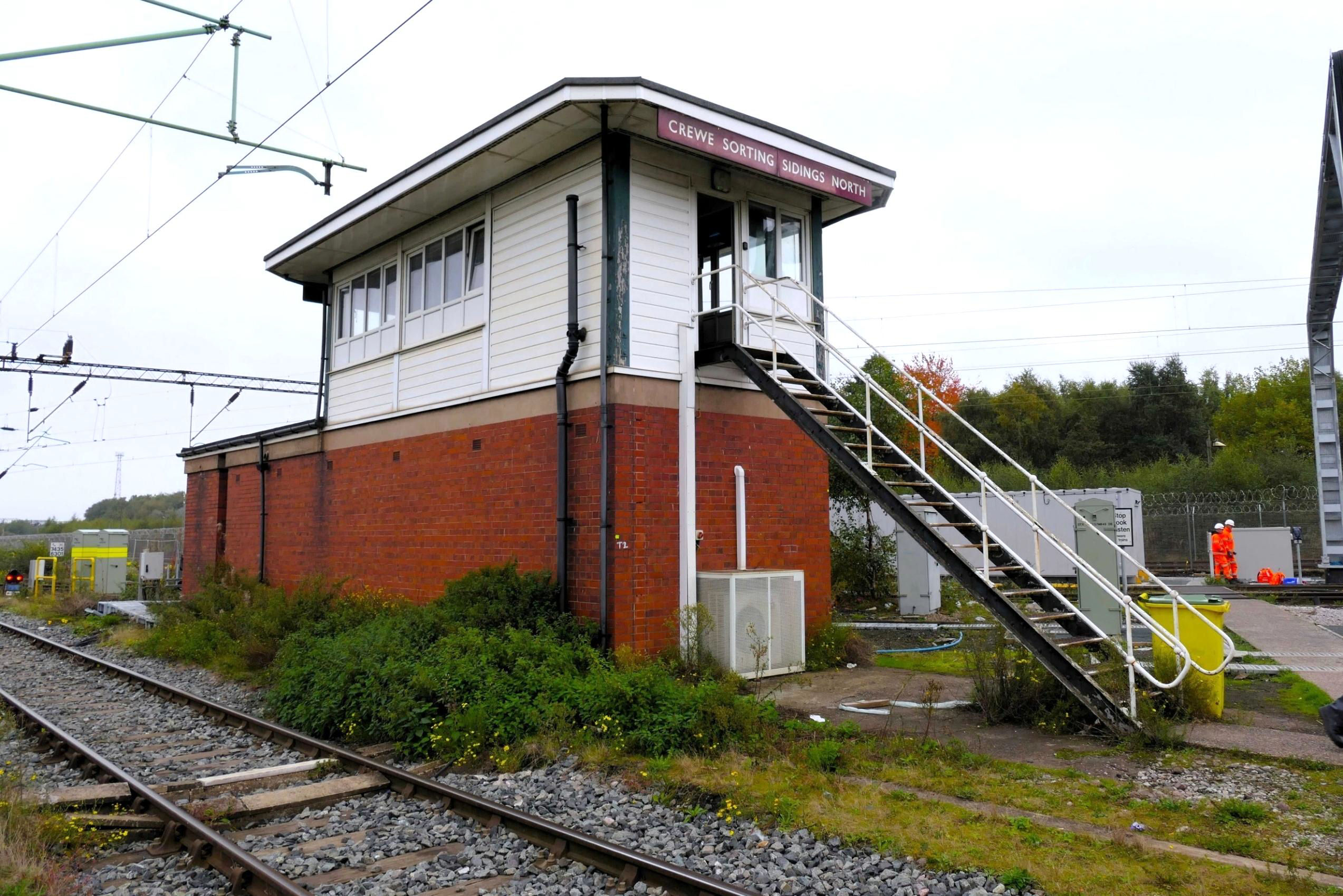
Crewe Sorting Sidings North signal box.
[© Nick Garnham 2024]Perhaps surprisingly, the box was provided with a BR(LMR) Individual Function Switch (IFS) panel from new in 1962, which explains how such a small box could control so much. The original panel was replaced by the then current TEW IFS panel which was commissioned on 11 Aug 2013. It had a total of 41 signal controls, only seven of which controlled main aspects and 25 individual point controls. While the Up and Down Independent Lines themselves were fully track circuited, many of the other lines were not.
The track layout here was (and still is) very complex: To the south the Down Fast Independent (outside) and Down Slow Independent (inside) lines from Basford Hall Jn passed to the west of the yards. In contrast, the single Up Independent passed to the east of the yards, gradually nearing the West Coast Main Line running lines, eventually running parallel to them, on the approach to Basford Hall Jn.
There was also the Up Through Siding (not track circuited), which ran close to the east side of the virtual quarry that had earlier replaced most of the Up Sorting Sidings, again only meeting the Up Independent on the final approach to Basford Hall Jn. Between the Virtual Quarry and the Down Independents, there was (and is) a huge fan of mostly unelectrified sidings (not track circuited). The remains of the Up Sorting Sidings were (and are) single ended, shunted from the south as they have been for many years, if not since construction. They did not therefore concern Sorting Sidings North box. The Down Sorting Sidings were and are double-ended, feeding out to the north at Sorting Sidings North.
A few of the points nearer the box were motor worked and signal protected controlled from the box but most, particularly further into the yard, were hand worked. The position of the box toilet at the top of the steps in the southwestern corner of the box was most unfortunate, as it blocked the signaller's view of the Down Sorting Sidings and the non-track-circuited points. It appeared that the toilet had probably been there since the box was built as the design of the door matched that of the surrounding woodwork.
Facing north, the Up and Down Fast and Slow Independents sandwiched a headshunt heavily used for shunting the north end of the yard and were worked on the Absolute Block system, with permissive working (passenger lines) to the north, authorised through to Salop Goods Jn (BLN 1484.2534 has details). To the south, the Up Independent and the Down Fast and Down Slow Independents were also worked on the Absolute Block (AB) system but without permissive working.
The 'block instruments' for these sections were incorporated into the lower part of the panel, while the actual block indications were shown by small LED lights. The commutator switches (conventional Absolute Block to Basford Hall Jn and permissive to Salop Goods Jn) mimicked the relevant elements of BR standard block instruments built into the panel, giving a most unusual appearance! One of the signallers was firmly of the opinion that they were specifically designed for this panel by Crewe Works. Studied carefully, it could be seen that the plane on which the commutator handles sat was not flat, as would be the case on an ordinary 'penguin' block instrument. Instead, it was actually angled to allow the commutator to sit at a slightly gentler angle than that of the overall panel. The panel also had PERMISSIVE / ABSOLUTE 'flaps' on the fascia next to the 'block instrument' commutators.
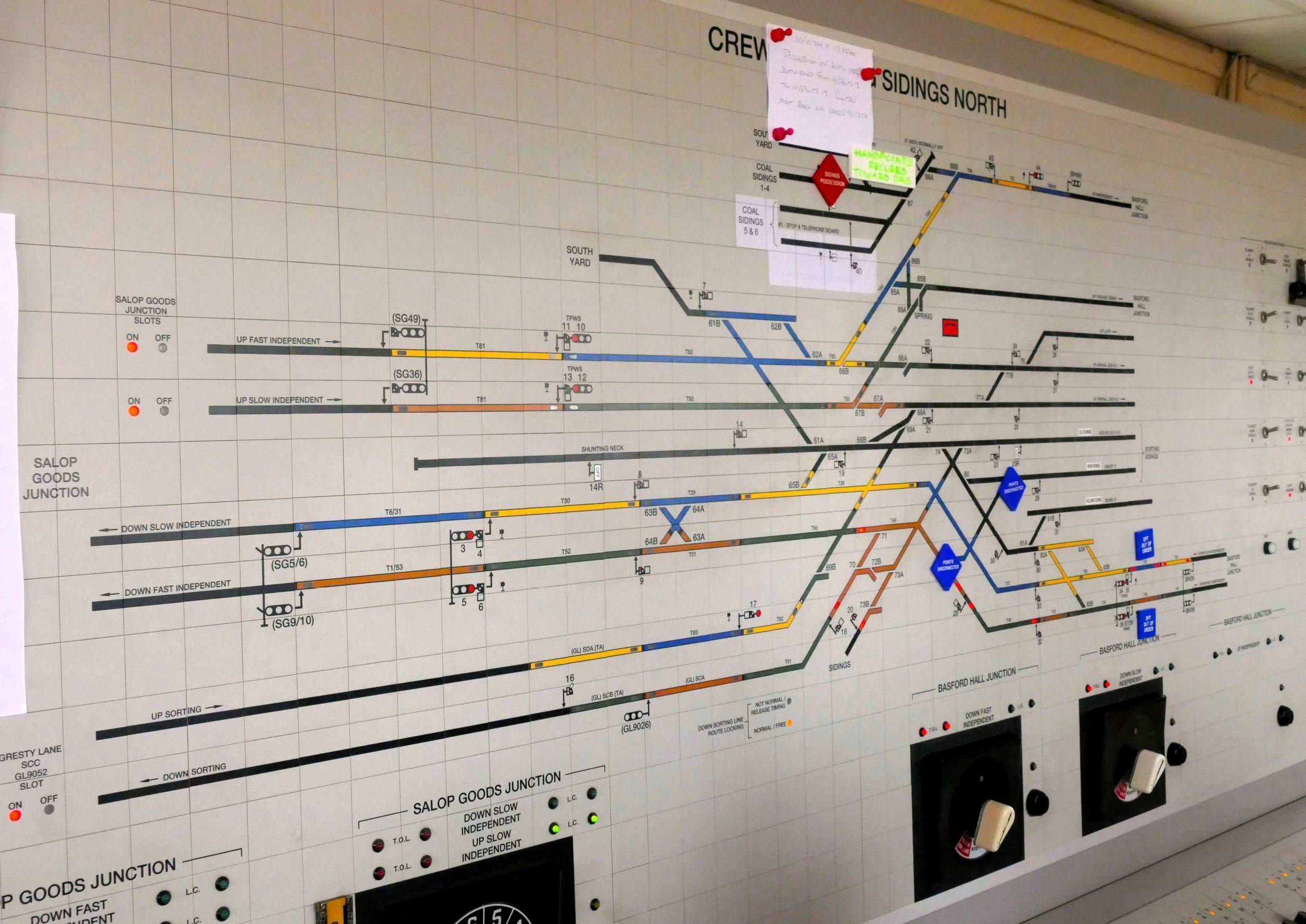
Crewe Sorting Sidings North panel Salop Goods Junction.
[© Nick Garnham 2024]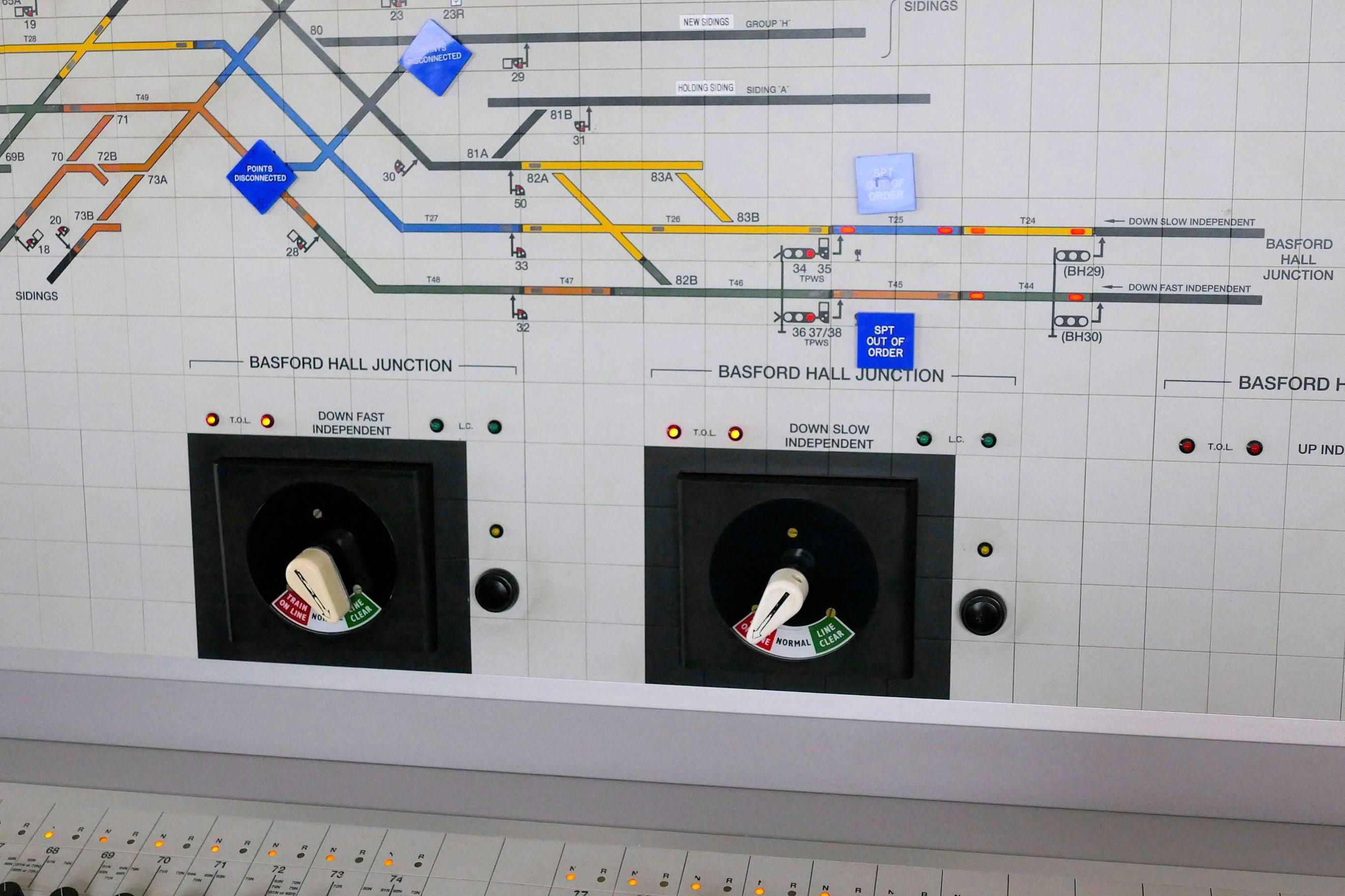
Crewe Sorting Sidings North panel block instruments.
[© Nick Garnham 2024]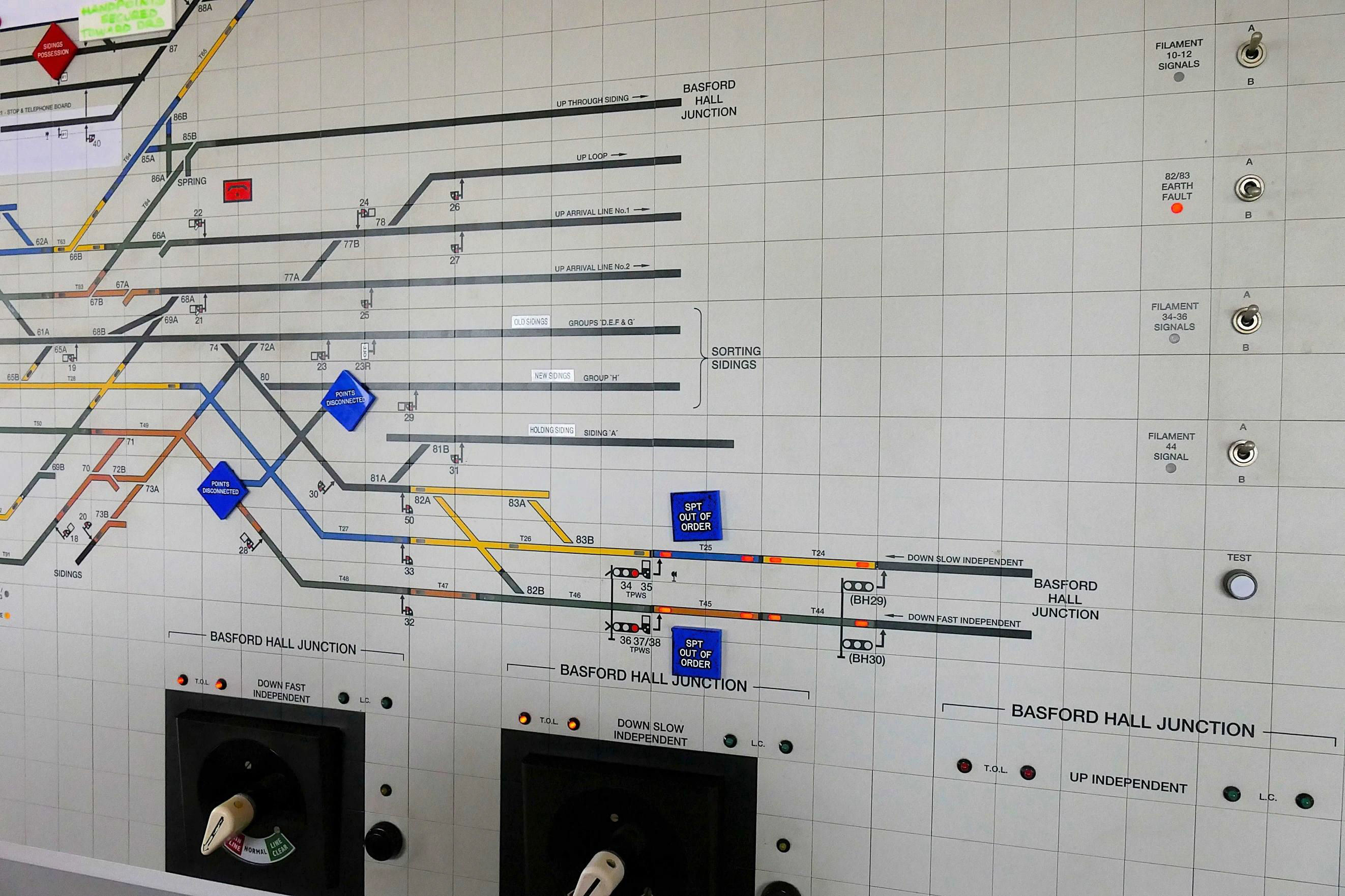
Crewe Sorting Sidings North panel Bashford Hall Junction.
[© Nick Garnham 2024]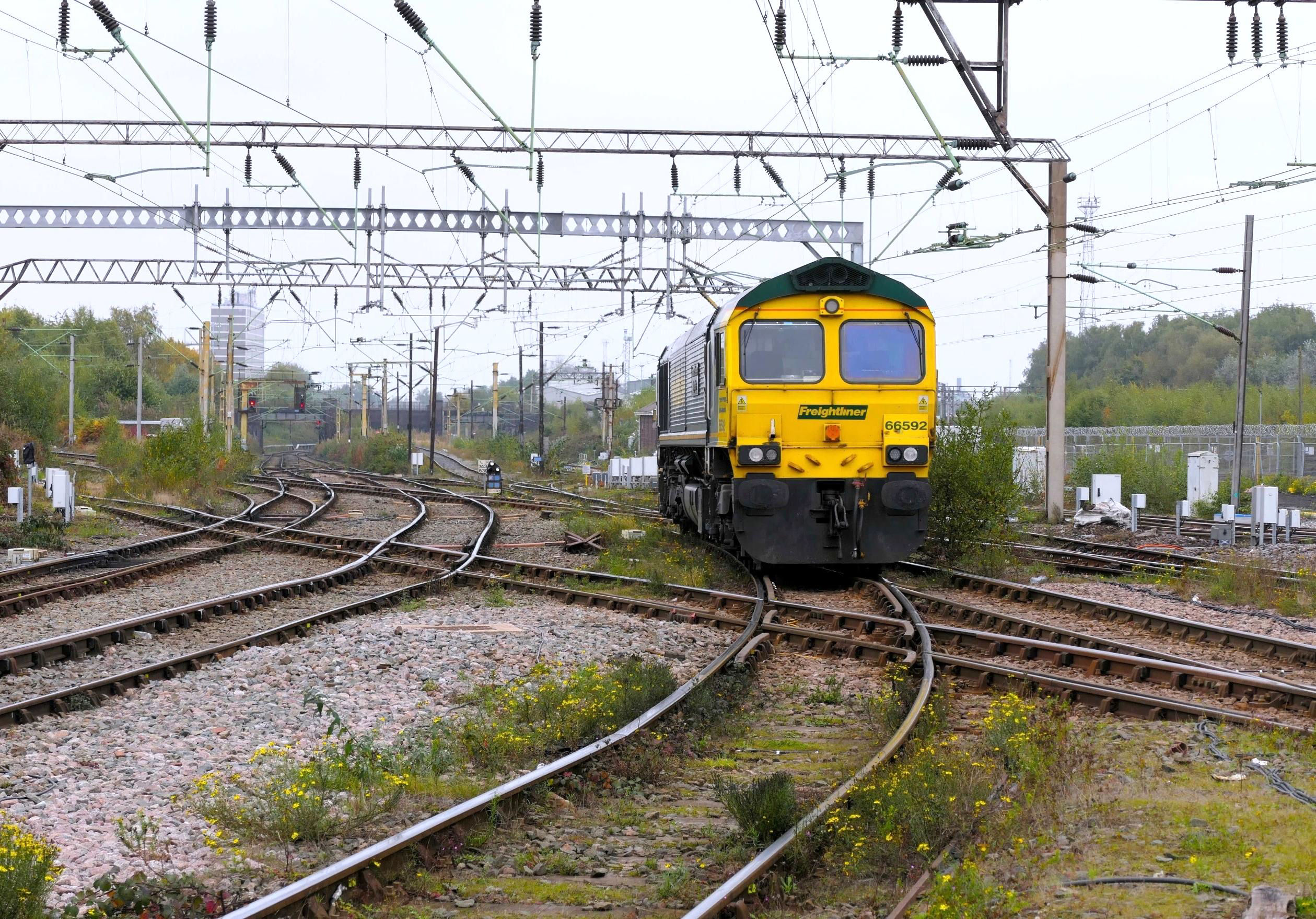
Freightliner 66592 approaching Crewe Sorting Sidings North box.
[© Nick Garnham 2024]The north-facing double track connection to Gresty Lane Jn on the Shrewsbury line (the 'Up Sorting' and 'Down Sorting' lines on the panel) diverges to the west and was operated under Track Circuit Block regulations, but the Signal Box Special Instructions (SBSIs) noted that 'Trains conveying passengers must not be allowed to travel over the Down and Up Sorting lines between this box and Gresty Lane Jn'.
To the east, there was a connection to 'South Yard' shown on the panel. This accessed the Rail Operations Group (ROG) South Yard and also the South Yard Through Siding, not a track circuited route, through to a connection with the Shrewsbury line near to Crewe South Jn. When trains passed over this route, the Sorting Sidings North and Crewe Signalling Control Centre signallers needed to agree what was to happen by telephone, recording details of headcodes and the times that trains were authorised onto the line then passed clear of it on special sheets maintained in each signal box. The SBSIs only discussed trains operating in the Up direction and to and from the ROG sidings but the lines could be used in either direction allowing Down trains from the Sorting Sidings to gain access to the Chester line.
ROG have a compound accessed off this line which they use for stock movements and storage. Movements come in from either end, signalled using the sheets mentioned above. If trains terminate in the ROG sidings, the Person In Charge (PIC) of the ROG compound phones the relevant signaller to advise that the train has arrived complete and is clear of the through sidings.
The junctions themselves are no less complex and the layout is reminiscent of the steam era. There are multiple diamond crossings, at least one single slip and a full scissors crossover between the two Down Independent lines. Ground Position Light Signals 14 and 23, facing in opposing directions on the shunting neck, could both be left cleared, allowing shunting movements from the yard into the neck and back to continued unhindered. But all other signals needed to be cleared each time a train was to proceed.
The complexity of the layout and the presence of many sections of lines without track circuits made this a challenging job in itself but it was further complicated by heavy use of the telephone. As well as dealing with the four other adjacent signallers and NR train running control, regular conversations were needed with the various freight operators, in particular Freightliner who have a major base here. Accordingly, the box was a Grade 6 signaller role, possibly unique for a BR(LMR) box of this size! The signaller on duty was a mine of information having worked the box for many years. He would clearly miss it.
Basford Hall Junction: It's probably quite surprising that, in 2024, any sections of the West Coast Main Line to Scotland were still controlled by a signal box worked by a lever frame but Basford Hall Junction was one of three such boxes. The others being Crewe Coal Yard and, a little further north, Winsford. As with Salop Goods Junction, Basford Hall Junction box was a London & North Western box dating back to 1901 with the creation of the yard and Independent Lines. The box had been modernised to a degree internally and had a (quite low) false ceiling.
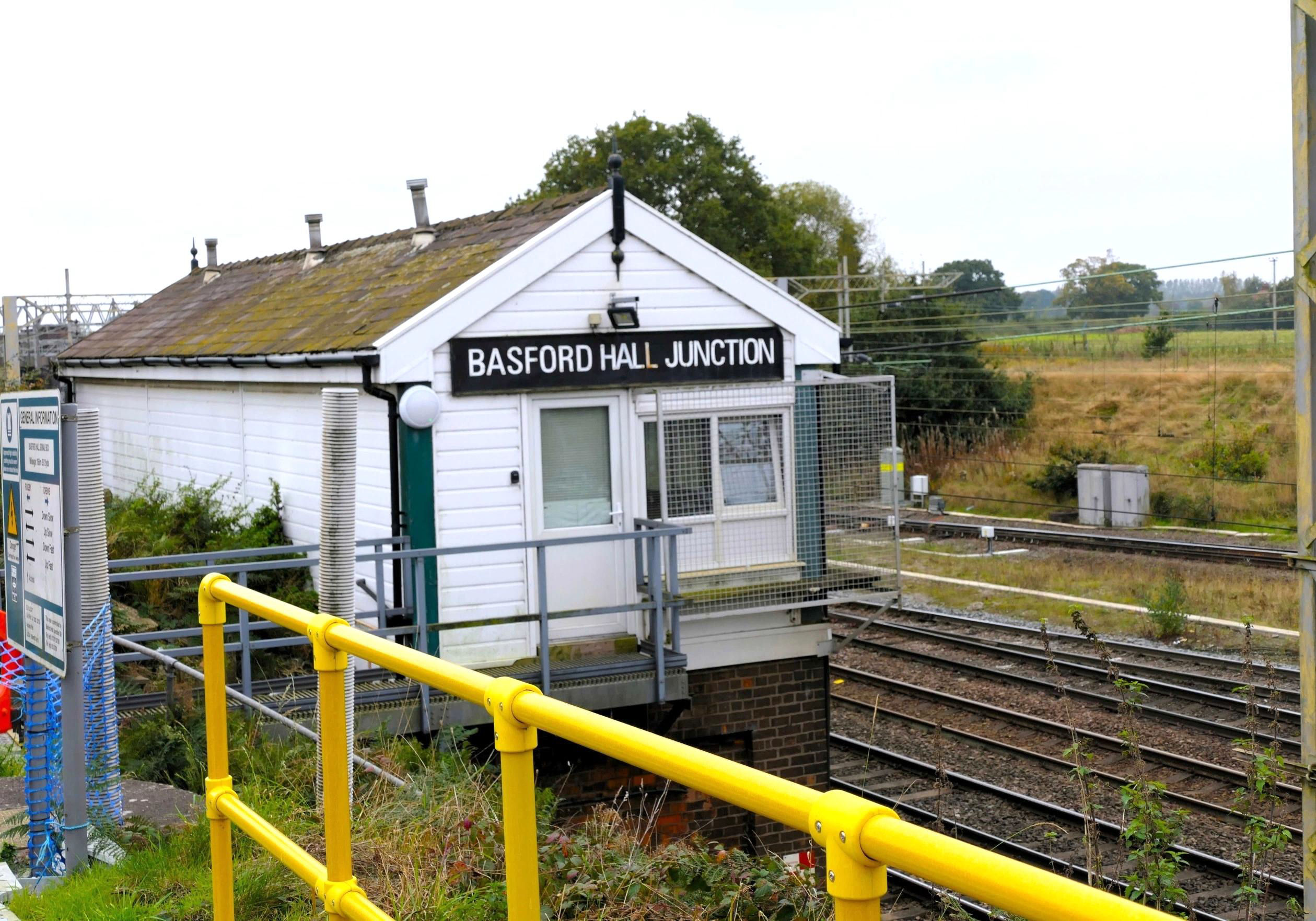
Basford Hall Junction box viewed from the path along the top of the cutting side.
[© Nick Garnham 2024]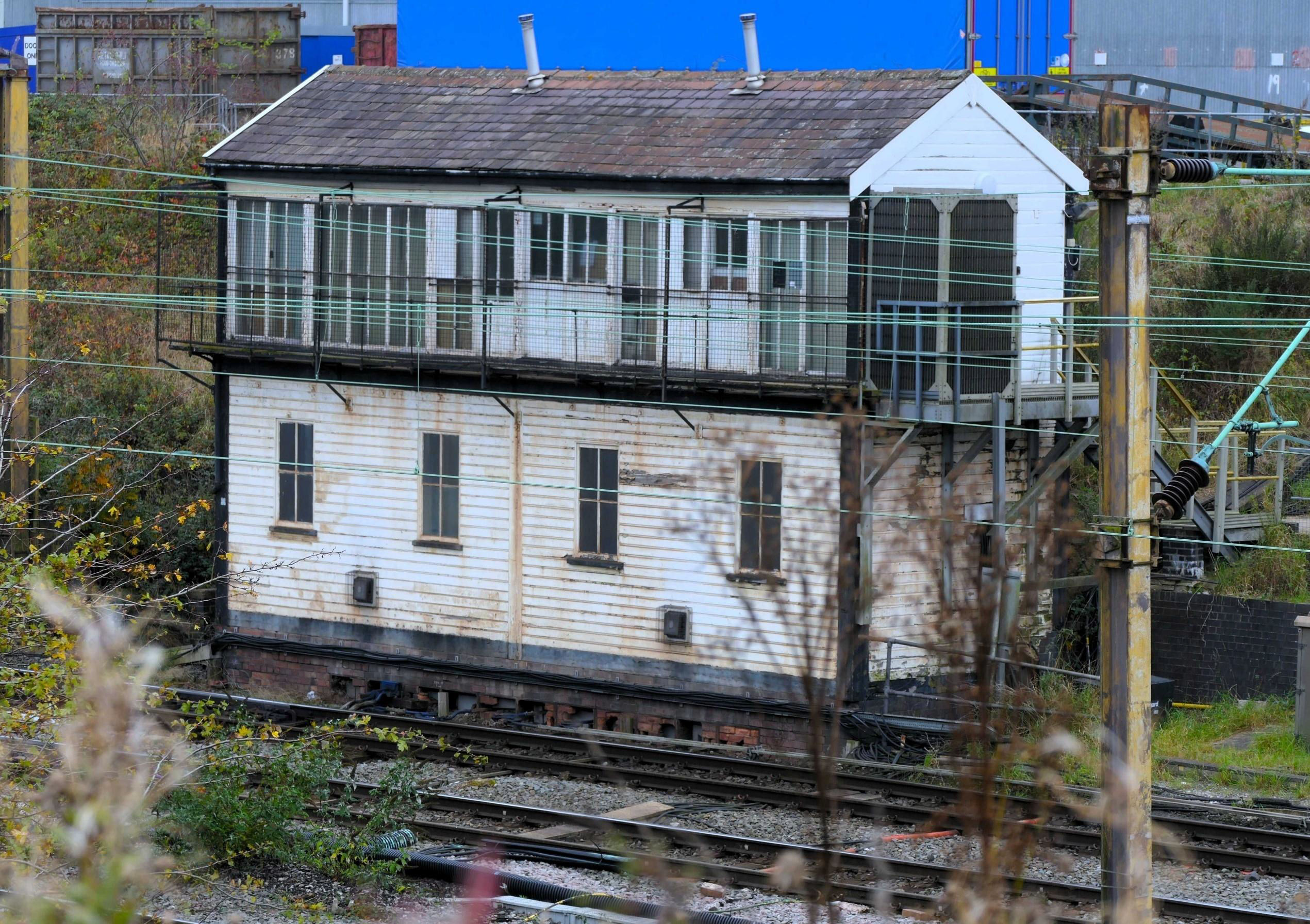
Basford Hall Junction box.
[© Nick Garnham 2024]There was a substantial frame with 38 working levers, 10 out of use levers and a gap that previously housed levers 31-38 inclusive. That element of the frame had been entirely removed and accommodated a small table with the train describer on it. The box acted as fringe to both Rugby Rail Operating Centre and Crewe Signalling Control Centre on the main lines which, as would be expected, operated under TCB regulations. The box only had a single controlled stop signal on each of the four main lines, which could be 're-stroked' after the passage of a train (the lever replaced to normal and immediately reversed again). All other signals on the main lines were auto-signals, although many had emergency replacement switches. A couple of the latter, for 105 (Down Slow) and 106 (Down Fast) were of a most unusual and elderly looking design that none of the ten members present recalled encountering previously.
The main rôle of the box, however, was to control the junction for the Independent Lines. The sections to Sorting Sidings North were operated under Absolute Block regulations using single direction BR Standard block instruments - one each for the two Down lines and one for the single Up Independent line; the Up Through Siding was non-block. Permissive Working (passenger lines) was again authorised on the Down Fast Independent as far as starting signal BH30 and, on the Down Slow Independent, as far as starting signal BH29. However, permissive working was not authorised beyond the starting signals to Sorting Sidings North on either Down Independent, or anywhere on the Up Independent.
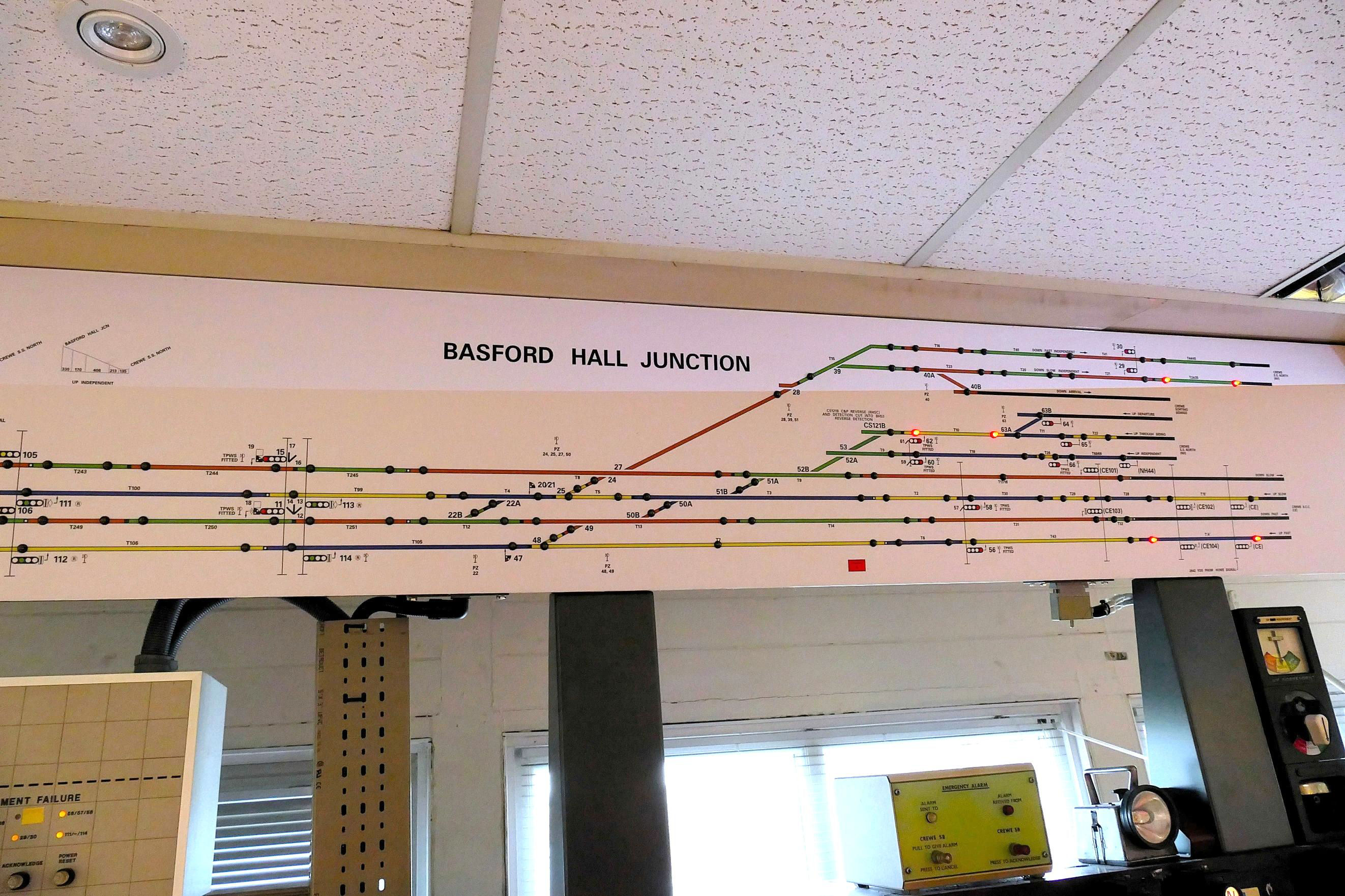
Basford Hall Junction panel.
[© Nick Garnham 2024]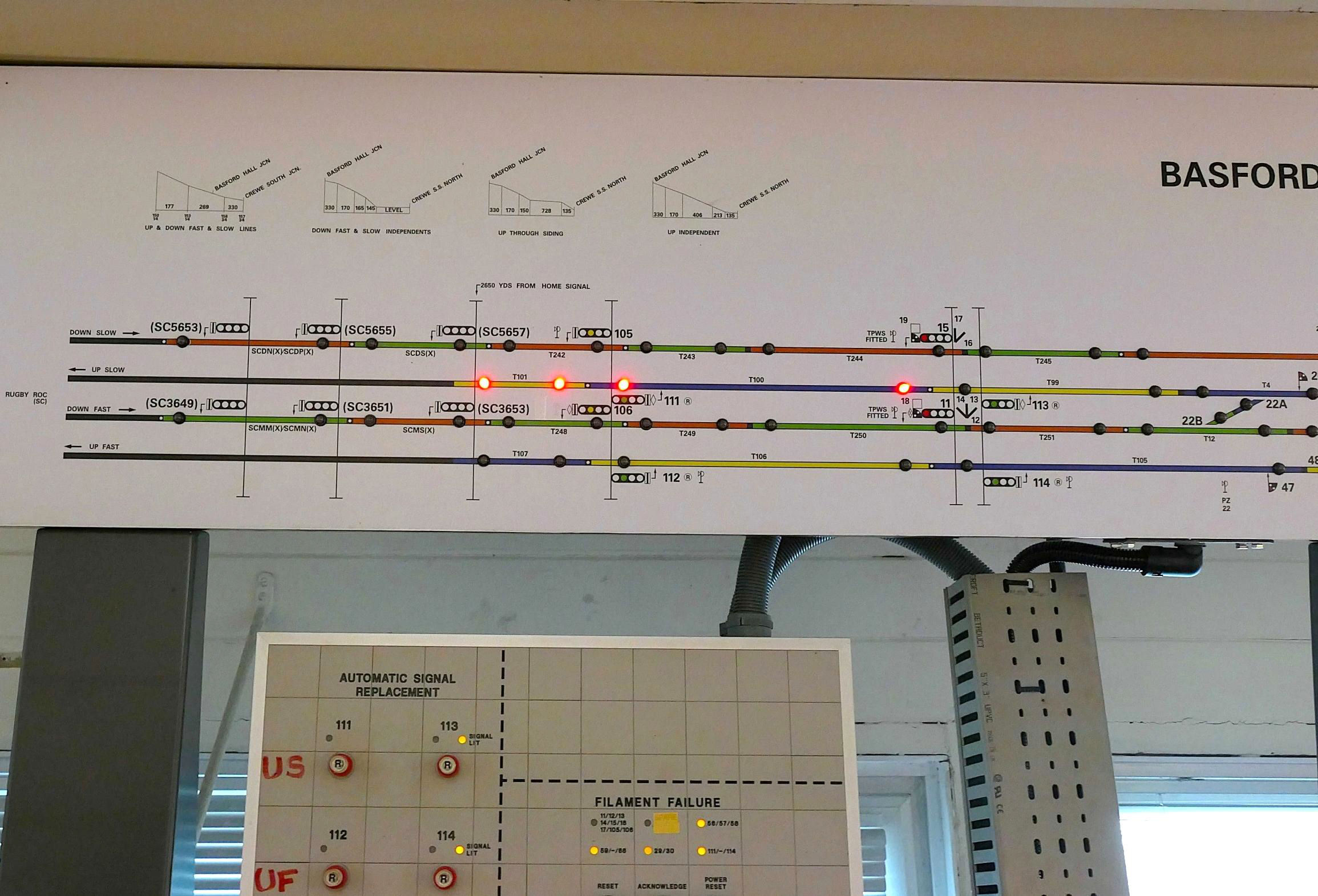
Basford Hall Junction panel West Coast Main Line end..
[© Nick Garnham 2024]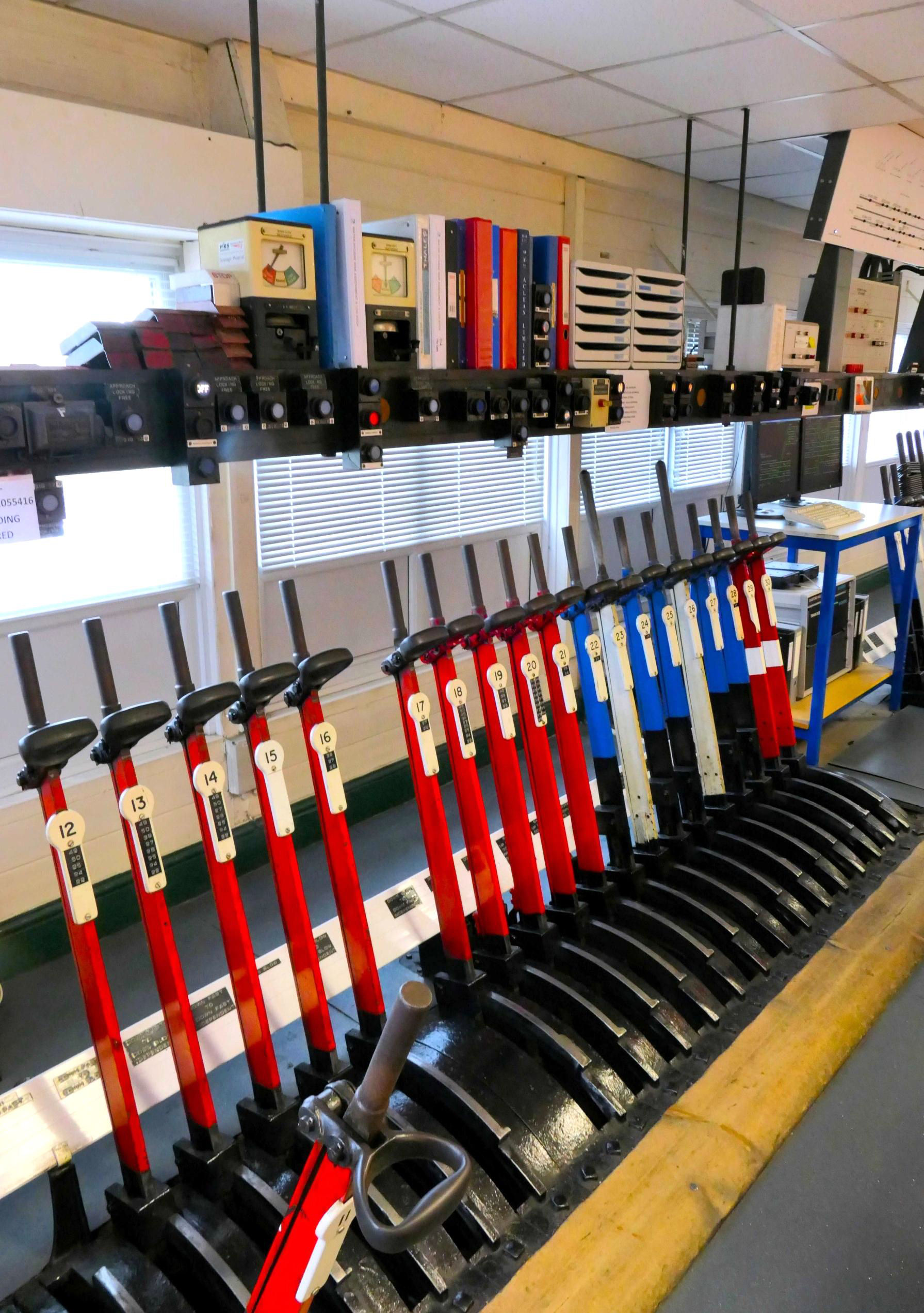
Basford Hall Junction lever frame and block instruments.
[© Nick Garnham 2024]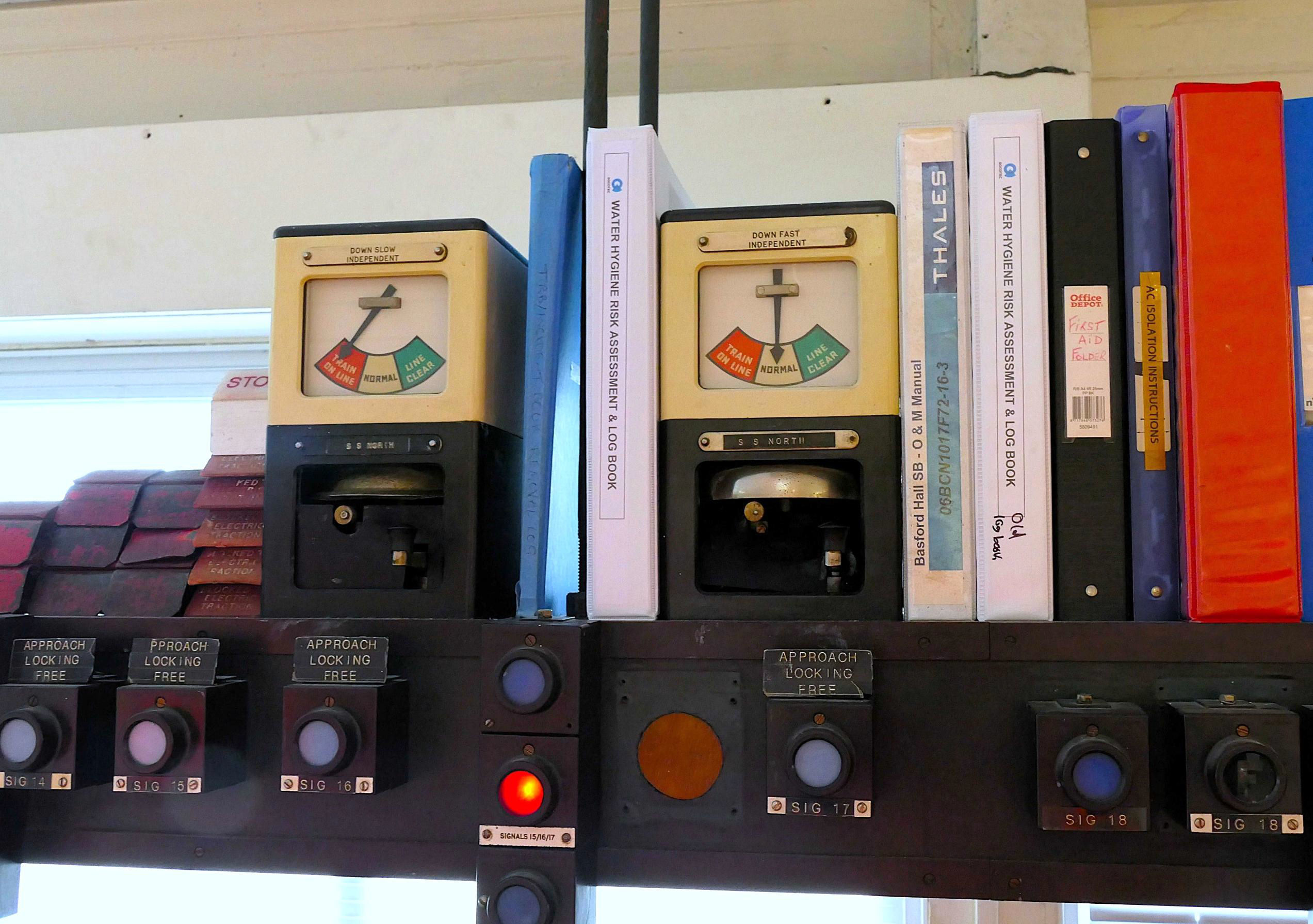
Basford Hall Junction Down Fast & Down Slow block instruments.
[© Nick Garnham 2024]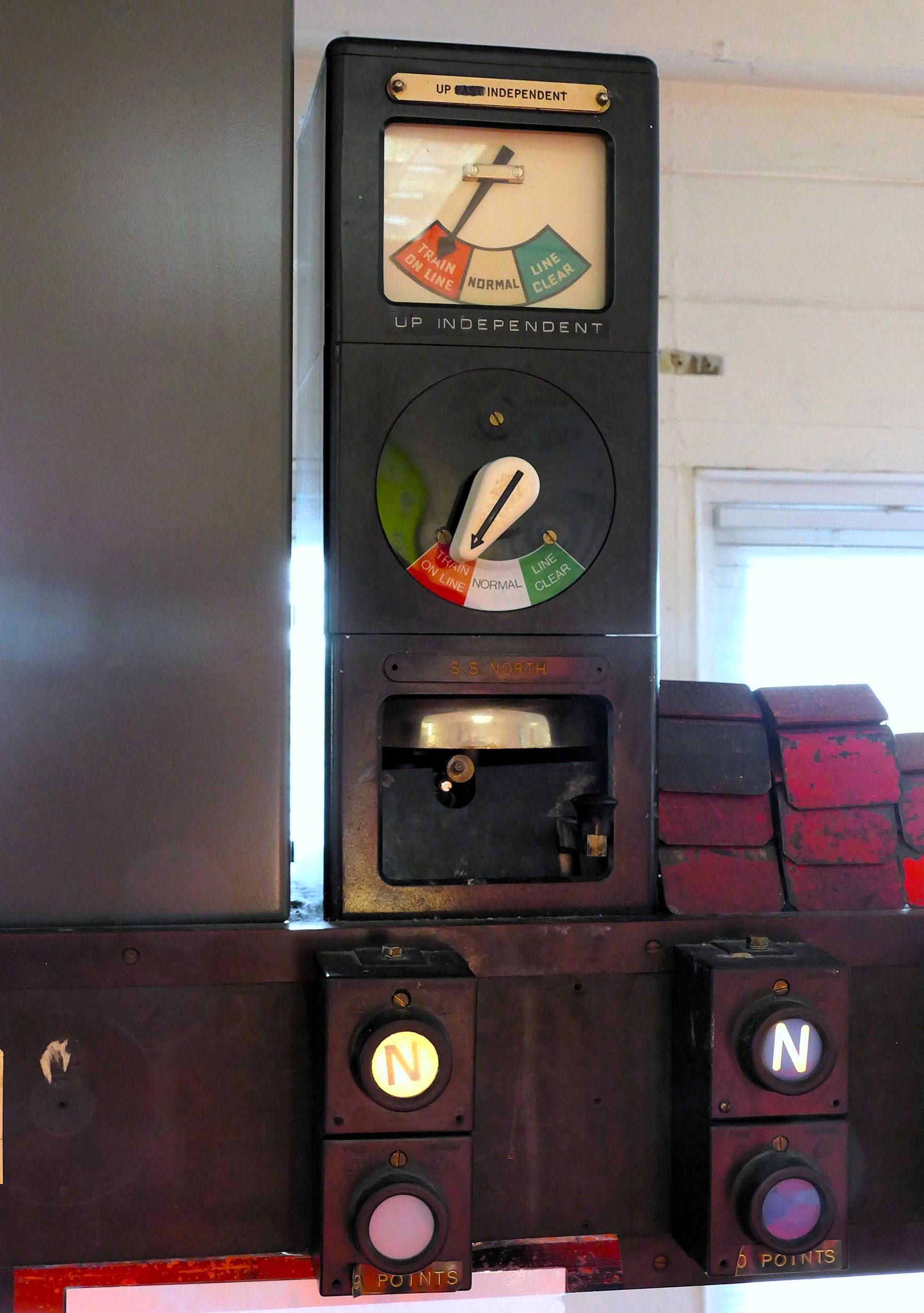
Basford Hall Junction Up Independent block instruments.
[© Nick Garnham 2024]Most of the Up direction controlled signals were at the country end of the frame and Down direction signals at the London end of the frame. The signaller regularly had to walk up and down the box to set up a route with, typically, the levers for the route to be set being at one end of the frame and those for the flank protection required at the other. They obviously didn't do ergonomics in those days, although nowadays it would have kept the signallers fit.
The box was accessed by a long walk over a path along the top of the cutting side which was very firmly behind a locked gate. The box was once worked by a team of two but latterly there was only one signaller on shift. It was a Grade 6 box, so very much at the top end of manual boxes. Finally, attention must be drawn to the well-heated outside toilet, built of engineering bricks, on the bank side (the official 'brick sXXt-house') which was provided for the signallers. It would be interesting to know if it was L&NWR built or a more recent construction in a traditional style. A register of signal box toilets anyone?
The Future: The Independent Lines signalling was deemed to be life-expired and the three boxes visited were decommissioned on Christmas Eve 2024, a £190M resignalling project, control moved to Manchester ROC. This eleventh hour visit to the boxes allowed members to see the very traditional operation of the Independent Lines before the boxes were swept away at the year-end. Our grateful thanks to NR Local Operations Manager, Natalie, her signallers and colleagues for allowing and hosting such an interesting set of visits, as well as enabling a second visit a few weeks later for 10 members who could not be accommodated before. £700 was donated to Almost Home Dog Rescue as a result.