Nine members joined Adam Turner at Baker Street station, for what turned out to be a truly memorable day, blessed by clear blue skies and very warm sunshine. Arrivals almost perfectly matched a 'furthest travelled, earliest to arrive' pattern, attendees from Newcastle (246 miles) and the Isle of Dogs (6 miles) bookended things. For my part, as I passed Grove Park carriage sidings on the way in, I noted the large digital clock which has since reached the five month period when it actually shows the correct time!
Our website advert made it very clear that this was 'not for the faint hearted' but in his usual inimitable style, Adam made this day one that none of us will forget easily. Not only trains and planes but … see later. The links (all E&OE) should work in PDF e-BLNs but won't in 'Anyflip' (or paper BLN of course!). Joe Brown's excellent London Railway Atlas would help in further understanding parts of this report.
Baker Street Underground Station is, famously, an original Metropolitan Railway station; construction began in Mar 1860 and was completed at the end of 1862. Passenger traffic began between Paddington and Farringdon on 10 Jan 1863. That route is now part of the Hammersmith & City line and the Circle line. With expansions over the years, there are now eight extra platforms, serving the Metropolitan Bakerloo and Jubilee lines. The surface building above Baker Street is Chiltern Court - construction began in 1912; it was to be a hotel and the Metropolitan Railway HQ. The intervention of war meant that, when construction restarted in the 1920s, the building was repurposed as luxury flats. Plaques around the building show something of the variety of occupants that made Chiltern Court their home. They include HG Wells, Arnold Bennett and, of 'Carry On' fame, Kenneth Williams. The original restaurant (now a bar) was featured in the BBC programme Metroland - introduced by Sir John Betjeman in 1973.
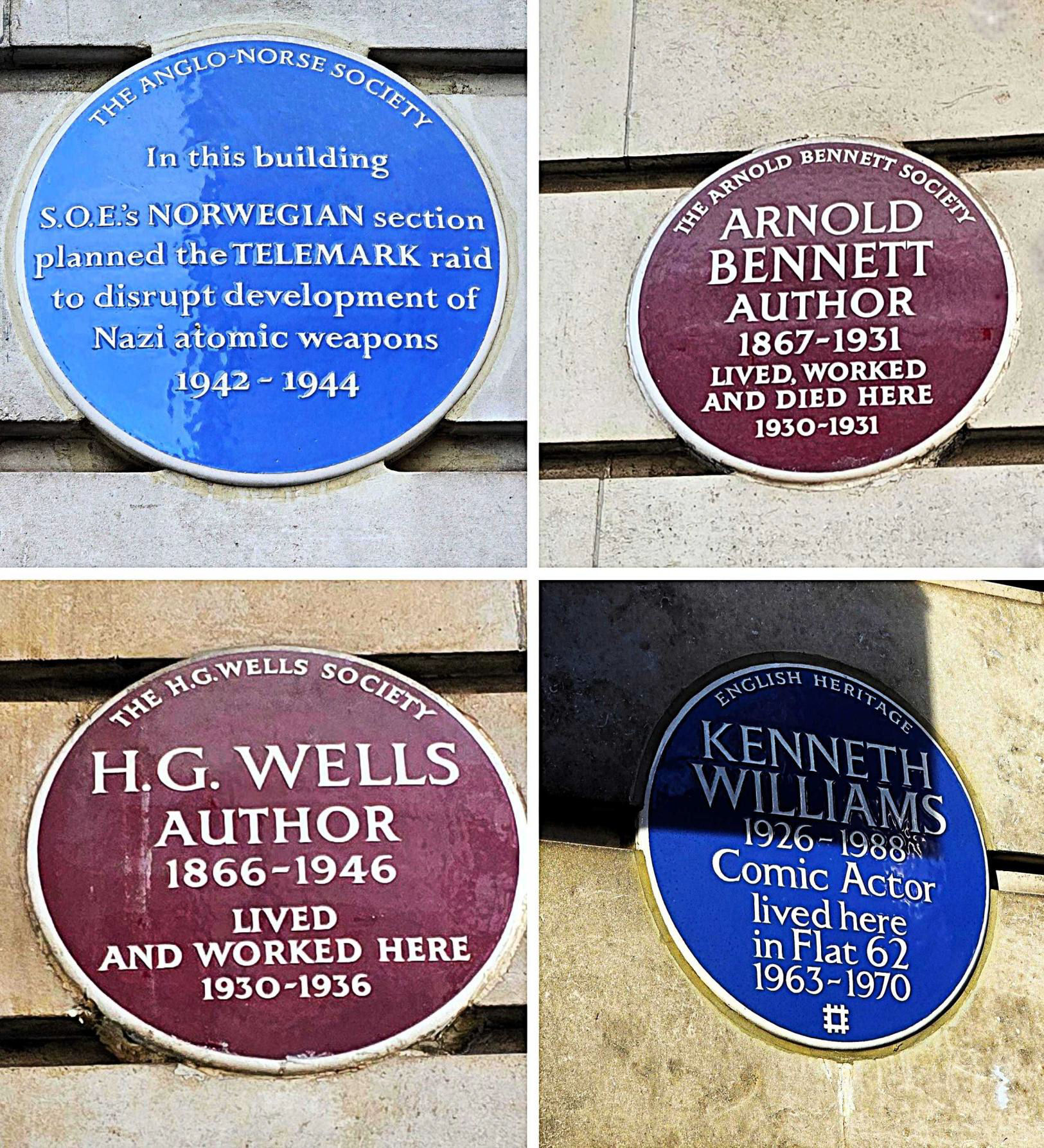
Plaques at various locations around the luxury Chiltern Court flats above Baker Street station.
[© Mick Oldfield 2025]Behind the station, in Allsop Place, is the original Grade II listed
Metropolitan Railway HQ with a superb decorated façade, including two wonderful buffer stops, at one time - and maybe still - water hydraulic. Finally, next door to that, is the
LT catering training centre opened in 1949, which can handle up to 1,200 staff at a time. The sculpture of Artemis (Diana) over the door presumably shows some of the fare on offer in the canteens of the day. Onwards, to our first tube journey. We took the 09.16 Metropolitan line service from Baker Street to Harrow-on-the Hill changing at Wembley Park for the Jubilee line to…
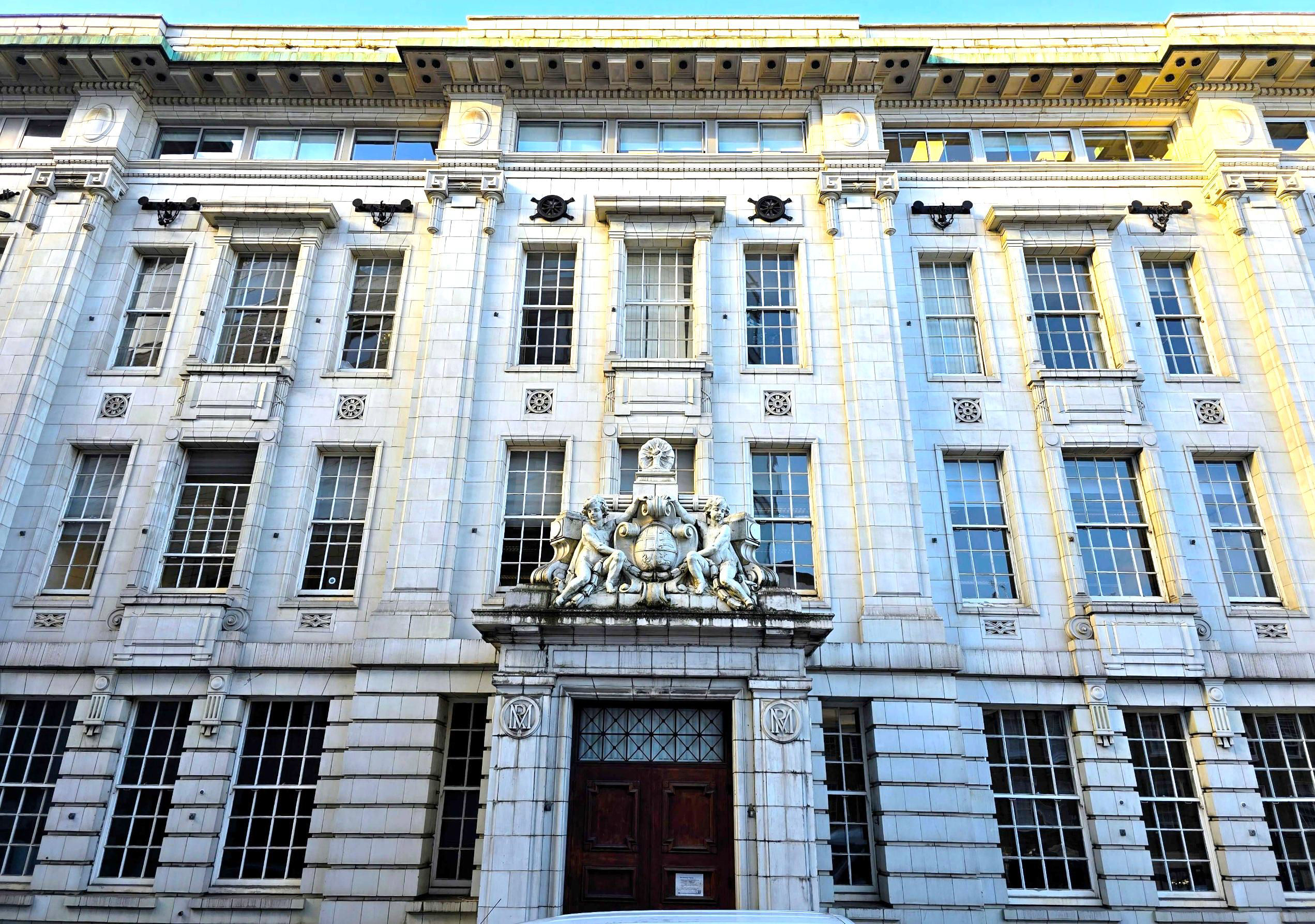
Behind Baker Street station is the original Grade II listed Metropolitan Railway HQ, Allsop Place, note the four buffer stops with chains left and right below the top run of windows.
[© Mick Oldfield 2025]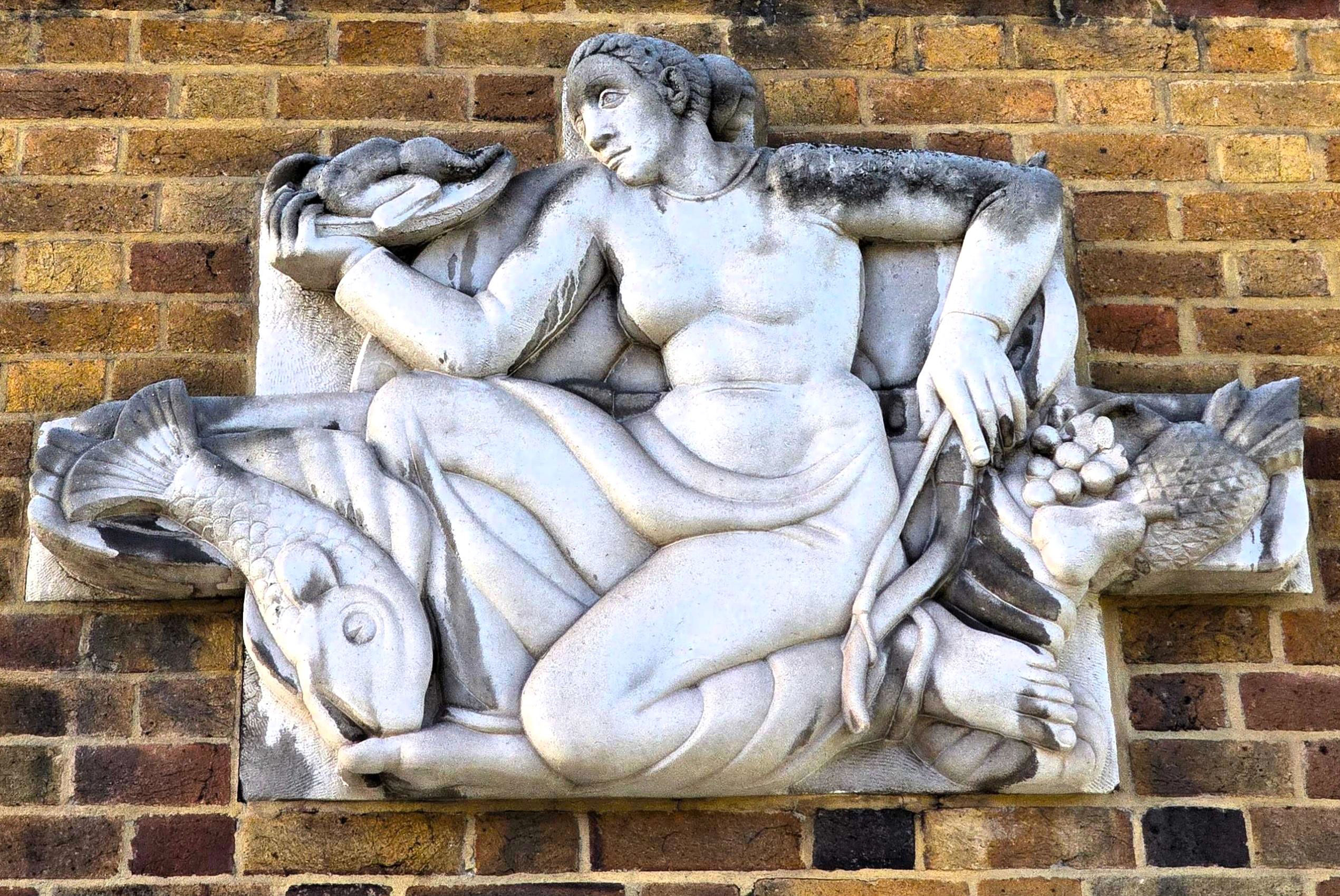
The sculpture of Artemis (Diana) over the door of the adjacent London Transport Catering Training Centre, which could accommodate 1,200 staff.
[© Mick Oldfield 2025] The name has no historic connection to the area whatsoever and was apparently coined by a local property developer to match the adjacent suburb at Kingsbury. Of interest here is that the station itself, sitting as it does in the middle of an apartment block, does not have an external roundel. Instead it has two rare protruding blue name bars. However, across the road, in the middle of a roundabout, is a very prominent roundel indeed. Tempting as it was for the more athletic of our number, there was a notice attached, reading 'Do not climb, Danger of Death'. Warning heeded, no climbing ensued. At the time of construction (early 1930s), Laing's Estate was offering it as a site with 80 shops and 1,000 houses, freehold £595 - £1,000 with good terms. (£1,000 in 1930 = £83,530 now!)
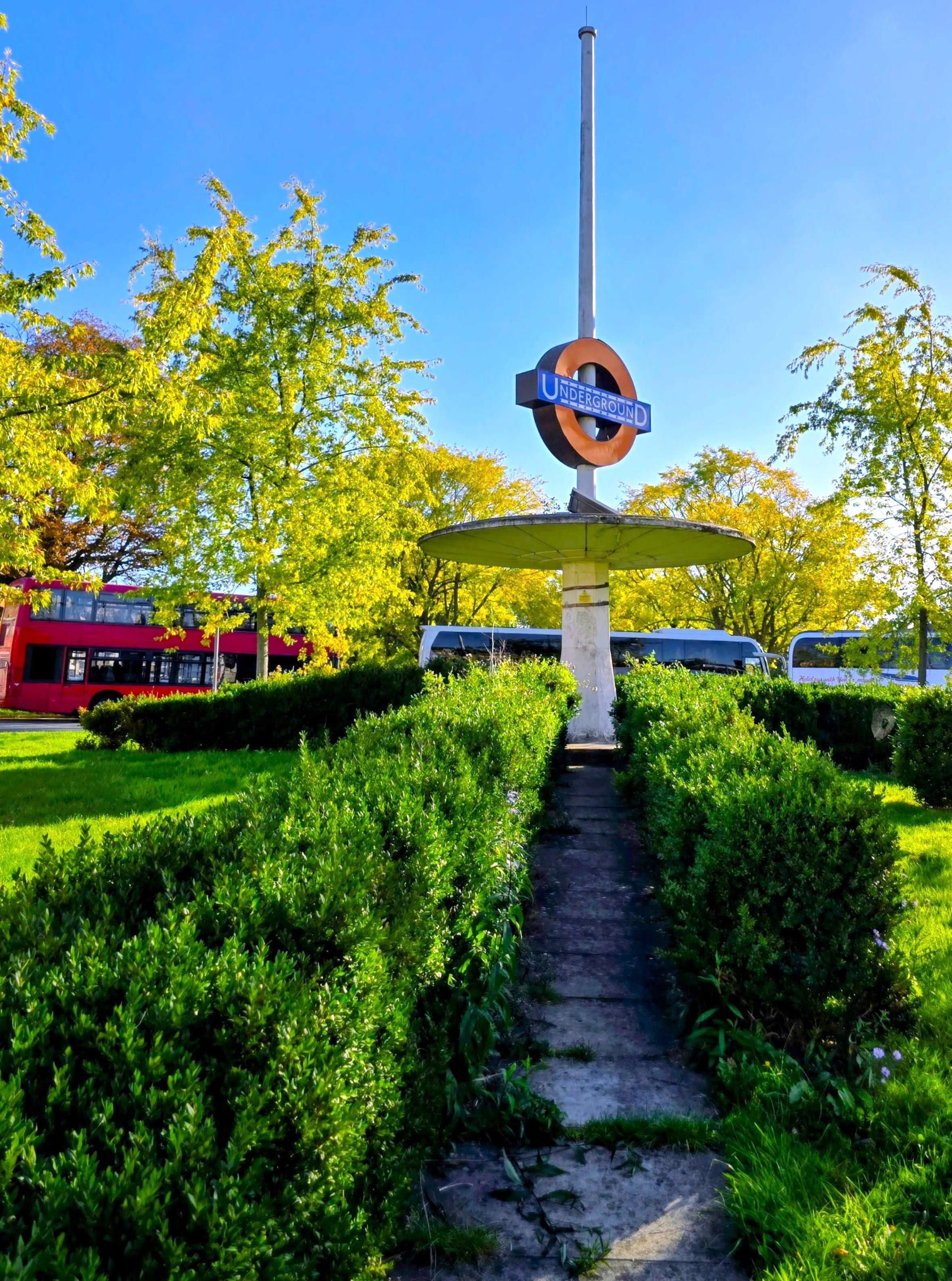
The Underground roundel near Queensbury station comes with a warning not to climb it!
[© Mick Oldfield 2025]We attempted to locate a WWII bomb shelter in, or near, the station car park but weren't convinced. It was noted that the current TfL policy of utilising all available space more 'cost effectively' (translates as 'more income') likely means that the car park site will become flats, or offices, at some point.
Back on the station and the 09.55 Jubilee line southbound to North Greenwich, our destination was West Hampstead, for a 328 bus onwards to Kilburn Park. We did pause at
West Hampstead to note the symmetry of the building, even though half has now been repurposed for shops and, of course, to take a quick look over the road bridge to see assorted Chiltern Line workings while waiting for said bus.
The bus goes all the way to World's End (Chelsea) but we still had a spring in our step.
Kilburn Park station is Grade II listed and, it has to be said, looked absolutely magnificent on the day of our visit. As the link states, probably by Leslie Green's successor, Stanley Heaps but clearly with all of the Green 'house' style. Adam pointed out to us, with one of his fabulous series of old photographs, that only the original canopy is no more. I'm not sure that photos can do it justice; it is a must-visit station.
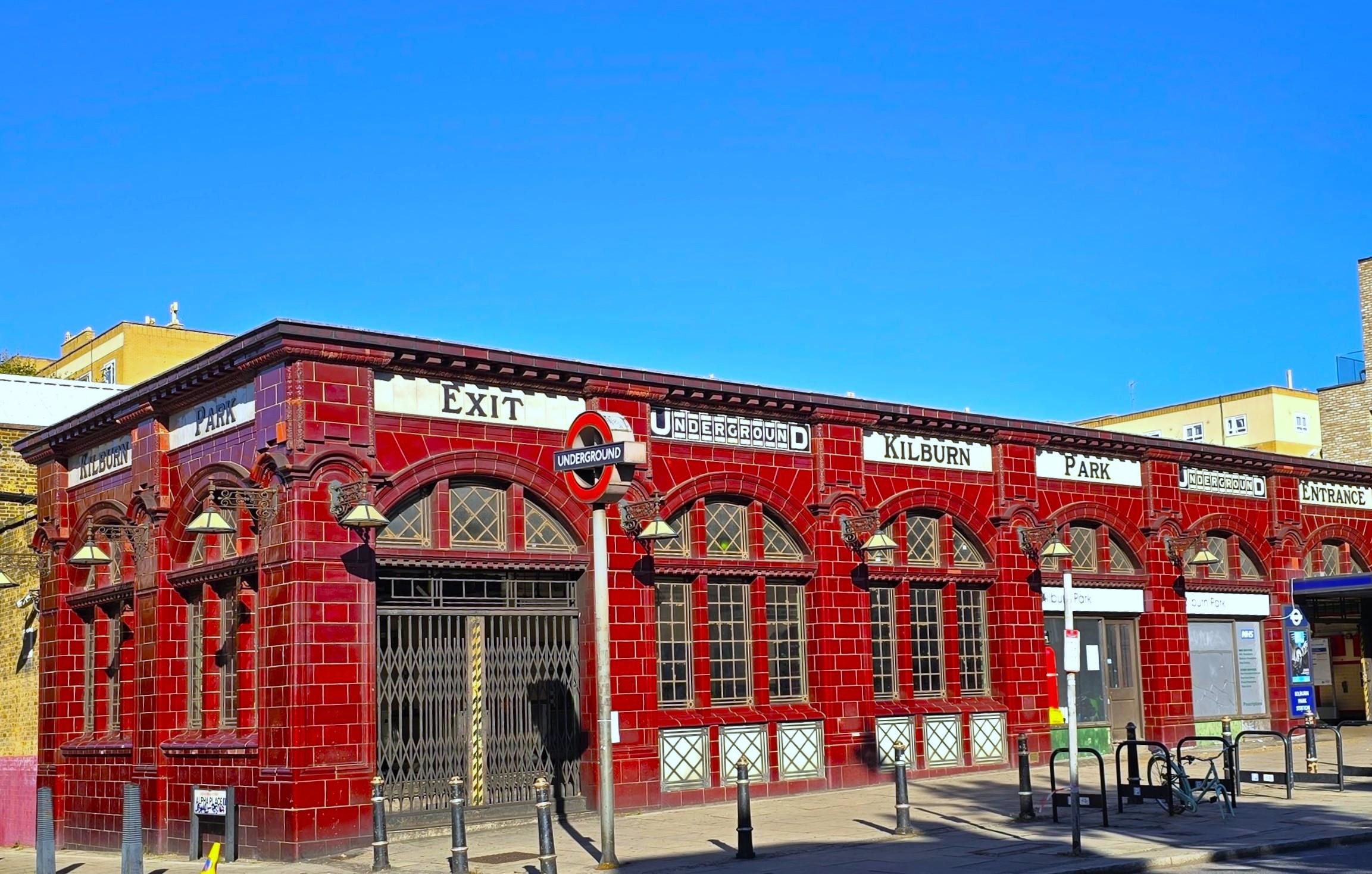
Kilburn Park station.
[© Mick Oldfield 2025]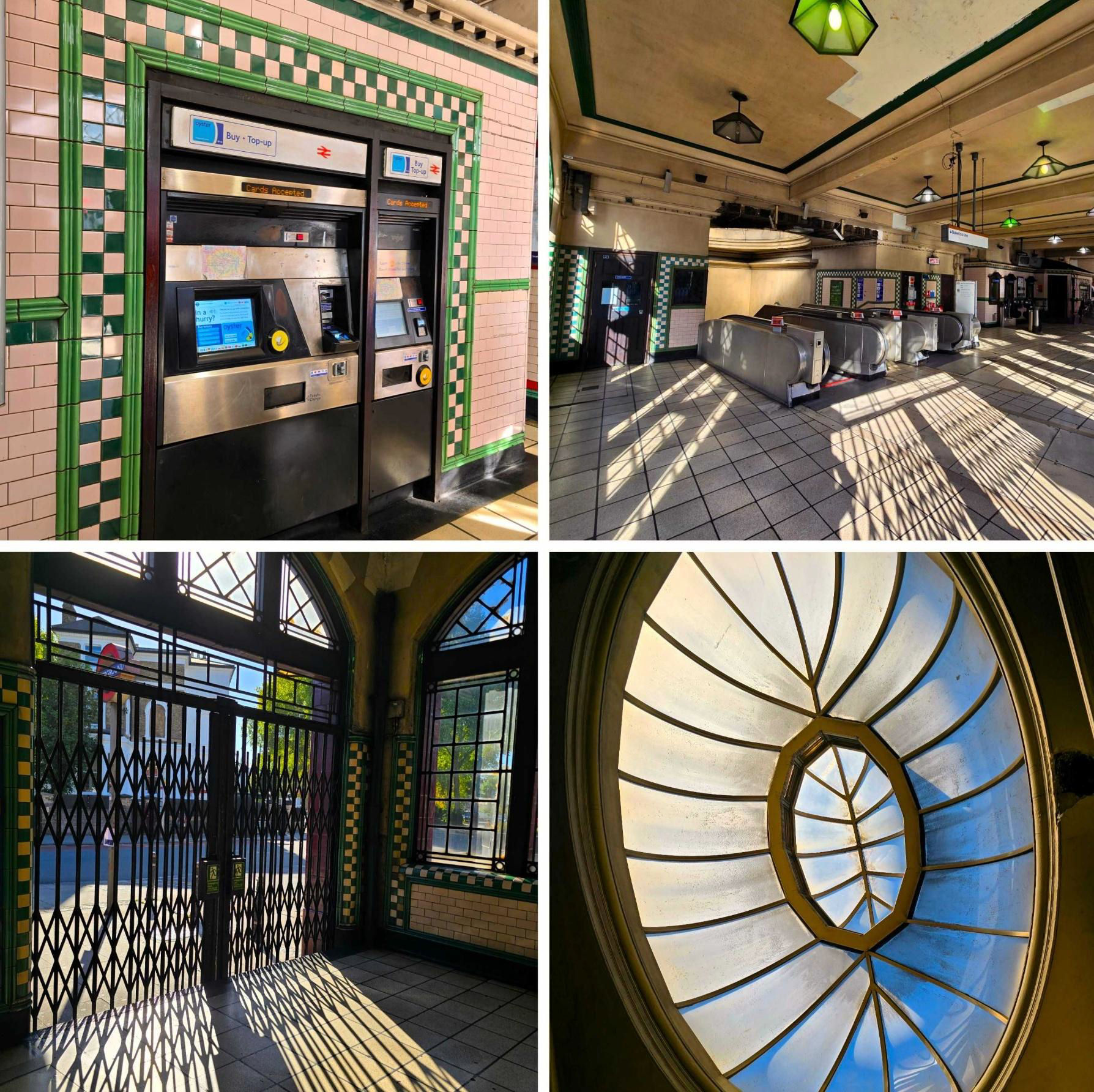
Four photos taken at Kilburn Park station - a visit is highly recommended.
[© Mick Oldfield 2025]Time and tide wait for no man and so we were onto the southbound Bakerloo line towards Elephant & Castle with
Maida Vale our destination. Again, Grade II listed, with some lovely old features, including the original entry-only / exit-only pair of crossed staircases, mosaics and some old signage. We took advantage of a spare five minutes to walk round the building, via Elgin Mews, which, for those with an encyclopaedic memory, was featured in the 1968 Avengers episode 'Take Me to Your Leader' of course!
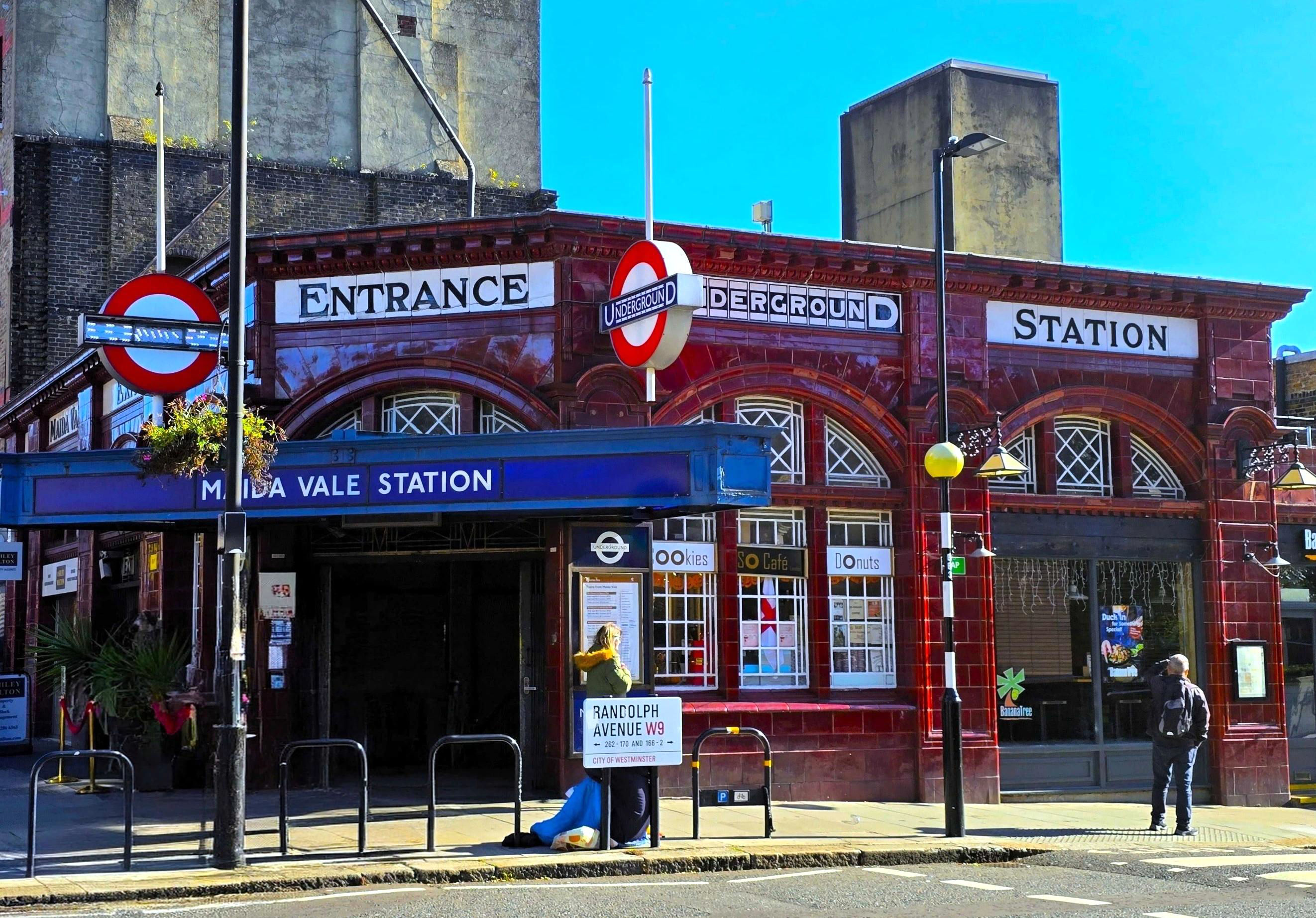
Maida Vale station.
[© Mick Oldfield 2025]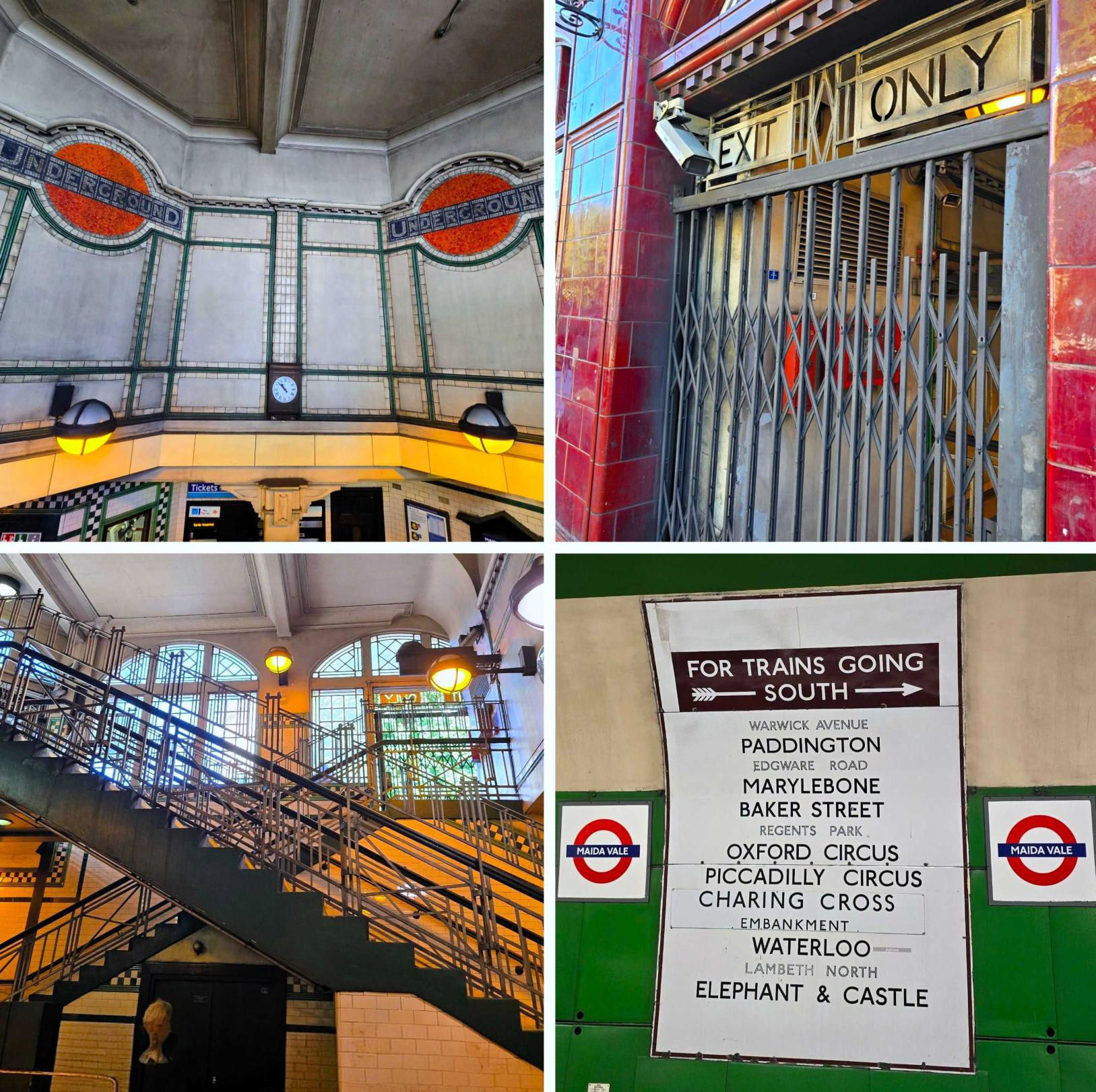
Just a sample from Maida Vale station - another one worth visiting.
[© Mick Oldfield 2025]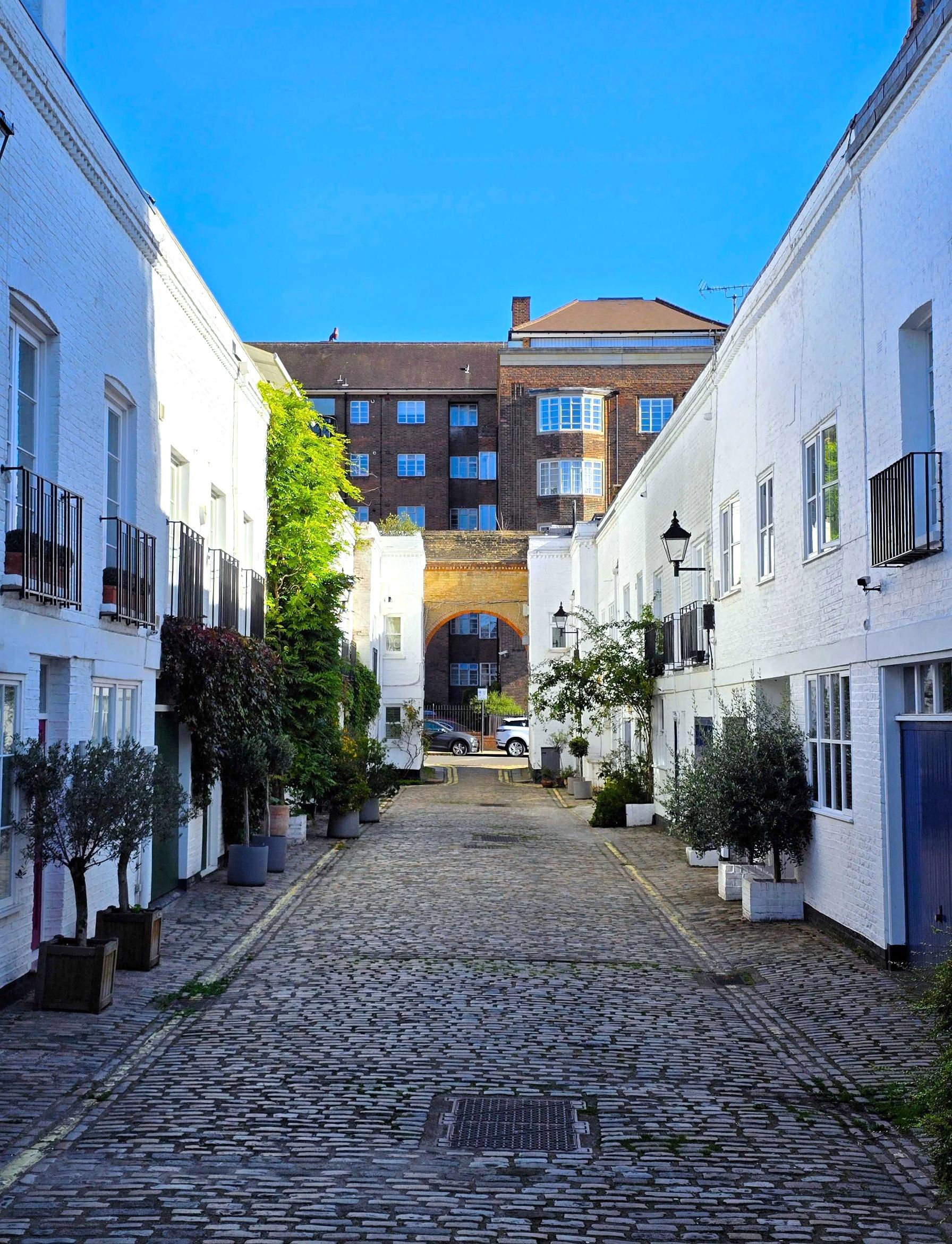
Elgin Mews, no cats and nothing to do with railways but featured in an episode of 'The Avengers' in 1968 'Take Me to Your Leader'.
[© Mick Oldfield 2025]Two hours and 3,000 steps in, we continued southwards on the Bakerloo to
Paddington - just two stops. As with so many parts of London, if you have not visited for a year or two, change is the only constant. The
Architects' Journal is probably the best place to go to read about the latest developments in and around the station. The
British Listed Buildings site outlines why Paddington station is Grade I listed. Personally, I love how the GWR Paddington building is now so much more open and obvious to the passing casual walker. Once more, Adam's historic photos helped us to position where original features, such as the taxi ranks, were located. We noted the royal emblem at the rear of what is now the GWR First Class and Sleeper lounge but was Queen Victoria's personal waiting room. There is also a wonderful display showing historic railway track, described
here by the ever entertaining Ian Visits.
A quick detour took our members to the Praed Street underground entrance which is opposite the façade of what was known as the Great Western Hotel. Next was nearby St Mary's Hospital for what to most of us was an utter surprise. Now the Mint Street wing of the hospital, the site was formally used as stabling for the original GWR dray horses, as
this historic photograph shows. Once you know, you can clearly see that same viewpoint today (below). Such a joy and privilege to see.
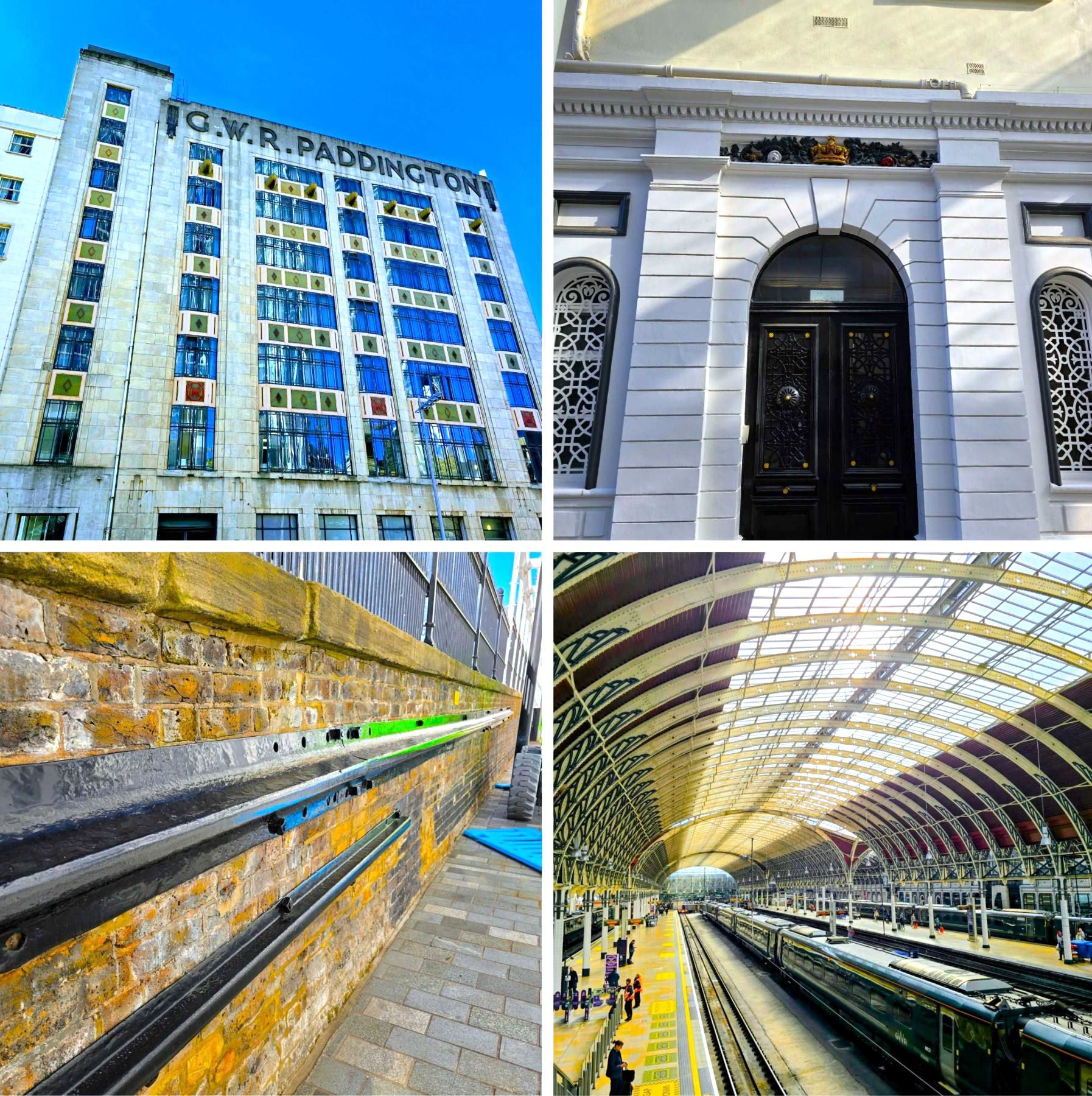
In and around Paddington station, the collection of rails is bottom left, probably not noticed by many people who are usually in too much of a hurry.
[© Mick Oldfield 2025]By now, we had easily exceeded 5,000 steps and so the 12.08 to Heathrow T4 train ride on the Elizabeth line west to Hanwell came as something of a relief to the feet.
Hanwell (& Elthorne), as many will know, stands out for the recent restoration that was carried out as part of the Elizabeth line works. Grade II listed, it is well worth a visit, even if, as with our tour, it's a question of hop-off, take a look, and hop-on again. The Service Information board at the station entrance contained a quote, from Stephen King 'You can, you should, and if you're brave enough to start, you will' - it was a fitting tribute to our party.
E-BLN has a few shots to highlight the nature of the buildings but there are many more available online. It may be tempting fate to say this but it was very pleasing to see that there was no obvious graffiti to be seen either to the station exterior, or to the buildings themselves. (In fact, I'd go so far as to say that was true for all of the heritage buildings that we saw). One final note from Hanwell, the lady on duty was clearly quite chuffed to see us all taking such an interest in the station, more on that aspect later.
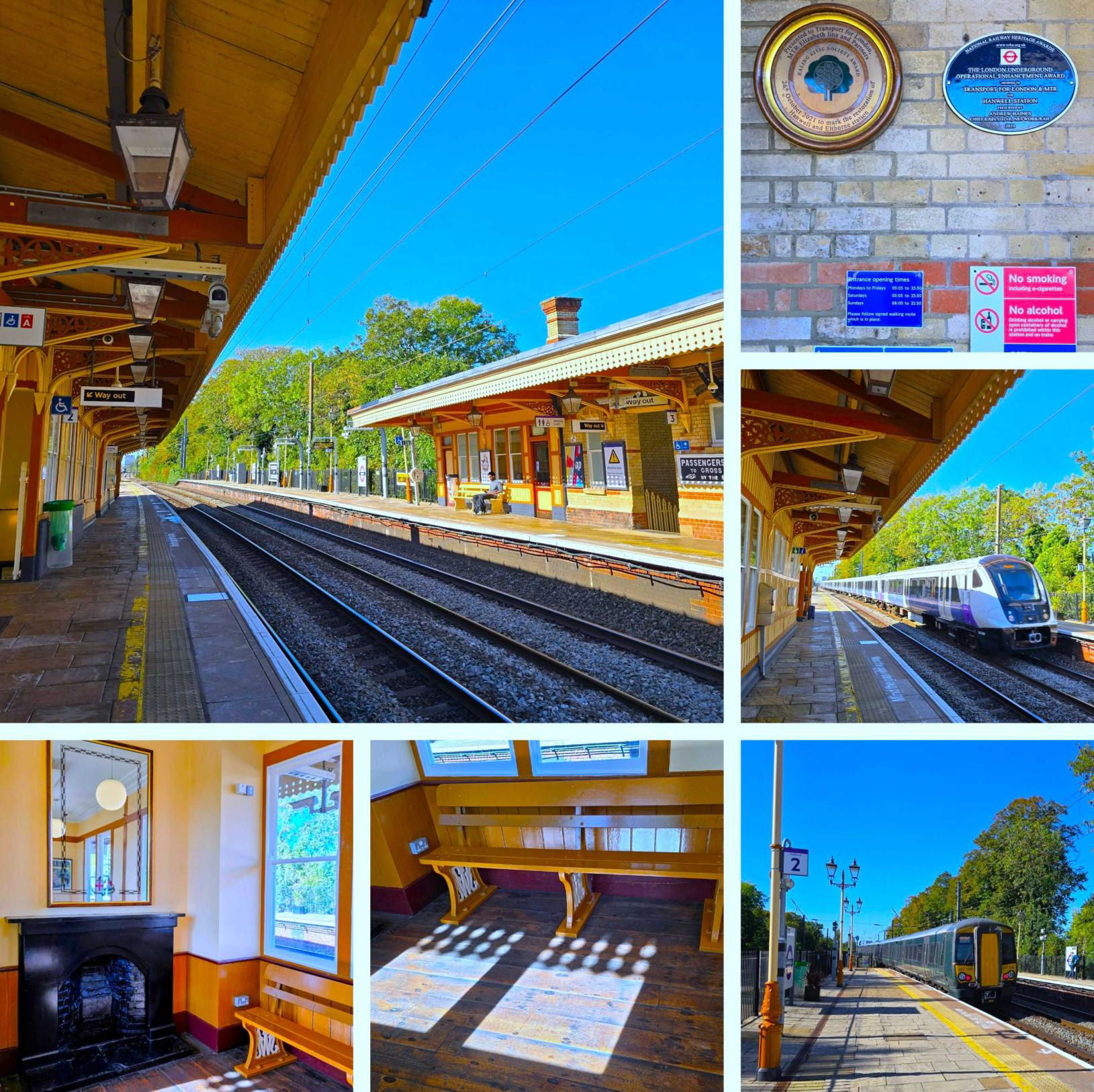
Images from Hanwell station.
[© Mick Oldfield 2025]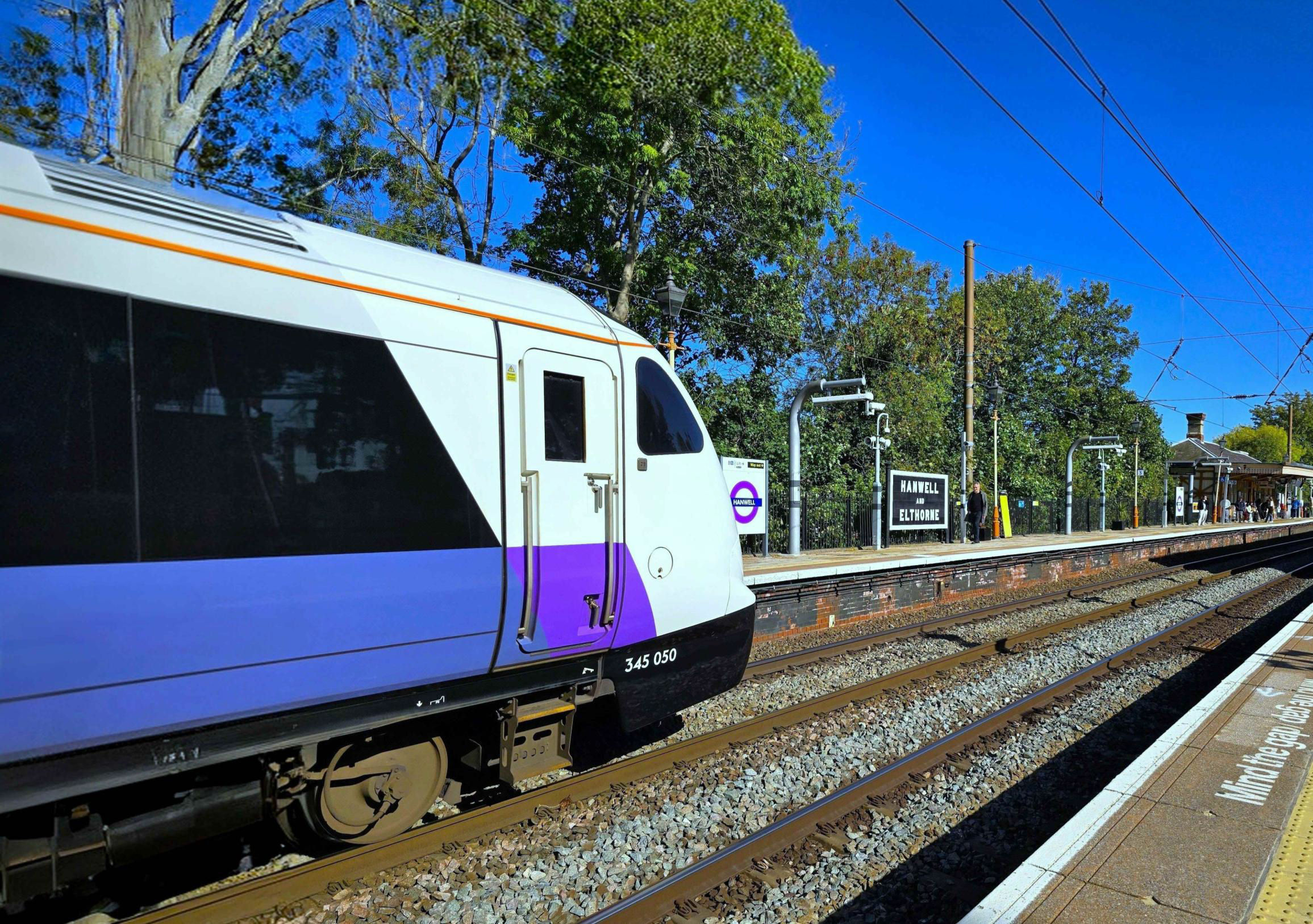
Elizabeth line class 345 345050 at Hanwell station.
[© Mick Oldfield 2025]Well into the afternoon now and the 12.38 to Heathrow T2/3, where we changed to a connecting service for T5. There was more transport excitement as we sped past
Southall Railway Centre briefly noting Class 57 57002 'Winston Churchill'. Then we were overtaken by flight BA266, which had left Portland some five hours before we had assembled at Baker Street. As we headed for the Level 2 car-park area at T5, I think most of us were wondering what Adam had up his sleeve this time, and what a treat it was.
Pod parking might sound dull, but it very much is not! These
pods operate from T5 to a very expensive car park on the airport perimeter; however, there is no obligation to have a car parked to use the pods and they are free to ride in. The original plan was to have five of us in one pod and five in another, however, much to the amusement of all, that attempt failed when a red light appeared, followed soon afterwards by a security gentleman on the intercom pointing out that we were 'overweight'.
Chastened, we split into smaller groups and set off to Station 'A'. The pods operate individually along a defined concrete route, which takes them right across the end of the runways, just behind the final set of landing lights. Naturally, as a BLS tour, we then had to walk to Station 'B' in the car park, to cover as much of the concrete track as possible in the available time, The clever thing is to do every route.
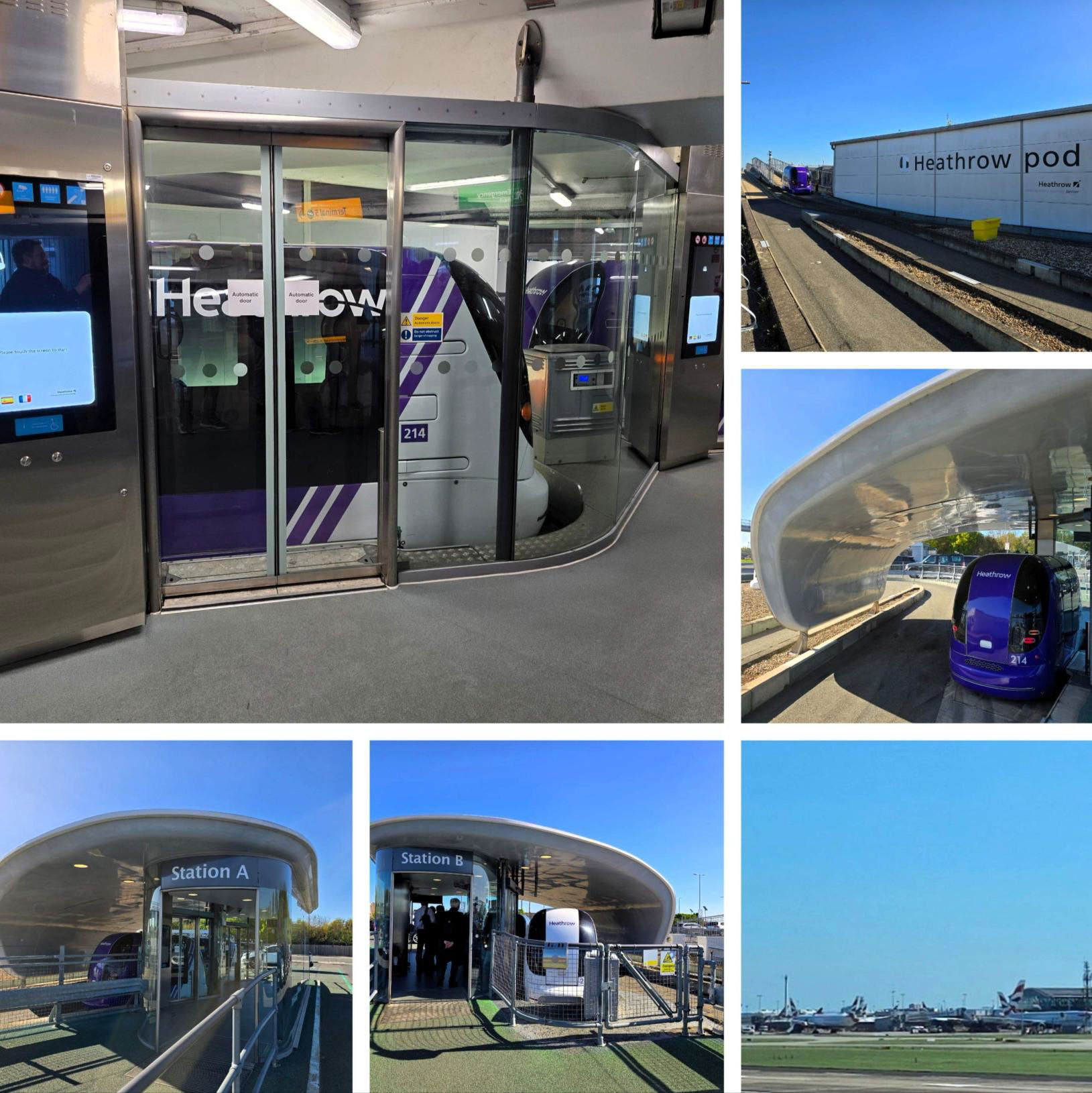
The Heathrow T5 pod system.
[© Mick Oldfield 2025]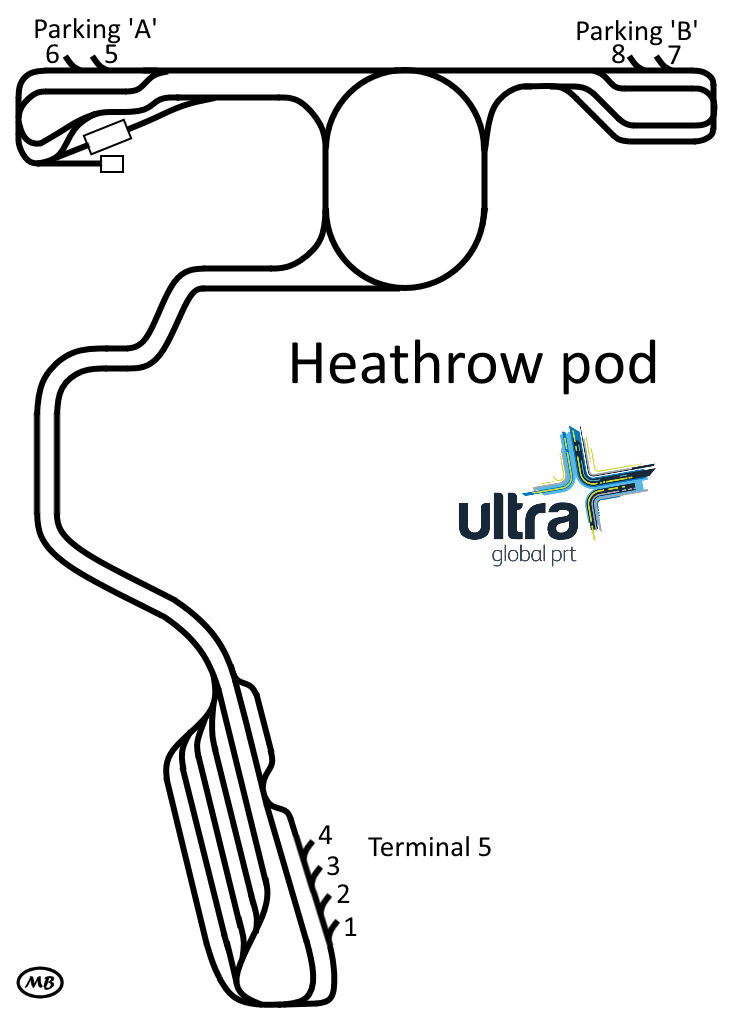
Heathrow T5 pod 'Track plan'. See BLN 1291.2121 'Podcast' in BLN of 21 Oct 2017.
[© Martyn Brailsford 2025]All agreed that, even for Adam, this was a highlight indeed. A pitstop at T5 (and now over 7,500 steps), we headed for the Piccadilly line platforms and our specially reserved (group joke), empty, front carriage for the next leg to Hatton Cross. The destination of our train was Cockfosters, another fine station but one for another day, perhaps.
Hatton Cross itself, opened on 19 Jul 1975, as the Wiki entry mentions, it is particularly famous for the surviving mosaic tiling, the design dating from 1932, and featuring the (then) Imperial Airways Speedbird logo, adopted by BOAC on the 1939 merger. Of course, the British Airways callsign is still Speedbird, having been chosen at the time of the BOAC / BEA merger in 1974. [BOAC was British Overseas Airways Corporation and BEA was British European Airways.]
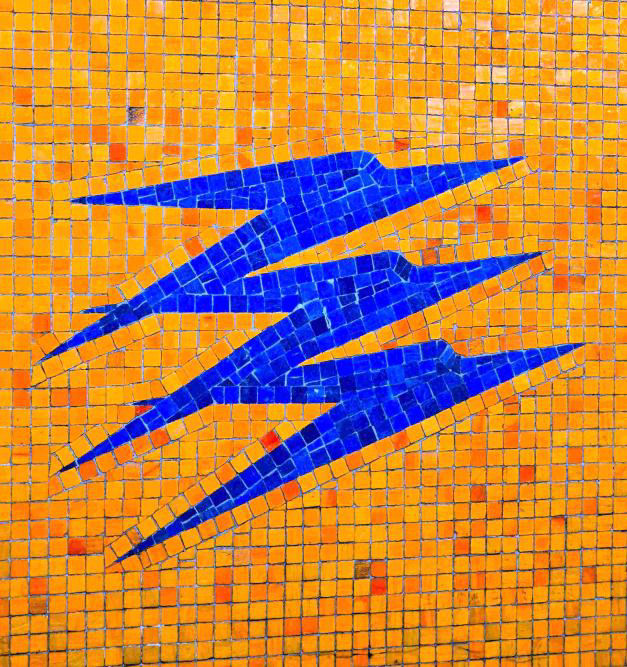
Hatton Cross, surviving mosaic tiling of the 1932 Imperial Airways Speedbird logo, adopted by the British Overseas Airways Corporation with the 1939 merger. British Airways callsign is still Speedbird, after being chosen at the time of the BOAC/BEA merger in 1974.
[© Mick Oldfield 2025]We stayed sub-surface and boarded the next eastbound train again towards Cockfosters, this time heading for Hounslow West. Of interest on this bit of track is that it surfaces out of the tunnel for a brief period, to cross the
River Crane of which more at the link to Paul Talling's excellent page. Should you ever want to know more about the lost rivers of London, or bygone London, Paul's
Derelict London
and
Lost Rivers websites are gold dust - there are many, many transport related photos on there!
Hounslow West itself is now a Charles Holden building designed in 1931 but Adam had yet another corner for us to investigate. So, after a sharp left outside the station, there it was a small section of the original building (opened as Hounslow Barracks station in 1884). How it has survived all the changes detailed on the Wiki page is hard to fathom but survived it has. As AA78 from Dallas came in overhead, we headed back inside, where, again, the station staff were only too happy to show us the working railway set now set up in the old passimeter (ticket booth originally with turnstile)
here has more.
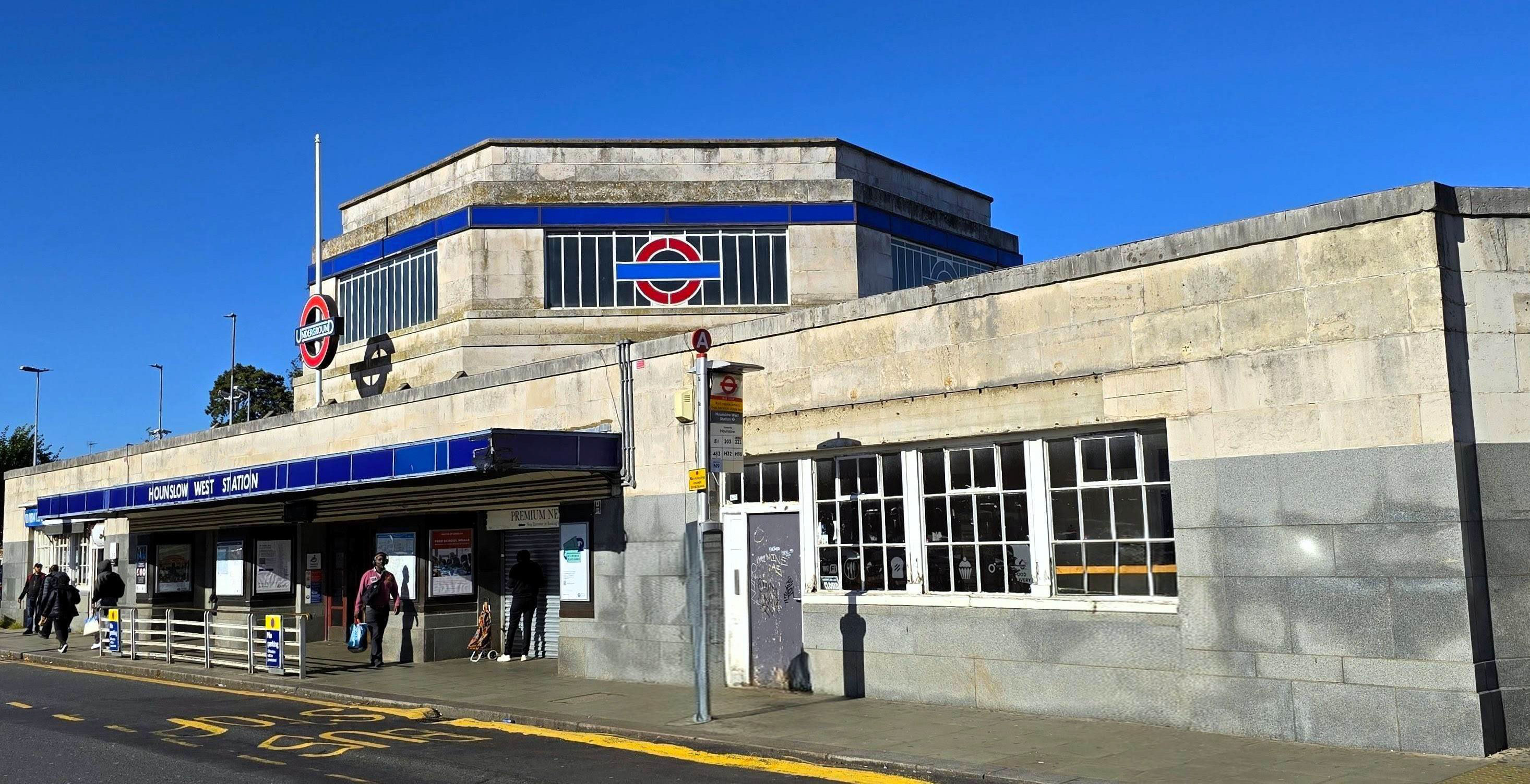
Hounslow West station.
[© Mick Oldfield 2025]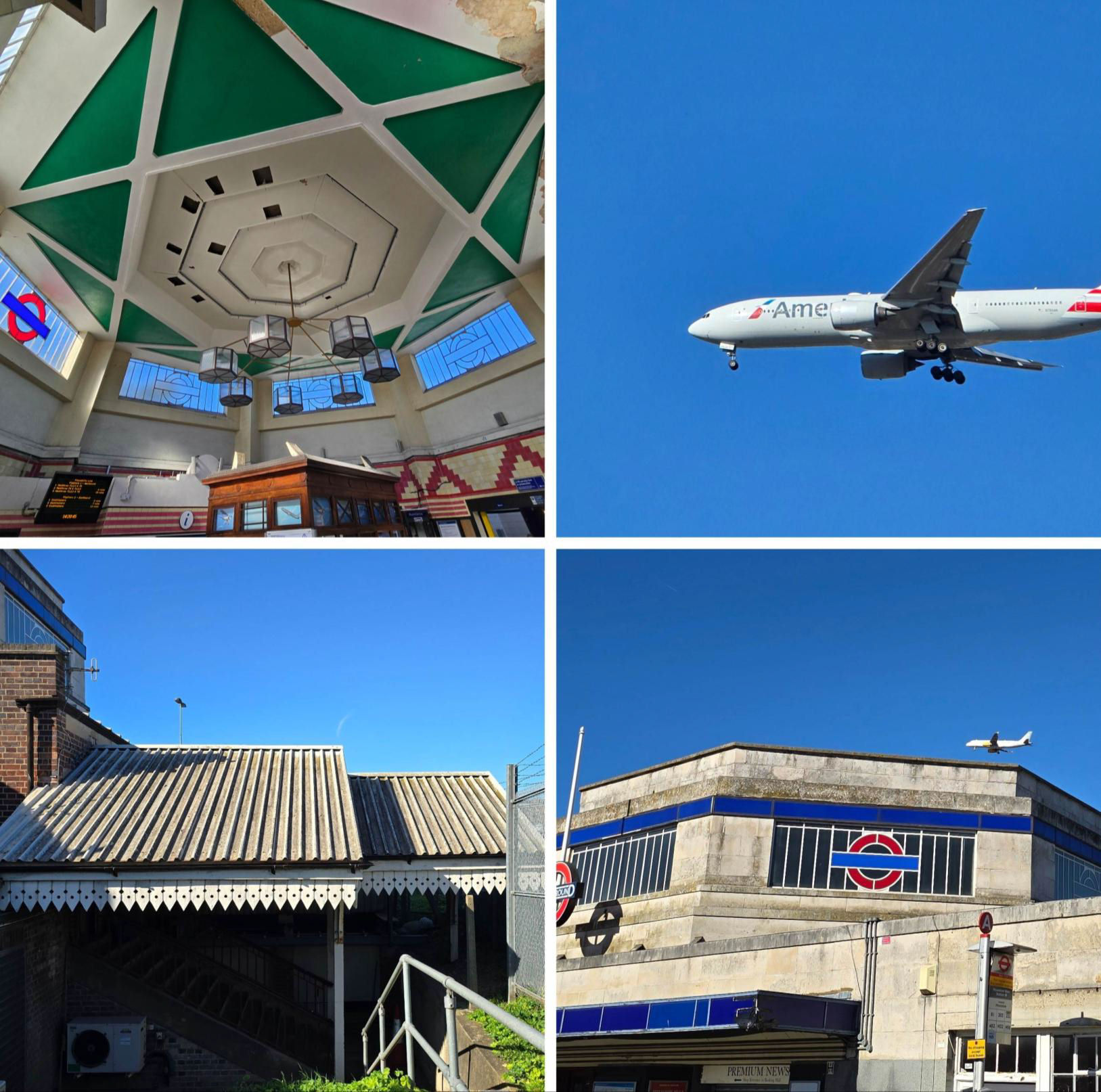
Images from Hounslow West station.
[© Mick Oldfield 2025]