Day 4, Mon 28 Apr 2025:
Despite the later start, I still woke up at about 06.00 but had a lie in and rose at 06.30. By 07.15 I was out of the apartment and by just gone 07.30 had spotted Peter Green, the Editor in Chief, already chomping a Bacon & Egg wrap in McD's on Poznań Główny station (reminder: Główny = 'main'). To ring the changes, I had the mushroom and egg wrap with the obligatory bucket of caffeine.
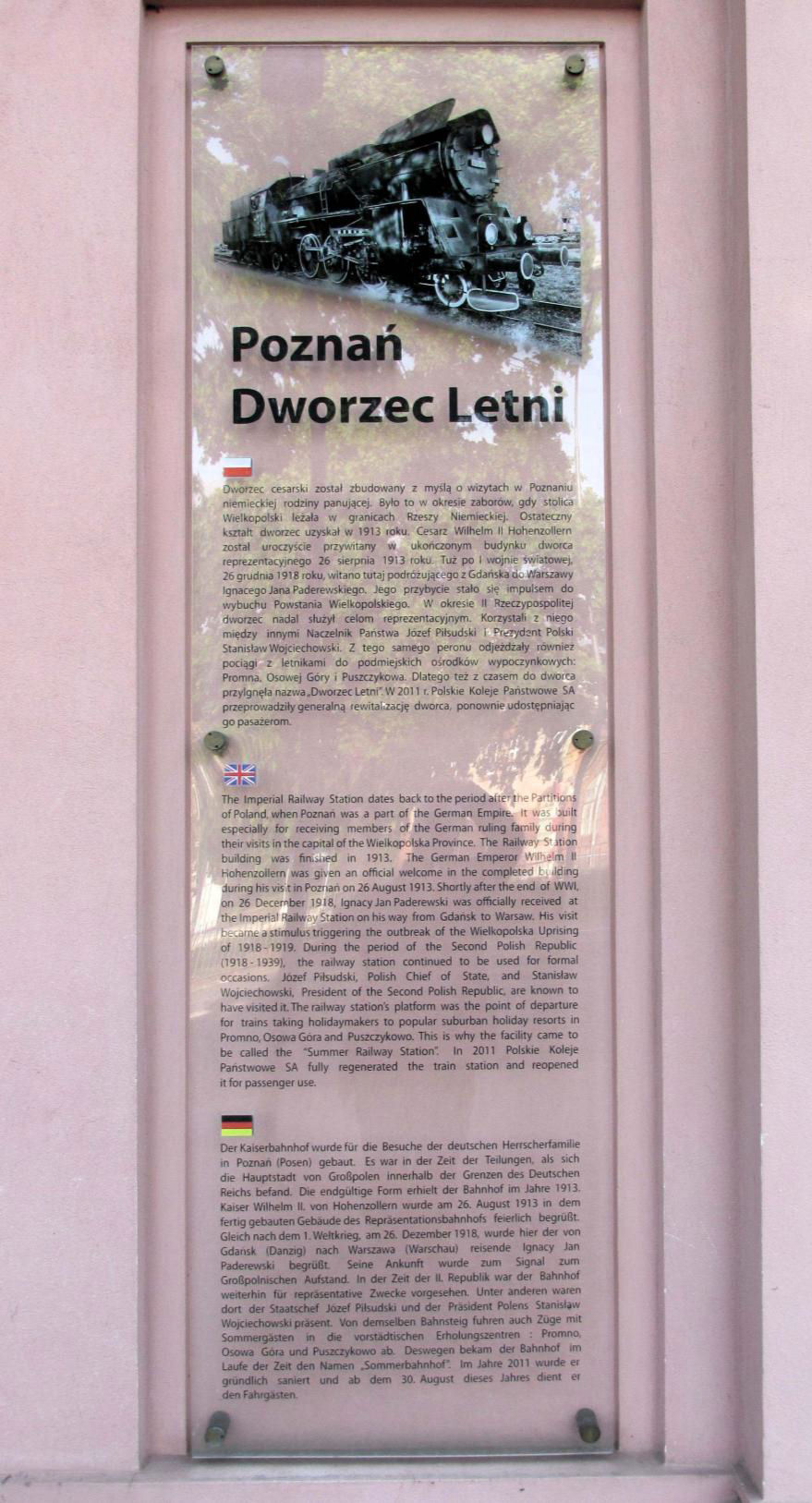
Poznań Dworzec Letni (= Poznań Summer Railway Station), an information panel in Polish, English and German.
[© Simon Mortimer 2025]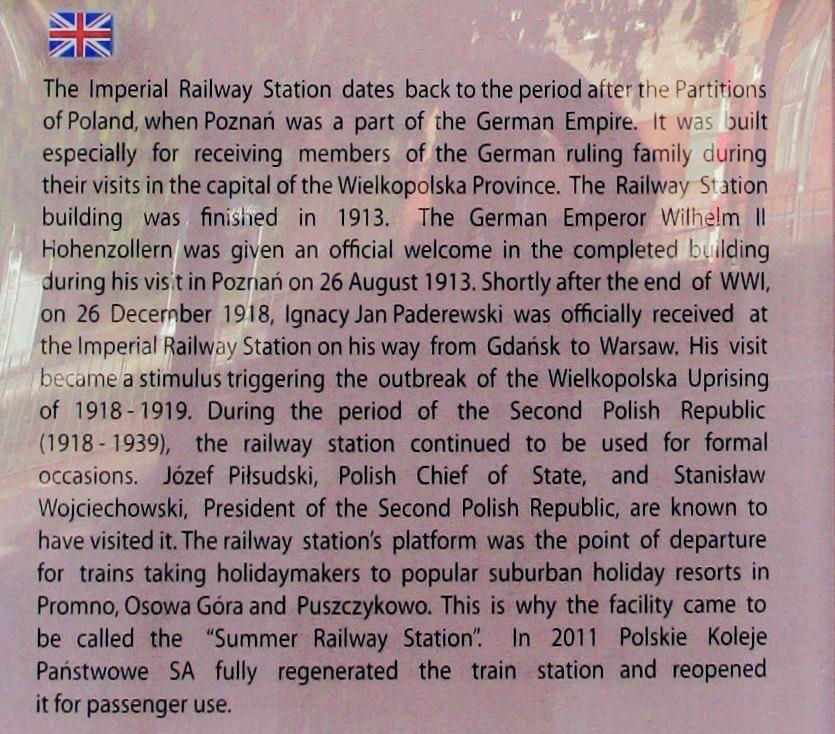
A close up of the English section.
[© Simon Mortimer 2025]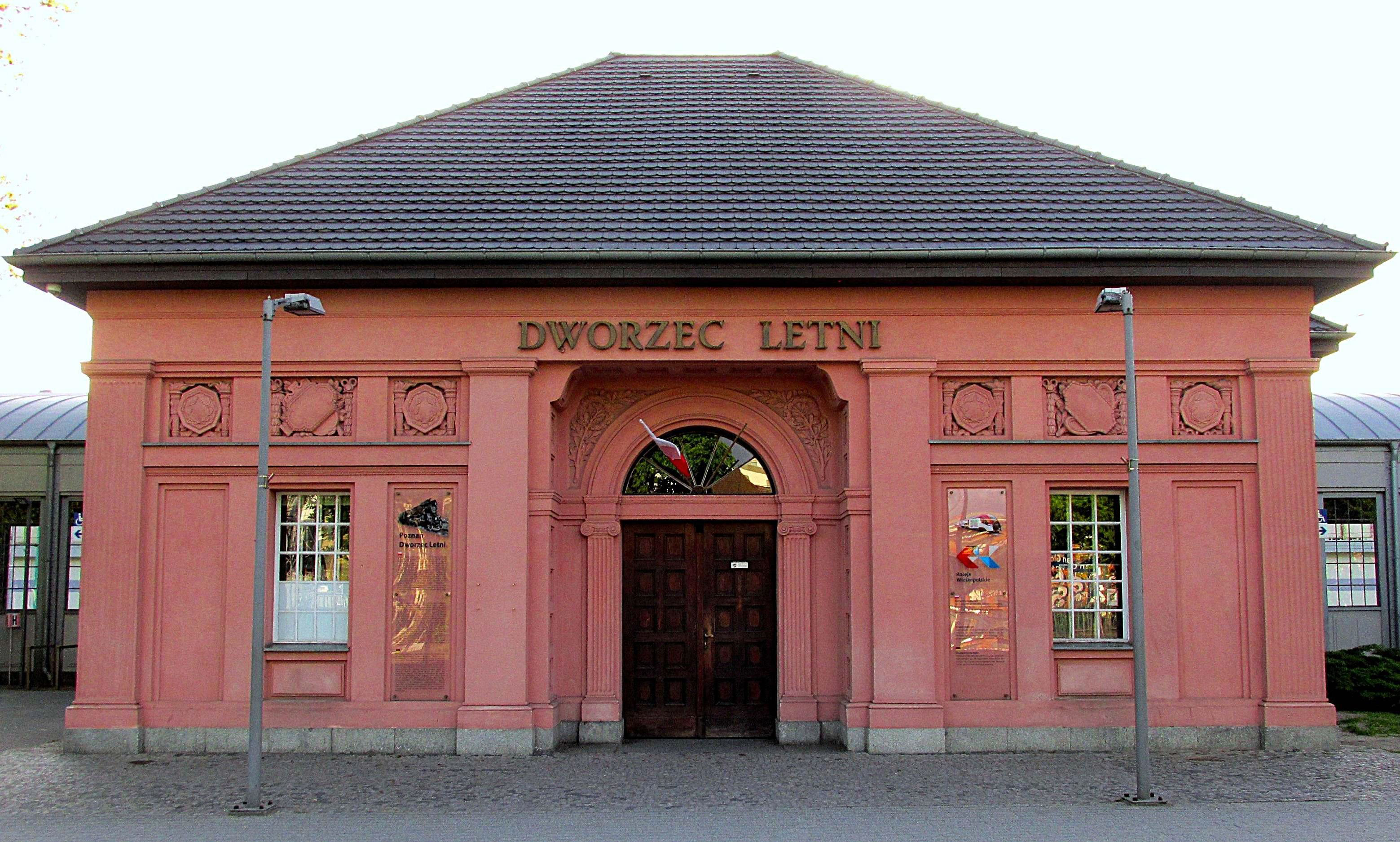
The Summer Station... Poznań Dworzec Letni ...opened by Der Kaiser Wilhelm in 1913!
[© Simon Mortimer 2025]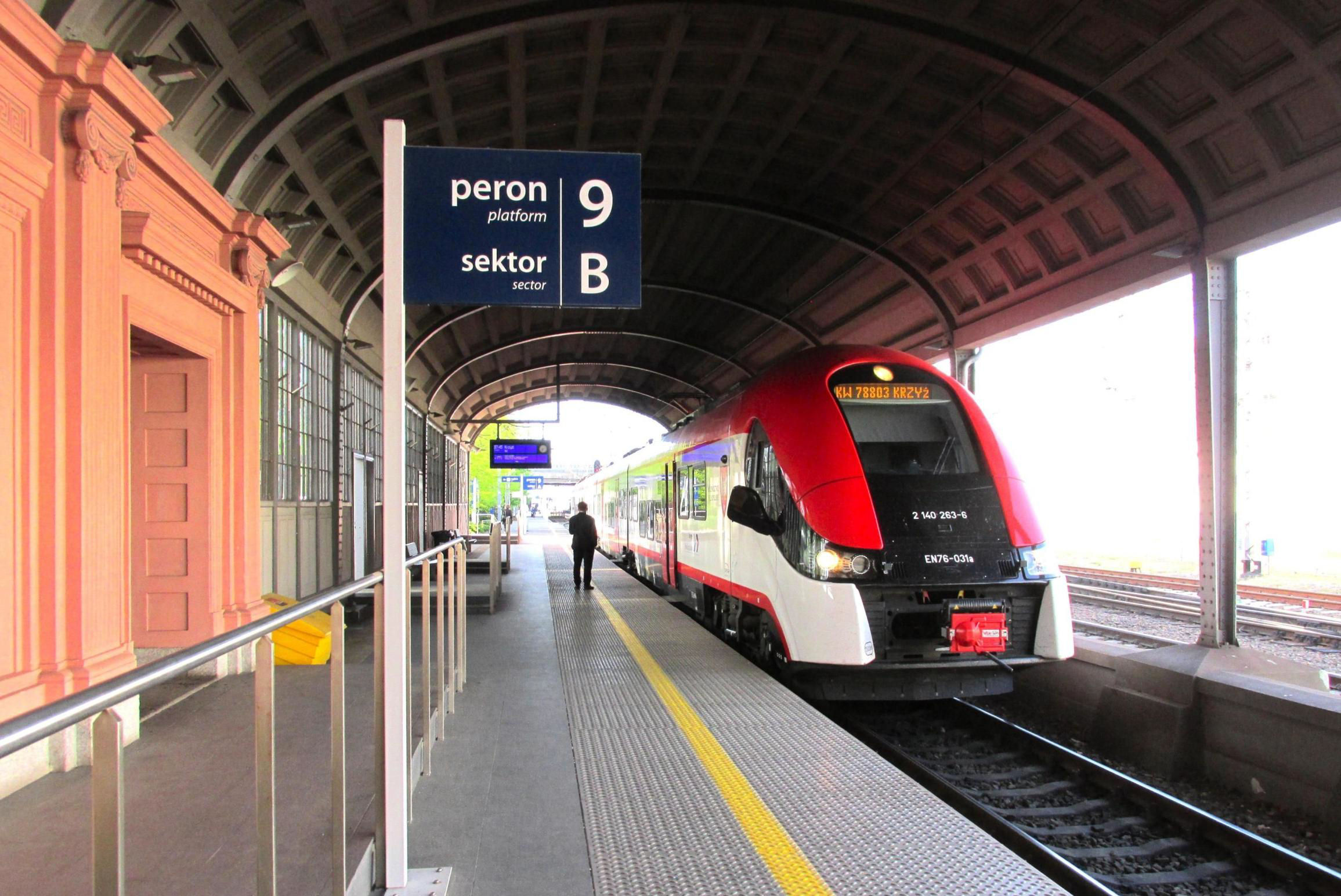
The other side of that building … EN76-031 on the 06.33 departure from Poznań Główny Peron (Platform) - 9 the Imperial Platform
[© Simon Mortimer 2025]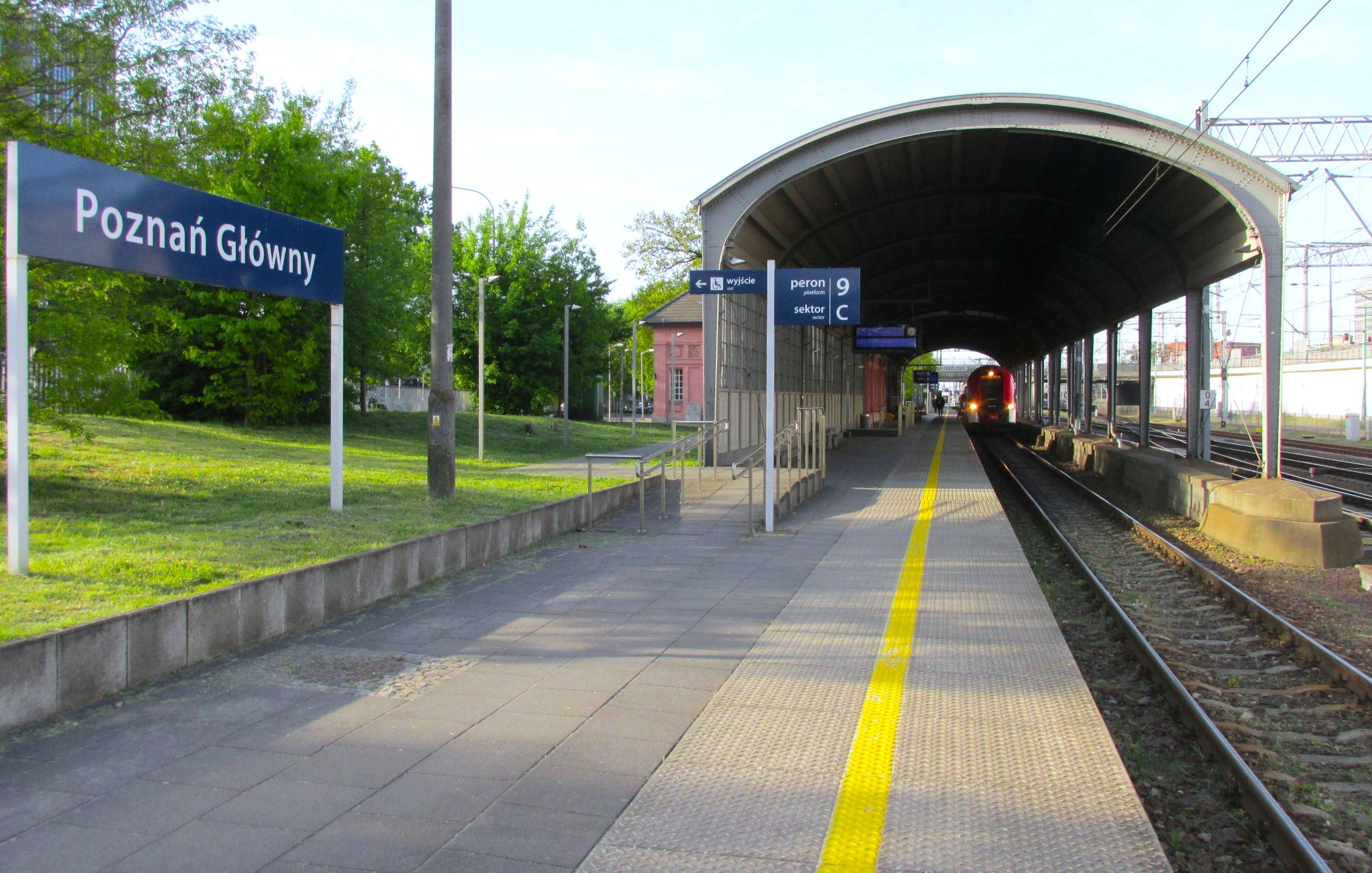
As can be seen, yellow lines have reached Poland as well … stań za żółtą linią!
[© Simon Mortimer 2025]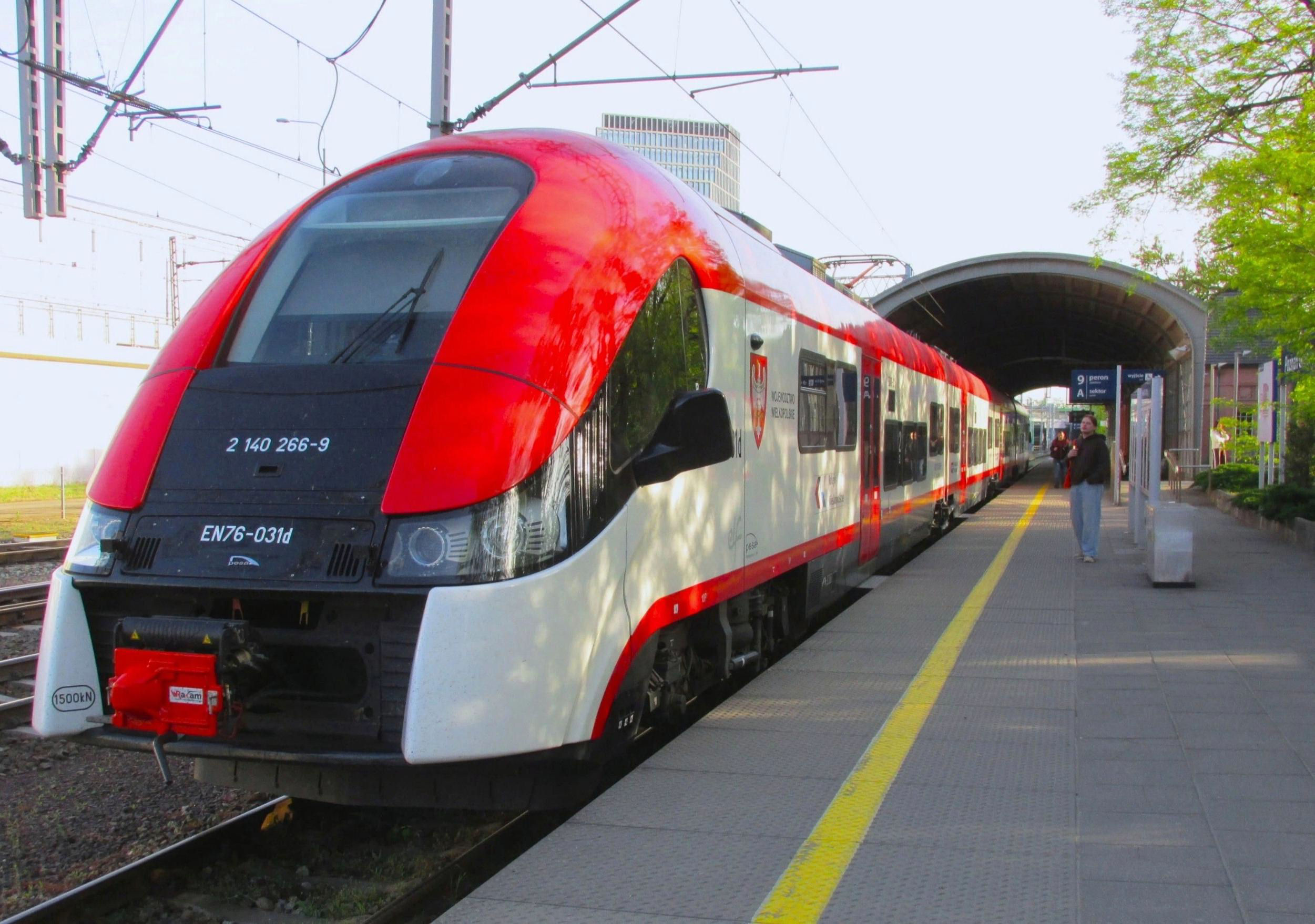
The other end of the same platform (but a different unit!).
[© Simon Mortimer 2025]At 08.11 precisely, we zipped out of Główny towards Poznań Starołęka back over the long ladder of crossovers that we had traversed the other way (to the delight of the bidirectionalists) the night before. Then it was back around Curve 352 to Franowo Yard. This time we took the southern side passing PFD (Poznań Franowo signal cabin 'D' rather than just Poznań as suggested in the BLN 1477 report) on Line 824 to flyover our route from last night towards Swarzędz, looking down on Line 806 to our right … one for another day! We pressed on through the trees, Chord 805 joined us from the right; at the time of the tour blocked for rebuilding. Our tour flew over the main (Line 300), this time veering left at podg. Zieliniec isolated in the woods onto Line 395 and diving under Line 353, noting that some industrial sites marked in the Mały Atlas looked more ex-sites. [For the last time, podg. is posterunek odgałęźny, literally 'separate post' or 'branch post' effectively a 'junction'.] Then our train reached the impressively long curving viaduct over the Warta (again!) - Poland's third longest river - pushing onto Poznań Piątkowo. We crossed over Line 354, observing that much of the track in the opposite direction was dewired or lifted, clearly a typically Polish complete reconstruction, including Curve 803 towards Złotniki.
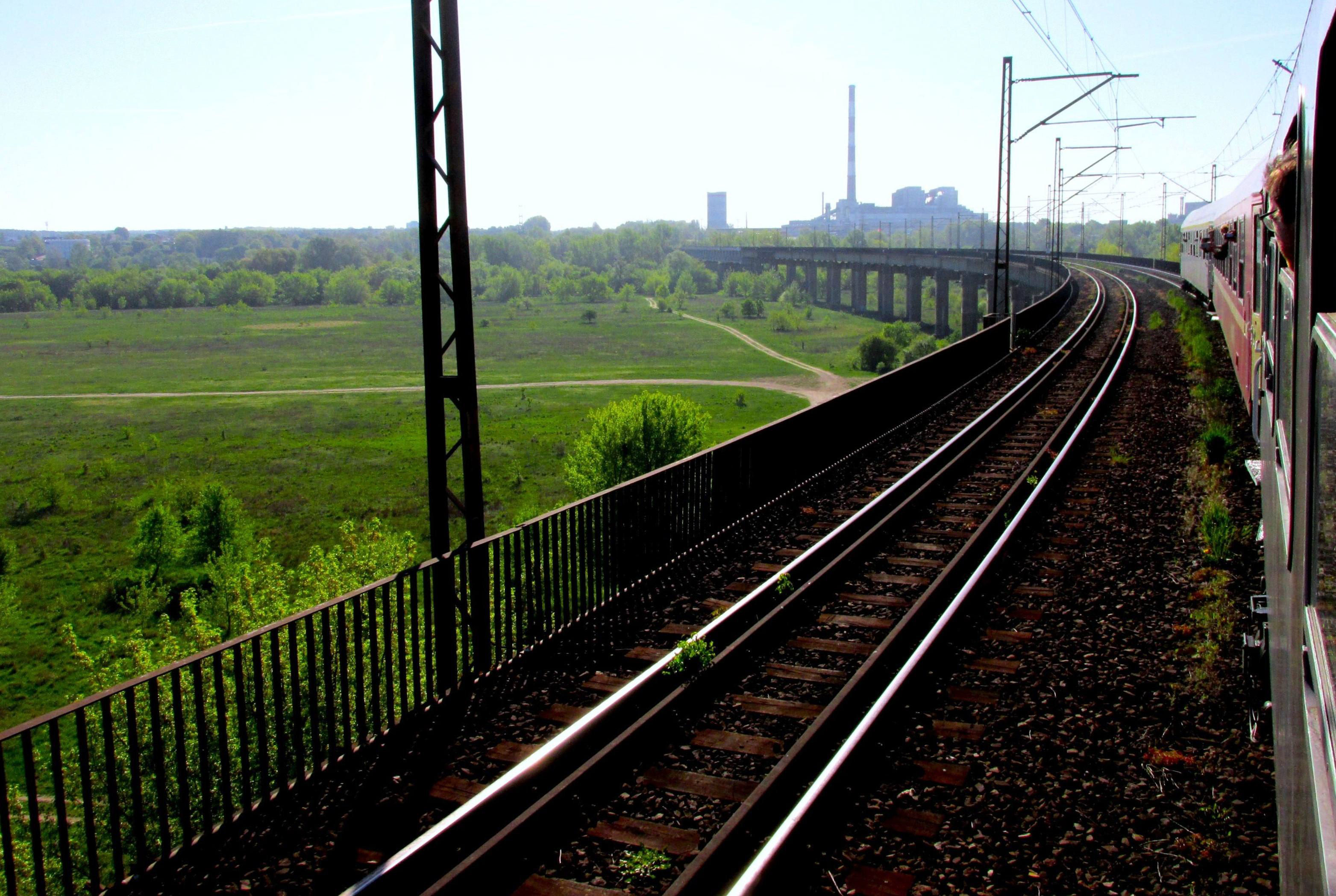
View back crossing the Warta river and floodplain on the Poznań freight ring.
[© Simon Mortimer 2025]Our tour eventually approached Kiekrz on the main Line 351 towards Krzyż (an important railway junction; incidentally, krzyż is Polish for cross). This was our next point of reversal but, before arriving, we veered right through the yards, Track 3, to gain the platforms on the Piła to Gorzów Wielkopolski line, (Wielkopolski = Greater Poland) off the main line northwards which otherwise just flies over, a rare move and connection. While our loco ran round, flood damage inflicted on the subways here could be perceived as they are completely boarded over, one wonders if they are still full of water?
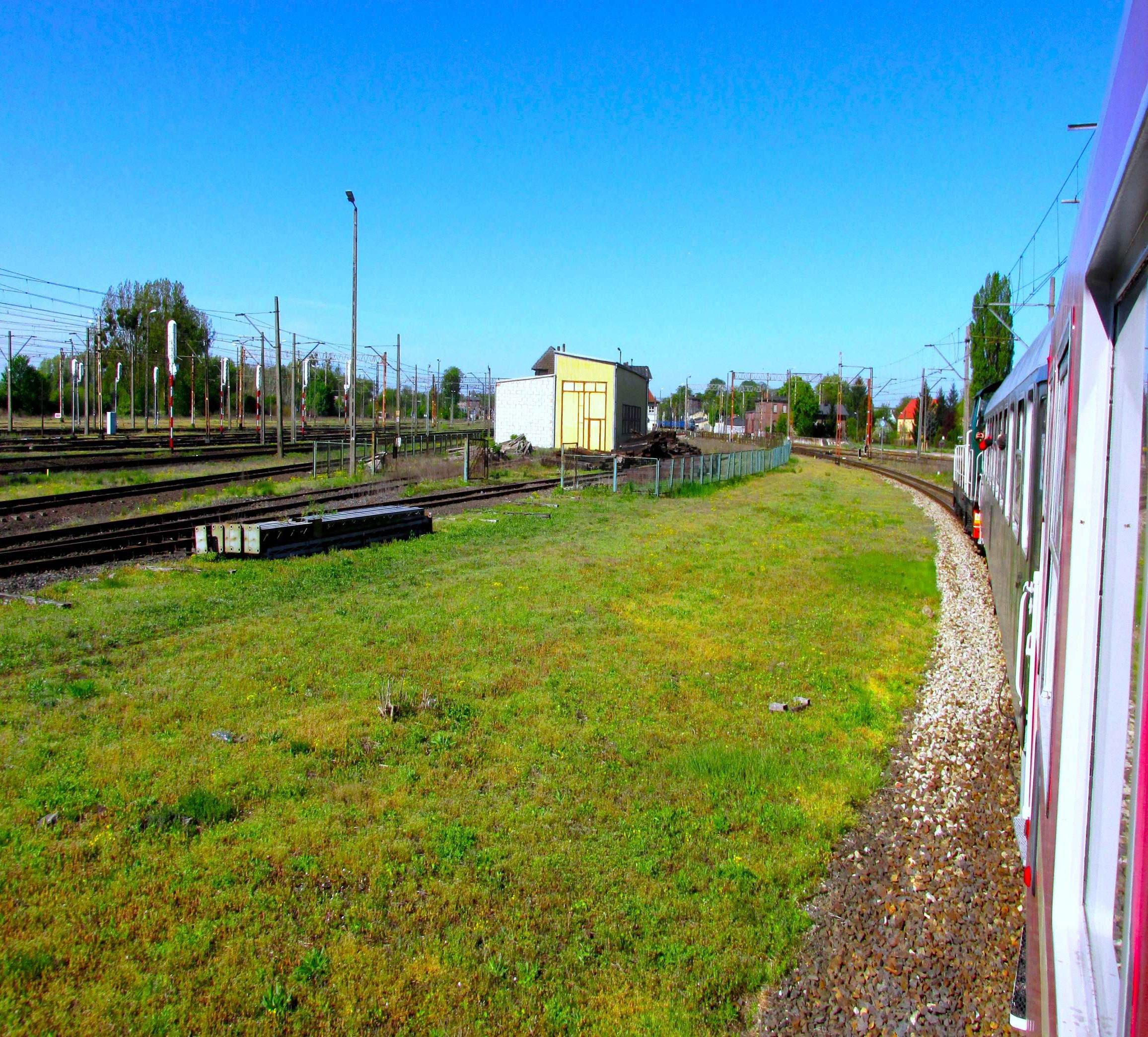
View forward towards Krzyż, here the railtour is on Track 3 that connects the main north - south Line 351, left, with the east - west Line 203, right.
[© Simon Mortimer 2025]We ran along secondary Route 203 for an hour or so to the typically Polish country junction of Piła Główna, where seven lines converge and six are still open to regular passenger traffic. Naturally, we headed for the seventh, Line 374, which used to run to Czarnków and onto a junction just south of Krzyż, a duplicate route to that just traversed but mostly south of the River Noteć. Today, we were restricted to the 14km to Mirosław Ukski station and stopped where its station lights were clearly visible ahead just beyond the level crossing. The Polish equivalent of a MOM (Mobile Operations Manager) perhaps a KOM - Kierownik Operacji Mobilnych, threw the manual weighted points to set us off down a branch into the woods The branch reached a level crossing across the same road which passes just in front of Mirosław Ukski station. The KOM opened the gate and our tour ran into the concrete sleeper factory, run by WPS (Wytwórnia Podkładów Strunobetonowych), one of the biggest manufacturers of sleepers, turnout bearers and railway crossings in Poland, where the loco could run round. We weren't allowed to alight here, which was understandable so there was a very good 'turnout' in the front vestibule which went to crush load for track and photage. No stress there and no 'sleepers' amongst participants then.
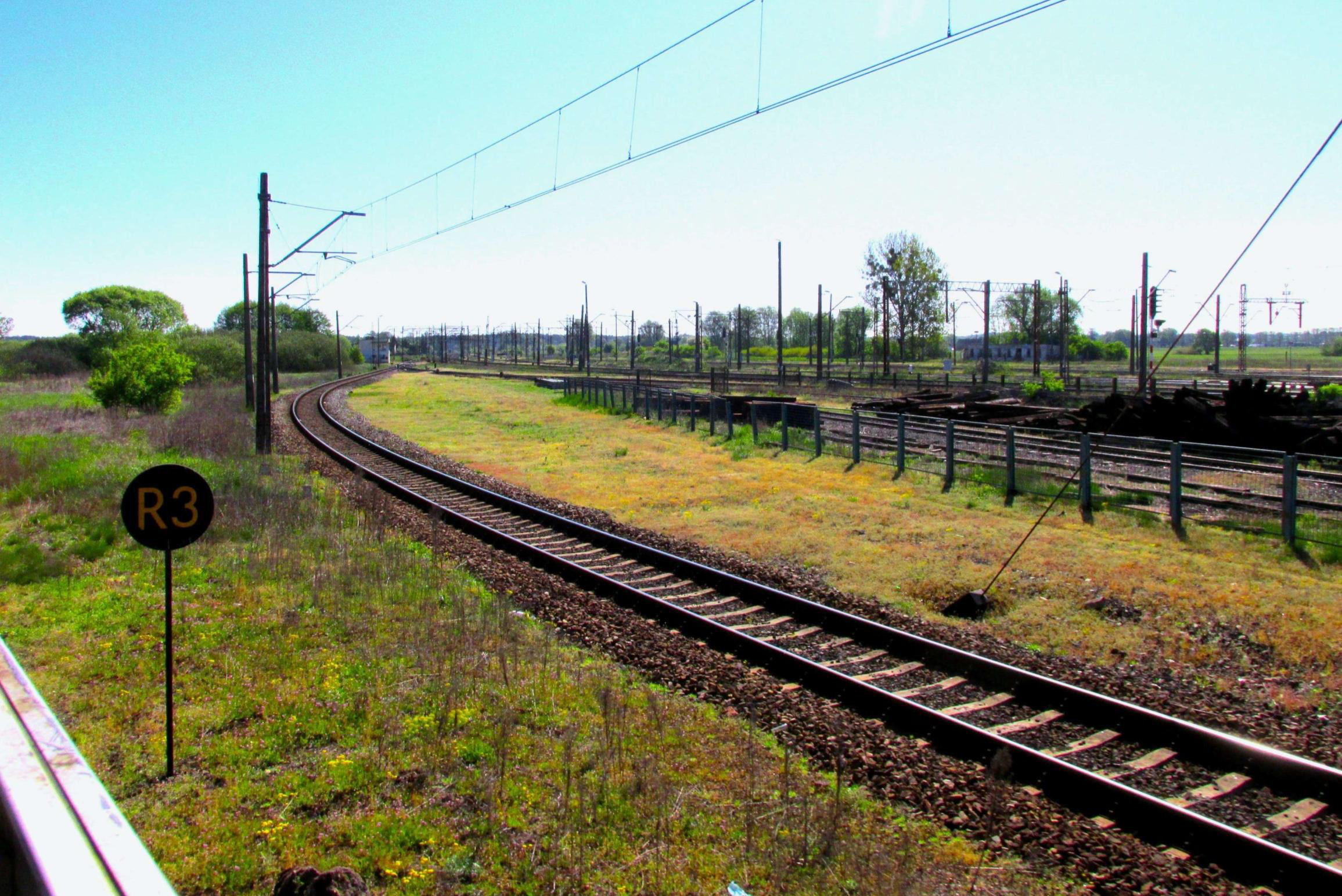
Leaving Krzyż on Line 203 towards Piła Główna; view forward of that Track 3 link line (right) just traversed by the tour from main Line 351, far right.
[© Simon Mortimer 2025]Returning off the branch, we wondered if we could propel to the station but it appears that section is 'closed', whatever that really means in Poland, as the line was clearly all intact. Anyway, it wasn't to be and we returned to Piła Główna. After a pause, we were off along Line 403 to Kalisz Pomorskie (67km).
Kalisz Pomorskie used to be a crossroads of lines but today just that from Stargard, which we had travelled from Piła Główna in the opposite direction, has passenger traffic. Until recently, Line 410 was closed to all traffic. It runs from a junction at Choszczno on the line from Stargard towards Poznań, then continues fully 50km to Złocieniec. However, thanks to one V Putin and the Poles taking their national security seriously (a subject they have ample historical experience to draw upon), this line had been rebuilt and reopened to provide strategic access to several military bases and storage sites which even glancing over the Mały Atlas or Google Maps are (little soldier symbol) quite abundant in this region.
This route had been offered to our organisers in lieu of the Drawno branch but that was quickly turned down due to the lack of a runround. It would have required a second loco but none was available locally.
A second loco was not available in the area (unlike at Rzepin for the Sieniawa line), so this would have been prohibitively expensive. Taking this route took us further away from Poznań, so some elements of the freight rings had to be dropped there but, hey, 50km of 'new' line isn't available every day!
At Kalisz Pomorski we ran round to the accompaniment of a timber train being loaded with logs, laboriously, by grab crane, each drop resonating a drum beat across the town. We left 23 mins down and turned left almost immediately onto serenely well laid track, all pristine concrete sleepers and continuously welded rail. Despite being timed for what appeared to be 80km/hr we trundled along at 60km/hr; perhaps we were being used to bed the road in but it looked immaculately tamped. Our train passed the occasional middle of nowhere remnant of a station until, 16km on, we passed through the substantial settlement of Mirosławiec. It is possibly the only really notable population centre on the route; in 1843 it had roundly 2,300 inhabitants and now has … 2,700, so no sign of explosive growth!
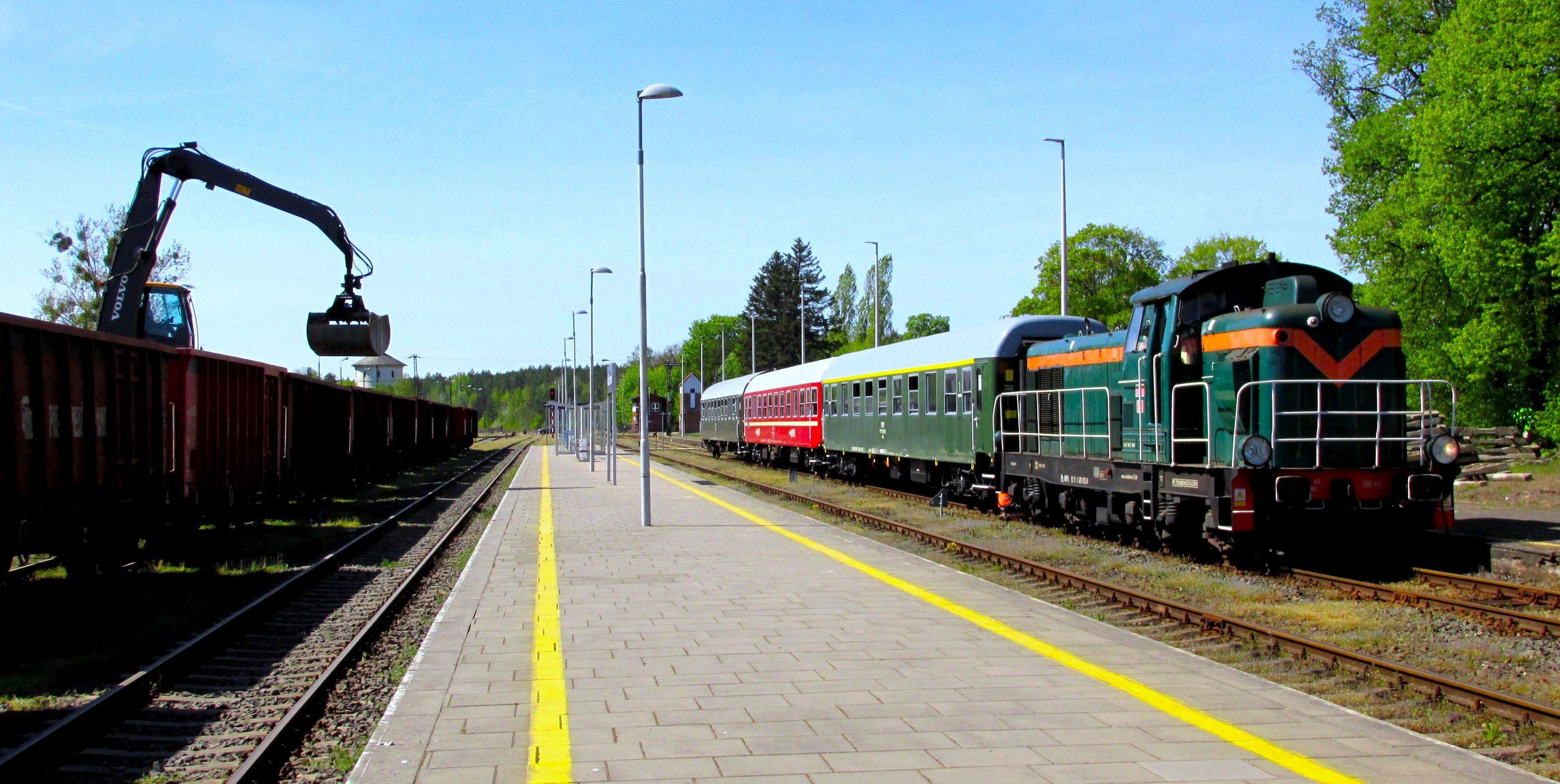
Kalisz Pomorskie; our tour runs round to the rhythm of the timber loading (left)
ready for our 50km run over the reopened strategic military freight line to Złocieniec.
[© Simon Mortimer 2025]About a further 6km further on, a very rusty and rather decrepit looking spur (in total contrast to the running line) trailed in from an adjacent classic Warsaw Pact style military airfield with semi-circular hardened aircraft hangers, designed to deflect and absorb incoming ordnance. A little way north of here, a much larger old yard with hard standing where military vehicles could be transhipped to railway transport could just about be determined in a jungle of trees clearly grown over decades, possibly last used by the resident Russian military when they went home‽ In contrast to the old military installations and remains at the station of Wierzchowo Pomorskie 75.9km (29km on down the line), approaching the notably well renovated building which only betrayed its location with a large 'Wi' painted on the wall, five children ran down their front steps and waved us through! Given none looked over ten years old, this was almost certainly the first passenger train they have ever seen pass their home and, given their location, possibly EVER! We eventually rolled towards the junction at Złocieniec, 28 down.
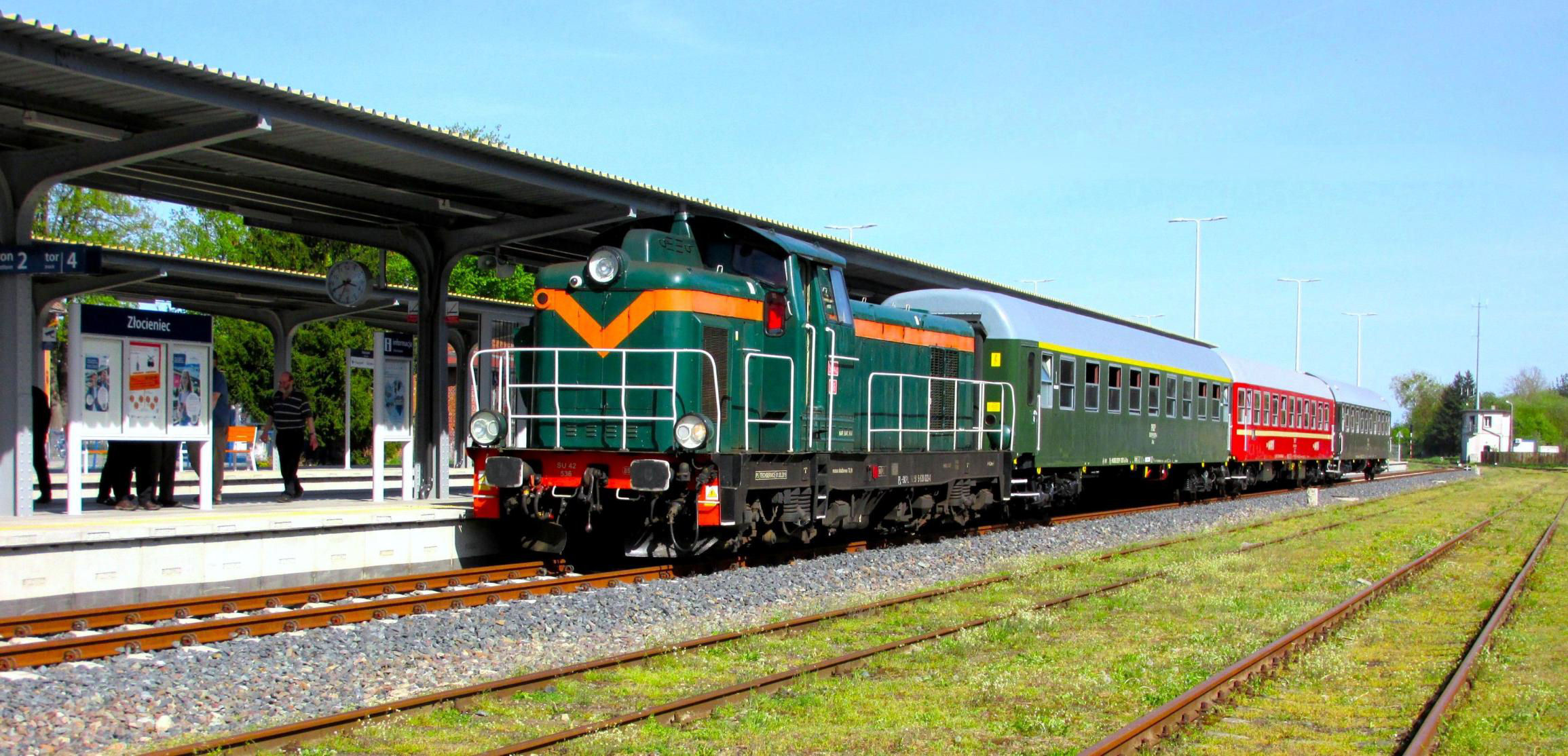
Złocieniec; SU42 526 has arrived from Kalisz Pomorski via the reinstated 50km freight link for the military before the run round ritual begins. Left, in the shadows beneath the clock on the platform, is Alan Welsh (our previous Membership Secretary and BLN proofreader extraordinaire).
[© Simon Mortimer 2025]The entire station and its trackwork have undergone wholesale renewal, although a couple of new tracks are still blocked by temporary walkways. We deployed to the ballast to get the best light for photage before the loco ran round. Unfortunately, our late arrival clearly threw the subsequent timings over the single lines. So, after a couple of units had passed, one a very new and impressive looking bimode, we eventually left 57 down towards Szczecinek, just 45 minutes away.
Here, the crew ran round just one last time … it must have brought a tear to the eye … although the emotion/s engendering that might have been a bit mixed! There was one potential point of excitement on the return that commenced 57 down, Line 999. Not restricted to the emergency services, it takes a completely different route into Piła Główna from podg. Piła Północ and has about eight booked services. However, it wasn't to be. Ironically, it is believed that our presence on the standard route did cause other services to take this, including one taken by a few tour patrons who had bailed at Szczecinek for a faster run back to Poznań. Hindsight is a wonderful thing! Clearly timings here were fairly slack as we arrived only 13 down and with a booked stand of 23 minutes left on time.
About 30 mins later, we were looped at Budzyń to allow the express to roar past and followed it on time to Poznań where we rolled in at 20.35 nine early, again Peron (Platform) 10, Tor (Track) 54.
It was time to gather belongings and check everything was in order, dodging the Ghostbuster style vacuum cleaner crew that swept onto the train with a zeal to cleanse, rarely seen elsewhere. It was wondered if they had in fact realised this wasn't a PKP train and therefore possibly fell outside their remit but hey, when there is dirt to vacuum! We bade our farewells and, with Ed in Chief in tow, it was off to the kebab place again opposite Hotel Traffic from last night, followed by Bar 56 for a couple of Kozel Dark before a final goodbye. A splendid tour, it didn't do everything but if a trip like this did, then it's recommended that you buy a lottery ticket! All credit to our BLS organiser, Iain Scotchman, for his application to the cause and Turkol for bringing off what is now a hat trick of superlative tours, much enjoyed by participants. They have seen much red biro spread across several pages of Ball/Mały Atlas and offered an insight into many locations which otherwise wouldn't be seen, looking to the future!