Day 1, Fri 25 Apr:
Dawn .. well, fairly soon ... the sun was yet to rise over Poznań„ - the oldest and fifth largest city in Poland - at 03.45. Such was the hour of your correspondent's rising to make the departure of the third BLS Poland extravaganza from Poznań Główny (= main station) at 05.23, to accommodate not one but two separate possessions that we had to be through to maintain our route.
But first, the name Wielkopolski? This is a voivodeship* in Central-Western Poland centred on Poznań and was first coined in Polish (as opposed to Latin) in Wielkej Polszcze (Greater Poland) during 1449. It was populated by Polens which, as their title suggests, were the original Poles, so it is something of a heartland. This is slightly ironic because, as is typical of Poland, it underwent numerous iterations of invaders and occupants over the intervening centuries to settle down as 'the German bit' after the Treaty of Vienna in 1815 (the penalty for being on the 'wrong' side of the conflict), when it was absorbed largely into Prussia as part of the partitions, where, as we shall see, it remained until WWII.
[*A voivodeship is not a car dealership but an administrative region or province in several central and eastern European countries, historically and still in modern Poland. It's the highest-level administrative division in Poland, roughly equivalent to a province in many other countries. The term is derived from 'voivode,' which historically referred to a local ruler or governor, much like a duke.]
So, back to predawn Poznań, strolling through the largely deserted streets, although trams were already running with quite a few passengers! Arrival some 15 mins later at Poznań Główny found McDonald's fully open and selling breakfast (in the UK, it's burgers only before 06.00) where many tour patrons were fiercely tapping the automatic ordering points, which obligingly can be selected to operate in English. Meeting my tour oppo (report Chief Editor, our member Peter Green), already through most of a bacon and egg wrap, we noted an 05.23 SKPL: Stowarzyszenie Kolejowych Przewozów Lokalnych: which sort of trips off the tongue more easily as 'The Association of Local Railway Transport' on the big display at P5.
It's worth considering SKPL's role in this tour; SKPL was established in 2001, splitting infrastructure and actual train operation in 2010 operating a slightly bizarre mix of shunting, main line locos, DMUs and coaches. It has operated and operates a mix of one off, seasonal and regular timetabled services all over Poland, offering stock and traction for hire often where none other is available. This tour faced something of a crisis only two weeks before the off; the usual stock based in Wrocław was not available.
Fortunately, SKPL filled the breach (with arguably a better buffet coach and stock) saving the day. In contrast, all other aspects of the tour progressed in an atmosphere of almost zen-like serenity, honest.
'Erste frühstück' (literally 'first breakfast' - how many do they have in Poland?) completed, we descended to the platform with the increasingly audible drum beat of our mighty SU42 on load three; seating compos sandwiched an (essential!) kitchen / buffet car. This made a striking contrast to the now typically sleek, modern PKP fleet of trains. (Reminder: PKP = Polskie Koleje Państwowe = Polish State Railways.)
SU42 536 was built in 1977, so is far from the oldest example of these locomotives in traffic. It was built in Chrzanów by Pierwsza Fabryka Lokomotyw w Polsce (= The First Locomotive Factory in Poland) Spółka Akcyjna (= Joint Stock Company, similar to a Limited Company) or, to the more linguistically challenged, Fablok, a Polish manufacturer of locomotives. It is part of the 5xx series that had a 3kV hotel electric supply powered by a Caterpillar diesel engine installed around 1999, allowing all the prime mover's power to reach the railhead offering a blistering top speed of … 56mph (90km/hr)!
Our party was split between 1st and 2nd Class compartment coaches in half of each flanking coach, so Turkol (Polish tour operator Turystyka Kolejowa = Railway Tourism) could sell their part fare tickets in either class. With a maximum of four in any compo, they all offered a comfortable corner and plenty of room where participants typically divided up by nationality or language so they could talk to each other.
So, initial photos taken, seats bagged, bags dropped, the dawn was now with us. At 05.23 precisely, whistles blew, doors slammed and with a plume of clag we drew out of Poznań Główny, rapidly gaining top speed down the main line to Leszno. Except even wide open our SU42 on load 3 we could not show a clean pair of heels to the Sparkies on load 10. So, our train was looped in the platform at Czempiń, the first photo stop, until an electric flashed by. Then we were away again to gain refuge on the west side of Leszno and the line towards Głogów, which reopened to passenger trains with the Dec 2019 timetable.
From Głogów, the tempo was much more relaxed as the line to Żagań is closed to passengers and apparently has no freight either! The rhythmic beat of the rail joints at about 20 mph, interspersed by an occasional bit of welded rail, could have induced sleep, so it was to the buffet for a coffee. Here some passengers were already tucking into their breakfast of scrambled egg, frankfurters, bread … and cucumbers … was a bit of a pointer for later. The chap behind the counter, when asked for a coffee, retorted something like 'normalny?' well yes, of course, who wants abnormal coffee‽ The water boiling apparatus (a saucepan on the gas as the electric kettle was out of use then) was low capacity and we were told 'five minutes'. Alright then … we're here all day … so, we settled down to observe the apparently deserted countryside passing at a very observable speed. There appeared to be no settlements of any note, so perhaps this lack of apparent clientele suggests why even the keenest railway line reopeners in Europe haven't got round to this trundle bahn (= railway). Coffee! Ah, here were our two cups and we resisted the scalding hot water for a while before starting the caffeine rush, except this coffee was apparently 'normalny' from a local perspective, with coffee grounds that slowly settle to the bottom in time. I left it a bit longer to avoid extracting small insoluble grounds from teeth over subsequent hours … from now on the magic word was … 'instant' a złoty (= 20p) more but much less dentally challenging.
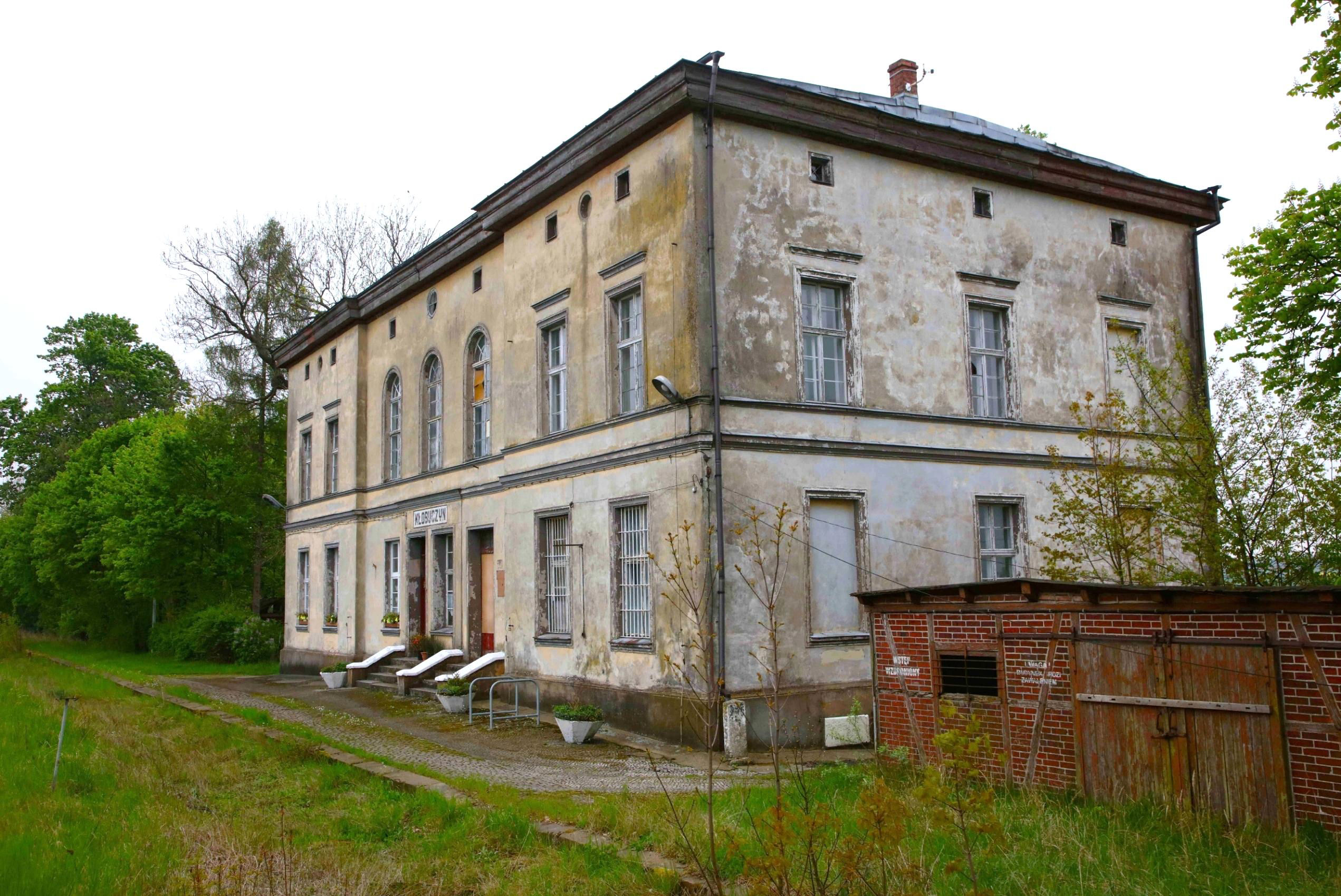
A development opportunity‽ The apparently rather oversized station building at Kłobuczyn.
[© Iain Scotchman 2025]There were many photographers along this line, no doubt obtaining some rare shots. It was notable that the signallers leant out of their boxes (especially staffed just for our passing!), taking photos and videos typically on their phones as well. We made a photo stop at Niegosławice, whose painted name on the end wall could just be made out. It's a typically intact but weed strewn abandoned station in the Polish countryside, which always makes a photo of a passenger train stopped in the greenery, the rails ahead thick with rust, all the more incongruous and unexpected on Polish Railways. Google reveals it has a population of 893 and its claim to fame is a one Gunter Blobel born here in 1934. He won a Nobel Prize in medicine in 1999 regarding protein signals in cells but, irrespective, he surely did the track before WWII! Respect! Next was Szprotawa, a much larger place of some eleven thousand citizens, which clearly has a much more modern station building, albeit in the traditionally weed strewn surroundings.
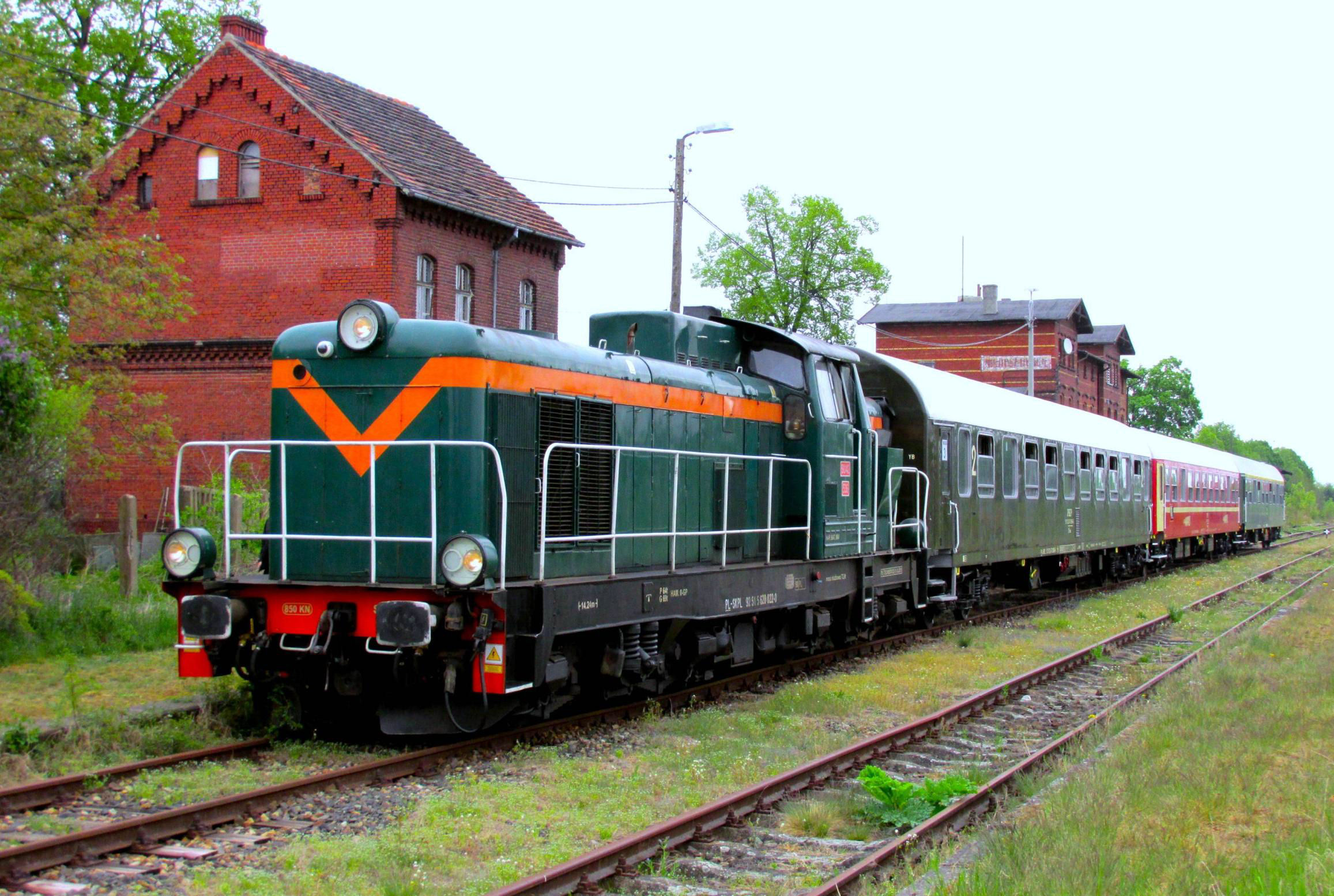
Niegosławice, SU42 536 stands with the BLS Wielkopolski Explorer Railtour on the otherwise disused route from Głogów to Żary.
[© Simon Mortimer 2025]This might be because the small industrial centre saw 90% of its buildings destroyed at the end of WWII before Red Army occupation. Latterly the Germans left (one suspects they needed little more incentive).
Under the post-WWII 1945 Potsdam Treaty, it was resettled by Poles, a formula for most of this region. On departure, photographers lined the road leading to the level crossing, some stood on the buffer stops at the ends of the sidings and the signaller had an elevated shot from his ample box, no doubt before switching out, locking up and immediately heading home!
Our approach to Żagań was under the main line and up into the station on the south side, which feels overly elaborate for the junction of two such lines. However, before WWII, the line we passed under was the premier line from Berlin to Breslau (Wrocław) but is now a relative backwater. This meant that to obtain the freight only line towards Bieniów, to the northwest, we had to undertake a mile long shunt out towards Żary, with then a propelling move back into Żagań on the north side.
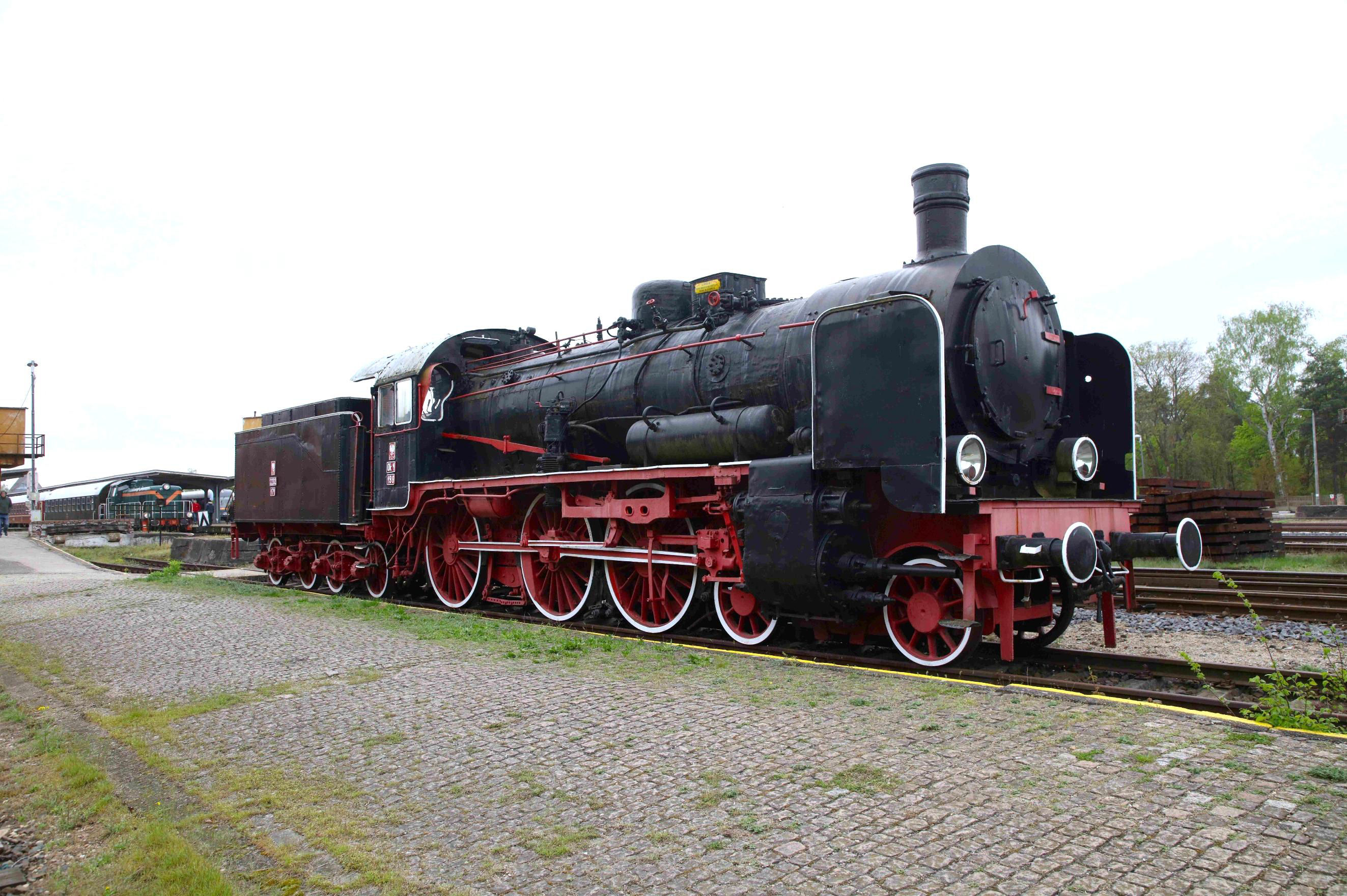
Żagan - a plinthed 4-6-0; our railtour is at the station lower middle left.
[© Iain Scotchman 2025]It was immediately notable that the entire station area, which is very generous, had been recently relaid with concrete sleepers in a sea of new ballast. Given its utilisation, in UK such a scheme would probably have seen half the layout abandoned! Now pointing towards Bieniów, we set off on what for many was the first new track of the tour. This line has also recently been recently relaid, as smooth as a billiard board and almost entirely straight giving a gliding ride through the forest, until we curved left at the junction and into Bieniów station itself. After a short pause, the branch towards Lubsko (right) could be seen to be undergoing renovation with a view to its reopening in a few years. At Żary, we had almost done three quarters of a loop back to Żagań but we veered right heading straight towards the junction station of Jankowa Żagańska. For your correspondent, this was another new section as it was closed for rebuilding last time and offering the then freight line towards Żagań on diversions instead. Now, both routes have regular services running over them! It was notable looking back passing through Jankowa Żagańska how the tracks around the station towards Żagań had been immaculately relaid too; when traversed in a diminutive SA105 railbus in Aug 2020, these lines were invisible under the vegetation.
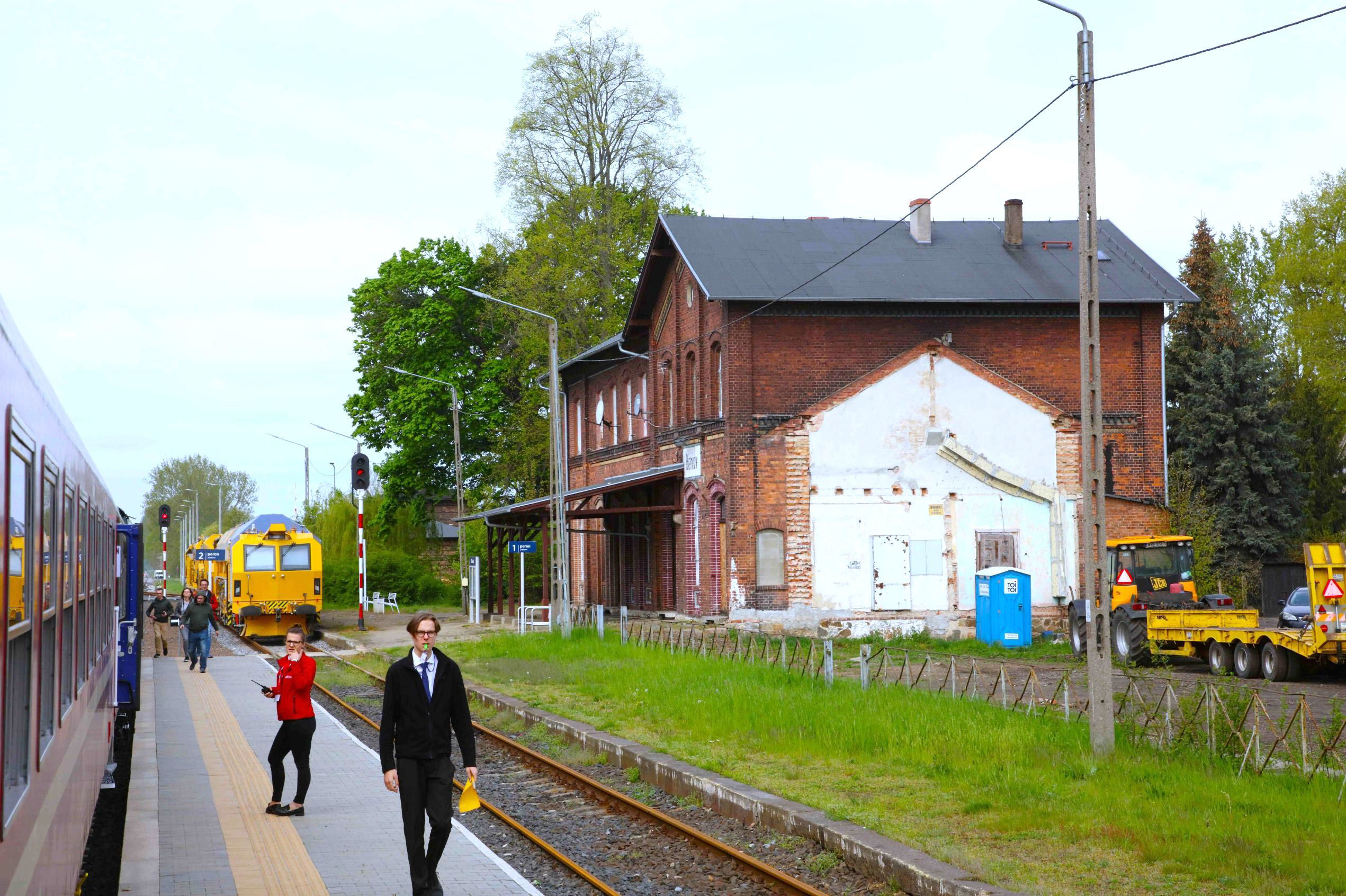
A pause at Bieniów station. Was the railroad intended to go through the middle of the house once?
[© Iain Scotchman 2025]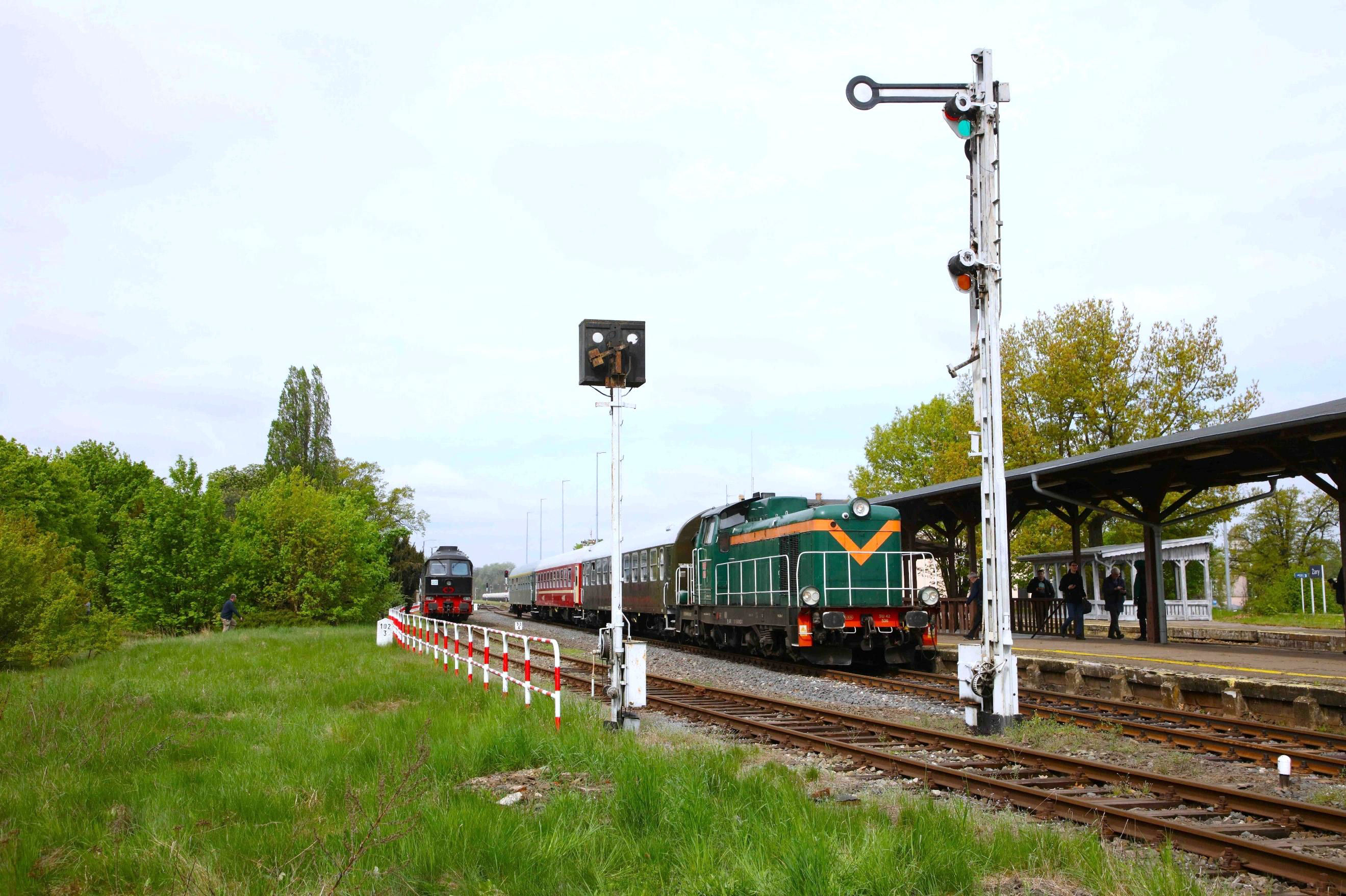
Photo stop at Żary, that semaphore signal (rear) looks familiar from the masthead of BLN International.
[© Iain Scotchman 2025]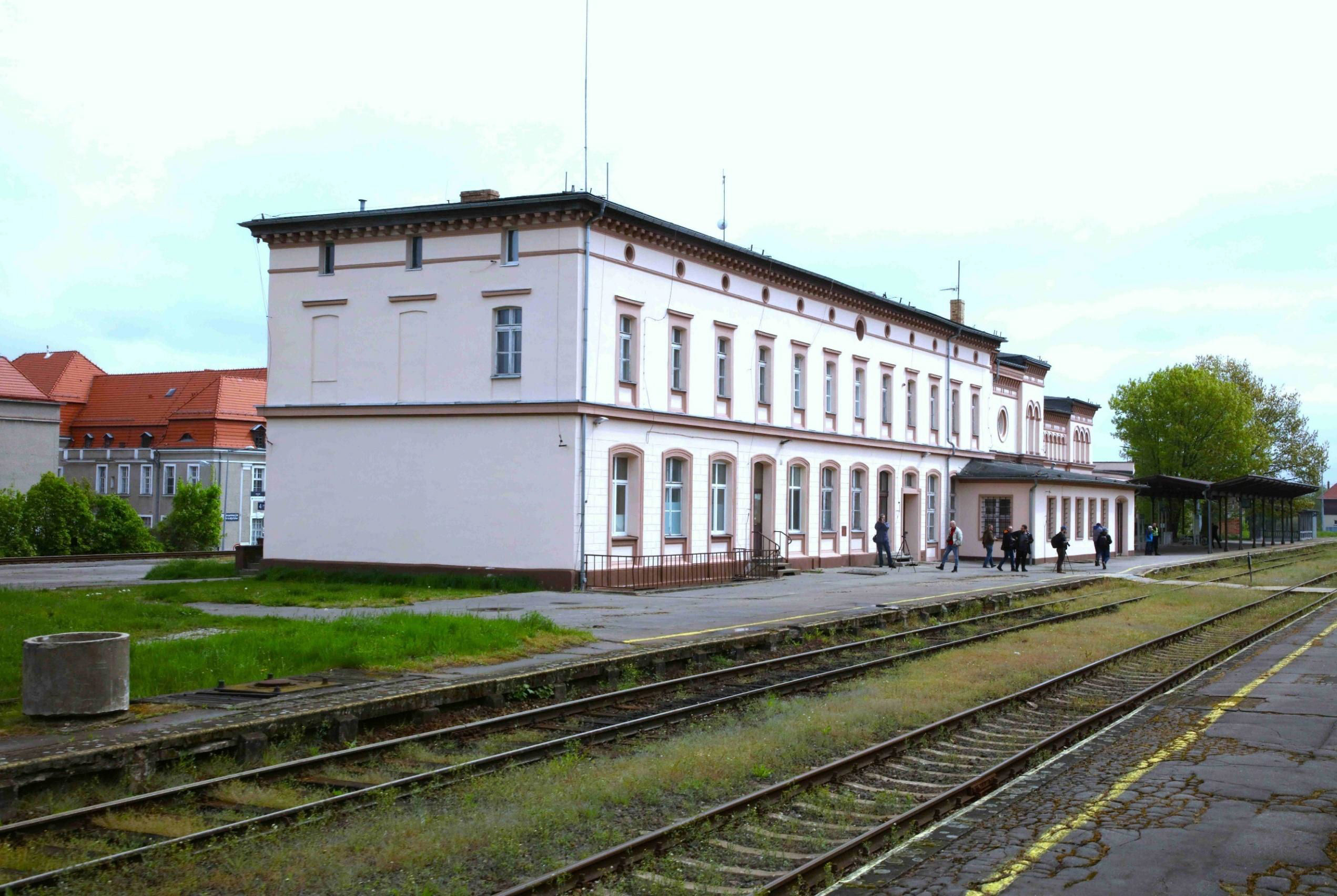
Conversely, the impressive station building at Żary looks well cared for and utilised, unlike some of the others.
[© Iain Scotchman 2025]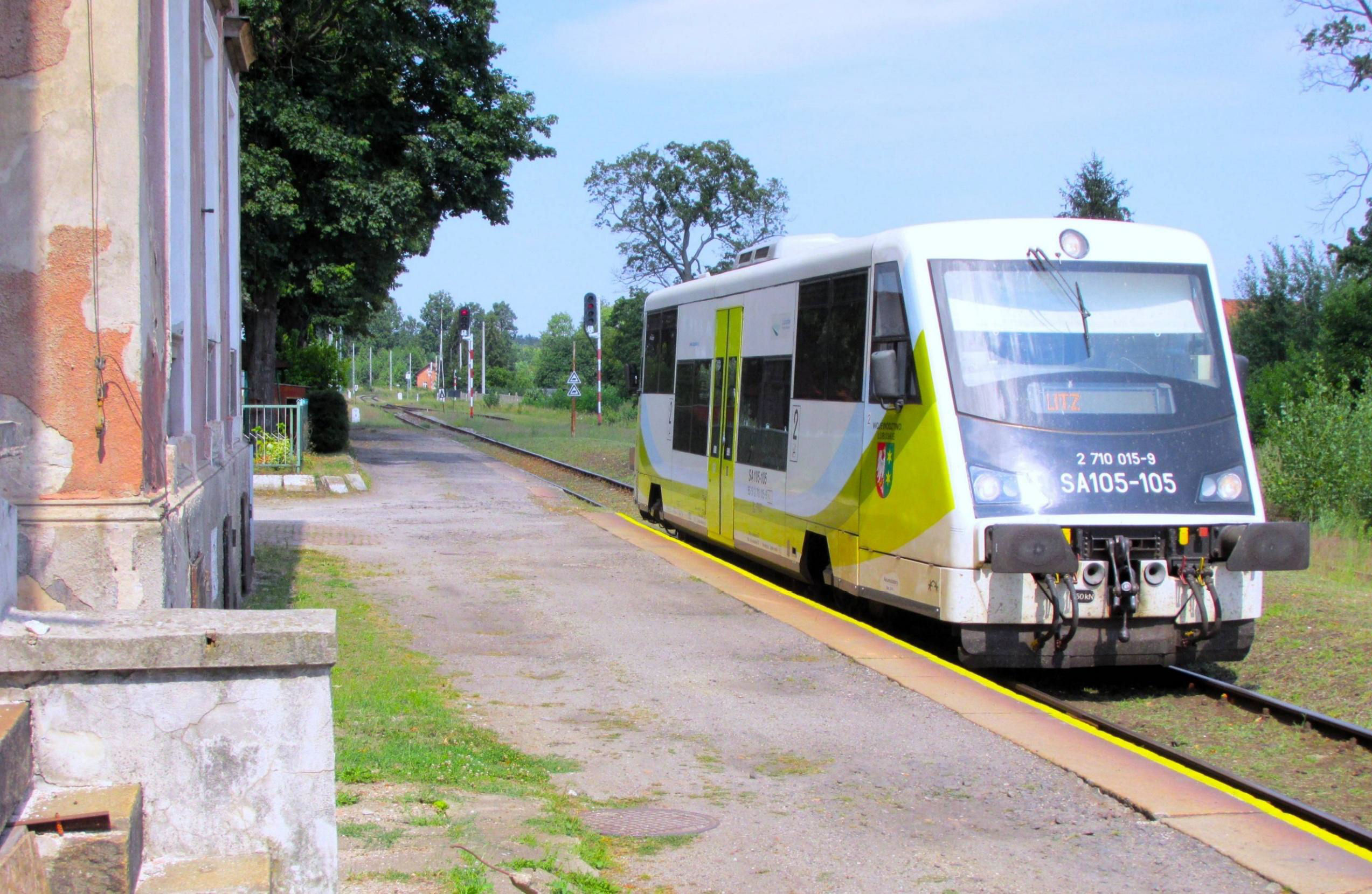
Back nearly five years to 13 Aug 2020 and railbus SA105-105 for Łódź (Litz in German) is awaiting a path south at Jankowa Żagańska. You would have difficulty NOT standing behind the yellow line at this station!
[© Simon Mortimer 2020]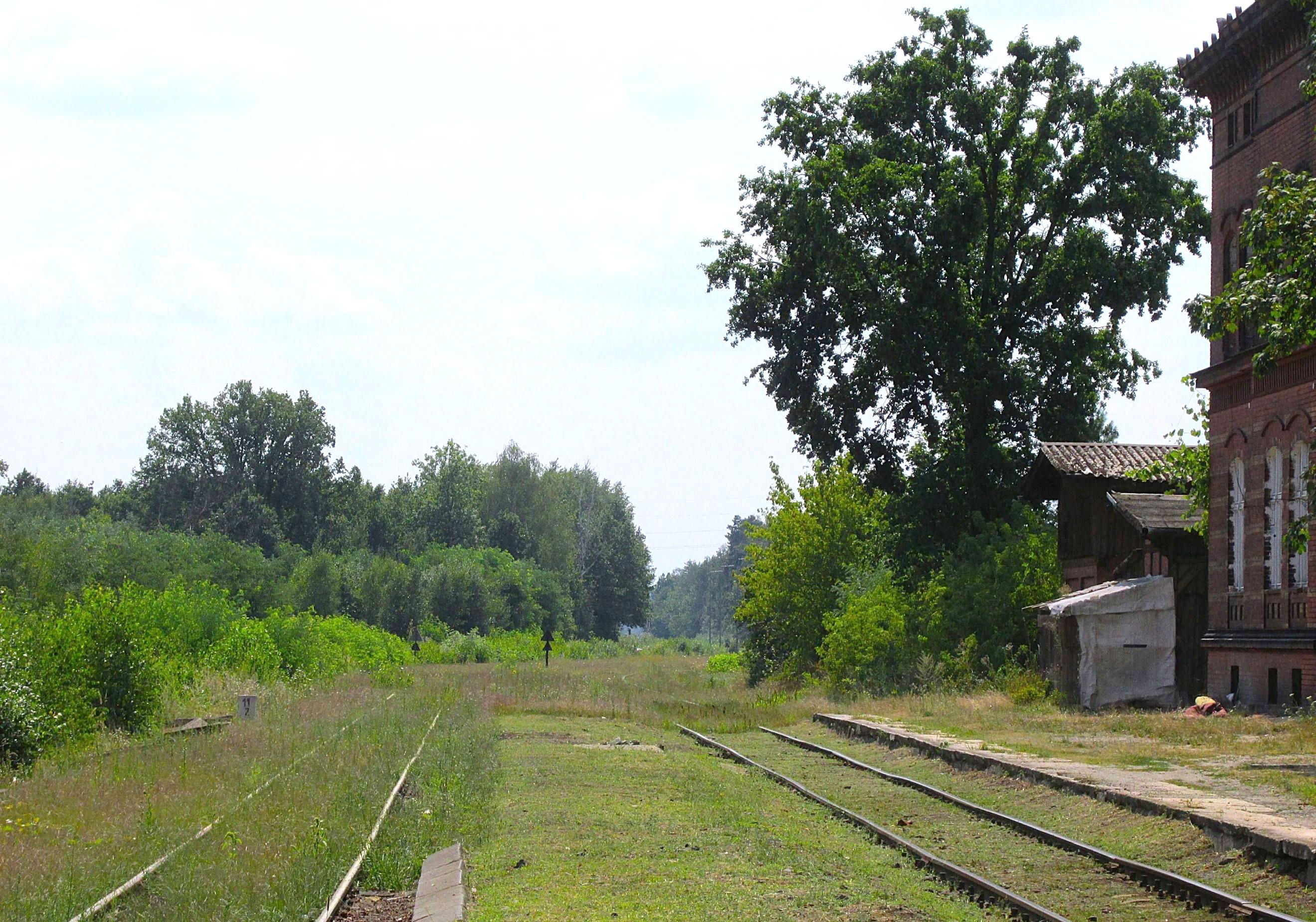
Looking south on the same occasion in 2020.
[© Simon Mortimer 2020]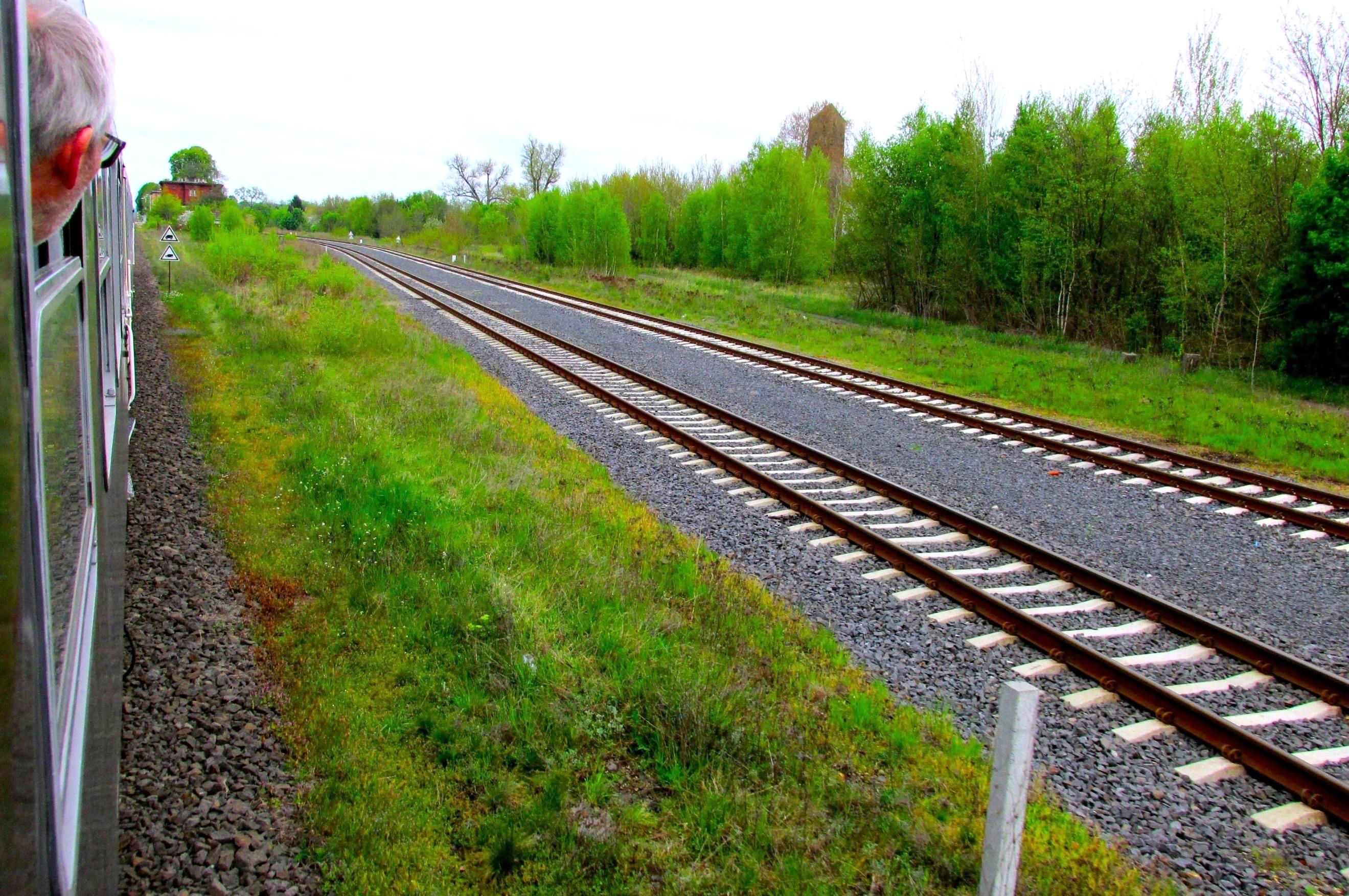
Looking back near junction just south of Jankowa Żagańska station in the distance (left) with the now immaculate weed free tracks in 2025.
[© Simon Mortimer 2025]We pressed on to Węgliniec, now beautifully restored. In recent years it has transitioned from semi-dereliction through stripped shell and back to a resplendent edifice, intricate brickwork with moulded eagles and railway flying wheel symbols. Here, there was a sudden double take, as a train loaded with Flakpanzer Gepards (anti-aircraft gun tanks) pointing towards Ukraine was passed, as per many YouTube videos. Seeing them for real was a stark reminder that, only a line on a map away, there was a war raging which, irrespective of whoever's figures are to be believed, has claimed a million lives and counting.
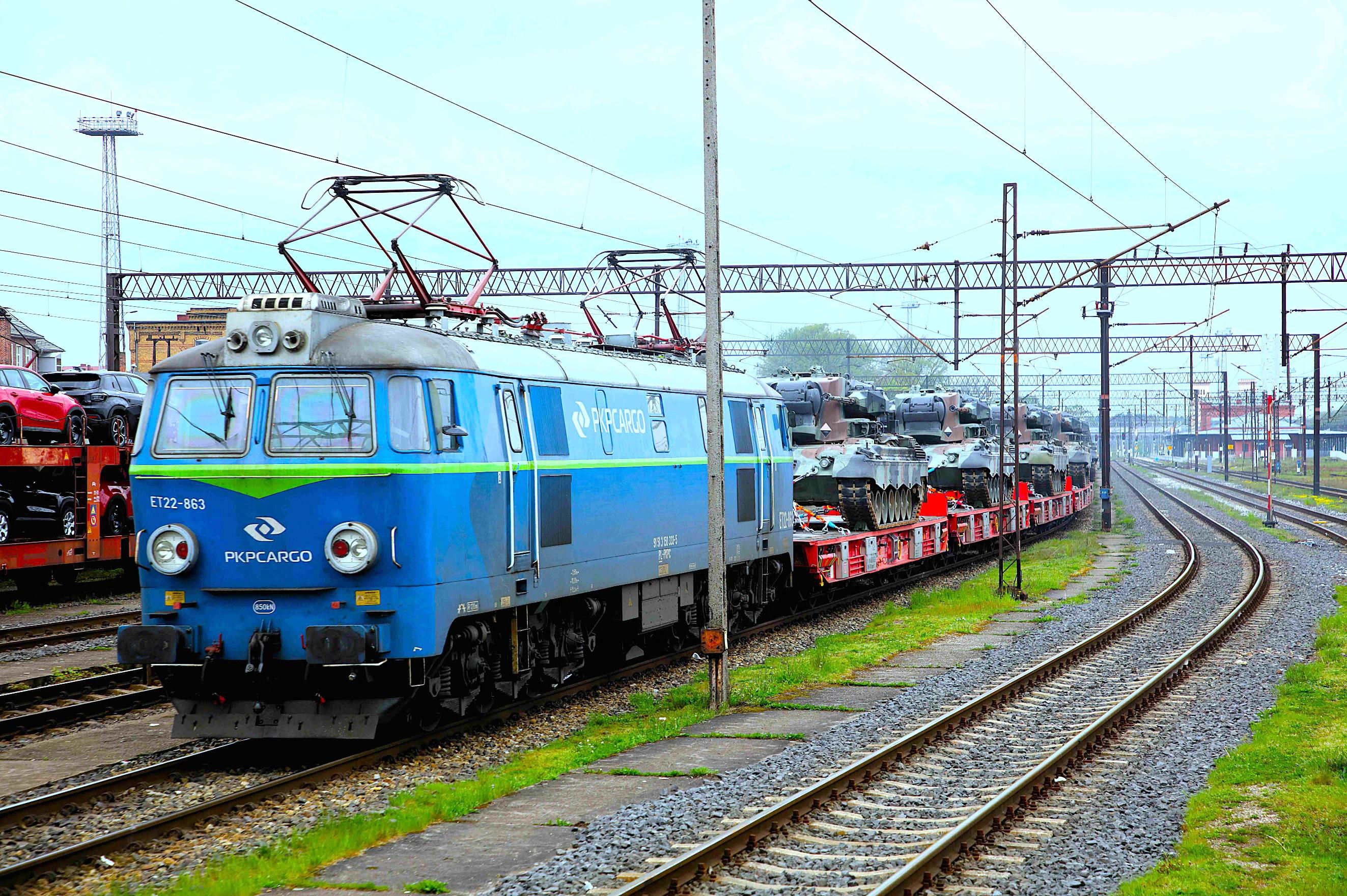
A train load of Flakpanzer Gepards (anti-aircraft gun tanks) for Ukraine at Węgliniec.
[© Iain Scotchman 2025]We arrived 10 minutes later at the junction of Zbrzydowa, where we immediately took the immaculately laid freight branch towards Niwnice. For a brief period, a through service was reinstated through to Jelenia Góra (for those paying attention at the time, which didn't include your reporter or our tour organiser Iain Scotchman!). The line is in good condition, (unlike the large intermediate station of Nowogrodziec, which is literally falling down) for frequent and high axle load aggregates traffic from the quarry beyond the station, where we stopped and ran round. There is a fully fledged signal box here controlling semaphores, from which the signalwoman emerged with the obligatory paperwork. One wonders just how many signalling staff PKP employs‽ We returned to Zebrzydowa and ran round again, to head for what for many was a highlight of the day (even the tour!), the Legnica Avoiding Line.
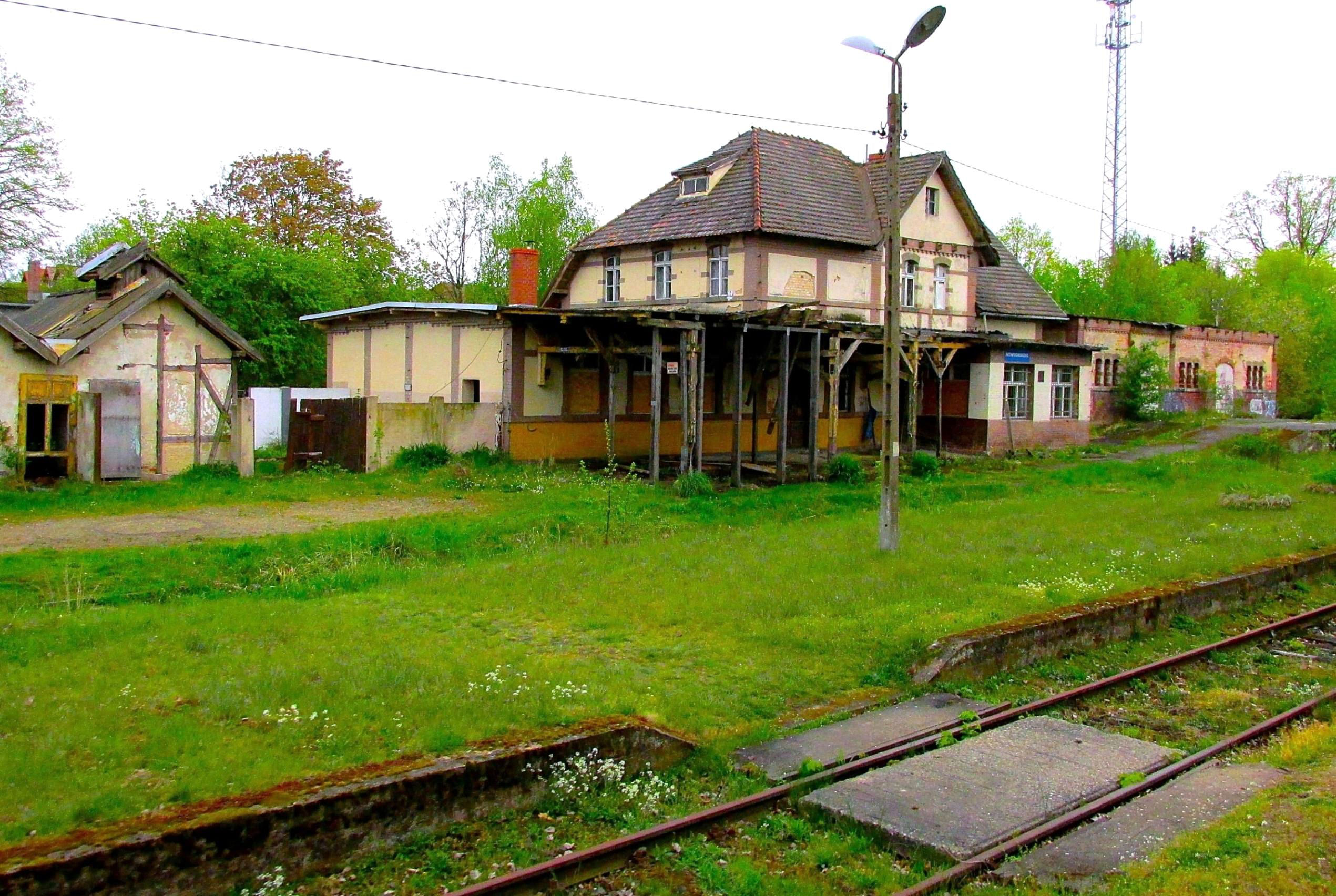
On the freight only branch to Niwnice, the station at Nowogrodziec is literally falling down and propped up.
[© Simon Mortimer 2025]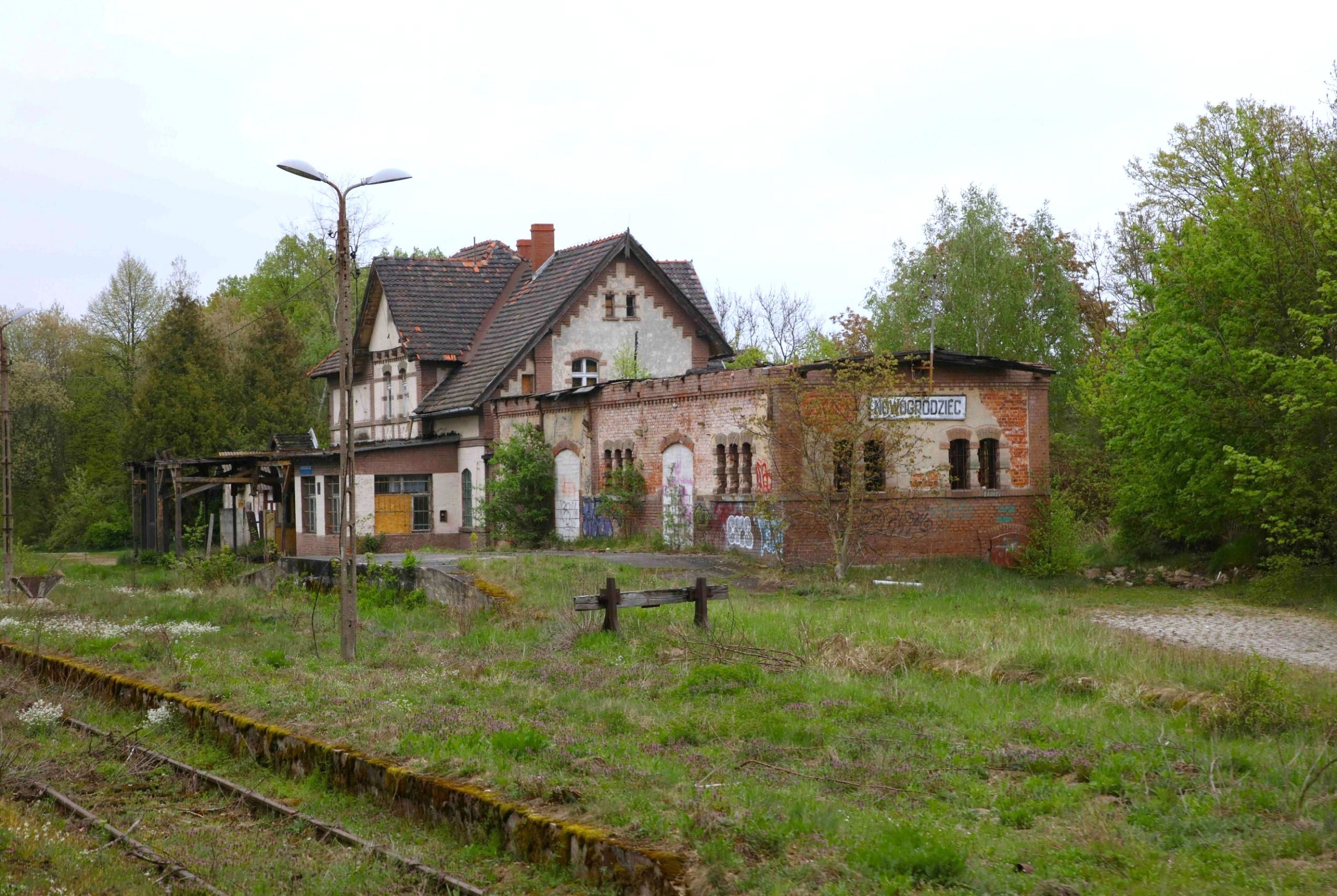
In need of a little TLC! Another view of Nowogrodziec.
[© Iain Scotchman 2025]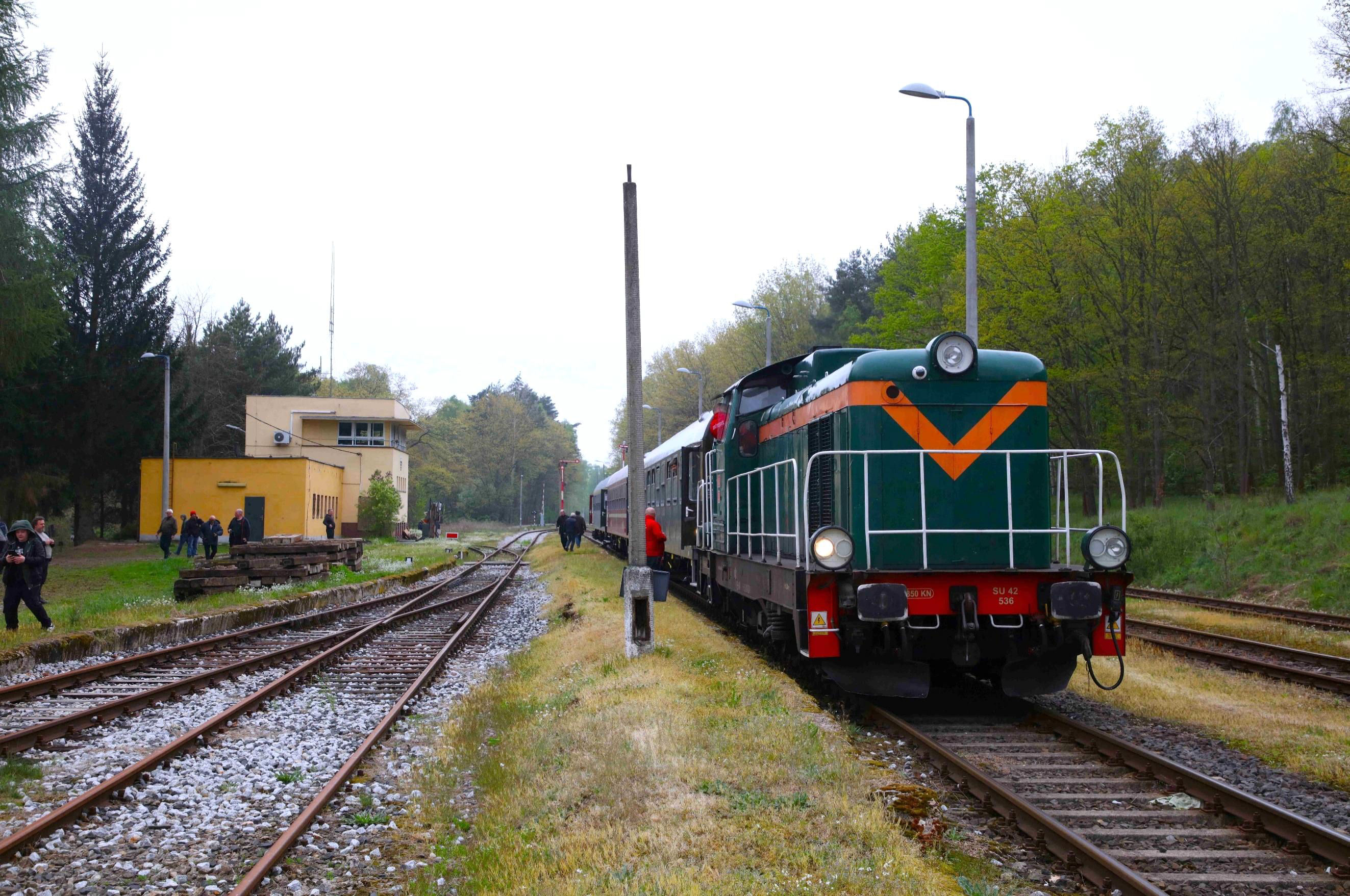
At Niwnice, the end of that freight only branch.
[© Iain Scotchman 2025]'Legnica Avoiding Line' sounds like a cheeky curve, or a loop around a station in UK terms but in Poland there is no such economy of provision. The avoider begins at Miłkowice about 10km west of Legnica - Line 296 for those tracing the route in the Mały Atlas. It initially runs south of main Line 275, before flying over east of Jezierzany (incredibly, that trainload of Gepards passed beneath us at the time!).
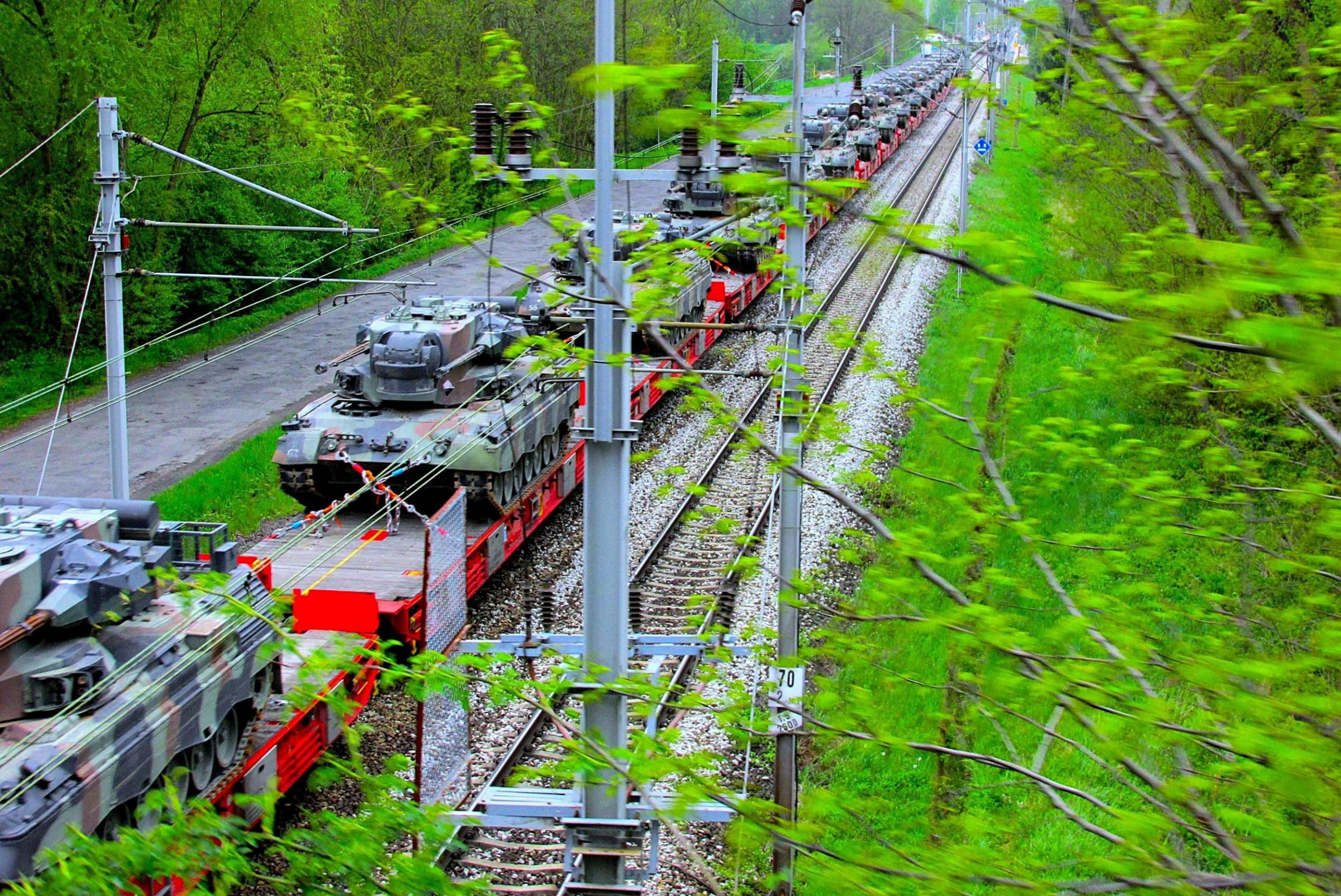
Passing over Line 275 east of Jezierzany with those same tanks again passing underneath. Did the train have a tank engine?
[© Simon Mortimer 2025]Running north of Legnica, the avoider crosses passenger Line 289 and freight branch 382 to Pątnów Legnicki. Here, they burn coal to send heating fluid around the region in pipes. We reached the junction at podg.Legnica Wschód. [podg. is posterunek odgałęźny, literally 'separate post' or 'branch post' effectively a 'junction' - remember that, as it pops up quite a bit. Strictly it should be 'p.odg.' but 'podg.' appears on many junction signal boxes, PKP Timings and the Mały Atlas.] Wschód simply means East.
At podg.Legnica Wschod, the flying junction from Line 275 below from podg. Wielkie Piekary (Wielkie = great) was shiny and in good order, which couldn't be said for the nominal route running our way with a stop board, track rusted solid, catenary collapsed and vegetation well established; closed for a while!
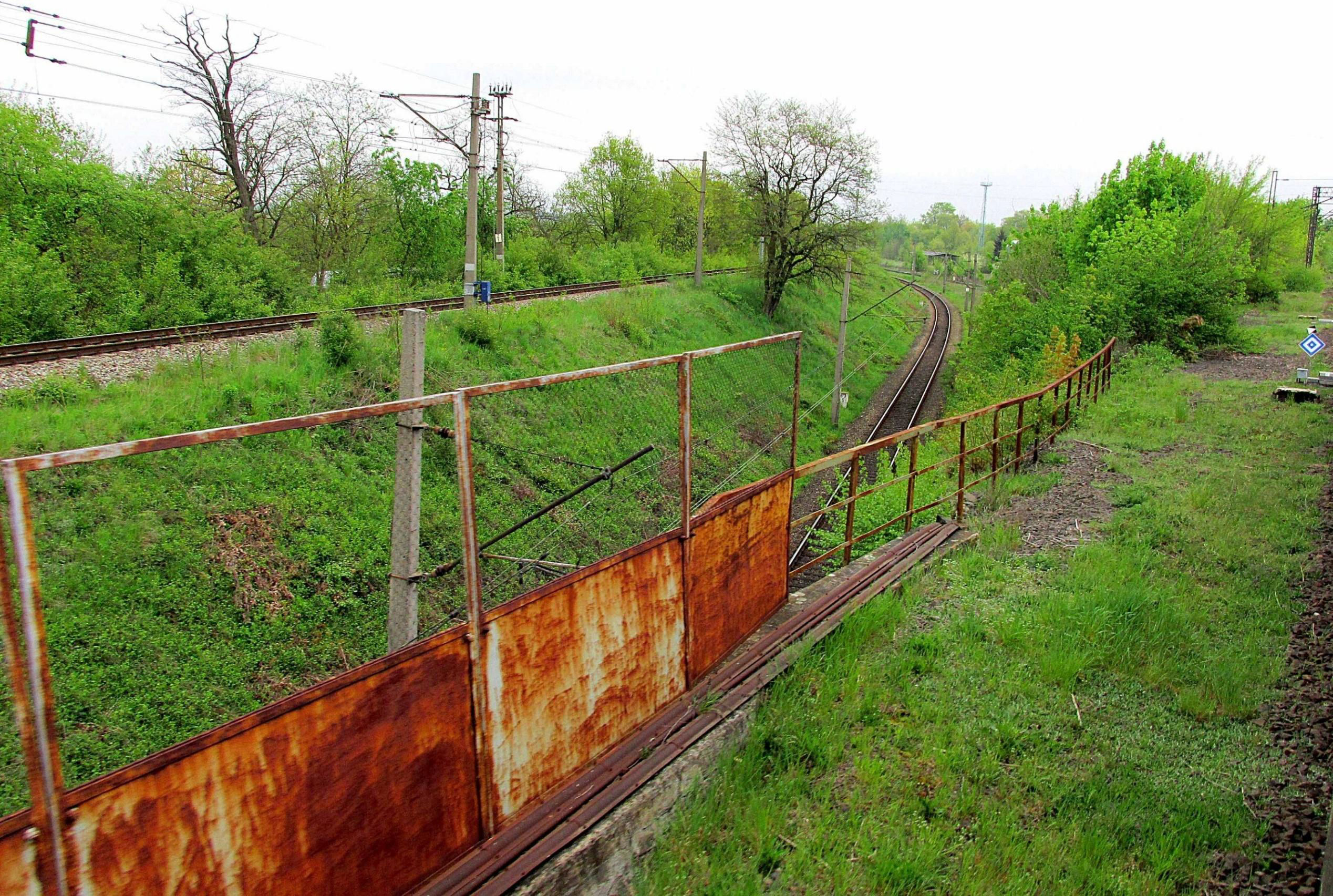
View forward and left at podg. Legnica Wschód, passing over Line 260 on the Legnica freight avoiding with a connecting line rising steeply left.
[© Simon Mortimer 2025]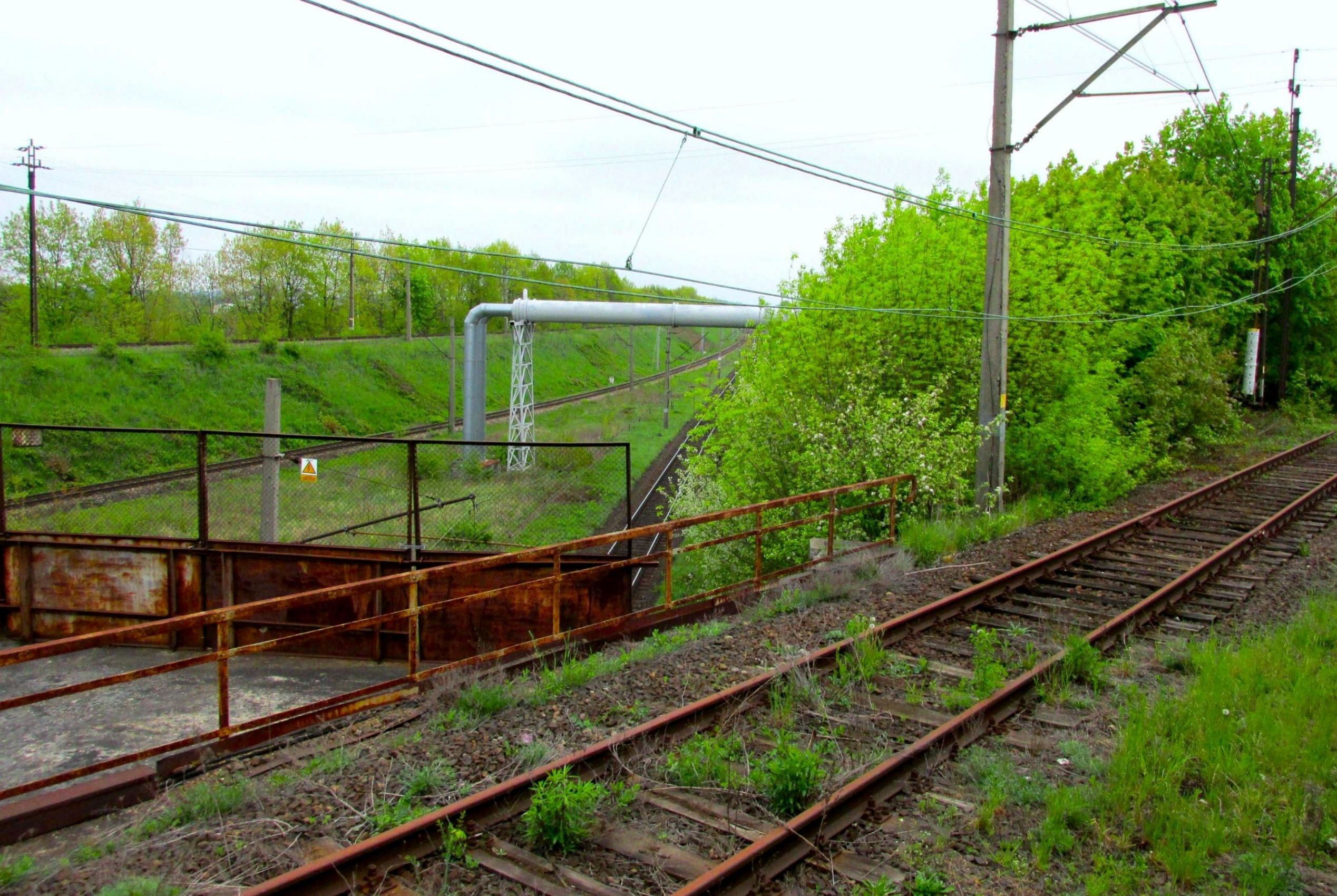
Further on, again Podg. Legnica Wschód passing over Line 260 on the Legnica freight avoiding line with, that connecting line rising steeply left.
[© Simon Mortimer 2025]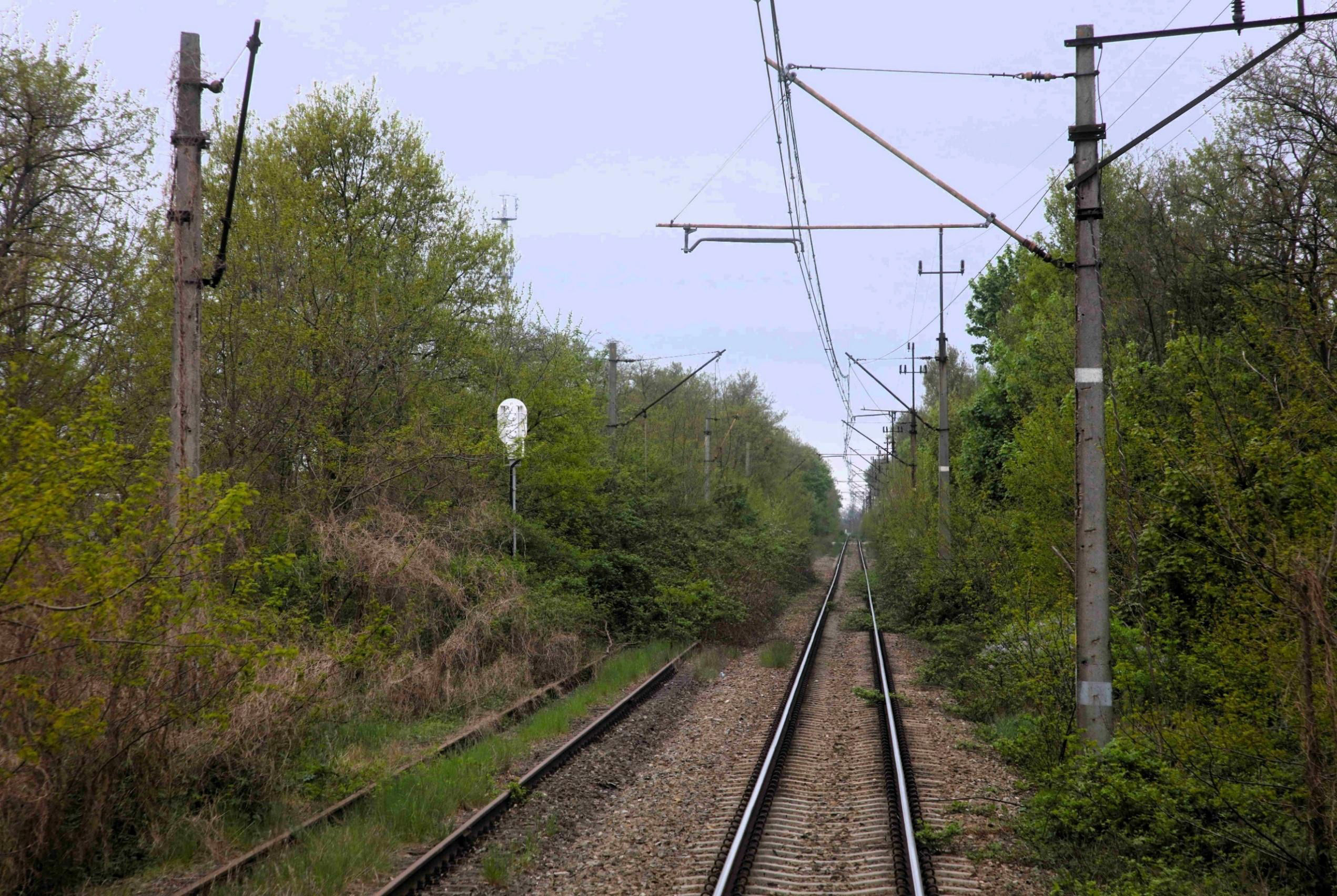
Still on the former double track Legnica Avoiding Line. There have to be some perks of being the tour organiser.
[© Iain Scotchman 2025]Having finally regained the main line out of Legnica at Piekary, we ran on to Rogoźnica where we were due to stand fairly briefly, before proceeding towards Strzegom and taking the former passenger Line 302 to Grabina Śląska, which now serves Grabina Granite Quarry. On perusing this fairly unremarkable station as we simply awaited our path, it was notable there was a large shiny black granite slab on the wall, it was all in Polish (not unreasonably!) but at the bottom the German words Gross-Rosen were instantly recognisable. This it transpired, was the station for the Gross-Rosen Concentration Camp, a sub-camp of Sachsenhausen and, to join all the dots, was run by SS-Deutsche Erd und Steinwerke. (German Schutzstaffel (the 'SS'), Earth and Stone Works) GmbH (Gesellschaft mit beschränkter Haftung - a German term for a private limited company.)
https://tinyurl.com/yc4funw6 has more information.
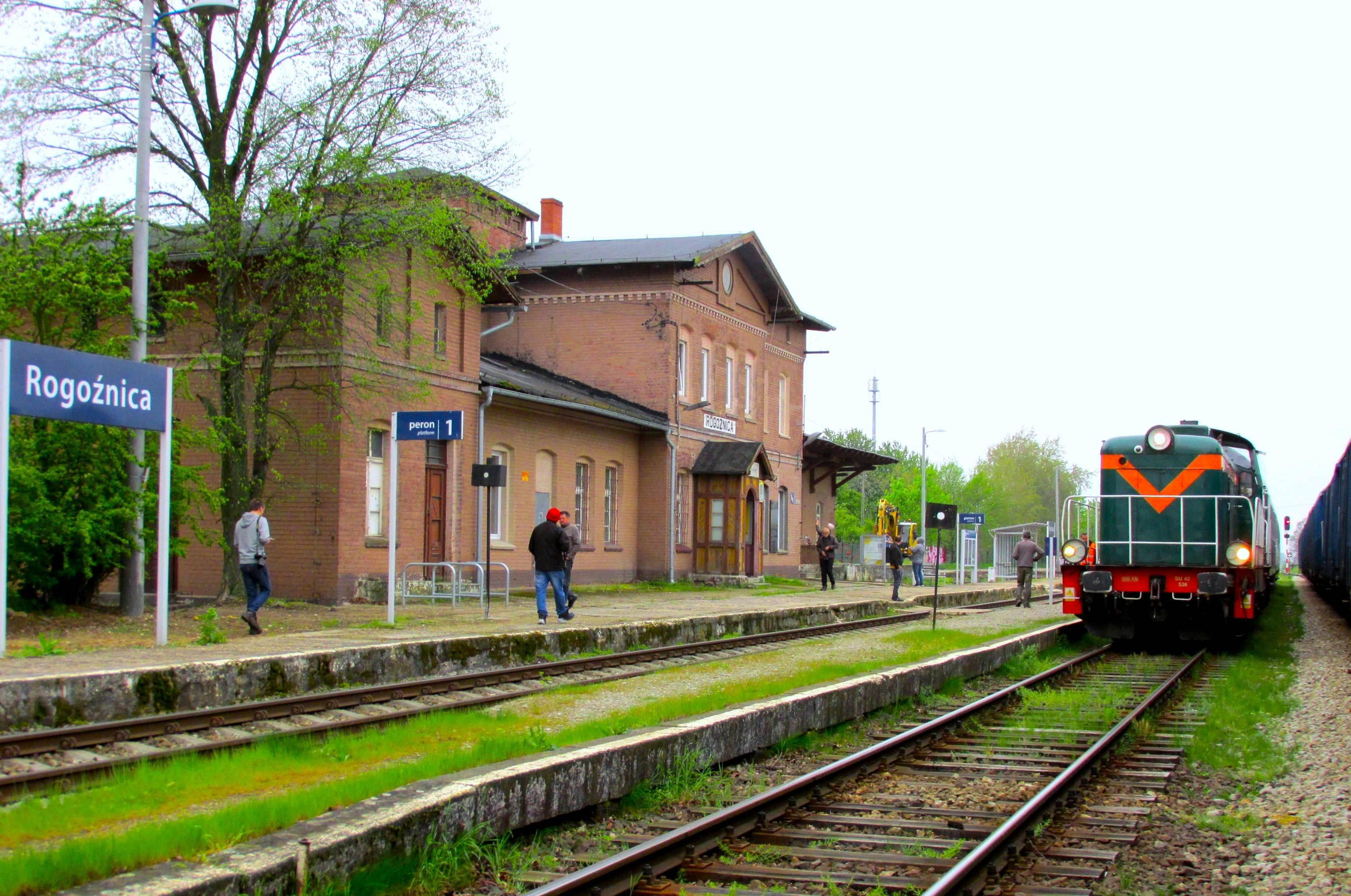
Rogoźnica; our BLS Wielkopolski Explorer awaits time. The granite plaque on the building is visible just beyond the wooden entrance.
[© Simon Mortimer 2025]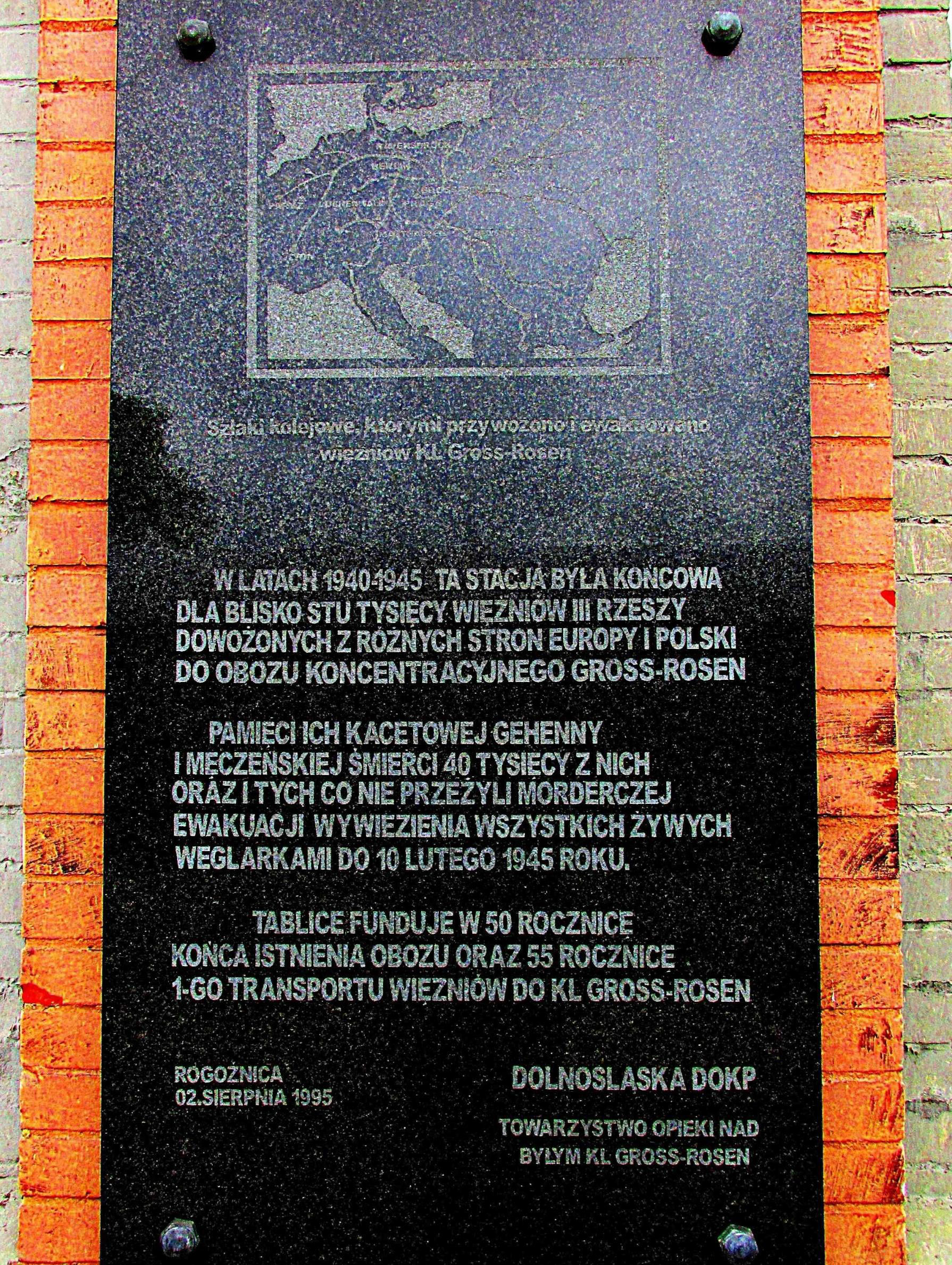
That granite memorial to the Gross-Rosen Concentration Camp at Rogoźnica station.
[© Simon Mortimer 2025]At Strzegom, there was the standard photographic deployment around the train and then, as we appeared to linger a little longer to photo the Ludmila SM42 in the adjacent yard, it then became clear we were lingering a little too long. More time passed without our train manager Patrik, who, exiting the signal box, was shaking his head. It was clear that all was far from well. Indeed, shortly afterwards it was announced there was a (presumably unscheduled) freight train occupying the branch that wasn't going anywhere anytime soon … so that part of our tour was CAPE (the correct UK railway term, not 'caped!).
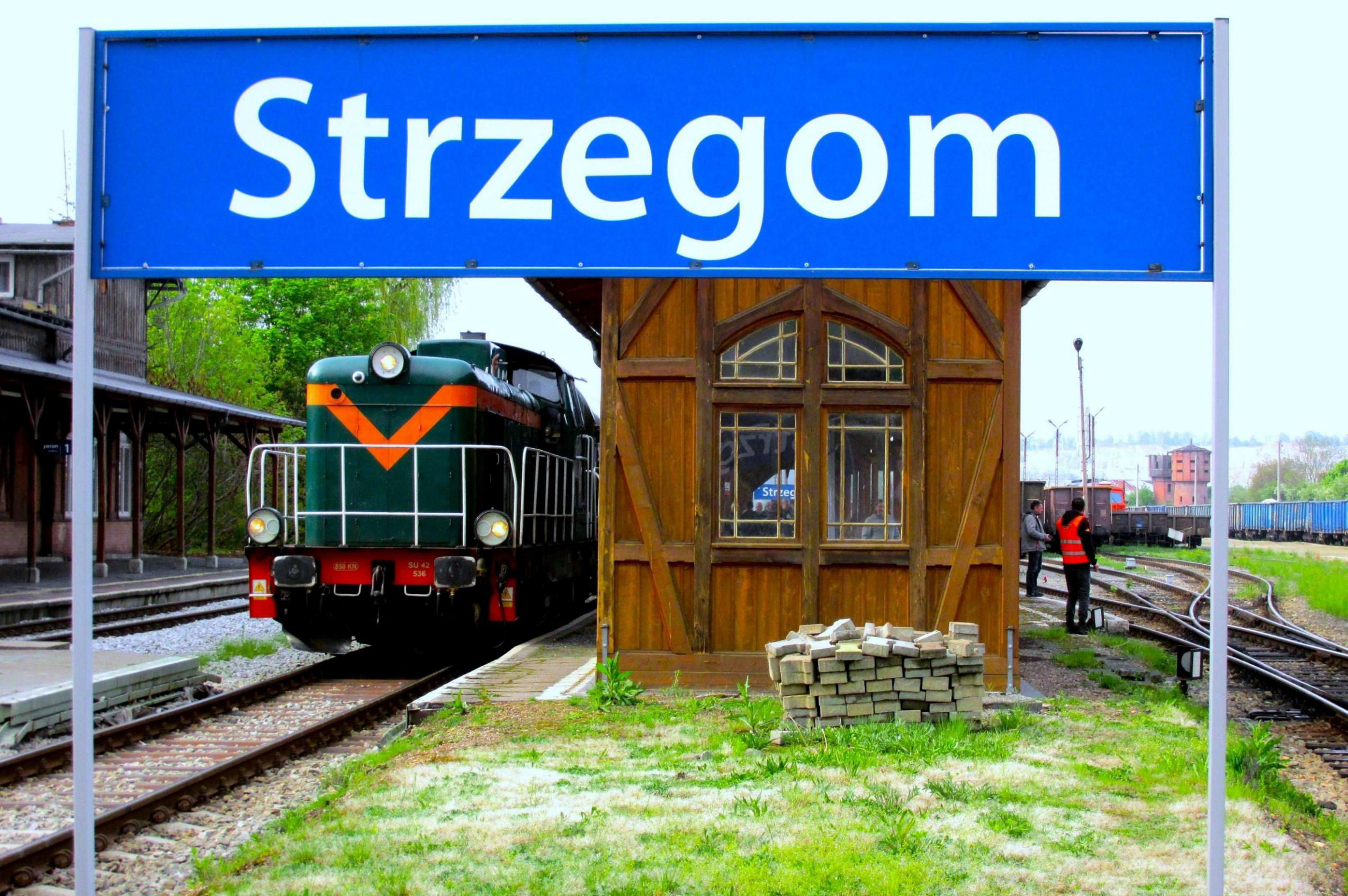
A prolonged stop at Strzegom as a train on the on the branch to Grabina Slaska Quarry prevented access. An elderly 'Ludmilla' lurks in the yard.
[© Simon Mortimer 2025]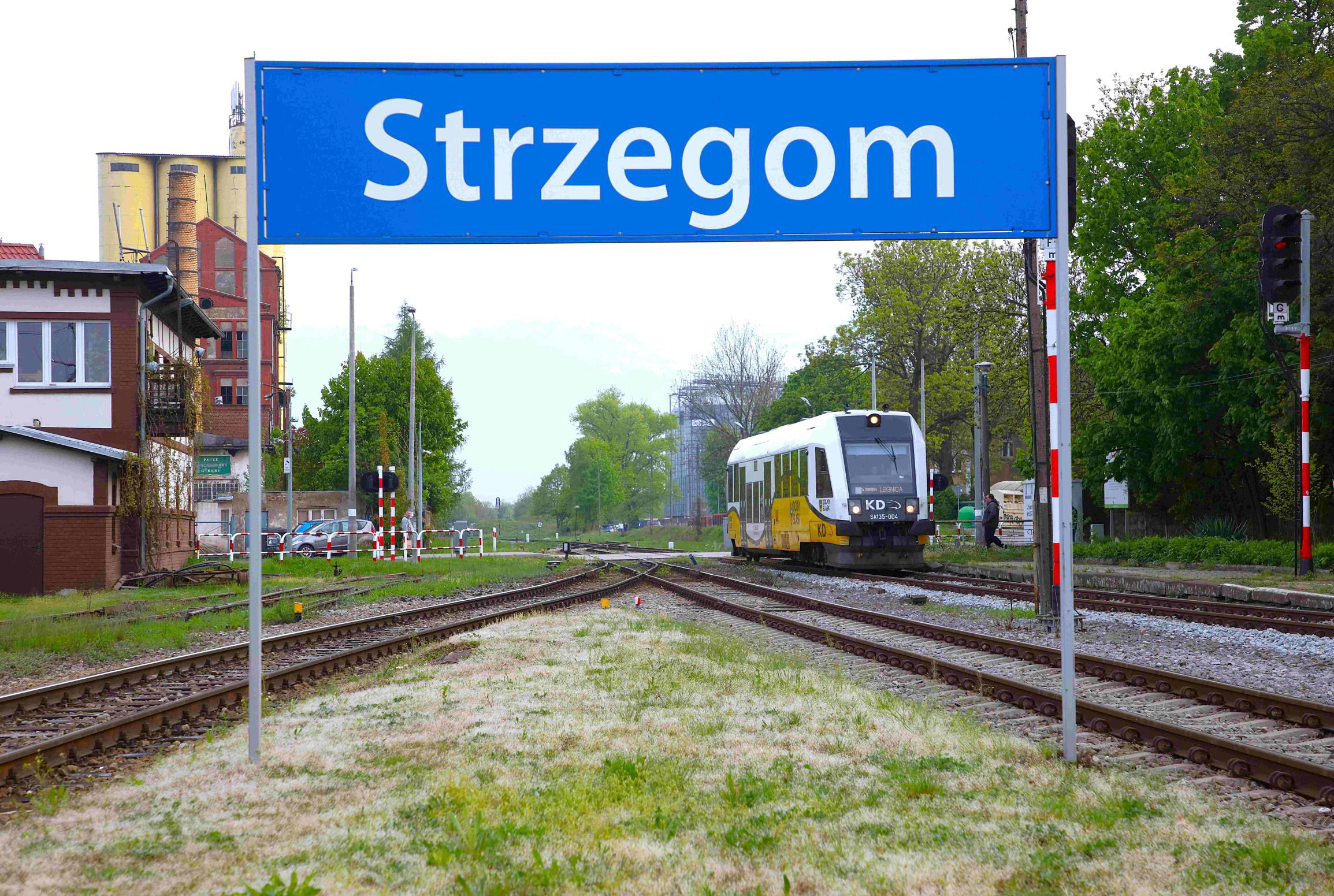
In the other direction.
[© Iain Scotchman 2025]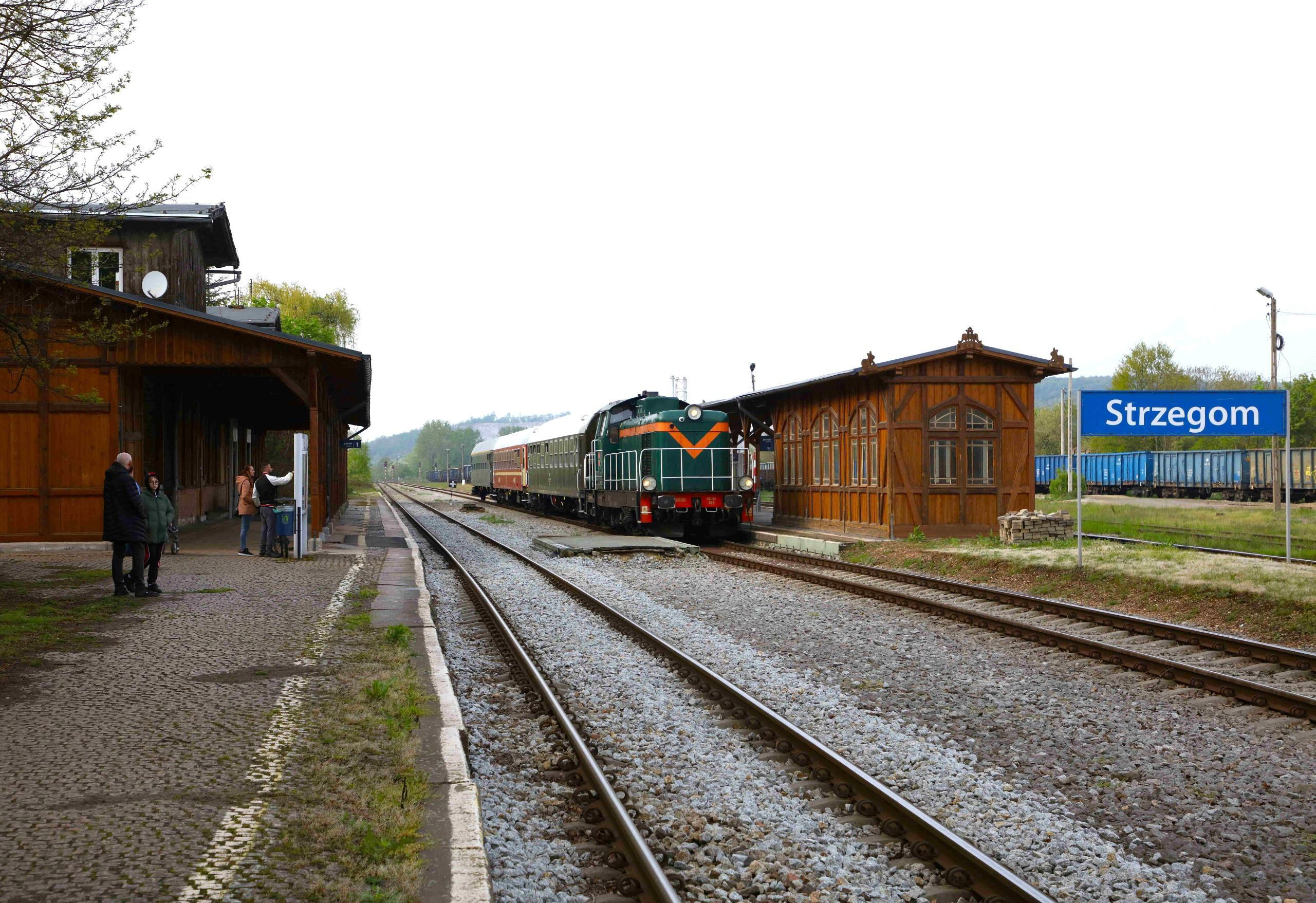
Another view from the other platform in the opposite direction - well, they did have rather a long time there…
[© Iain Scotchman 2025]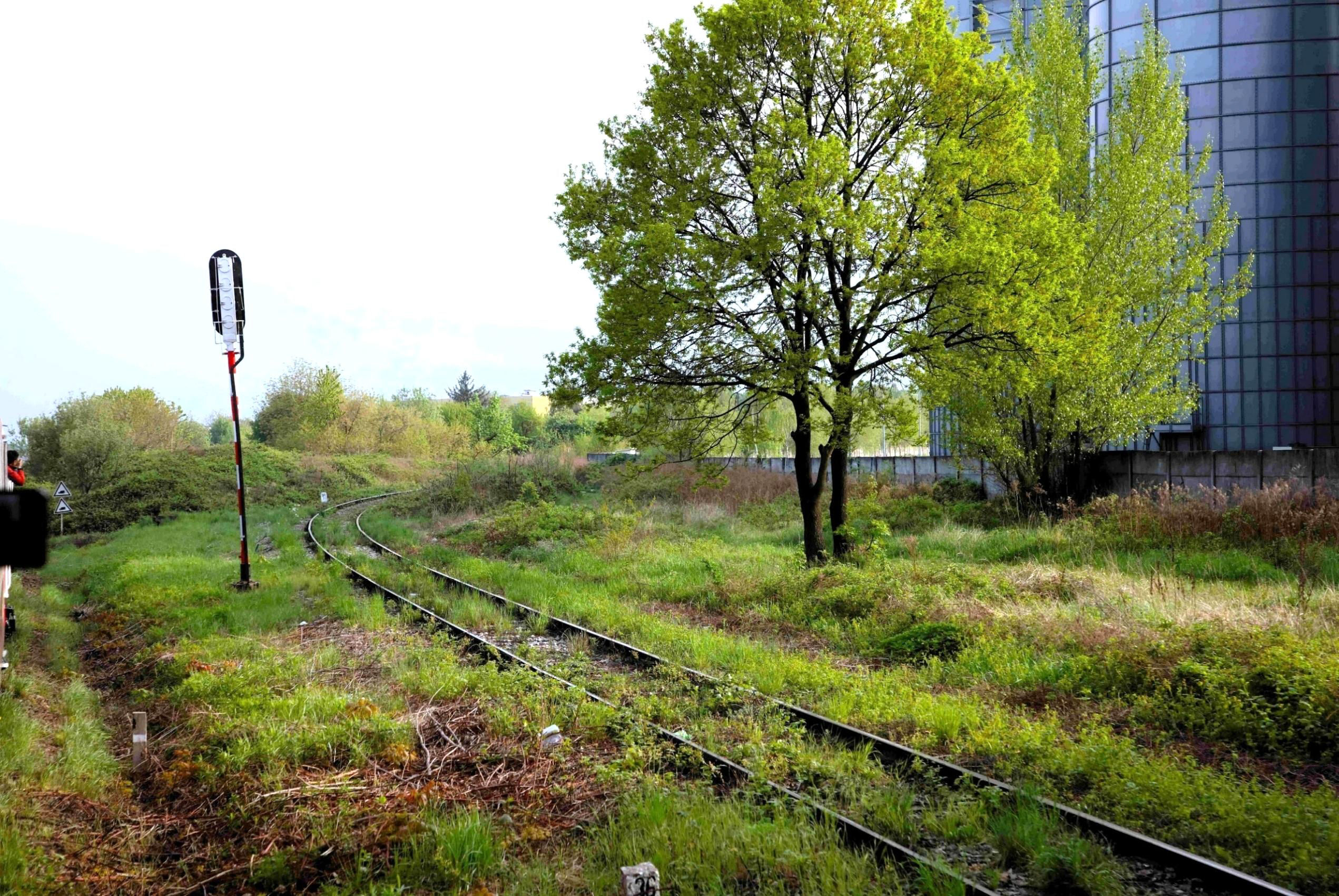
The one that got away - Strzegom - the Grabina Slaska Quarry branch. It was in the plan but not done due to the unexpected freight train!
[© Iain Scotchman 2025]