150 members were offered the chance to participate in test running of former D78 District Line stock converted to battery operation for short non-electrified sections of the main line railway to operate without the use of diesel engines. Part of the final testing, before entering services, was to check operation with a full load of passengers.
I had previously only travelled on one of these conversions, when 230002 (converted in 2017) gave demonstrations on the Bo'ness & Kinneil Railway back in 2018. I had been most impressed with the general performance of the train and ambience of the passenger accommodation.
The day started with a short trip on South Western Railway 450 stock from home to Waterloo, rather than the expected 455 stock on the train. Then it was the delights of 1972 stock on the Bakerloo line as far as Oxford Circus, before joining the longest Underground journey from Epping (once longer still to Ongar, of course) to West Ruislip for a quick look at the nearby HS2 workings at the west end of the Central line. I had wondered if the new 2024 stock Piccadilly line train might be visible in Ruislip Depot but was to learn later that it had moved to Northfields Depot a few days before.
Returning to Greenford gave the chance to change for the 2-car Turbo DMU on its 11 minute journey to West Ealing. Arriving there, the train topped the 3-car battery unit 230001 sitting in bay P5, quietly charging ready for our special workings. P5 is authorised for permissive working. During the last year or so 230001 had been testing on the branch (over 900 trips) in between the normal half hourly (SuX) service. Plenty of photographers were taking an interest, many part of the test load of 250 passengers.
The assembly point for us all was outside the station entrance. The number of people waiting gradually increased as the designated time approached. After checking in with the person 'in charge' (!) I learned that a willing volunteer had offered to write this review which saved me making too many notes. A few days later I was told that the willing volunteer had not been able to make the trip due to illness so could I please do one? (Our Editor tells me willing volunteers for report writing would be greatly appreciated!)
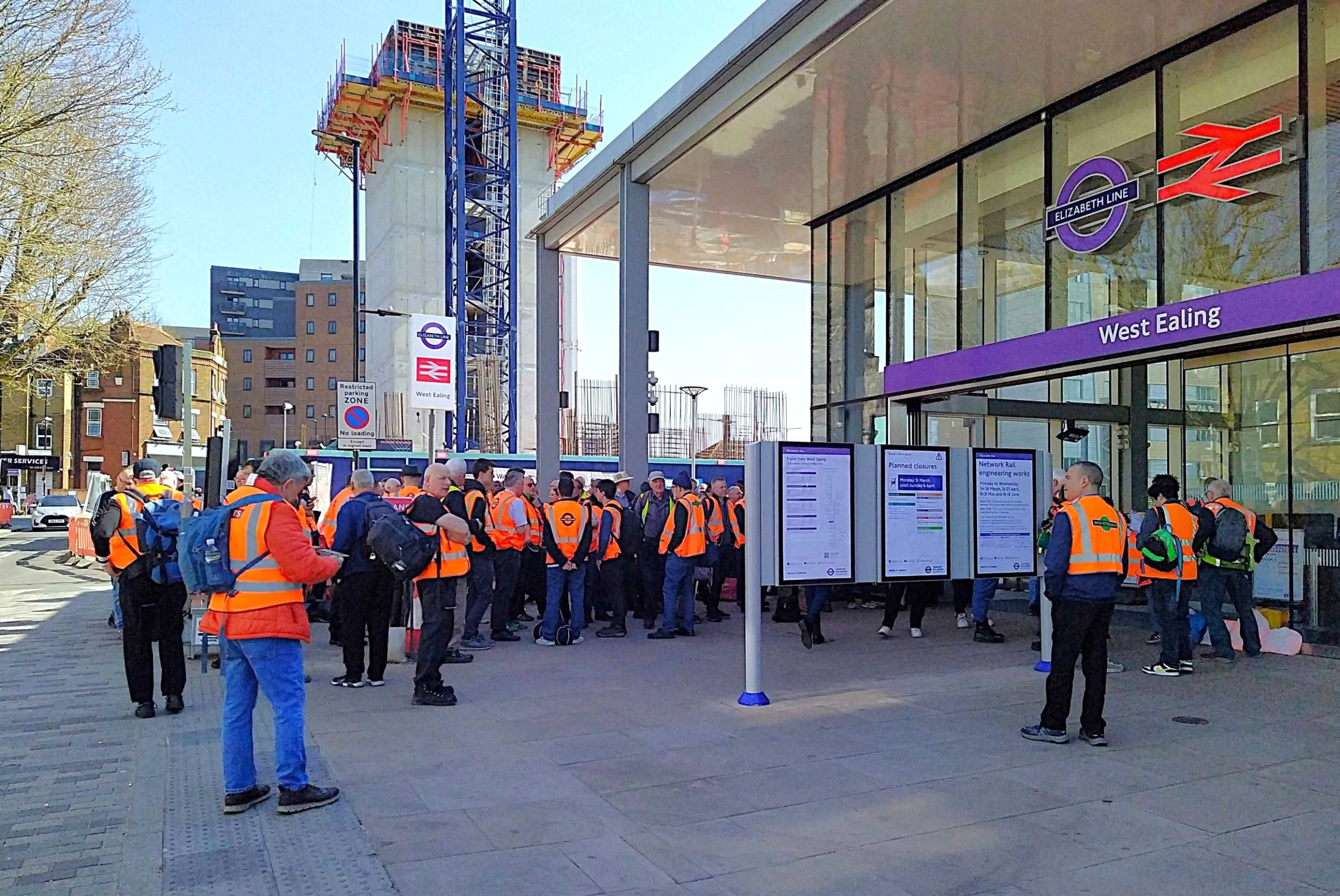
Participants assemble outside West Ealing station for our 3 Apr 2025 'Push & Pull' fixture. There was no pushing or pulling here.
[© Phil Logie 2025]Eventually, we all donned our Hi-Viz jackets and made our way down to the platform where we were each individually weighed, then presented with a badge and a booklet about the fast charge train technology that would be demonstrated to us. Passengers had been allocated to specific coaches, to ensure a spread of load and that a seat would be available. I was in Coach 'B' (the centre coach) - the one with most modifications from the original build. The end two coaches had the seating arranged in bays of four around tables. The centre coach was similar but also had the two centre sets of doors removed, giving additional seating capacity. These areas could be easily identified by the square windows rather than the rectangular windows elsewhere. The only evidence left of the former door areas was the plated over exterior door control button area. Also, a fully accessible toilet has been fitted to the centre coach which seemed to take up rather a large amount of the overall coach capacity given the shorter length of the vehicle compared with normal mainline coaches. Although it should be noted that this coach was more of a prototype and demonstrator than a final option for conversions.
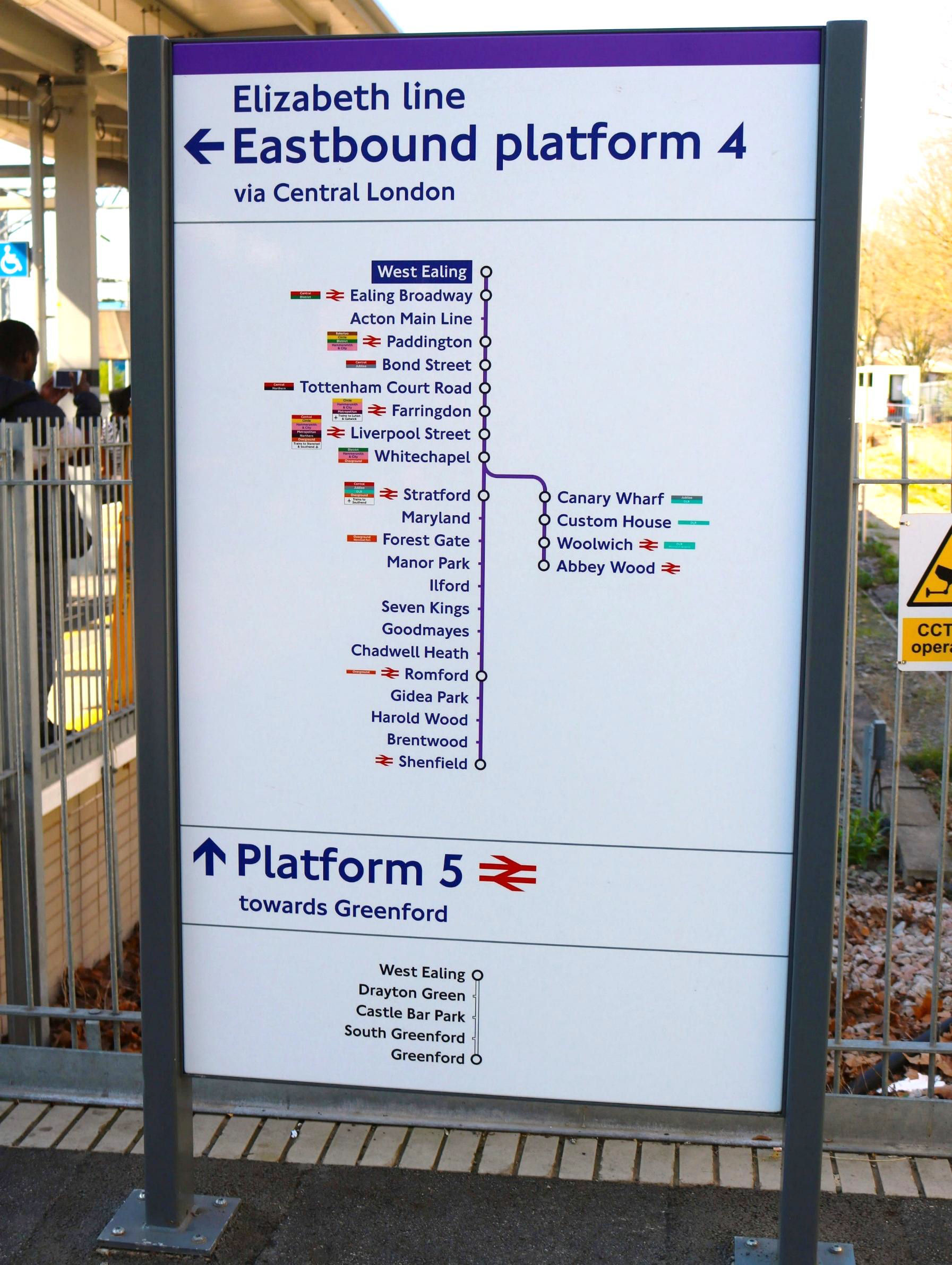
West Ealing P4 and, easily missed hidden at the bottom, P5, route guides.
[© Geoff Noakes 2025]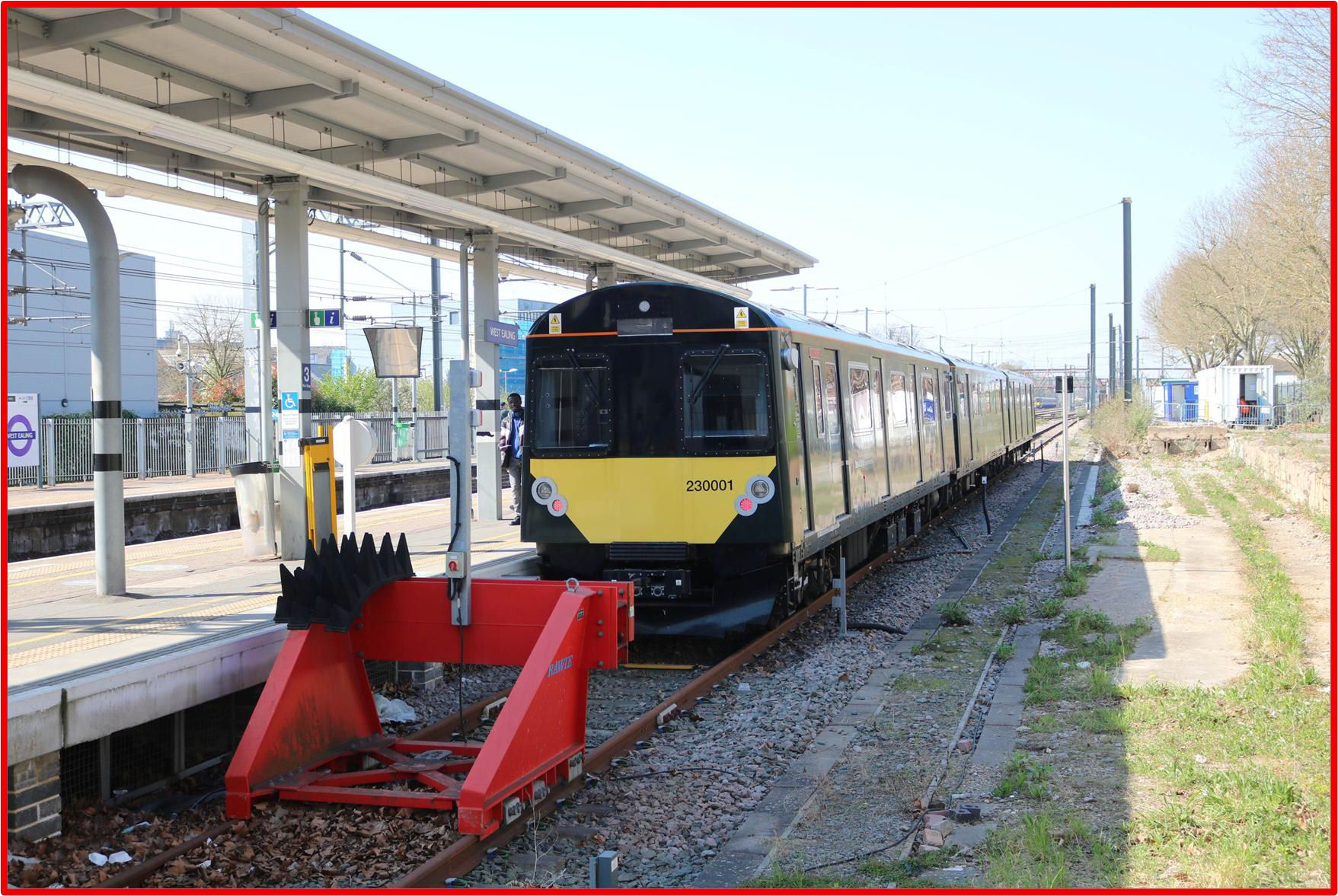
General view of West Ealing bay P5, looking west, with the unit and the charge cabins to the right.
[© Geoff Noakes 2025]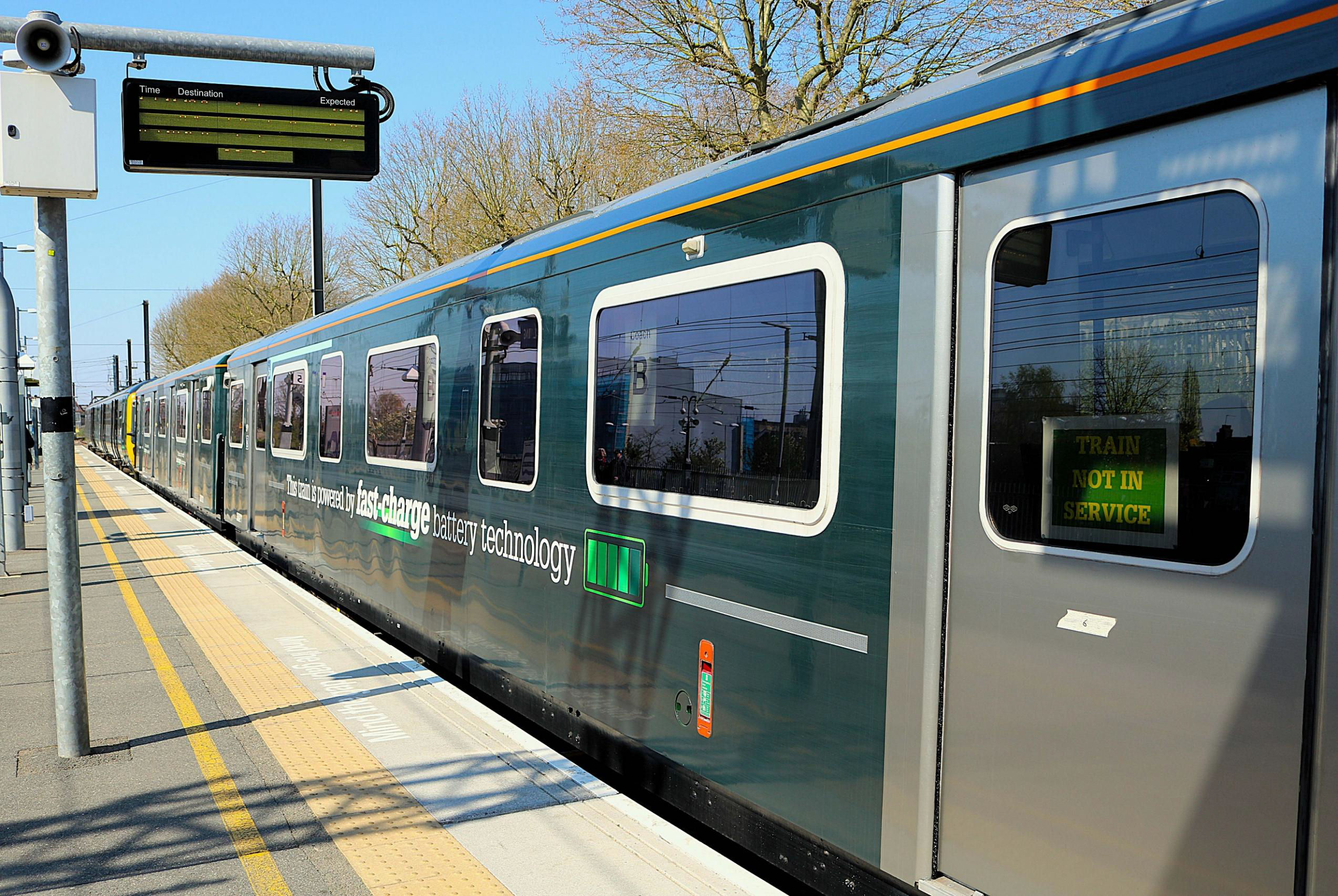
he centre coach, now without centre doors. The door nearest was out of use as a table with monitoring equipment was right behind it.
[© Geoff Noakes 2025]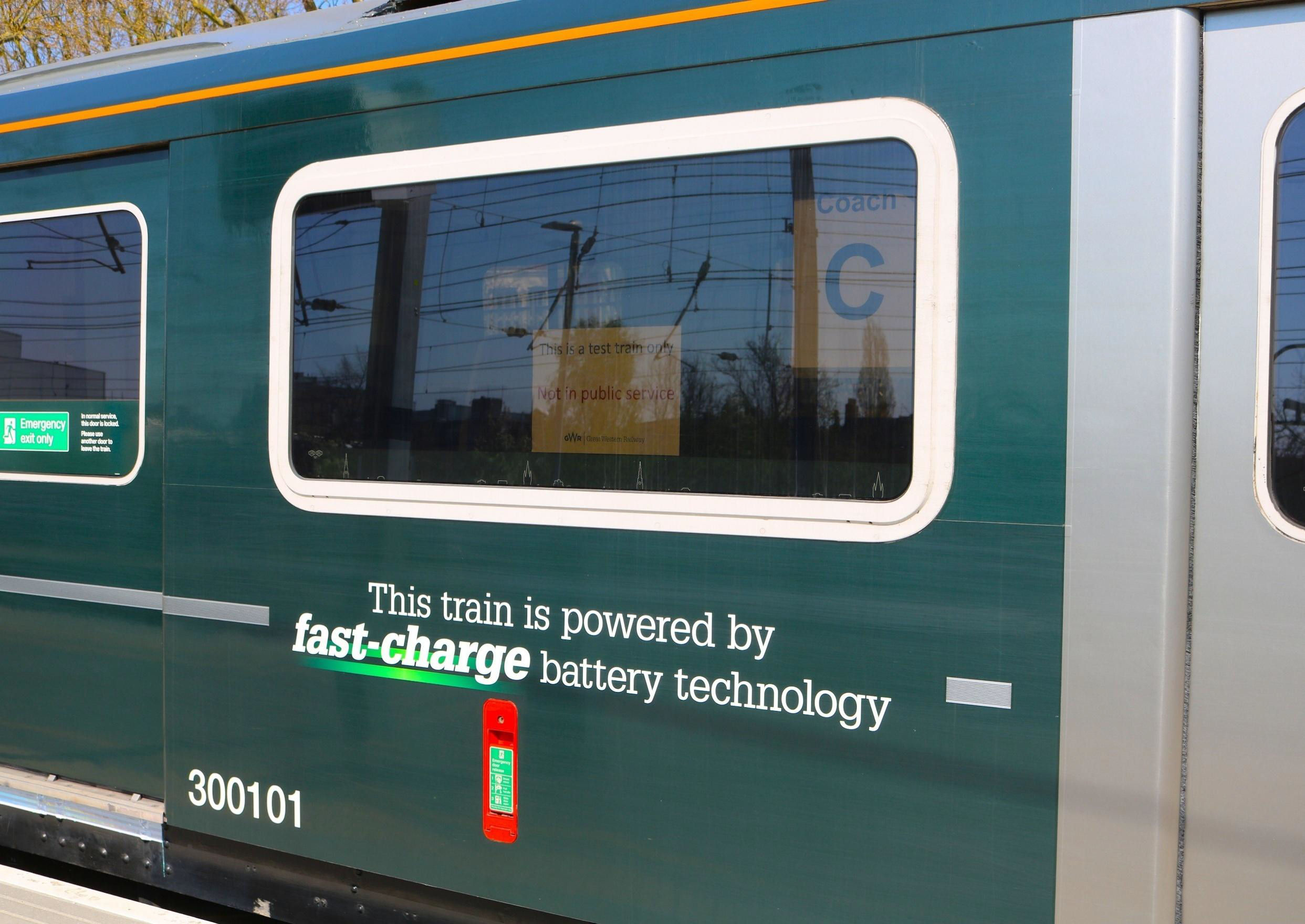
Coach C advising This is a test train and not in public service.
[© Geoff Noakes 2025]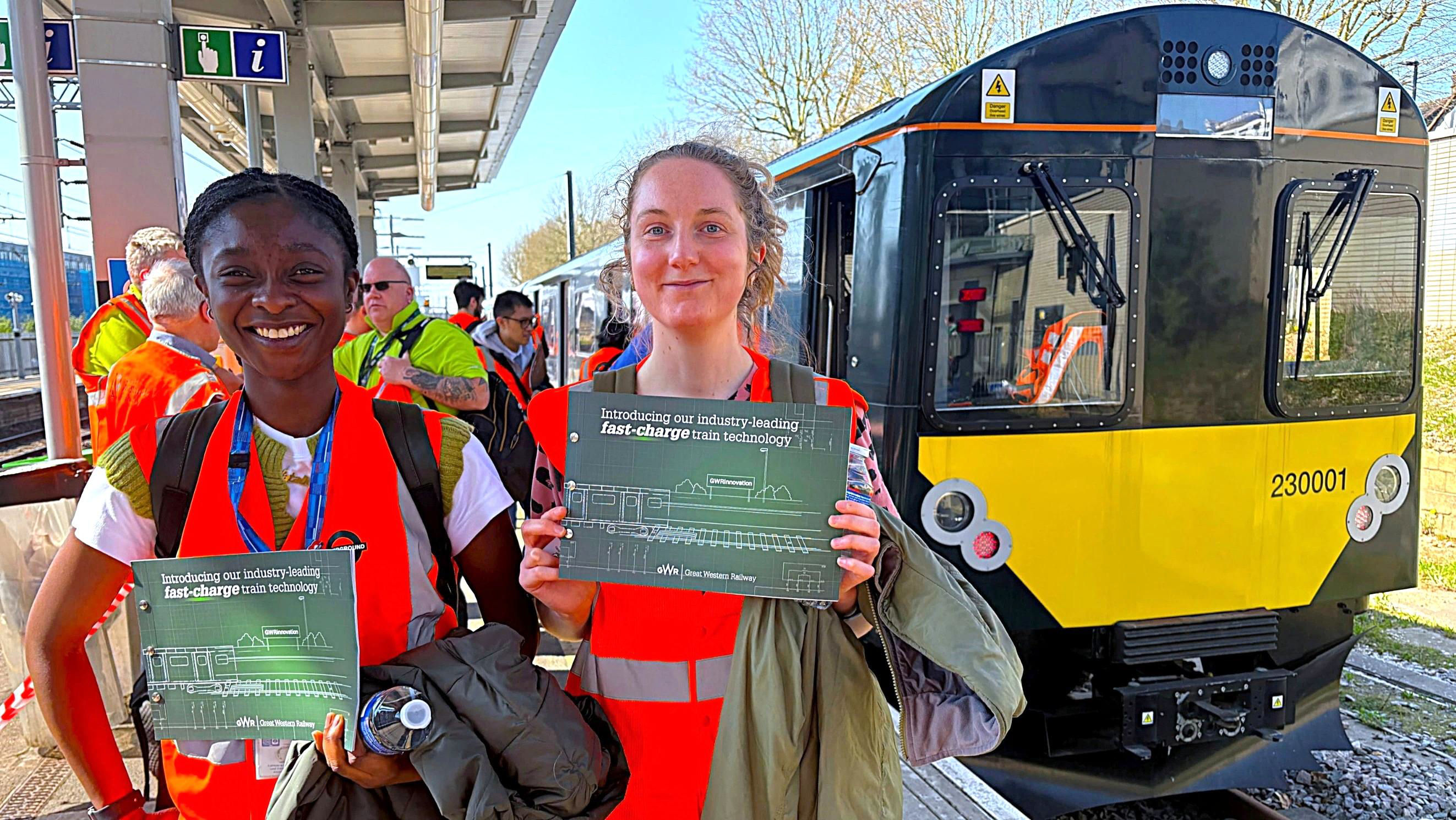
Maybe we could sign these two up for BLS membership? They seem very pleased with their souvenir booklets at West Ealing P5.
[© GWR 2025]Once everyone was settled in their seats, we set off precisely at the booked departure time of 13.32. Overall impression was the train was quiet and smooth; we stopped, without the doors opening at Drayton Green, Castle Bar Park and South Greenford on the short journey. The three minute turn round at Greenford was achieved before we returned to West Ealing. Drayton Green is the least used station in Greater London with 20,198 passengers in 2023-24. Its ticket machines were removed in 2008, leaving only contactless payment facilities. At West Ealing, we undertook a detrainment exercise while the train recharged before our second trip - on test at Long Marston it has done over 76 miles in one charge but that was a non-stop continuous unloaded run. The end two coaches evacuated quickly but those in the centre coach encountered a problem with one set of doors blocked by monitoring equipment, leaving the passengers to egress by the one remaining door which apparently was reluctant to open initially.
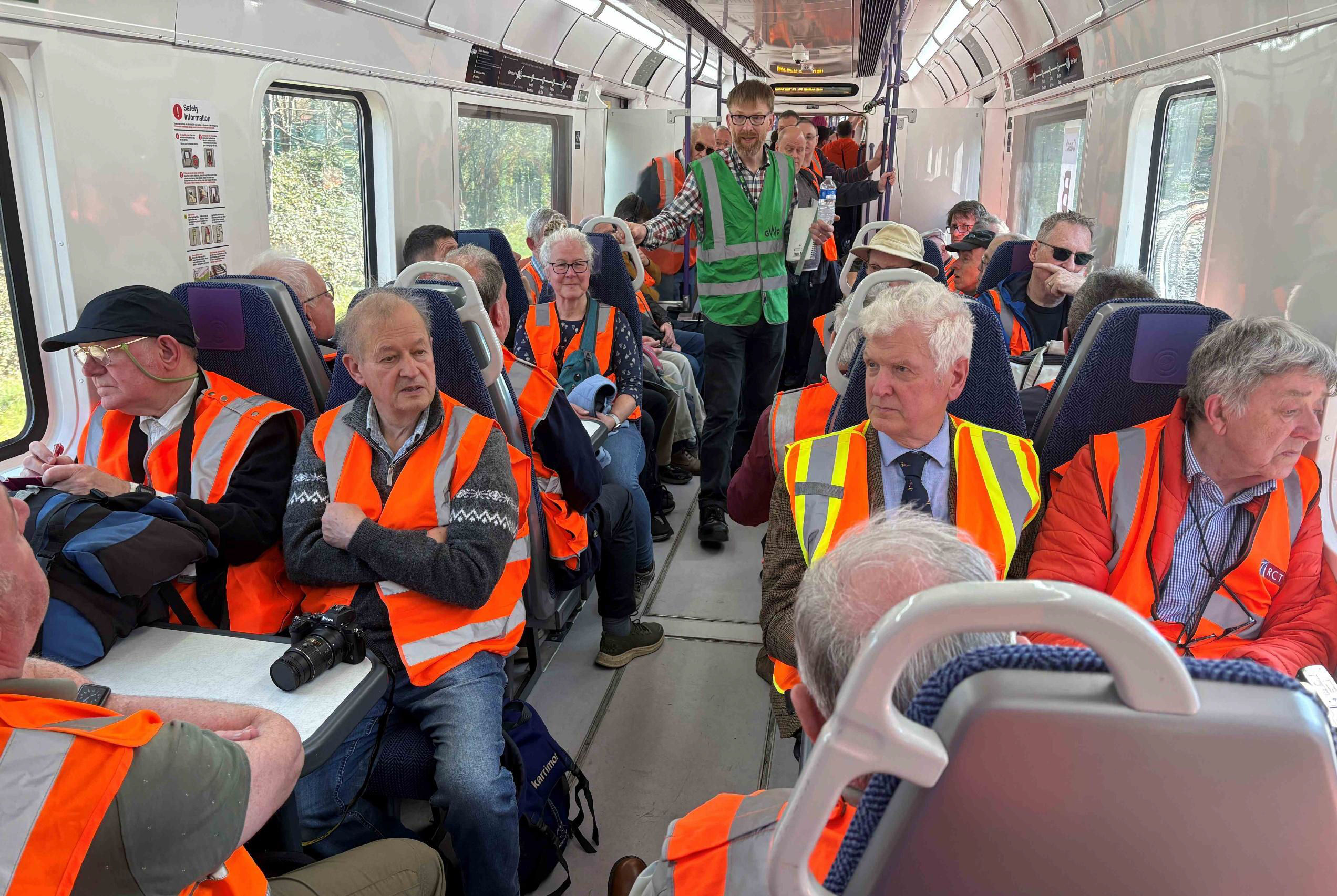
ou may recognise some of these people, note the square windows each side where the centre doors used to be
[© GWR 2025]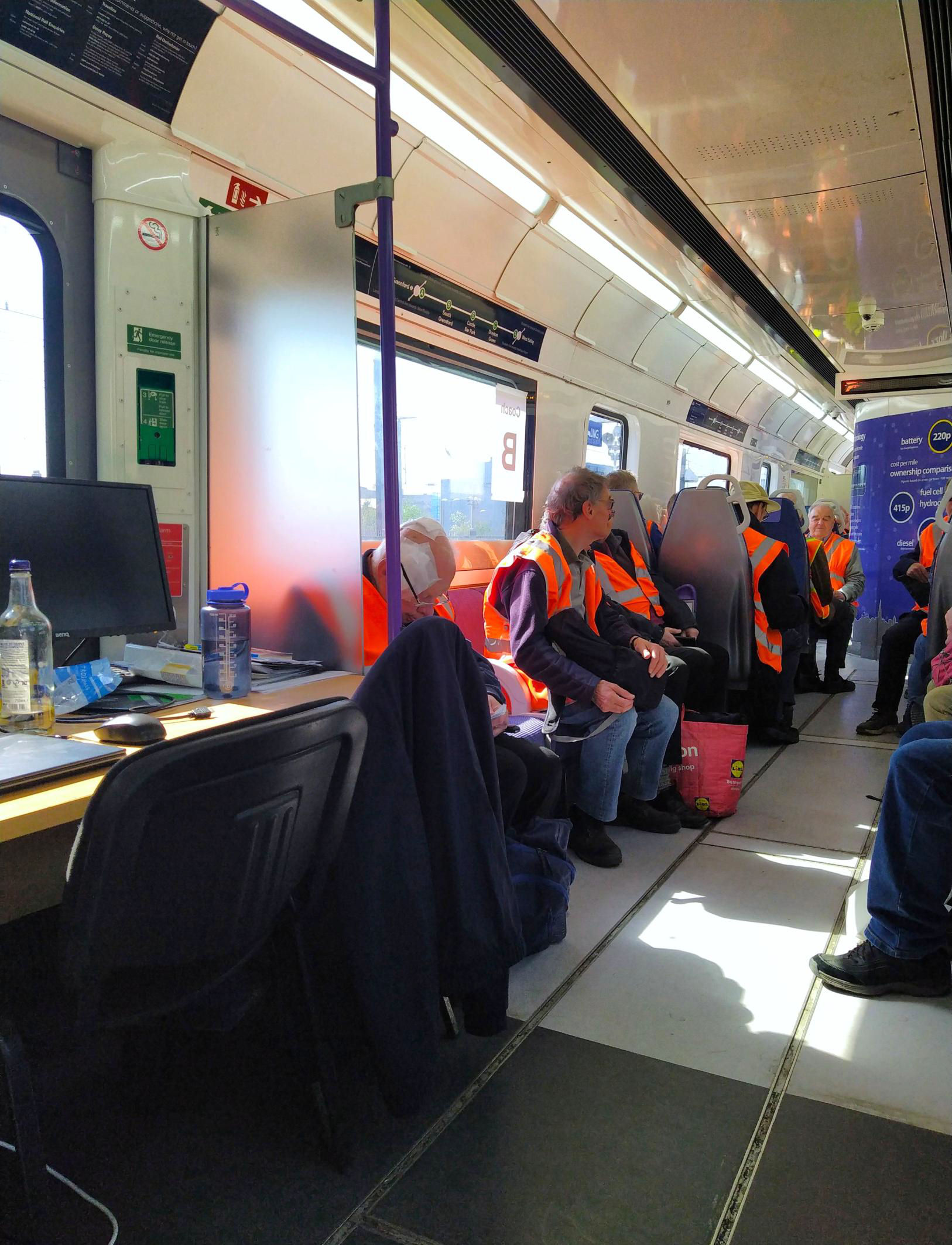
Centre coach 'B' showing monitoring equipment, the toilet and former
Society chairman Robert Green facing the camera in the distance.
[© Phil Logie 2025]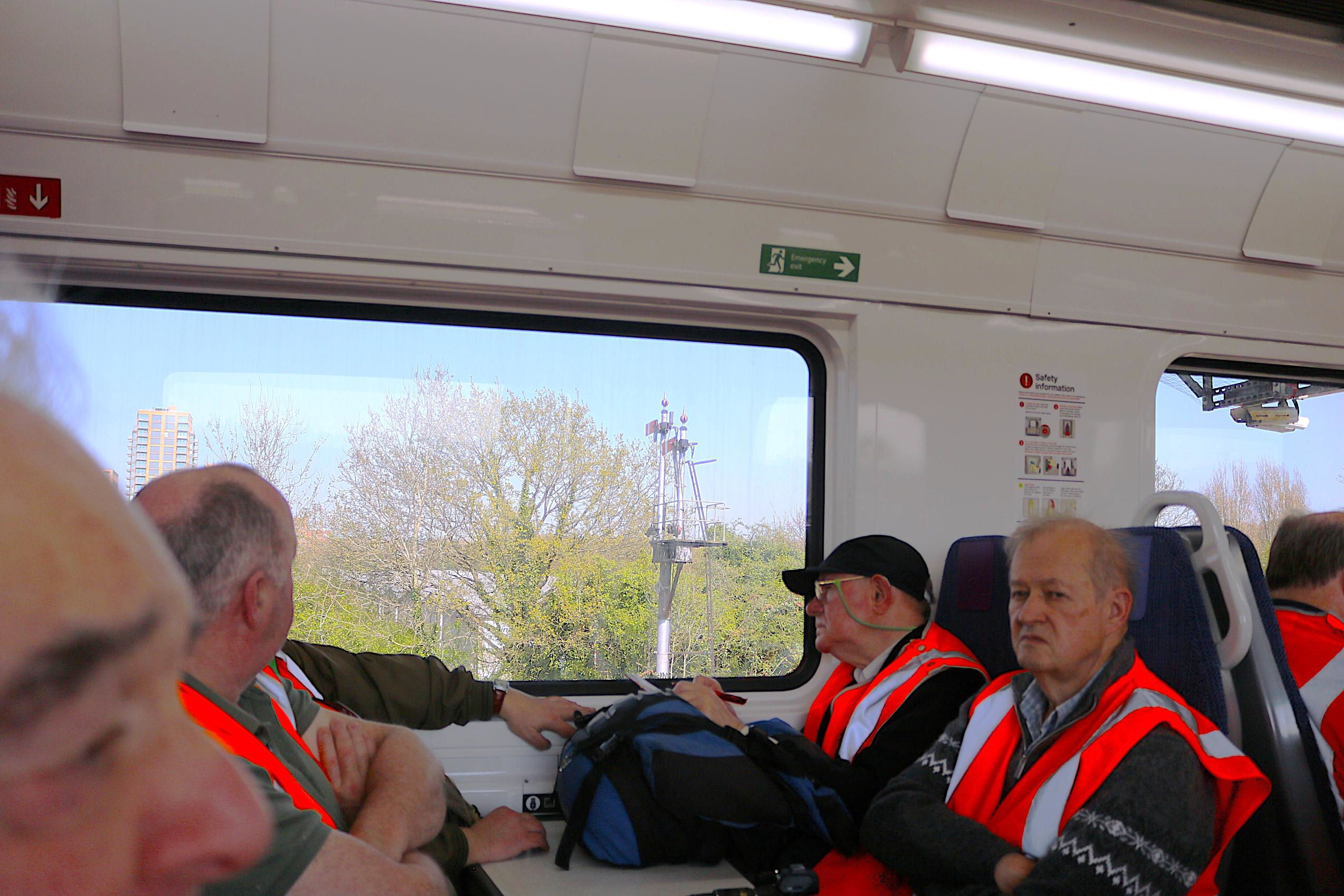
Contrast at Greenford with distinctly old technology seen through the window.
[© Geoff Noakes 2025]Once the door had been opened, the 67 passengers in the centre coach all achieved a speedy well organised evacuation. Had there been a genuine emergency evacuation, we would have moved to the adjacent coaches to leave the train, of course.
While all this was taking place, the normal DMU shuttle arrived and departed - its few passengers probably wondering what was going on - before we rejoined the train for our second round trip, departing at exactly 14.24. This again went smoothly until reaching South Greenford, where we didn't make our booked departure time but remained standing at the platform. The live passenger information on the other platform showed subsequent workings on the line as cancelled, suggesting all was not well.
Checking the data available on railcam.uk revealed that the DMU had become defective and eventually departed ECS at 14.48 (18 minutes late), allowing us to leave South Greenford 6 minutes late to GE51 signal at Greenford South Jn, to await the DMU leaving the bay platform and single line section at Greenford. During this time, it became apparent that the PA system was not working in the centre coach (we were also told neither was the air-conditioning but that was not noticeable for the short trip).
Arriving back at West Ealing 16 minutes late, our train berthed on top of the defective branch unit, which was now blocking access to the charging facility. Testing over, we left the train and walked to an adjacent hotel for a presentation (with tea and coffee provided) about the train and the innovative fast charge system, with a question and answer session at the end.
Hopefully, the important parts have all been remembered and will inform all those who did not make the fully booked event. The train weighs 95 tons (of which 10 tons are just batteries), with 20 tons of passengers conveyed (it was after lunch). The total cost of a battery train is about 50% of the cost of an alternative train over its entire life. This includes purchase, material costs, build, conversion, running costs and replacement batteries etc. The raft of batteries is so heavy that special strengthening is required. They have a useful life of about 8-10 years. Once replaced by new ones, they can then be reused for about 15 further years as a power bank before being recycled.
The unit has 106 kWh battery rafts, with a practical operational range of 40 miles, requiring an eight minute charge for that mileage. The battery powered train can be charged through an automatic charging point. Alternative means of charging the 3-car vehicle include the use of a static battery bank to provide an electric supply of either 11 kV or 33 kV. The train requires a minimum of 750V to operate.
Here, power is from the domestic supply, trickle-charging a battery power bank supply in adjacent lineside cabins. The batteries are a fairly small component in the cabins, which also house a lot of control gear. The three recharging rails are only live during the fast recharge when the train is in the charging position. The centre rail is longer than the two others so cabling can be attached to the longer section.
We were shown graphs indicating how recharging the train during the three minute turn round provides enough power to fully cover the normal requirement until the next recharge. The power banks trickle-charge themselves in between train charging. There is sufficient capacity for the train to operate for a few trips without charging or for the power banks to be able to cope with a power cut of a few hours or late running. The graphs also indicated relative consumption of power and the time that batteries will last under various conditions. The variable which was hardest to cover was different driving techniques!
There is more demand on the batteries for a train leaving a depot in the morning to power heating, lighting and air-conditioning, so a shore supply is desirable overnight. The other DMU operated Thames Valley branches are ideal candidates for future operation. (GWR bought all the spare Vivarail D78 stock after the company went into administration on 1 Dec 2022, two weeks before Adrian Shooter's death.)
Longer term, the Cornish branches would be new build units. The North Downs line is a problem as the third rail sections have insufficient power to recharge for the intermediate non-electrified sections. This was a very interesting afternoon, the 'charge' resulted in a £1,320 donation to Railway Children.