Fri 1 Sep dawned bright and early for me with a roughly two hour drive from Aylesbury to Whittlesea station, in the town of Whittlesey, the meeting point for 11 hardy members at 09.00. It was yet another strike day with no passenger trains running on the line between Peterborough and Ely. However, the intensive freight traffic meant we saw plenty of action. Our organiser, Nick Garnham, explained the day's activities and the small convoy set off through the relatively flat countryside to the furthest out box to be visited, Manea. While waiting from 08.50 to 09.15, 66774 passed Whittlesea, 13 early, on the 05.20 Doncaster iPort to Felixstowe South and 66560 passed 44 early with the 05.50 Felixstowe North to Leeds.
Manea: (pronounced 'May-nee' locally) was the first box to be visited. Here, we met Local Operations Manager (LOM) Gary Atkins, our guide for the day. Gary was an excellent guide, his many years of operational experience on the railway kept us informed and entertained throughout the day.
Manea: Whittlesea and March are some of the last semaphore controlled locations in East Anglia. Full access to the signal box was not available but it was possible to look in through the door and take photos. It is a McKenzie & Holland designed box built in 1883 with a 25-lever frame, although only about 10 levers are in use. There is an adjacent level crossing before the station platforms. Manea fringes with Cambridge signal box, which controls the Ely area to the southeast. The line is worked by Track Circuit Block (TCB) to the east (Up direction) and Absolute Block (AB) to the west (Down direction).
Four splendid semaphore stop signals are controlled and the Up home is on a lovely photogenic bracket protecting the crossing. The Up and Down distant signals are colour lights. There is a trailing crossover in front of the box, regularly used by light engines crossing from March Up Sidings to the Down line.
This is because March South Jn trailing crossover was OOU. The Down line ground signal for the points had fallen over but was not an issue as no movements were being made that way. During our 30 mins at Manea, four tarins were: ●66090, 27 early (-27) on the 08.00 Felixstowe South to East Midlands Gateway. ●66561 light engine Ipswich to March Down Reception Sidings (RS) (-33). ●66603 on 05.12 Tunstead to Barham stone. ●66561 light engine, 11.12 March Down RS to Ipswich Servicing Point (-43).
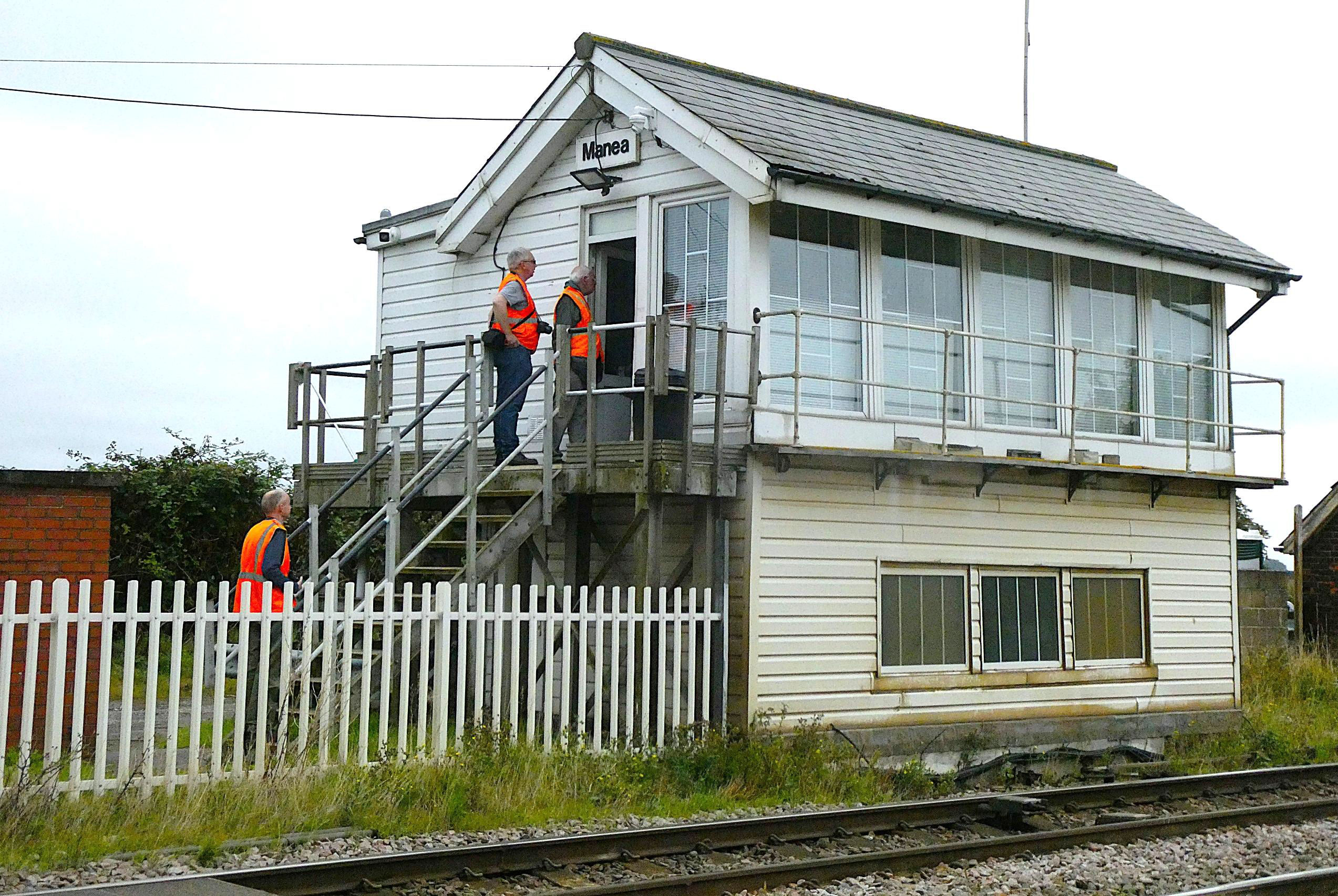
Manea box was the first to be visited on Fri 1 Sep 2023, Nick Jones is on the balcony to the left
[© Nick Garnham 2023]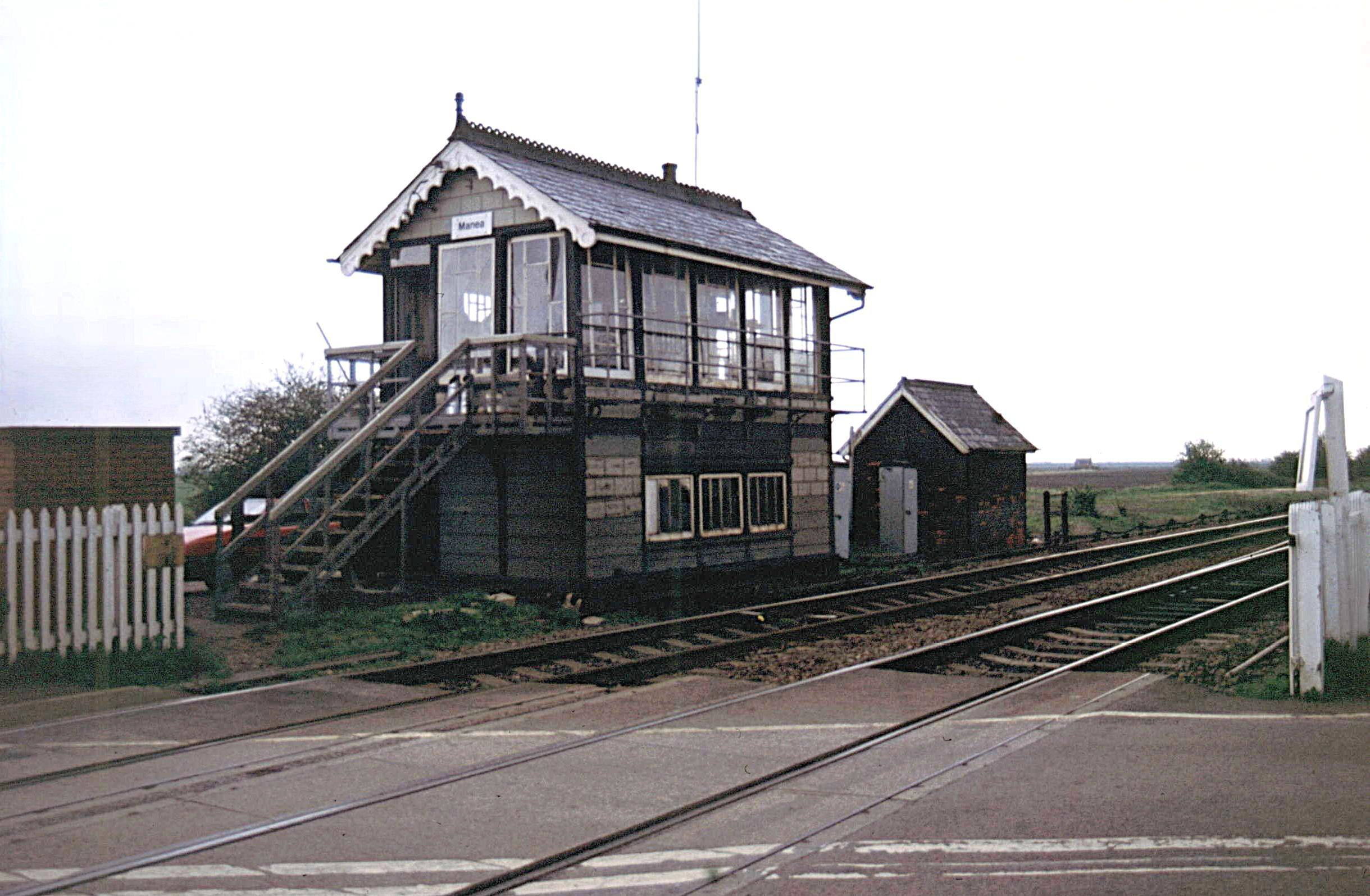
Manea box on 17 Apr 1993 looks very run down, it has since been reclad in uPVC and all its windows have been replaced
[© Angus McDougall 1993] Travelling the short distance northwest, we arrived at the modern 'portable cabin' style building. The original 1883 signal box on the southwest side of the line, on the Ely side of the level crossing collapsed in 1984, when this box opened. Manea signal box, less than two miles southeast, can be seen in the distance, the line being very straight in the flat fenland landscape. Stonea box houses an Individual Function Switch (IFS) Panel. Although next to a road underbridge, there is also an adjacent level crossing for tall vehicles to cross the line. The road bridge, at only 6' 6'' high, is one of the most struck bridges on the network, with much agricultural traffic in the area. The crossing is in constant use.
Single gates on each side of the line span both tracks when open to road traffic and were replaced in 2021. With up to 12 trains per hour, this is a busy box for the signaller. This block post controls three signals and works AB to Manea to the southeast and TCB to March South to the northwest. When the gates are closed to road traffic they are bolted and the Key Lock keys* from each gate are removed, locking the gates shut. The two keys are inserted into two slots on the front of the panel enabling the interlocking to release the signals. If the gates or signals cannot be released, there are emergency keys in the box. 66707 was on the 08.16 March Up Yard to Middleton Towers empties, 160 minutes late.
*These are not Annett's Keys, which are a specific type of key. Key Locks are a system of very basic keys invented by the LNER (they can be inserted into any Key Lock and have no individual coding, unlike an Annett's Key). For this reason, they are only used where one person is in sole possession of the keys to be used at one location (like a set of crossing gates). An Annett's Lock could be used to release an in-section ground frame with the key attached to a train staff, so it would be essential that only the authorised key could release that equipment. Additionally, a royalty was due for every Annett's Lock (as it was a patented design), so LNER avoided this with their own simple design.
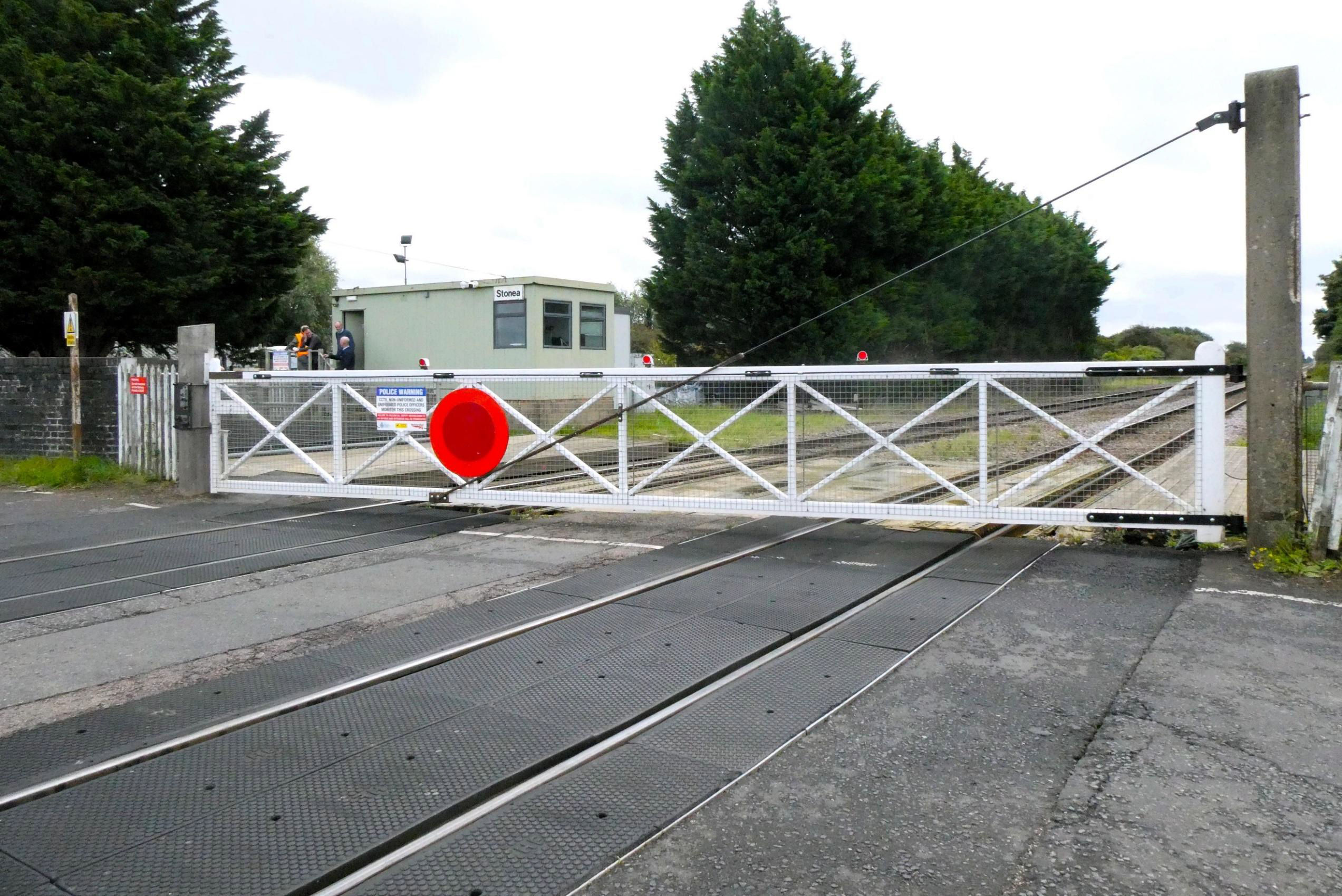
One of the two impressive manually controlled wooden level crossing gates at Stonea with the signal box.
[© Nick Jones 2023]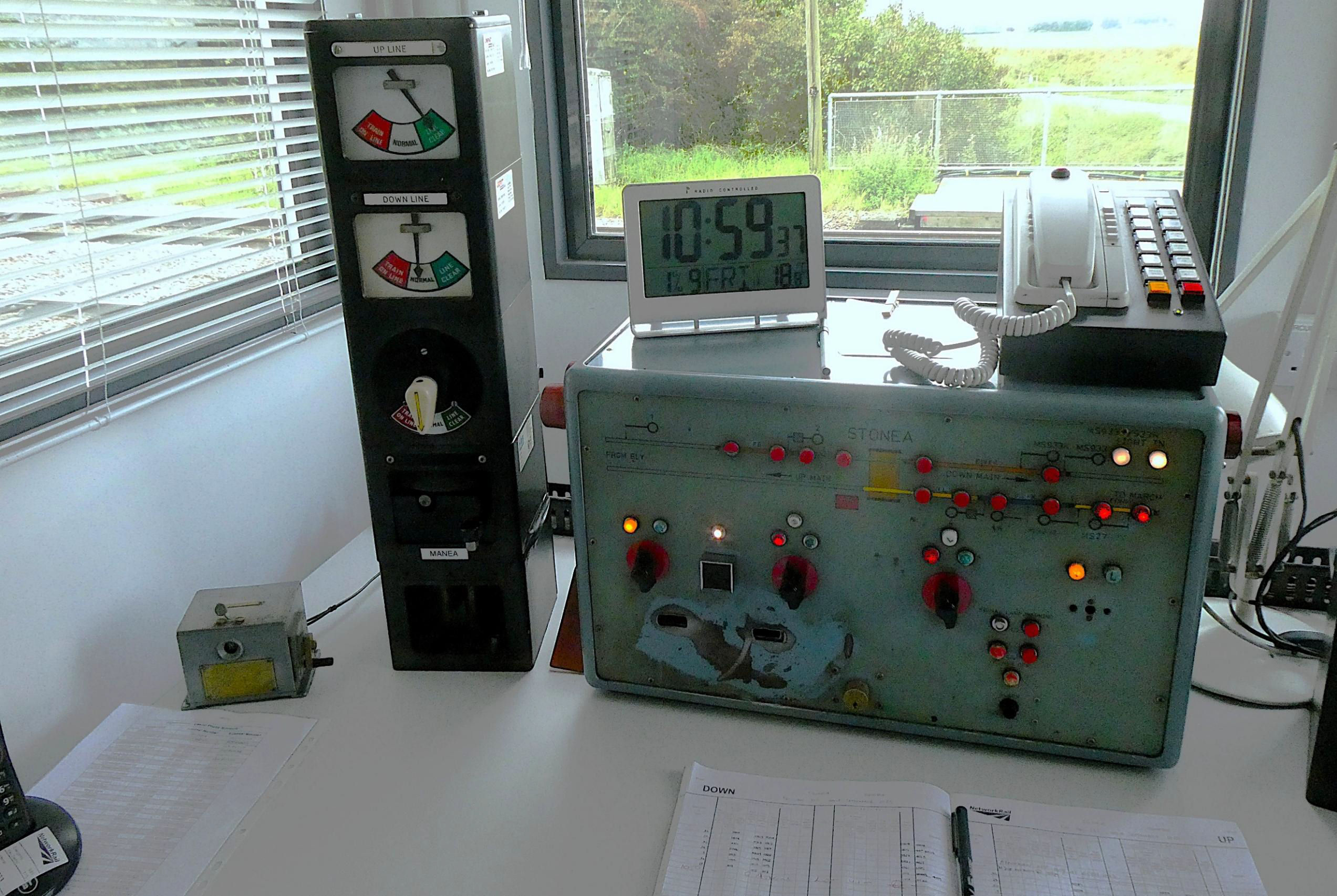
The small Individual Function Switch Panel at Stonea photographed in difficult lighting conditions.
[© Nick Garnham 2023] Travelling northwest from Stonea, the next box is March South Junction, which controls the adjacent level crossing and approaches to March. The box is next to a level crossing over four tracks, the Up & Down Main and No1 & No2 Down Goods Lines, adjacent to sidings which were full of redundant EWS Coal hoppers in 2023. Built in 1927, it is a London & North Eastern Railway Type 11a box with a 51-lever Saxby & Farmer 1888 duplex frame, replacing the original 1876 Nene Junction box, renamed March South Junction in 1928. The box still bears a BR (ER) - British Rail Eastern Region - dark blue enamel sign on its front. The frame is numbered 1-50, plus a lever 'A', which used to control the line to St Ives via Chatteris (closed 6 Mar 1967) and now regulates trains into the Up Reception line.
Originally March South crossing was wheel operated until it was converted to barriers, now controlled from a pedestal at the southeast end of the box. Crossing barrier release is by Lever No50. The electrically operated trailing crossover east of the box was out of use, a collar on Lever 19 prevented its use, hence the need for light engines to run to Manea to cross over from the Up to the Down. Another interesting feature of the box are the five electrical release plungers on the floor rather than being on the block shelf, although they are no longer used. This was common LNER practice and used in hundreds of boxes - 'interesting' now as so few boxes remain. All signals on the main are colour light, with ground signals controlling the sidings. Up Signal 934 and Down Signal 934 southeast between the box and Horsemoor Automatic Half-Barrier Crossing (AHBC), monitored by the signaller, are automatic. Silt Drove User Worked Crossing is beyond Horsemoor, then an AHBC at Badgeney Road. (TRACKmaps 2 p13C 2020).
A new signal diagram covered over the previous one several years ago and shows the layout all the way through March station to March East Jn for Whitemoor Local Distribution Centre. In the locking room downstairs, we saw that the point rodding runs out in three directions, illustrating that the box is of some size. The toilet is in a separate brick-built building. Noted passing were finishing machine and track regulator 77802 on 10.00 Frodingham to Broxbourne Tamper Sidings, 66783 on 10.28 Felixstowe North to Birch Coppice (-24) and DMU test train 950001 running from Bury St Edmunds to Peterborough.
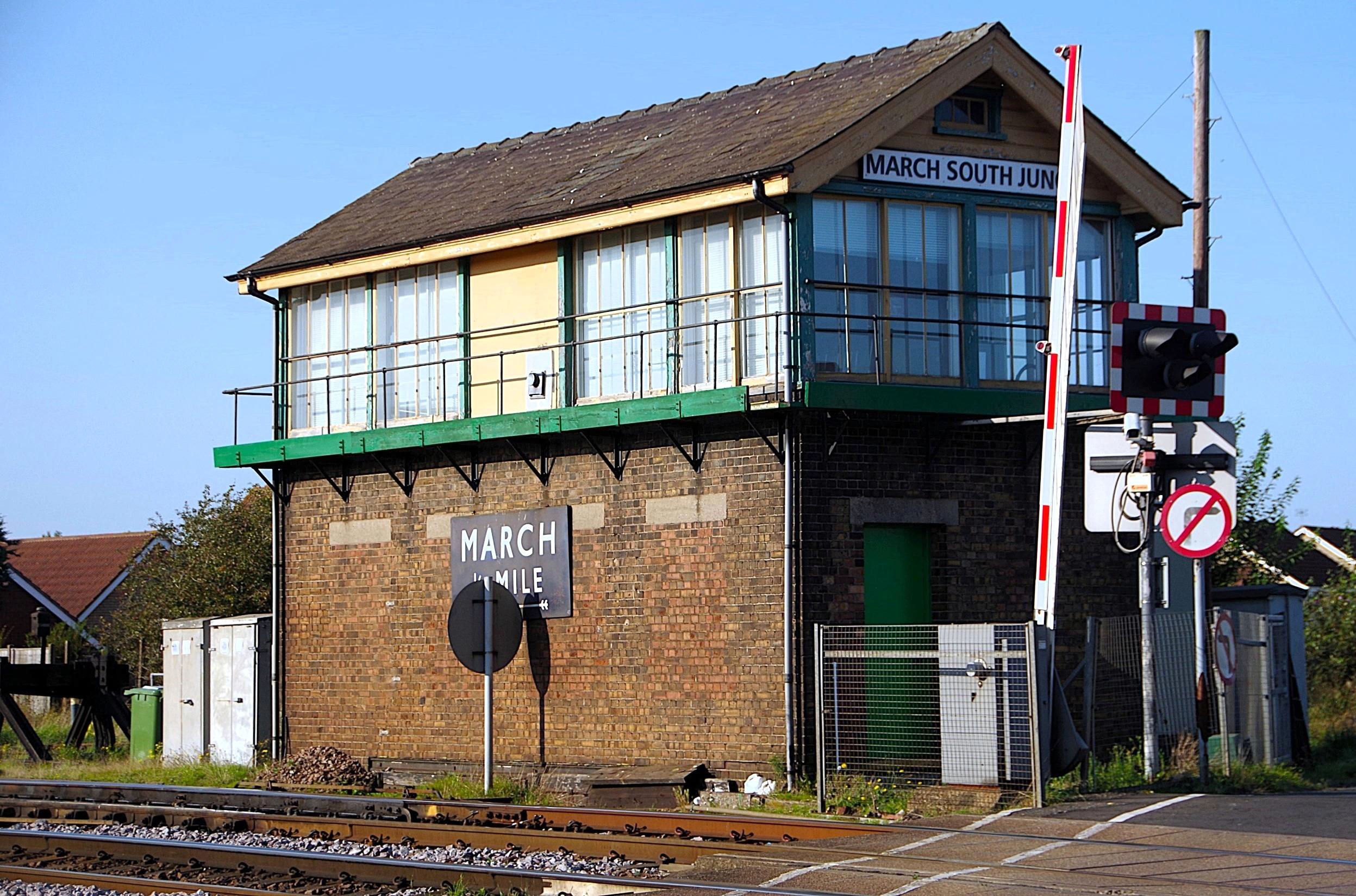
March South Junction.signal box.
[© Nick Garnham 2023]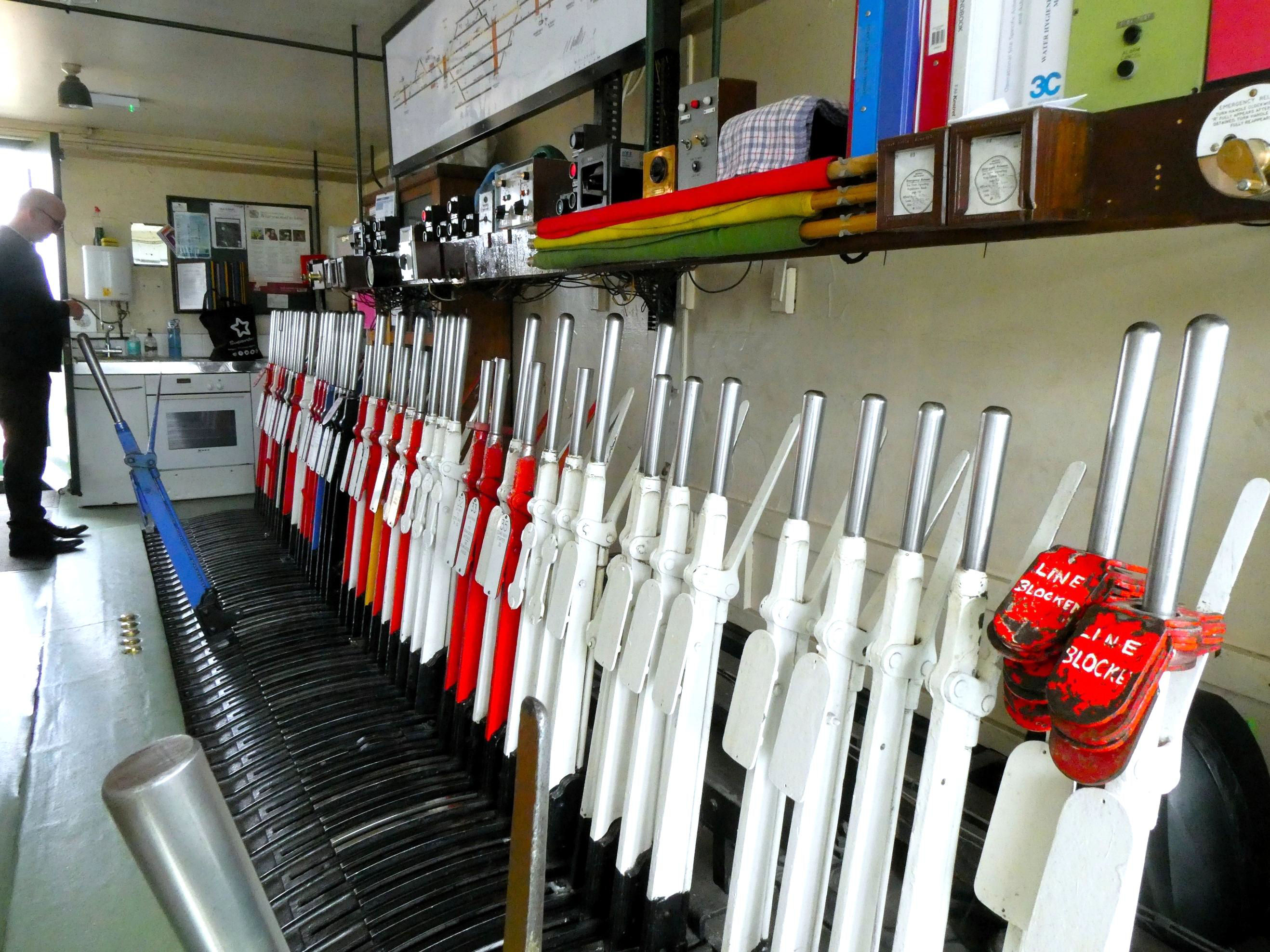
March South Junction signal box lever frame, instruments and diagram.
[© Nick Garnham 2023] This 1885 built box, a Great Eastern Railway Type 5 and Saxby & Farmer design, was extended in height in 1897 to improve visibility over March station, immediately northwest of the box and the level crossing. March station used to have seven platform faces but now only has two with track; as a result, the 61-lever Saxby & Farmer frame installed in 1897, when the box was modified, has many white (spare) levers. The frame was relocked and reduced to 59 levers in 1987, when the box took control of the former March West box area with track rationalisation. The levers are numbered 1-56, plus lettered levers 'A' to 'E' but 'A' and 'B' along with many others are out of use. Levers 'C', 'D', 'E' & 1 are for the Goods Lines, 'E' is for Up Goods to Up Main, and the other three are for the Down Goods to Down Main, controlled by subsidiary signal arms. All main line signals are colour light; only subsidiary arms and ground signals are used in the sidings. Lever 56 is the barrier release and, as at March South, the barriers are signaller operated. Lever 27 operates the Up Main to Whitemoor West Curve points, while the Up Main to East Curve is operated by 35, 50 (whether it is east or west curve), and 51 the entrance to Whitemoor, rather than Wisbech Siding which is the start of the former Wisbech branch.
Lever 28 operates the facing crossover east of the station giving Down trains access to the East Curve, or Up trains access to March Down Yard. The box was refurbished in 2011. The line west of here to Three Horse Shoes is TCB. Noted were 66142 on the 10.04 Wakefield Europort to Felixstowe South (-14), 66767 on 10.46 Felixstowe to Hams Hall (-20) & 66744 on 11.18 Felixstowe South to Tinsley (-30).
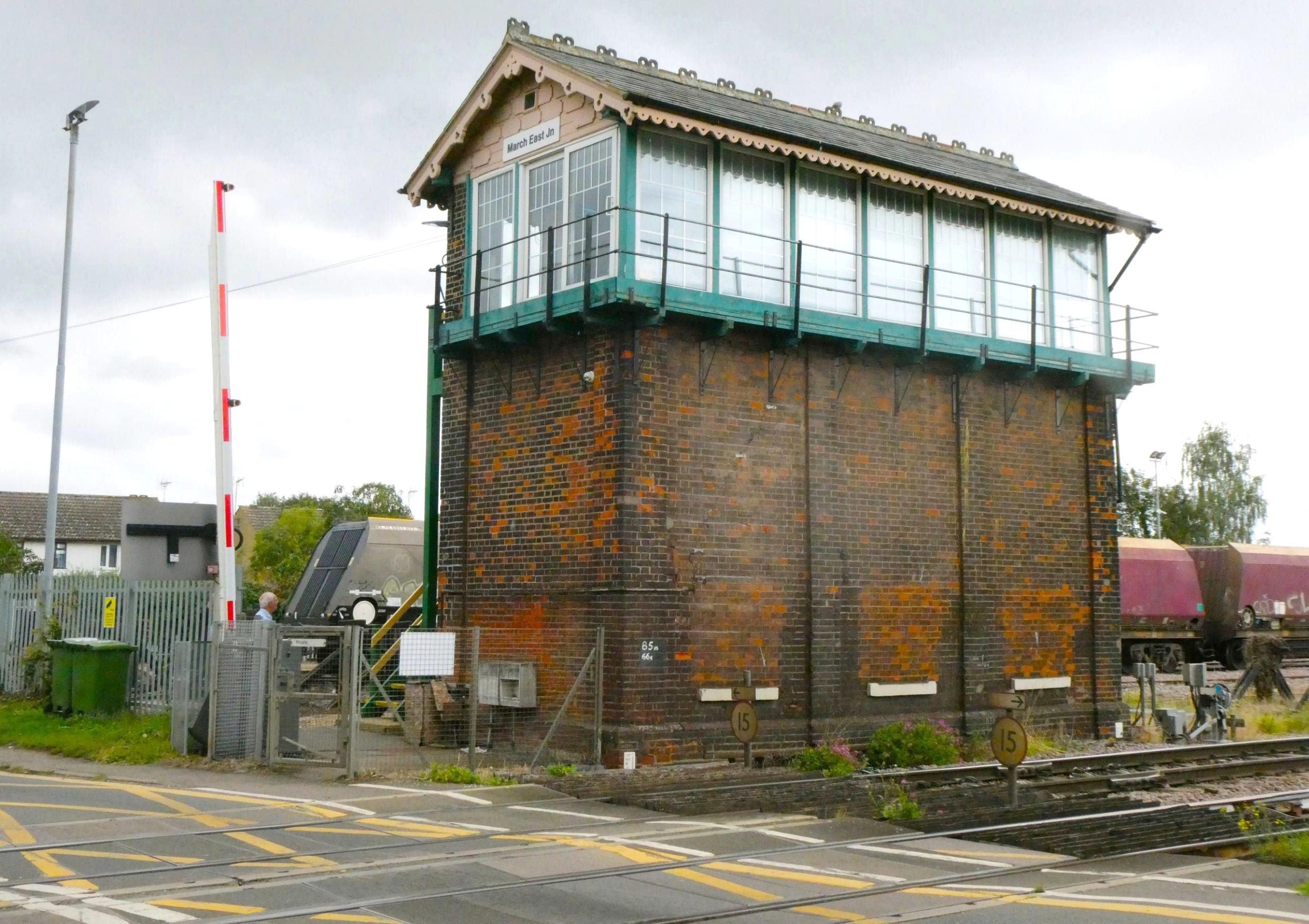
March East Junction signal box.
[© Nick Garnham 2023]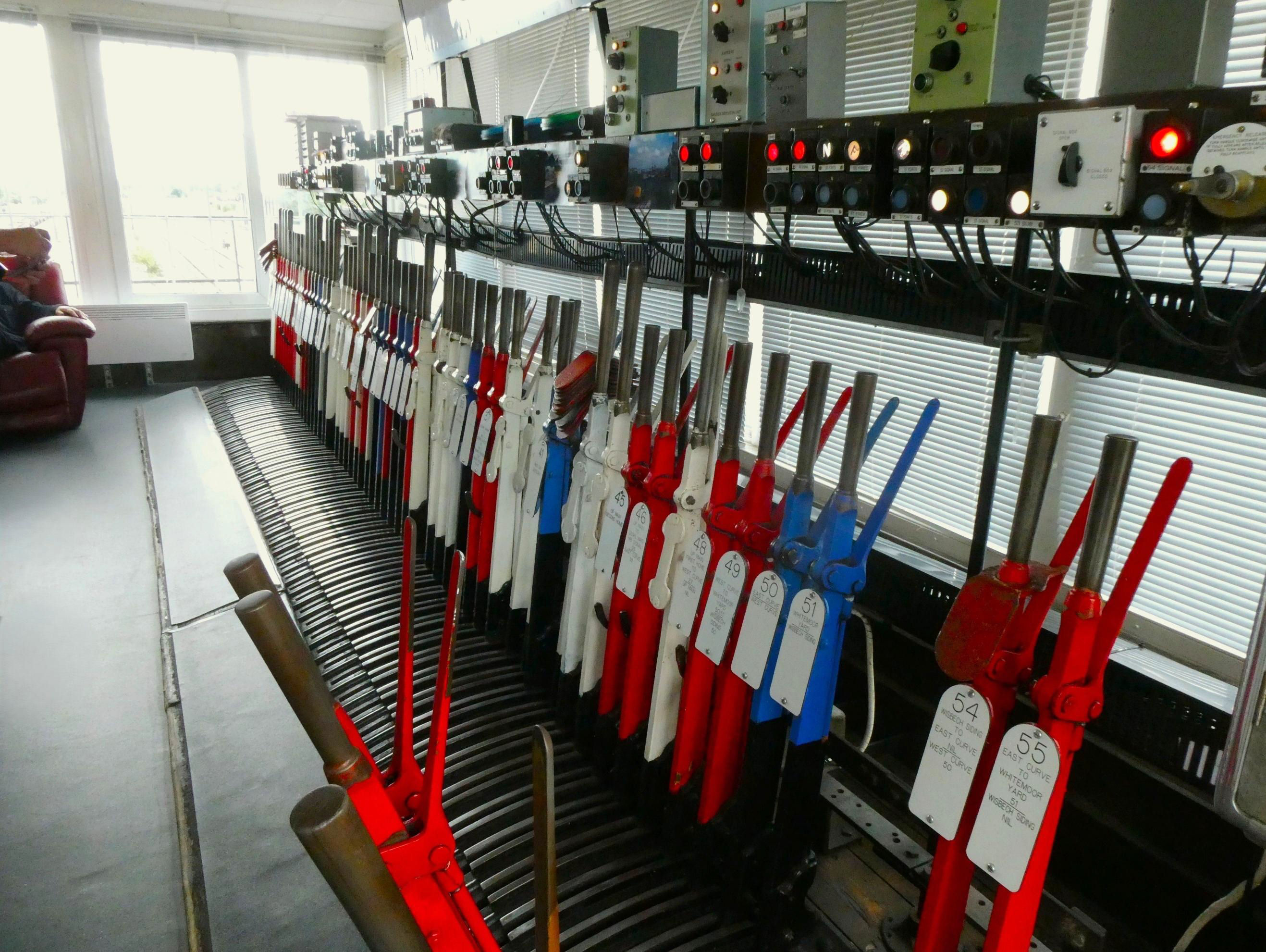
March East Junction signal box lever frame and instruments.
[© Nick Garnham 2023] This 1901 Great Eastern Type 7 box, with a McKenzie & Holland five inch 30-lever frame, acquires its name from the local pub in the village of Turves. It used to control the Benwick Goods branch (CA 30 Jul 1964); the remains of a loading gauge still hang alongside the Up main where sidings once stood. This block post oversees six level crossings, four are AHBC and two are user worked. Of the 30 levers, only five are not white. Two levers control signals on the Up and three signals on the Down.
All signals are colour light, with 30 and 29 controlling the Down Main homes and 27 a combined Down Main intermediate block home and distant. The box works AB to Whittlesea and TCB to March East Jn. Lever 1 is the Up Main distant and No2 the home. During our visit, one user worked crossing was in constant use due to harvesting and the phone was regularly ringing with tractor drivers asking for permission to cross. This meant home signal levers 30 and 2 were repeatedly fitted with collars so they could not be cleared. The diagram had blue tape highlighting the crossings in regular use. 66524 was on the 11.18 from Tinsley (-12) and 66784 on the 11.11 Hams Hall (-22) - both to Felixstowe North.
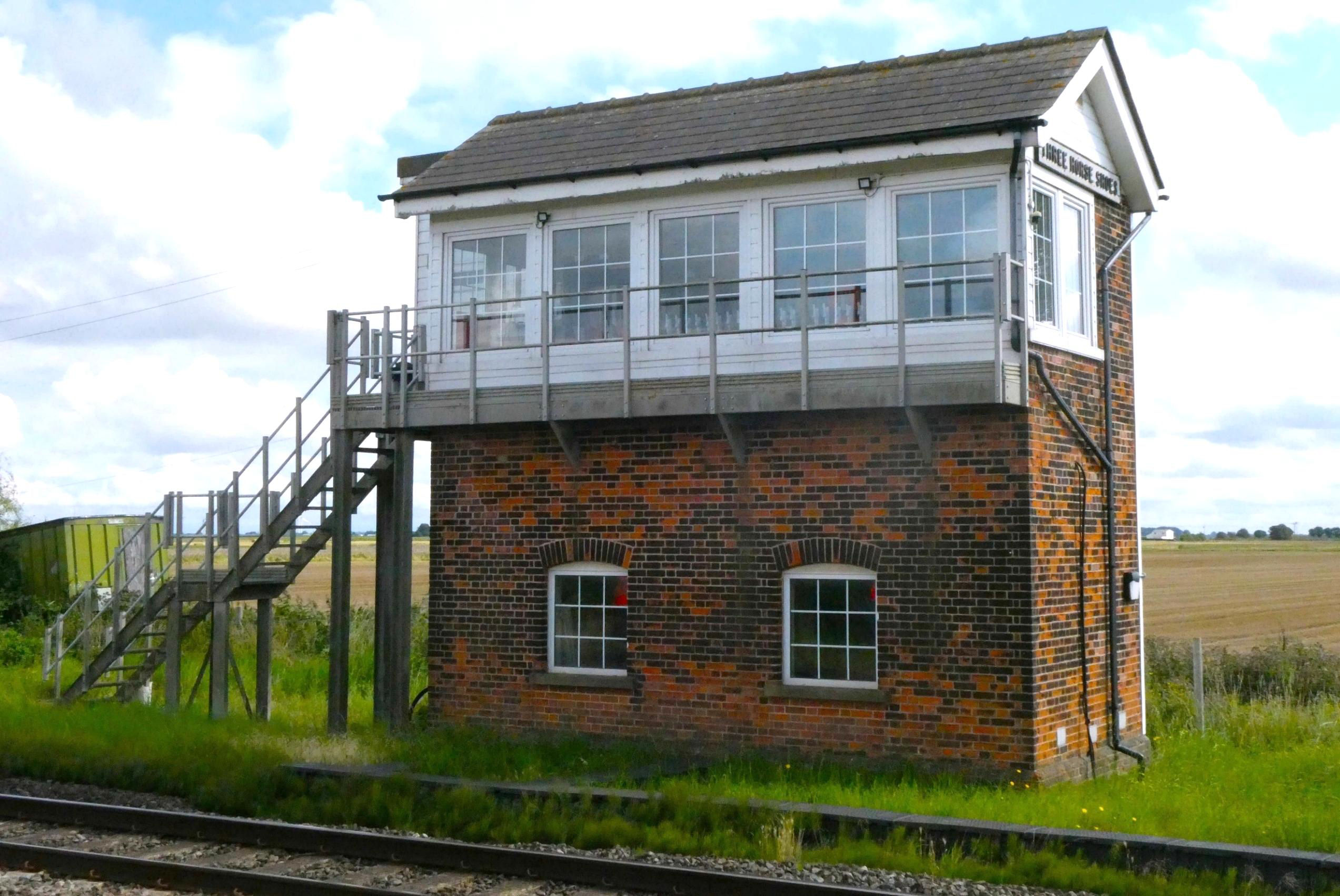
Three Horse Shoes signal box - sounds like the name of a pub (it was!) - once the junction for the Benwick freight branch.
[© Nick Garnham 2023]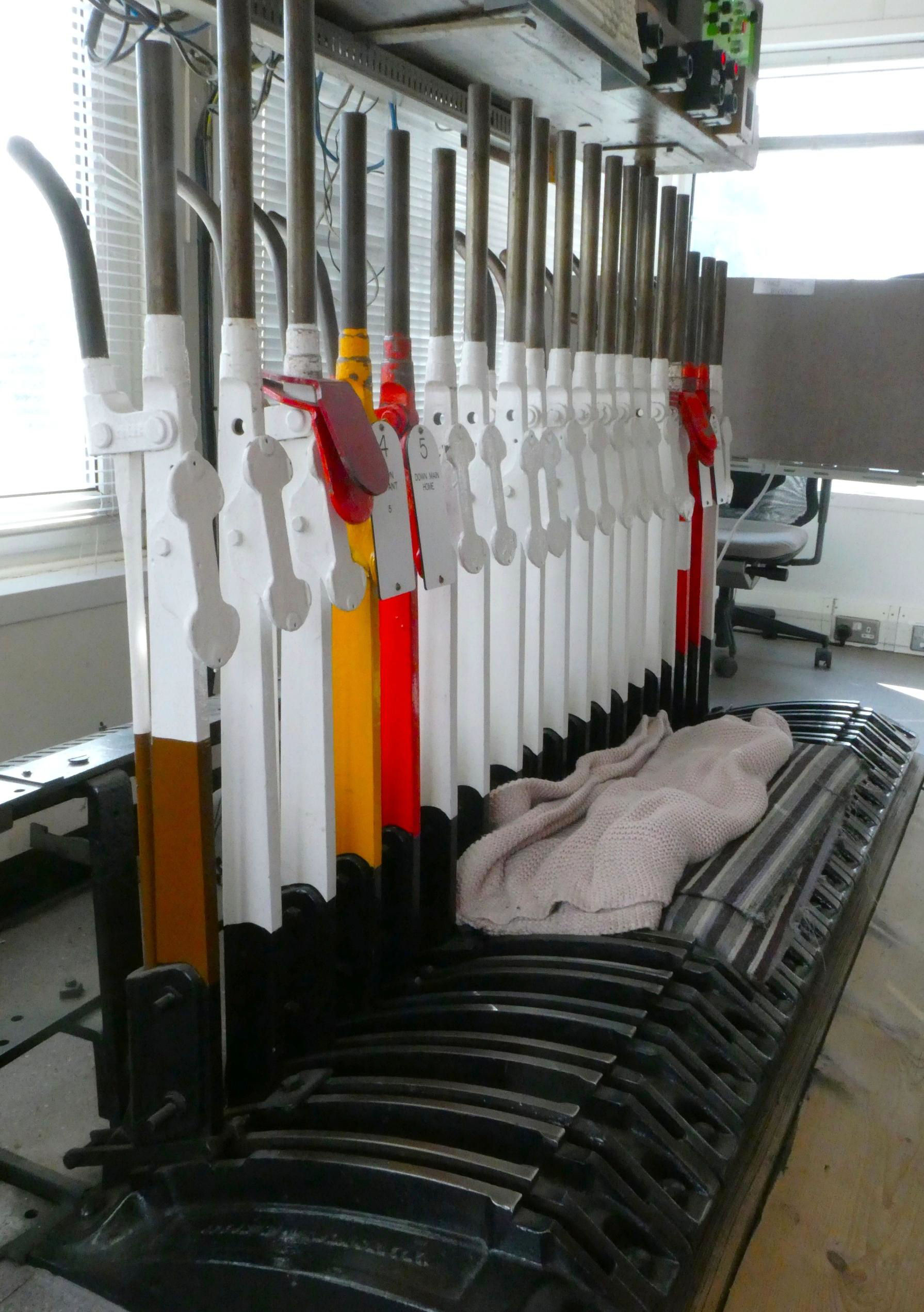
Three Horse Shoes signal box lever frame.
[© Nick Garnham 2023] The western most box to be visited, this is a block post with an adjacent level crossing under its control. Built in 1899, this almost single storey building, with a reduced height locking room, contains a Dutton 1893 patented 19-lever frame. 'Dutton & Co Worcester' is cast on the frame edge. It is believed to be the final Dutton frame in use on NR at a block post. It is a remarkable location as the once busy A605 which crossed the railway here on the level has been diverted and now crosses by an overbridge (BLN 1406.1932). Security fencing had been placed on both sides of the crossing but the barriers were kept in their lowered position, complete with flashing warning lights 24/7, so that the interlocking with signals would still function! The line is AB to Whittlesea and TCB to Peterborough.
The box fringes with York Rail Operating Centre (ROC). The recontrol from the former Peterborough Power Signal Box took place the weekend before our visit but, due to a software issue, the signaller was having to telephone York ROC to identify and describe every train (headcode, not a literal description!) towards Peterborough. The box now only has four levers to control colour light signals. Lever 4 controls the Down distant, 5 Down Main home, 17 Up Main starter and 18 Up home, protecting Funthams Lane LC to the west (BLN 1397.768), monitored by CCTV. Despite all the signals on the ground having a 'KD' prefix, when the new box diagram was installed, the signals were only given a 'K' prefix. This was the prefix for King's Cross Power Signal Box! The only train we saw passing here was 66722 on the 11.38 Masborough GBRf to Felixstowe North, 11 minutes early.
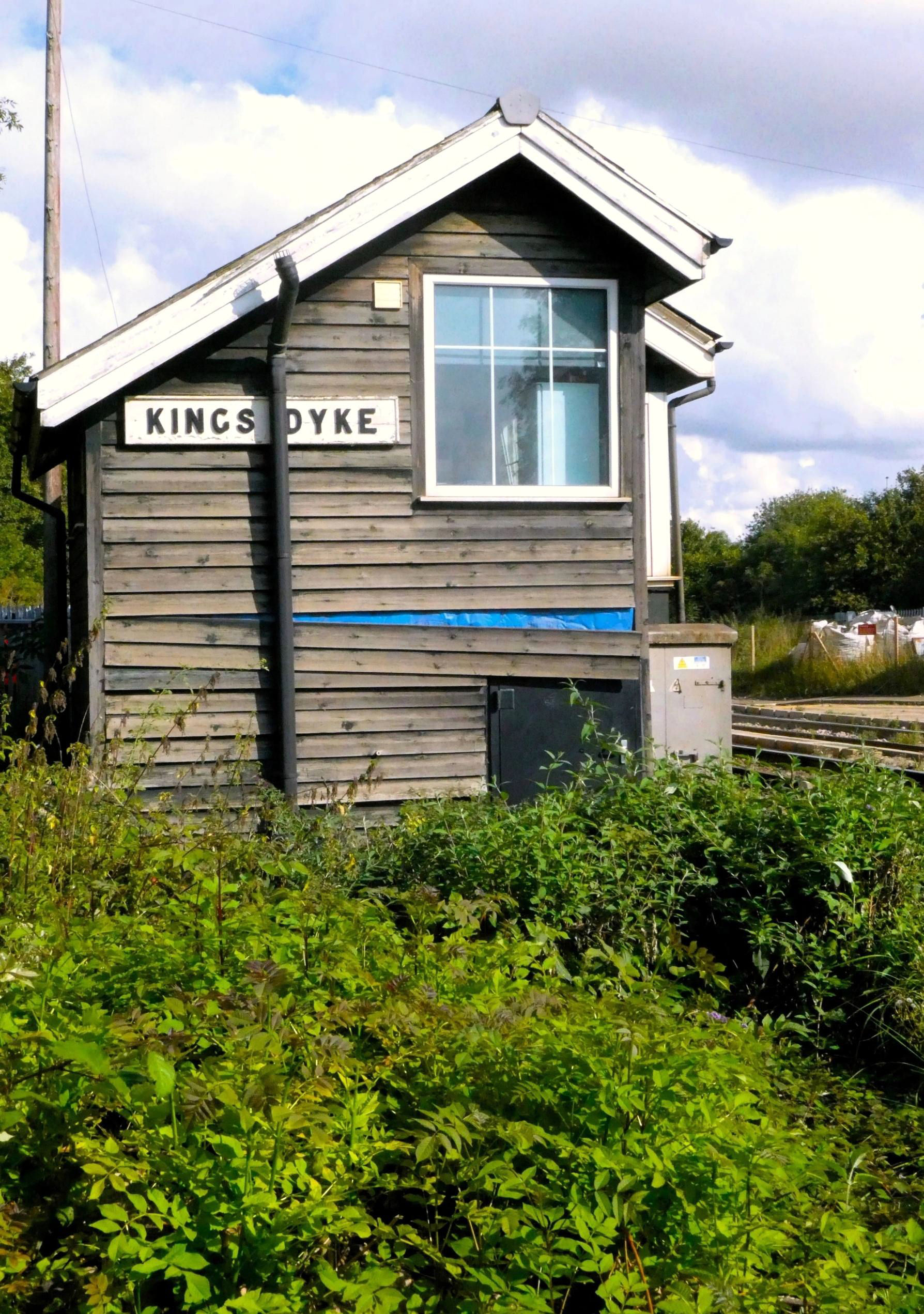
Kings Dyke signal box (96m 75ch) is on the March to Peterborough line, west of Whittlesea.
[© Nick Garnham 2023]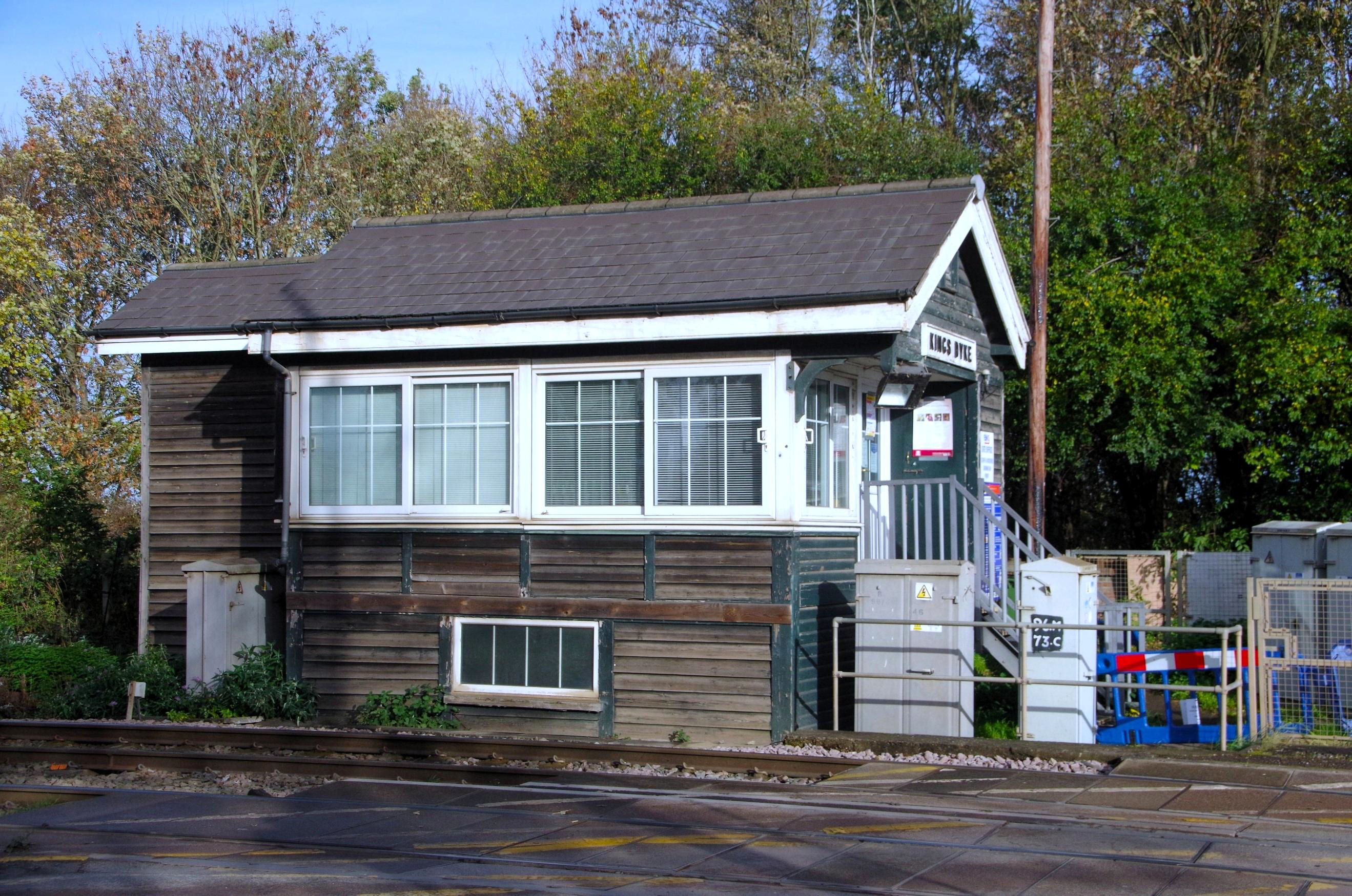
Kings Dyke signal box.
[© Nick Garnham 2023]