BLS London Roundabout Curiosities Tour
Monday 1st July 2024
Report by Paul Watson
The Branch Line Society (Test)
Guest

The title of this fixture immediately appealed to me, as I take an interest in the unusual across the railway network. The start, at St Pancras International was also convenient, as I live on the Thameslink Bedford route.
The fully booked group of 12 members met next to the wonderful 6' 9" tall bronze sculpture of Sir John Betjeman. The former Poet Laureate played a significant role in saving St Pancras station and The Midland Hotel from demolition in the 1960s, resulting in them being Grade 1 listed in 1967. British Rail had planned to divert the residual train services to King's Cross! We jest not. Did you know that Sir John's coat tail on the statue was designed to emulate the shape of the wonderful 1868 Barlow train shed roof?
We had a quick look outside to take in Sir George Gilbert Scott's 1874 hotel building - the sun was out and the bricks were glowing red. The group learned from our learned guide, Adam Turner, that the town hall at Armentières in northeastern France is said to be the inspiration behind much of the building. The Midland Hotel cost far more than budget. Empty niches can be seen across the frontage of the building, for statues that were cancelled as an economy measure.
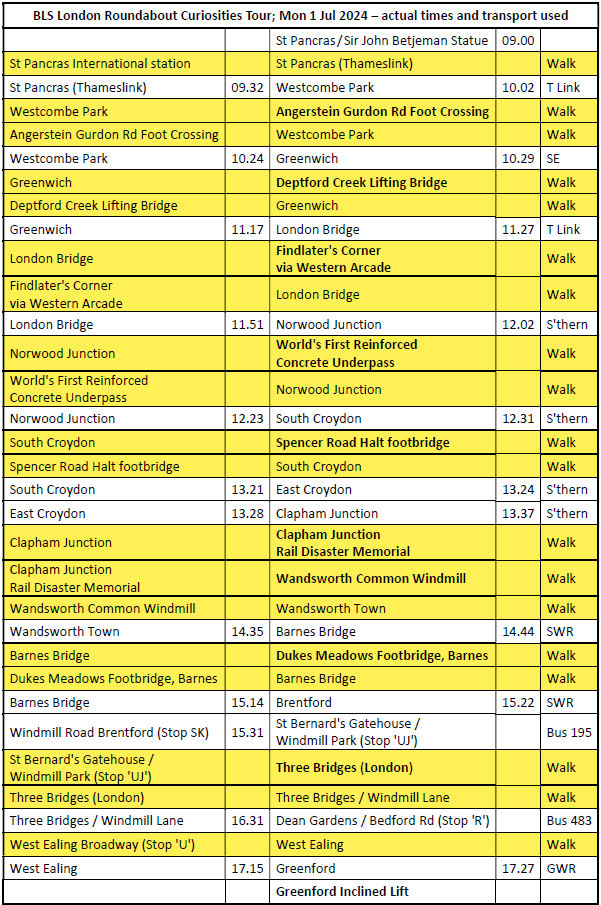
There was a little nervousness when we found that our first train of the day, a Thameslink to Westcombe Park, was delayed with many trains coming through ahead of it. There was no need to worry, when we reached Westcombe Park we were only a little behind. Our group crossed the bridge over the busy southern approach to the Blackwall Tunnel to visit and cross Angerstein Foot Crossing over the freight branch, which dates back to 1851, one of very few foot level crossings in Greater London. The only others I can think of are Trumpers Crossing Halt on the Brentford branch and any survivors on the Romford to Upminster branch. [Its only one in the Sectional Appendix is Osbourne Road Foot Crossing at 1m 19ch.]
We hot-footed it back to Westcombe Park to find that our train back to Greenwich was also delayed but we were ahead and in time for an earlier (delayed!) service. We stopped off at Greenwich to see the Grade II listed 1878 station building façade with its tall Georgian windows, a fitting companion to the Georgian almshouses opposite. Our tour took us down the backstreets, finding a random assortment of rails set in the pavement of Lovibond St (the name of a former brewery on the site but seemingly without an internal railway, so it's not clear why there are rails in the pavement!). Around the corner we were back at the railway that runs on a listed viaduct at Norman Rd, part of the original London & Greenwich Railway. Opened between 1836 and 1838, it achieved some 'firsts': The first permeant steam railway in the capital, the first built specifically for passengers and the first entirely elevated railway. [The actual first steam railway in the capital was operated by Richard Trevithick in Euston Square Gardens in 1808.]
Walking along a short path, we arrived at Deptford Creek. I enjoyed seeing the lifting bridge here which is easily viewed from the adjacent footpath. This gave me a lift. The London & Greenwich Railway was required to provide a lifting bridge, for Thames sailing barges to navigate up the creek (without a paddle) to Deptford Bridge. The present bridge, the third, was built in Dec 1963 and is welded shut as the Act of Parliament requiring the bridge to lift was repealed in the 1980s. Next, a return to Greenwich station for the short ride to London Bridge. Approaching that station, participants spotted a NR light blue Class 153 track recorder. At London Bridge, we zipped through the Western Arcade to arrive at the recently refurbished tiled Baroque Revival frontage and clock with the unusual ceramic stag's head above it at Findlater's Corner, a shop at the T-junction of Borough High Street and Duke Street Hill. It became the historic home of wine merchants to the royal family, Findlater, Mackie & Todd. Next door is the beautiful, refurbished mosaic frontage of the former Express Dairy Co Ltd unit, now a Starbucks (with milk?).
We were soon on the fast line to Norwood Junction for a spot of niche tourism! The subway underneath the station (not accessible from the station with its own internal subway) opened in Jul 1912 and is understood to be the first reinforced concrete subway in the world. [The things you see and learn on a BLS visit.] At 31m long, we quickly covered its distance much to the bemusement of the local 'Normals'.
Once more, we were on the rails to South Croydon. Winding through residential streets of late Victorian villas, we came upon a gully that helped us to reach the Spencer Road Halt lattice footbridge. The timber platforms have long gone after closing from 15 Mar 1915 (they were demolished in 1935).
The line (part of the Woodside & South Croydon Railway) is disused here but much of that railway became part of London Trams (Croydon) further north. Woodside to Sanderstead had a poor, peak only service, of little-used 2-car EMUs. Listed in the Beeching Report for closure, this didn't come for 20 years (16 May 1983). The footbridge is still NR maintained and the tracks, with dead third rails, remain under the vegetation - a most surreal location. Using footpaths between houses and a bridge over the Brighton Line, Thameslink trains scurrying by below, we arrived back at South Croydon. Its waiting room was the perfect location for the group to enjoy a seat (leather no less!) and a much-needed sandwich and drink.
Once more on the move, it was not long before we arrived at East Croydon station, where we changed trains (thankfully on the same platform) onwards to Clapham Junction. Then our group walked towards Wandsworth Common. Along the way we paused at the Clapham Junction Rail Disaster Memorial, immediately above the line where one train crashed into the back of another. A small garden has been created on the embankment. The memorial itself, a granite stone in a half arc, is set at 90 degrees to the road. One side is incised with an inscription about the rail disaster, the other side features a relief of rails in the background with one hand reaching down to grasp another hand in an offer of help.
Next up was probably the most unusual sight of the entire day, Wandsworth Common railway windmill. In the 1830s, the London & Southampton Railway provided a small wooden smock windmill (this type of windmill derives its name from its resemblance to smocks worn by farmers in a rather earlier period), unfortunately now sail-less. It was to drain water from the railway cutting into an ornamental lake on Wandsworth Common that became known as the Black Sea. The windmill is eight-sided, complete with a cap and it had four sails with a fan wheel. It fell out of use in 1870 and the lake was filled in.
We then set off for a walk across Wandsworth Common and then to Wandsworth Town station, by chance perfectly timed to catch the next train to Barnes Bridge. Here, our expedition crossed the road to have a good look at the Edwardian former station building at street level (sadly no longer in railway use), designed to be in keeping with the adjacent Georgian Barnes Terrace. We could also see from this location one side of Barnes Bridge - half is disused and trackless (BLN 1450.1449) - and noted the bales of straw hanging from scaffolding on the underside of the bridge (BLN 1451.1572). Work was taking place on the bridge. Byelaw 36.2 of the Port of London Thames Byelaws requires:
'When the headroom of an arch or span of a bridge is reduced from its usual limits but that arch or span is not closed to navigation, the person in control of the bridge must suspend from the centre of that arch or span by day a bundle of straw large enough to be conspicuous and by night a white light.'
Our posse crossed the pedestrian bridge next to the running lines and descended to the new Dukes Meadow Pedestrian Footbridge to see the original disused railway bridge span. We returned to the station to travel up the line to Brentford and caught a 195 bus to be nearer the 'other' Three Bridges. At Windmill Lane on the Brentford branch line, IK Brunel, in 1859 (the year he died), built a crossing with the Grand Junction Canal at the same location as Windmill Lane crosses both of these. The structure is remarkable; a cast-iron trough carries the canal over what was a double-track railway cutting below (now single), with the tow path alongside on brackets, all over another cast-iron bridge to take the road.
Participants were now on the last leg to Greenford (or were we on our last legs after so much walking?) Retracing our tracks, it was the 483 bus to West Ealing, for the Greenford branch. At West Ealing, we entered the new station building on Manor Rd, with purple Elizabeth line roundels on floor mats at the entrance. At the country end Up side Bay P5 for Greenford, we noticed the rapid charging rail for the GWR fast-charge battery trial with a Class 230 battery train. The trial and the train seem to be going well. Our Greenford train was a 2-car Class 165 Turbo DMU (how the mighty are fallen). Leaving West Ealing station, we noticed the roof of the (one) trial train stabled in front of the nearby Plasser & Theurer site.
Approaching Greenford, we caught a glimpse of Greenford East signal box. On arrival at platform level, there are two fine semaphore signals north of the Central line eastbound track, the Up Main homes bracket GE41/45 on the old main line. This was the tour's final location, to ride London Underground's first inclined lift down from the platforms to the booking hall - we all managed to squeeze in; a good job we only had a light lunch. It's a modern version of the well-known seaside cliff railways but indoors and there is no beach to enjoy! This station is also curious as one where you take an escalator up to the tube!
Many thanks to our group-leader and guide, the indefatigable Adam Turner, for a most interesting and wide-ranging day, we saw a great deal and learnt much. It also raised £240 for Railway Benefit Fund.
| Branch Line Society. A Company Limited by Guarantee - Company No 16743754. Registered in England and Wales. Registered address: 6th Floor, Derwent House, 150 Arundel Gate, SHEFFIELD S1 2FN |