May the Fourth be With You - Part 1
Saturday 4th May 2024
Report by Stephen Atkinson
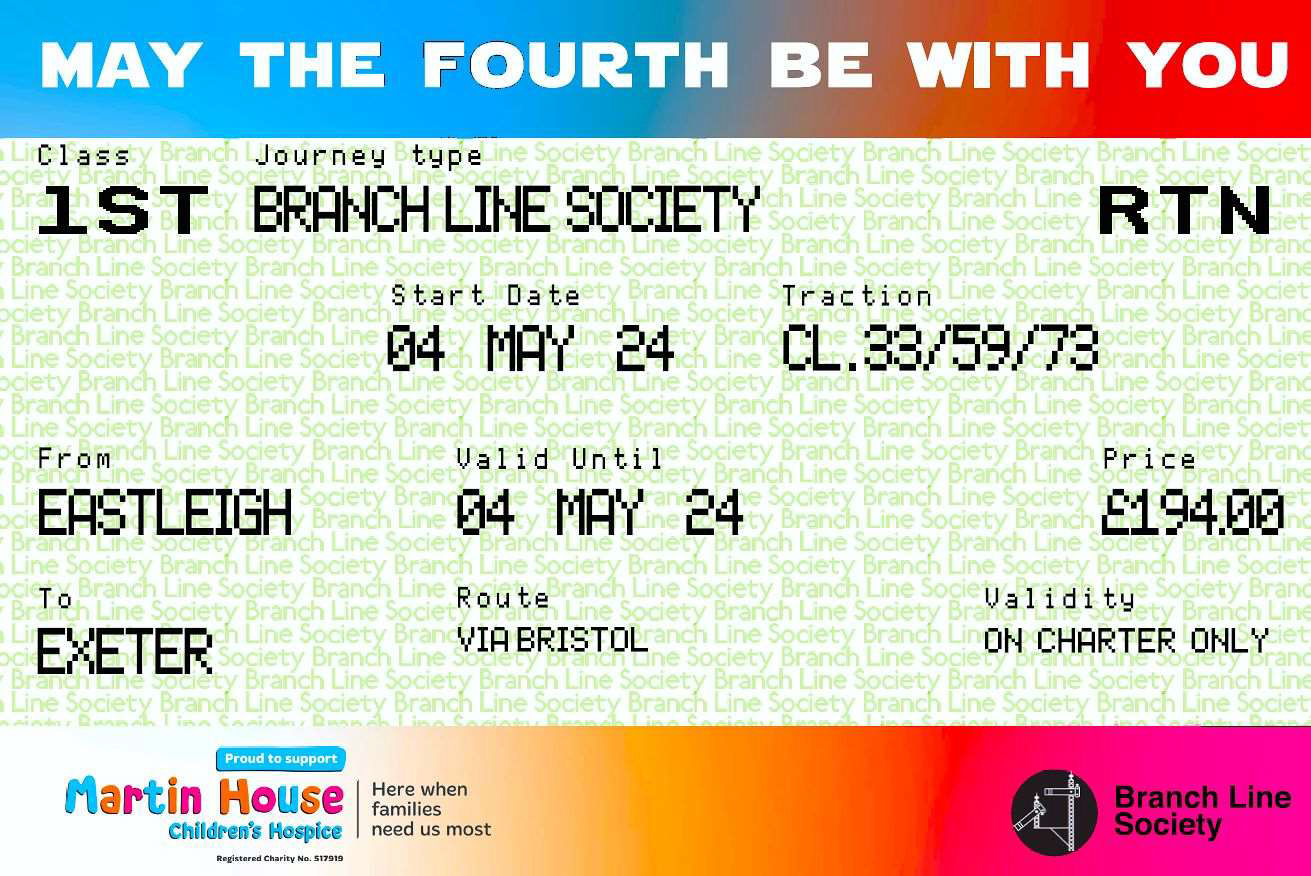
My 360th railtour was booked on the basis of the locos offered for haulage. Having already had nine of the small fleet of Class 59s for haulage on previous railtours, a tenth was added from the railtour the previous day when 59005 was one of locos that worked the excellent 'Return of the Shedi' railtour (report BLN 1450.1549). Two 'winning' locos for me were on offer for this next tour, plus 59005 again from the day before, making it an easy decision to book both tours. The other reason was that the previous day's tour finished in Eastleigh and this one started there next day, so it was a logical choice. The two tours were also supporting Martin House Children's Hospice charity. An explanation of the tour's name, a history of the locos and carriages follows over the next paragraphs with a description of the tour thereafter.
Tour name: 'The Return of the Shedi' and 'May the Fourth Be With You' are pun names based on the Star Wars film franchise and the annual informal commemorative 'day', 4th May. The supposed first recorded use of 'May the Fourth Be with You' was the day after Maragaret Thatcher and the Conservative Party had won the 3 May 1979 general election, with a 44-seat majority. Her party had placed a congratulatory advert in the London Evening News saying, 'May the Fourth Be with You, Maggie. Congratulations.'.
A brief history on the Class 59s: They are unique and controversial in railway history, being the first mainline diesel-electric locos to be designed and built overseas, and are the forerunners of an 'invasion' of Class 66 locos that now form the backbone of freight operations in the Great Britian. Six locos were originally ordered by the American company, Foster Yeoman (now Aggregate Industries), for improving the reliability and availability of limestone aggregate trains from their Torr Works Quarry (formerly Merehead Quarry but the Merehead name is retained for the railhead) in the Mendips, Somerset, to London, the South East and the South West, for all sorts of time sensitive construction projects, including providing the stone for many of the motorways built in early 1990s. The addition of the advanced anti-wheel slip system, 'Super Series' wheel creep control, enabled the locos to have increased traction at lower speeds meaning that double heading was unnecessary, so the order was reduced to four locos.
Entry into service was under union conditions that they were driven and maintained by British Rail (BR) staff. General Motors (GM) designed and built four locos that were delivered in Jan 1986 and entered service in Feb 1986 after acceptance testing at Derby (faster, then!). GM knew that orders for the mass replacement of older BR locos were on the horizon. They invested thousands of hours designing the Class 59s, so they had a nearly ready product to offer the newly privatised Freight Operating Companies. Reliability and availability improved dramatically as the locos settled down and proved themselves quickly, achieving an average availability of 99.8% over their first 10 years. Due to their success and the London area housing boom in the late 1980s, a fifth loco was ordered in 1988 and delivered in 1989.
Breaking records: In Feb 1986, 59001 set a UK record with a 4,639-tonne train, the heaviest ever hauled by a single non-articulated traction unit. In May 1991, 59005 broke the European record for the longest and heaviest train between East Somerset Jn and Berkley (trailing load 11,982 tonnes, length 5,415ft).
59003's overseas adventure: In 1997, 59003 was sold to DB Yeoman GmbH, a joint venture between Foster Yeoman and Deutsche Bahn. It was modified and exported over to Germany, working stone trains around Hamburg and Berlin. This operation finished in 1999 when 59003 was transferred to a new company, Heavy Haul Power International, keeping it in Germany until 2014. Then, GB Railfreight (GBRf) purchased and returned it to the UK, where it was prepared for mainline duties at Eastleigh. The loco was used to extricate the carriages of Great Western Railway 158763 and South Western Railway 159102 after the Fisherton Tunnel accident, near Salisbury on 31 Oct 2021 by dragging both the DMUs out. Its exertions did cause damage and repairs were undertaken at Eastleigh. The loco was repaired and returned to traffic in Sep 2023. In Feb 2024, Colas Rail leased the loco and currently operate it.
More 59s ordered: Not to be outdone by their competitors, Amalgamated Roadstone Corporation (ARC) Southern (now Heidelberg Materials), ordered four Class 59s from GM in Jun 1989, creating a sub-class, the 59/1s. Delivered in Oct 1990, they entered service in Dec 1990 also working stone trains, from the ARC Whatley Quarry in the Mendips. Despite Hanson PLC acquiring ARC in 1989, the locos were still in ARC yellow and grey; it would be years before they were repainted in Hanson blue and white livery.
Also joining the party, with an initial order for one Class 59, was National Power, one of four companies created from the privatisation of the Central Electricity Generating Board (CEGB) in 1990. National Power was the largest of the four, having a 52% share of the generating market. Their Class 59 created another sub-class, the 59/2, and went into service in Mar 1994, hauling limestone trains to their Drax Power Station in North Yorkshire for flue-gas desulphurisation. An additional five locos ordered for National Power in 1994 were delivered in 1995. Initially based at Ferrybridge Depot, these worked coal traffic.
The 59/2s were delivered with yaw dampers already fitted, allowing the locos to work up to 75mph. National Power ceased operating their own trains in 1998 when the fleet was sold to English, Welsh & Scottish Railway (EWS) - later DBC. EWS used them on various heavy freight trains until 2005, when they were deployed to the Mendips to work aggregates trains for both Aggregate Industries and Heidelberg Materials. The locos are now owned by Freightliner, who purchased them from DB Cargo in 2019. 59/2s are rarely seen away from the Mendip stone workings but do make the odd foray around the country.
Oh, bells: 59001 and 59201 sport a commemorative brass bell above the cab windows at their No1 end. 66779 is the only other loco to receive such an adornment. Since the 59s landed in the UK, all 15 have worked tours and appeared at heritage railway galas over the years but this is infrequent. I do hope my still required three, 59004, 103 & 205, will reappear soon. Despite the 59/0s having already celebrated their 38th year in traffic, they show little signs of their age and still ply their trade to this day.
On with the tour: The signature early morning start for a railtour beckoned, a 06.48 departure [much earlier for our stewards], although later pick up options were available. It posed a dilemma knowing no hot food was available on the train and no break was long enough to buy a breakfast until Exeter. First choice, Greggs, opened at 06.30 but, learning a bulk order [Bran Flakes?] had been placed the evening before, the idea was abandoned. Thankfully, a McDonalds that opened at 06.00 wasn't far away.
The stock arrived as I approached Eastleigh station, arriving on Platform 2. Southern green liveried 33012 (D6515) 'Lt Jenny Lewis RN' was at the London end and would trail on the leg to Portsmouth Harbour. The loco entered service with BR in 1960 and was acquired in 1997 by the 71A [= Eastleigh Shed] Locomotive Group https://bit.ly/4dT7vTl based at Swanage. The loco was named in 2014, a tribute after Lt Jenny Lewis died in a helicopter accident while serving in the Royal Navy. The loco is mainline certified and worked legs of our tour the day before. Today's tour would be hauled by blue and yellow liveried 73136 (E6043) 'Mhairi'. Owned by GBRf, our tour operator, it was built in 1965 by English Electric at their Newton-le-Willows works. It is designed to work on the 750V DC third rail electrification system but also has 600hp (although a 2014 load test discovered that only 420hp was available!) diesel engine for work away from third rail electrified routes but primarily in goods yards without third rail. GBRf purchased the loco in 2013, naming it 'Mhairi' in 2015; it is a GBRf tradition to name some locos after female employees.
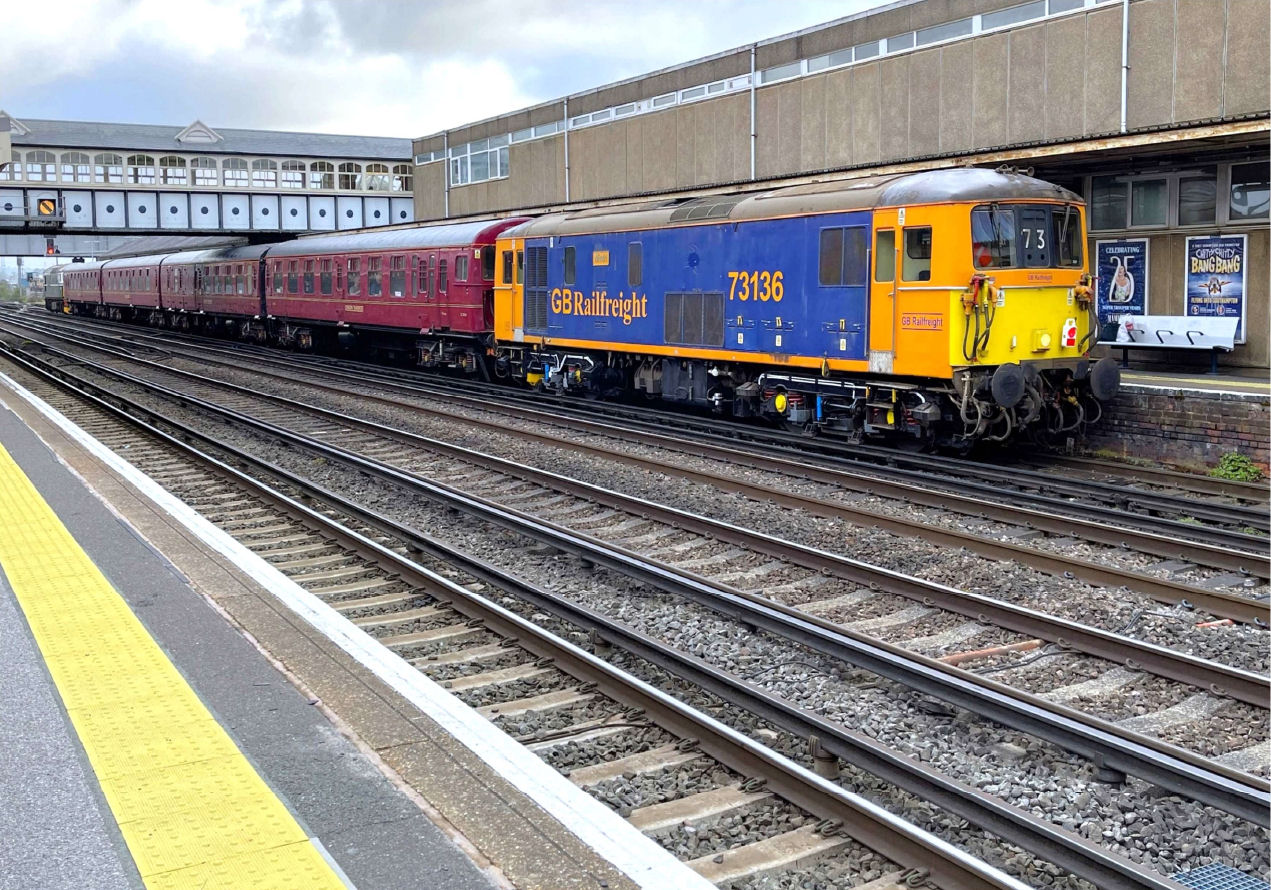
The stock has arrived from the depot at Eastleigh P2 with 73136 'Mhairi' that will lead the tour away to Portsmouth.
[© Stephen Atkinson 2024]The stock for the tour was Class 438 4-TC (Trailer Control) unit 428, comprising of DTSO LT76297 (behind the Class 33), TFK LT71163, TBSK LT70823 and DTSO LT76324. 4-TCs were unpowered adapted Mk1 carriages in sets of three or four with driving cabs both ends. Their purpose was primarily to be part of formations with 4-REP EMUs on Waterloo to Bournemouth services. At Bournemouth, they were split from the formation, then hauled to Weymouth over the then non-electrified section by a Class 33/1.
A sub-class of 33s, the 33/1s, was created when 19 locos were modified with push-pull apparatus for working electro-pneumatically braked multiple unit stock, specifically the 4-TCs. The 33/1s propelled the 4-TCs back to Bournemouth, driven from the leading cab of the 4-TC. 4-TCs could also work push-pull with Class 73 & 74 electro-diesels, as well as non-push-pull locos with Blue Star coupling code (although push-pull operation was not then possible). They also saw occasional use on Portsmouth Harbour to Reading and services to Kensington Olympia and Salisbury. They were very handy if traction power was isolated for engineering works. Branksome to Weymouth electrification authorisation in 1986 and DMUs coming to the Waterloo to Exeter line, meant that the writing was on the wall for the 4-TCs, most were withdrawn by 1992. [In their day, they were particularly suitable for railtours, as running round was not needed, two 4-TCs had a capacity of 404 seats and often there would be a buffet car marshalled between them.] These carriages, now fitted with central door locking and controlled emission toilets (CETs), are owned by London Underground. They are mainline certified and a popular choice for railtours now.
73136 led the tour (1Z73) away on time. Leaving Eastleigh on the Botley line, we glimpsed locos outside in the former BR Engineering Ltd works. Gleaming Harry Needle liveried 20302 & 20311, Locomotive Services Ltd 73002 (rubbed down outside the paint shop) and ex-East Midlands Railway HST power car 43083 could be seen. It wasn't long before the sun made an appearance, then stayed with us all day.
Fareham was soon reached then we diverged at Cosham Jn onto the Portsmouth Line, continuing to Fratton P3 and Portsmouth Harbour P4 for the second pick-up and a short break. Along with the regular BLS headboard, the 33 sported a Pompey Sailor headboard, mascot of Portsmouth Football Club.
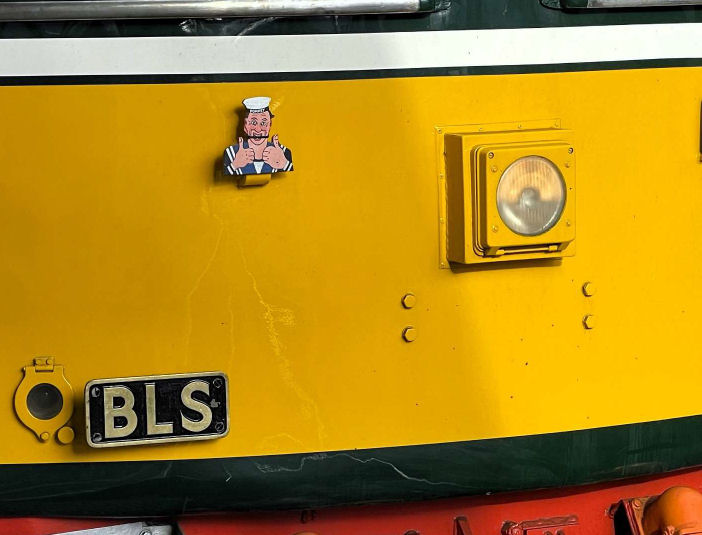
A BLS mini-headboard and 'Pompey Sailor' on the Class 33, very appropriately at Portsmouth Harbour station.
[© Stephen Atkinson 2024]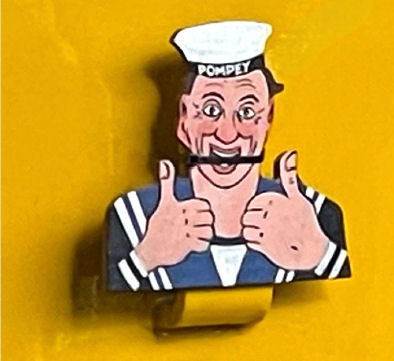
The 'Pompey Sailor' on the Class 33,very appropriately at Portsmouth Harbour station.
[© Stephen Atkinson 2024]Our tour restarted, the Class 33 leading the ensemble with the Class 73 attached at the rear. After Portsmouth & Southsea, we crossed to the Down & Up Fratton line to traverse Fratton P2 in the Up direction, before rejoining the Up Main via the crossover directly after the station. The charter continued, diverging left at Fareham North Jn to take the Southampton line, although early progress was slightly hampered by following a stopping service from Fareham. Nonetheless, the 5-minute pathing allowance at Hamble still meant the tour maintained good time. Our train took the Down Slow after St Denys and crossed to the Down Main, before arriving at Southampton Central on P1 for the third pick-up.
Ritazza to the rescue! Not long after 'May the Fourth be With You' began, it was declared that hot drinks would, unfortunately, not be available due to lack of power supply for the kettles / urns. However, a rescue mission was performed at Southampton, where Caffé Ritazza on P1 was obliging and filled up the kettles. The power supply was to play a more major part in the tour later in the day...
Meanwhile, Freightliner 70003 & 66519 arrived light engine into the station during the stop. Could it be another unadvertised on the day 'bonus', so much a feature of the Martin House charity tours that have conjured up some outrageous extras over the years? Sadly, no. Well, not just yet but there was still time.
After an on time departure, the tour entered the Up Goods Loop, for some SWR and GWR trains to pass. The stretch from Southampton Central to Redbridge is always interesting, where Millbrook Freightliner Terminal, the Freightliner loco and wagon depot, Maritime Freightliner Terminal and numerous ships berthed in Western Docks could be seen. The ships were: ●MV Grande Colonia, ●MV Clipper Kythira, ●MV Cosco Hope, ●MV Ventura, ●MV Teno, ●MV Marsa Pride and most prominently ●MSC Virtuosa.
66730 'Whitemoor' was seen from the loop working 4O46, an intermodal train from Trafford Park to Southampton Western Docks. 66728 'Institution of Railway Operators' was lurking behind trees in the Ansa Logistics Terminal at Millbrook. We restarted away from the loop, having to wait for a late running Portsmouth Harbour to Cardiff Central GWR service. 66953, 70004 'The Coal Industry Society' and 08765 could be seen on the Freightliner Depot when passing by. Having followed the late running GWR service, a wait at Redbridge Jn was needed while it made its station calls. This meant that our tour would run progressively later all the way to Exeter. Salisbury P4 was also a pick-up, before we headed to Westbury.
At Westbury, the locos observed in the Up & Down sidings were 66106, 66075, 70805, 70806, 67027 and, on-hire to Colas, 59003 'YEOMAN HIGHLANDER'. Westbury P1 was the final pick-up and with a 'bonus' surprise. Not one, not two, but THREE Class 59s were hooked up to 33012. They were 'multied' together, working in unison to Exeter St Davids. 59202 'Pride of Ferrybridge' led 59101 'Village of Whatley' led 59104 'Village of Great Elm' piloting 33012, with 73136 on the rear. 9,900 hp was more than adequate to pull the 33, 4-TC and 73136, equating to about 300 tons, a mere snip compared to the heavy aggregate trains that emanate out of Whately Quarry or Merehead on a regular basis these days. Departure from P1 was about 10 mins late, still feeling the effects of the late running GWR service. The first crossover was used to the Up Main before diverging onto the Up Trowbridge. The picturesque Avon Valley was enjoyed and the tour passed Bath to pause briefly in Down Bath Goods Loop where the dilapidated disused household Refuse Transfer Station could be viewed.
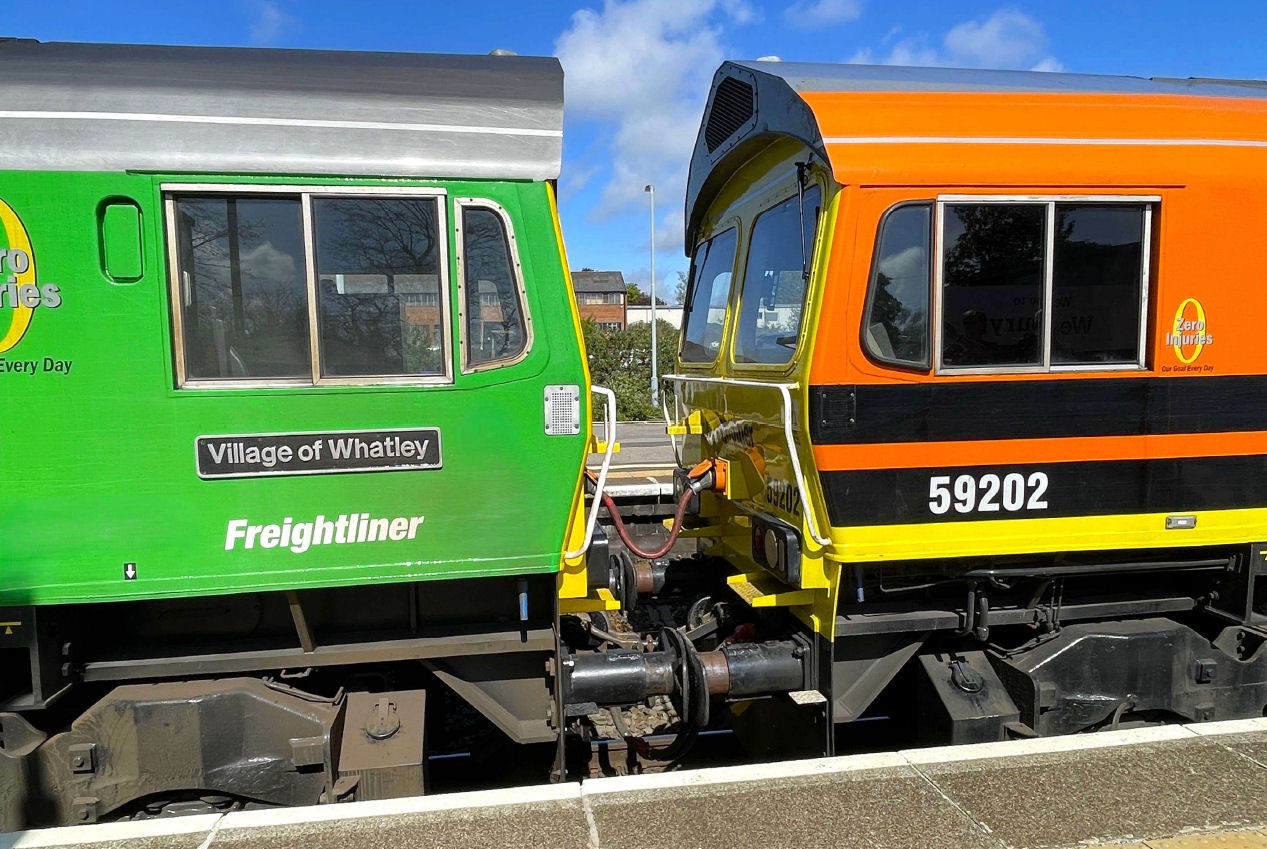
Westbury P1; definitely in multiple! 59101 'Village of Whatley' + 59202 'Pride of Ferrybridge'.
[© Stephen Atkinson 2024]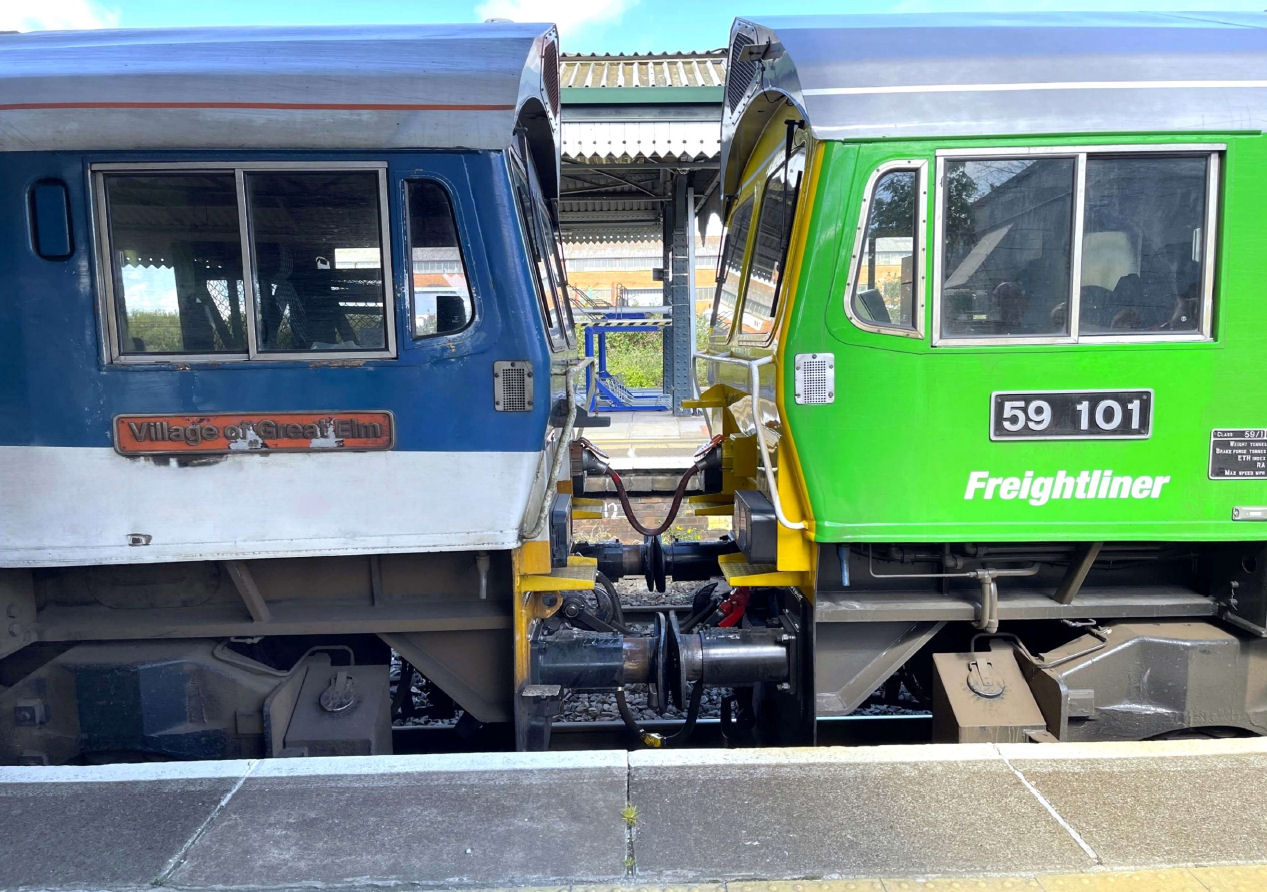
Westbury P1; definitely in multiple! +59104 'Village of Great Elm' + 59101 'Village of Whatley;.
[© Stephen Atkinson 2024]The connection to it from the goods loop is severed. The trains that used the facility were variously called 'Binliners', 'Pongliners' and 'Avon Bins'; they took containerised refuse from three loading facilities at Bath, Bristol Barrow Road and Westerleigh. The then Avon County Council inaugurated the service on 18 Nov 1985 with trains running to the former claypits in Calvert, Buckinghamshire, until 1 Apr 2011. Ironically, instead of exporting waste from the area, it now comes in by rail from Northolt and Brentford to be processed at the Severnside Energy Recovery Centre between Avonmouth and Severn Beach.
Continued in Part 2