Nine members congregated on the main concourse at Hull Paragon station (three places were unfilled, most unusually) and were met by our host for the day Gareth Pearson (NR Local Operations Manager). Gareth arranged for the group to be accompanied by Sam Elliott, a local Relief Signaller, who was able to enthusiastically share his encyclopaedic knowledge of current and past operations.
After a safety briefing, we took the short walk to Hull Paragon box (HP) opened 25 Apr 1938, originally with a Westinghouse One Control Switch (OCS) panel. It was replaced by the current British Rail (Eastern Region) Entrance-Exit (NX) panel on 2 Dec 1984. The NX panel was intended to be used in the relay room as an emergency panel with control passing to Hessle Road but this never came to fruition.
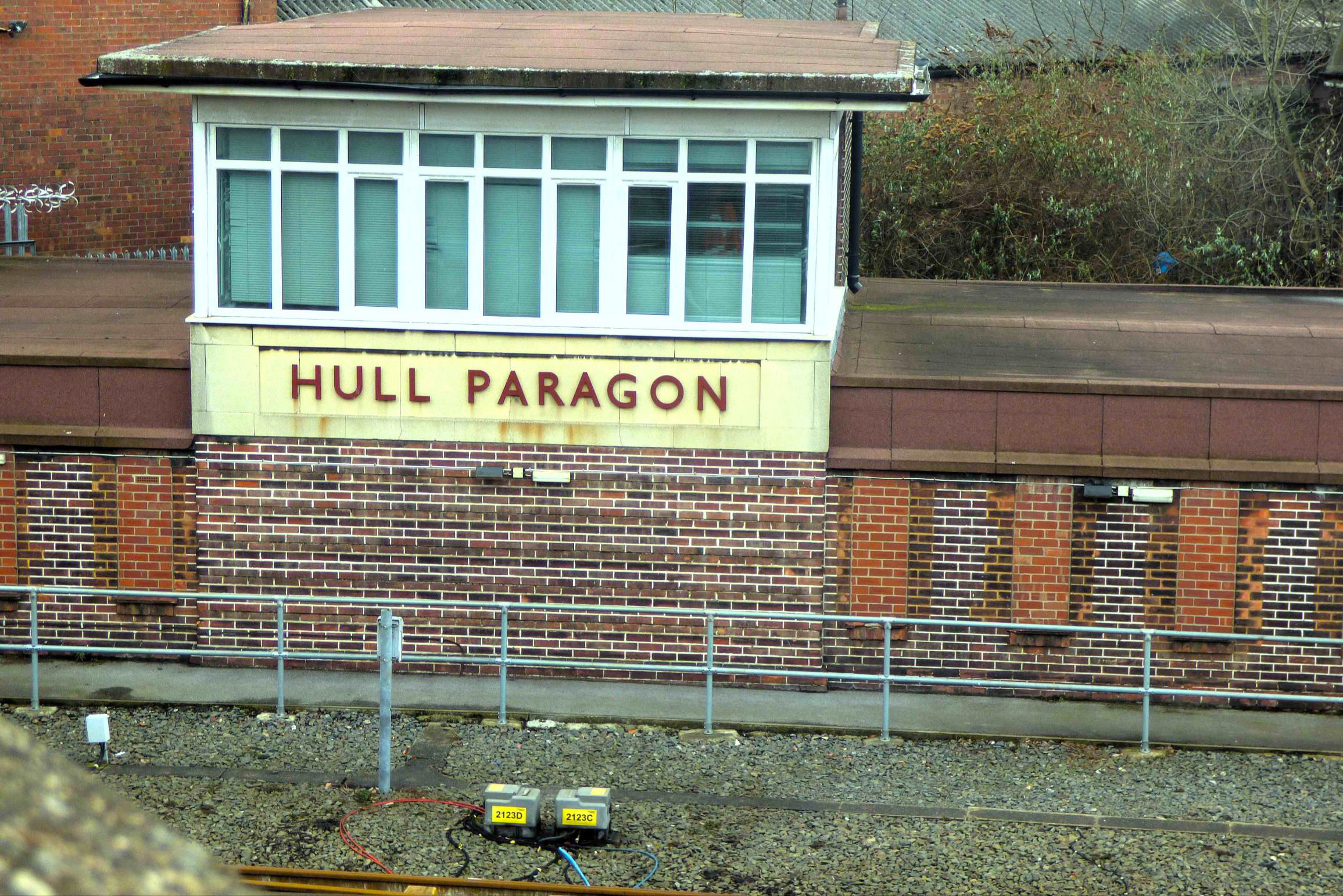
The very distinctive Hull Paragon signal box is on the Up side just outside the station (left on departure - 7 Mar 2018.
[© Angus McDougall 2018]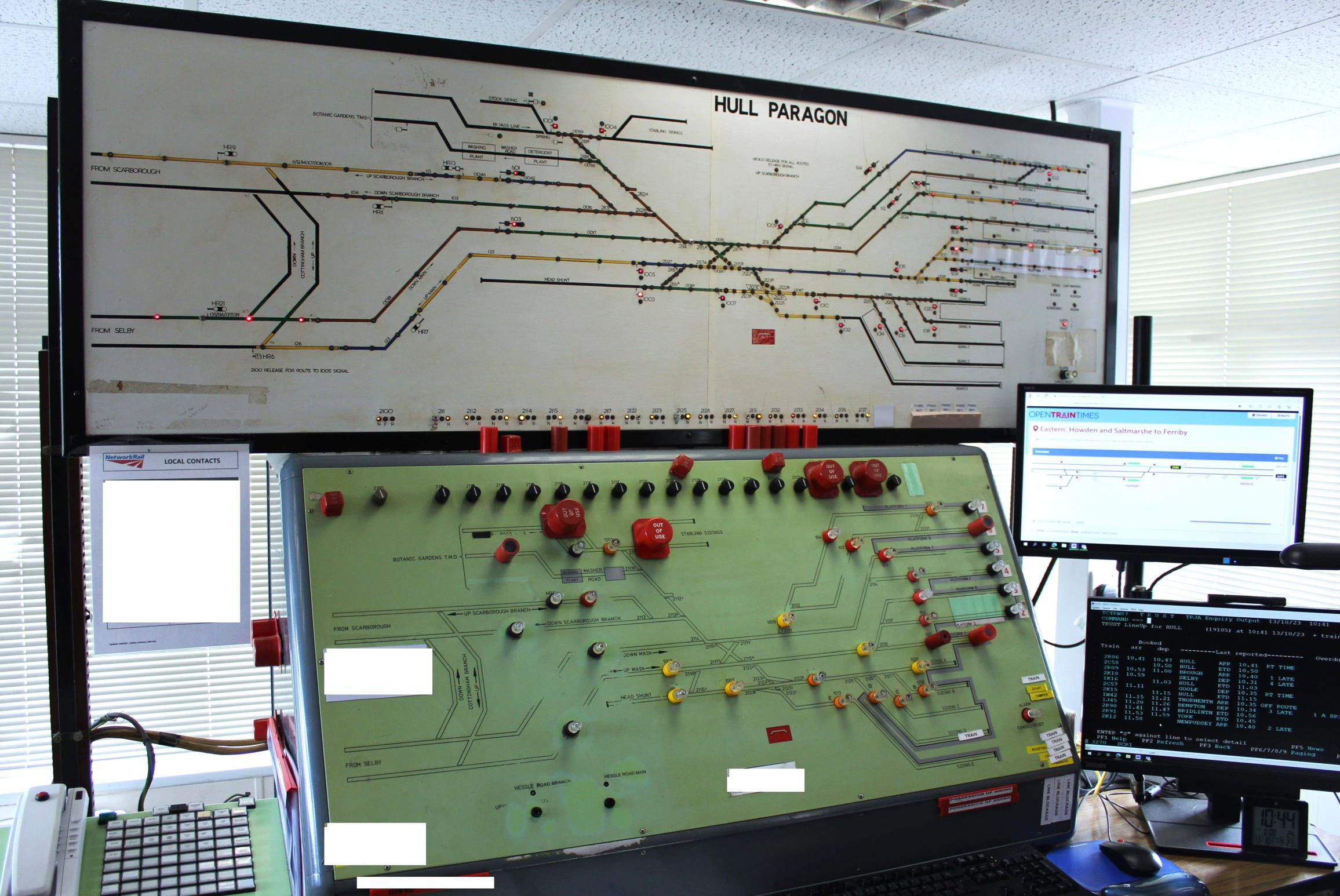
Hull Paragon NX Panel and diagram. The unusual orange collared buttons on the panel perform the same function as yellow collared buttons (shunt routes).
[© Andrew Gardiner 2023]Train detection is by Track Circuit Block (TCB) on the Up & Down Main Lines (to Selby) and the Up & Down Scarborough Branch. Trains are described by single stroke bell. While it only has one route for every outbound and inbound service, the panel is equipped with Train Operated Route Release (TORR), which means the route drops (cancels itself) after the passage of each train. The other NX panels we visited at Hessle Road and Seamer don't have this facility and the signaller must pull each route after the passage of a train. These are sometimes referred to as 'dead' routes. The panel has unusual buttons with orange collars, which perform the same function as yellow collared buttons (shunt routes).
Moving on to
Hessle Road, we found another NX panel, commissioned 22 Jun 2008. This replaced the original NX panel commissioned 7 Oct 1962 when the box opened. The replacement panel sits in the original console. In addition to working to Hull Paragon, as above, Hessle Road also works by Track Circuit Block to Beverley on the Scarborough line (Single Stroke Bell) and the Brough Workstation at York ROC on the Main lines (Train Describer). As well as controlling these lines, it also controls the freight line to King George Dock. We were fortunate to see a train leaving the dock as traffic is now relatively sparse* and the signaller commented that it would be several days before he contacted the chargeman / shunter again. The box also controls several CCTV level crossings, including Walton Street South and Walton Street North which are adjacent to each other over a busy dual-carriageway road.
[*From 2 Jan to 14 Jun 2024, there were 26 steel trains (114 in the whole of 2023) from / to Rotherham Masborough Freight Depot, two of imported gypsum to Ferrybridge and just one biomass to Drax.]
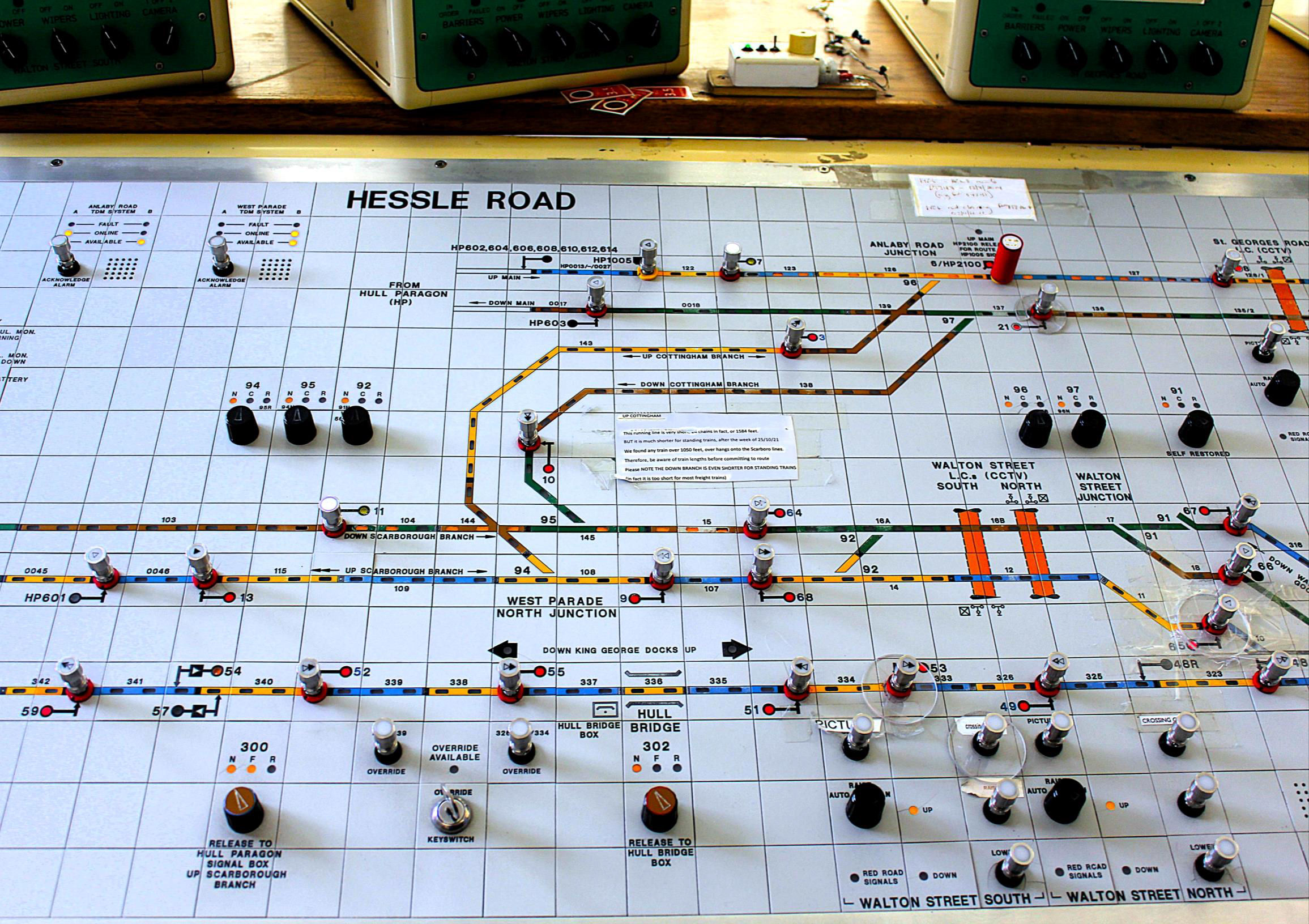
Hessle Road NX panel
[© Andrew Gardiner 2023]One of the highlights of the day was a visit to
Hull Bridge box (a 'cabin' on TRACKmaps 2 p38C 2020) on the NR section of the line to King George Dock. We had to cross the swing bridge itself to reach the box (on the east side), although there is a safe walking route on the original Up Line formation from double track days. The box dates from 1885, with rebuilding of the top floor control room following bomb damage in 1940, it contains a non-standard five lever Saxby & Farmer lever frame from the same date along and a 1964 panel. From 2 Dec 1984, an overlay diagram was placed on top of the original 1964 panel surface, with indication lamps replaced by modern equivalents, but the original switches etc remained in use. [Reports of a new 1984 panel are incorrect.] However, a modern TEW panel was commissioned 22 Sep 2008 mounted on top of the old 1964 panel console, with its panel removed.
(TEW is a signalling engineering company / brand) The panel just consists of the illuminated track diagram; the only controls are the release from Hessle Road box, required to swing the bridge.
All the other controls, along with the signals, are worked from the lever frame. However, as there is no commercial shipping traffic which requires the bridge to be swung currently, it is bolted 'normal' and involvement of the Permanent Way Department would be needed for it to be swung again.
An opportunity was taken for a group photograph on the swing bridge pier before those in the group with a head for heights tackled the tall spiral staircase up to the operating floor of Hull Bridge box.
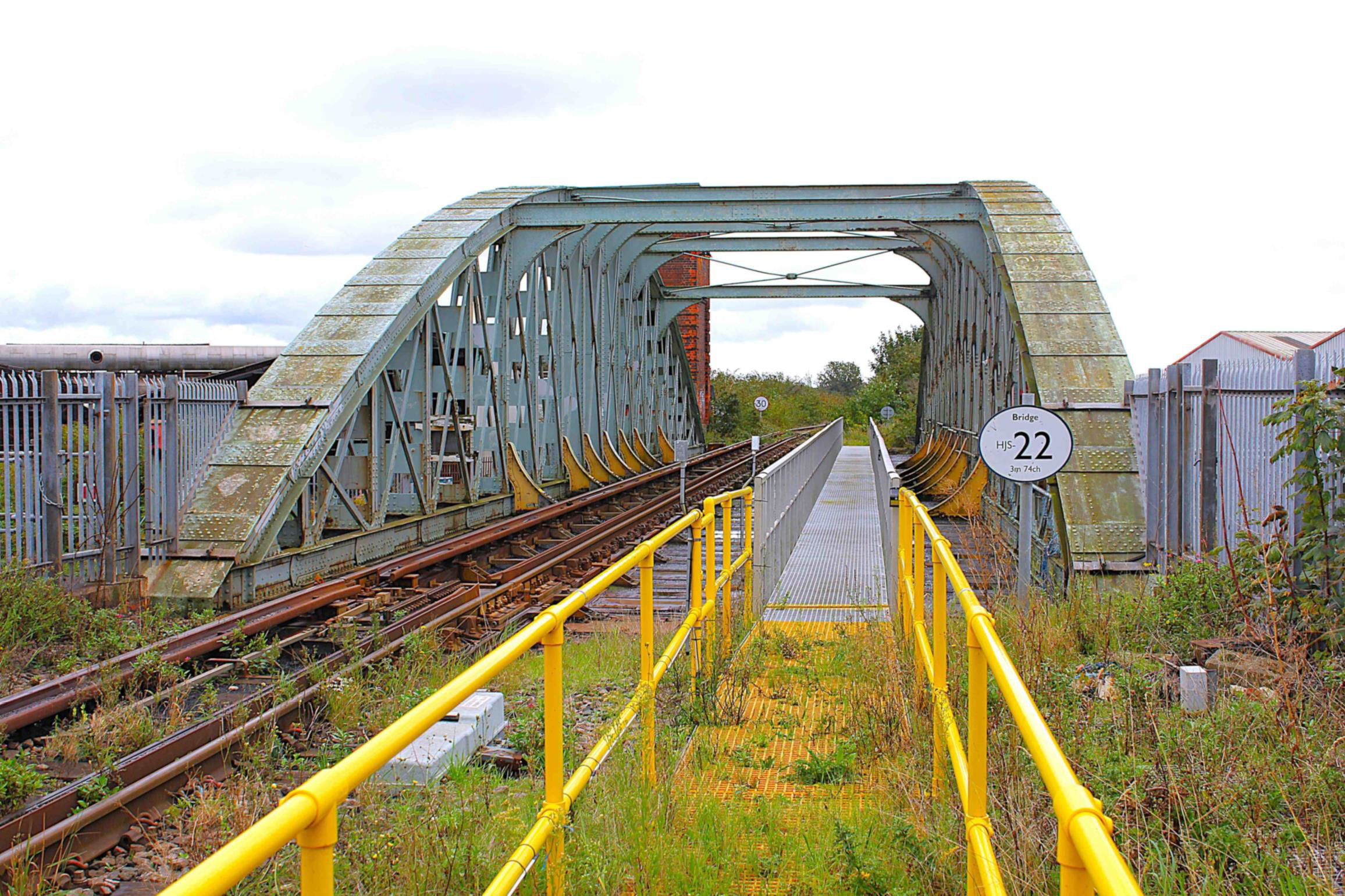
The official walking route over Hull River Swing Bridge to Hull Bridge Box on the Up Line formation.
[© Andrew Gardiner 2023]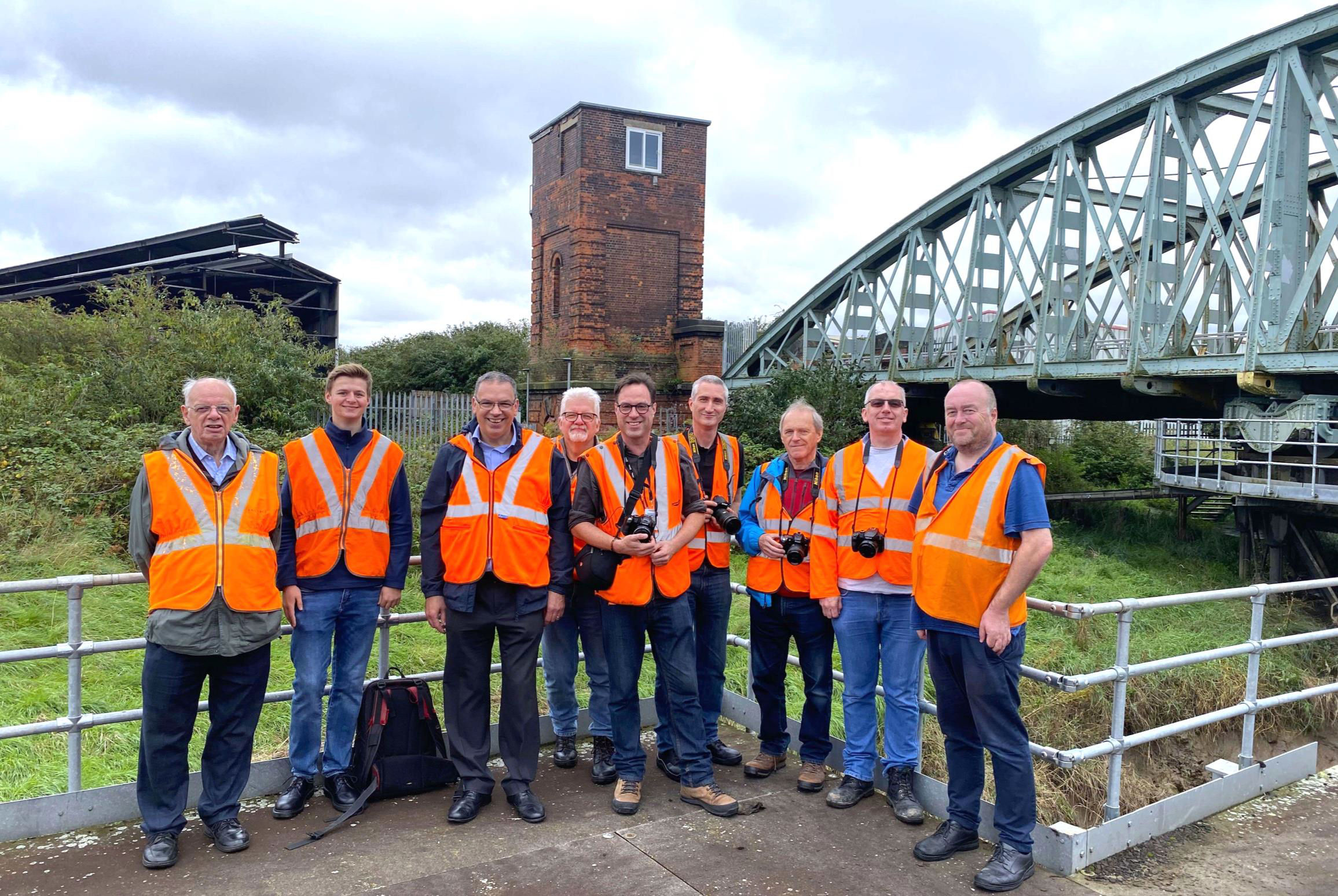
A 'panel' of our signal box aficionados at a very difficult to access location; Hull River Swing Bridge with the 'box' behind.
[© Barnaby Clark 2023]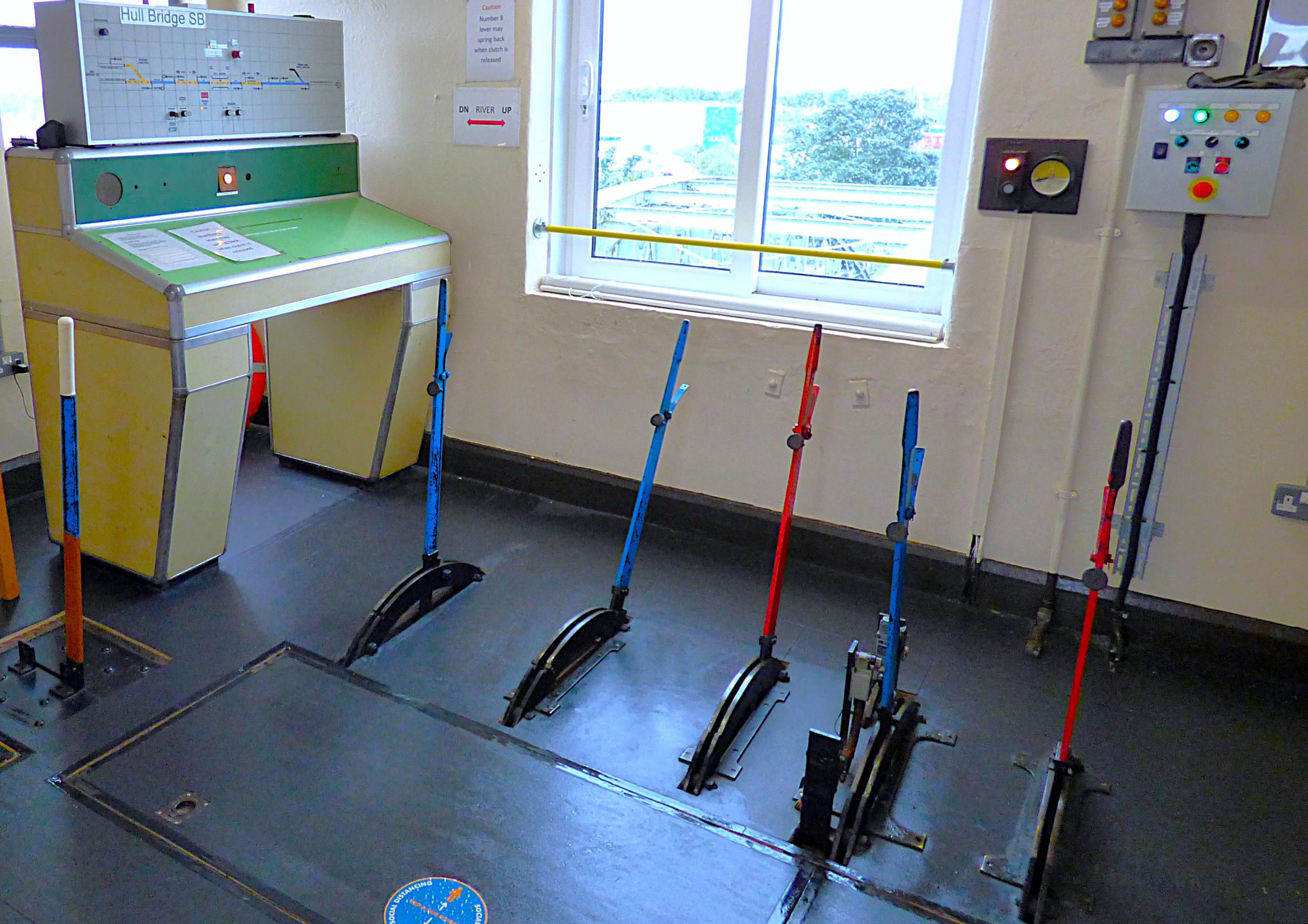
The operating floor of Hull Bridge box.
[© Barnaby Clark 2023]Moving to the Scarborough line, we arrived at
Beverley Station box, a North Eastern Railway Type S4 box dating from 1911. It contains a McKenzie & Holland Type 16 lever frame, which also dates from when the box opened, but is now reduced to 20 levers. Sam explained that Beverley was an example of the Early Rationalisation of Signalling (EROS) scheme, where there were local schemes to merge the number of boxes into one control point. This led to the box controlling six level crossings, four by CCTV and two visually (MCB), as well as supervising several Automatic Half Barrier (AHB) crossings.
While the lever frame was retained in this instance, the workload for the signaller led to a change of mind at Driffield, where an IFS panel was installed. (IFS = Individual Function Switch, each switch controls one point or signal, with the operator making the required sequence of switch operations to set the route for a train.) Heading north, we move away from Track Circuit Block to Absolute Block. Notable on the Up Line (to Hull) at Beverley station are interesting co-acting colour light signals (BS13), one at track level, due to the sighting constraints of the station overall roof and platforms footbridge.
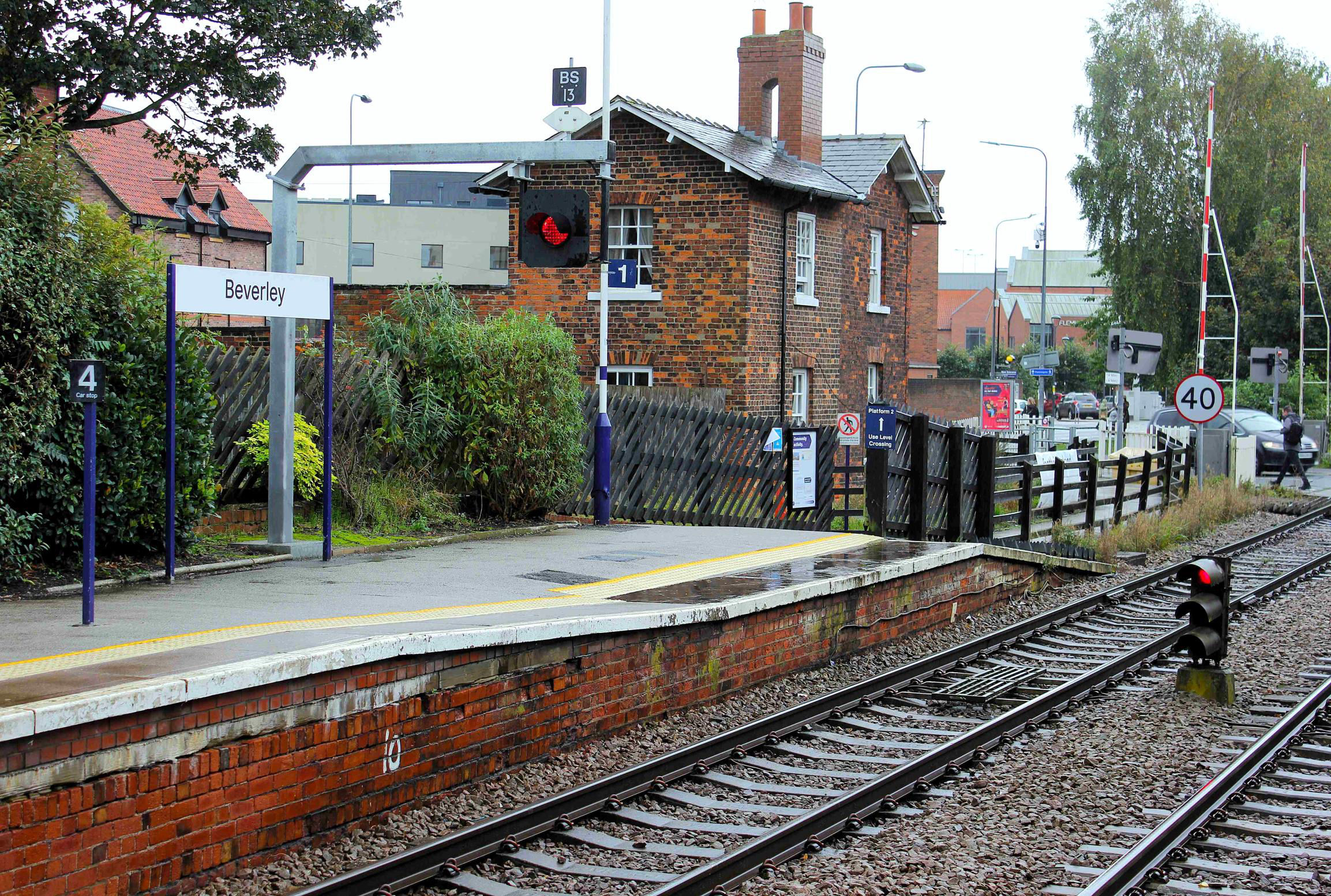
The co-acting colour light signals BS13 - one at ground level bottom right - on the Up Line at the Hull end of Beverley station.
[© Andrew Gardiner 2023] box dates from 1875 and is a North Eastern Railway Type S1a+ box, now with an IFS panel commissioned 12 Apr 1987. As the barriers at the adjacent level crossing are still manually operated by a gate wheel, there is a small three lever frame for the barrier release and the wicket gates. As is traditional practice, the wicket gates are not interlocked with the protecting signals. These gate wheel operated barriers are now rare, given that this is one of only three sets left in use on the national network (the others are at Nunthorpe on the Whitby branch and Barton Hill on the Scarborough to York line). Furthermore, wicket gates at barrier crossings are also rare, as it is understood that these were only provided at the wheel-operated barrier crossings. This type of crossing was a British Rail North Eastern Region 'special' to simplify level crossing maintenance. The box symbol on the diagram at Driffield is also relatively unusual, as it depicts both the IFS panel and the lever frame.
Absolute Block instruments for working north to Bridlington (formerly Bridlington South) and south to Beverley Station boxes are incorporated in the IFS panel, with the indications of the instruments (Normal, Line Clear or Train on Line) shown on the box diagram. 'Non-stopping' controls are provided at Cranswick and Nafferton Automatic Half Barrier (AHB) crossings. These control when the respective AHB crossings activate, depending on whether the train is non-stop or booked to call at these stations.
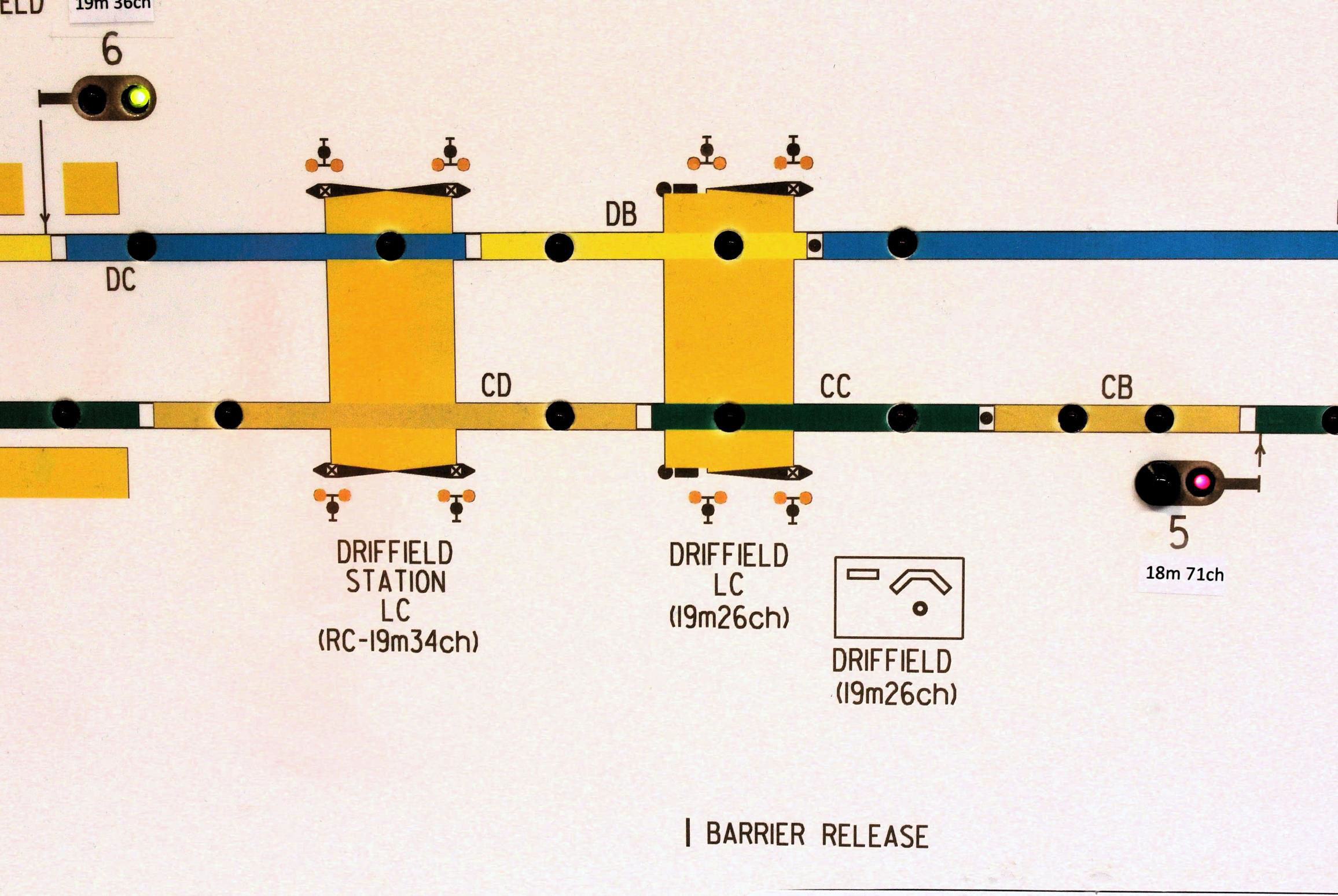
The signal box symbol on the diagram at Driffield (excerpt below) is relatively unusual as it shows both a panel and a lever frame.
[© Andrew Gardiner 2023]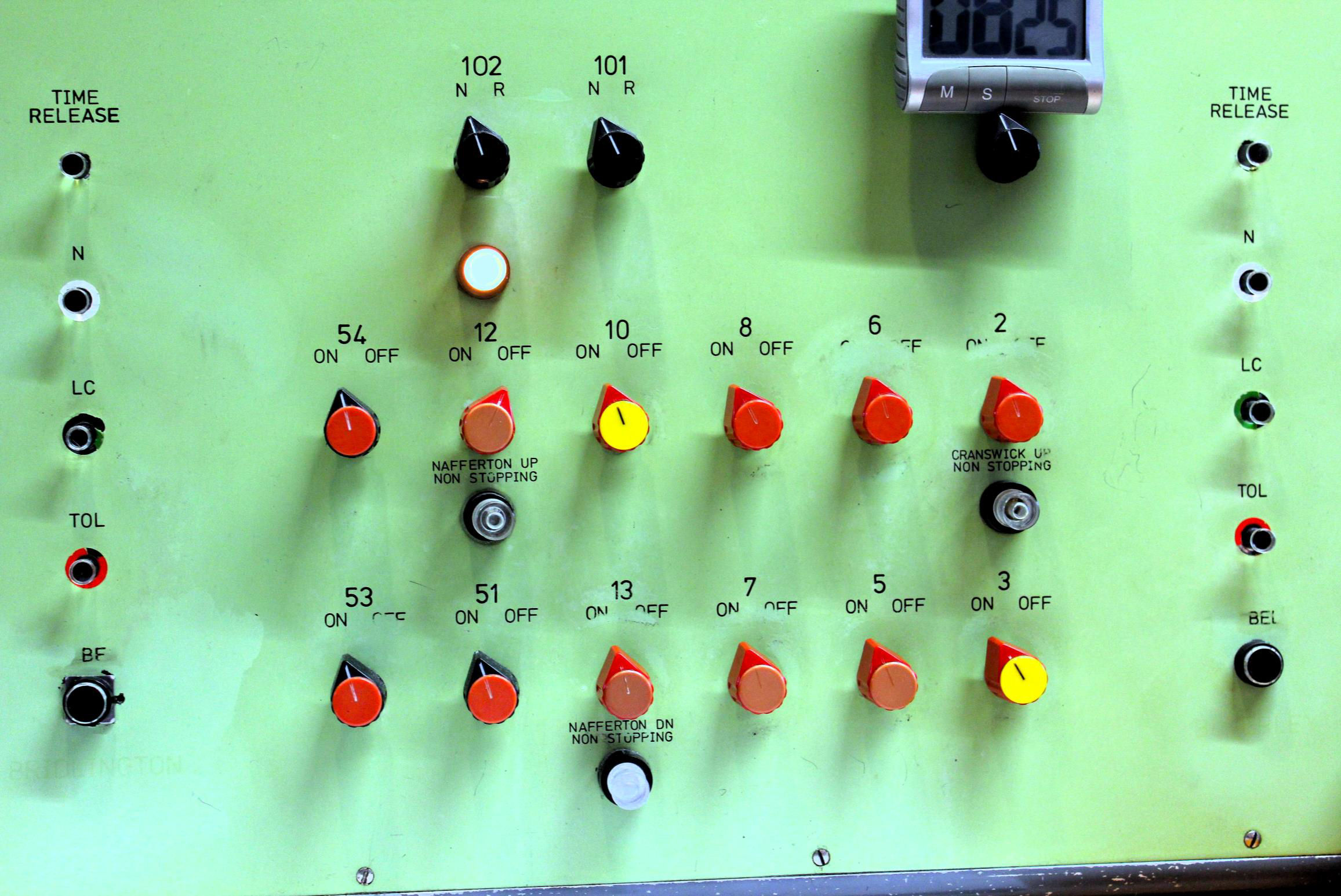
Detail of the controls on part of Driffield IFS (Individual Function Switch) panel.
[© Andrew Gardiner 2023]Heading north to Seamer, we stopped at
Gristhorpe, originally opened in 1874, which is now just a gate box on the single line between Filey and Seamer. It has only survived as the owner of the station building refuses to sell the land for the installation of an AHB level crossing, as she didn't want to be disturbed by its operation. The wooden crossing gates here have only been replaced by metal ones in recent years. The gates are hand-worked and, in the box we saw the 'Moreton-on-Lugg' controls introduced across the network following the fatal accident there in 2010. When the crossing keeper at Gristhorpe wishes to clear one of the protecting signals, they have to press a plunger which activates the system. If no train is detected as having passed when the protecting signal is replaced, a timer starts and the Key Lock Release lever is electrically locked until the control times out (thinking time).
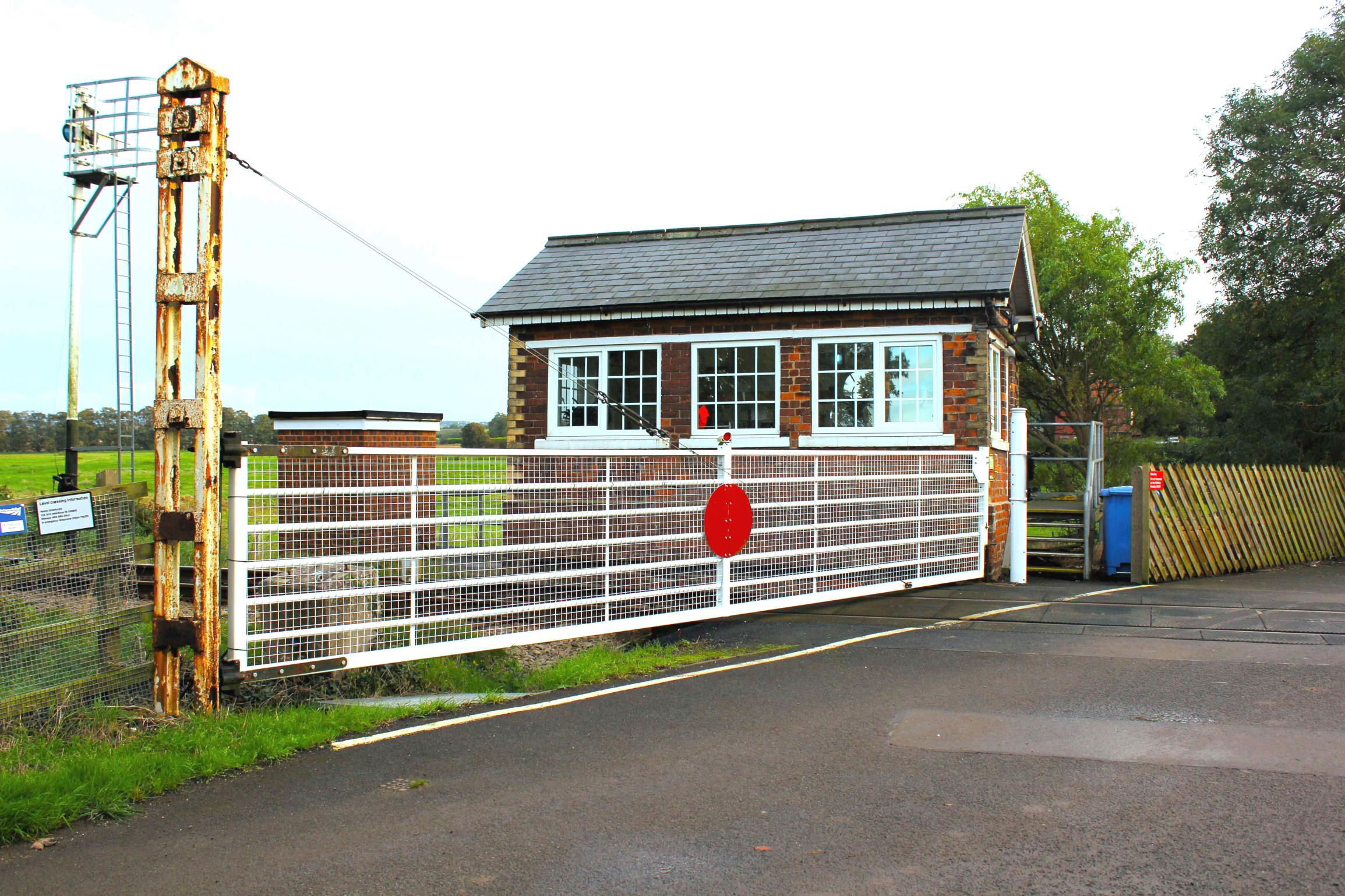
Gristhorpe gate box (46m 39ch) on the single track between Filey and Seamer with one of its two hand operated crossing gates.
[© Andrew Gardiner 2023]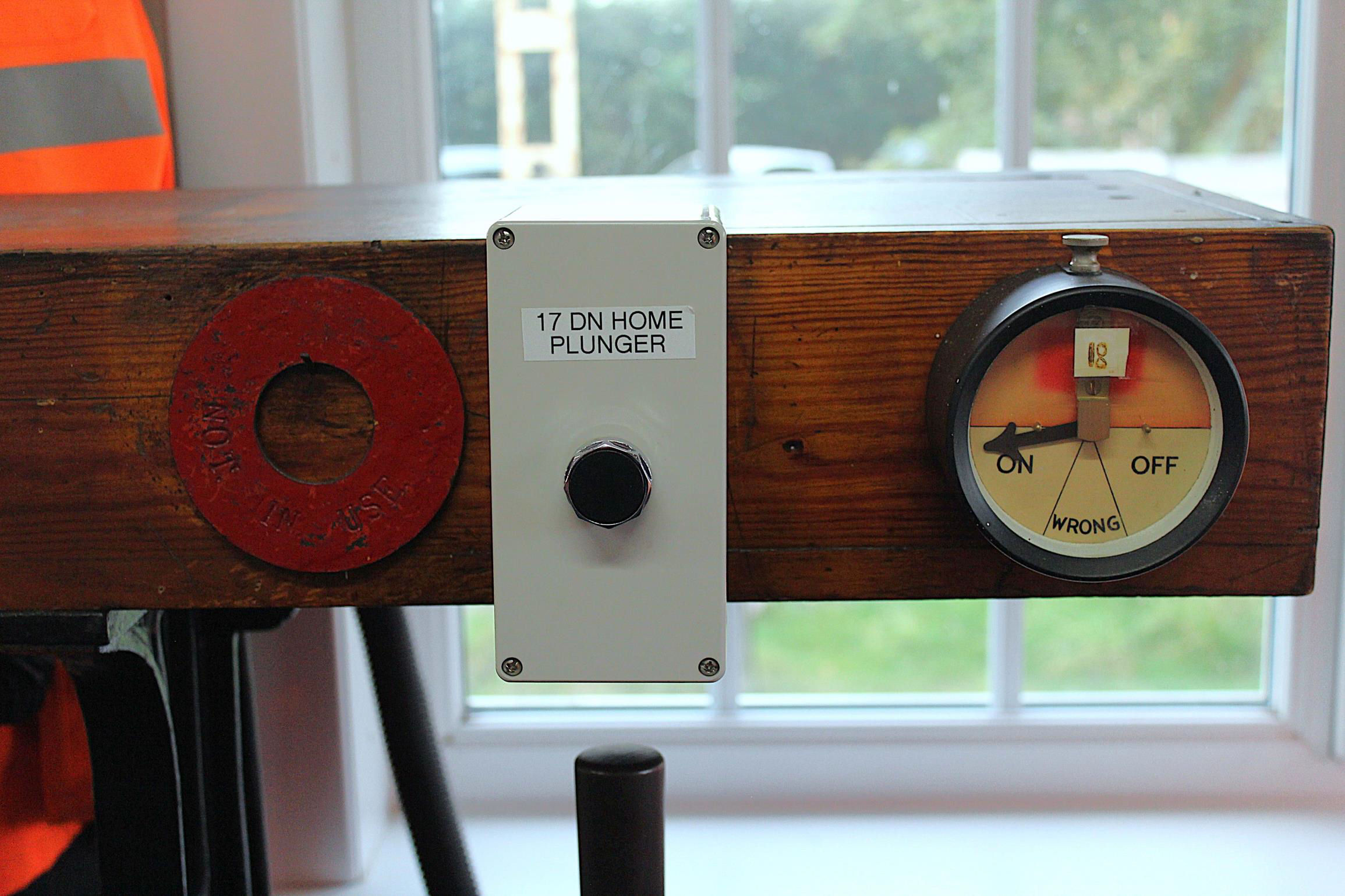
Close up showing the plunger which activates the 'Moreton-on-Lugg Controls' for a Down train, protecting Signal 17 (Down Home) at Gristhorpe.
[© Andrew Gardiner 2023]At
Seamer, we reached the Scarborough to York line. Seamer (formerly East) box controls the Hull line from Hunmanby and fringes with Bridlington (not visited this day), which itself has full control of the single line and provides a slot to Seamer for Up trains. Seamer works Absolute Block to Weaverthorpe box on the York line and has sole control of the Seamer to Scarborough line. The NX panel was first commissioned on 10 Apr 2000 and took over the Scarborough area from Falsgrave signal box from 1 Nov 2010. A pedestrian crossing over the Down line provides access to the island platform at Seamer and the box controls the wicket gates, which in this instance are interlocked with the protecting signal.
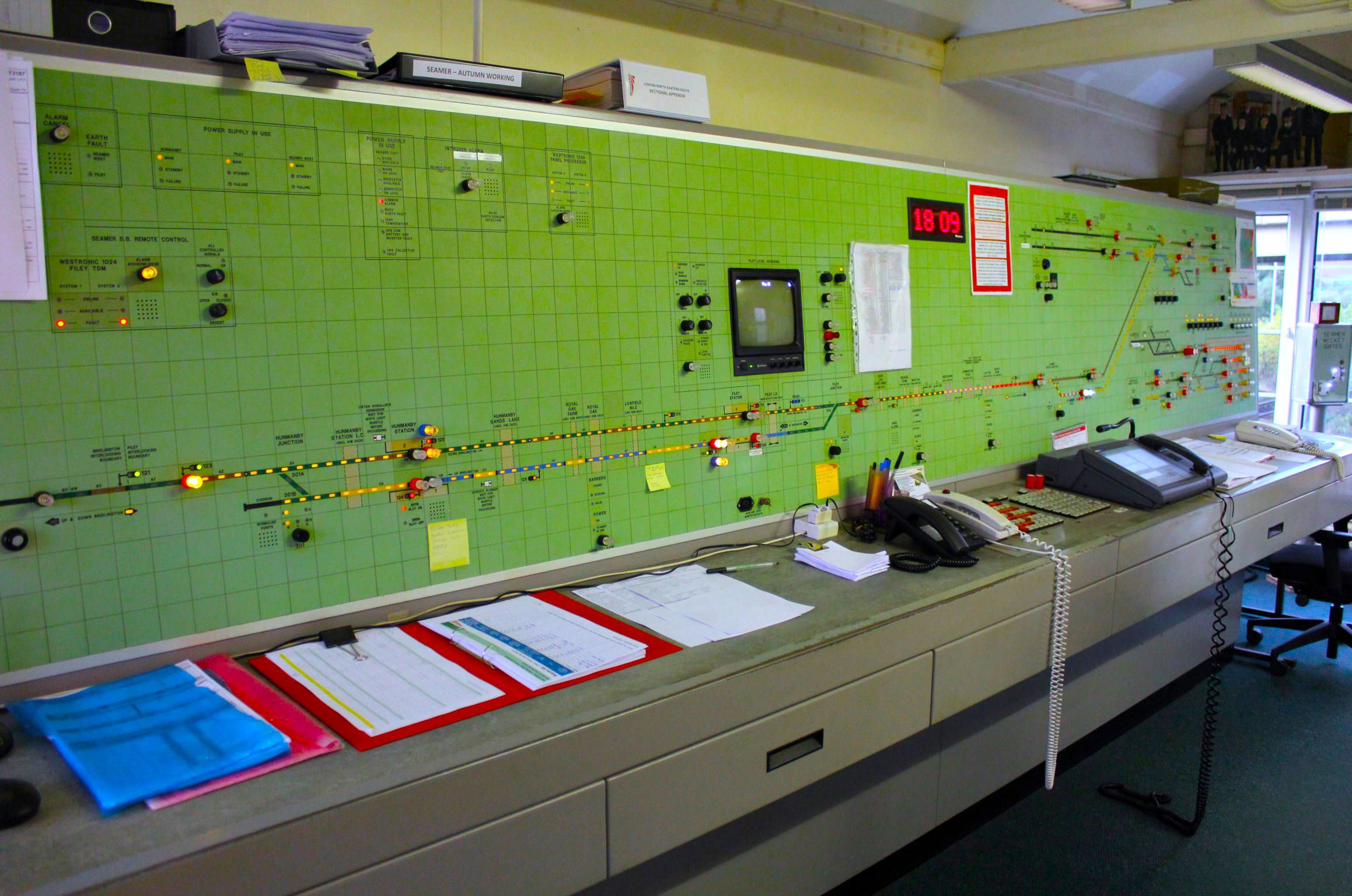
Overall view of Seamer signal box NX (Entrance Exit) Panel at 18.09 precisely!
[© Andrew Gardiner 2023]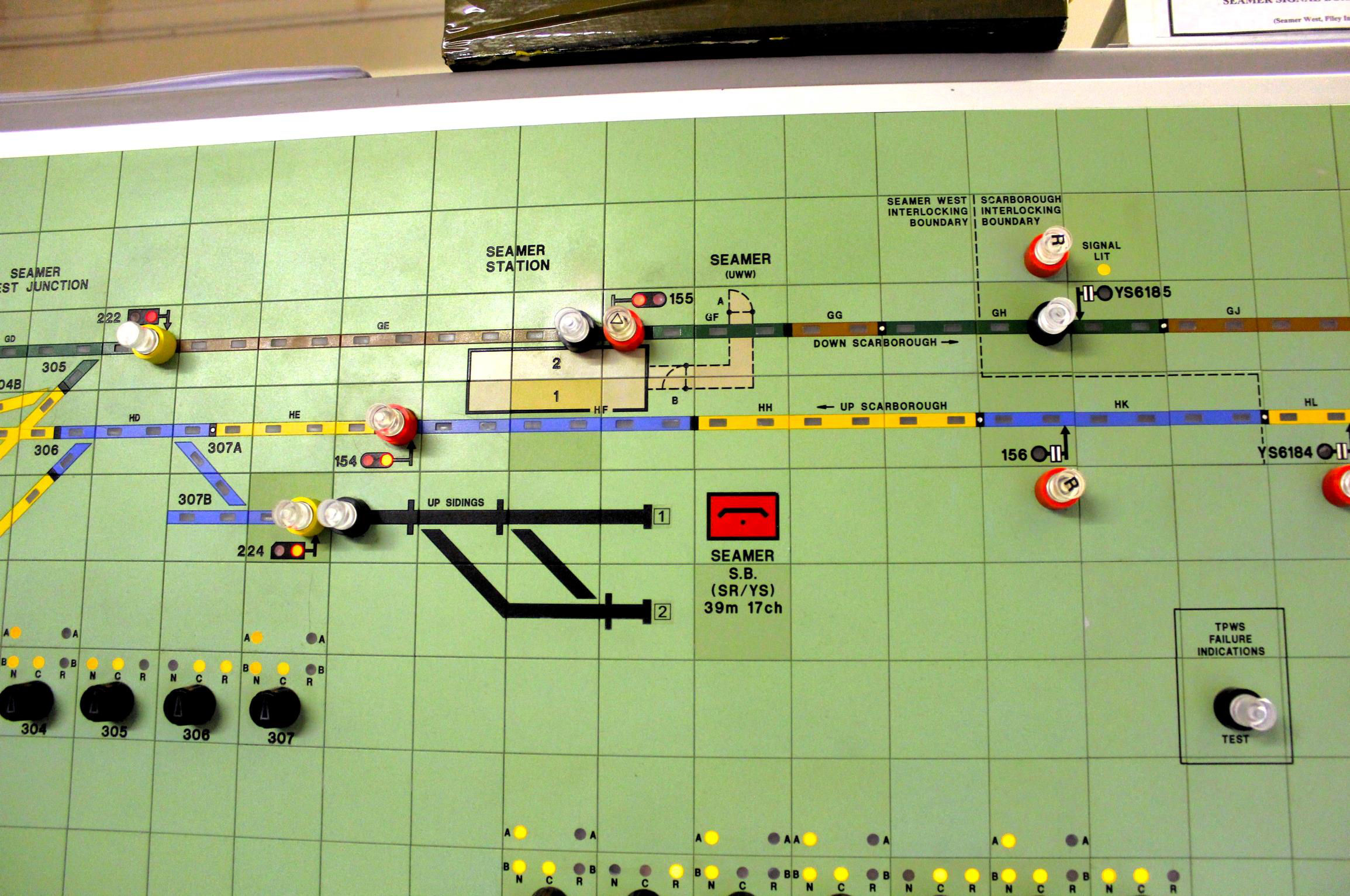
Close up of the Seamer area on this panel.
[© Andrew Gardiner 2023]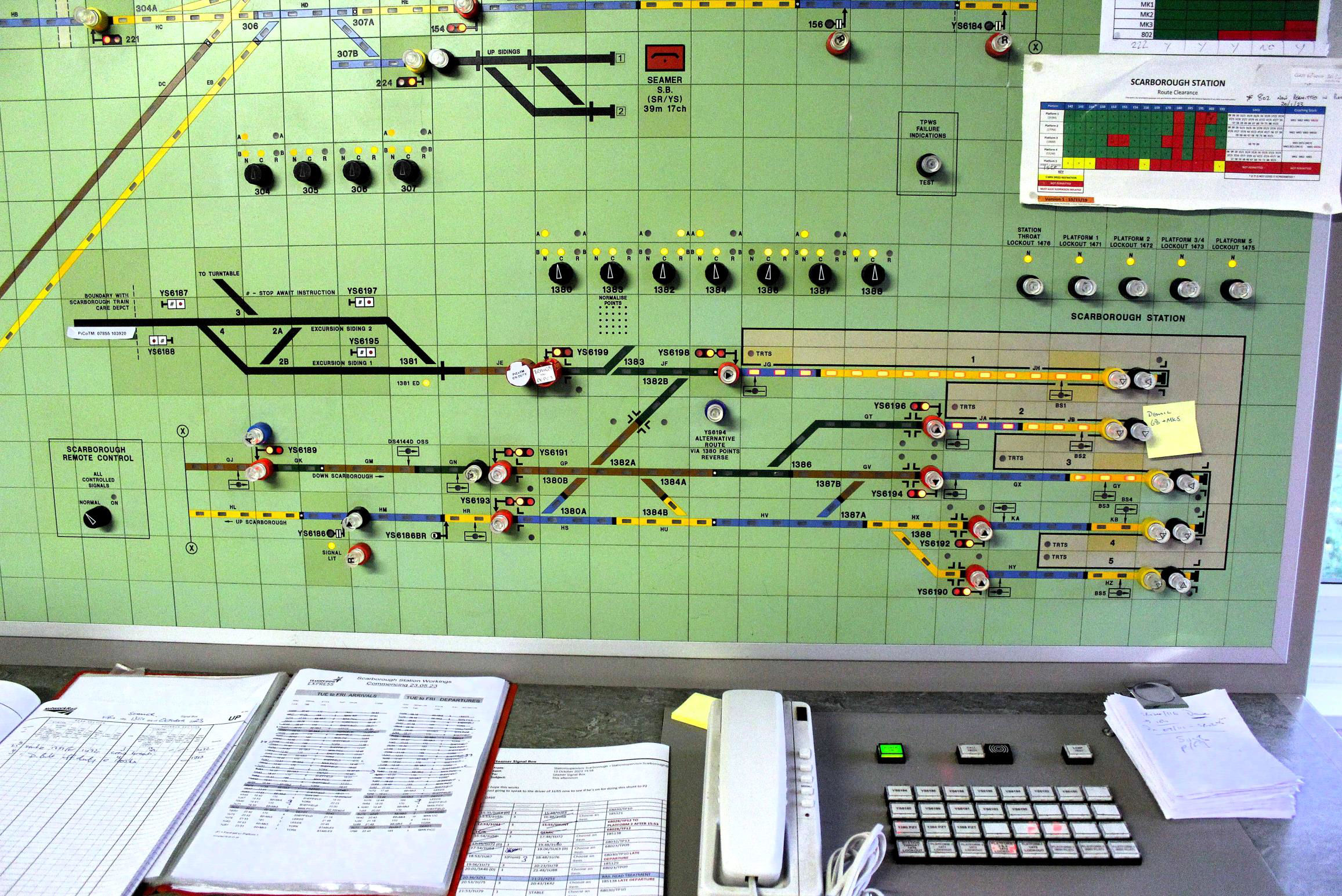
The Scarborough area, which was added to Seamer Panel from 1 Nov 2010. They really ought to make more use of Platform 5 though!
[© Andrew Gardiner 2023]Our final port of call was an unexpected, on the day bonus, early evening visit to
Weaverthorpe on the Scarborough to York to main line. As it was dark, some atmospheric night photographs were possible and outside light glare through the windows was not a problem. This North Eastern Railway Type S1a box dates from about 1873 and works Absolute Block to Malton and Seamer. The level crossing gates are mechanically operated from the box using a gate wheel, which are becoming relatively rare on NR as this is one of only seven remaining crossings with wheel-operated gates on the national network.
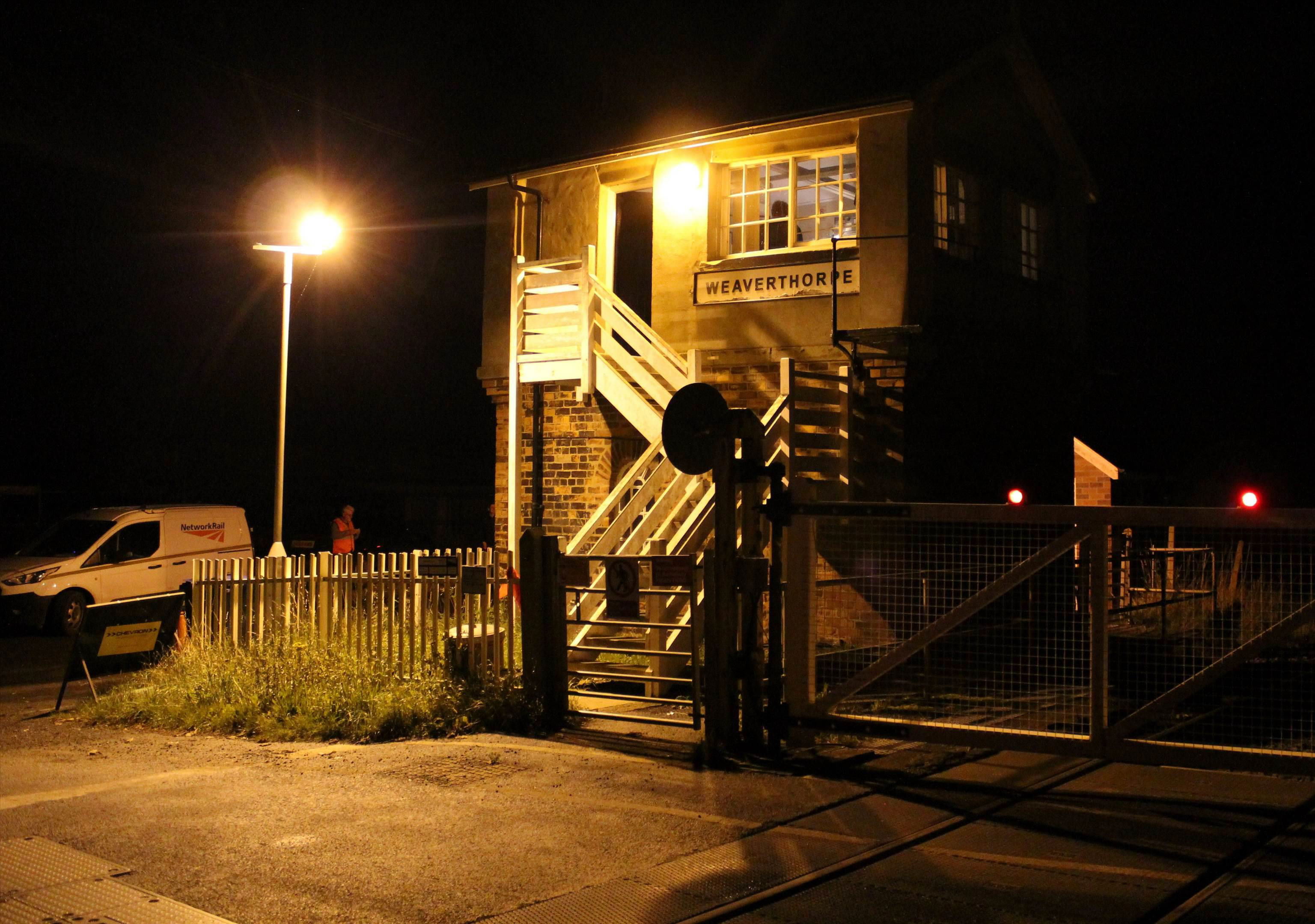
Weaverthorpe Signal box.
[© Andrew Gardiner 2023]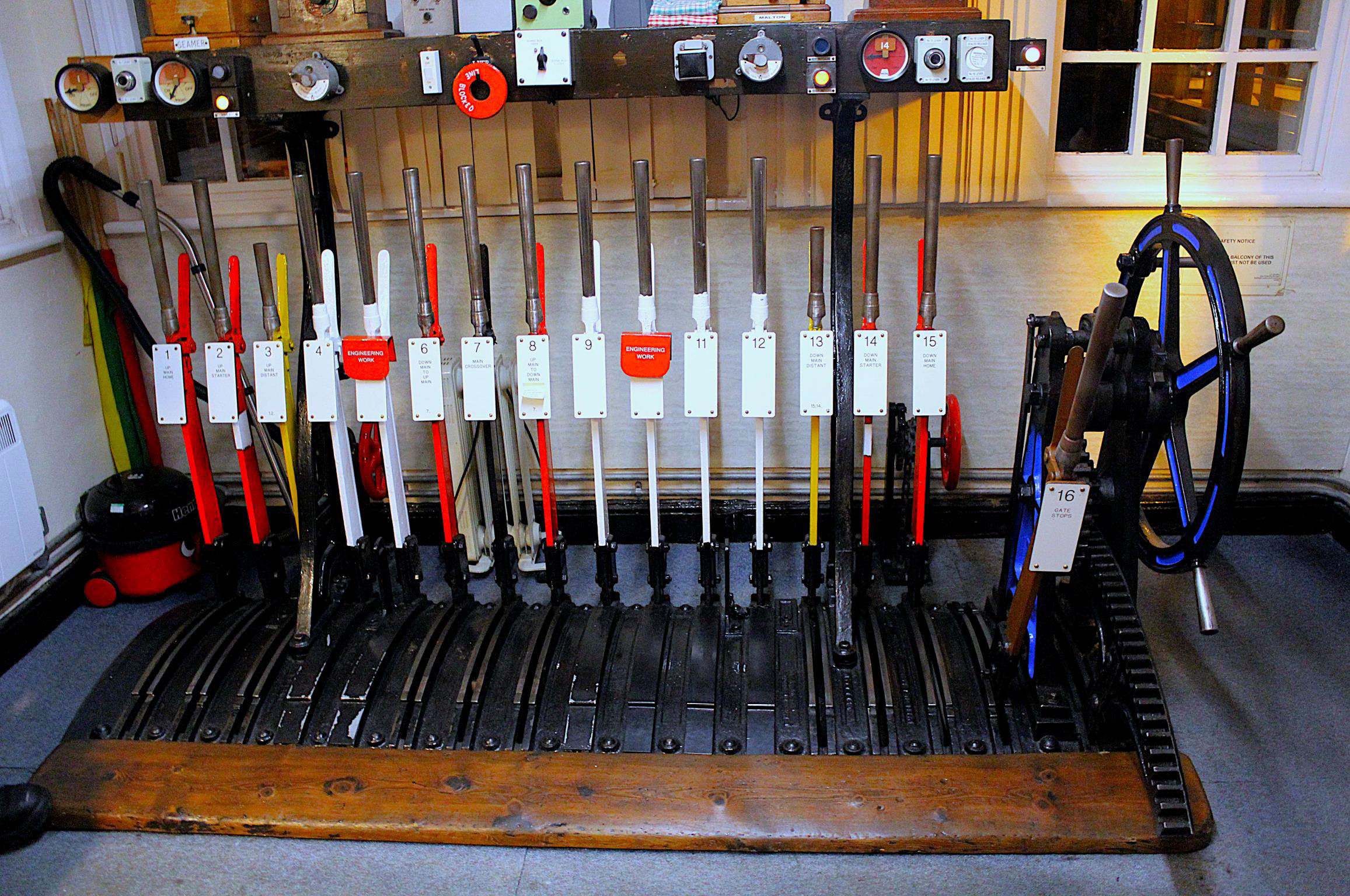
Weaverthorpe box frame without the usual daytime photo light glare problem through signal box windows…
[© Andrew Gardiner 2023]Our thanks go to all the duty signallers for being so accommodating and especially to Gareth Pearson, Sam Elliott and not forgetting our member Barnaby Clark for organising the visit. £500 was raised by the visits for Martin House Children's Hospice, a charity chosen by Gareth. The full set of pictures from the visit and some others can be found on Andrew Gardiner's extensive Flickr signalling image site.