On arrival by car from Essex at about 08.20, we found one set of coaching stock sitting in Sheffield Park P1 and a few members sitting in the Café awaiting breakfast. After a good breakfast, we ventured out ready for our 09.15 charter departure. Class 09 No D4106 (09018) was on P2, under the footbridge with the London & North Western Railway observation car. It is a perfect vehicle for a railtour, a single coach to access short lines allowing participants to walk up and down. The large windows, including at both ends, give excellent all round visibility along with reversible, comfortable, toast rack type seats and good capacity (68 - the tour had fully booked soon after opening). Despite its age (over 110 years old) it was, until recently, the highest mileage carriage on the railway. One of the wheelchair accessible Mk1 coaches, which is used almost every day, has now overtaken it. Class 09s have a higher maximum speed than their sibling Class 08s - 27½mph against a mere 15mph - very suited for our trundles. [*Scaccarium Dies is literally 'Treasury Day' in Latin, reflecting the fact that 6 Apr is the first day of the new financial year.]
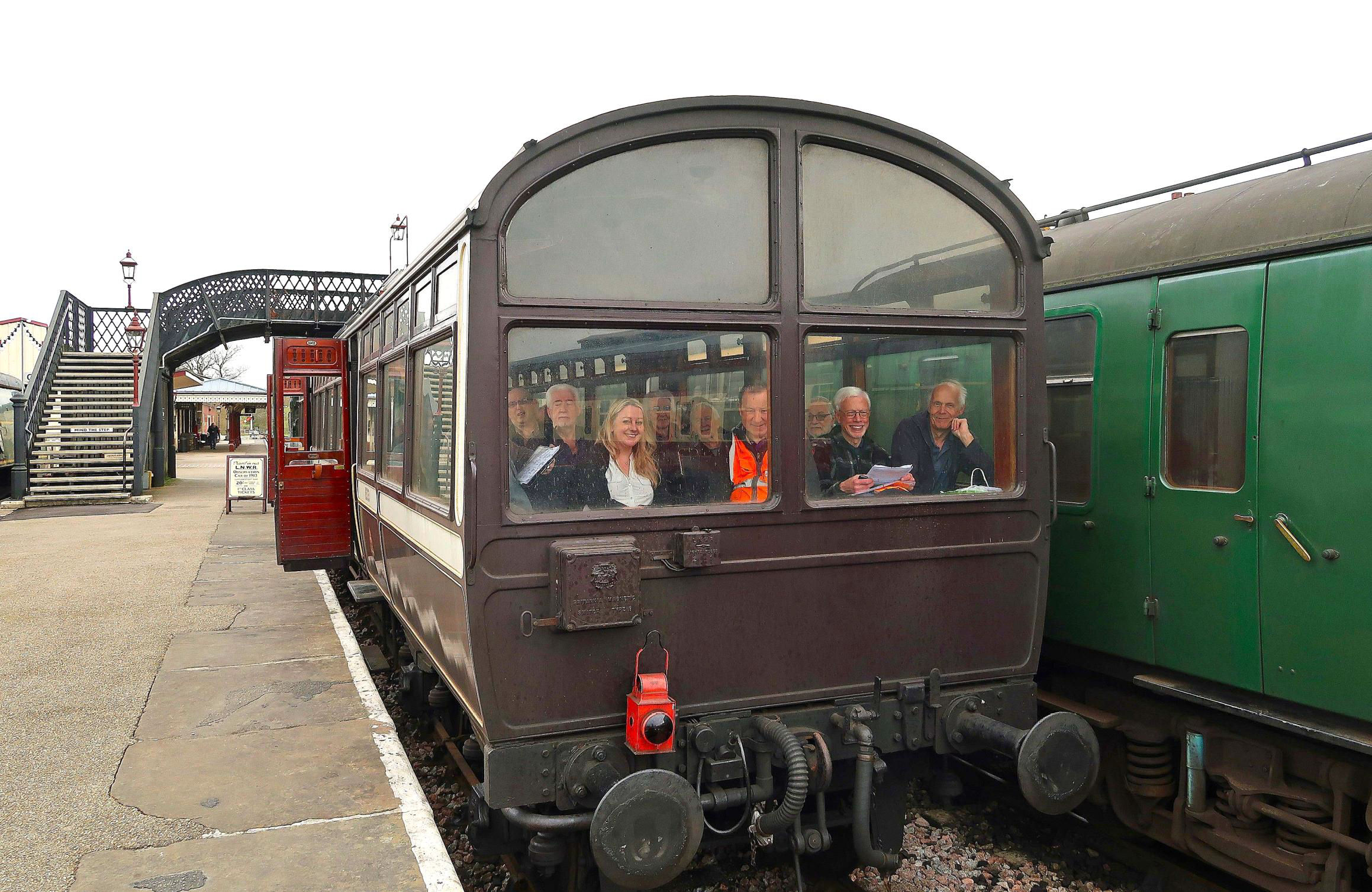
Our Bluebell Railtour tour at Sheffield Park P2 first thing in the morning, looking north. In orange is Darren Garnon, our Sales Officer, who organised this event, right of him (as viewed) is Paul Stewart (BLN Editor) then Tim Wallis (General Secretary)
[© Ian Mortimer 2024]We left on time, heading north with the observation car about 40% full and passed through Horsted Keynes P3 and along the Main. Before reaching West Hoathly (or Sharpthorne) Tunnel we were asked if we would like the lights on, the reply was a resounding 'NO'!! The 731yd tunnel is the longest in the British Isles on a standard gauge heritage railway (Mail Rail is longer but 2ft gauge). Graham Aitken, our friendly guard for the whole day, is former BLS member 730 so knew exactly what we wanted! As well as a guard, he is Bluebell Railway Volunteer Coordinator and Sheffield Park Senior Station Master.
http://www.minorrailways.co.uk/trackplans/bluebell.pdf is a Peter Scott track plan dated 14 Oct 2022.
Our train continued through Kingscote P1 to East Grinstead Bluebell Railway platform to pick up the remaining participants, many had come by train. With the observation car now full, we were propelled back south to Ground Frame 'B' (TRACKmaps 4 p20B 2019) to clear the points for the Run Round Loop, then reversed onto the loop to clear the points with the Cripple Siding at the south end, before being propelled along the Cripple Siding to the stop blocks. Graham said it was the first passenger train to go in there. The '09' then hauled us back into the loop before running round. Now on the south end of the observation car, the '09' propelled us through the remainder of the loop to the headshunt stop blocks at the north end. We then returned to the platform for a break and await our 10.40 booked departure.
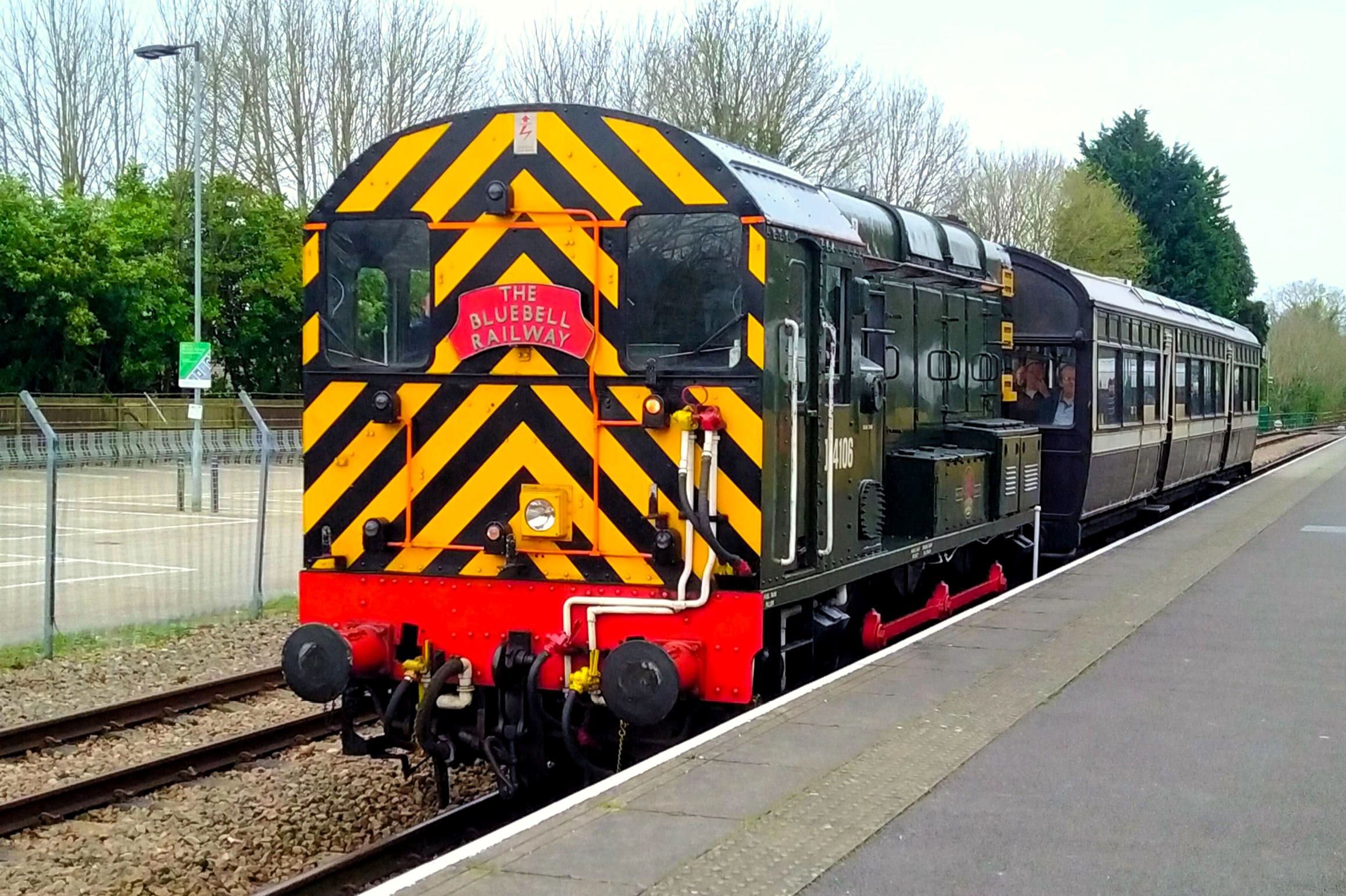
Our Bluebell Railway tour at East Grinstead in the morning- the end of line is off left, Sheffield Park is off right.
[© Phil Logie 2024]Running south from East Grinstead, we arrived at the north end of Kingscote P2 then were propelled as far as possible along the Down Siding, before returning to the north end of P2. We waited in P2, (designated as the loop, it is the left hand line looking south), for the arrival and departure of the 10.30 Sheffield Park to East Grinstead, hauled by BR (British Rail) Standard 5 No73082 'CAMELOT'. Once the service train had departed P1, designated 'the Main', we were propelled back north to clear the points with the Main at Ground Signal No29. We were then hauled south through P1 towards Horsted Keynes.
At Leamland Jn (11m 09ch from the former Culver Jn) we took the 'Main' (left hand) line and ran through Horsted Keynes Line 4, the one between P4 & 5 - before entering the Down Yard. New Road Siding ahead of us held Class 73 NoE6040 'The Bluebell Railway' on a rake of hoppers containing coal and tamper No73315. We crossed to Headshunt No1 (the middle of the three dead end lines), which was traversed to the stop blocks. Here we reversed and took Carriage Shed Road 'E' up to the Carriage Shed doors. Next it was back to Headshunt No1 to clear the points, before reversing again to the yard exit. We then had to wait for the two service trains to pass each other in Horsted Keynes. 'CAMELOT' was first, into P4/5 with the 11.30 ex-East Grinstead, then BR Standard 4 No80151 arrived into P3 with the 11.45 Sheffield Park to East Grinstead service. Having watched 'CAMELOT' depart southbound, we were given the right of way once 80151 had departed northbound. It was impressive how the Bluebell Railway could fit us in around two steam service trains and, later, also a dining train doing cream teas.
We ran through P4/5 and along the 'Main' past Leamland Jn to the Up Inner Home Signal. Reversing again to head south, we took the right hand 'Loop' line (the 'Main' and 'Loop' are both bidirectionally signalled as are Horsted Keynes P2-P5). Our tour entered the Up Yard, where we covered Siding 2 up to the foot crossing. After the Up Yard it was north along the 'Cottage' Headshunt as far as possible. The train was then hauled back to the Up Yard to clear the points and propelled onto the Loop line. Our return to Sheffield Park was by way of the Loop to Main crossover and Horsted Keynes P3.
Back at Sheffield Park, 'CAMELOT' was waiting on its train in P1 as we ran into P2 (right on arrival). Our participants had the option of alighting to catch the service train or remaining on board to cover a few more lines before lunch. Unsurprisingly, no one got off as they would have missed one of the rare track highlights! After the quick stop in P2, the tour proceeded onto the Pumphouse Siding, reversed and propelled into the relatively new Up side Carriage Shed, taking Road 'A' (furthest from the running line) into the shed to the stop blocks. In the shed the Golden Arrow Pullman set was on Road 'C' and Road 'B' was occupied by Southern Region Class S15 No847, with two tenders and other stock.
We returned to Pumphouse Siding before reversing again and being propelled into No2 Dock - behind the Down end of Sheffield Park P2. This is where No21C123 'BLACKMORE VALE' was stabled, so we could only traverse the Dock line to just into the platform. Leaving the Carriage Shed, we noticed that SECR No65 had propelled the stock for the 'Wealden Rambler' service into P2 for the afternoon tea service (with our special, four trains were now running). Our train returned to the Pumphouse Siding.
Once 'CAMELOT' had departed P1 with the 13.00 to East Grinstead, No65 shunted the 'Wealden Rambler' stock from P2 to P1, allowing us to return into the south end of P2. The last manoeuvre before lunch took us southbound into the Loco Headshunt (the second from the east side of the line) to the stop blocks before reversing and being propelled into the Loco Shed Road 3. There was just about enough room for the whole observation car to fit into the shed but not the '09', the moves had been carefully thought out to maximise our track coverage. After the shed road, we reversed on the Loco Headshunt and proceeded to the stop blocks of the recently vacated 'Wealden Rambler Dock', then disembarked for a lunch break. There was some puzzlement on arrival at the Dock as it had barriers along the length of the platform (to protect 'Normals') - then we were told to alight from the other side of the carriage, where a small but adequate platform runs along the length of the loco shed!
There was plenty to do during the break, some went to the café or purchased an ice cream, others managed to have a tour of the extensive loco sheds. I elected to photo 80151 arrive with the 12.45 from East Grinstead and No65 depart with the 13.45 'Wealden Rambler'. Just after 14.00, two intending gastronomes arrived at the ticket office, looking for their cream tea train. They were not amused to discover that it had left (on time!) but the Bluebell staff sorted out a way for them to catch up with it.
With members back on board for a 14.15 departure, D4106 hauled us back onto the Loco Headshunt to clear the points and then propelled us back into P2, where it ran round. Now on the north end of the observation carriage, the '09' then propelled us south to the stop blocks of the Pumphouse Siding.
After this, it was back to P2 again, reverse, and then down Newick Siding to the stop blocks. This was of particular significance as it was the original single track running line south to Culver Jn and Lewes before final closure from 17 Mar 1958. It rose in altitude towards the stop blocks as there used to be an underbridge immediately to the south over the A275. This line is called Newick Siding as the next station to the south was Newick & Chailey. It is worth noting that the East Grinstead to Culver Jn line was built for double track but the second track was only laid as far south as Horsted Keynes, the rest was only ever single with loops; it was also remarkably undulating. Both features were evident from our observation car. We were then hauled into P1 to await the arrival of 'CAMELOT' into P2 with the 14.00 from East Grinstead. Once it had arrived, we departed northwards for Horsted Keynes. Another feature seen from our vehicle were signs marking the sites of the former Ketches Halt, Freshfield Halt, Holywell (Waterworks) and Bluebell Halt heading north from Sheffield Park to Horsted Keynes. The signs were clear due to the impressive standard of vegetation clearance along the whole Railway. BLNs 1375.1095 & 1374.MR51 have more about these halts with (1374) a map showing their locations.
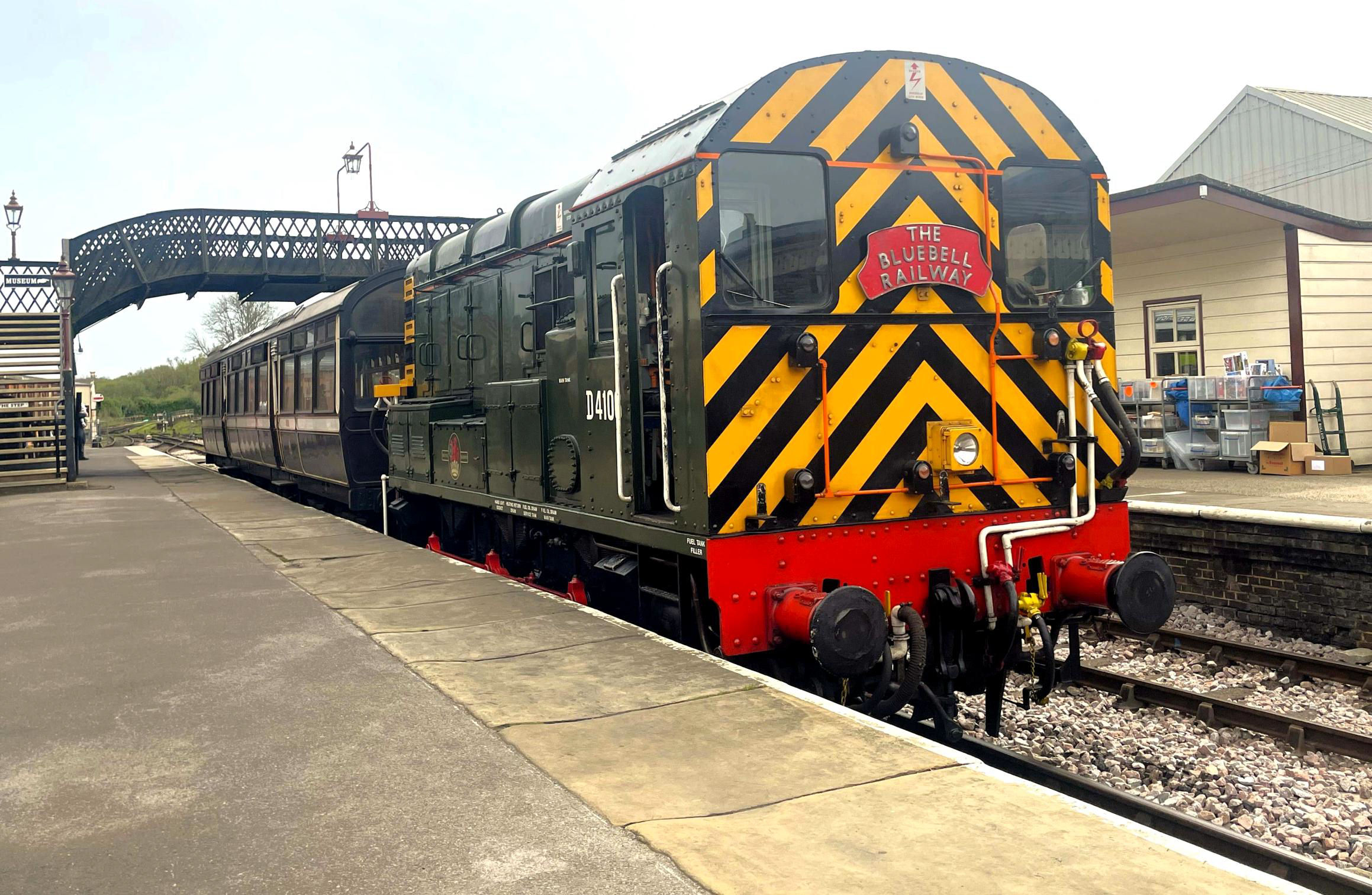
Mid-afternoon in Sheffield Park P1 looking towards the end of line. Those platform edging (nosing) stones are £115 each new to buy.
[© Kev Adlam 2024]On arrival into Horsted Keynes, I took the opportunity to take a photo of the Carriage Shed pilot, Rolls Royce No10241, as we passed it and headed through P3 to reverse on the Main at Ground Signal No18. No65 was sitting in P2 with the 'Wealden Rambler'. After propelling through P4/5 and into the Down Yard again, we continued along New Road Siding as far as possible. After a short reversal north to clear the points, our tour was propelled southward again onto Headshunt 2 to the stop blocks.
On the move back to P4/5, I photographed the Wickham Trolley sitting in the Engineer's Yard. After a reversal in P4/5, our coach was propelled south to reverse again at the Up Inner Home Signal and then into P2. We were then propelled as far as possible along the Ardingly Branch, just past the connection with P1 and the signal box. Horsted Keynes is arguably the standard gauge heritage station in the UK with the most complex layout and signalling; the signaller probably hadn't had so much excitement before and we must have tested nearly every lever. The 09 then hauled us back north through P2 and, once clear of the points, reversed as far as possible into the north end of P1, with just enough room for one doorway to be platformed. There was another break while the two service trains crossed again. Most of Horsted Keynes P1 is out of use for repairs to return it to operational use, the wall has been rebuilt, the edging stones need replacing (180 at £115 each = £20,700, plus £5,300 for other costs).
I rushed to the south end of P2 to photograph 'CAMELOT' arrive at P3 with the 15.45 Sheffield Park to East Grinstead, while 80151, the BR Standard 4, arrived on P4/5 with the 15.30 ex-East Grinstead. At this point the rain started to fall, so most members elected to rejoin the observation carriage. From there, we could view a rather worn looking 'SHARPTHORN', a Manning Wardle engine built in 1877, as well as 'Oxted' Unit Driving Motor No60130 'Brighton Royal Pavilion'. Under tarpaulin was also the small 4-wheel petrol locomotive built by James & Frederick Howard Ltd in 1926.
We left P1 at 16.20 to head back north to Kingscote P2 then it was into the Down Siding again but this time after reversal, our train was then propelled southwards as far as possible into the Water Tank Siding, with just an immovable 4-wheel tank wagon between us and the blocks. Then it was a shunt back to the north end of P2, via the Down Siding, while 'CAMELOT' passed through P1 with the last regular service train of the day. Having completed all the rare track on the tour, we were hauled back to East Grinstead for those finishing the day there to alight, being warned that we were two minutes late (not bad at all on such a complex itinerary) with only six minutes to make a Southern London train!
Once the passengers had left the train at East Grinstead, the Class 09 ran round to the south end to lead back to Sheffield Park. The return took us back through Kingscote P1 (in case you were wondering if we did that), only normally used for crossing moves although both platforms are bidirectional.
Passing through West Hoathly (13m 07ch), just north of the tunnel, our coach enabled us to 'observe' the remains of the two low level platforms on this former double track section - the single track runs through the middle away from them both. The NIMBY campaign against station reopening succeeded. This time it was Horsted Keynes Main and P3. At Sheffield Park, the luxurious, very smart, 'Golden Arrow' Pullman set had been positioned in P1 for the evening dining service so we arrived into P2.
Considerable thanks to our very enthusiastic and knowledgeable guard, Graham, who knew everything and anything about the Bluebell Railway, the train crew and definitely the ground staff for all the point clamping. We made 49 reversals during the day (table thanks to Jim Sellens) travelling 48m 57ch. It was pleasing to be able to contribute £1,850 to the Railway, plus the significant sales of food and refreshments to participants during the day. We have been invited to return for more! Finally, thanks to our Sales Officer, Darren Garnon, for his trademark meticulous planning of an exceptional event.
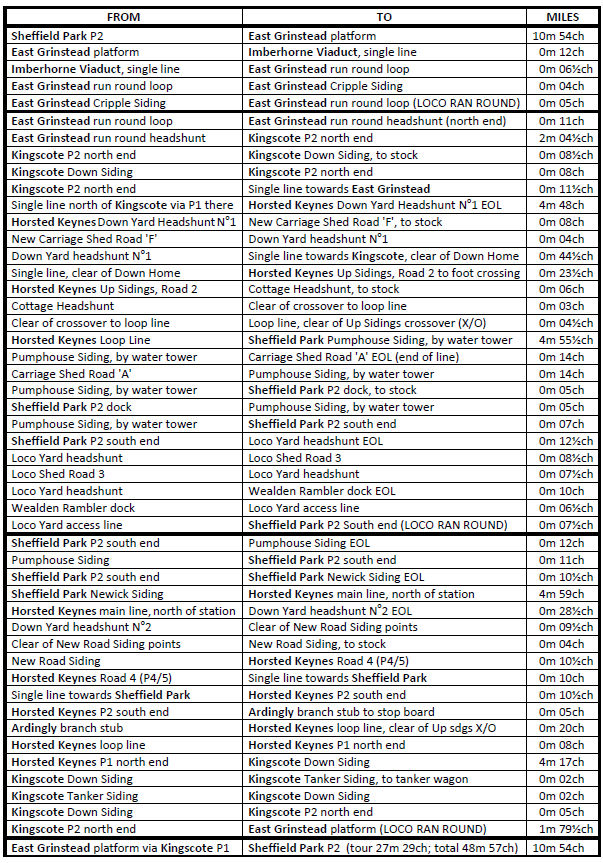
Route and mileage table. Afterwards, many went on to Haywards Heath to do the rare crossovers available for this one day only due to a convenient landslip between Preston Park and Wivelsfield (BLN 1447.1127). It was a much more chaotic journey than the well-planned day we had enjoyed at the Bluebell Railway!