Lostwithiel:
16 members met on Lostwithiel Down P2 at 09.30 and were treated to a day of spectacular sunny weather and spectacular signalling with semaphores. Our host was NR Mobile Operations Manager, John Stocks. Goonbarrow Junction, Par, St Blazey, Truro and Roskear Junction boxes were also visited. This was 'in advance' of the Siemens Mid-Cornwall Resignalling Project; installation began in Sep 2023 with commissioning now in progress and live signalling due from Mon 11 Mar 2024. Lostwithiel, Par and Truro signal boxes will be abolished with recontrol to a new workstation at Exeter Signalling Centre.
This will be the end of the iconic lower quadrant semaphore signalling in these areas and a reduction of the number of signal boxes in the Duchy from nine to six. Liskeard, Roskear Junction, St Erth and Penzance will remain on the Cornish Main Line plus St Blazey and Goonbarrow Junction on the Newquay branch. Absolute Block working will then only remain in operation between Hayle and Marazion. Lostwithiel crossing will be CCTV control from the new Exeter workstation, Truro Level Crossing will be converted to Obstacle Detection. Track circuits will be replaced by axle counters.
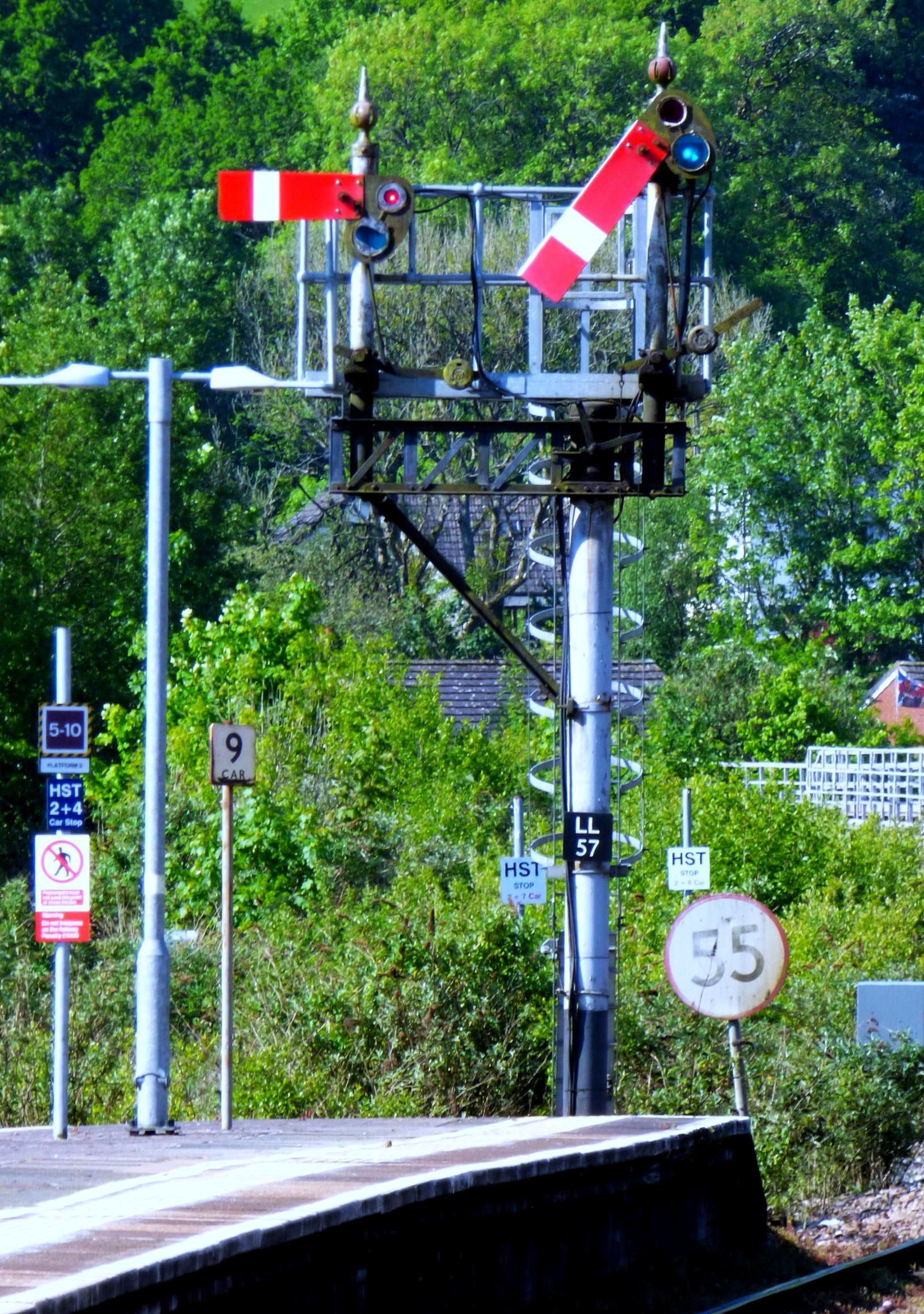
Bracket signal at the country end of Down P2 for Down Main/Carne Point branch.
[© Barney Clark 2023]Lostwithiel (LL) signal box, still externally plated as Lostwithiel Crossing, is situated at 277m 34ch; the London end of Down P2. It is a GWR Type 5 box of 1893 build (Signalling Record Society, Signalling Atlas & Signal Box Directory), with GWR 5-light replacement windows on refurbishment and with a 1923 GWR VT3 tappet locking 63 lever frame. This frame controls points and signals in the Lostwithiel area. The box also has a Henry Williams supplied Entrance-Exit (N-X) panel controlling the Bodmin Parkway and Largin areas to the east, installed in 2018 to replace a 1991 Westinghouse N-X panel. The box was Grade II Listed in Jul 2013, partly as it is the earliest known surviving GWR type 5 design.
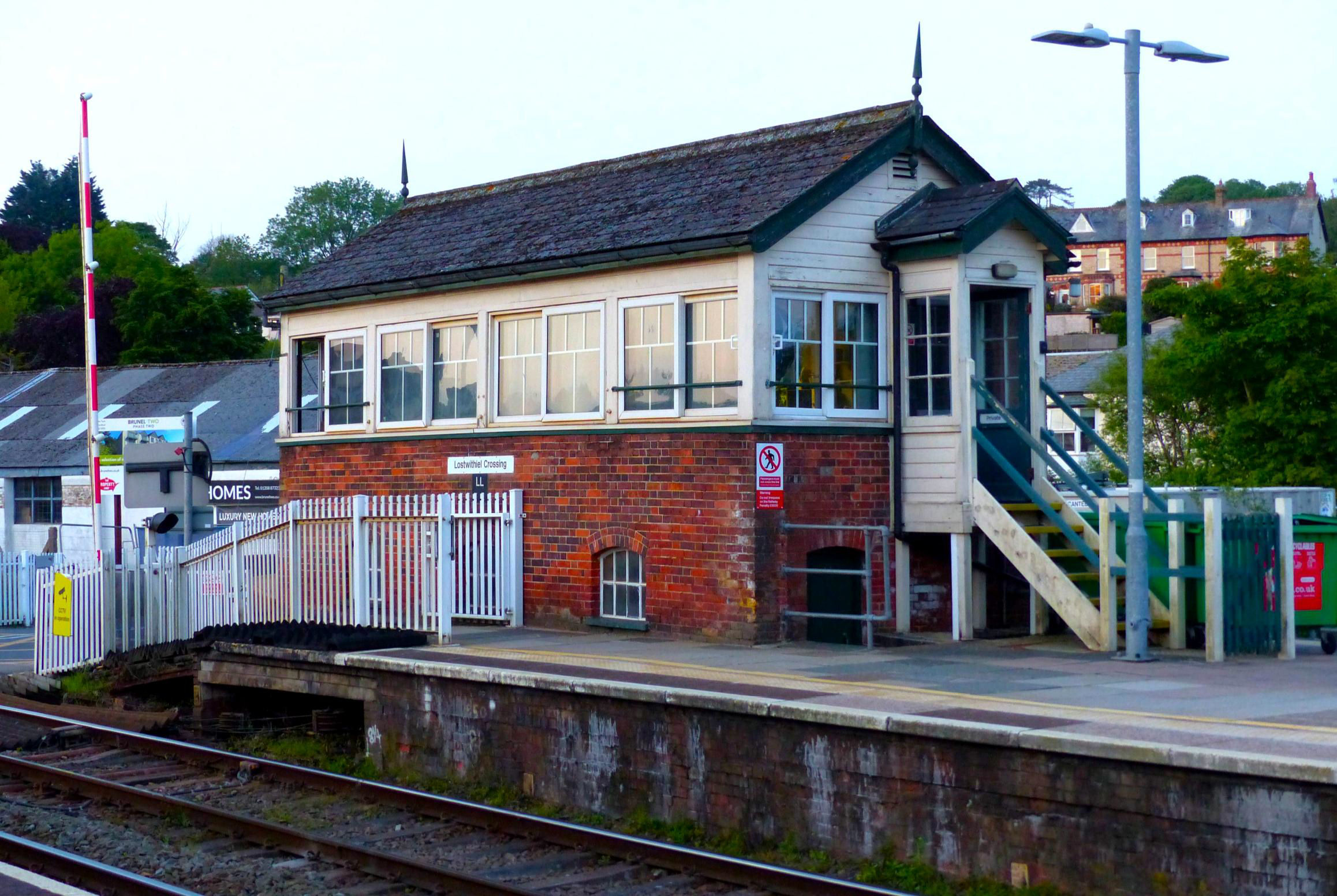
Lostwithiel (Crossing) box, on the London end of Down P2 and adjacent to the level crossing.
[© John Cowburn 2023]Lostwithiel works Absolute Block with Par to the west, with a 1947 pattern GWR block instrument, a wooden peg is utilised to deaden the sound of the block bell when offering and accepting a train! To break up the long section, there are Intermediate Block signals at Treverrin. Working to Liskeard in the east is by Track Circuit Block, with trains described - as opposed to being offered and accepted - on a further block bell. Delightfully, the vast majority of the main running signals controlled by the lever frame are of the GWR lower quadrant semaphore type. [Most/all now date from BR days with tubular steel posts etc.] LL1, the Up Main Distant, LL61 the Down Main Distant and LL10, the Up Main Outer Advanced Starting, are colour light signals with cut down lever handles to show this. Further, 100/100R are a switch on the block shelf for the Intermediate Block home and distant colour light signals on the Down Main to Par, with a 'line clear' from Par required before these signals can be cleared.
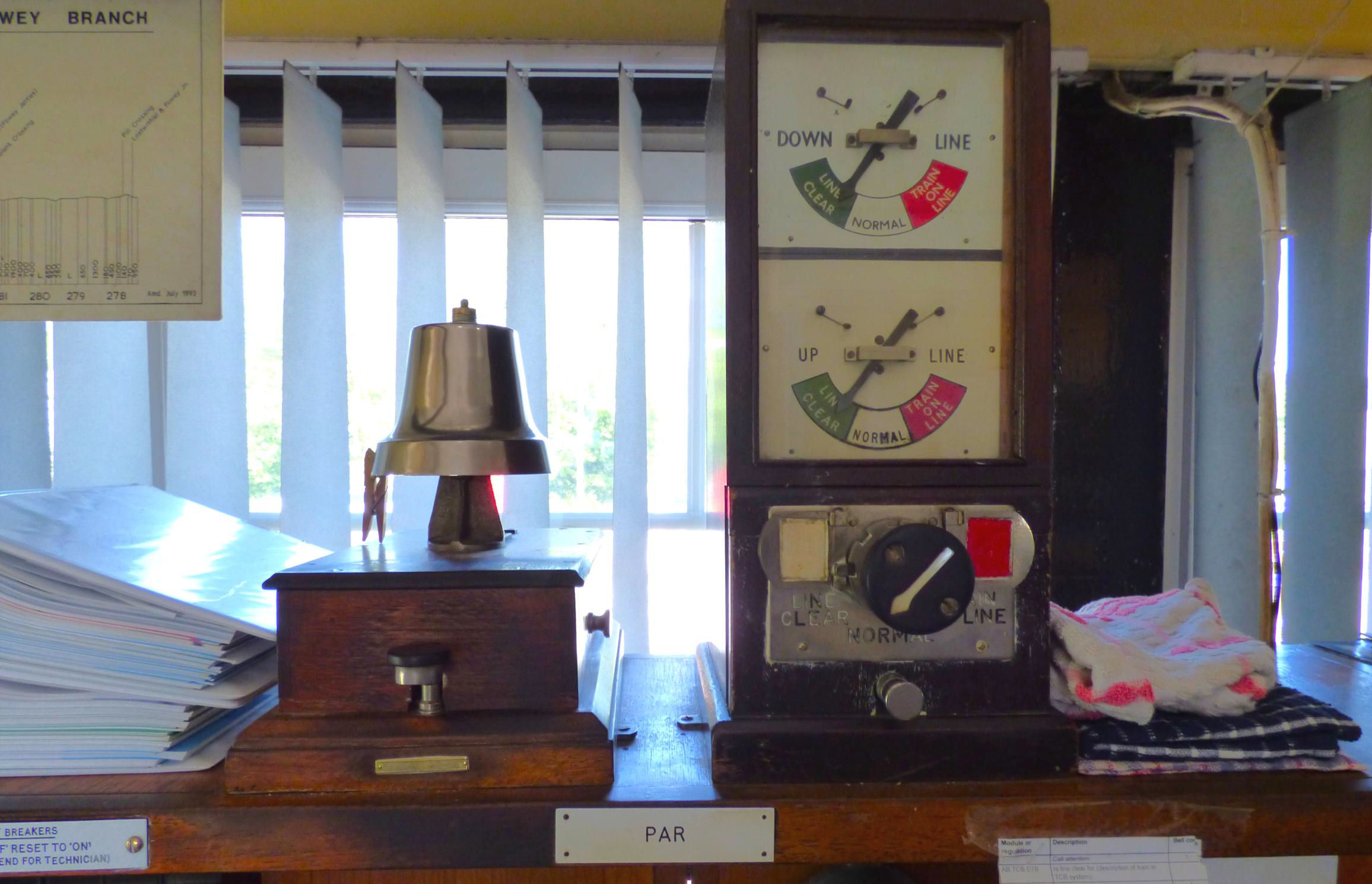
Lostwithiel block instruments for Absolute Block working to Par, with a wooden peg on the block bell to muffle it.
[© Barney Clark 2023]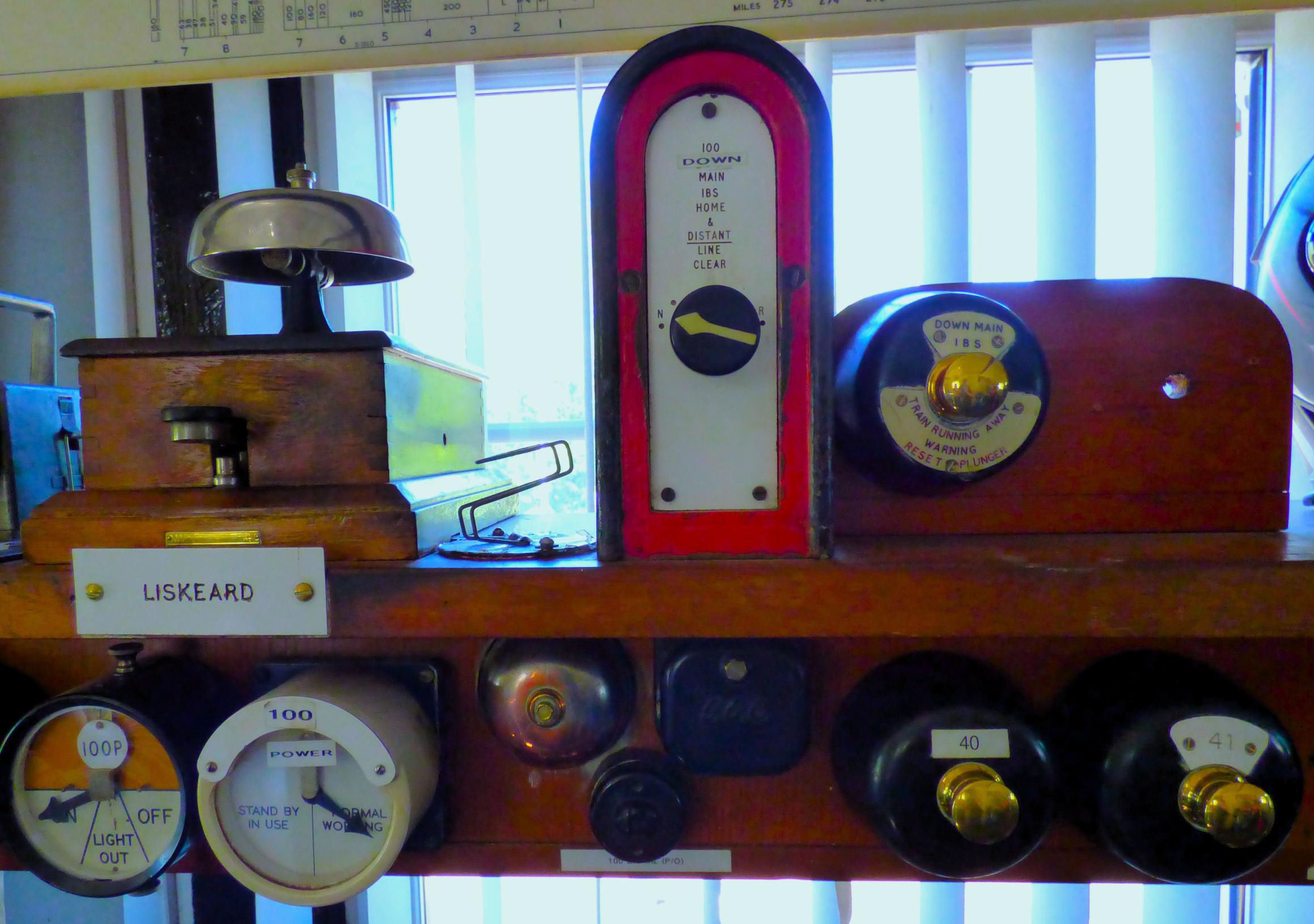
Instrument for the Intermediate Block Signal 100 control on the Down Main to Par.
[© Barney Clark 2023]Levers 12, 13, 21, 22, 24 to 29, 32 & 53 are spaces; they have been physically removed from the frame.
Levers 18, 19, 20, 23, 30, 31, 33, 34, 35, 37, 39 & 62 are spare and painted white to indicate this.
The Up Side Cattle Pen Sidings/Milk Sidings and the associated infrastructure were disconnected in May 2007 and recovered in Mar 2021. Consequently, Lever 43 - former points Up Main to Cattle Pens - and Lever 48 - former interlocking lever for the ground frame - are permanently bolted in the 'normal' position in the frame. If levers are taken out of use but remain part of the interlocking, the convention is usually to paint the lever half white with the lower half retaining its original colour. This has been done with Lever 43, which is now half white and lower half black, although Lever 48 remains half blue and lower half brown. Lever 42, former disc ground signal for 43 points, has a reminder appliance that it has been disconnected. On abolition, LL42 disc ground signal was the final yellow disc in Cornwall.
The Down Sidings and Fowey branch Down bay (Fowey passenger service withdrawn in 1965) were also removed in 2021, with the track going to the Plym Valley Railway. Levers 15 (former motorised points Down Main to sidings), 16 (former disc ground signal controlling Down Sidings to Branch) and 17 (former disc ground signal controlling Down Sidings to Down Main) are therefore disconnected with reminder appliances in place. In the Up direction on the lever frame, there are six stop signals to be cleared by the signaller: 2, 3, 5, 6, 8 and 10; all but No10 are semaphores! This is a high number for a mechanical box in the 21st Century (can readers think of any surviving NR mechanical box with more?).
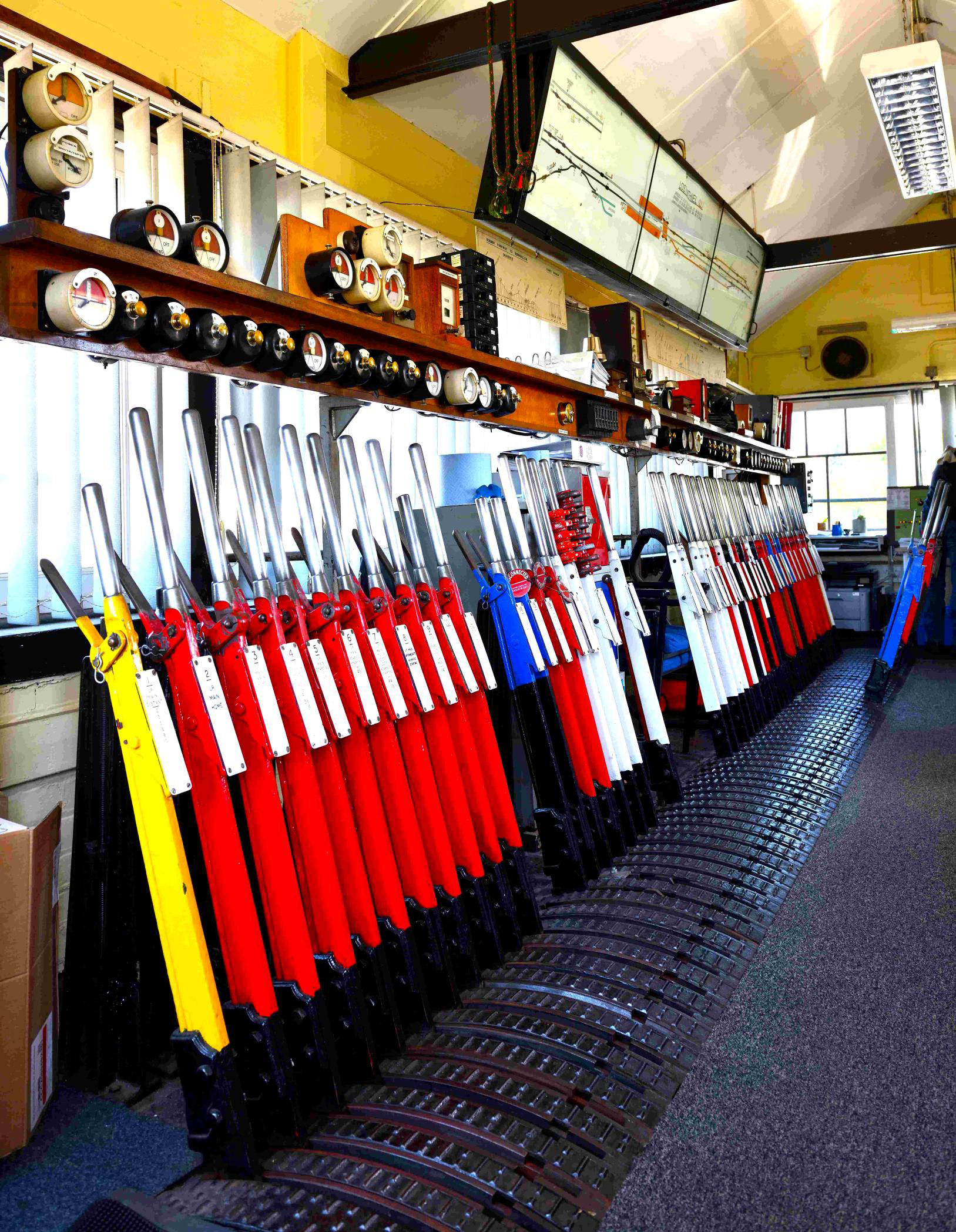
The lever frame
[© Mark Sutton 2023]None of the semaphores on the frame is motorised. Where there are bracket signals, it was noted that only the main signal number is plated on the bracket itself. For example, the lower quadrant bracket with LL54, the Down Main starting to Branch signal for the Carne Point (Fowey) branch, and LL57, the Down Main starting signal, is plated only LL57.
Regular use is made of both the Up and the Down Goods Loops; China Clay traffic from Goonbarrow or Treviscoe (on the Parkandillack branch) to Fowey Dock at Carne Point accessing the Up Goods Loop to run round. Trains from Fowey generally use the Down Goods Loop, although LL36 disc ground signal and 41 Crossover allow use of the Up Goods Loop as well. At the time of the visit, China Clay was still conveyed in the classic CDA wagons, the use of which finished on 11 Aug 2023. Trap points 44B on the western end of the Up Goods Loop are of the relatively rare one-rail design (rather than both). At the loop end further from the box, 50 A/B and 51 A/B pairs of points and traps are motorised, as is 14 A/B, the points and trap for the Carne Point branch on the other side of the station, with the lever handles cut down to indicate this. These motorised points have integrated locking in the drive mechanism but Lever 45 is the facing point lock (FPL) for mechanical points and trap 44 A/B Up Main Facing to Up Goods Loop. As they are the exit from the Down Goods Loop, Points 38A/B have no FPL and 41 is a trailing crossover, so does not require an FPL either. A loco making a run round in the Up Goods Loop has to make relatively complicated moves; as the Cattle Pen Sidings have been removed, it is necessary to use the Down platform to change ends and reverse. Having exited the Up Goods Loop on LL49, the signaller utilises LL56 disc ground signal to route the loco 'down' the Up Main but there is no signalled route further back along the Up Main from LL46 disc ground signal, so the loco must utilise 41 A/B crossover to access the Down Main into the Down Platform reversing behind LL36 disc ground signal.
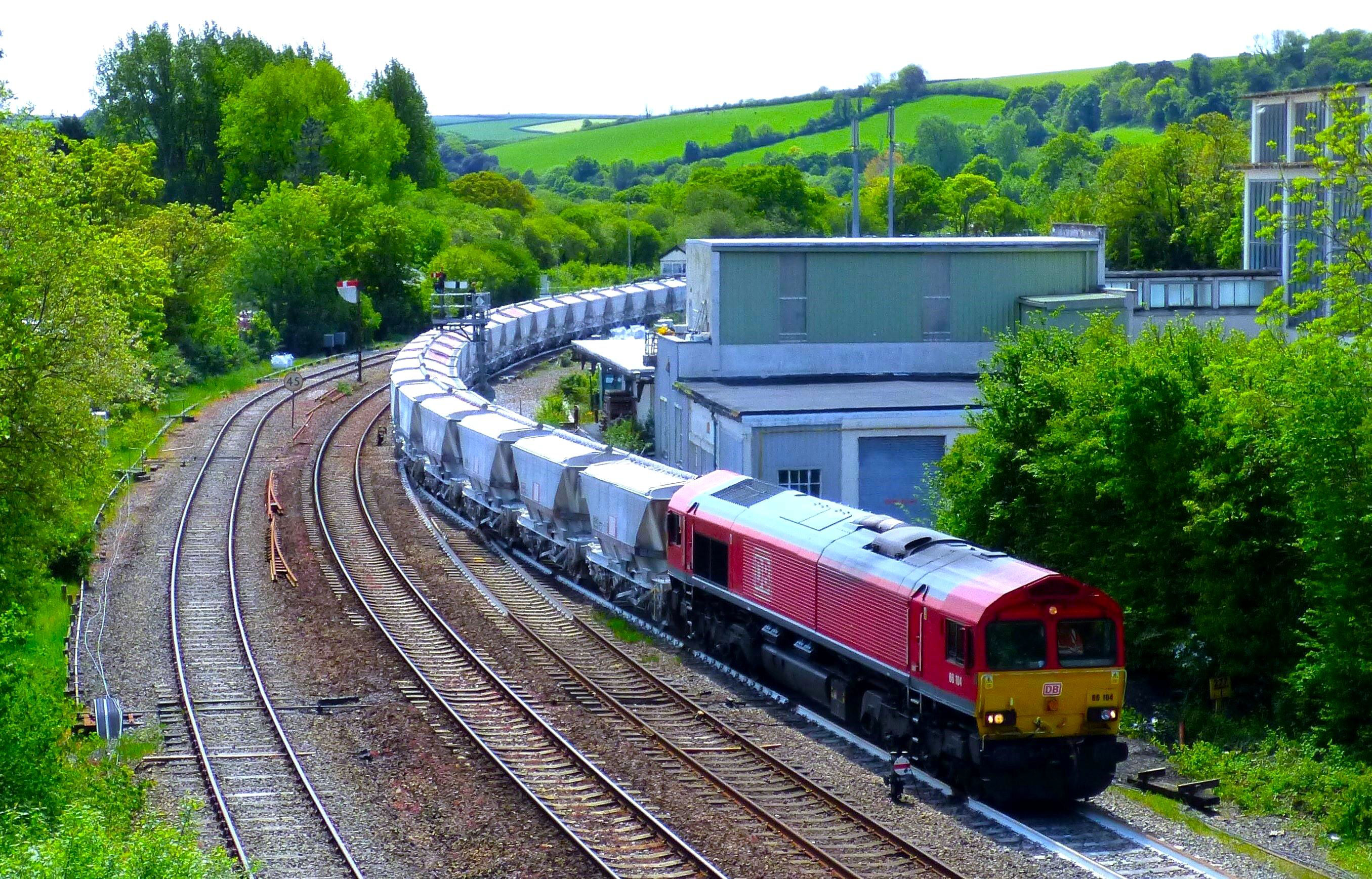
66104 on 6G09 Goonbarrow to Fowey Dock Carne Point loaded china clay train enters the Up Goods Loop to run round. Lostwithiel signal box can just be seen next to the rear of the train.
[© Barney Clark 2023]This run round movement is therefore relatively infrastructure intensive, using both the Up and Down Mains and requiring the level crossing to be closed several times. A run round in the Down Goods Loop for a freight train from Fowey, on the other hand, needs only utilise the Down lines, therefore it is the preferred loop for arrivals from Fowey. Resignalling will resolve the issue by creating a signalled wrong direction move along the Up Main through the station towards a new Penzance end Limit of Shunt.
For freight trains running to Fowey Dock on the single line Carne Point branch, the loco must stop first outside the signal box on Down P2 to pick up the train staff from the signaller. On the day of the visit, this aluminium staff was spotted between two fire extinguishers adjacent to the signal box door. It is engraved with the inscription 'LOSTWITHIES (sic) - CARNE POINT', although the last word was heavily worn off and illegible. This is testament to the large number of times the staff has been handled over the years as it is passed back and forth between the signaller and driver, with each end of the staff taking an equal amount of handling whether the staff is offered handle first or not. After about 40 min, the train arrives at Fowey Dock and the Carne Point shunter telephones Lostwithiel box to report to the signaller that the train has arrived and is clear of the staff section. To return to Lostwithiel, the driver - in possession of the train staff - contacts Lostwithiel box to ask the signaller's permission to pass Carne Point Up Stop board. Returning along the branch, trains see a fixed distant and then occupy berth track circuit 'DDT' for LL4 (fitted with Train Protection Warning System) Up Branch home to Up Main semaphore signal and its associated LL9 shunt signal disc Up Branch home to Down Main. Routed into the Down Goods Loop the train will see only the LL9 disc clear and will then run up the Down Main into the Down platform, stopping outside the box to return the staff to the signaller.
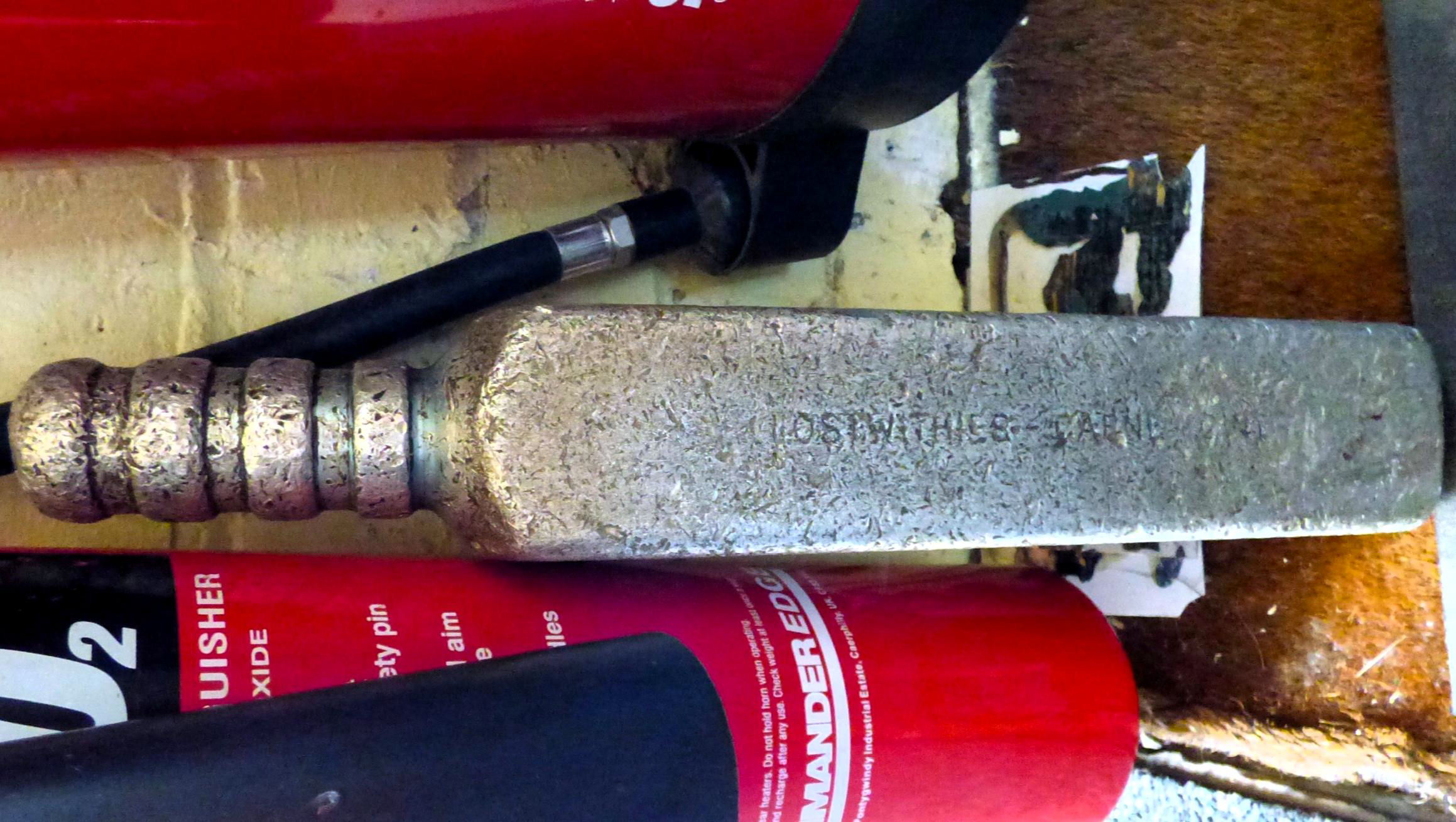
The train staff for the Carne Point (Fowey) branch in the signal box.
[© Barney Clark 2023]Eastbound, control of the Cornish mainline passes to an NX panel at the far end of the box from the entrance and parallel to the side wall. The original Westinghouse N-X panel was installed in 1991 when Largin signal box was abolished, controlling the Largin area via a solid state interlocking (SSI) situated in Par Signal & Telegraph depot. A new Henry Williams supplied N-X panel, part of the Cornwall Capacity Enhancement Scheme, replaced it in Apr 2018. The old Westinghouse panel is on permanent display at the Bodmin Railway (as it is now known). Its replacement panel controls Bodmin Parkway Ground Frame; control switch 1532 giving the release to access Bodmin Railway via a headshunt from the national network Up Main. However, a handwritten notice on the panel dated 28 Jul 2022 states: 'Temporary stop block placed at the NR boundary & 2A&B points clipped, scotched & spiked UFN'.
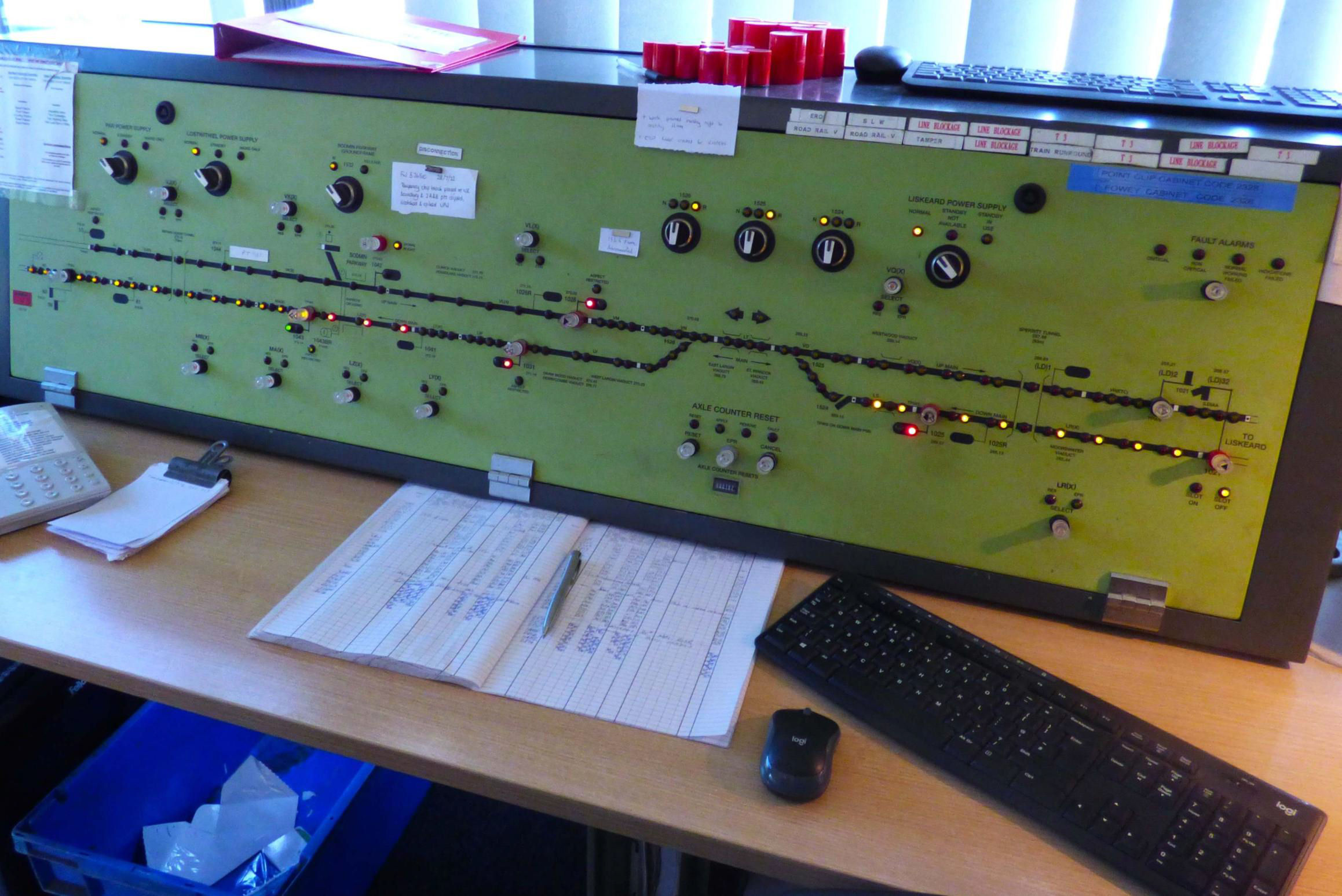
The Henry Williams supplied 2018 N-X (Entrance/Exit) Panel; note the single track section on East Largin and St Pinnock Viaducts.
[© Barney Clark 2023]As well as the Bodmin Parkway area of the mainline, the panel covers over East Largin and St Pinnock Viaducts, singled in 1964 to reduce the load on the structures, then (back to double track) over Westwood Viaduct and through Sperritt Tunnel to the interface with Liskeard box. Slot 1021 on the Down Main can be given to release Liskeard Down section signal LD32 and give a route to signal LL1025 on the panel. A full Down Main route on the panel is from signal LL1025 to Down Home LL60.
An annunciator sounds when a Down train reaches LL1043 at Bodmin Parkway on the panel, informing the signaller to lower Lostwithiel barriers. There is also an audible annunciator (as opposed to warning lights), known as the 'dying pig' because of its distinctive sound of a capacitor discharging, which activates when an Up train approaches signal LL1042 at Bodmin Parkway. This reminds the signaller to set a route on the panel through the single line section and describe the train to Liskeard. On the block shelf, an annunciator also sounds when a Down train passes Intermediate Block signal LL100 towards Par. There is no annunciator at Lostwithiel for Up trains approaching on the Up Main or the branch, the signaller must look for occupation of berth track circuit 'AAT' on the Up Main or 'DDT' on the branch; although a freight train can often be heard approaching from the box before the track circuit lights up.
Lostwithiel has a pedestal control for its Manually Controlled Barriers over Grenville Road (London end of station); Lever 63 is the barrier locking. This crossing was renewed in 2017 with new tubular steel barriers. When lowed and detected down, an alarm sounds and the signaller checks there are no obstructions, presses the crossing clear button, then replaces Lever 63 to normal for the interlocking.
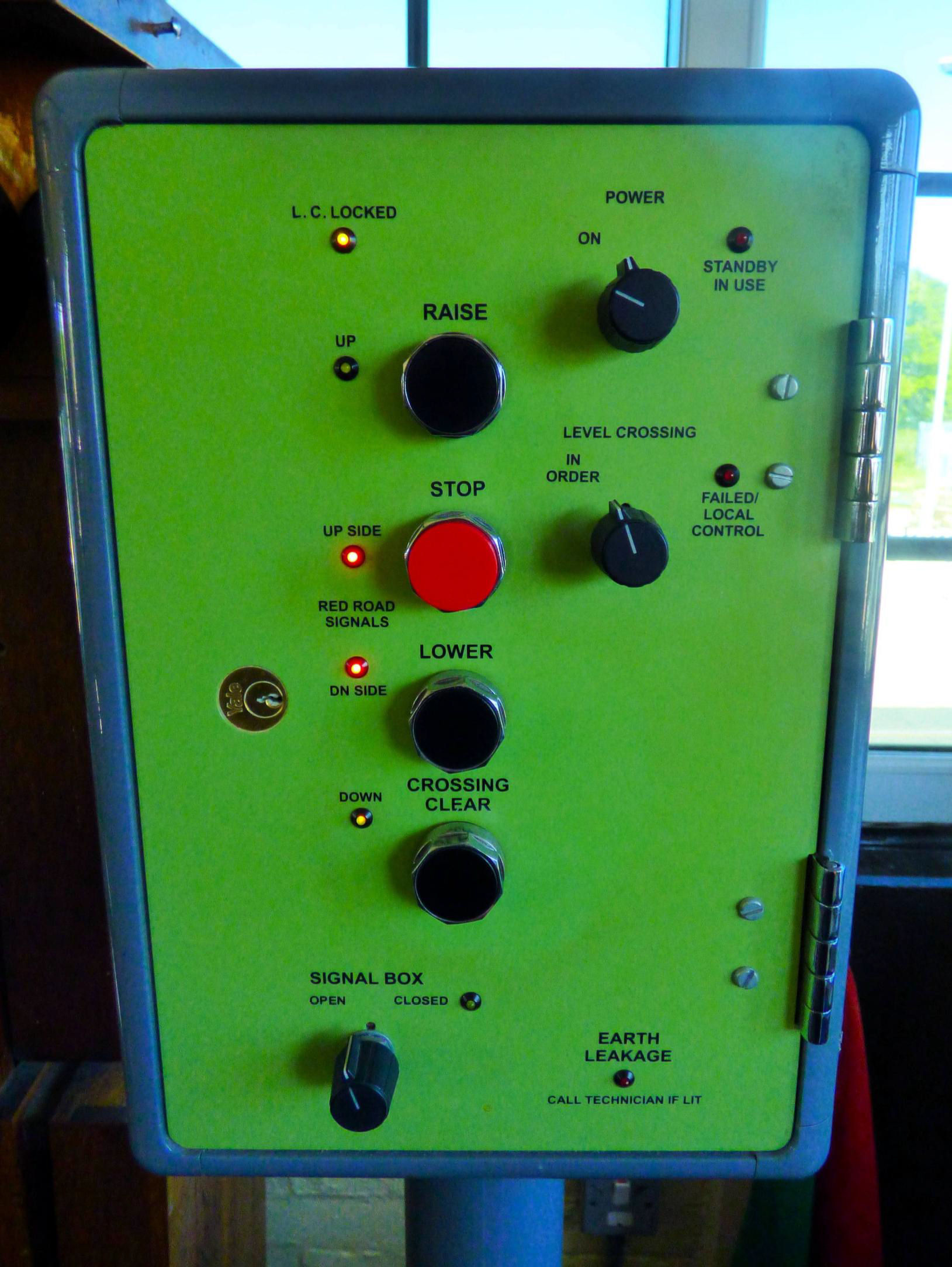
The level crossing control pedestal in Lostwithiel signal box.
[© Barney Clark 2023]Much to the interest of our members, access was kindly granted to view the Locking Room under the operating floor, the electric locks for Levers 14 & 15 (lever disconnected), and 50 & 51, all facing point locks, were conspicuous by being set forward some substantial distance from the locking tray.
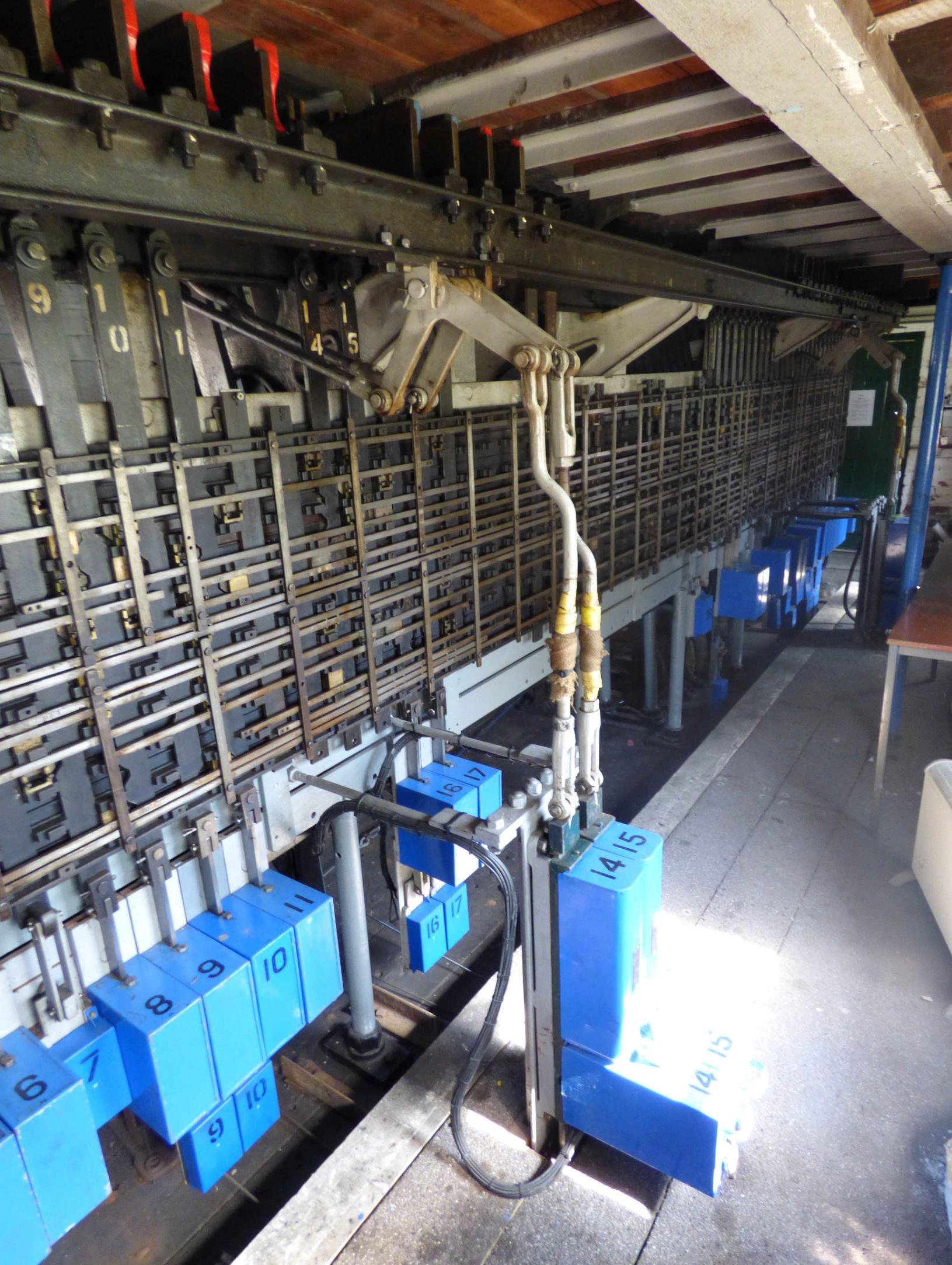
The Locking Room beneath the operating room, an early 'mechanical computer'.
[© Barney Clark 2023] has a FARSAP (Film Archive of Railway Signalling & People) online video covering Lostwithiel box, filmed in Sep 2016 and Jul & Sep 2018. In the westbound Down direction, Lostwithiel works absolute block with Par, the next box to be visited by our group this day.