The day started with 10 members assembling at Wokingham station, where we checked in with our organiser, Barnaby Clark and met our guide David Knott, a relief signalman of many years experience, who regularly works all the signal boxes we were to visit. After a quick briefing on expected behaviour within the signal box environment and ensuring we all had hi-vis jackets for later, we made our way out of the station and over the level crossing. The complicated road layout was noted and the adjacent Grade II listed footbridge, constructed from old rails, (photos e-BLN 1376.X.111 & 1396.X.72).
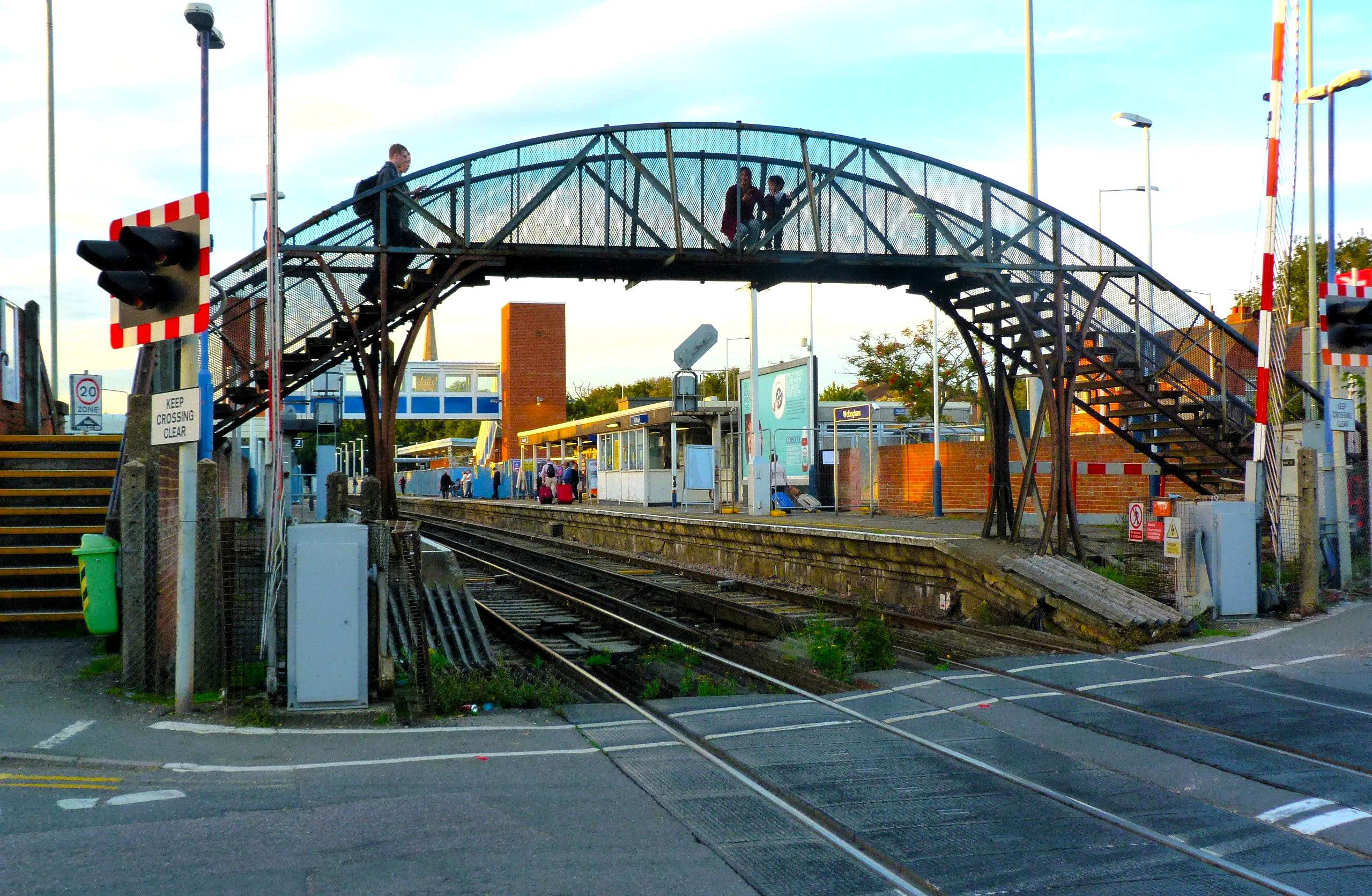
Made of old rails, this Grade II listed footbridge at Wokingham station, London end, is over 130 years old. It was built after two deaths at the level crossing in 1886 and is believed to be the only one of its type left in the UK. Looking towards Reading on 26 Sep 2013.
[© Angus McDougall 2013]The signal box, which dates from 1933, retains a 38-lever frame but its many white levers reflect the simplification of track and signalling over time since original installation, also in 1933. The current layout is a two track railway throughout, with Wokingham Jn some 200+ yards to the London side of the box, where the lines from Ascot (electrified) and Guildford (non-electrified) converge. A trailing crossover enables trains to turn back at the station from these routes. An electrified 12-car EMU siding at the junction lies alongside the Down Guildford Line but sees little use. It was completely refurbished and the third rail extended with commissioning in Apr 2021 to stable stock at times of disruption.
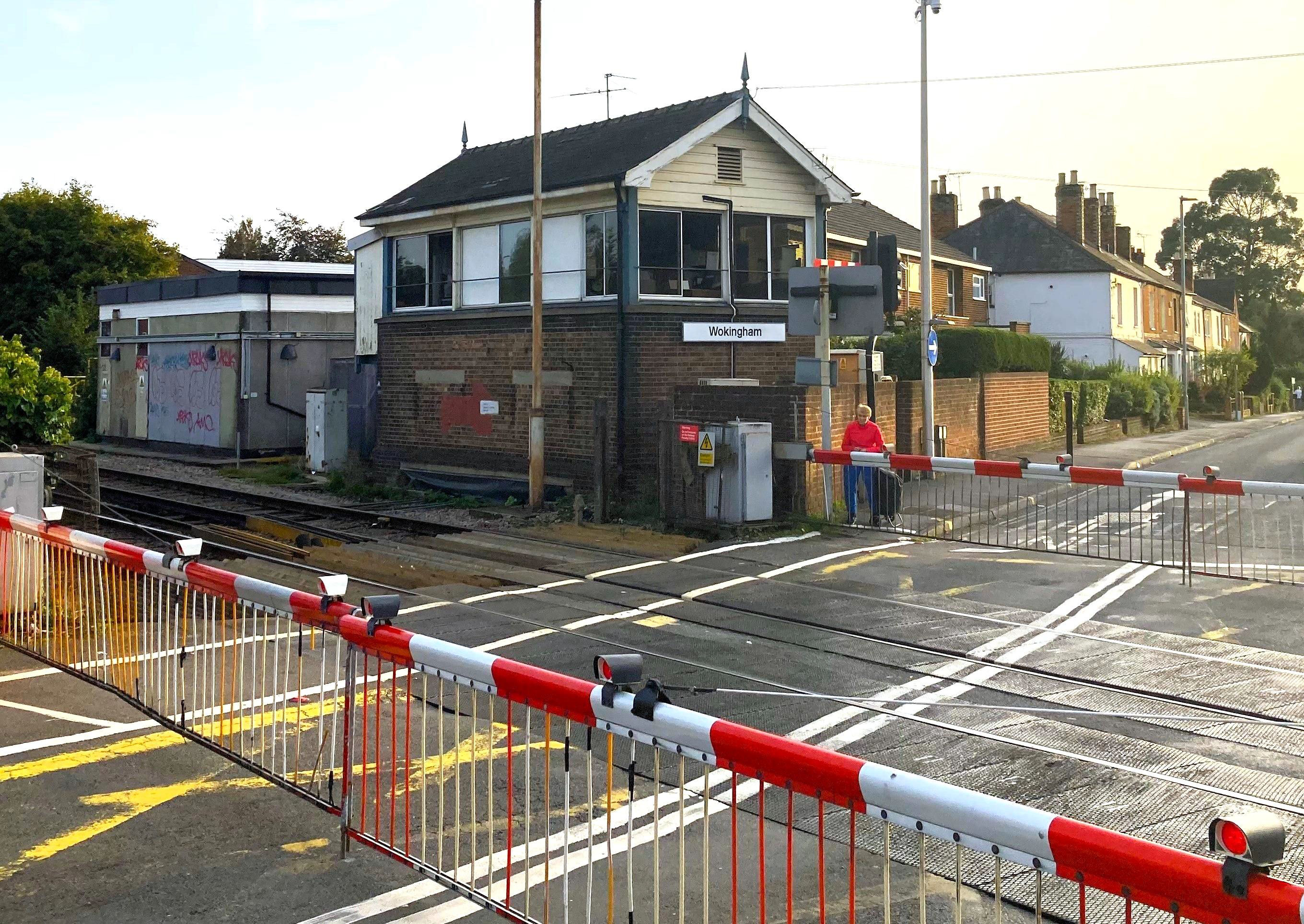
Wokingham signal box.
[© Barney Clark 2023]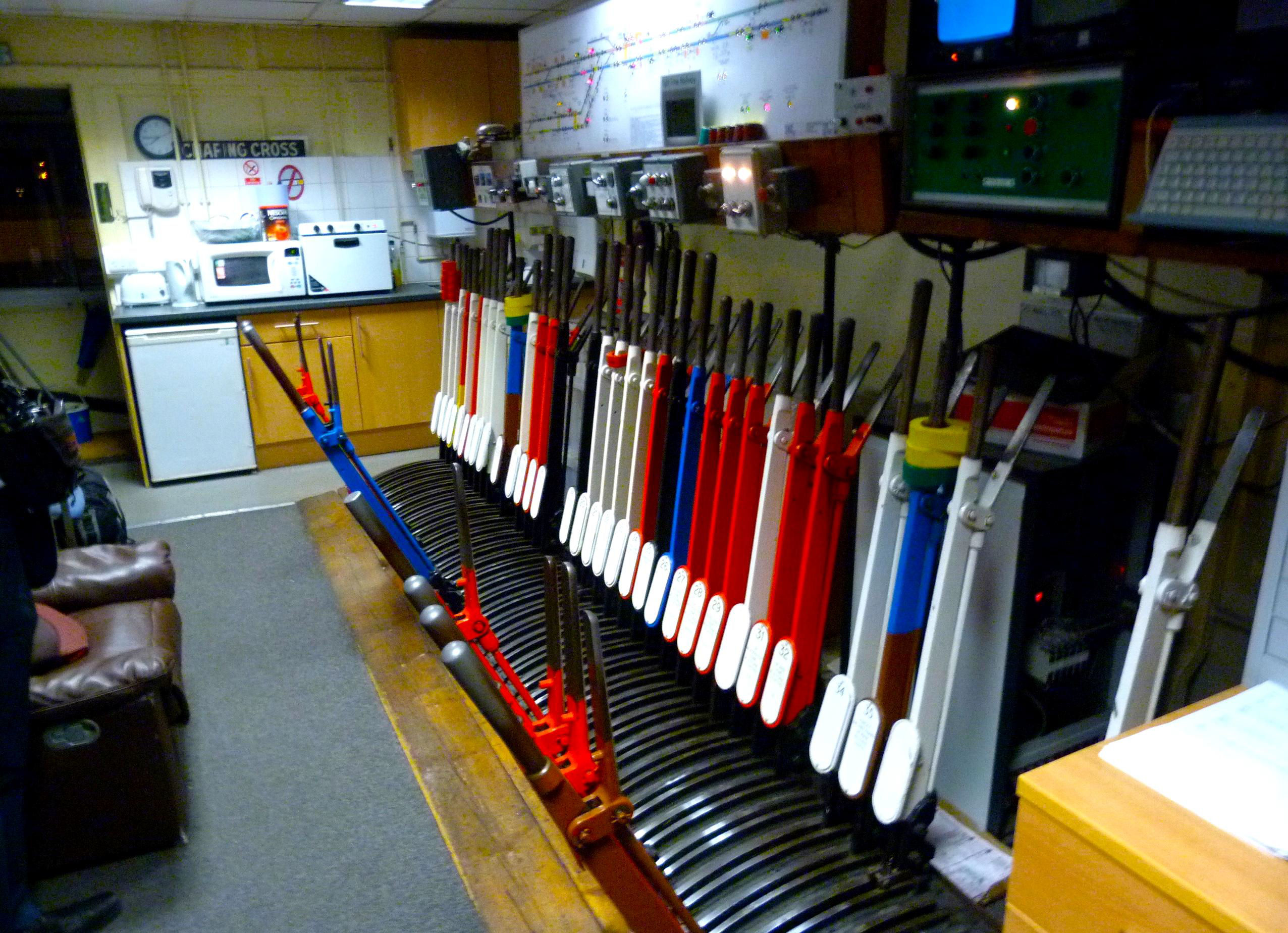
Inside Wokingham signal box on 26 Sep 2013.
[© Angus McDougall 2013]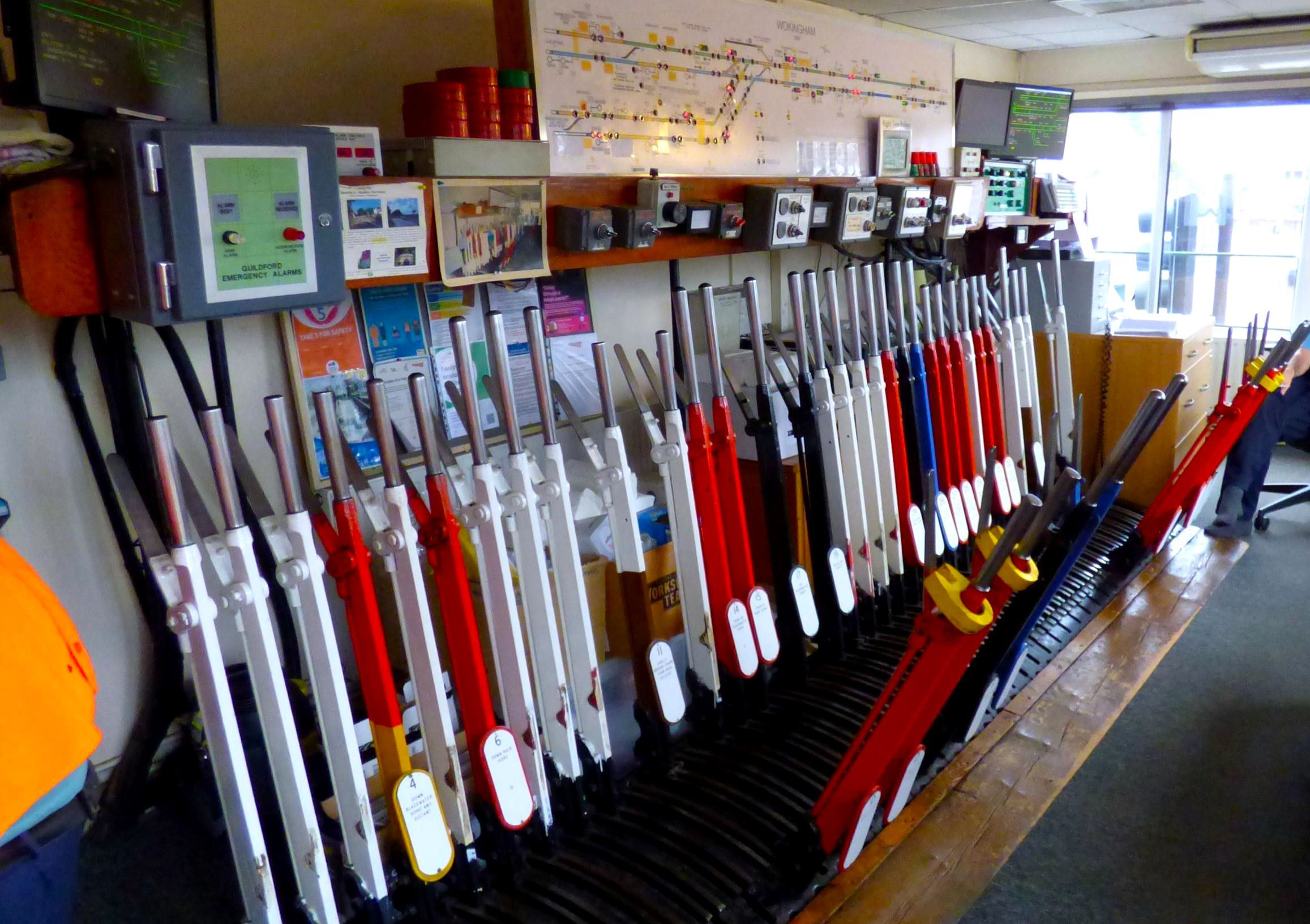
Inside Wokingham signal box which was still in use but has since been decommissioned.
[© Barney Clark 2023]Working by Track Circuit Block is to Basingstoke ROC (Ascot Workstation) towards Bracknell, to Guildford ASC (Area Signalling Centre) beyond Blackwater and to Thames Valley Signalling Centre (Twyford Workstation) at Didcot beyond Earley. Some mechanical working is still in existence here with, other than at Yeovil Pen Mill, the last mechanical disc ground signals on the Wessex route. The ground discs here are illuminated by floodlighting when needed at night, rather than by having lit aspects. The junction points - about 220yd from the box - are also mechanically worked and we were able to observe the rodding and linkage movements opposite the box area. It was explained that, during early afternoons at the height of summer, the expansion of the rodding was such that difficulty was often experienced with the movement of the points and locking until the temperature dropped.
Level crossings controlled are at Star Lane (CCTV) on the Bracknell Line and between Wokingham station and the box. Due to the density of traffic at Wokingham and consequent potential difficulty in operating the lifting barriers, the crossing controls include a facility to set the road traffic lights, for movements that would pass over the crossing, to red for 15 seconds before the normal lowering sequence is initiated. During our visit, we observed a line blockage for staff attending a track circuit failure being given up and the subsequent cautioning of the first train through the section after rectification. Before departure from Wokingham, we were allowed to see the interlocking underneath the box. Although, since our visit, its functions have been over by Basingstoke ROC (from 9 Feb 2024), it is anticipated that the box will be used as a base for the local Permanent Way staff so will survive.
Then it was off to
Guildford where the box, on the Down side, is hidden along a narrow road between buildings on the station approach, just north of Chalk Tunnel south of the station. We were given a brief talk about the area. The main running lines are all that remain of a busy area with a multistorey car park on the far (west) side occupying the former roundhouse site, long shed and turntable of the motive power depot. On the east side, where we assembled, had been sidings and the former south signal box. The only remaining artefact here to relate to is a tall concrete post, now covered in ivy.
The current signal box is an unimpressive block built structure opened as a 'temporary' building, now 25 years ago in 1998. It replaced the previous box diagonally opposite at the other end of the station and took over the Ash and Shalford signal box areas. At present there is no known date for transfer to Basingstoke ROC (Rail Operating Centre). Once inside the box, we were able to look at various signs on display owned by a signalman, who had also made some large working model signals. Some pictures of the Guildford railway area and rescued items from other boxes, notably Shalford, were also admired.
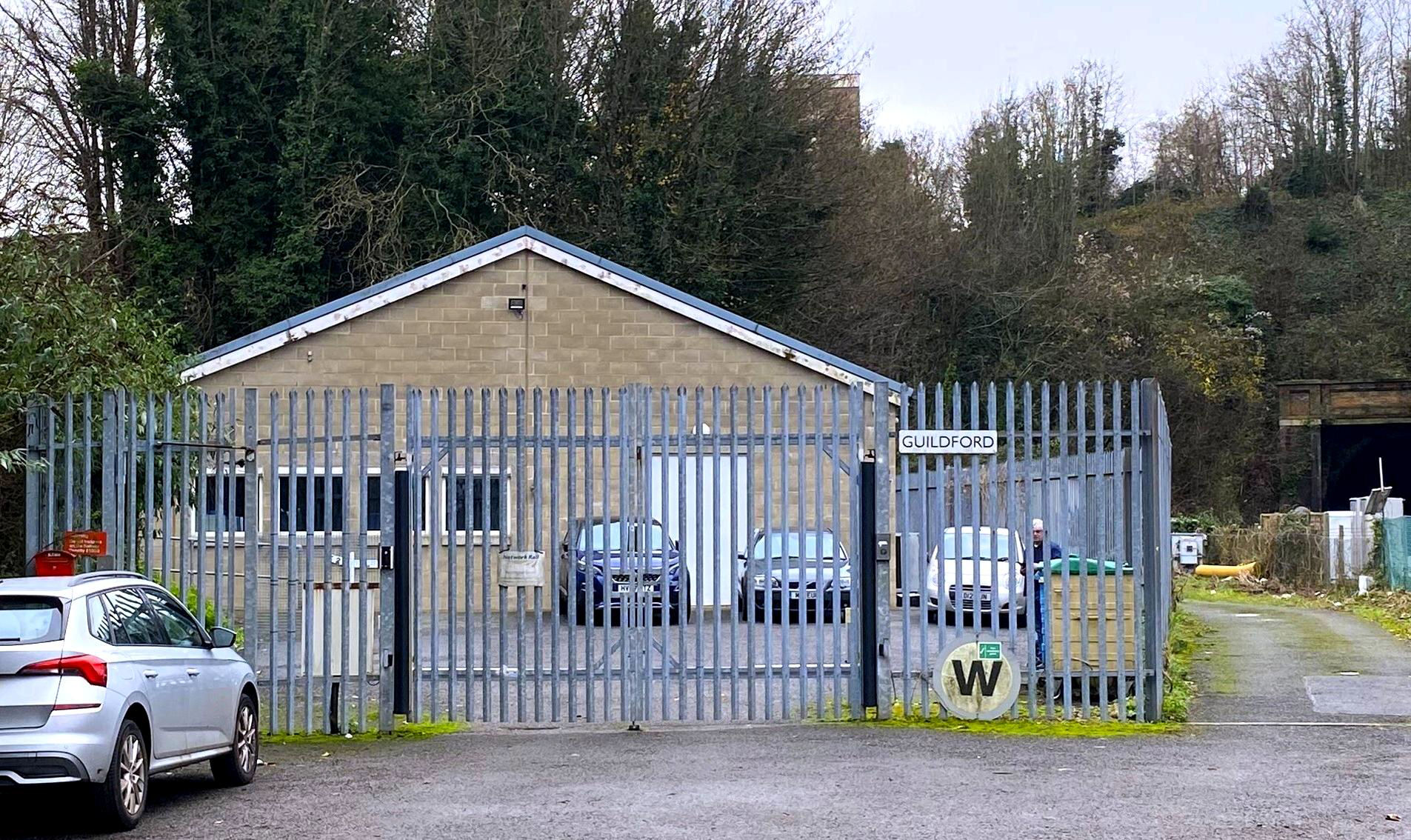
Guildford Area Signalling Centre is on the Down Side of the station at the south end with the Chalk Tunnel north portal far right.
[© Barney Clark 2023]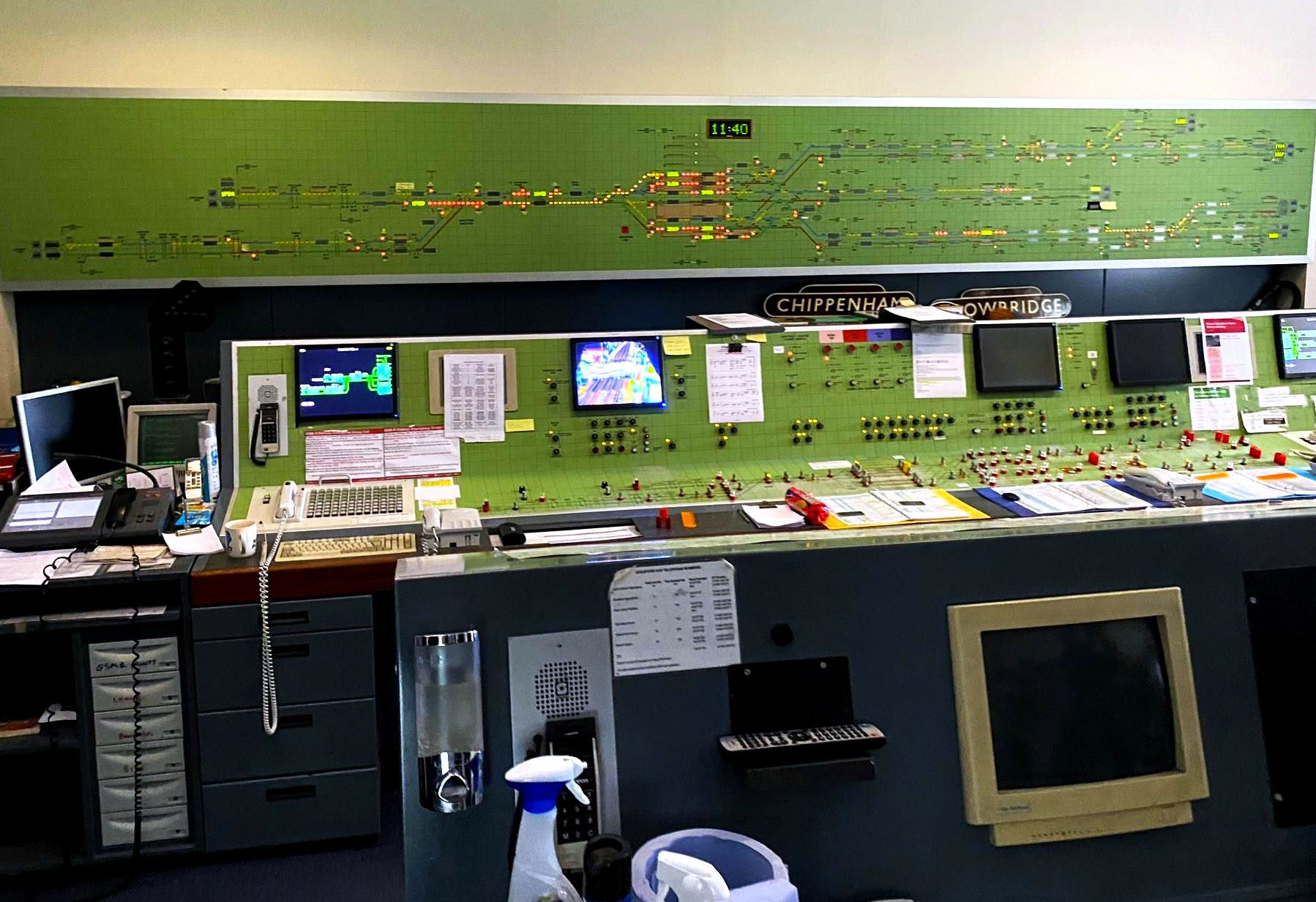
Inside Guildford Area Signalling Centre.
[© Barney Clark 2023]Signalling is by an NX (Entrance Exit) panel. The controls are on a central desk with two signallers; a large track display takes up most of the wall. Guildford station area is towards the centre of the display with the various routes branching off: ●Top left, the Ash Lines splitting at Aldershot South Jn towards Aldershot (link to Woking ASC Panel 3) and towards Blackwater (Wokingham). ●Right, to Worplesdon (Woking ASC Panel 2). ●Bottom right, to Effingham Junction where the lines split towards Cobham (Woking ASC Panel 1) and Bookham (Wimbledon ASC Panel 4). ●Bottom left, the North Downs Line to Gomshall (Reigate) and finally, to the left, to the former Peasmarsh Junction area (Farncombe).
The main station area comprises three pairs of lines (Cobham P2/3, Main P4/5 and Ash P6/8); P3, 5 & 8 are bidirectionally signalled, giving flexibility of operation at times of disruption. There is also a London end Down side bay P1, available only for trains using the Cobham Lines from/to Effingham Junction.
(TRACKmaps 5 p26 2019) There are three berthing sidings on the west side next to the Ash Lines and another two (still called North Box Sidings) between the Cobham and Main Lines, with a servicing platform between them. It was explained that, at night time, a considerable amount of rolling stock is berthed (also in the station platforms) and how critical it was to put everything in the correct platform for start of service otherwise platform changes could then be needed for several hours. P3 & 8 are normally left clear overnight, as this allows trains to run through the station to/from any route. A quirk of the layout was also explained that a train from the Worplesdon route could be routed via P3 but it has to cross over to the Up Line at both ends of the station in the Down direction (see TRACKmaps!).
Level crossings are at Farnborough North (private User Worked Crossing and public Footpath Crossing, with a crossing attendant at certain times because of regular misuse, particularly by students), North Camp (CCTV - Closed Circuit TV remotely monitored), Ash (CCTV), Tangley [near Shalford] (AHB - Automatic Half Barrier), Chilworth (CCTV) plus [near Gomshall] Brook (AHB) and Burrows Lane (AHB).
The railway climbs steeply heading towards Gomshall (Redhill Line), a source of problems especially each autumn, requiring certain trains to be held at Shalford until a clear run can be given through the section. Steam specials regularly used to take water at Shalford, then had to start from a stand to climb the bank, so the water stops for these are now made at Chertsey. However, invariably, the timings of these trains mean they are held at Shalford anyway being close behind the preceding train!
Unconnected with signalling, mention was also made of the famous topiary of Jessie's Seat (sometimes referred to as the Chilworth Chicken), see
https://bit.ly/42qwiZY next to the railway near Chilworth. It is a long standing memorial to a guard killed in an accident back on 29 Feb 1892.
Our group then travelled on to
Farncombe box, the first of the afternoon visits to the Portsmouth Line boxes due to be replaced in Nov 2024. Farncombe (originally West) signal box is by the West Level Crossing. Northeast is Farncombe station with the East Level Crossing (CCTV) at its London end.
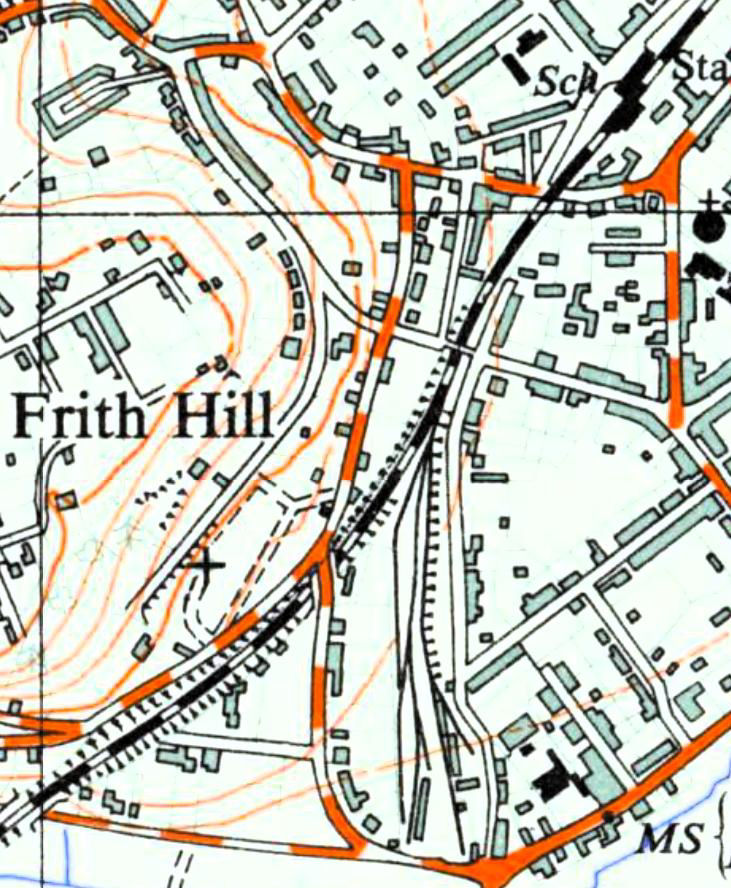
1:25,000 map (1961). Farncombe station top right (towards Guildford and London); Godalming/Portsmouth are off bottom left. Godalming Goods,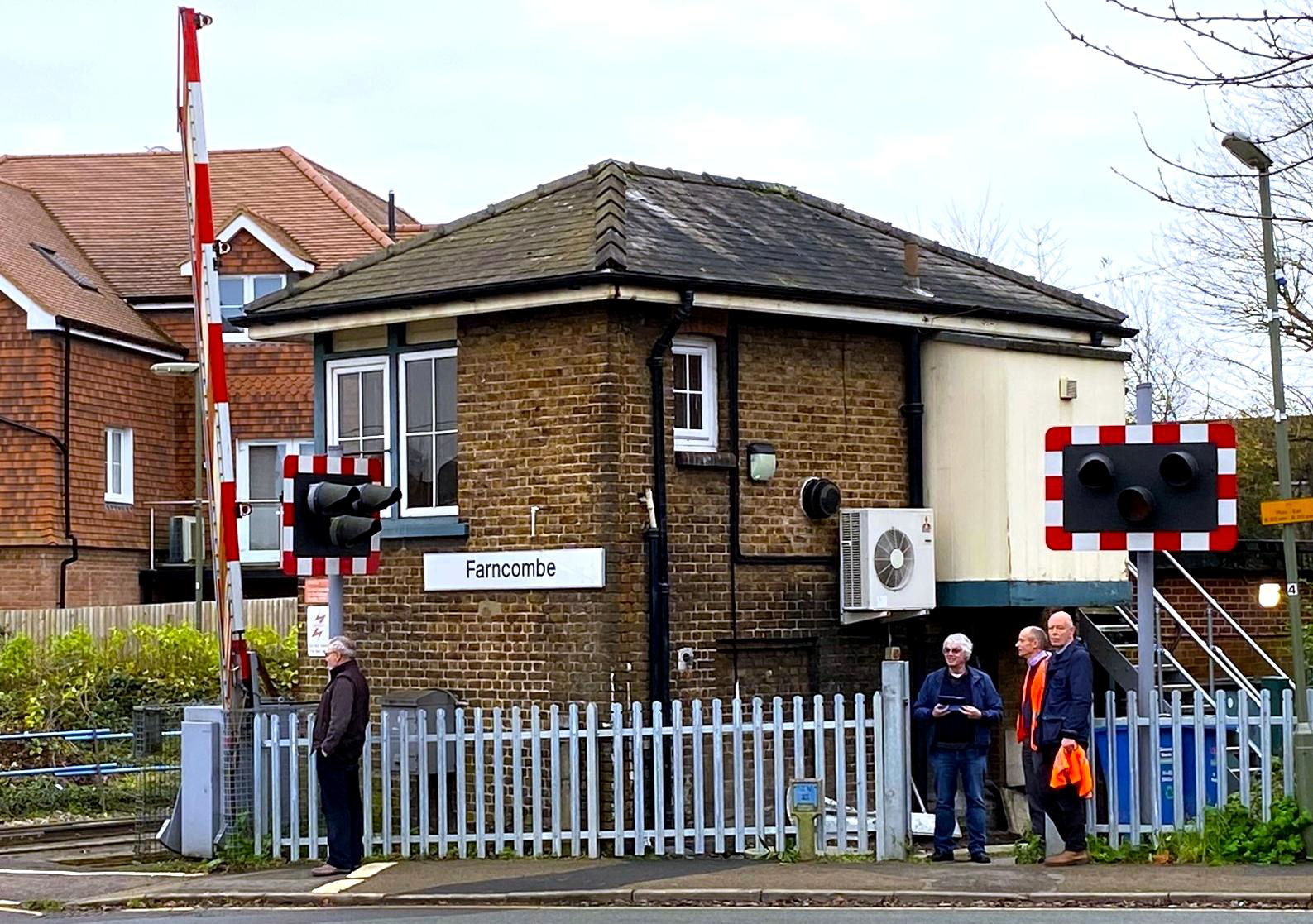
Farncombe signal box.
[© Barney Clark 2023]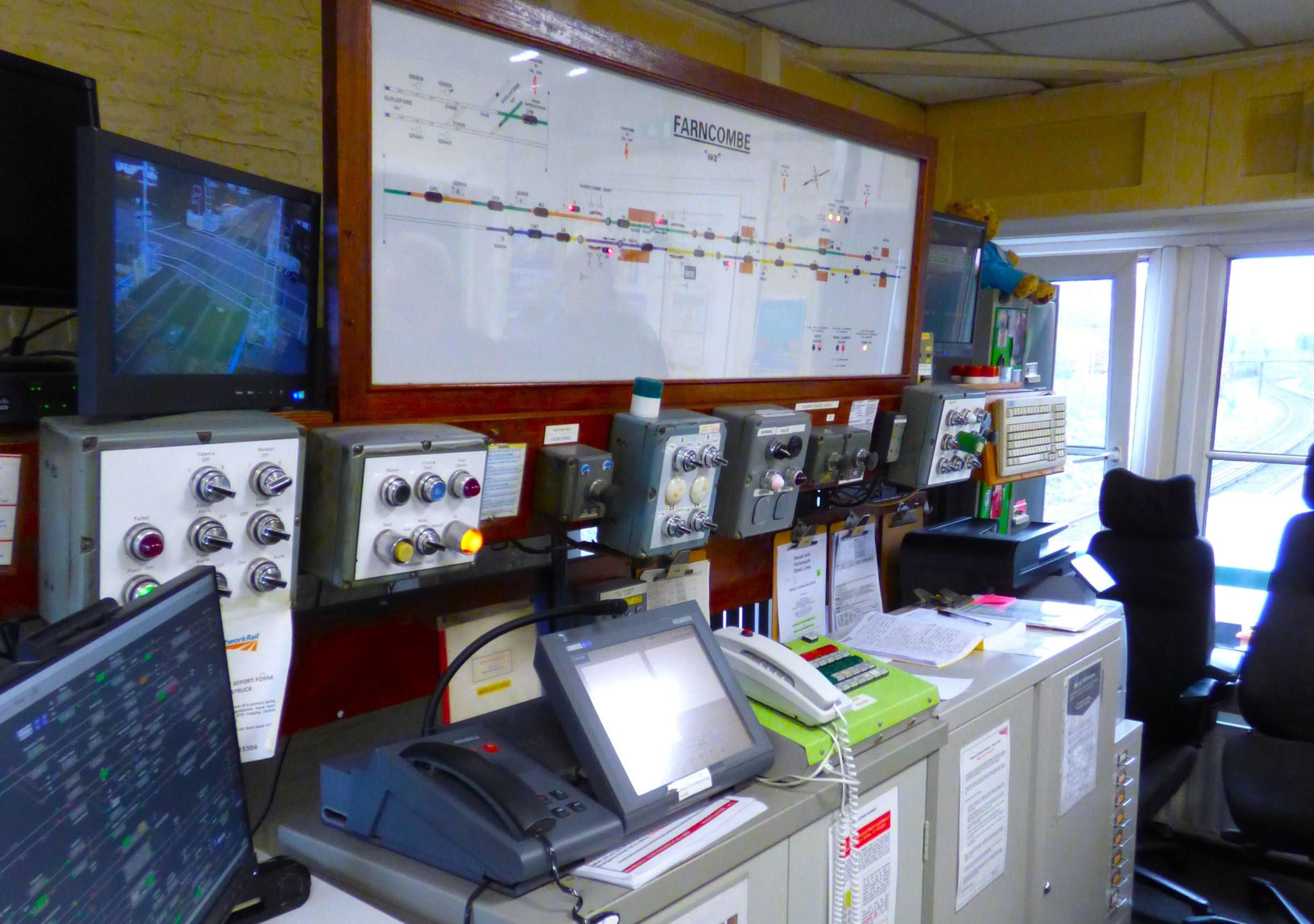
Inside Farncombe signal box.
[© Barney Clark 2023]As this box was smaller than the others visited, we divided into groups. Since 16 Mar 1986 signalling has been controlled by switches mounted on the front of the former block shelf underneath the diagram. The switch banks are known to some as 'cooker panels' (also at Petersfield box), as they are turned like cooker switches. The lever frame was removed many years ago.
The other level crossing in the controlled area is at Milford (AHB), just beyond the end of the platform at Milford.
We were advised of the working for the fast and slow operation selections for Down trains. Normally, a fast train will initiate the sequence some distance before the station; in contrast, for stopping trains, the sequence only initiates as the train is running into the platform to minimise barrier downtime and reduce the temptation for misuse. As it was the end of the autumn leaf fall season, a fast selection was used for all trains to cater for potential slippery rail conditions. Of interest, there are no points in the Farncombe controlled area but it could be considered the busiest of the three boxes visited on the Portsmouth Direct Line with the train service pattern and the crossing operations - something is nearly always happening. Also, clearly visible from the box were the reverse curves towards Godalming, where the original passenger terminal route to Godalming Goods curved off (CP 1 May 1897; CG/CA 6 Jan 1969). Trains could be seen leaning first one way and then the other with the track cant but not quite as much as Pendolinos! While some were in the box, others were able to visit the, now rather empty, locking room beneath, to see the few remains of the signal lever frame. It is stamped with McKenzie and Holland manufacturer details and 'L&SWR 1896'. When decommissioned, the box, dating from 1897, will be demolished unfortunately.
Moving on to
Haslemere, we were lucky to secure the last available spaces in the 358-space car park and one of our party commented that he had only bought his car some 18 hours earlier to be able to participate in the visits! Access to the box, which dates back to 1895, was gained by a gate directly from the car park onto the platform. Once the Grade II listed box is taken out of use, this will become the route to it when it reopens as a museum, after being restored to its London & South Western Railway condition by a local group. Before we entered the box, a group photo was taken and we also looked at the recently installed signal gantries at each end of the station for the new signalling.
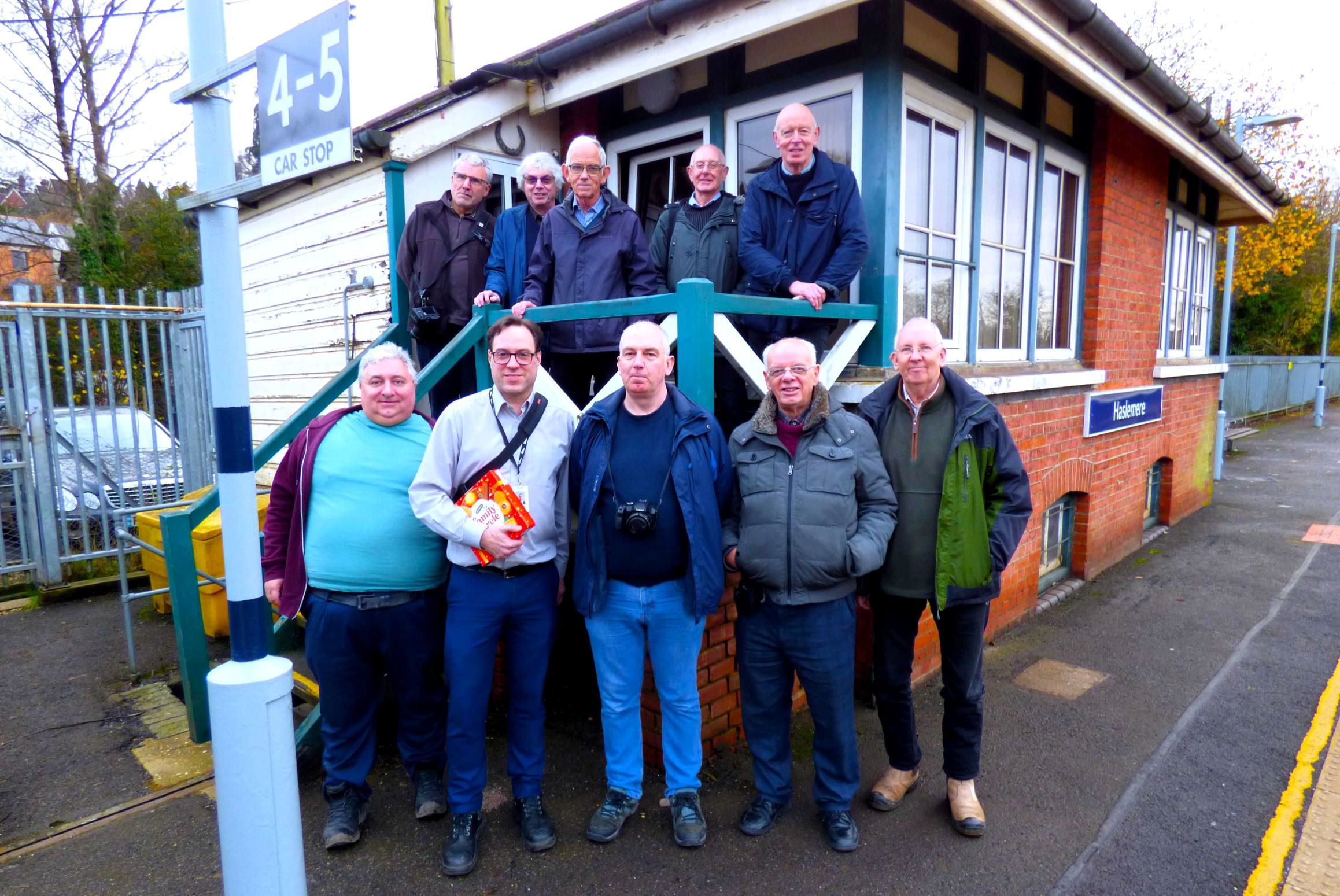
Thinking outside the box - a group photo of our signalling aficionados at Haslemere - no Dummies or Dollies here of course.
[© Barney Clark 2023]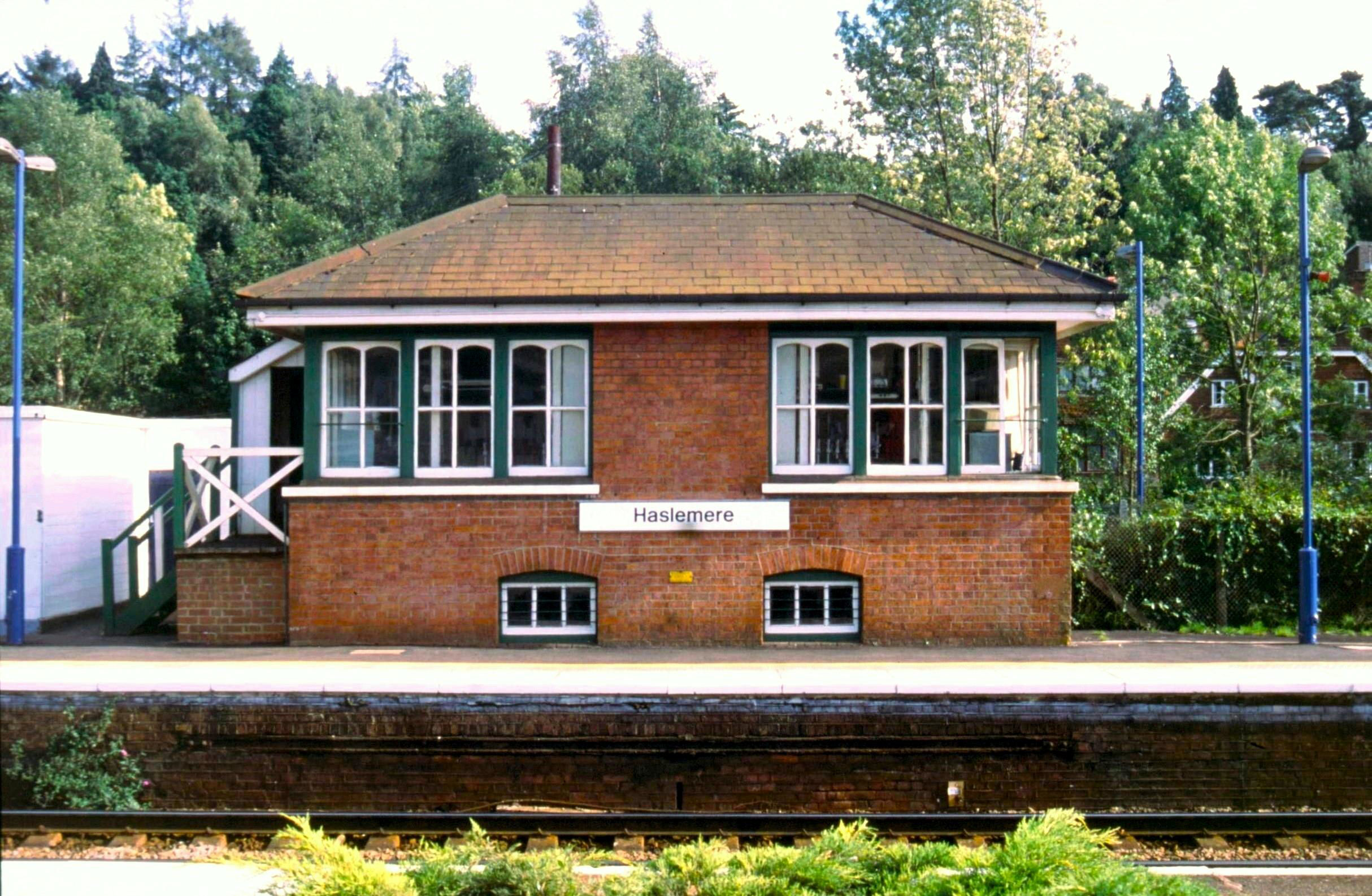
Haslemere signal box, which is on Down P1, on 2 Aug 1998.
[© Angus McDougall 1998]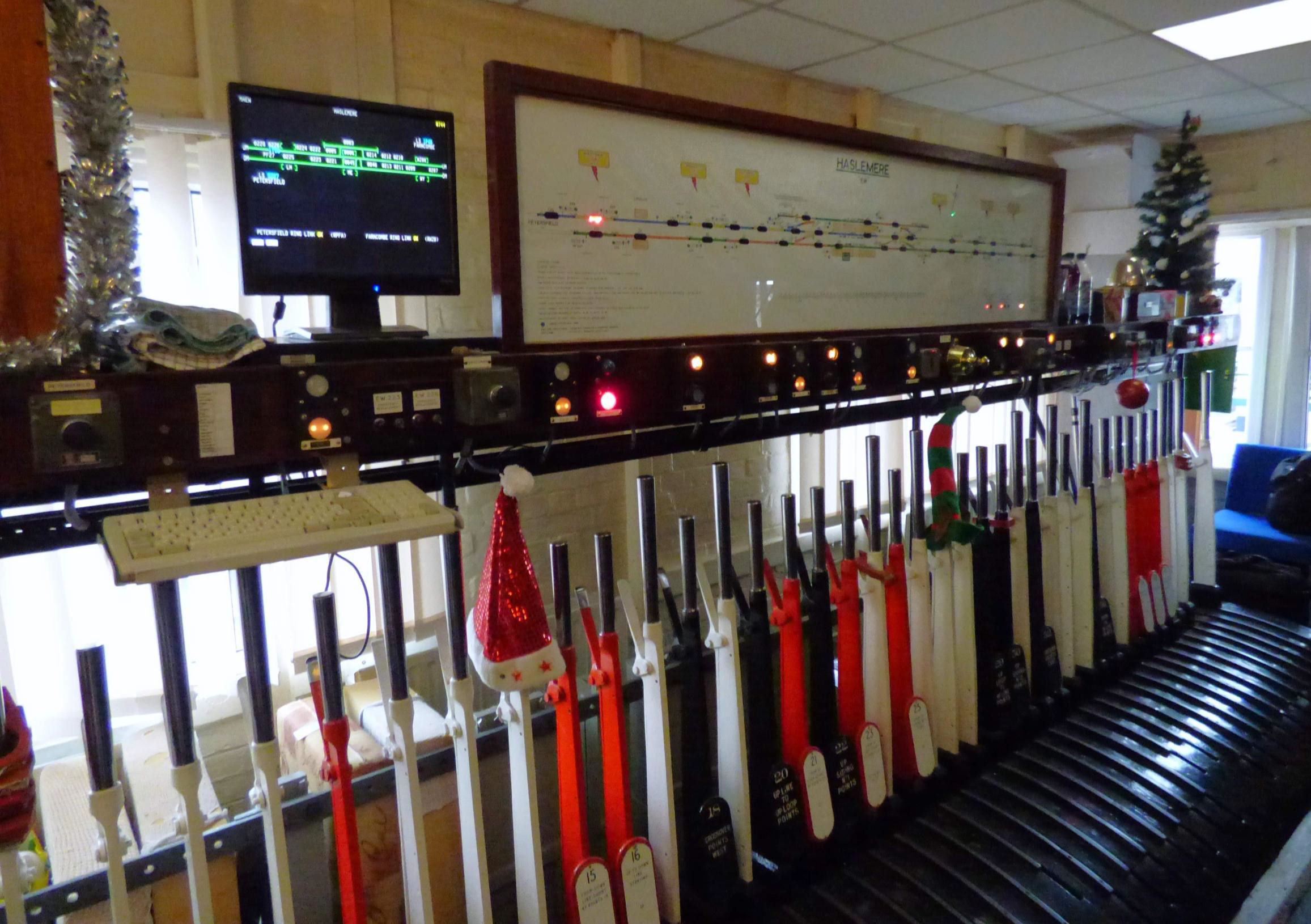
Inside Haslemere signal box.
[© Barney Clark 2023]Once inside we were able to spread out along the entire length of the 47-lever frame to admire all the signalling equipment (and some Christmas decorations!). The layout comprises the Up and Down Main Lines and an Up Loop. The Up Main through P2 is bidirectional, effectively meaning two lines are available in each direction for regulating purposes; the only location for this in the 35 miles between Shalford Jn and Havant. The layout has changed little over the years and, unlike the signal boxes either side, there are no level crossings in the area covered between Witley and Liphook. The slow approach into the Up loop was noted and the fact that the junction indicator for Signal 2 was repeated (as an illuminated arrow) in the box. Once resignalled, a faster approach is expected with flashing yellow aspects installed. A considerable number of trains were observed during our visit, as many diversions occurred of trains that would normally have run via Winchester, due to a trespass incident there. Also, conveniently stopping outside the box was a mixed Class 444/450 combination enabling the minor differences in the corridor connections because of the different coach lengths, to be compared.
Our final visit was to
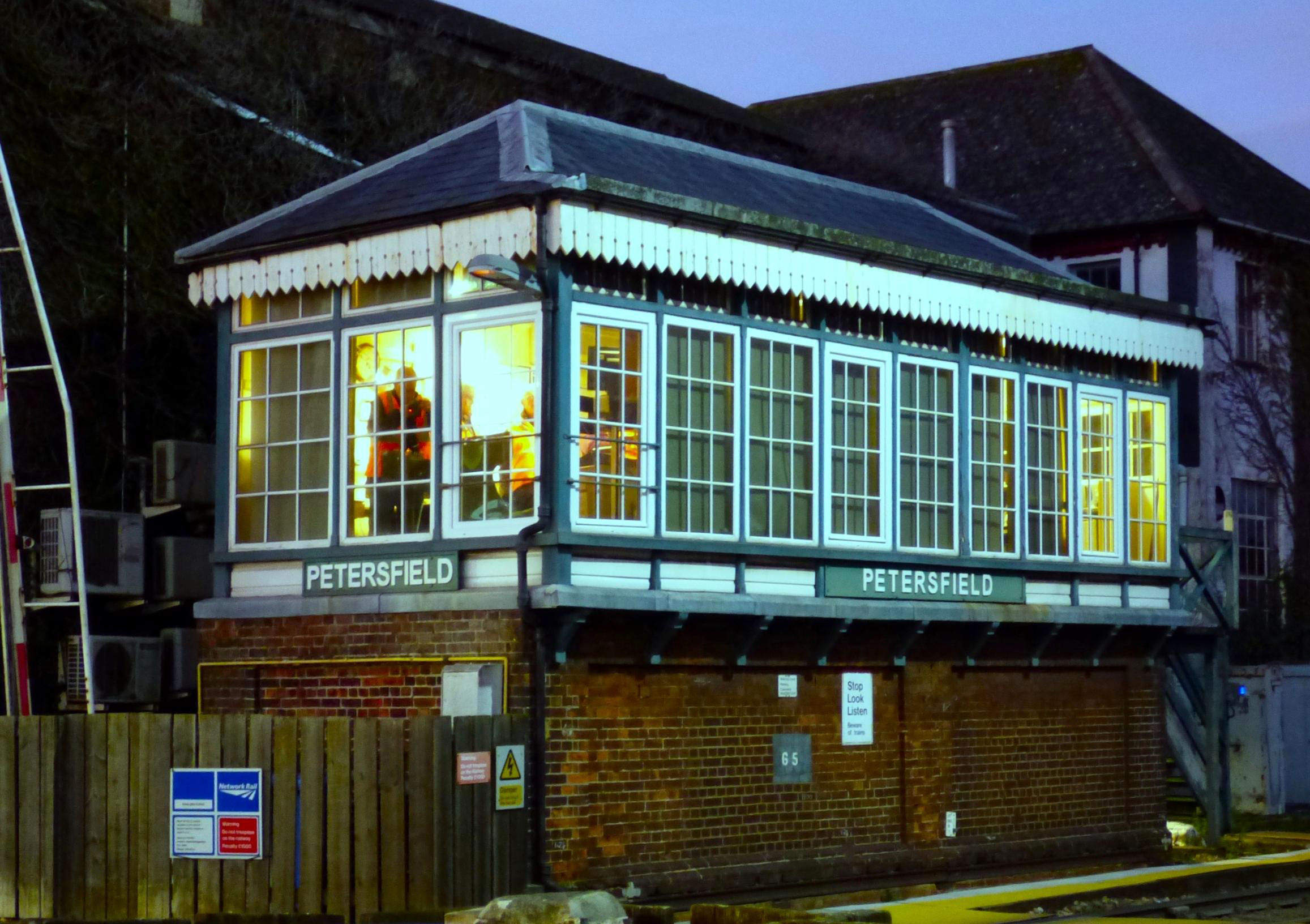
Petersfield signal box, dating from the 1880s, where again it was necessary to split into groups because of the space available in the box. Here the access required us to cross over the railway by a staff foot crossing, under supervision when there were no trains in section, wearing our hi-vis vests. This box retains a small section of its lever frame for the London end trailing crossover and associated ground signals near the box. The remaining length of the operating area is taken up with the switch controls similar to Farncombe. Again, it is a relatively simple two track railway but with many level crossings within the controlled area from Liss to Buriton where control passes over to Havant ASC. There is an MCB (Manually Controlled with Barriers) level crossing at the north end of Petersfield station, a CCTV crossing at Liss, and AHB crossings at Liss Common, Princes Bridge, Sheet and Kings Fernsden, six level crossings in four miles. All the switches etc for the signal and crossing controls are underneath the relevant location indicated on the diagram above, so result in a rather crowded left hand end of the controls. The distinctive signal box is another location that is Grade II listed and, when taken out of signalling use, is expected to become a managerial office.
Petersfield signal box
[© Barney Clark 2023]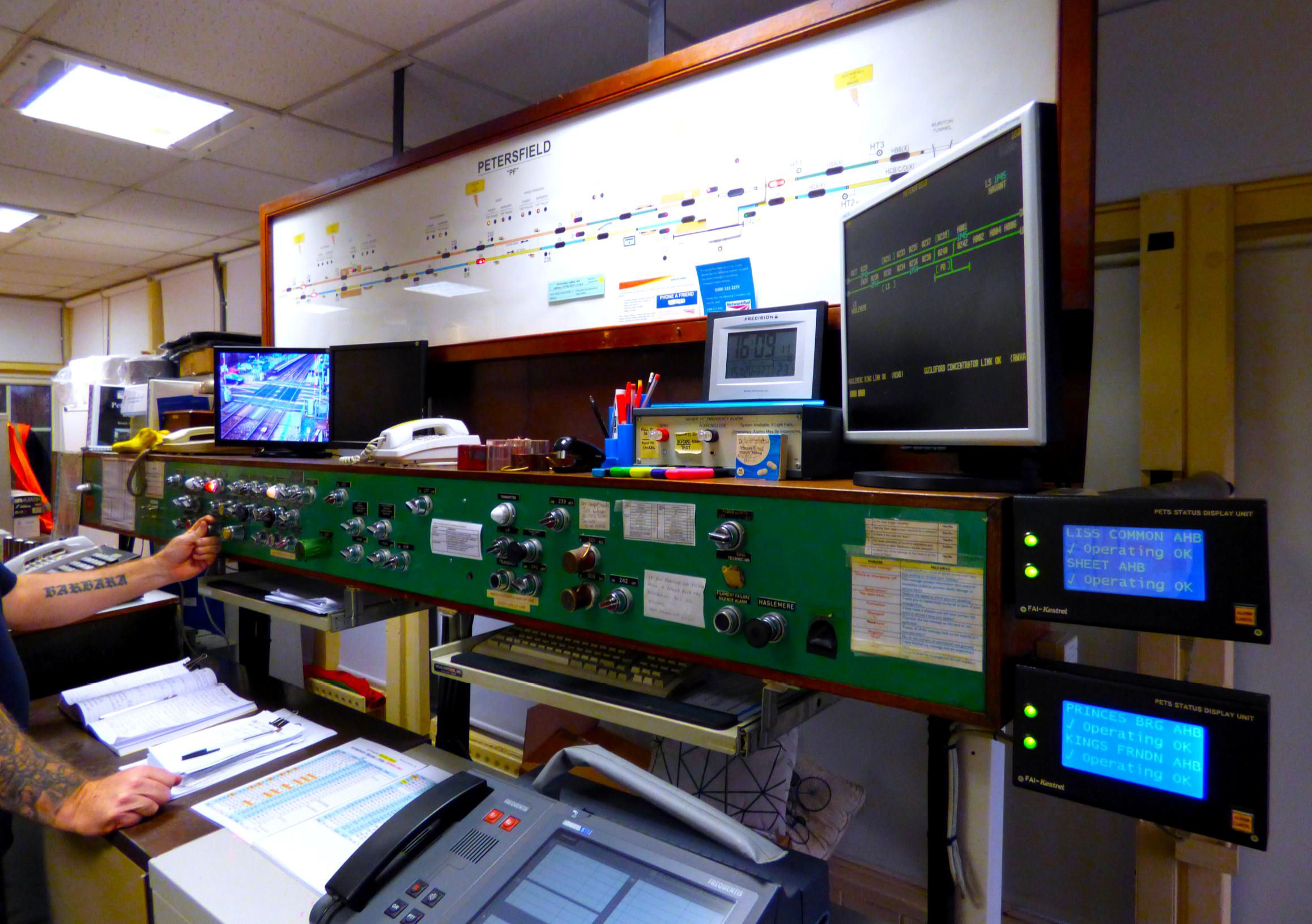
Inside Petersfield signal box.
[© Barney Clark 2023]After everyone had visited Petersfield, we all headed our separate ways. Some additional points from the day were that trains describers were used throughout at all the locations visited, with block bells provided for emergency use only. There were unusual signal box prefix codes for Farncombe (WZ) and Haslemere (EW). Finally, it was further noted that there were short black levers for motorised points at both Haslemere and Petersfield boxes, as opposed to the more commonly seen blue/black marking.
Many thanks to our organiser, member Barnaby Clark, for this enjoyable and interesting day, as well as our excellent guide David Knott, plus all the signallers for allowing us to visit their place of work and answering our questions and queries. A pleasing total of £510 was raised by the participants for Network Rail's nominated charitable cause, the 'Routes Out of Homelessness' campaign.