Day two and, for most participants, the main event. Again, we were on the train ready for an 07.15 departure. A much longer train today, with two sleepers, one for ONCF staff and one for us (a first for a BLS tour?) as we would return overnight, the two passenger coaches we used on day one and a generator van, half of which was to be used as a food preparation area by the Suprateam (who run/ support all sorts of tours in Morocco not just rail) staff accompanying the tour. At least they had electric sockets for the heating appliances. On my last journey to Bouárfa a giant gas cooker looking horribly dangerous was used. We also had two locos, one for the outward journey and one for the return. Again, DH411 was the lead with DH367 the other, from an older class, some dedicated to freight and some uprated for passenger usage. Despite asking for a freight loco we had a passenger one.
In 2013 my train to Bouárfa had been greatly delayed by sand on the tracks, and as a result arrived there in the dark. So, the last thing I wanted today was a late departure, and, of course, that is exactly what happened. Despite the overnight train arriving pretty much on time ONCF insisted on making us wait until the 07.50 to Tanger Ville had departed and passed Béni Oukil. We finally left 54 min late.
I had been asked to make sure no one alighted during pathing stops at Béni Oukil or Guenfouda, to make sure we didn't lose more time. It was another day with thin fog quickly dissipating to give a hot sunny day with some cloud cover at times. Leaving Guenfouda I had to watch that 'lost' branch to Jerada diverging on the right but the mood on the train was good, with the prospect of a great railway journey ahead and the previous day's disappointment set aside.
Oued-el Heimer was passed through without stopping. A former mining town with a smelter, only the vast ruins of the processing plant and a tall chimney remain of this operation with no sign of the former loading staithes. There is one tunnel on the line. The 370 metre long Tiouli Tunnel is north of the town and a compulsory photographic location. The train set down, then reversed back into the tunnel to emerge, horn sounding, for the benefit of photographers. A lone local watched this from near the top of the tunnel, doubtless bewildered by these strange people disturbing his herd of goats.
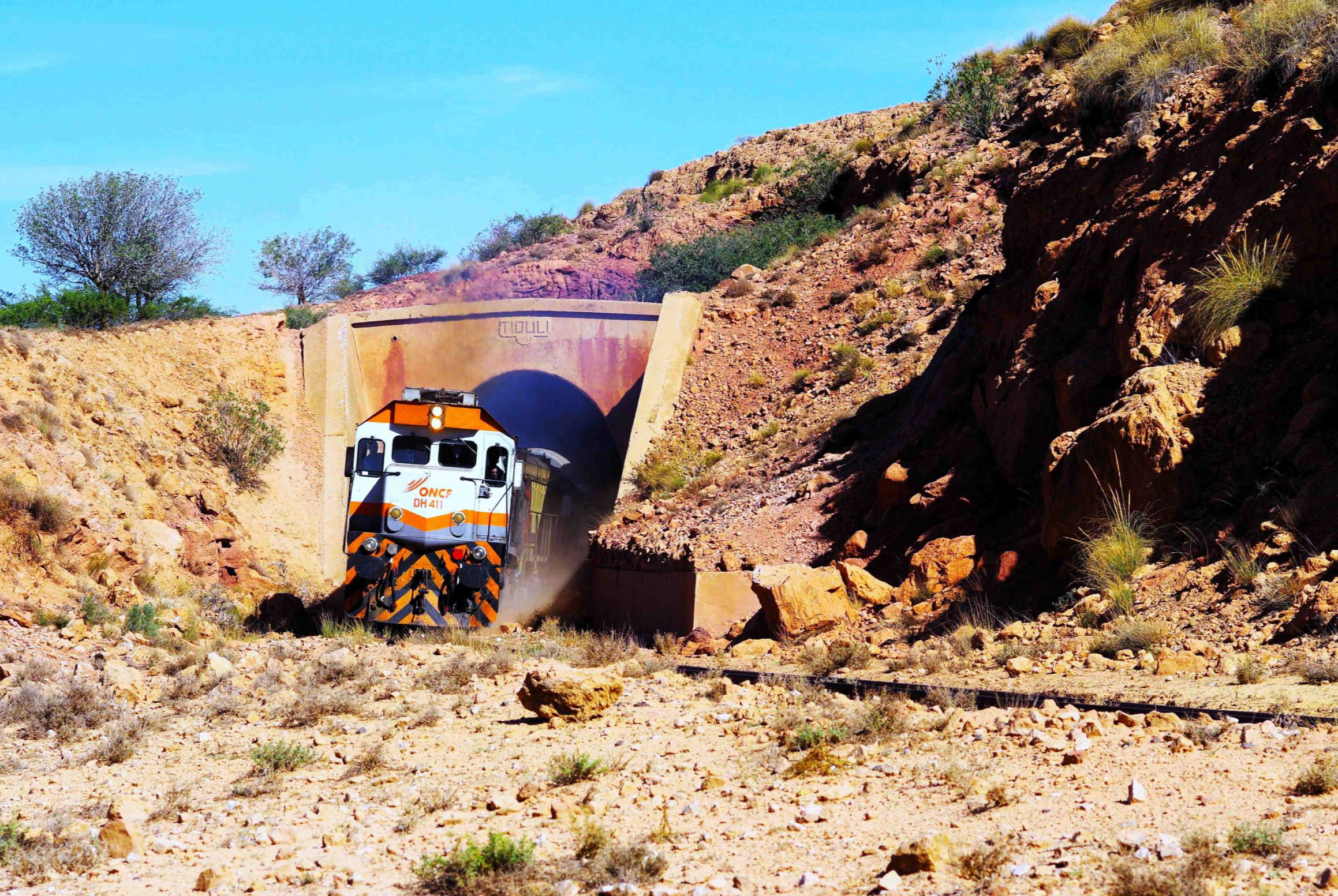
DH411 with our train emerges from the Tunnel de Tiouli on the photographic run past. No concerns about leaf fall or sanding the rails on this line!
[© Paul Griffin/Brian Carter 2023]Our next stop was at the sizeable town of Aïn-Béni-Mathar, with its old water towers. The locals turned out in force to watch us, constrained in their enthusiasm by the presence of police and military..
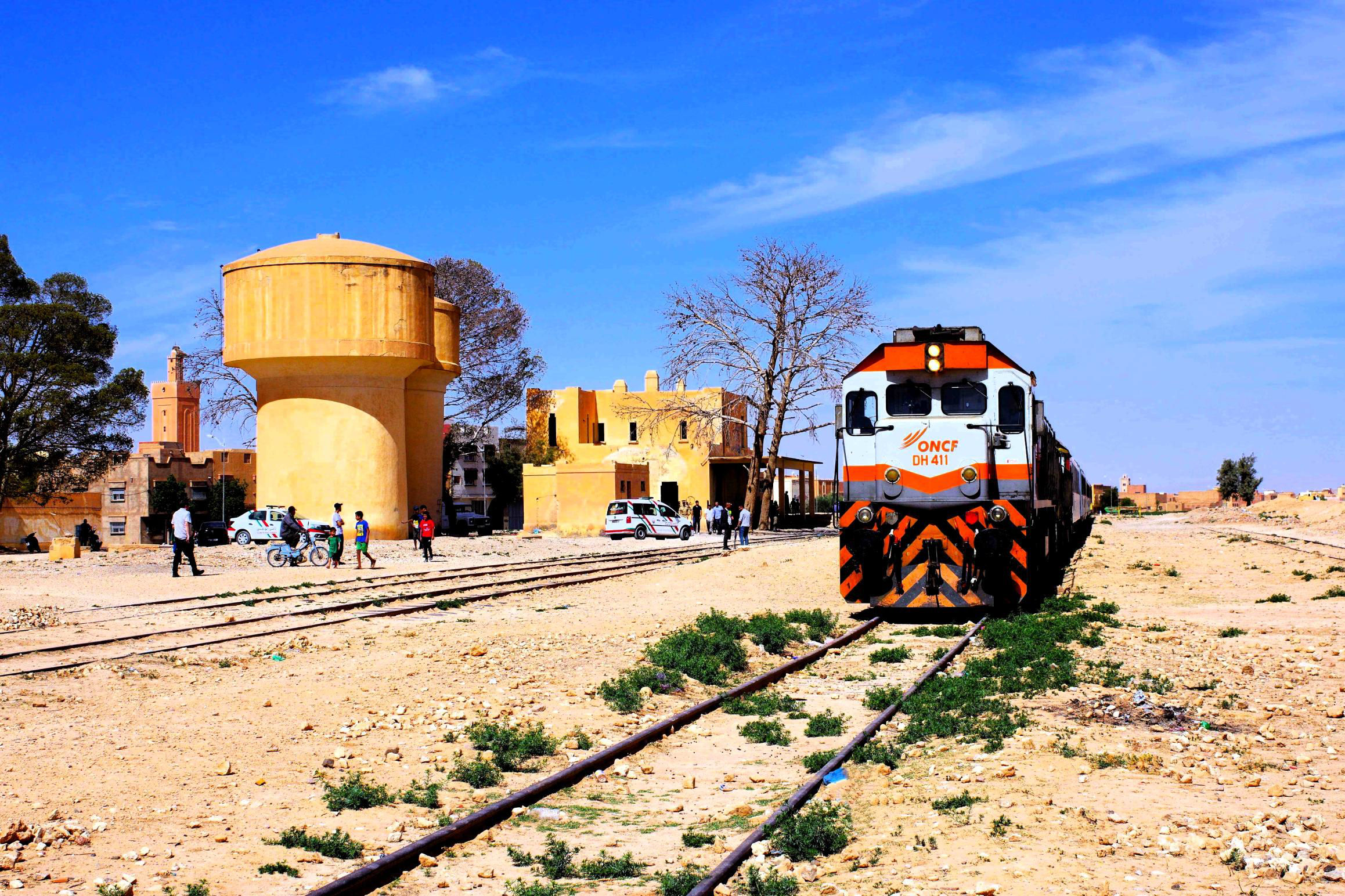
The old water towers and station building at Aïn-Béni-Mathar and not a high-vis in sight.
[© Paul Griffin/Brian Carter 2023]The police car would follow us, wherever possible, all day. Apparently, security is always tighter as the Algerian border is approached and at one point we could clearly see the mountains of Algeria in the distance. The two countries really don't get on at all. The scenery now became even more arid as the long ascent to the High Plateau started in earnest. This is over 1.000m above sea level and, in the winter months, snow sometimes falls. It is a bleak place, with little human habitation other than nomads whose tents were sometimes seen from the train. The 35 minute stop in the loop at Berguent Fouchal was for the drivers to have their lunch and afforded an opportunity to get everybody together for a seminar picture on a broad curve in a very bleak location with just a ruined building present. A laminated paper headboard was the best we could manage for the picture. It really did say 'BLS'!
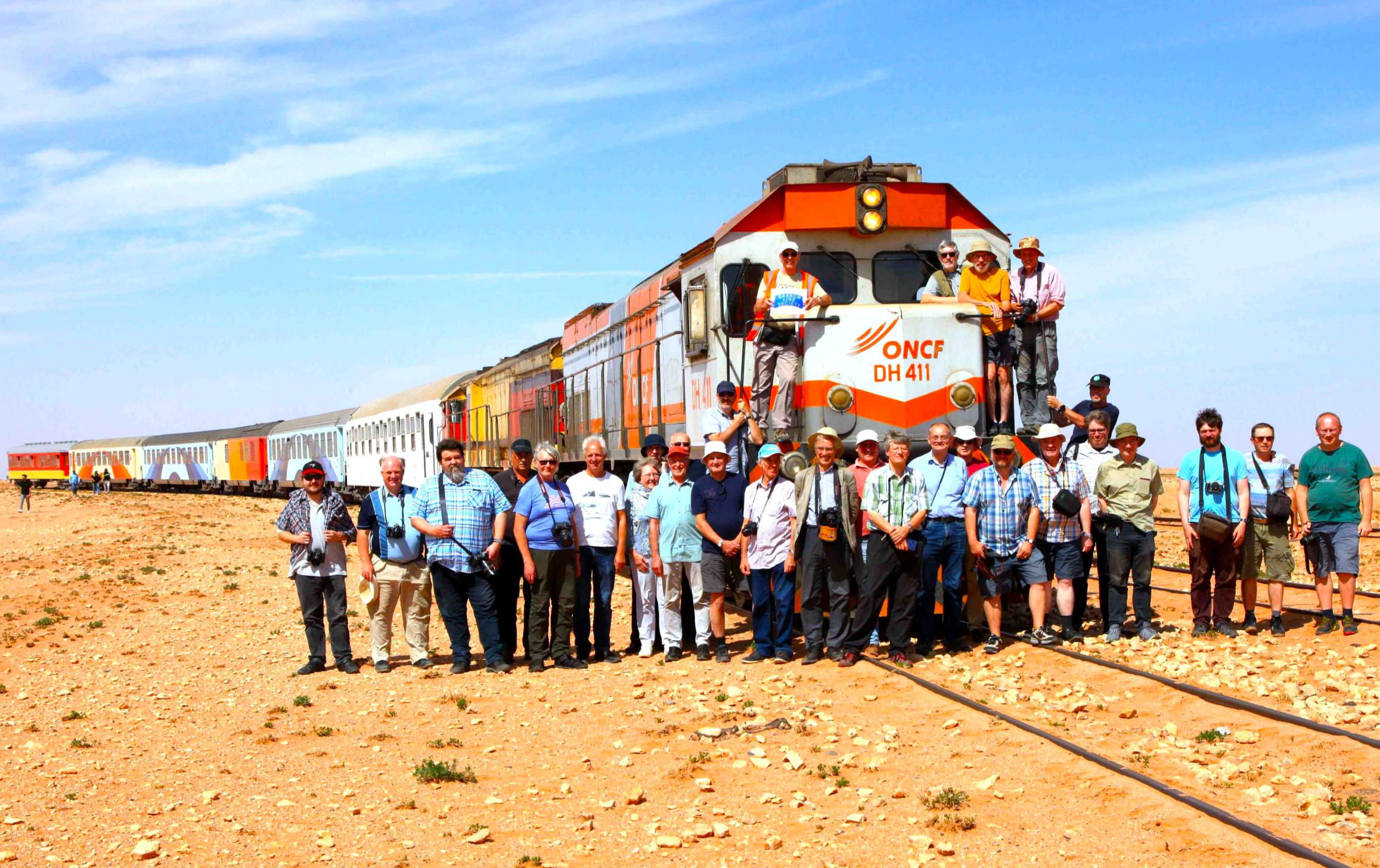
Berguent Fouchal, waiting in the loop, the one location where the train stopped on a curve. A laminated paper headboard (held at the front of the loco on the left) was the best we could manage for the photo. It really does say 'BRANCH LINE SOCIETY'!
[© Paul Griffin/Brian Carter 2023]After departure our own lunch was served - to our seats - and very nice it was too, rated by some as one of their best meals they had in Morocco. Tea and soft drinks were always on sale in the generator van but water was free. After Berguent Fouchal the line is straight for a long way, paralleling the main road to the south and providing an opportunity to relax and watch the flat desert scenery go by before the most important photo-stop of the tour - Tendrara. This lonely station, many kilometres from the town it served, and the highest station in the ONCF network at 1,374 metres has ruined buildings and water tower making for a 'romantic ruin' which is very photogenic. It was also the place, in the James Bond movie Spectre, where Bond leaves the train and is picked up by a 1948 Rolls Royce Silver Wraith by the bad guys. We were met and welcomed by a group of flag waving children, who, when asked, sang to us (they turned out not to be the folk group we'd been expecting). A ruined building at the southern end of the station had some rather dangerous steps leading to the first floor - a wonderful location to photograph the train and station and soon everybody was up there. Again, there was an old water tower.
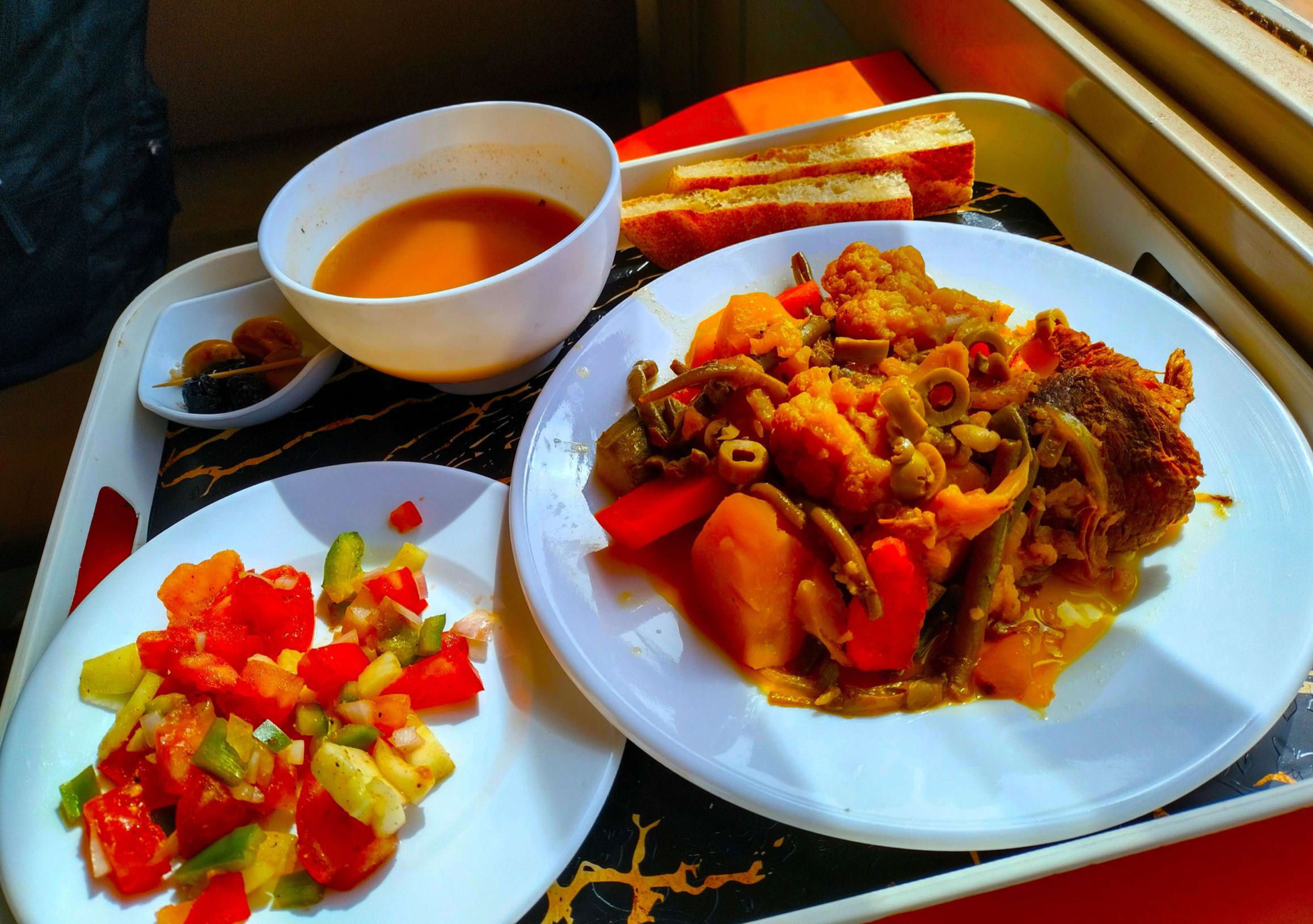
This meal was rated by some on the tour as one of their best in Morocco, and was even served at seat!
[© Paul Griffin/Brian Carter 2023]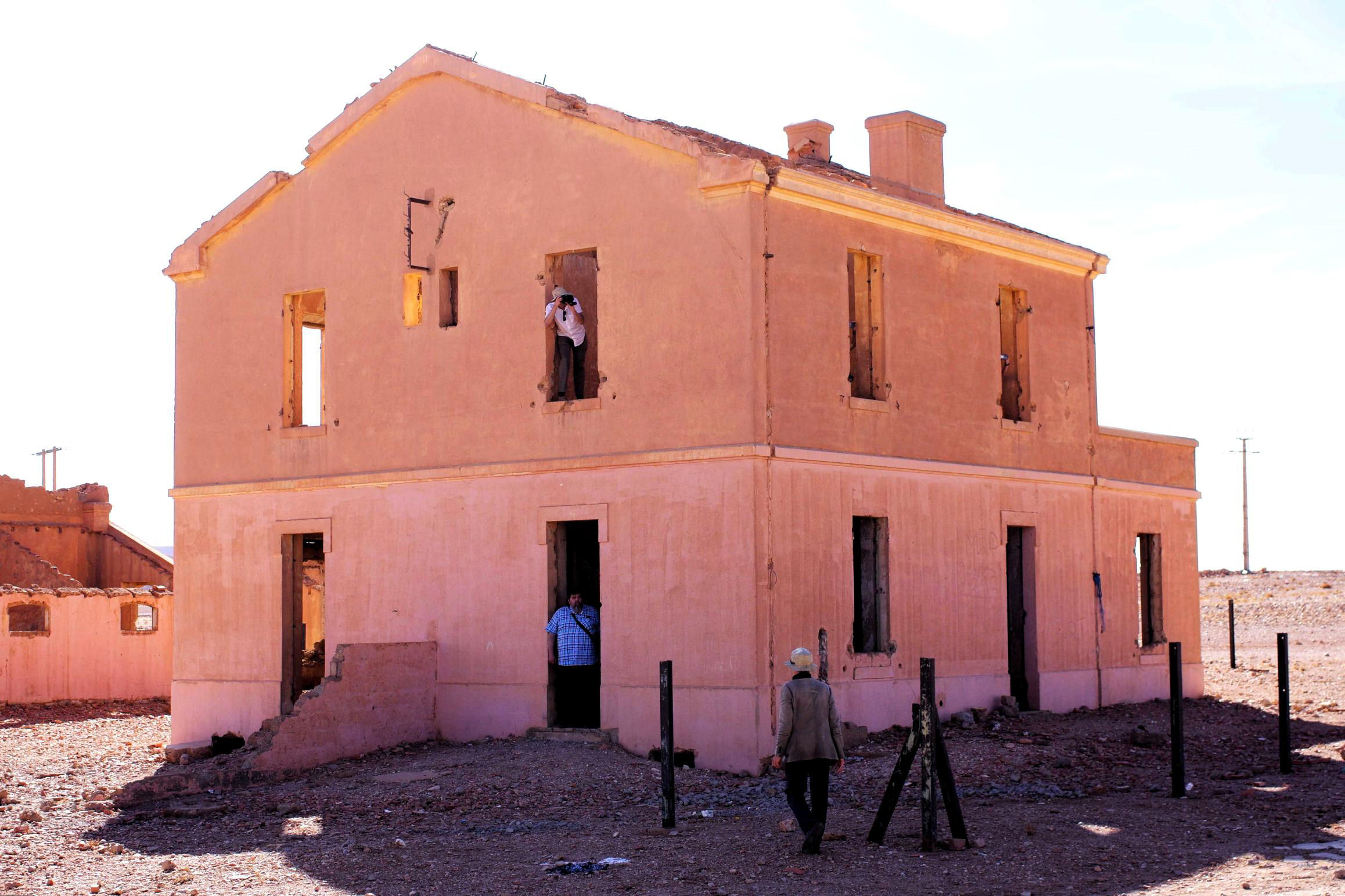
The first floor of this ruined building was obviously the best photographic location at Tendrara and soon everybody was up there.
[© Paul Griffin/Brian Carter 2023]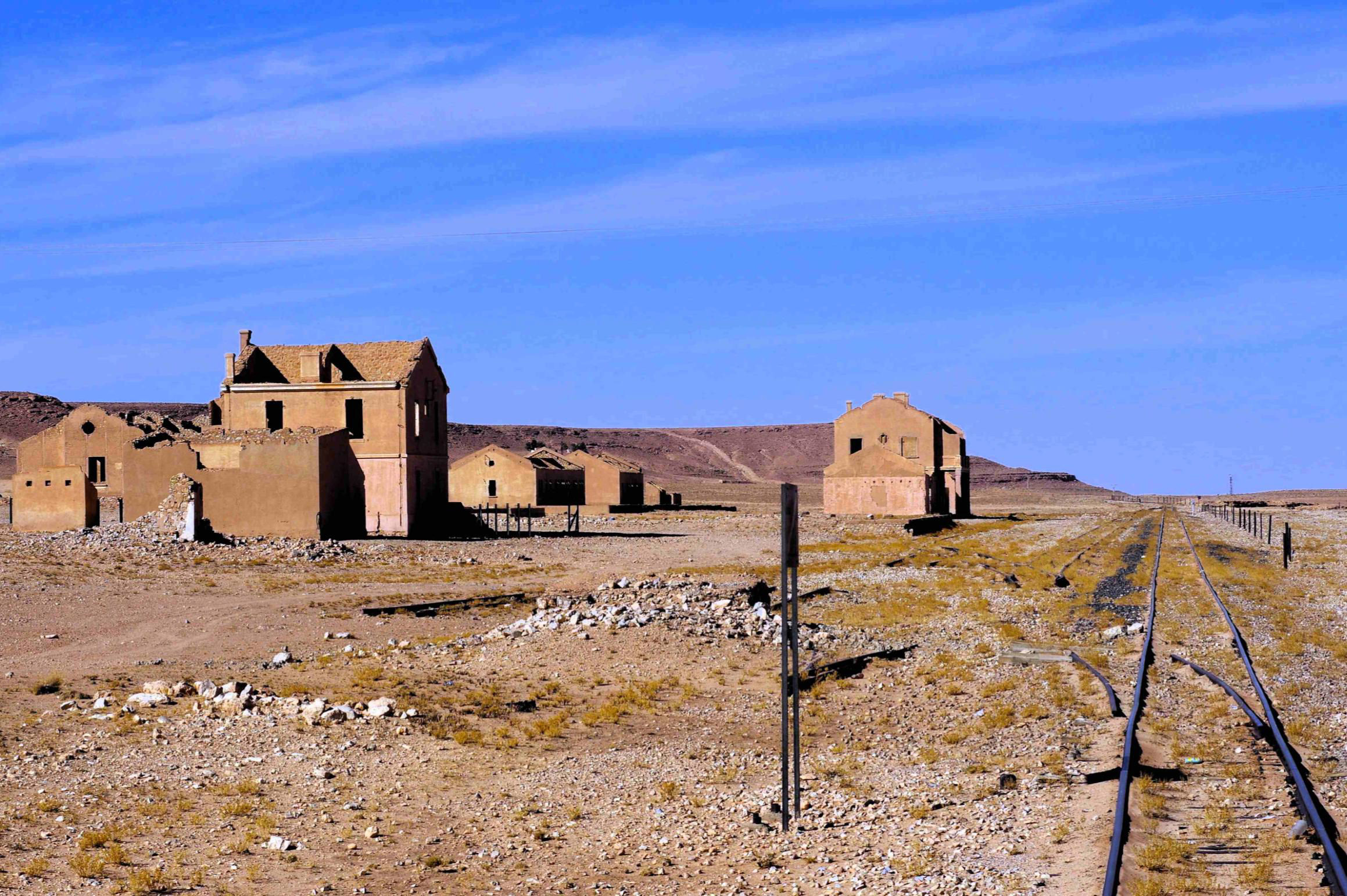
From the back of the train leaving Tendrara; note the disconnected loop and sidings. The water tower is hidden behind the far right building.
[© Paul Griffin/Brian Carter 2023]We now entered the area where sand is often blown over the tracks in shallow cuttings, (Fairbourne Railway style - see BLN 1184 p177 of 11 May 2013) but an ONCF gang had been clearing the sand from known problem locations ahead of us and we had no problems for a while. The next major point of interest is where the track bed of the Trans-Sahara railway diverges to the left. WWII effectively ended the construction of this line, which was subsequently abandoned. Imagine if you could have boarded a train at Oujda for Timbuktu. It could have happened - the most difficult part of the line had been built.
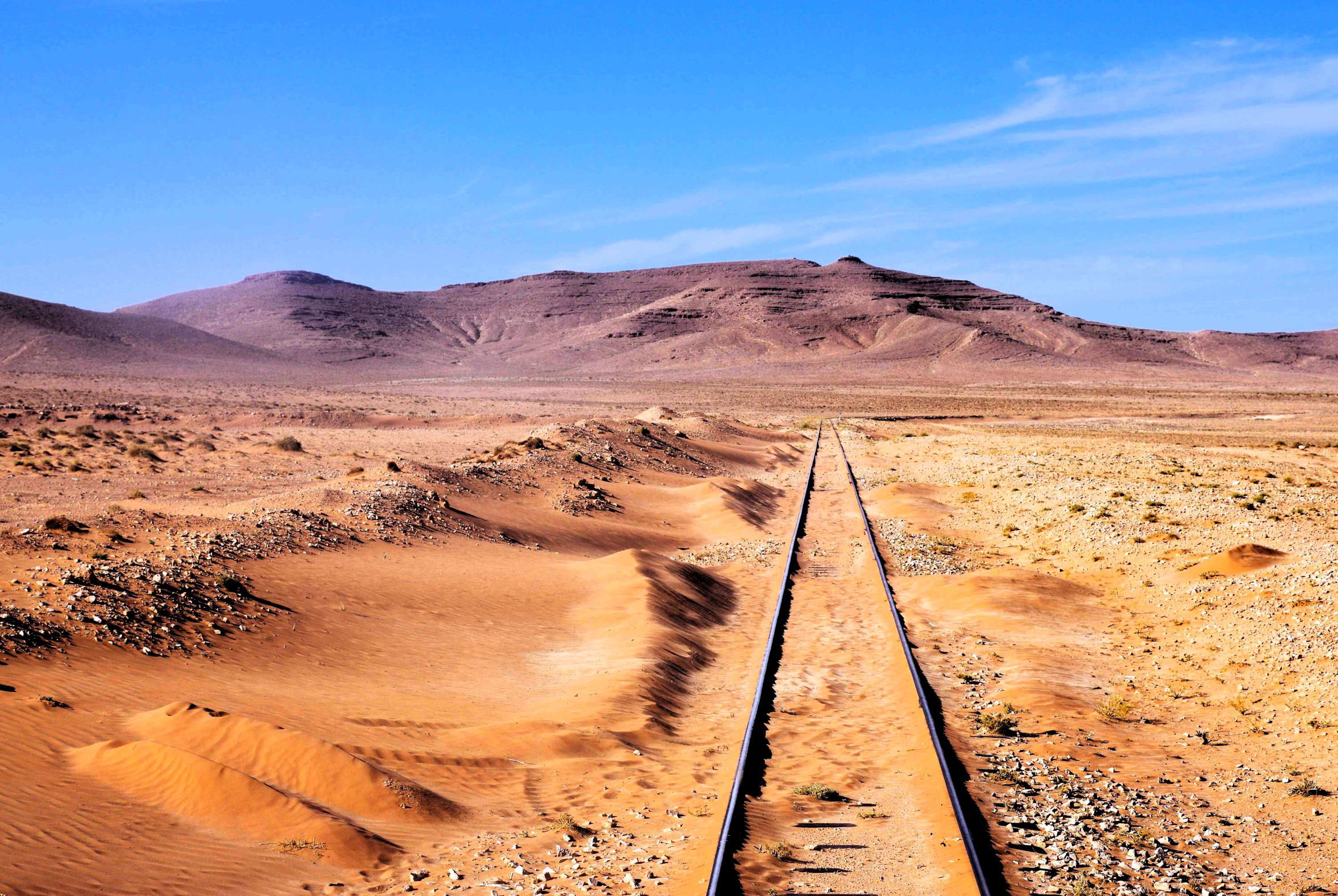
View of the line and typical desert scenery along this branch from the back of the train.
[© Paul Griffin/Brian Carter 2023]Thoughts of what might have been quickly ended as we stopped at a shallow cutting with windblown sand over the rails. The ONCF gang had not yet reached here, so our own gang of men, on the train for just this purpose, got to work. All the tour participants (except one) were delighted and alighted for photos. Another cutting, a little further on, also had sand but the ONCF gang arrived in their vehicle and quickly cleared it. To my relief we had no further sand issues and ahead the mountains behind Bouárfa were now visible and an arrival in daylight was looking promising. Indeed, we came to a halt at the old station (CP Oct 1995), 288km of freight line completed with the light just beginning to fail.
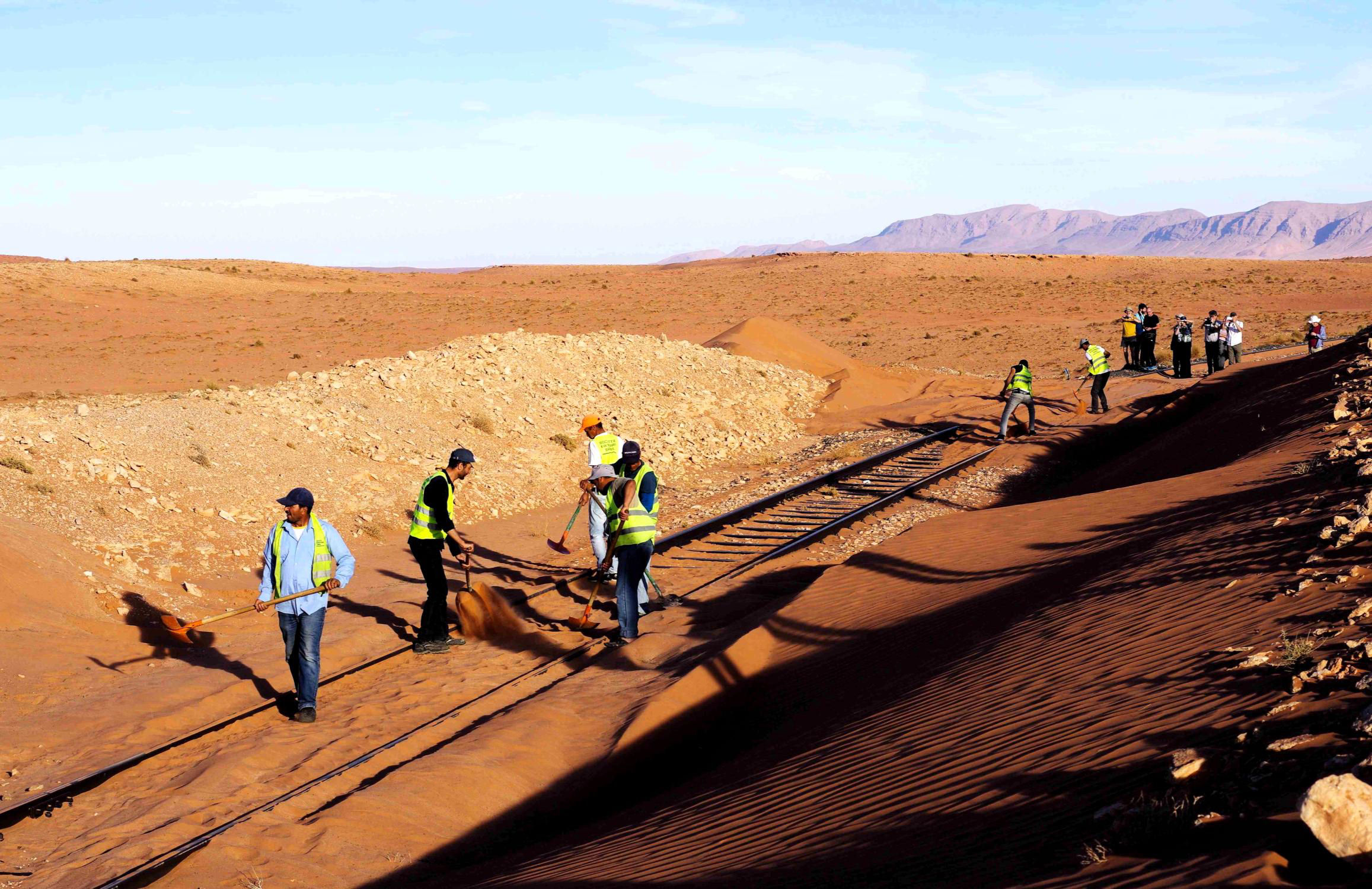
An ONCF gang travelling on the train clear wind-blown sand covering the rails in a cutting while
being photographed by tour participants (right). The mountains of Bouárfa are visible in the background.
[© Paul Griffin/Brian Carter 2023]The old station at Bouárfa is several kilometres from the town and the station building still looks to be in use. We were told that we were the first charter to use the line this year, so we may have been the first train of any sort in 2023. There was no sign of the vehicles to transport us to the restaurant, but that just meant more time for pictures, some people climbed the hillside for better shots.
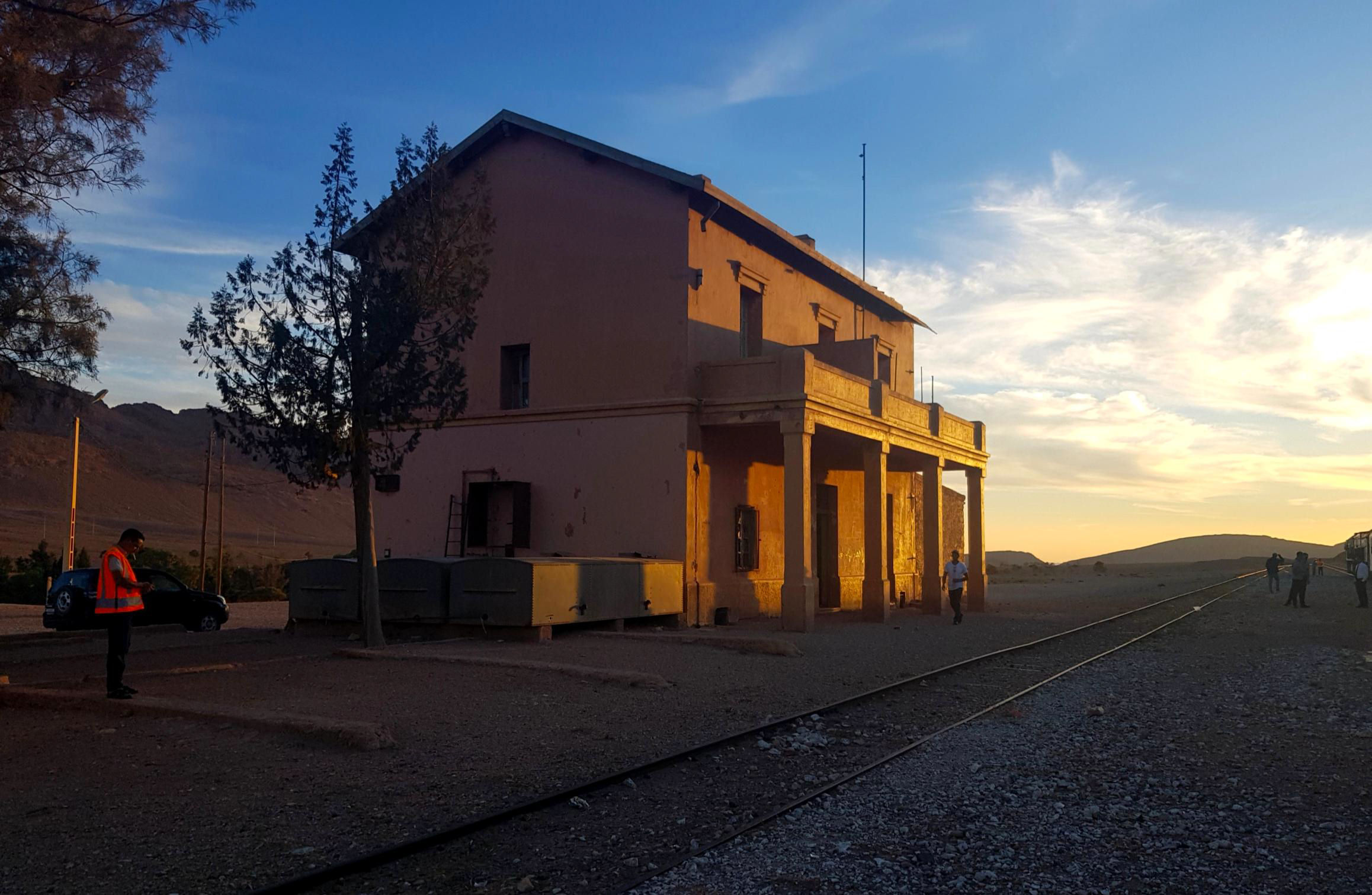
The old station at Bouárfa is several kilometres from the town and the station building still looks to be in use. The tracks continue on to the phosphate mine but are currently out of use. We were told we were the first charter to use the line this year, so that may mean we were the first train of 2023.
[© Paul Griffin/Brian Carter 2023]Meanwhile the locos shunted the passenger and sleeper coaches to the front of the train. Dusk was falling as we were conveyed by a mixture of taxis and minibuses to a restaurant on the northern edge of Bouárf, part of the administration complex for the first Bouárfa mines. We were welcomed at the restaurant by locals singing and dancing and they also performed again as we waited for the minibus/ cars to return us to the train. The railway carries on from Bouárfa station for several kilometres to the present mine but is not currently in use - as we could tell from the condition of the tracks when we passed over them. It was not surprising therefore that our request to travel to the mine in the B10 coach had been refused. Apparently the mine traffic is to be resumed, and the line 'reactivated'.
The restaurant served us soup, then a traditional Moroccan dish called Mechoui, which is (very) slow cooked lamb with rice and vegetables. Edi claimed this was the peak of Moroccan cuisine. Certainly there was plenty of it, followed by a dessert (well deserved after all that desert) and fruit. We had arrived at Bouárfa at 18.28, almost two hours late, so the original departure time of 19.00 was never going to happen. In the event we were driven back to the train, departing at 21.07, with DH367 now powering it assisted by DH411 up the bank out of Bouárfa. Most participants used the four berth couchette compartments but a surprising number of passengers opted for seats in the B10 coach where the lights were turned off, affording an opportunity to gaze at the Milky Way in the night sky, completely devoid of any light pollution. They also noticed that we stopped at one station until the police car showed up, then set off again. We were awoken shortly after 05.00 to tell us we had arrived back at Oujda and over the next hour set off in dribs and drabs to the Ibis hotel where breakfast had been arranged for all tour participants.
There was plenty of time for those wishing to catch the 07.50 to Tanger Ville, though some people had hedged their bets in case of a late arrival and would travel on the 11.35. Some tour participants would go on to clear their Moroccan passenger track in the days that followed but for one tour organiser the 11.40 flight from Oujda to Paris Orly marked the end of his holiday and responsibilities. Despite the loss of Jerada, many passengers commented on how much they had enjoyed the tour, and travelling the railways of Morocco. [Thanks to our organiser Paul Griffin for all his time and efforts on this tour.] The tour brochure has maps, photos, line details and history, search 'Sahara' on our website archive.