It was eleven at night but sleep was eluding me. So, when my phone pinged, I decided to look at the email. It was from Aimrane, our organiser from Suprateam and it wasn't good news. He had just received an email from ONCF* at Oujda. This read:-
Bonjour, pour la sécurité des clients, la mise en circulation du train spécial prévu le 04 Octobre 2023 n'est pas possible vers Hassiblal Jerrada. A cet effet, nous vous proposons soit le circuit d'Oujda vers Guenfouda et retour à travers Naïma vers Oujda ou nous faire une proposition de circuit de votre convenance. Restant à votre entière disposition pour tout complément d'information. Cordialement.
For those who struggle with French, broadly: Hello, for the safety of customers, the passage of the special train scheduled for 4 October 2023 is not possible to Hassiblal Jerrada. We offer you either the circuit from Oujda to Guenfouda and return through Naïma to Oujda or make us a proposal for a circuit of your convenience. Remaining at your complete disposal for any further information. Sincerely.
So we couldn't do the star section of track on the entire tour. I was plunged into despair.
[*ONCF is from the French Office National des Chemins de Fer; Arabic: للسكك الحديدية
المكتب الوط ن al-Maktab al-Waṭaniyy lis-Sikak al-Ḥadīdiyyah; that is Moroccan National Railways Office to you.
It seemed likely that the disturbances and protests there in 2017-18 were still causing concern.
The 2017-2918 Moroccan protests, more commonly known as 'Hogra' (or ح كرةال in Arabic), were some mass demonstrations, popular protests and strike actions within Morocco carried by activists and civilians, which began in the town of Jerada after two miners died in a tunnel accident.
I replied to Aimrane proposing we would be happy to go most of the way down the branch but not entering Jerada. Surely that would be safe. He agreed with my logic and promised to contact ONCF the following morning (the day before the tour) and see what he could do.
The following day was a travelling day for me, from Fes to Oujda. Aimrane had told me that Eduard Kunz (Edi) the former owner of Suprateam and my primary contact for the tour would be waiting to meet me at Oujda and bring me up to date with the situation. Ian Mortimer was also there and we learnt that our appeal had been to no avail. We would have to settle for a shortened itinerary on day one. Now I had to tell everybody and watch their faces fall. Sometimes being a tour manager sucks.
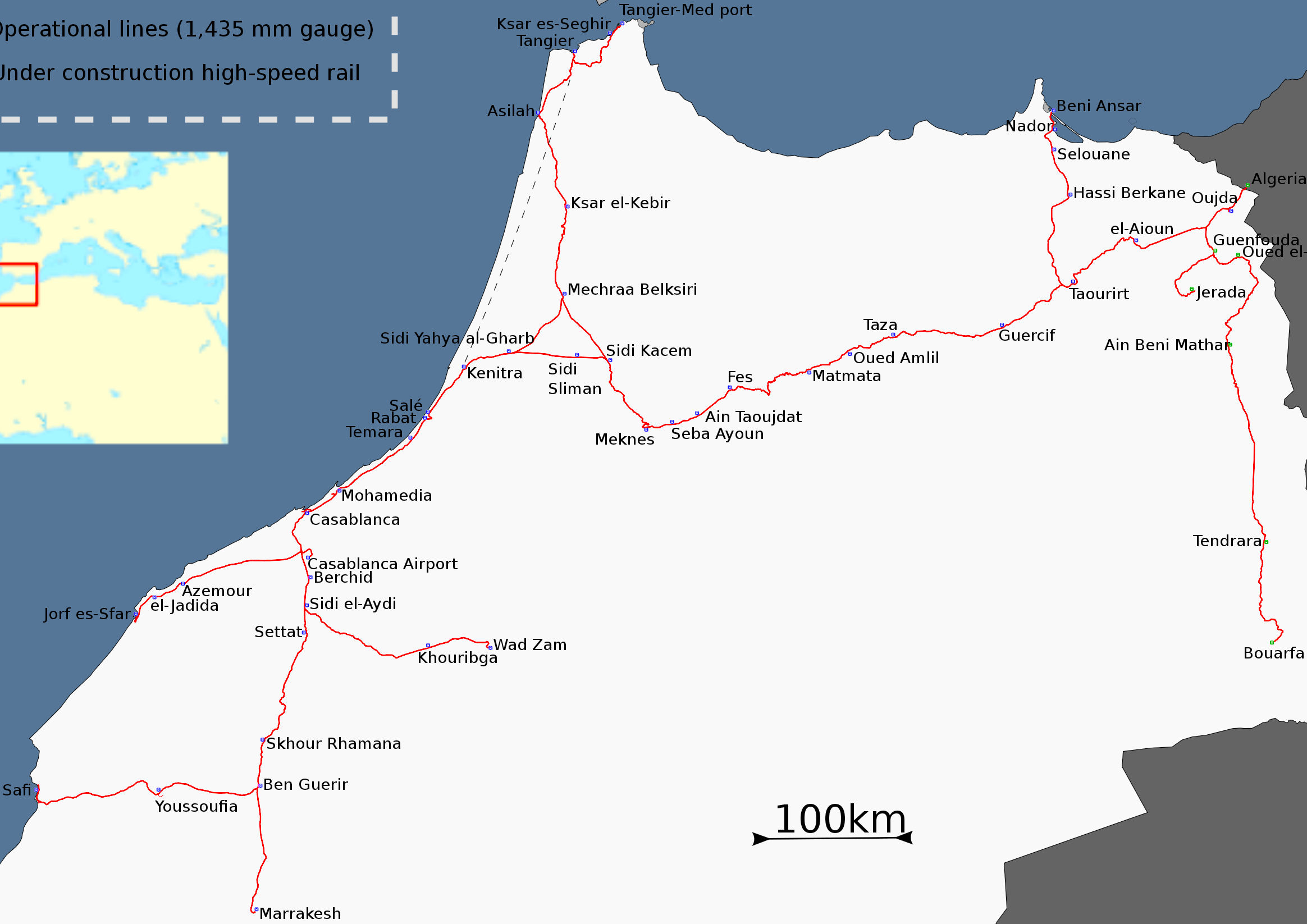
Morocco; blue dot = main station with regular trains; green dot = closed to passengers or served by 'irregular' trains. Oujda is top right, the Jerada branch is below and Bouárfa bottom right. (4 Jun 2012),
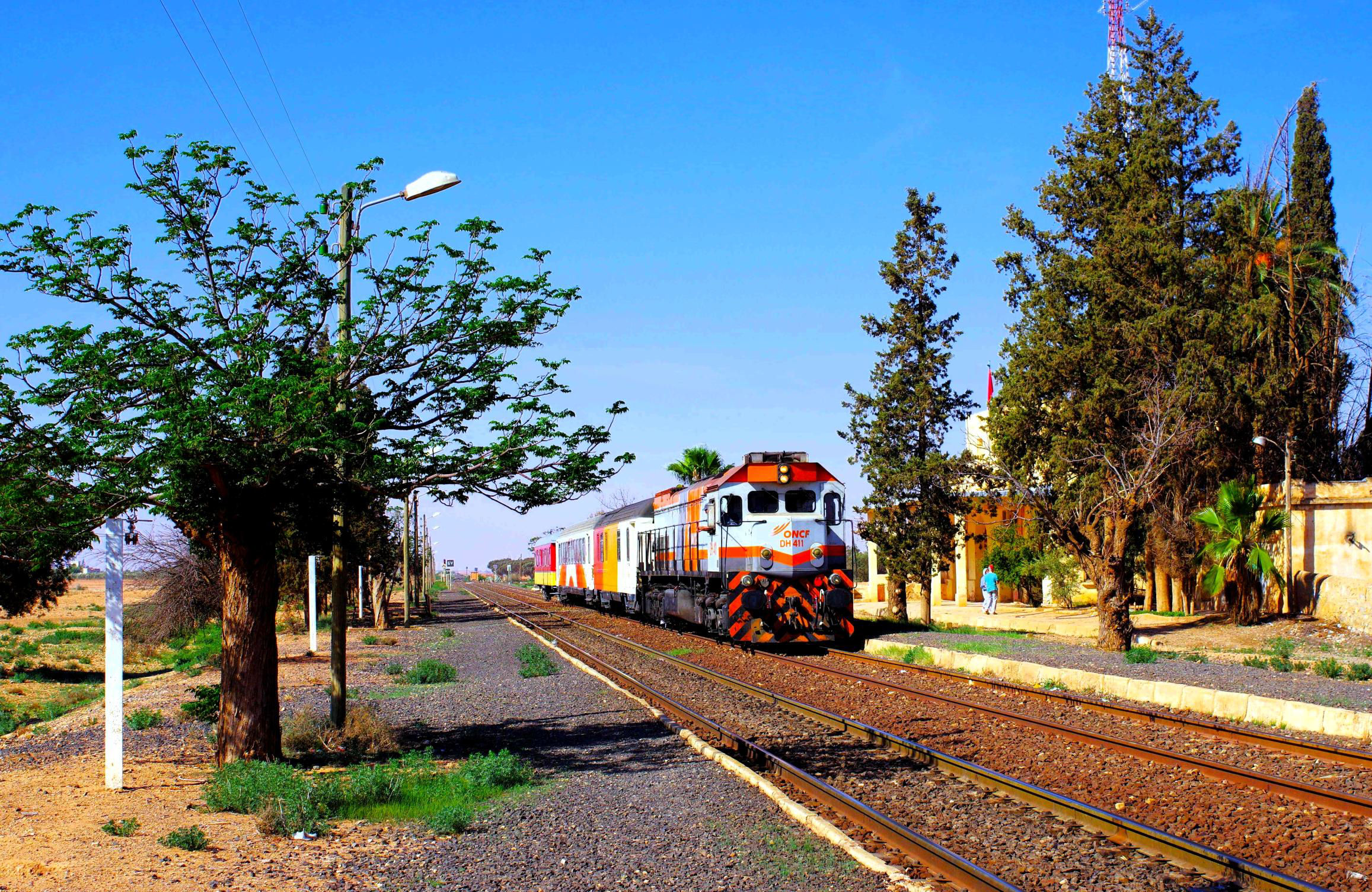
[© Tachfin CC BY-SA 3.0 2012]It was still dark when I rose and made my way downstairs for breakfast. The new station at Oujda is absolutely massive, architecturally spectacular and very spacious, complete with clock tower. Before the station was built, tracks continued into what is now the square in front of the station and on my 2013 trip we reversed back nearly to the buffer stops. Top track, with the benefit of hindsight! Our train was the only one in the station - three coaches and a loco. DH411 was a passenger loco but I'd pretty much expected that. Soon the stock for the Tanger train (Tangier to the Brits) backed in.
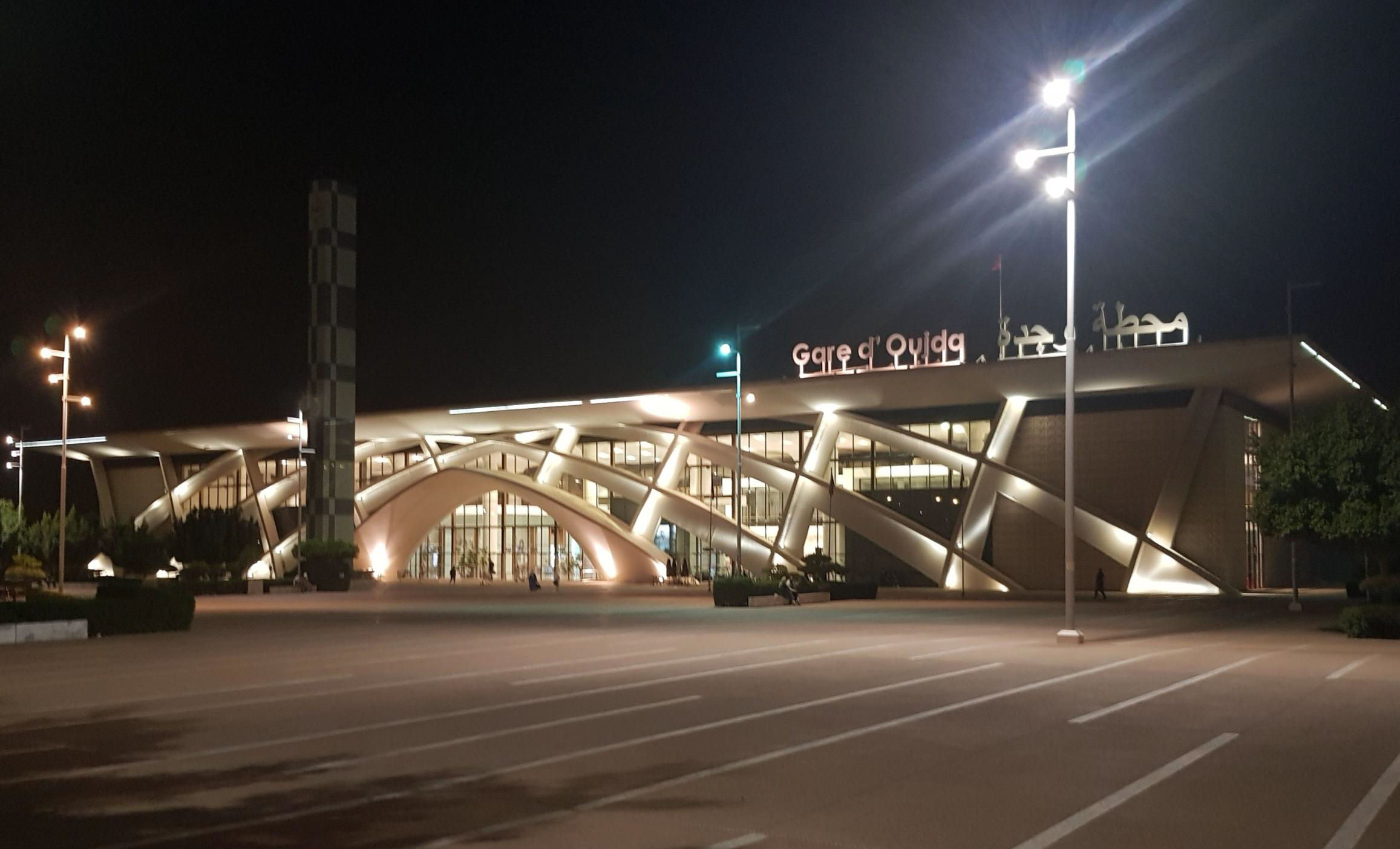
The new station at Oujda with its clock tower. Before the station was built the tracks continued into what is now the square in front of the station (not a car park, despite the lines). On my 2013 trip we actually reversed back nearly to the buffer stops; top track, with the benefit of hindsight!
[© Paul Griffin/Brian Carter 2023]07.15 was the booked departure time but this was contingent upon the arrival of the overnight train from Casablanca at 07.10 as we couldn't access the single track until it had arrived and the paperwork had been completed. All my 32 passengers were present and ready to go but the overnight was late. It would be a close thing if we were to depart before the 07.50 train to Tanger Ville but depart we did.
At 07.32 the Sahara Explorer pulled out of Oujda on our Society's first ever railtour in Africa then pottered gently down the main line to Béni Oukil, the first station. We stopped here for photographs and to let the 07.50 from Oujda pass through. The stationmaster, possibly overwhelmed by the activity at his otherwise sleepy station, insisted several times that we keep well away from the platform edge as the Tanger Ville train passed through with the horn sounding continuously. When we set off again we quickly took the curve onto the freight only line to Bouárfa. Passing the previous day it had looked much less well used than the avoiding line which soon trailed in on the right completing the triangle.
There was plenty of space to spread out on the train, with the 80 year old B10 coach (ex-SNCB/NMBS* - second class, ten seating bays) and an air conditioned open coach, so we settled down to watch the arid scenery pass by. Ahead of us was the gap in the Atlas Mountain range in which Guenfouda lies, and as we approached this sizeable town there were big piles of mining waste on the right.
[*Société Nationale des Chemins de fer Belges/Nationale Maatschappij der Belgische Spoorwegen which is the National Railway Company of Belgium.].]
The thin fog in which we had set off had completely disappeared by now and it was warming up, though still very pleasant as we alighted at Guenfouda. Here two locals on their donkeys were obviously not going to let the presence of a train disrupt their normal route across the tracks. This is the junction station for the forbidden Jerada branch, so the loco had to run round allowing plenty of time for photographs. The station is on the edge of the town; quite a few locals turned up to observe us, perhaps tipped off by the presence of the security forces. These included a police car with blue lights flashing and several military looking individuals. Those who wandered away from the train were discreetly followed by plain clothes officers. It was clear that no risks were being taken for our safety.
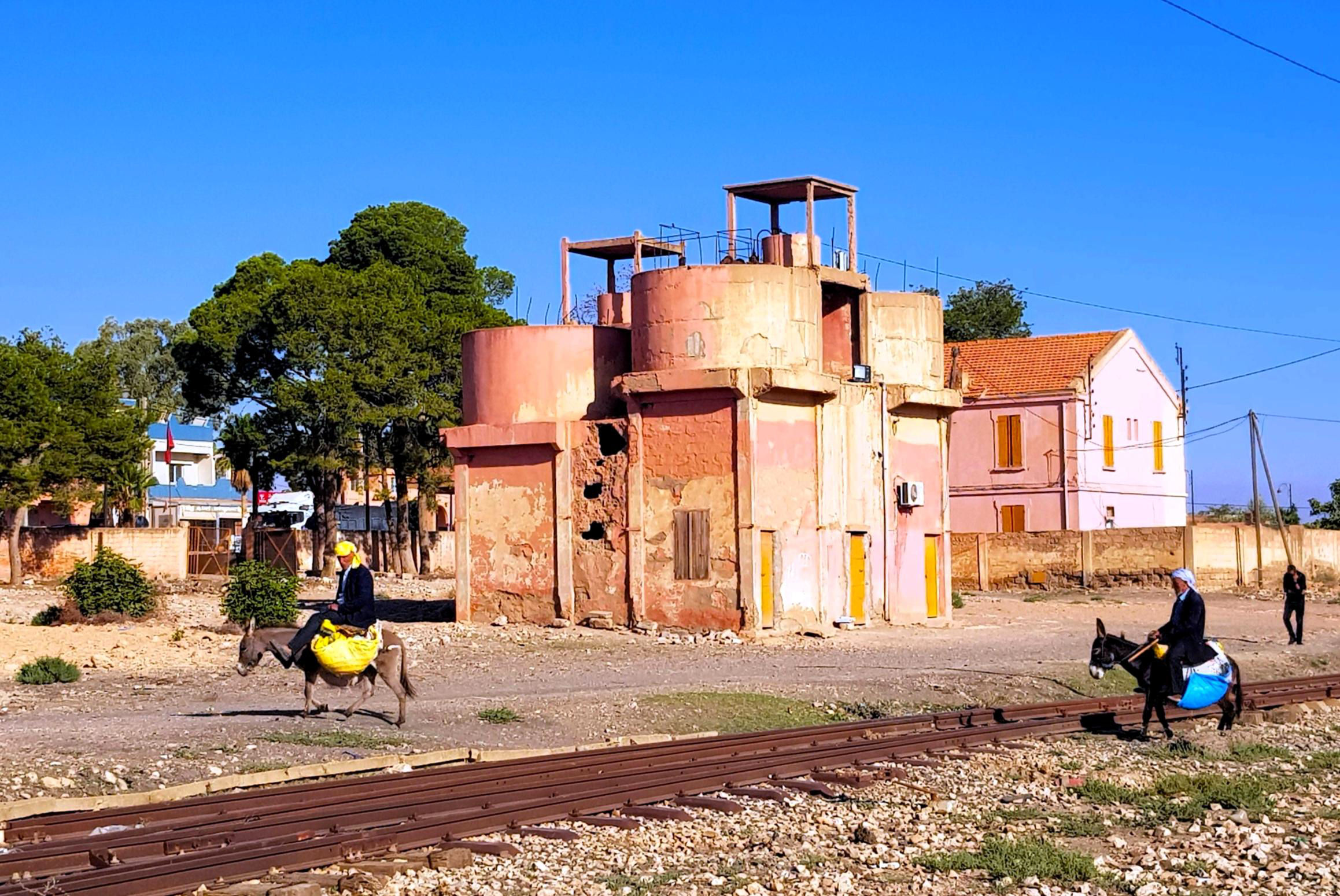
At Guenfouda these two locals on their donkeys were obviously not going to let the presence of a train disrupt their normal route across the tracks.
[© Paul Griffin/Brian Carter 2023]Until the Jerada branch was built, anthracite used to arrive by cable car, Guenfouda was then busy with transhipment from cable car to wagons. Today nothing remains of the téléphérique (transhipment facilities) but the old water tower is partly in use if the presence of an air conditioning unit is any guide.
After reversing we returned towards Béni Oukil, slowing and then stopping briefly at the junction for the avoiding line before slowly crossing onto it. I was determined to enjoy this - now the only new track for me on the entire tour - and a BLS first as it seems certain that we were the first ever passenger train to travel the 1,100 metre curve which allows mineral trains from Bouárfa and now imported coal from Nador destined for Jerada (where the coal mines are now shut) to avoid reversal at Béni Oukil. As has often been said on our fixtures and railtours: We had come a long way for this. All too soon we joined the main line towards Taourirt and Fes and headed for Naïma to reverse.
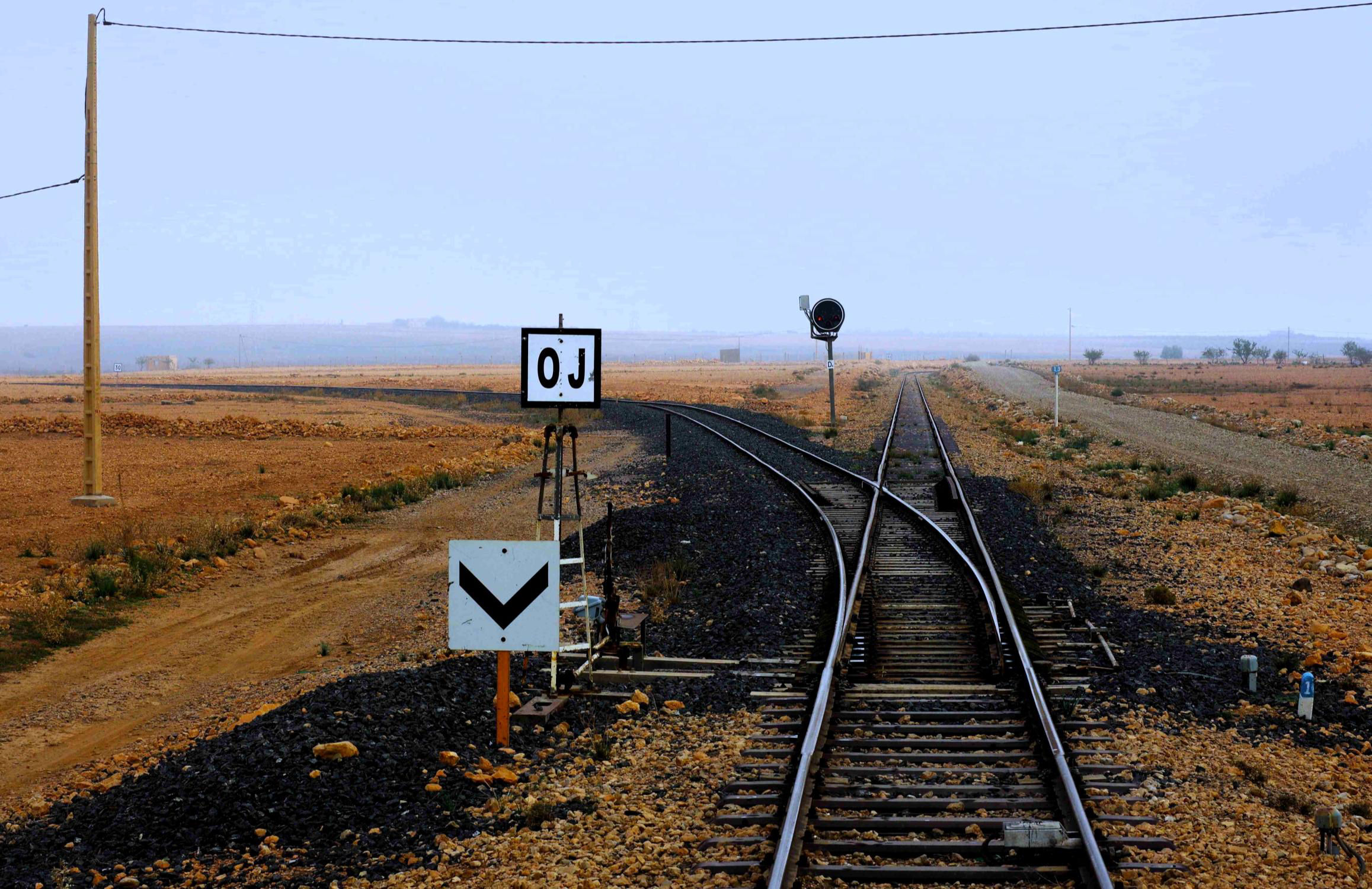
Drivers eye view of the Béni Oukil avoiding line diverging to the left. Actually a bit of a cheat, as the picture was taken the following day from the back of the train, which is why the points are set for Béni Oukil! This was the only bit of new track (all of 1,100m) that your reporter needed on the tour!
[© Paul Griffin/Brian Carter 2023]Naïma proved to be rather larger than maps had suggested, with a broad avenue leading from the station building for a considerable distance into the town. It seemed an unlikely tourist destination, but a young man from the local authority charged with developing tourism in the area clearly had some enthusiasm for the possibilities as he approached me and, in reasonable English, made us all welcome and asked if we would do a group picture by the station name board for the town's Facebook page. We had been informed that a freight was coming through shortly, so his picture had to wait until four coal wagons hauled by two locomotives, came trundling through.
The pleasant little station of Naïma was the first place on the main line to Fes where the loco could run round. About 50 metres to the left of the platform was the trackbed of the Fes to Oujda narrow gauge line, built for military purposes and long abandoned.
[© Paul Griffin/Brian Carter 2023]The pleasant little station of Naïma was the first place on the main line to Fes where the loco could run round. Fifty metres or so to the left of the platform was the track bed of the former narrow gauge line from Fes to Oujda, built for military purposes and long abandoned.
So, it was back down the main line to Béni Oukil and Oujda with the time barely past midday. Since a depot visit had been refused and because it was becoming hot with temperatures in the 30s, most opted for a long lunch and a break before setting off for some railway tourism in the late afternoon.
The obvious destination was the original Oujda station in the north of the city on the closed line to Algeria, a leg stretching 1½ mile walk each way. En route to the station I met Petr Pokorny, one of the three Czechs on the tour, and he told me that the old station was on the right of the level crossing - not the left as the map appeared to show. This proved to be correct, and after taking a picture I was collared by a man (I believe he was the caretaker) and given a guided tour in voluble French, of which I understood almost nothing. The original station building whose picture I had included in the tour brochure (on our BLS website archive, search 'Sahara') has been extended on both sides at some time but is now empty and deserted, with the ceilings collapsing in places. Outside a high wall now separates it from the low, crumbling station platforms. Disused tracks remain but the line has been abandoned for many years. Not far away, but on private land, are parts of a loco shed and turntable.