The day dawned bright and sunny. It also felt like the dawn of a 'new era' of signal box visits, which had been on hold for over three years due to Covid-related restrictions. Our group of 16 members assembled in Stothard House, Barnetby station for a briefing from our hosts for the day, Mobile Operations Managers Doug Pratt and Gary Crompton. Stothard House was the original station building and now serves as Network Rail offices. Refreshments were kindly provided by our hosts and the building itself held much interest. An original ticket window survives, plus various old photos of railways in the area. The highlight for many of us was the set of original preserved signal box diagrams, including Barnetby East and Goxhill.
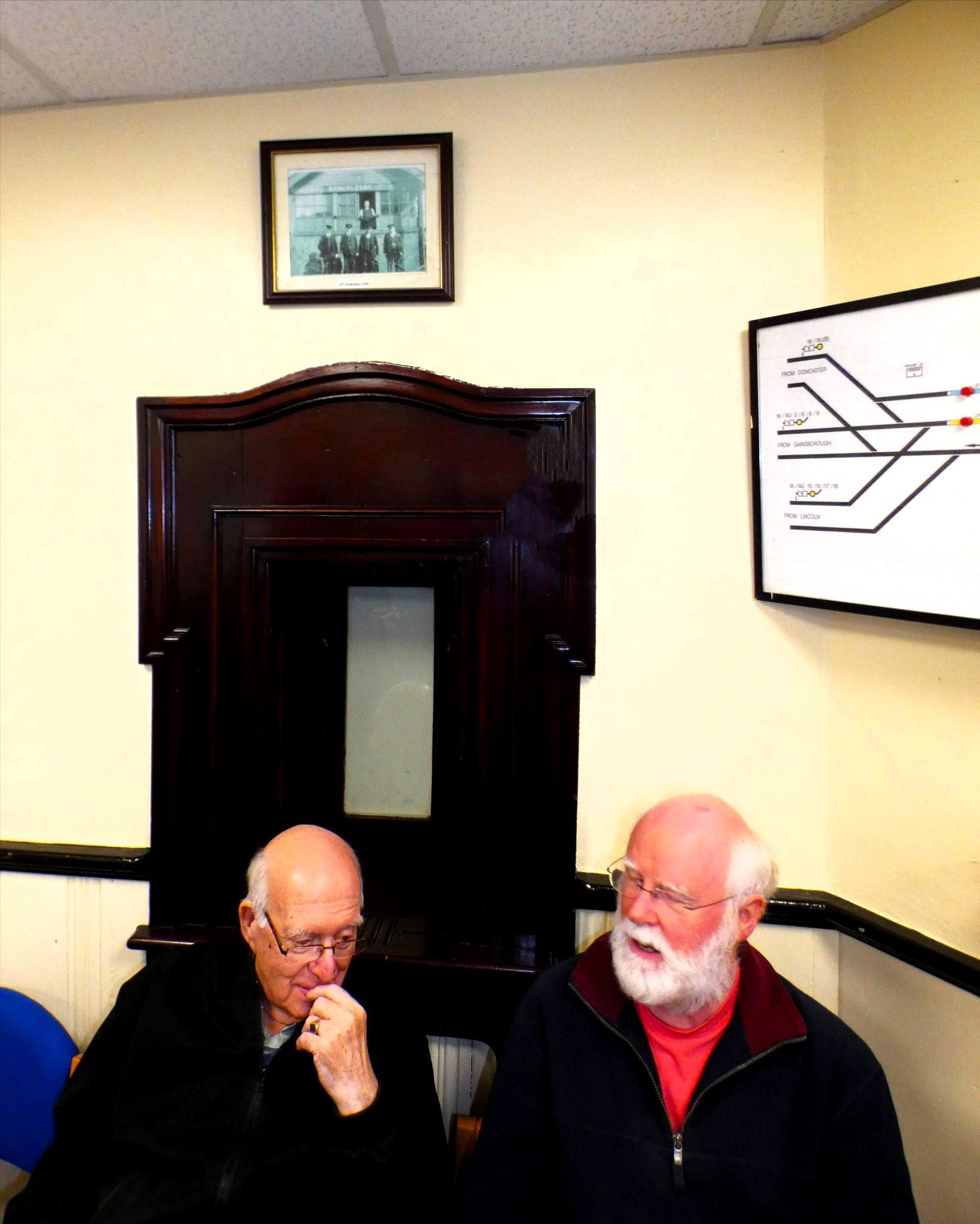
An original ticket window at Stothard House, the former Barnetby station building, now NR offices.
[© Nick Jones 2023]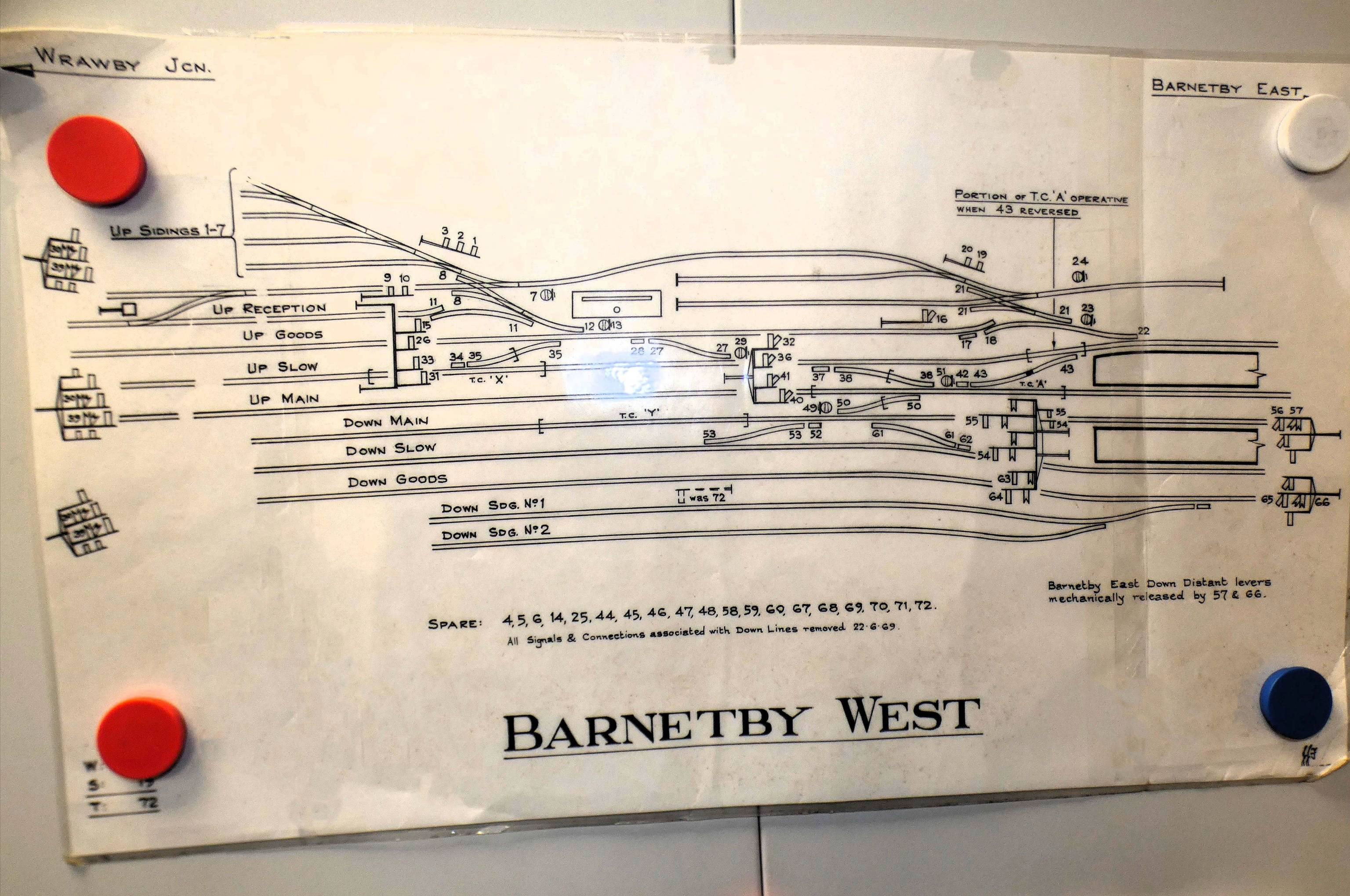
An undated (but post 22 Jun 1969) Barnetby East box signalling diagram (Displayed at Stothard House).
[© Nick Jones 2023]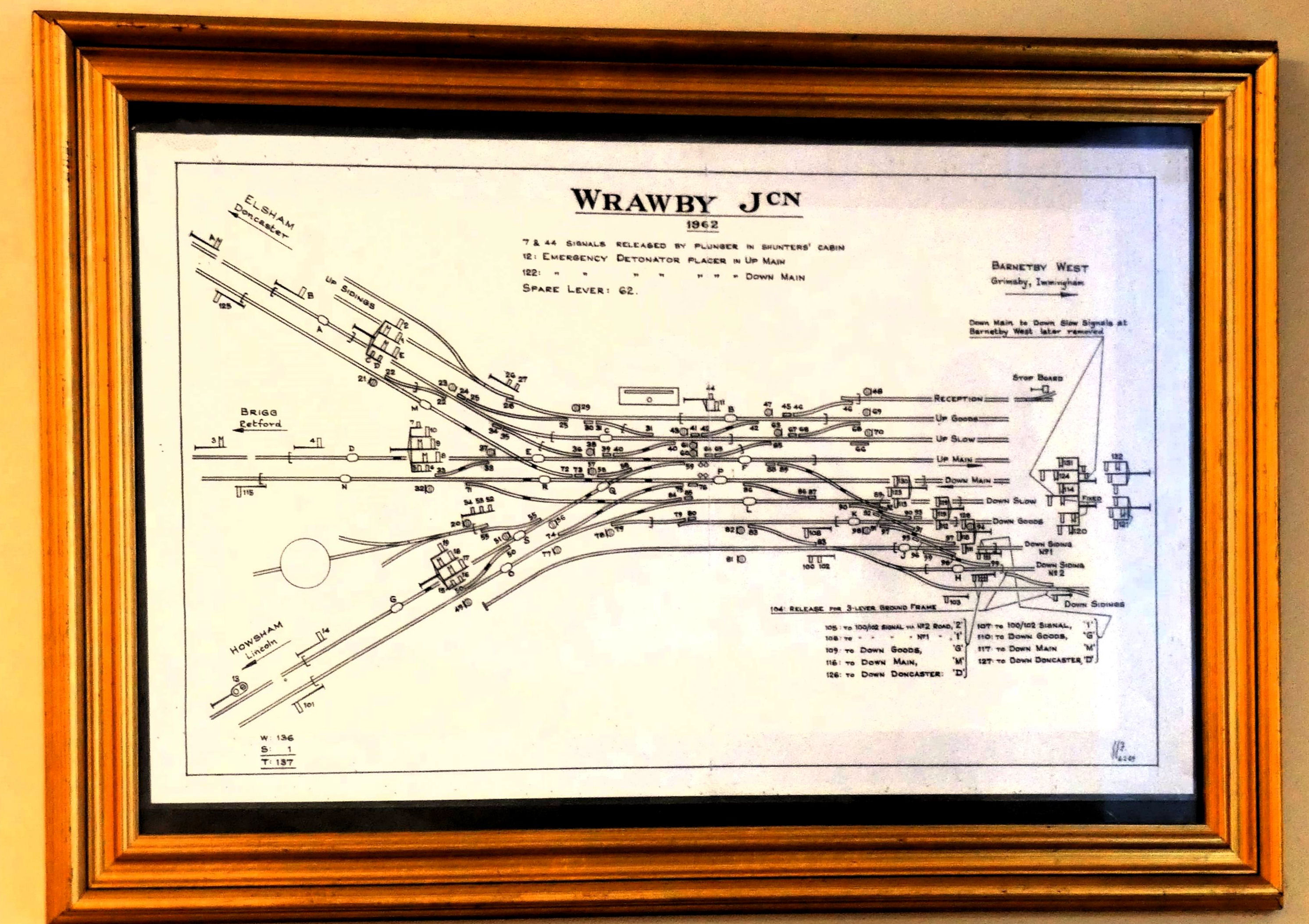
Wrawby Junction box diagram in 1962 (Displayed at Stothard House).
[© Nick Jones 2023] Suitably fed and watered we drove, in convoy, the short distance to Wrawby Junction. The access road crosses the connection to the disused (and heavily overgrown) Up Sidings. Wrawby Junction box was visited by our Society on 4 Oct 2014 when it was still operational but it closed on Christmas Eve 2015, with its beautiful array of many junction semaphores swept away at the same time. The LED signalling in this area is now controlled by York Rail Operating Centre (ROC).
Happily, Wrawby Junction box is Grade II listed and kept in good order by local NR volunteer staff.
It opened on 7 May 1916, replacing an earlier box that was in situ by 1880. It is classified by the Signalling Record Society (SRS) as a Great Central Railway (GCR) Type 5* and, at 70 feet long, is a very impressive tall structure, with excellent views over the many running lines and sidings.
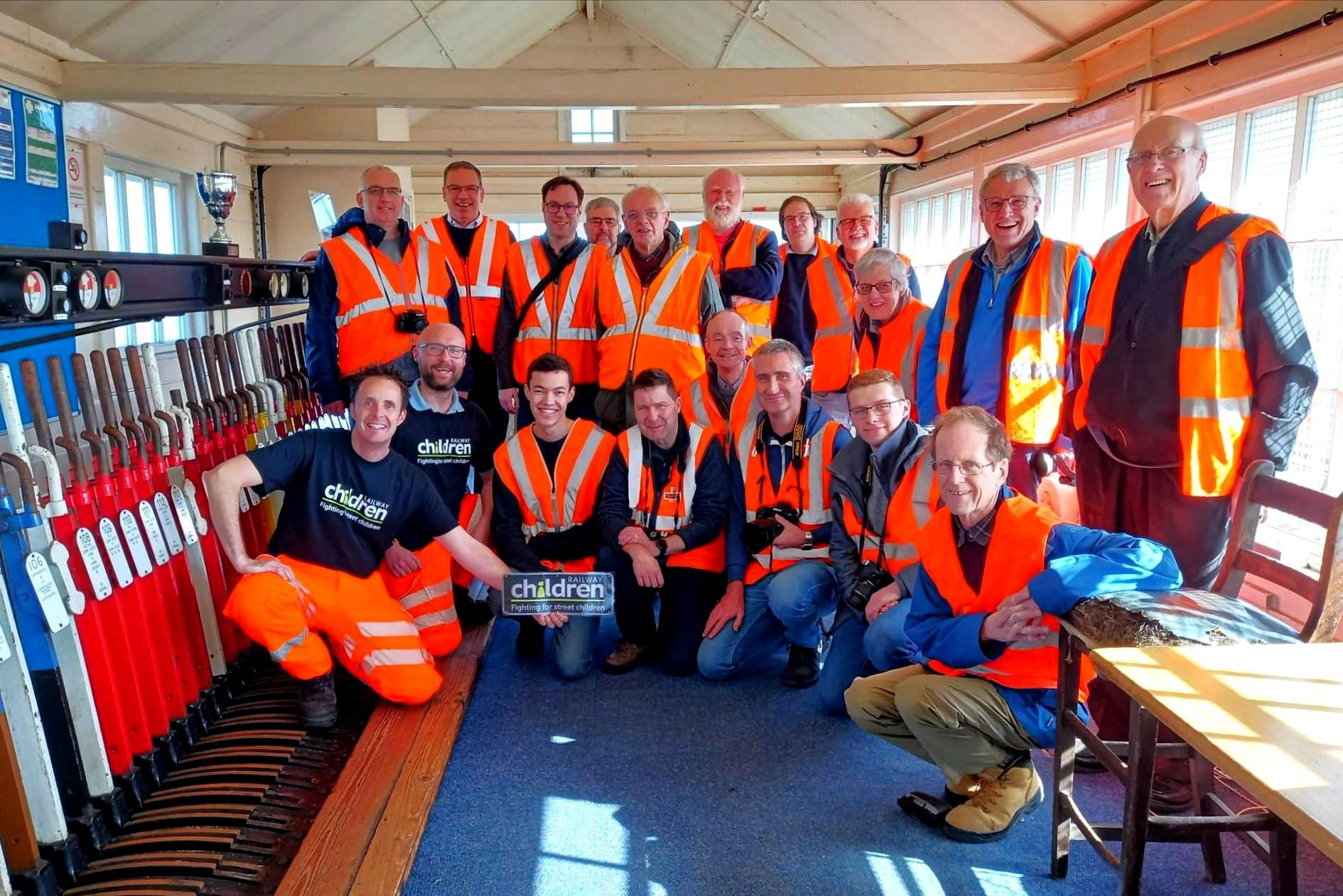
Group photograph, standing, second right is Nick Garnham, your BLN East Midlands Editor. The two Mobile Operations Managers are crouching far left.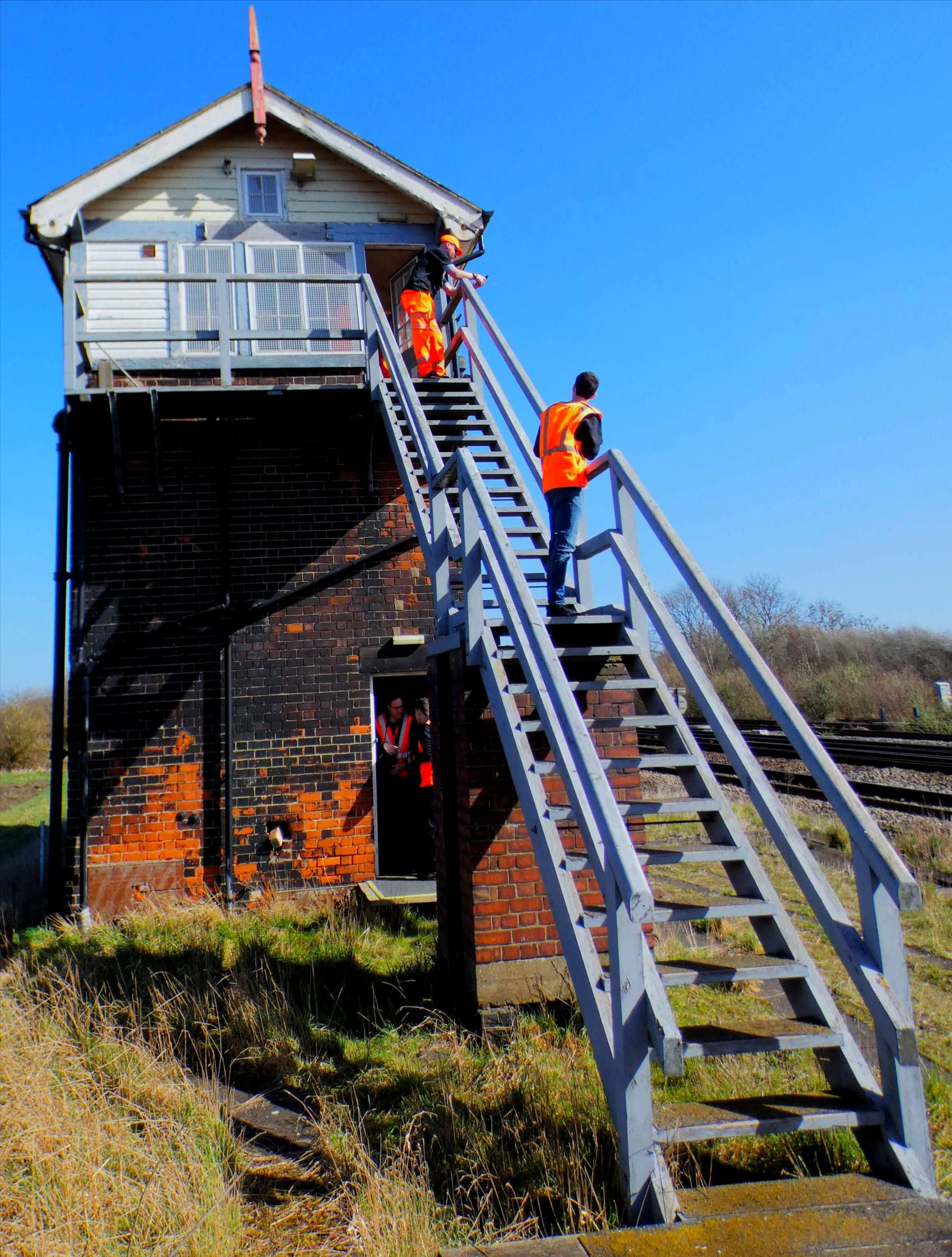
The very tall, now non-operational, Wrawby Junction box looking east towards Barnetby station. Note that the ground level Locking Room was kindly opened for participants to see as well.
[© Nick Jones 2023]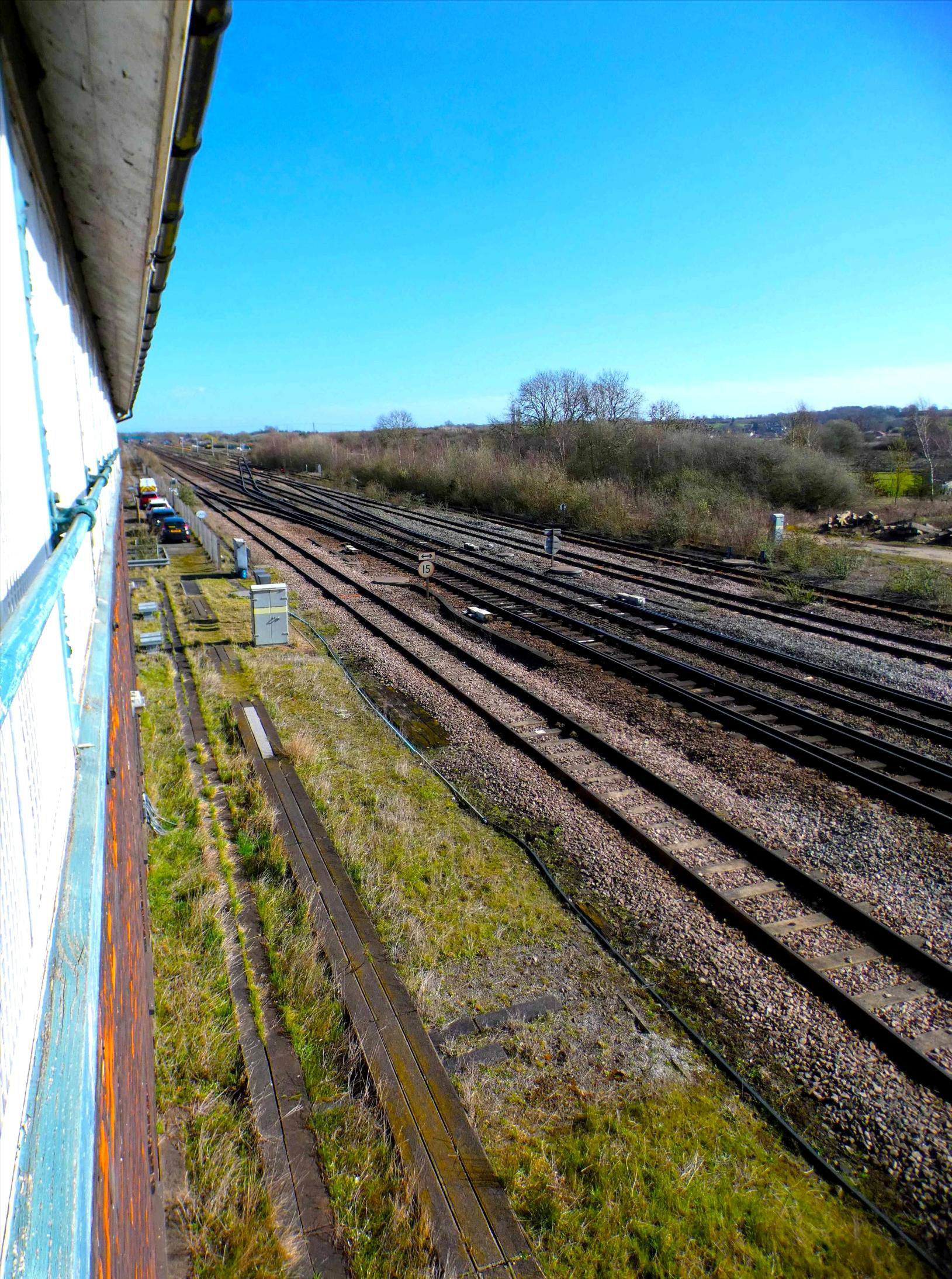
View east towards Barnetby station in the far distance.
[© Nick Jones 2023]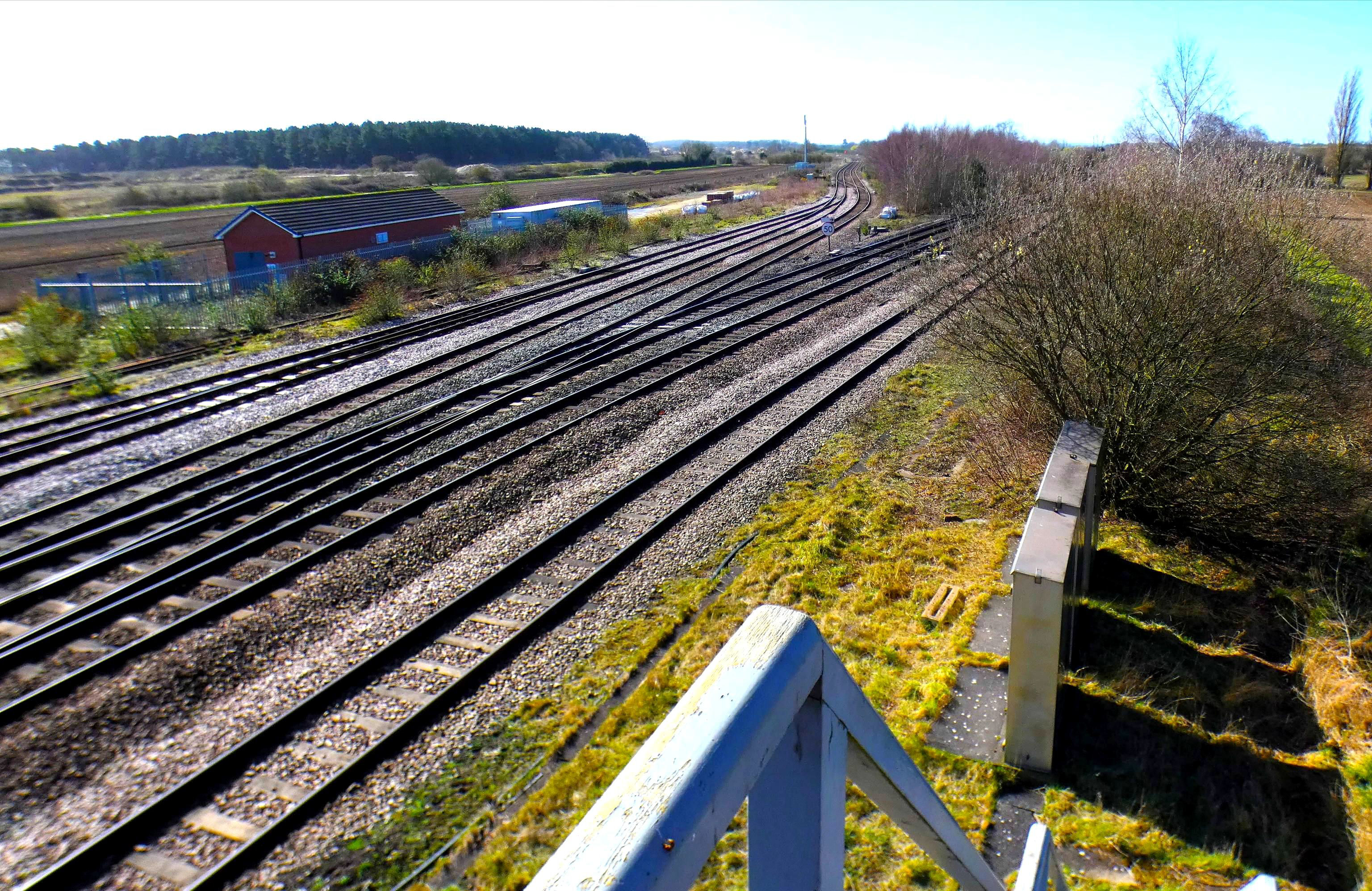
The view of the triple junction west, to Lincoln and Newark far left, Brigg and Gainsborough / Scunthorpe and Doncaster to the right.
[© Nick Jones 2023]Returning to Barnetby station, we paused to see the recently refurbished Barnetby Up Ground Frame (GF) controlling access to the Up Sidings (out of use on TRACKmaps 2 p30C 2020). 'Up' is towards Cleethorpes. It has two levers, a blue/brown release lever and a black lever controlling two point ends, namely the trailing connection to the Up Slow and a trap point. Although the sidings are not currently used, they may be resurrected. Meanwhile, as one end of the points is on an active running line and the other end protects the running line, it must be maintained in good order. From this 'point' on, we split into two separate groups of eight to avoid overcrowding at the smaller still operational boxes.
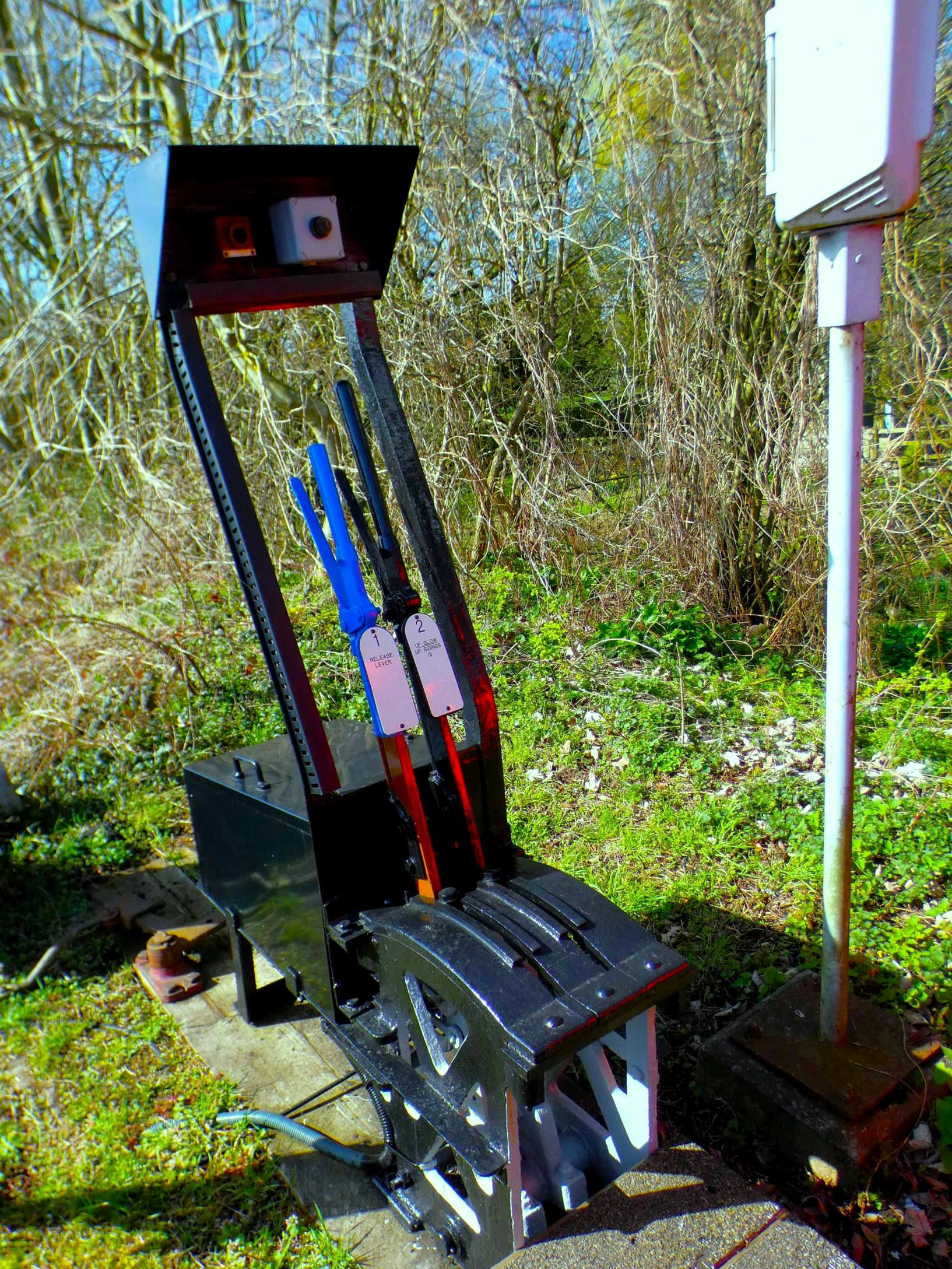
The recently refurbished Barnetby Up Ground Frame, could it have been painted red previously?
[© Nick Jones 2023]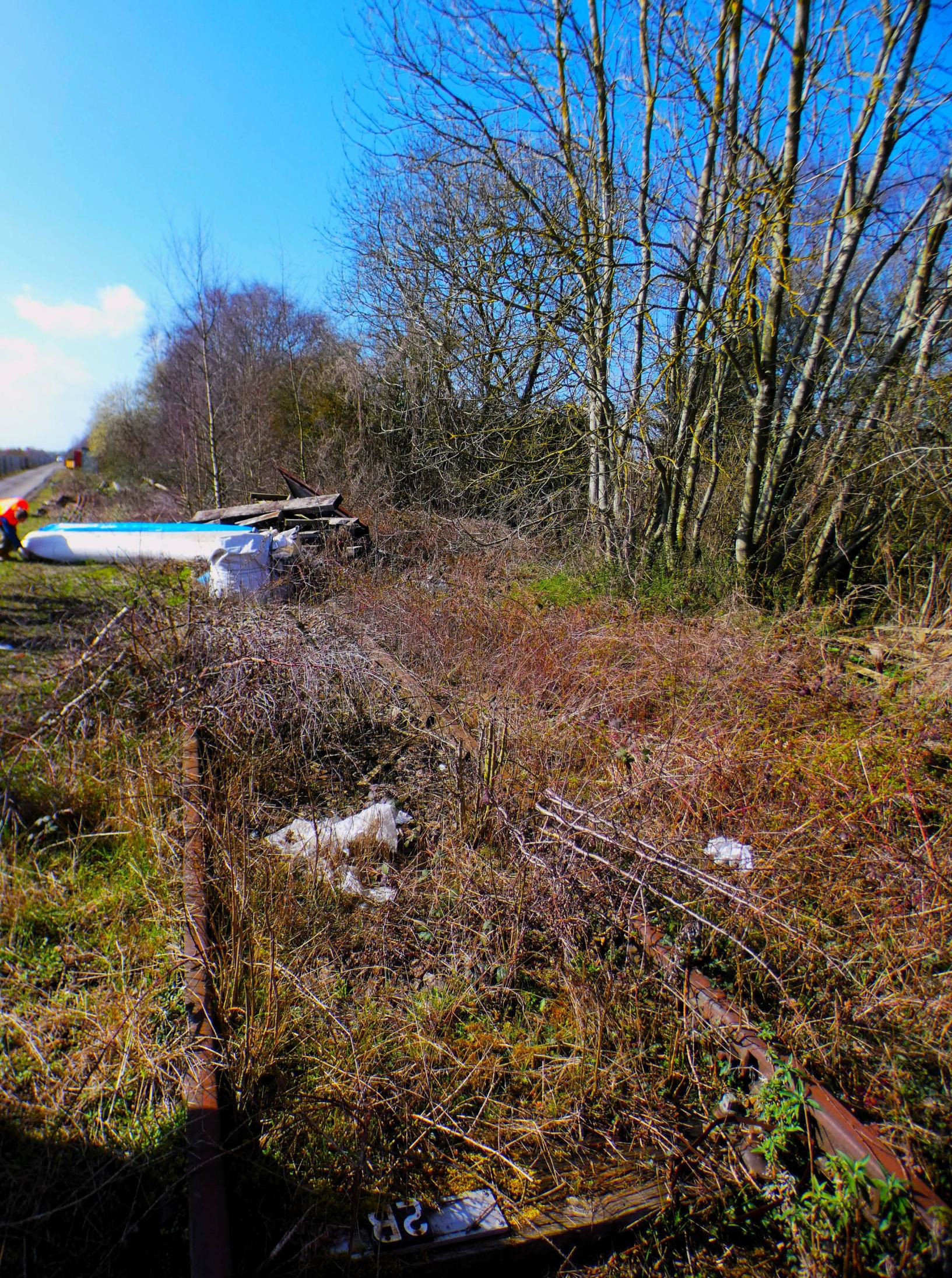
The access to Barnetby Up Sidings is well out of use… No, it is not a dead sheep.
[© Nick Jones 2023] (TRACKmaps 2 p31B 2020) I was in the group led by Doug Pratt, which went to Immingham West Jn box next. This was exciting as the box is normally impossible to see - even from the outside - because it lies within Associated British Ports' (ABP) Port of Immingham. Driving into the port, we passed 66177 hauling biomass from the Humber International Terminal (HIT) to Drax Power Station. The box is quite small, so we further divided the group, to visit the box two people at a time.
Its location (at 105m 06ch) seems odd at first as it is not aligned with any of the nearby tracks. The box originally controlled a triangular junction between the main port access line from Humber Road Jn (hence Ulceby), the branch via Killingholme to Goxhill and the lines to the west side of Immingham Dock. All three routes survive (albeit with Killingholme now the end of a branch and currently out of use), however the northeast side of the triangle (which the box was adjacent to) is no more.
The box opened on 25 Mar 1912 - shortly before the Port of Immingham was opened by the Humber Commercial Railway & Dock Company, in association with the Great Central Railway. It is a GCR Type 5 design but the lower half of the box is hidden by a blast wall constructed to protect the box during WWII. Immingham West originally had a British Pneumatic Railway Signal Co Ltd slide frame (similar to Immingham Reception Sidings seen later). However, this was removed in 1979 when the layout was radically changed and signalling is now controlled from two Individual Function Switch (IFS) panels.
The larger panel (to the right) controls the area from Western Entrance Level Crossing to the end of the Killingholme branch, plus the connections to the remaining terminals and quays on the west side of Immingham Dock and the Immingham Bulk Terminal. The original panel dated from 1979 but a replacement was supplied by National Rail Supplies (NRS) around 2002, presumably to accommodate the then new Humber International Terminal (HIT). This replacement panel sits in the old 1979 shell. The smaller panel, supplied by LB Foster (TEW) SM48 was commissioned on 7 Jul 2015. This controls the connection to, and lines within, the HIT itself. There is a complex illuminated diagram showing the whole layout (both panels). At first glance it took a little effort to understand because - like many such diagrams - it does not reflect the geographical layout. All the lines and branches run in the same direction (from a junction on the right, to a dead end on the left) on the panel, even though some run geographically in the diametrically opposite direction from each other! (TRACKmaps 2 p31B 2020)
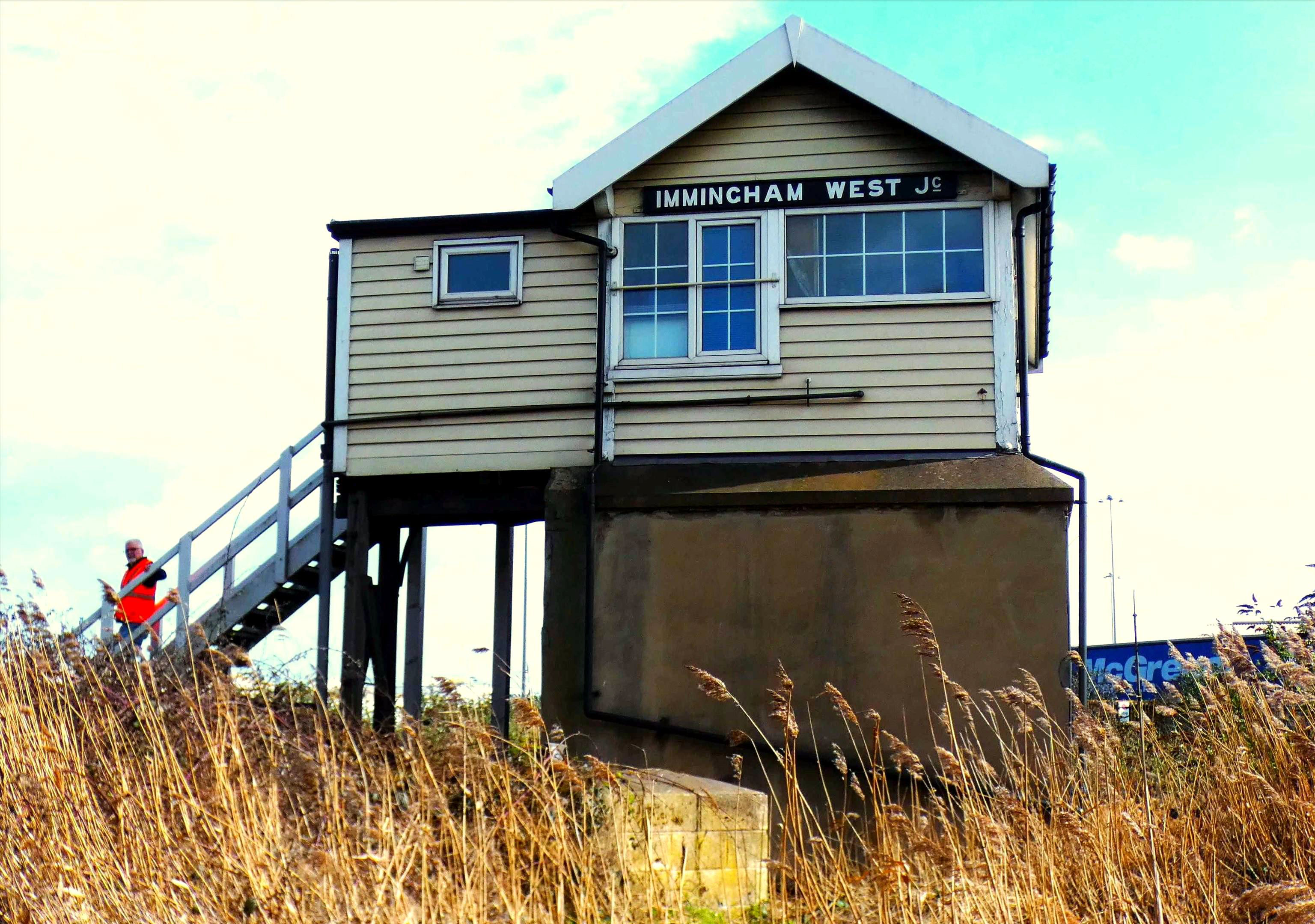
Immingham West Junction box;
[© Nick Jones 2023]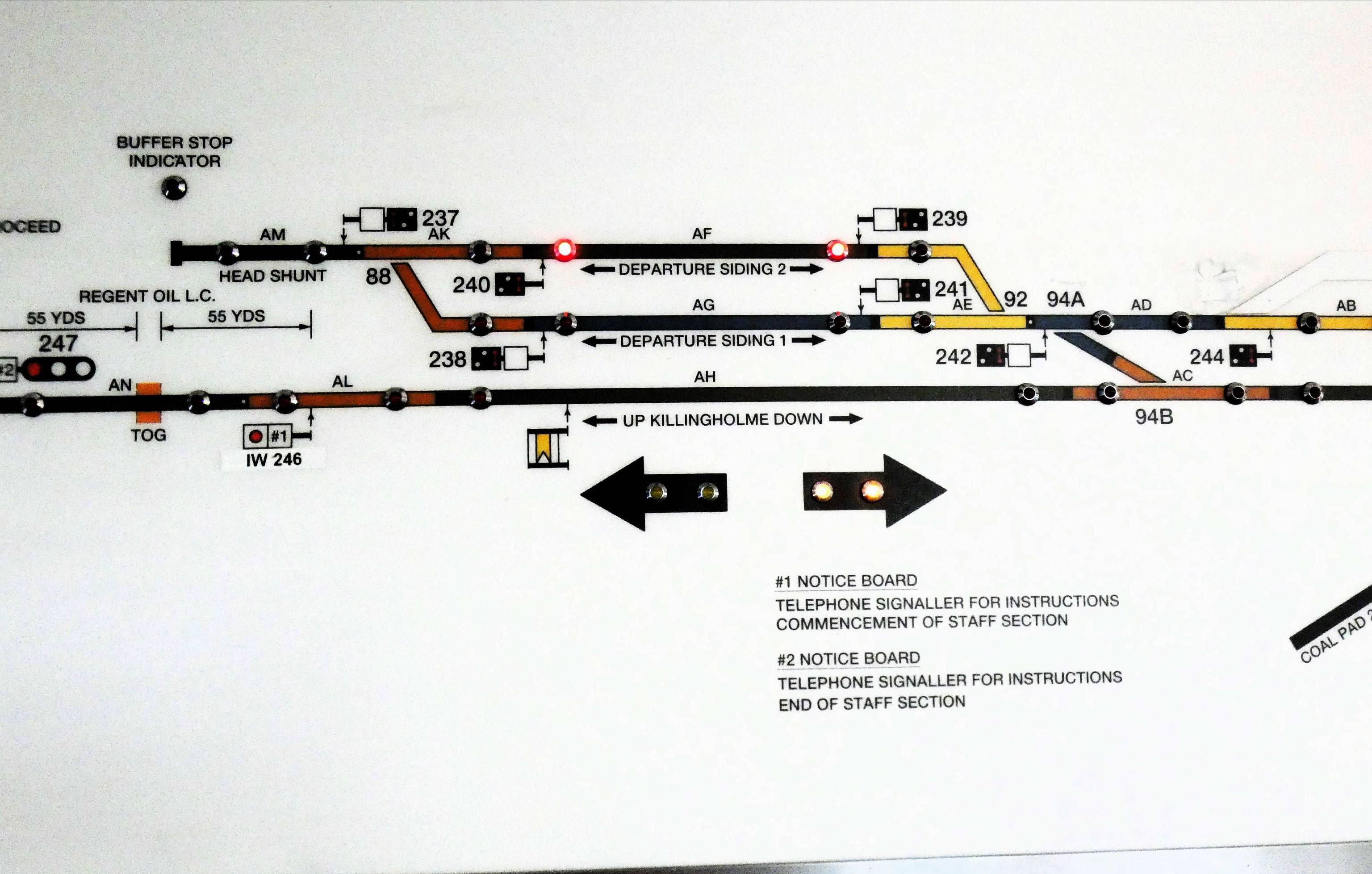
Immingham West Junction box; Humber International Terminal (HIT) diagram; Killingholme is off left and Immingham West Jn right.
[© Nick Jones 2023]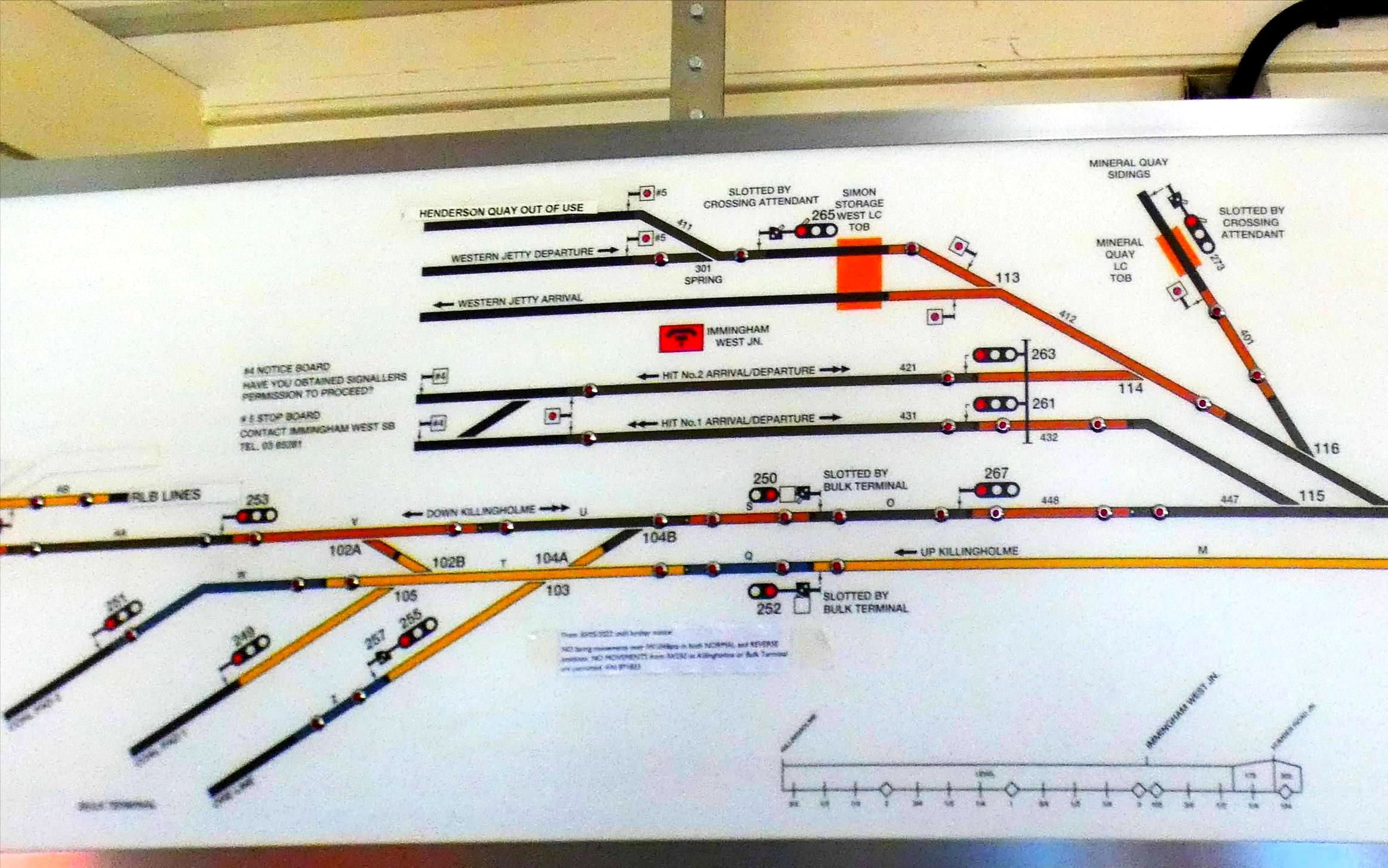
Immingham West Junction siding groups, HIT and Killingholme off left; it is non-geographical like many box diagrams (TRACKmaps 2 p31B 2020).
[© Nick Jones 2023]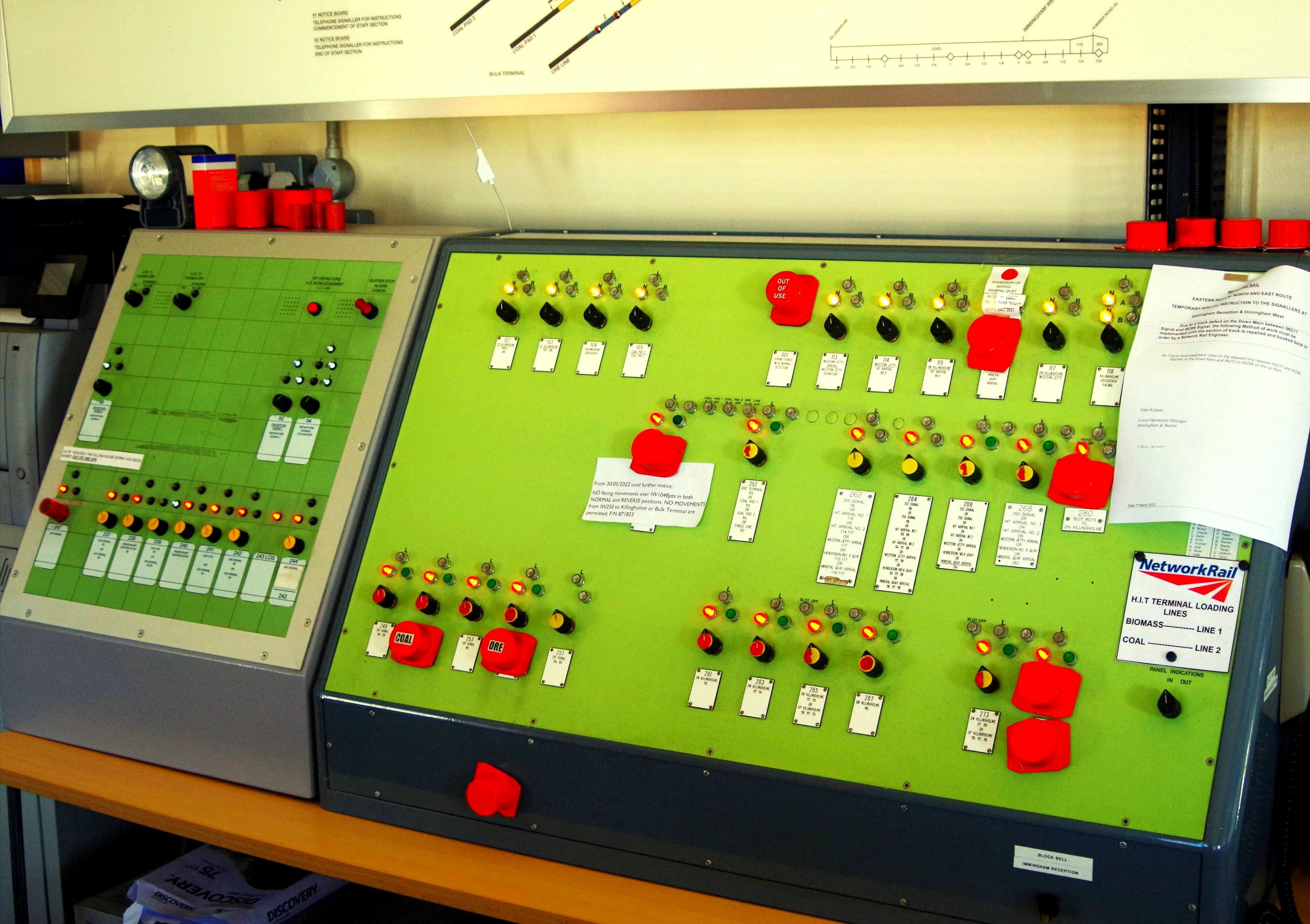
The panels at Immingham West Junction - the HIT panel is on the left.
[© Nick Garnham 2023] (106m 38ch) Leaving the port area, our next visit was to Oxmarsh Crossing. This brick built BR (Eastern) Type 16a box opened around 1960, replacing an earlier Railway Signal Co box. Until 1981, the line here was double track. However, following the closure of New Holland Pier to passenger ferries, the route to the original New Holland station and pier closed and a 'new' New Holland station opened 400yd southeast. The route north of Oxmarsh was singled and the formerly goods/ECS only east west side of New Holland triangle became the 'main line' to Barton-on-Humber. [Some of us went to great lengths to do that curve, suspecting the Barton-on-Humber branch might close when the Humber Bridge opened on 24 Jun 1981. In fact it had a railtour then an hourly service each way - later 'temporarily' cut, due to BR rolling stock shortages, to 2-hourly, which has persisted.]
However, this was not the end of the Oxmarsh story. In 1984, the former Up Line from New Holland to Oxmarsh was reinstated as a siding for freight to serve New Holland Bulk Terminal on the site of the former station. The freight traffic never really got going and had completely dried up by the late 1990s with the end of Speedlink, so only the passenger branch is active. The former freight siding had been derelict but intact between Oxmarsh and the terminal boundary gate for many years and only in the last couple of years has the physical junction been disconnected from the main line at Oxmarsh.
The box works Absolute Block over the double track to Goxhill; the single line to Barton-on-Humber is worked by a train staff. Rather than handing the staff directly to train drivers, the signaller now hangs it on a hook outside the signal box for the driver to collect. This procedure was originally introduced in response to Covid-19, to maintain 'social distancing' between the signaller and driver. However, the practice was found to be convenient and remains in use. To warn the Barrow Road crossing keeper of an approaching train from Oxmarsh, a 'Passenger Plunger' is provided. There is a similar 'Freight Plunger' which was used for the former New Holland siding but this is of course now redundant.
Oxmarsh has a now very rare example of a traditional wheel operated level crossing with four gates. In fact, only five remain on the national network and we visited two of them on this trip - Oxmarsh and Goxhill (!). The others are Holywood (north of Dumfries), Kirkham Abbey and Weaverthorpe, both on the York to Scarborough line. The crossing is controlled by a gate wheel which converts the winding action of the signaller into a rotating vertical shaft down to ground level, which indirectly drives the gate rods forward and back out of the front of the box to move the gates. A single brown Gate Stop lever (No2) has three positions - normal, normal check and reverse. Among its many functions, it primes the complex auto-raising gear (visible at the lineside) for the road gate stops and ultimately releases the protecting signals. A small hand lever on the side of the gate wheel completes the controls for the crossing; this locks the wheel (and therefore the gate rods) and releases the Gate Stops lever when in a specific position. Separately, brown No1 lever locks both wicket (pedestrian) gates closed to the road.
The signaller understood that the gate wheel had been removed from an earlier box here, the top half of which was said to have been destroyed by fire. Indeed, tucked away in a corner in the box, was a remarkable if heavily faded photo which appeared to show the signalman on duty, standing on an 'open air operating floor' next to the still installed gate wheel and lever frame. It was said that the vaguely recognisable gate wheel continued to be operated from the remains of the old box, apparently diagonally opposite the replacement (current) box, while the latter was being constructed.
All of the previously quite elderly semaphore stop signals were recently renewed with modern, mechanically worked, semaphores. When, separately, the level crossing roadbed here was recently upgraded, the former freight line was completely removed from the crossing and the area tarmacked, although the gates still close across all of the double track formation. It also appears that the box diagram will be upgraded, as a new mosaic-style diagram was seen, apparently awaiting installation.
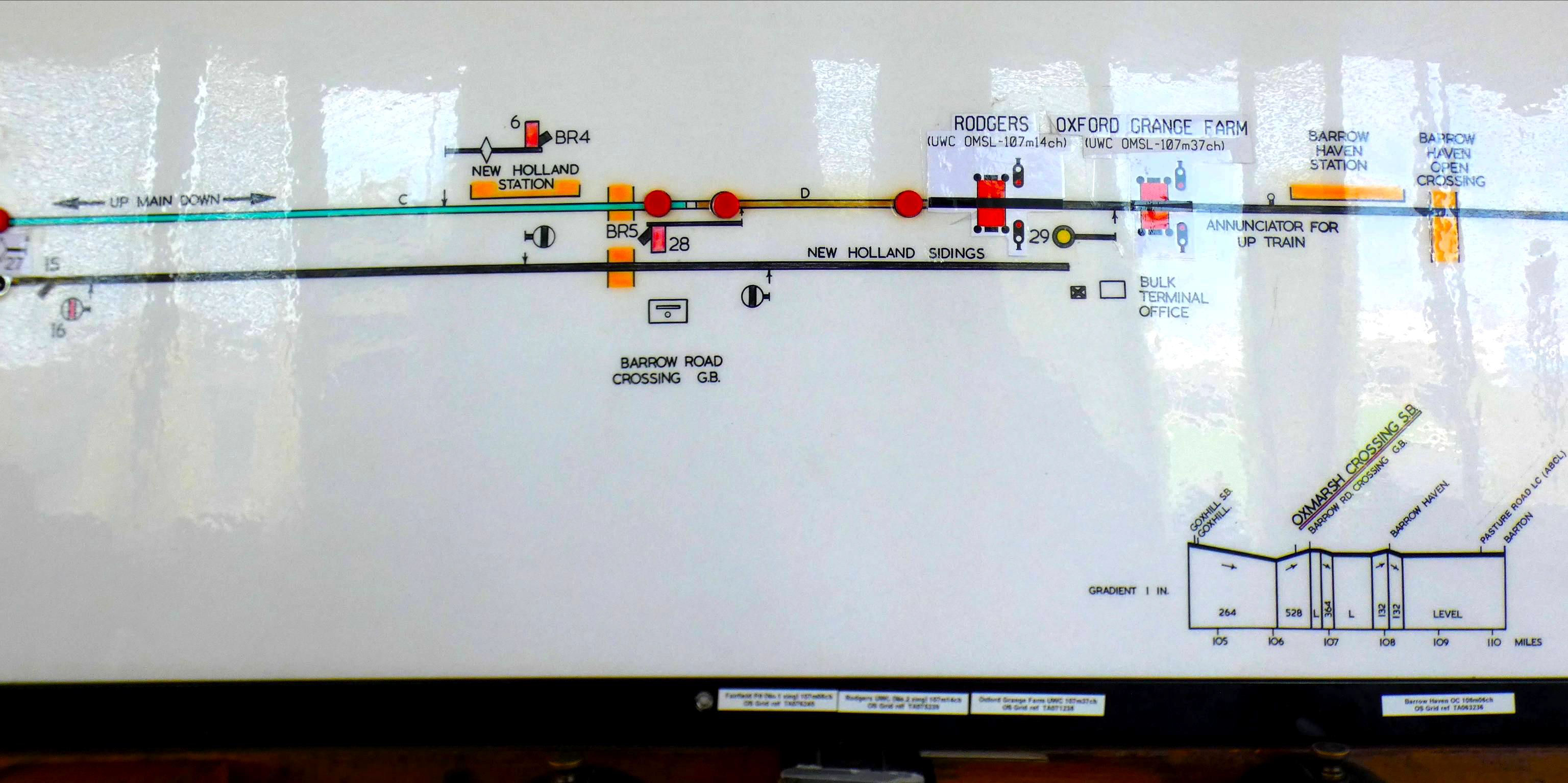
The Barrow Road Crossing and New Holland end of Oxmarsh Crossing signal box diagram.
[© Nick Jones 2023]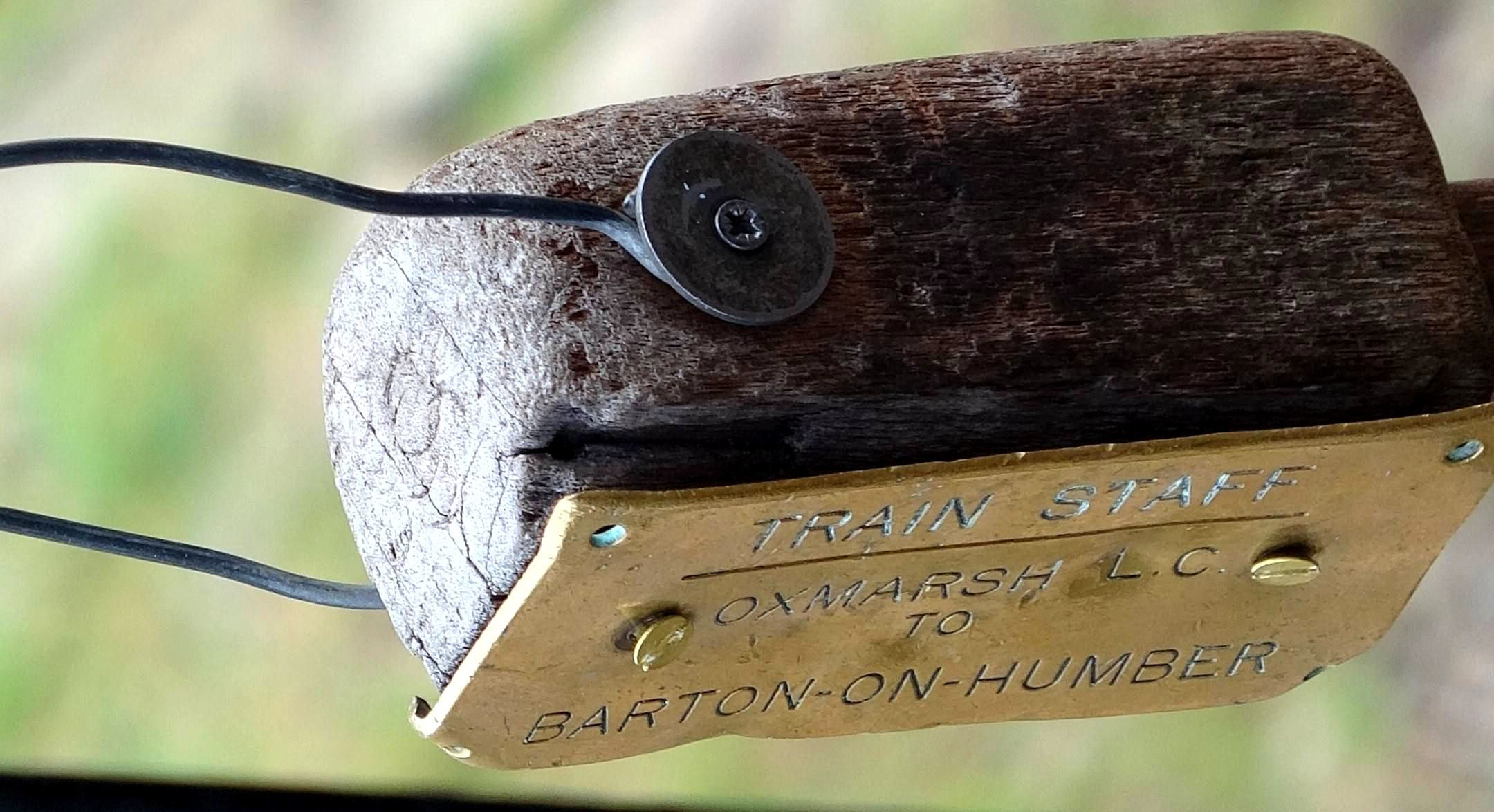
Who says that you can't get the staff these days? Nick Jones did!..
[© Nick Jones 2023]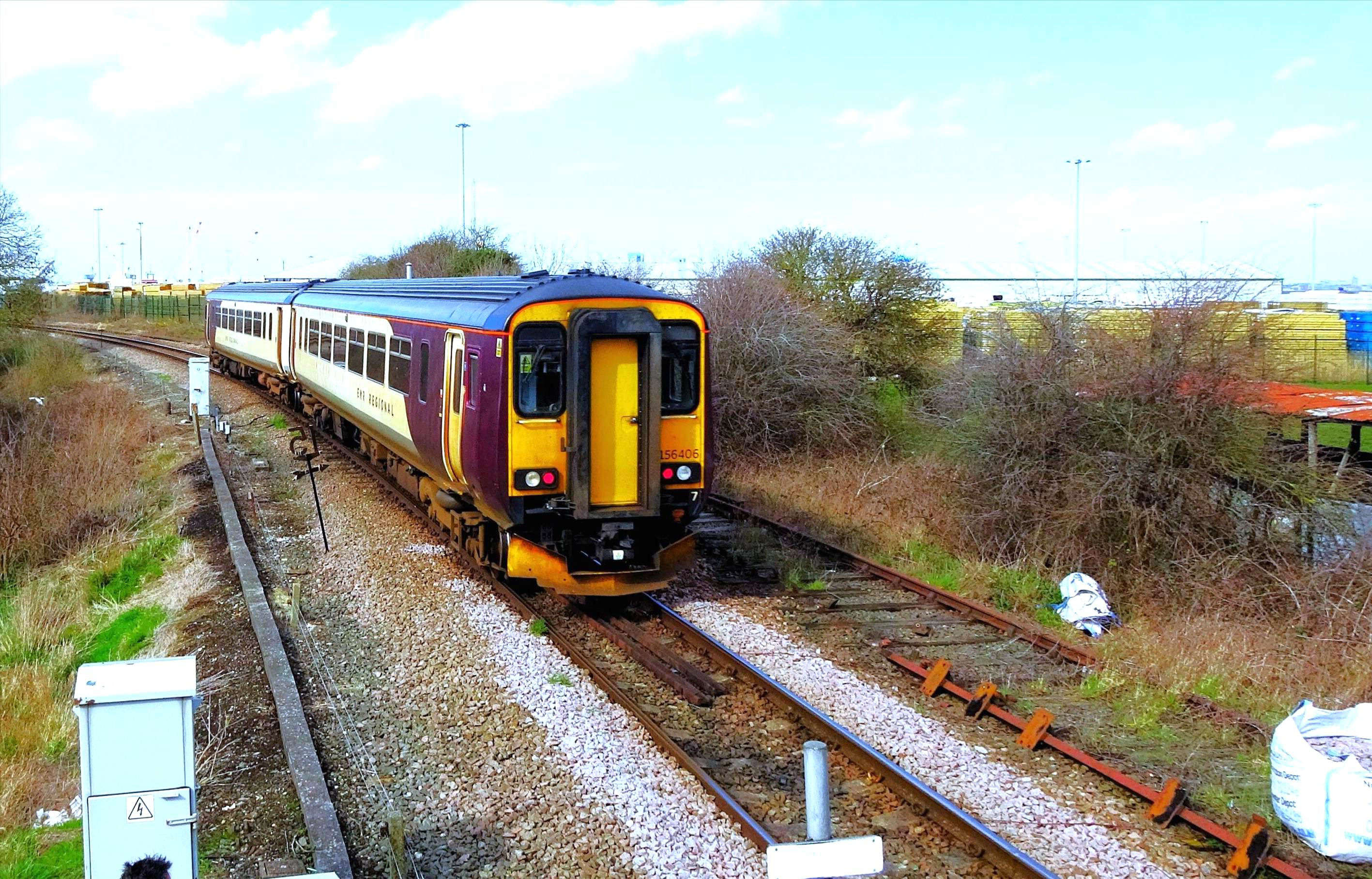
A Down train to Barton-on-Humber (off to the left) at Oxmarsh Crossing, the former Up line (latterly to New Holland Bulk Terminal) is right.
[© Nick Jones 2023]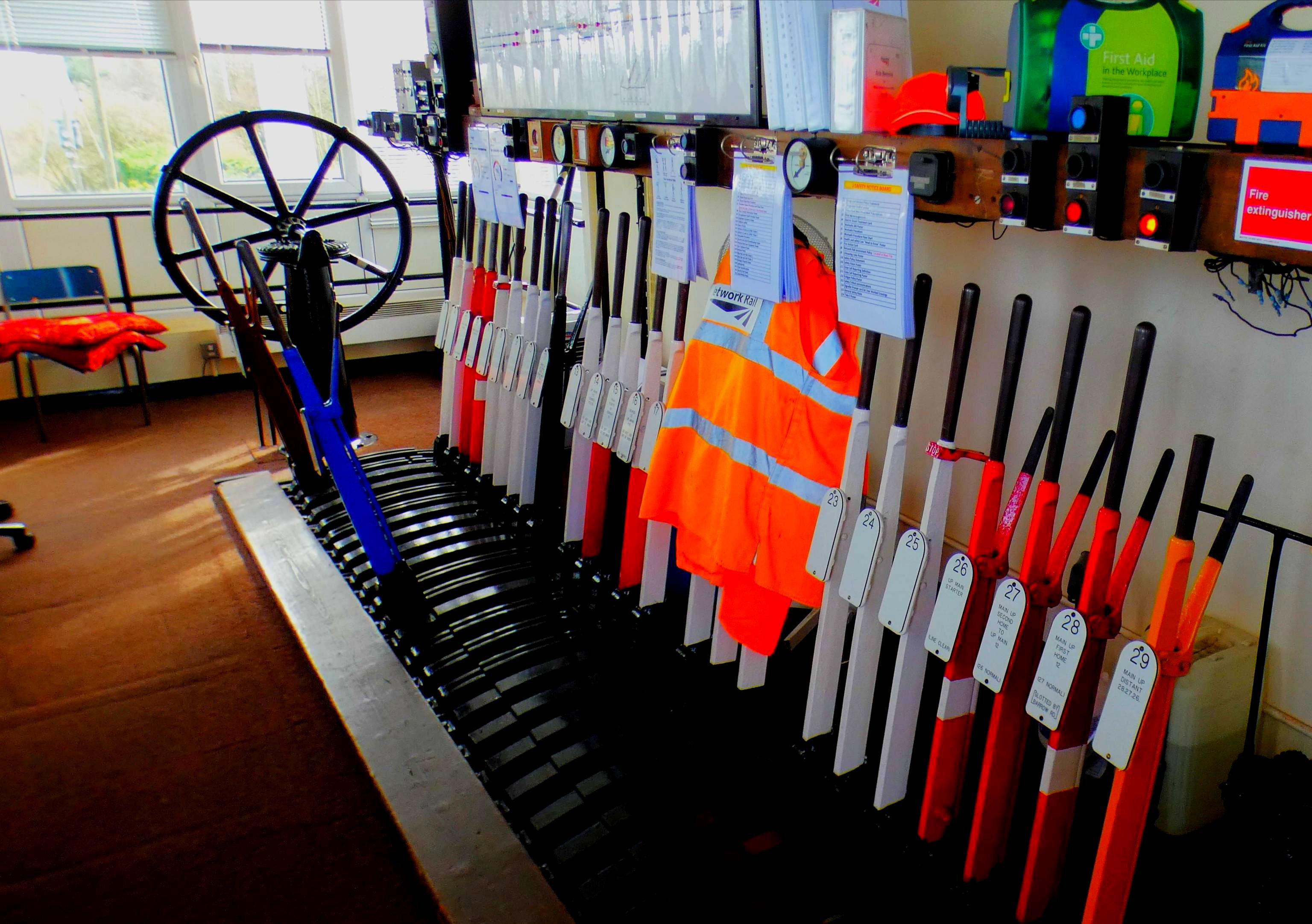
Oxmarsh Crossing and its traditional operational level crossing gate wheel..
[© Nick Jones 2023]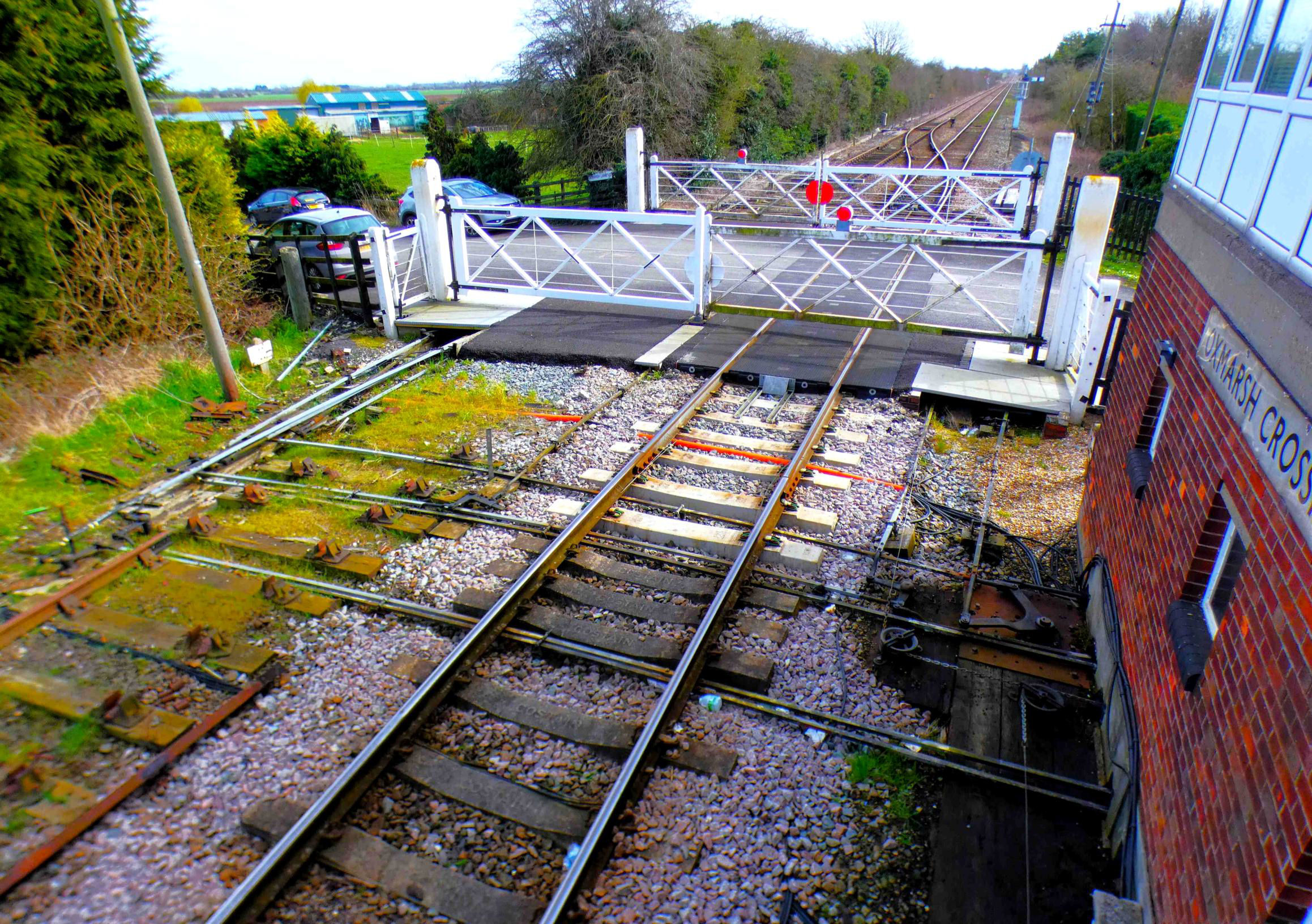
Oxmarsh Crossing, looking south towards Cleethorpes.
[© Nick Jones 2023]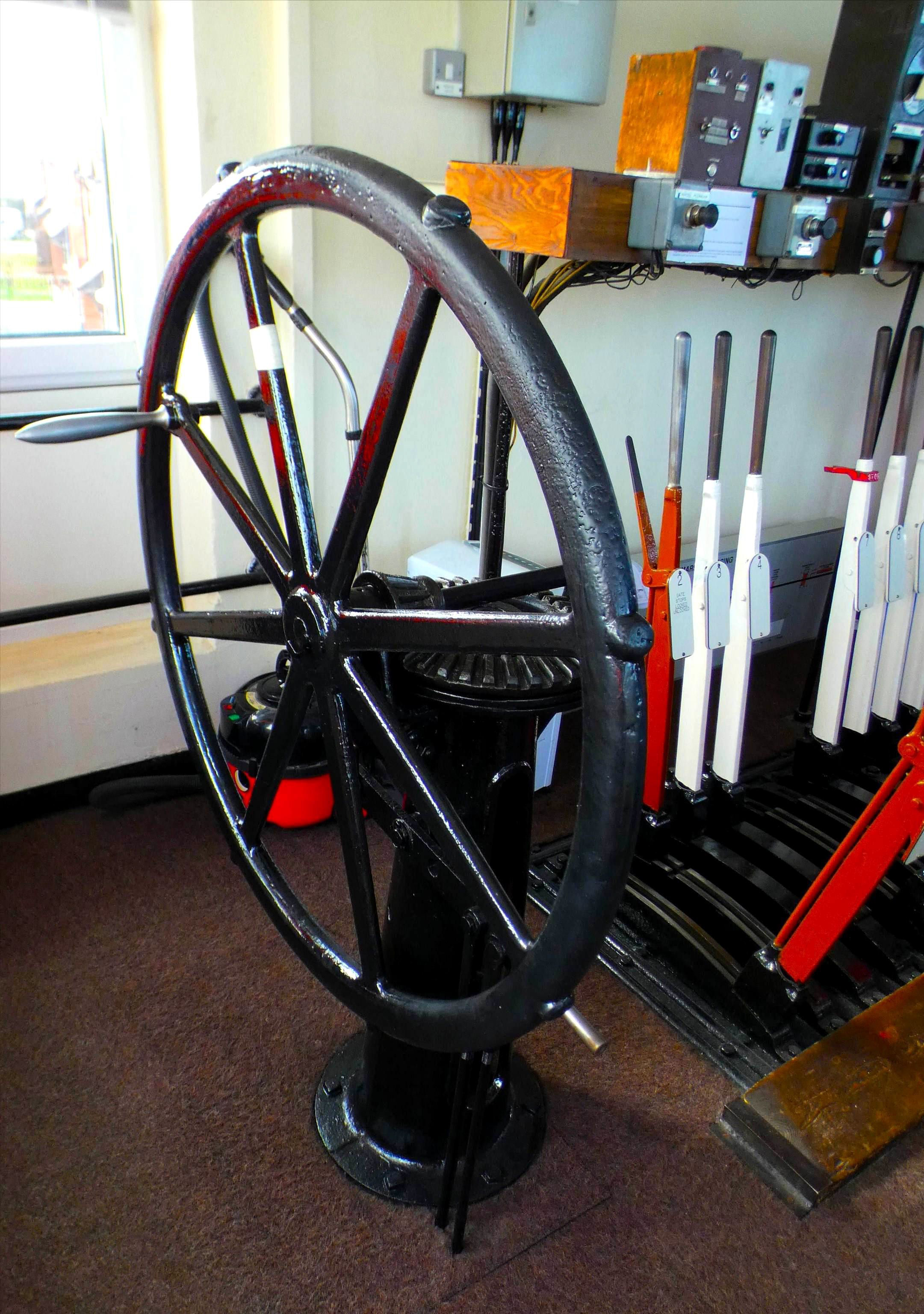
Oxmarsh Crossings traditional operational level crossing gate wheel.
[© Nick Jones 2023]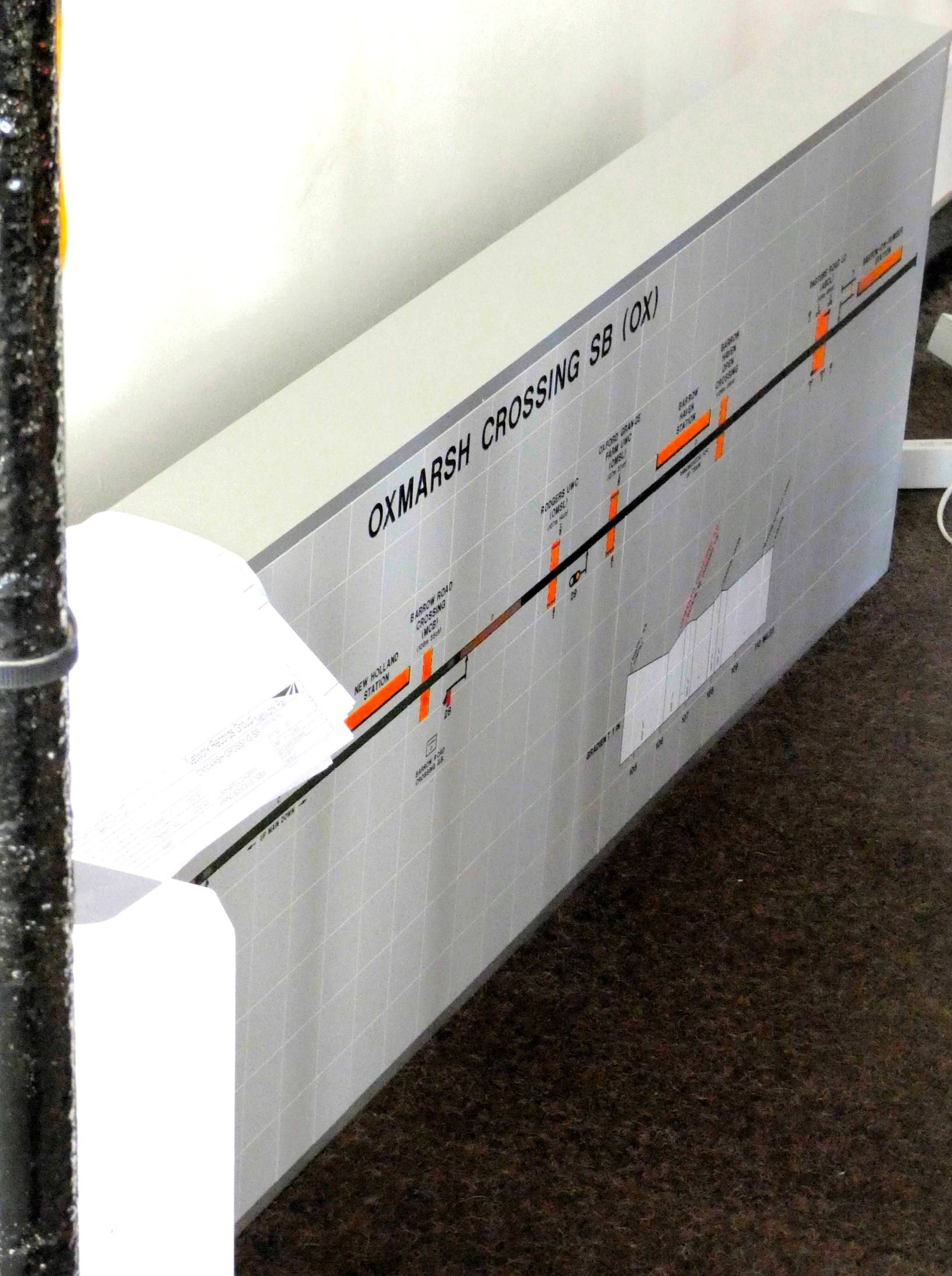
The new box diagram waiting to be installed (maybe after the summer Sunday services end?).
[© Nick Jones 2023] (106m 57ch) This has been a Gate Box only since 1981 (ie not a block post); its only function is to control the adjacent crossing which accesses the industries on the former New Holland Dock, Pier and surrounding area. The long disused track to New Holland Bulk Terminal was also removed from the roadbed at the level crossing in Summer 2020 to make road maintenance easier, prior to the hand operated co-acting gates being replaced by lifting barriers in early 2021.
There are only three working levers, one releases the barriers for road traffic and there is one for each of the two semaphore stop signals protecting the crossing. The signals are slotted with Oxmarsh, so a signal only clears if both the Oxmarsh signaller and Barrow Road crossing keeper have pulled their relevant levers. The box operates within the staff worked section between Oxmarsh and Barton.
Annunciators and 'Train Approaching' indicators are provided in both directions. These give the crossing keeper notice to lower the barriers, normalise the barrier lever and pull off the appropriate signal. The annunciator and indicator for approaching Down trains (from Oxmarsh) are activated manually by the Oxmarsh signaller. However, for Up trains (from Barton-on-Humber), they are activated automatically when the train strikes a treadle at Barrow Haven station.
With an interesting nod to the much busier past, on the back wall of the box was displayed a signalling diagram of Barrow Road from the days when it controlled a busy junction and had 28 working levers with none spare. Then there were three tracks towards New Holland Town: Up Main, Down Main and a Middle Siding which had a double slip part way along it, The New Holland 'avoiding line' was double track (Up Goods and Down Goods - now the single bidirectional passenger line, of course). There were various sidings and even a 'Loco Depot' with a crossover and single slip at its access. Contemporary diagrams for New Holland Town and New Holland Pier boxes were also shown; the latter still stands near the end of the pier that now forms part of the Bulk Terminal, although its lever frame is said to have been removed many years ago. Much disused track (latterly a coal depot) remains half buried at the Bulk Terminal and indeed, some survives on the pier itself, under the terminal conveyor system.
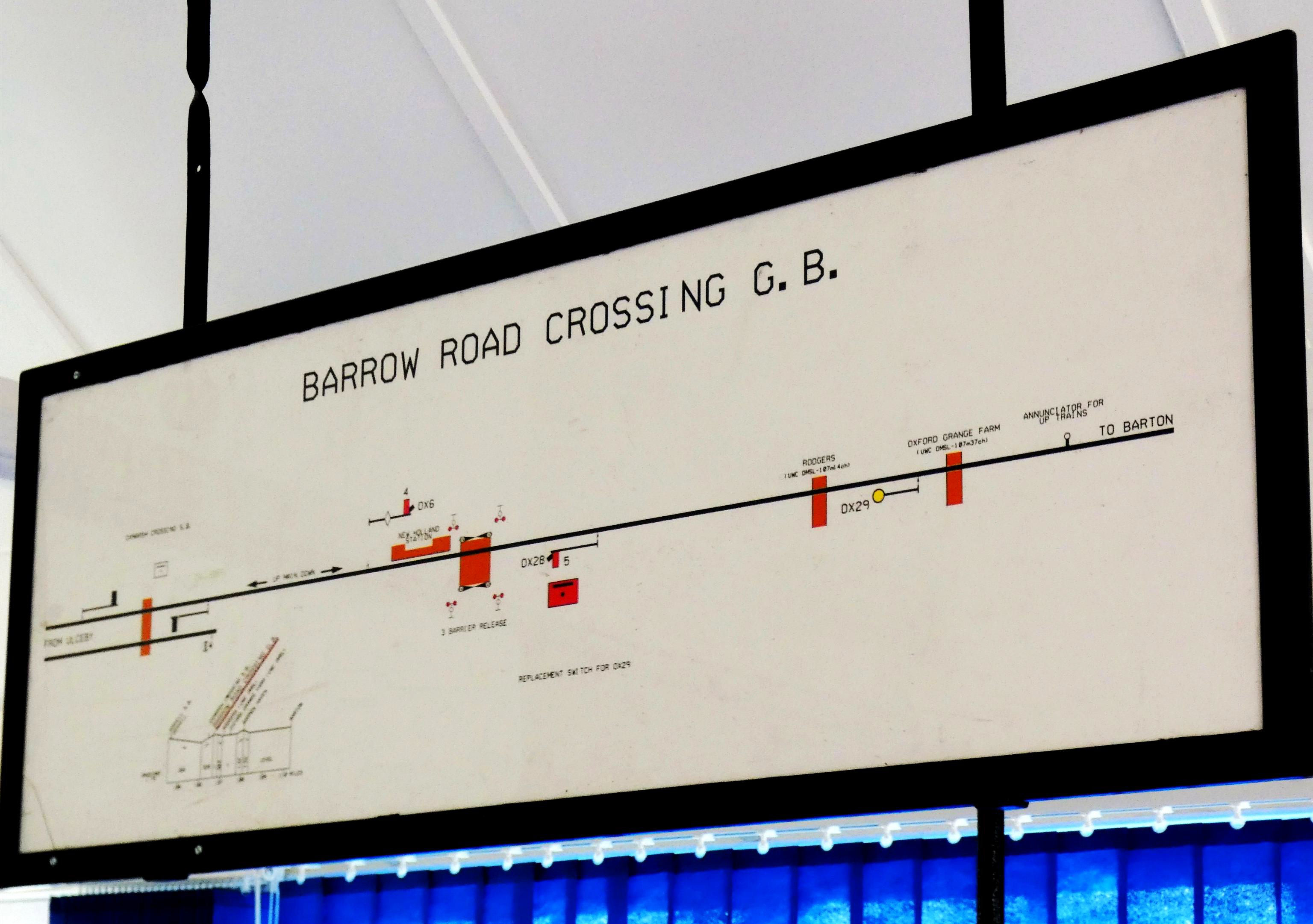
The Barrow Road Crossing gate box diagram.
[© Nick Jones 2023]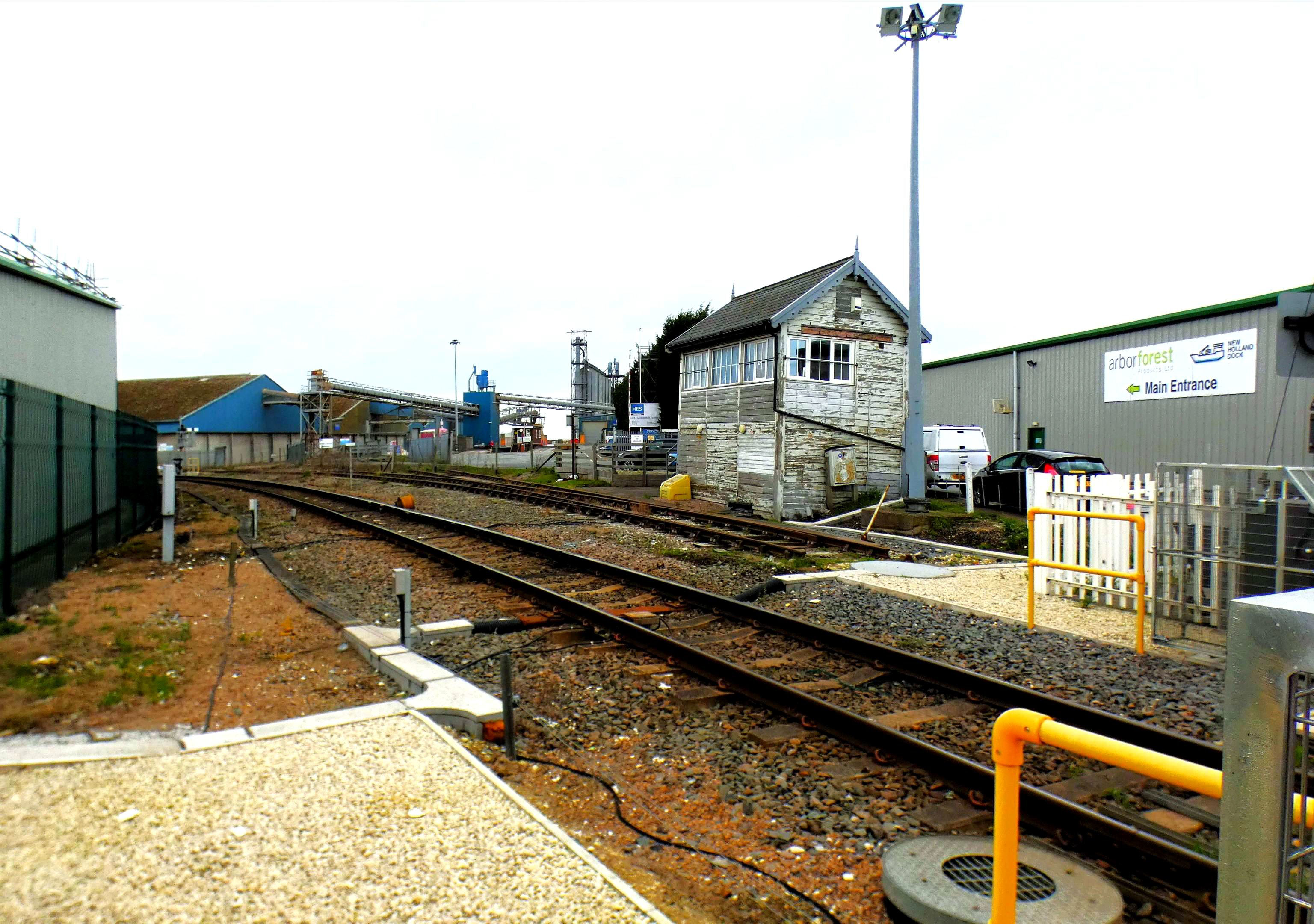
The rather decrepit exterior appearance of Barrow Road Crossing gate box, Barton-on-Humber is round to the left.
[© Nick Jones 2023]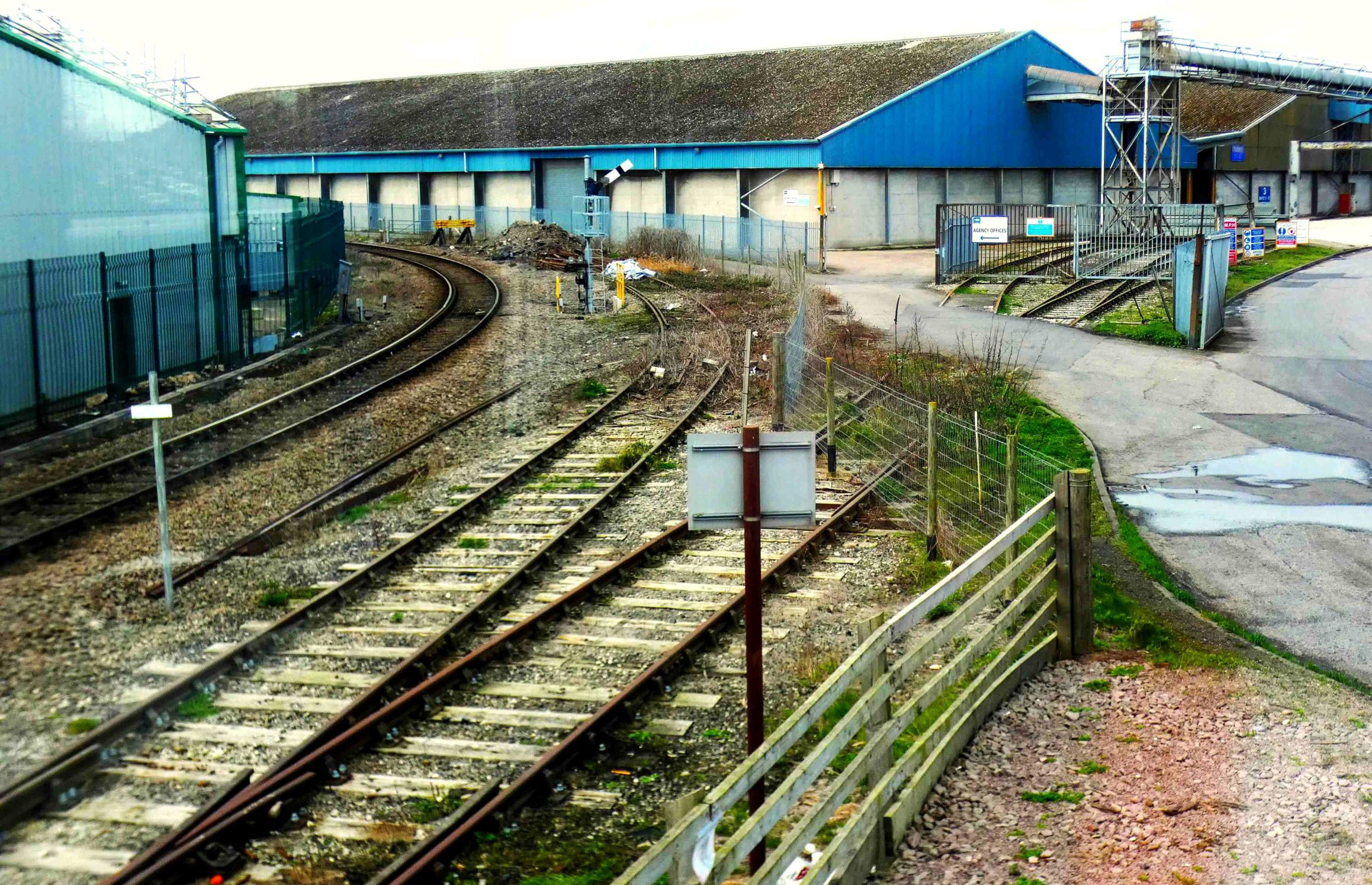
From inside the box towards Barton, New Holland Sidings are right; an Up train is expected from Barton.
[© Nick Jones 2023]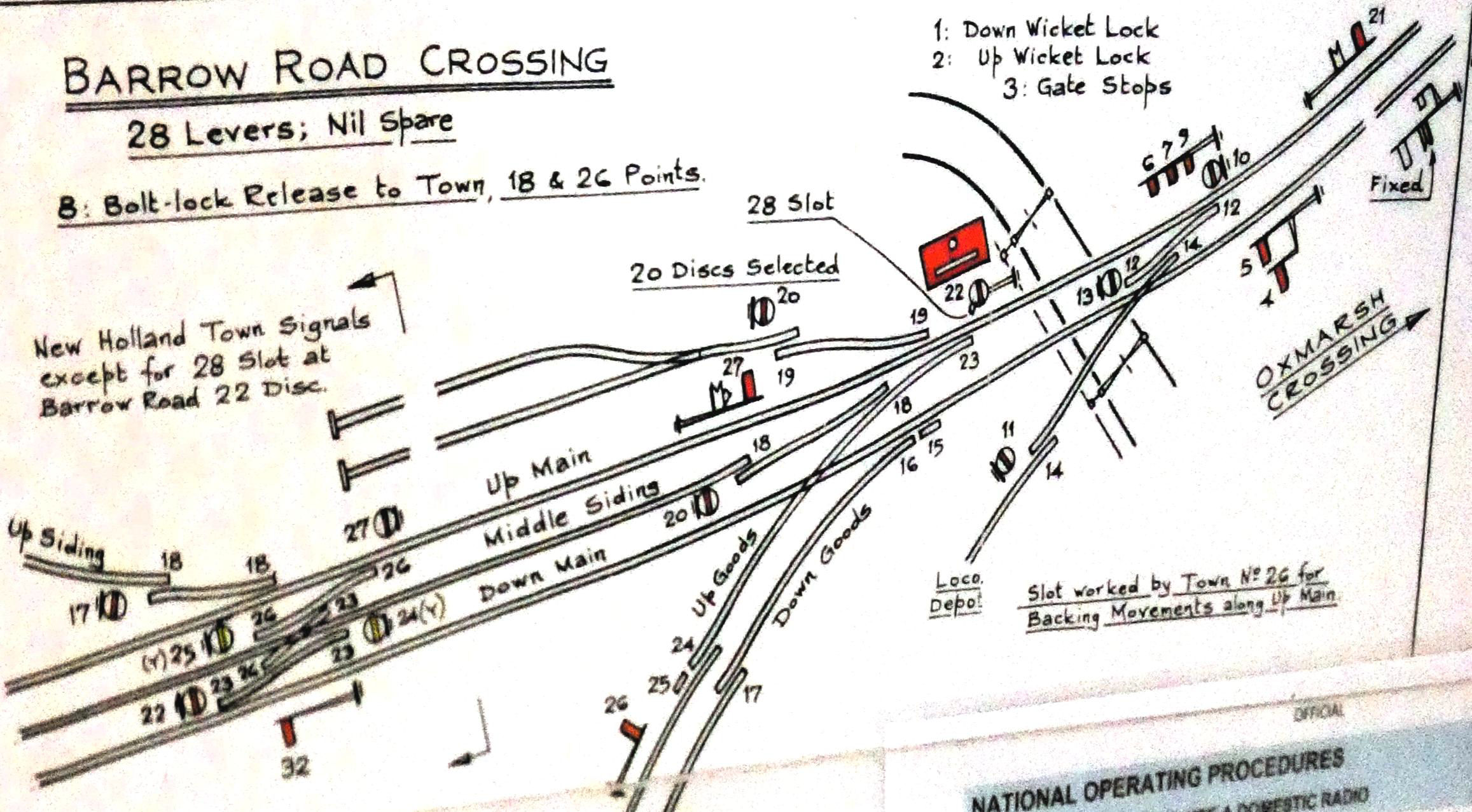
The glory days when Barrow Road was a proper signal box with 28 levers and no spares…
[© Nick Jones 2023]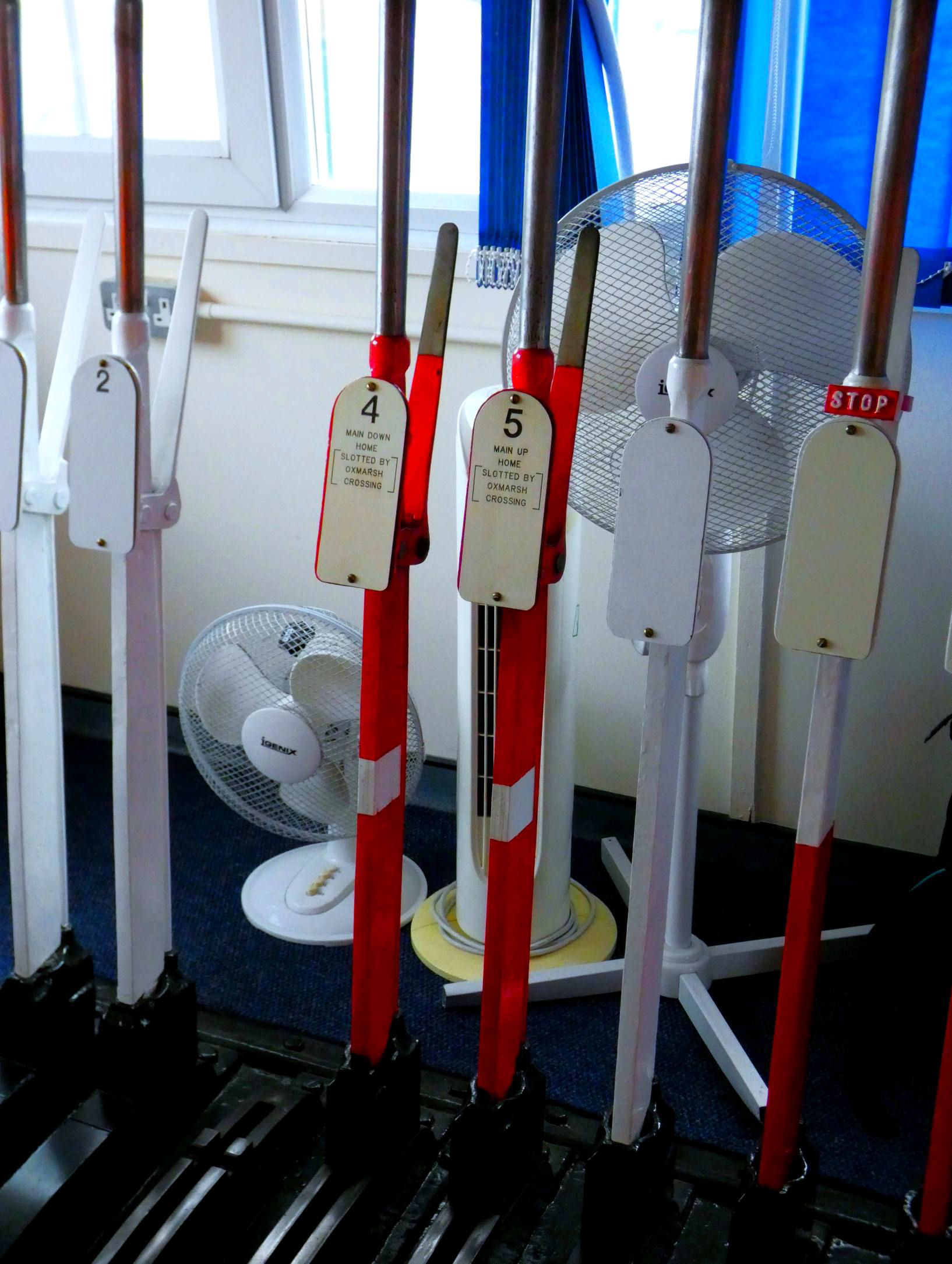
The slotted home levers. Our group of members weren't the only signal box fans present.
[© Nick Jones 2023]