The Katowice & Kraków Wanderer (Poland) - Part 4
Friday 12th May 2023 to Monday 15th May 2023
Report by Simon Mortimer
with contributions from Ian Hutton, Peter Green & Iain Scotchman (organiser).
Day 4 Monday 15 May:
So, the final day, utilising SM42 742 as originally planned, a few more bags were in evidence for some as they left hotels that had been home for the last three nights.
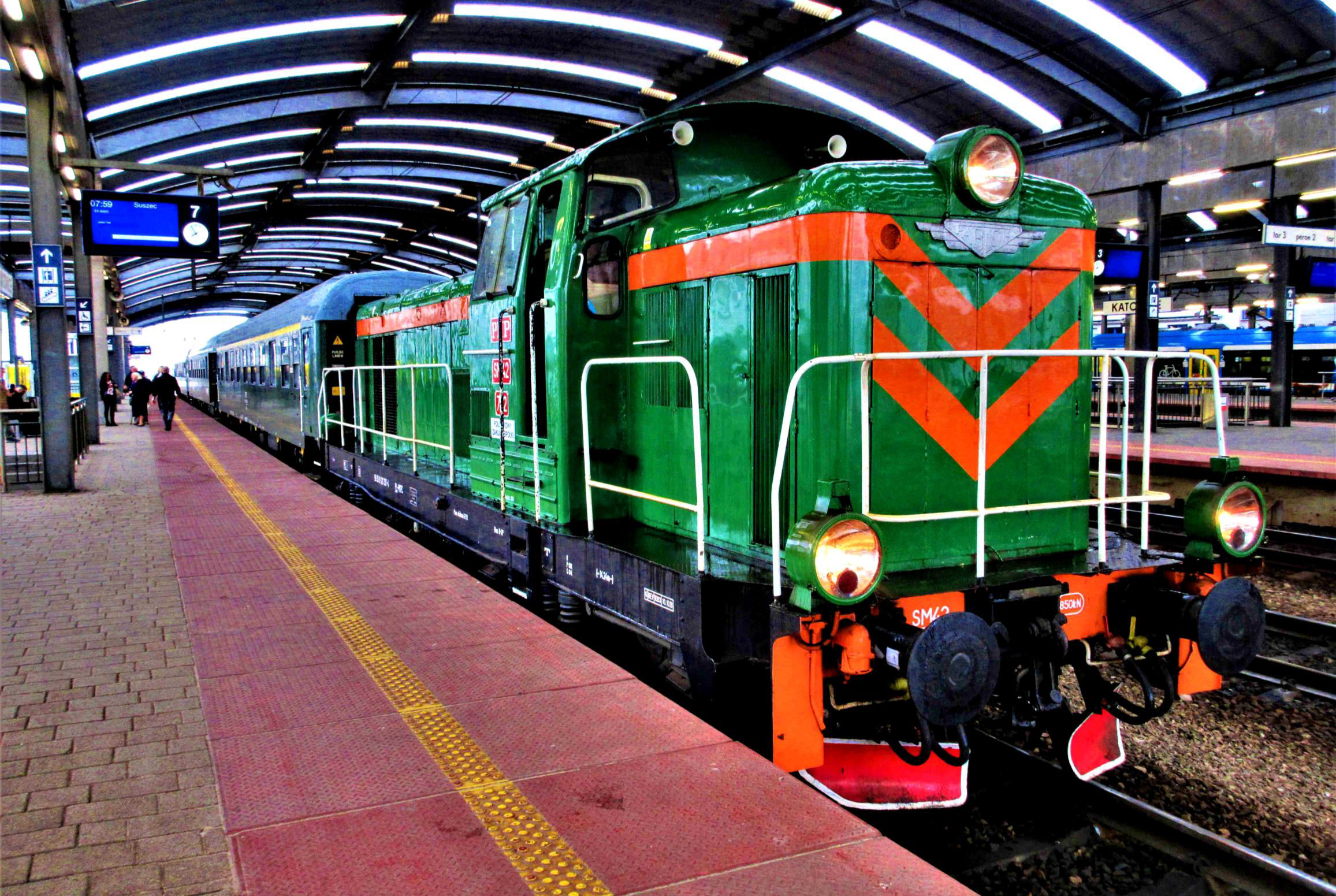
Katowice Glówny (Glówny = Main) SM42 742 stands on load three on the final day of our railtour.
[© Simon Mortimer 2023]From Katowice Glówny, via flyover Line 656, we took the standard passenger route to Zabrzeg. Here, compared to one of those obliterated routes of a few years ago, the main east west Line 150 appeared now largely back intact. Instead of the main line, we were booked through the freight yards on the north side. This was slightly ironic for those of us who had not done the normal passenger route but had done the yard roads on the long standing diversions. This being a railtour, of course, we did the same yard lines on Line 692 all the way to Chybie and not the requested alternative, on the far north side but hey ho. Here we turned back northwards along Line 157, built in the mid-1920s by PKP (which, as you all know by now, is Polskie Koleje Państwowe = Polish State Railways) and which is freight only bar a weekend plus skeletal dated pair of services. We took this route to podg* Debina and swung left to Pawłowice Śląskie which now marks the end of PKP metals. The line beyond here had a passenger service but is now owned by the coal company JJastrzębska Spółka Węglowa (JSW). You will recall from Day 1 that we were unable to do any of their lines for legal reasons (no passenger safety case).
[*For the last time, podg = posterunek odgałęźny, literally 'separate post' or 'branch post' - a 'junction'.]
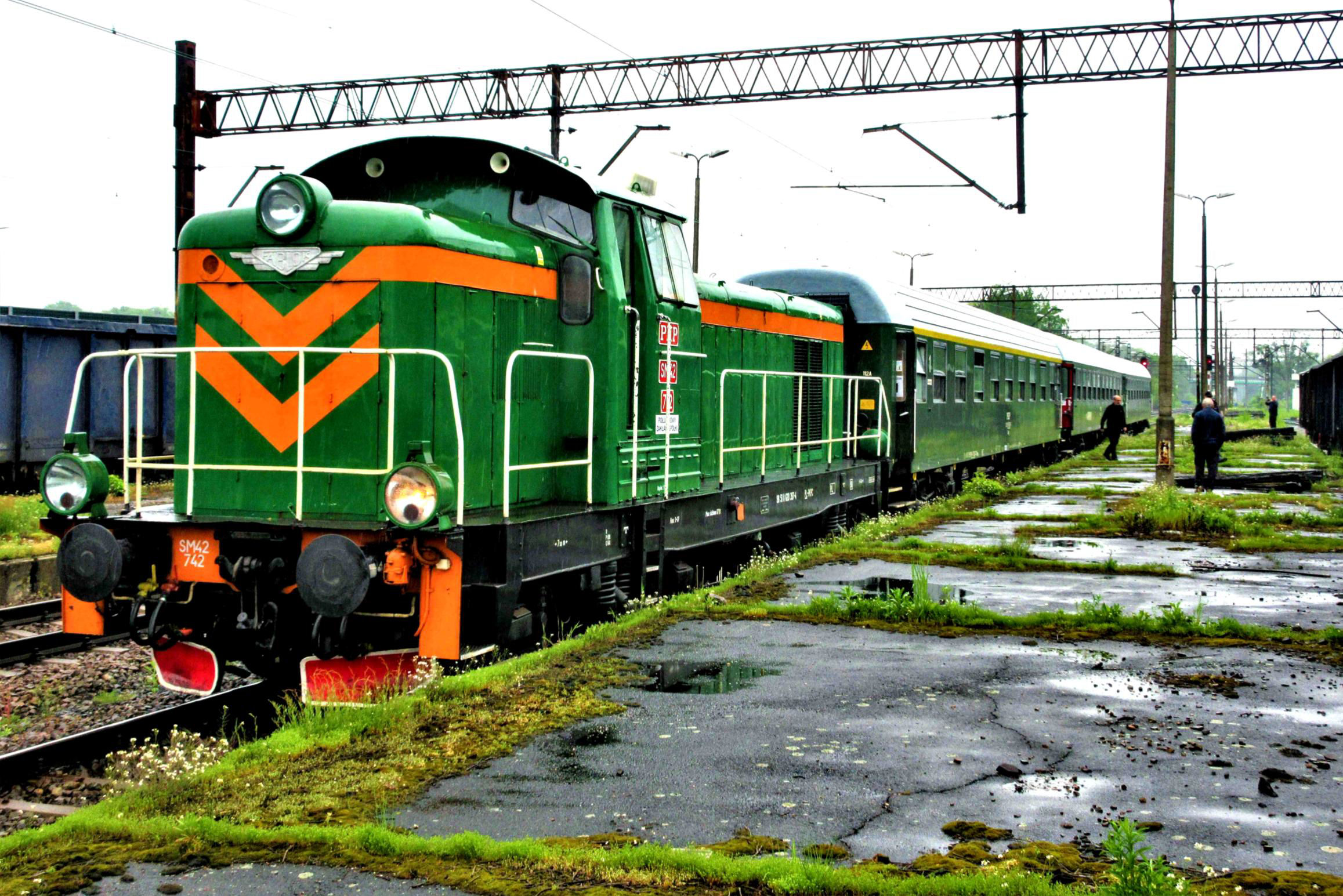
Awaiting run round at Pawłowice Śląskie, the current end of PKP metals, on an incredibly moss strewn platform.
[© Simon Mortimer 2023]The platform here is bare, covered in mosses and lichens, almost spongy underfoot. An approved Kolej Plus Programme plan (BLN 1429.1838) involves reinstating a service to Pawłowice Górnicze, not at this lonely spot but over a new line a few km long to the town itself. Having run round we took the west to north Curve 873 to eventually run into Żory and yes, run around again. We weren't looking to do this originally, rather the south to east curve south of Żory but this now belongs to JSW and there was a derailment recently, which they had not apparently repaired. PKP did offer to buy it and restore the route but JSW refused ... possibly as this might offer PKP a viable option to haul coal/coke traffic?
So, after the Żory reversal, we re-reversed at Susezc; the JSW power station branch en route appeared well out of use with vegetation across the rusty tracks. This brought us to Rybnik and an odyssey through the yard roads which had apparently been denied the day before. However, one person riding on the locos, with influence well beyond his power handle, had it reinstated at even shorter notice! We later discovered he is a PKP Director from Warsaw! No harm came to train or passengers.
Now, going round the back of a yard in British terms might just mean a parallel road five tracks over, but in Poland it's often a mini-railtour in its own right. We left Rybnik station and took Curve 957 past siganal cabin RTA and Yard Road 202 easily identified as they put up yard road markers... thanks PKP! (RTA etc is the designation on the signal cabin; so, this is Cabin 'A' at RT but what does RT stand for?)
On through the neck of the yard at RTB and to the next yard via Yard Road 308 and over Flyover 959 to gain Line 140 to Rydułtowy, where we ran round. Our sojourn here, while service trains passed, revealed a more typical country station completely abandoned and literally crumbling away. Its windows left open were being weathered down inside and out; at some point PKP has to sell off such buildings as these, a spacious property well located for commuters with ample scope for improvement or just bulldoze. We then retraced our steps back along Line 140. This time to ignore the flying junction route, passing cabin RTE on Line 959, cabin RTF and then take a choice chord from cabin RTF51 back into the yards' neck at cabin RTB, returning along Yard Road 202 going left around 688, to cover the curve towards Sumina. [Forget 'Painting By Numbers' - this is 'Gricing By Numbers'.] Here, after an odd propelling shunt a short distance onto Line 140 back towards Rydułtowy we … yes, you guessed it, reversed to run round in a different platform. At home it would be the 'Rybnik Rambler' and the end!
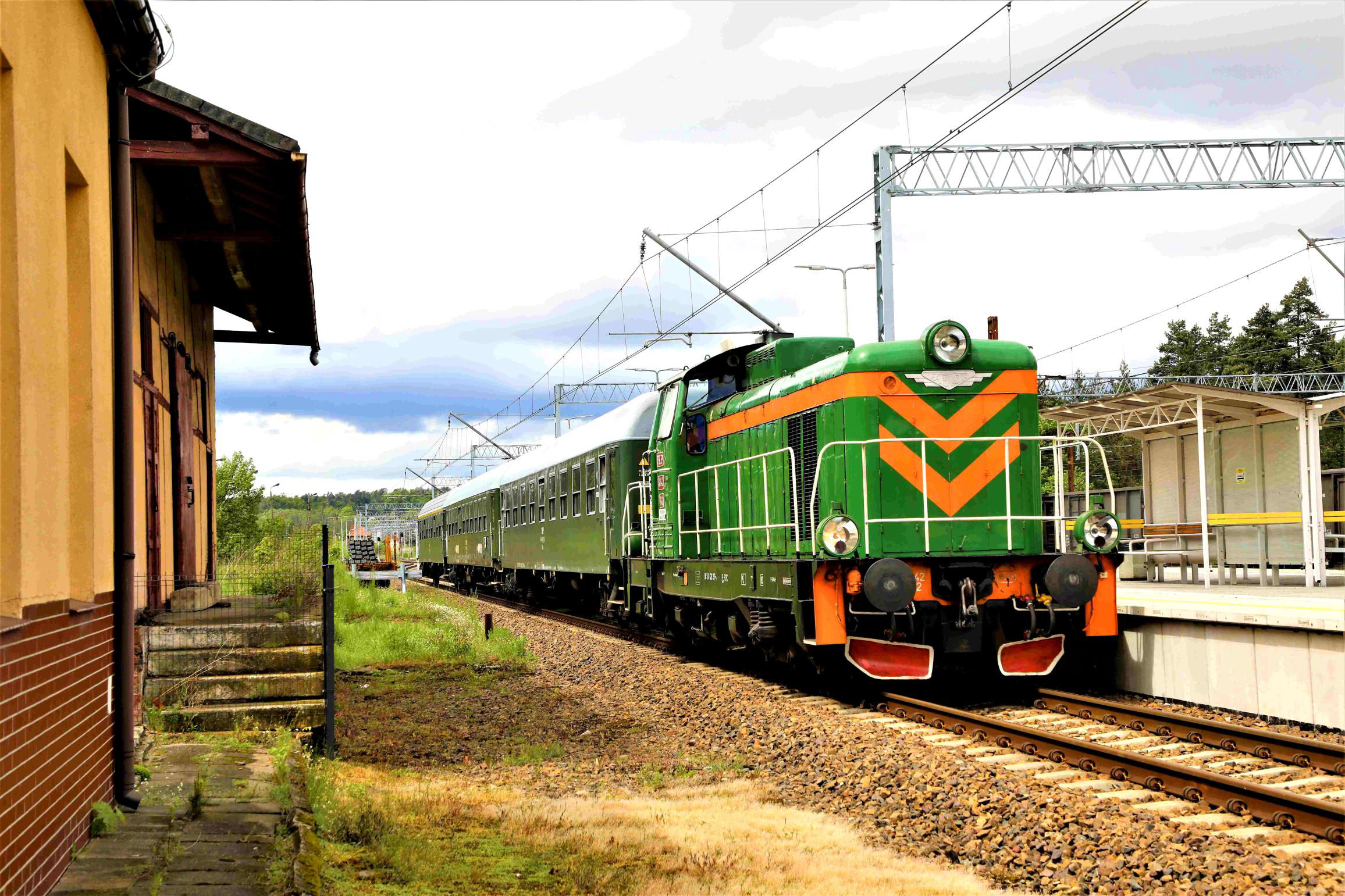
A photo stop at Sumina.
[© Iain Scotchman 2023]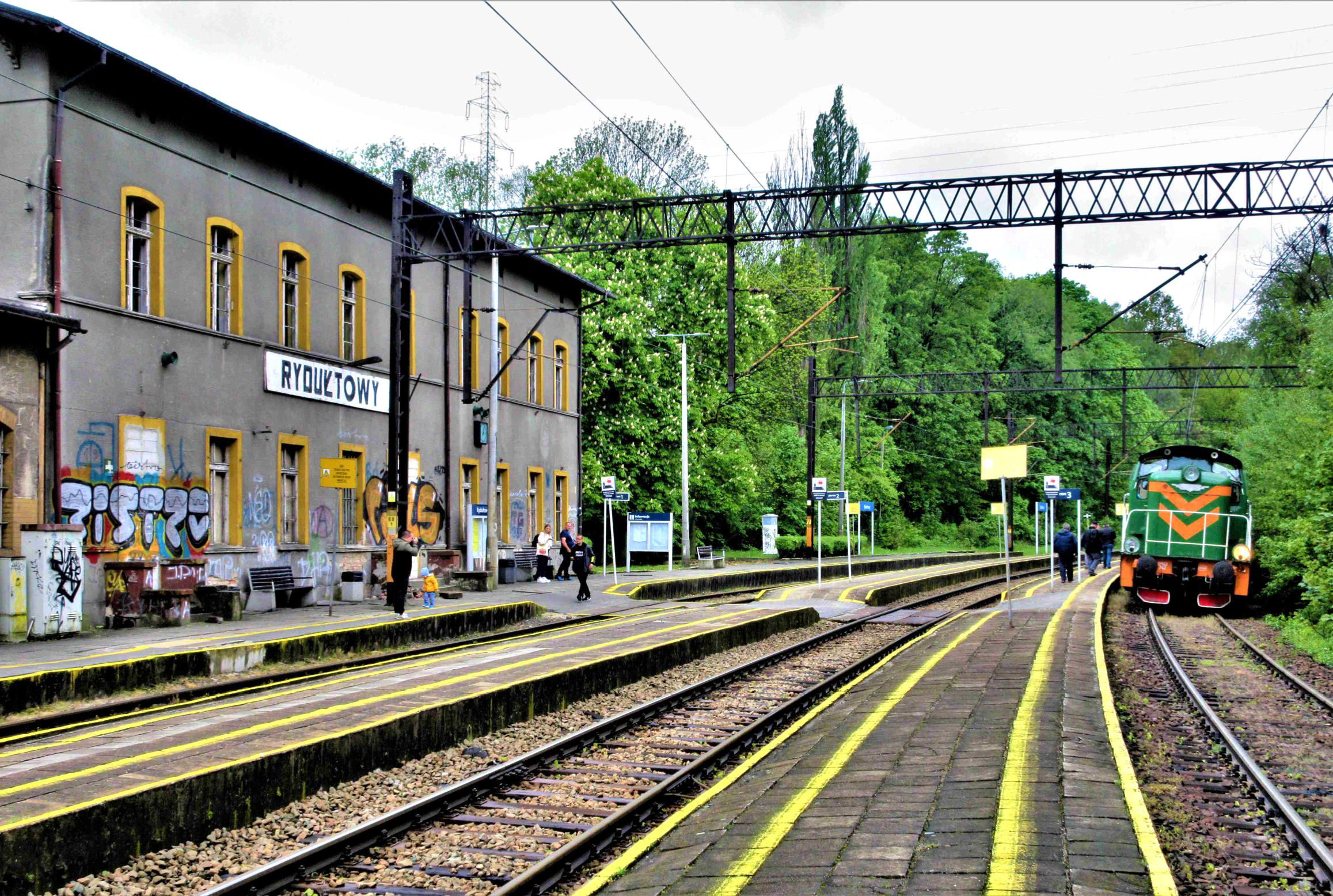
Rydułtowy with the disused decaying station building left and our tour (right) awaiting return to the Rybnik area.
[© Simon Mortimer 2023]However, our day was far from over, but first lunch … ha! Chicken I hear you say … but no! You might say I had finally cracked (implying a lack of culinary stoicism), or the Żabka* based meal I had in my bag was a great example of planning and forethought. I wish to refute either imposter; I'd accumulated so much in my bag that I realised lunch (ham) was simply waiting there. I did however make a major score in the buffet obtaining a rare cold bottle of beer not just for myself but my buffet oppo which raised the whole tone of the day. [*Żabka Polska is a chain of over 9,000 convenience stores in Poland.]
The tour returned through Rybnik but this time kept going onto Leszczyny, where we veered left and north onto freight Line 149, construction of which, from 1904 to sometime in the 1920s, meant it was started by the Preußische Staatsbahn (Prussian state railways - only the first word is capitalised) and finished by PKP, which was founded on 24 Sep 1926. It took us through a fairly typical post-industrial /woodland landscape including the active coal mines operated by KWK Knurów-Szczygłowice (KWK = Kopalnia Węgla Kamiennego = hard coal mine, referring to underground coal mines/pits with seams rather than the difficulty of extracting it). Yards full of coal, coal wagons and active pit winding gear made many onboard quite nostalgic for the sites of UK visits and tours of yesteryear (obviously on the strict understanding you didn’t have to actually work at them!). Some on the tour under the age of 30 (yes, there were some!) might even need some explanation as to what they were looking at!
This brought us to … small drum roll, the place name you have been watching out for … Knurów, where we had reversed on Day 1 to secure both sides of the triangle at Zabrze Makoszowy. We had a brief photo stop and then northwards on Curve 677, Line 141 and Line 147 which, you will remember (of course) we traversed before, albeit in the opposite direction. Then it was new metals at Bytom Bobrek as we veered left onto the Bytom Avoiding Curve 165 and Line 131 to Radzionków for a reversal.
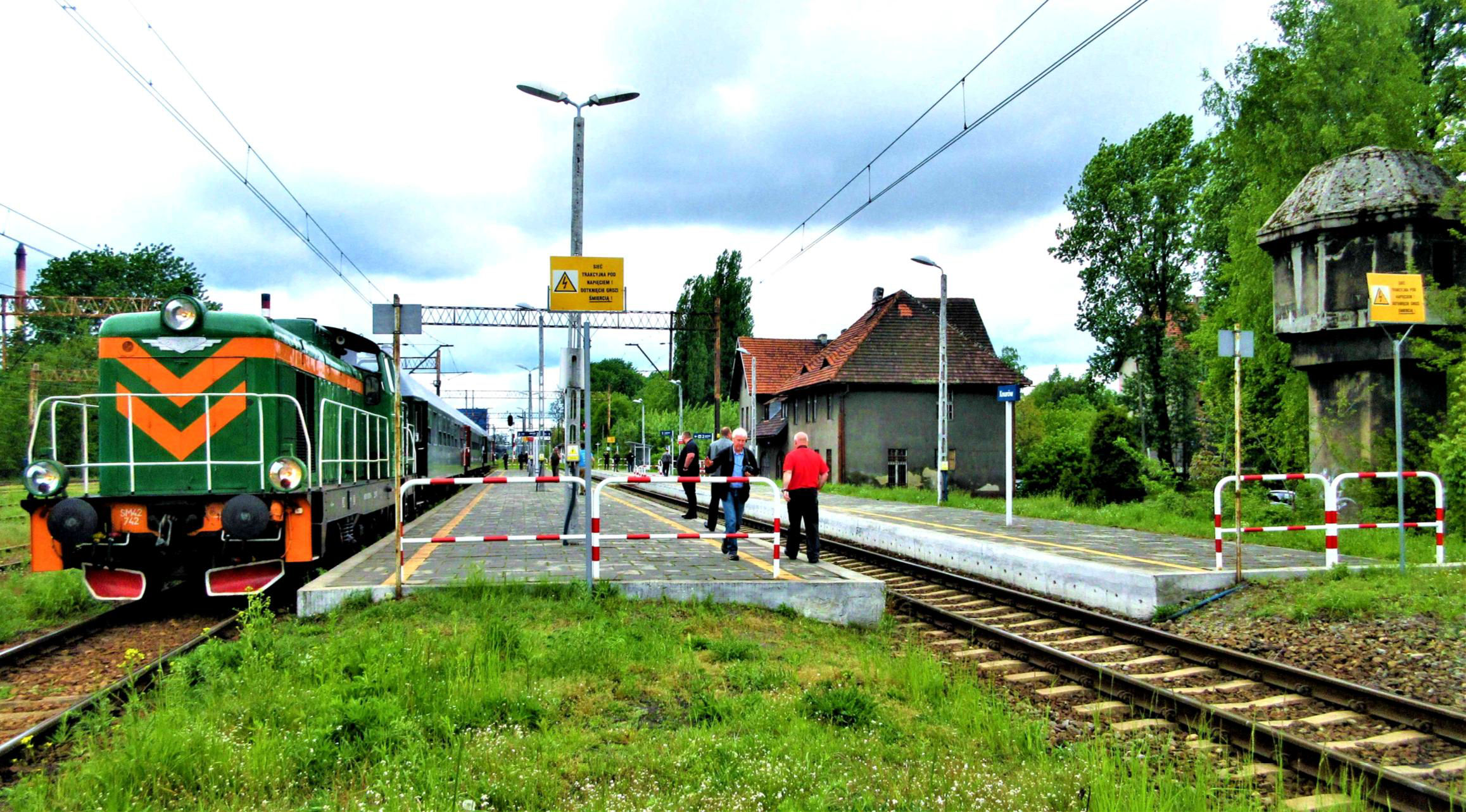
Knurów, during a brief photo stop while heading north. Note the cast concrete water tower far right. Iain Scotchman, our esteemed organiser of this 4-day tour in Poland, is at the end of the platform facing the camera; he knew he had been framed.
[© Simon Mortimer 2023]Incidentally, Line 131 is 431km long stretching all the way to Tczew in northern Poland and has a construction history stretching from 1852 until 1933 including the following railway administrations… Königlich Preußische Ostbahn, Rechte Oder-Ufer-Eisenbahn, Oberschlesische Eisenbahn, Posen-Thorn-Bromberger Eisenbahn, Preußische Staatseisenbahnen, Polnische Staatseisenbahnen und Französisch-Polnische Eisenbahn, which must be a potted history of Poland in itself! [Name dropping again, Simon.] We reversed here to access the now freight only branch to Piekary Śląskie which used to run through to Chorzów Stary (stary means old) and only had a passenger service from 1968 until 1976.
Somewhat bizarrely, especially as no passenger trains were calling at all due to the Bytom blockade, (BLN 1429) it appeared we were announced as an InterCity (IC) service to Wrocław during our wait. Did an announcer pick us up on the timesheet of a confused lad in a distant office and, seeing us on a screen, think (as we were an IC run service) he should announce us‽ The Piekary Śląski branch was no rickety freight stub but beautifully laid with continuously welded rail that befits the heavy and, in some cases, hazardous, traffics that operate on it - a lengthy train of tanks passed us while we ran round.
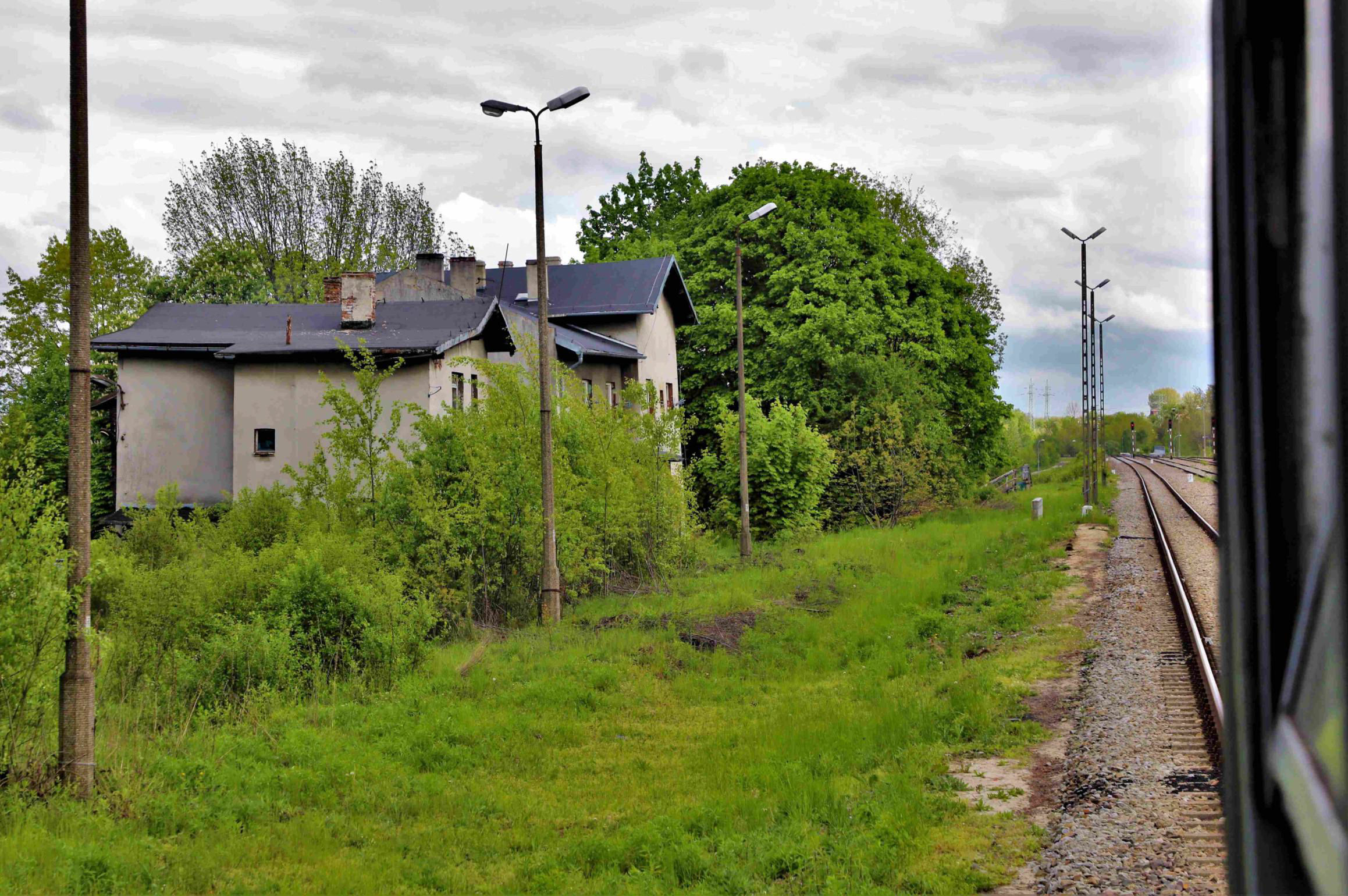
The closed station of Piekary Śląskie (which had passenger trains from 1968 until 1976) now a non-electrified freight line.
[© Iain Scotchman 2023]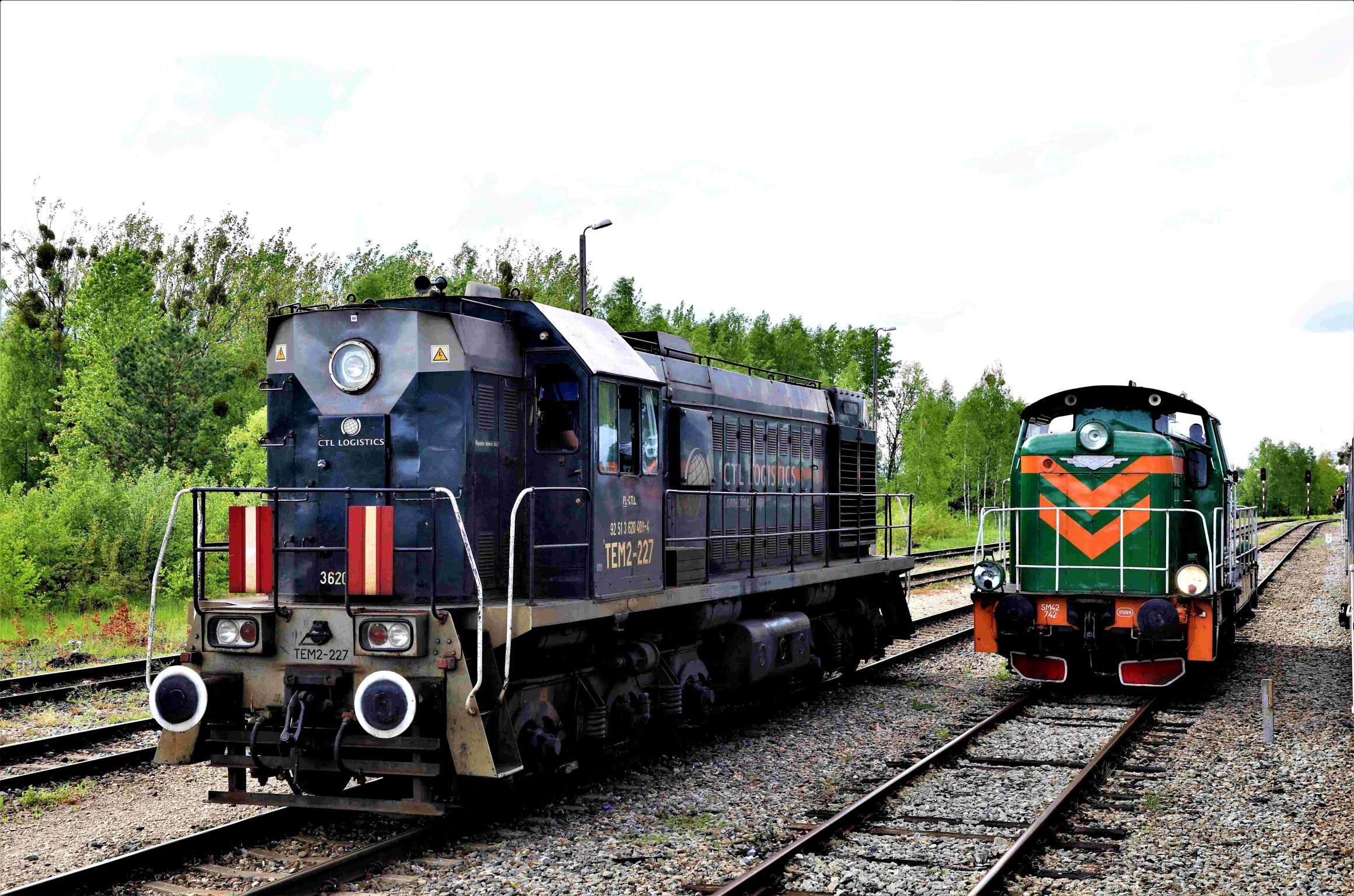
Running round at Piekary Śląskie next to the Russian built TEM2-227, the tour train is just off the photo to the right.
[© Iain Scotchman 2023]On reversal we ran through Radzionków to Tarnowskie Góry to take another obscure route, Line 144, which lost its passenger service in 2011, although since partially reinstated, as we shall see. It was double track, electrified and of reasonable significance but the lines fortunes dwindled over time. It is about 45km to the junction with the busy main line at Fosowskie; the first 15km to Tworóg is still wired (on the former northbound line only) for timber traffic. The other parallel track lies weed/small tree strewn as we ambled at an ever decreasing speed through the forests on this very straight line.
As soon as anyone had mentioned that services had ceased, the line beyond Tworóg was de-wired by some freelance metal recyclers belonging to the local chapter of the Caravanning Club of Romania. While stripping the wires off the 12km on to Kielcza, they set a new European speed record for a Westfalia van towing a cable drum. We stopped for a photo at Kielcza, where the local signalwoman seemed to be just knocking off for the day. There was probably no more traffic as the rails ahead of us were really rusty, implying little use of that line. A question elicited the answer that it is only open for freight as a through line two days a week and clearly there is not that much of it. After calling at this station with no passenger trains, our tour proceeded a further 8Km to Zawadzkie. This station does now enjoy a passenger service again to Opole and, creating a faintly historical moment, we drew in on the nominal southbound line alongside just such a service formed of rebuilt EN57 2063 on the 17.42 working. When was the last time two passenger trains stood here AND both going the same way
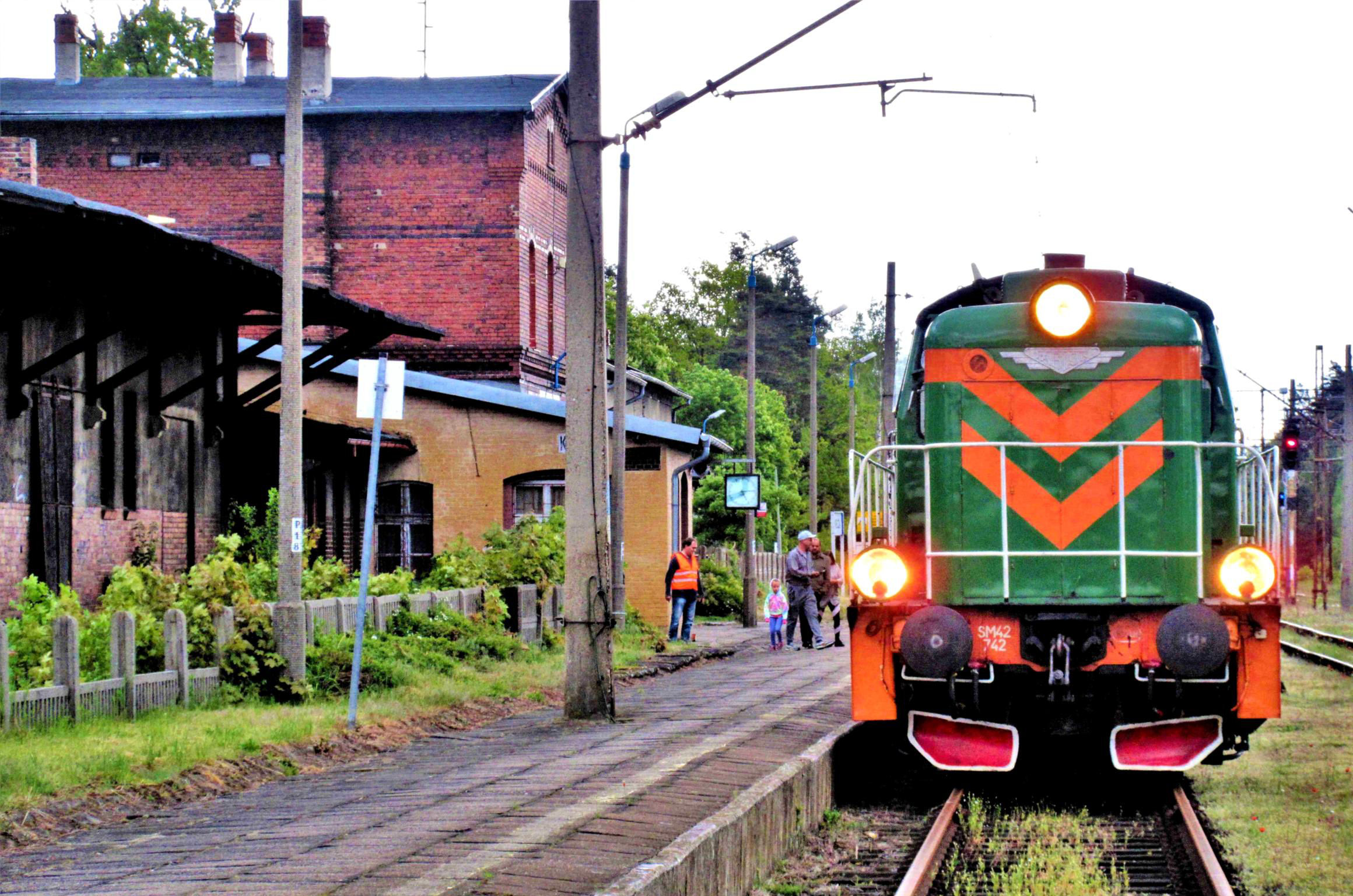
Kielcza on non-passenger section through Tworóg in deteriorating light, just prior to a rain storm, heading for Opole. Note the invisible OHLE.
[© Simon Mortimer 2023]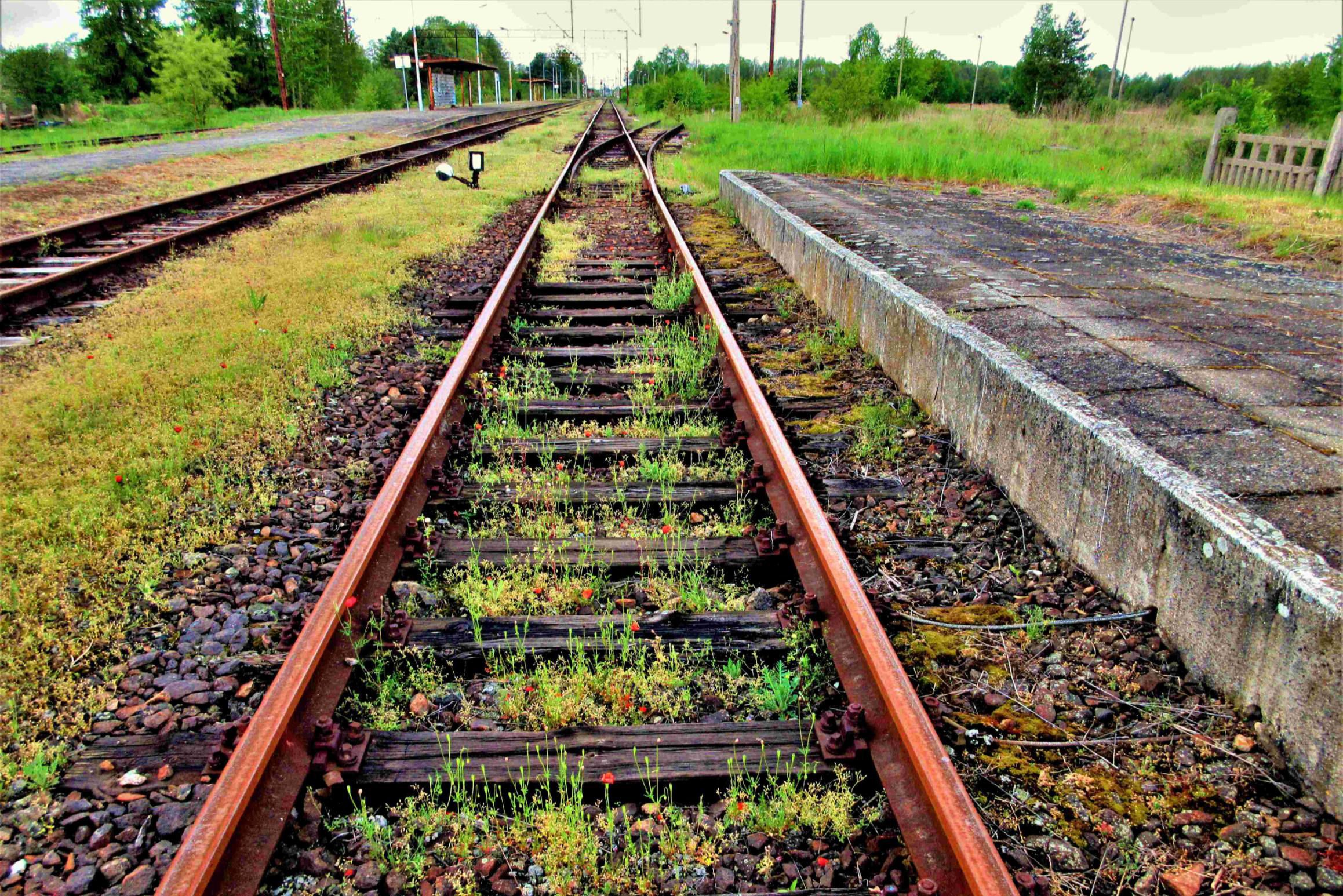
Kielcza looking north note disused platforms and very rusty rails (which the tour did after this) as the line is only open to freight two days a week!
[© Simon Mortimer 2023]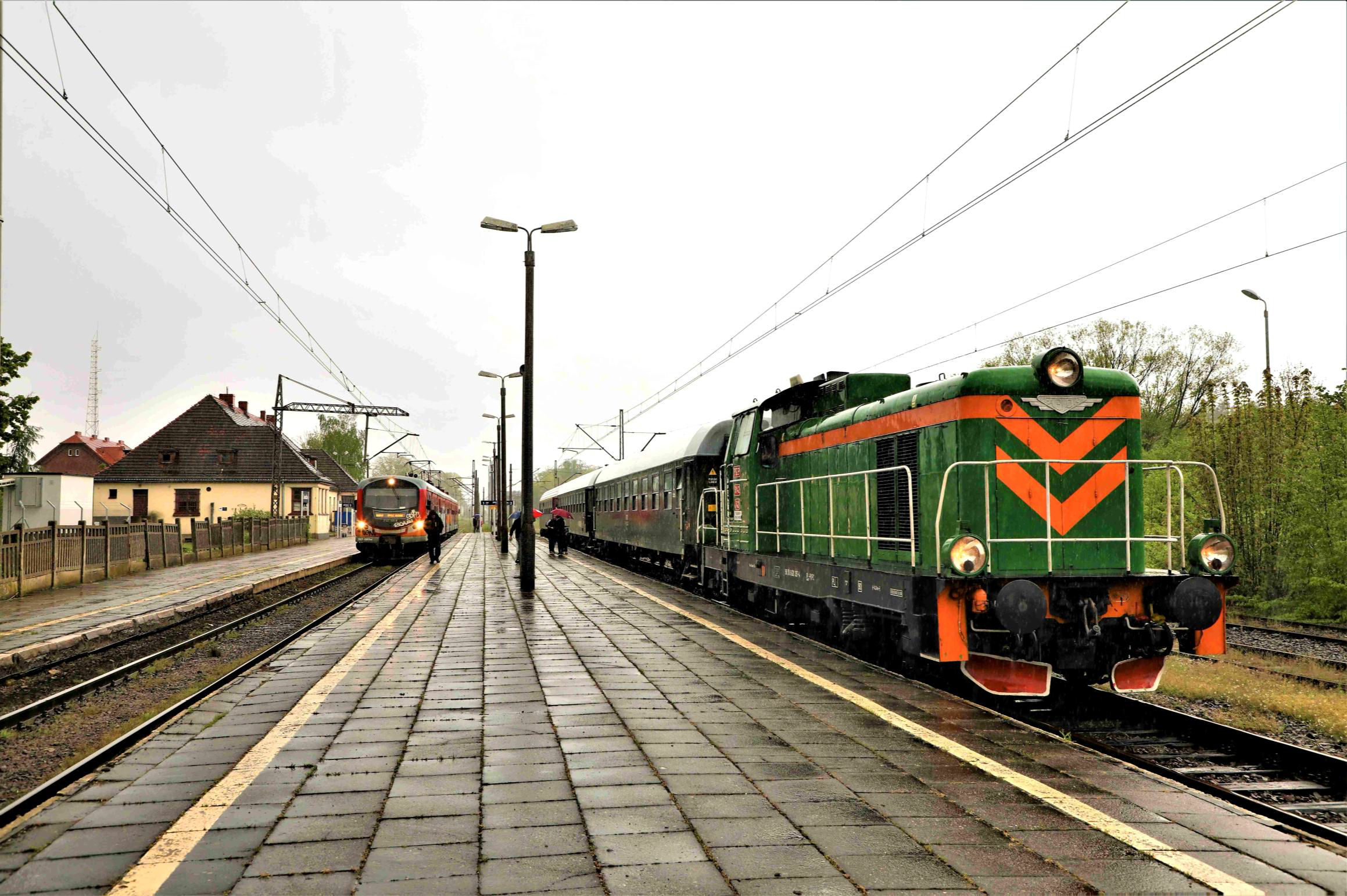
SingingGricing in the rain; a damp photo stop at Zawadzkie, further along this line on the section now reopened to passengers - train left.
[© Iain Scotchman 2023]We had to wait for the local to depart and clear the section but, by the time we had completed this route at Fosowskie, we were back on time. After a set down at Opole Główne (główne = main) nothing more remained to do than cross the rickety bridge and proceed at our best possible speed. Notably, we were not looped anywhere for faster trains to pass and arrived in Wrocław Główne P5 just six minutes late at 20.02. There had been a plan/idea to recover the flying junctions at Kuzniki only just outside Wrocław but, despite best efforts of all concerned, PKP filed this in the 'too difficult' box.
After Day 1 mired in operational dither and incidents that just plain thwarted some elements of the final* route from being executed, the whole event had really come up on the rails (both metaphorical and literal). Big swathes of the hitherto un-traversed web of lines around Katowice now looked thoroughly inked in. This, of course, always then throws into much greater prominence the odd curves and connections that are left (hint)! *'Final' because it was clear, even to the interested observer, (let alone the organiser) that the tour and its routing was put through the PKP timetabling machinery (as well as others like JSW thwarting use of private coal lines) time after time with sections of route previously agreed to being thrown out and sometimes reinstated with little/no explanation as to why.
The 'why' is useful as, if you understand the workings, it is easier to see how to solve the puzzle, of course; even within days or on the day sections were ruled out and then after communications ruled back in again. [Maybe they are simply not used to strange requests?] However, you can only deal with the organisation/s available of you and make the best picture from the palate available; which is what we did! So well done Iain and all others involved, I for one look forward to round three! Ding Dong!