The Katowice & Kraków Wanderer (Poland) - Part 3
Friday 12th May 2023 to Monday 15th May 2023
Report by Simon Mortimer
with contributions from Ian Hutton, Peter Green & Iain Scotchman (organiser).
Day 3 Sunday 14 May:
Breakfast at McDonald's ... not Tiffany's but no Audrey Hepburn either [sadly she died in 1993]; I like to think she would have enjoyed a scrambled egg and bacon wrap with a regular black coffee though?
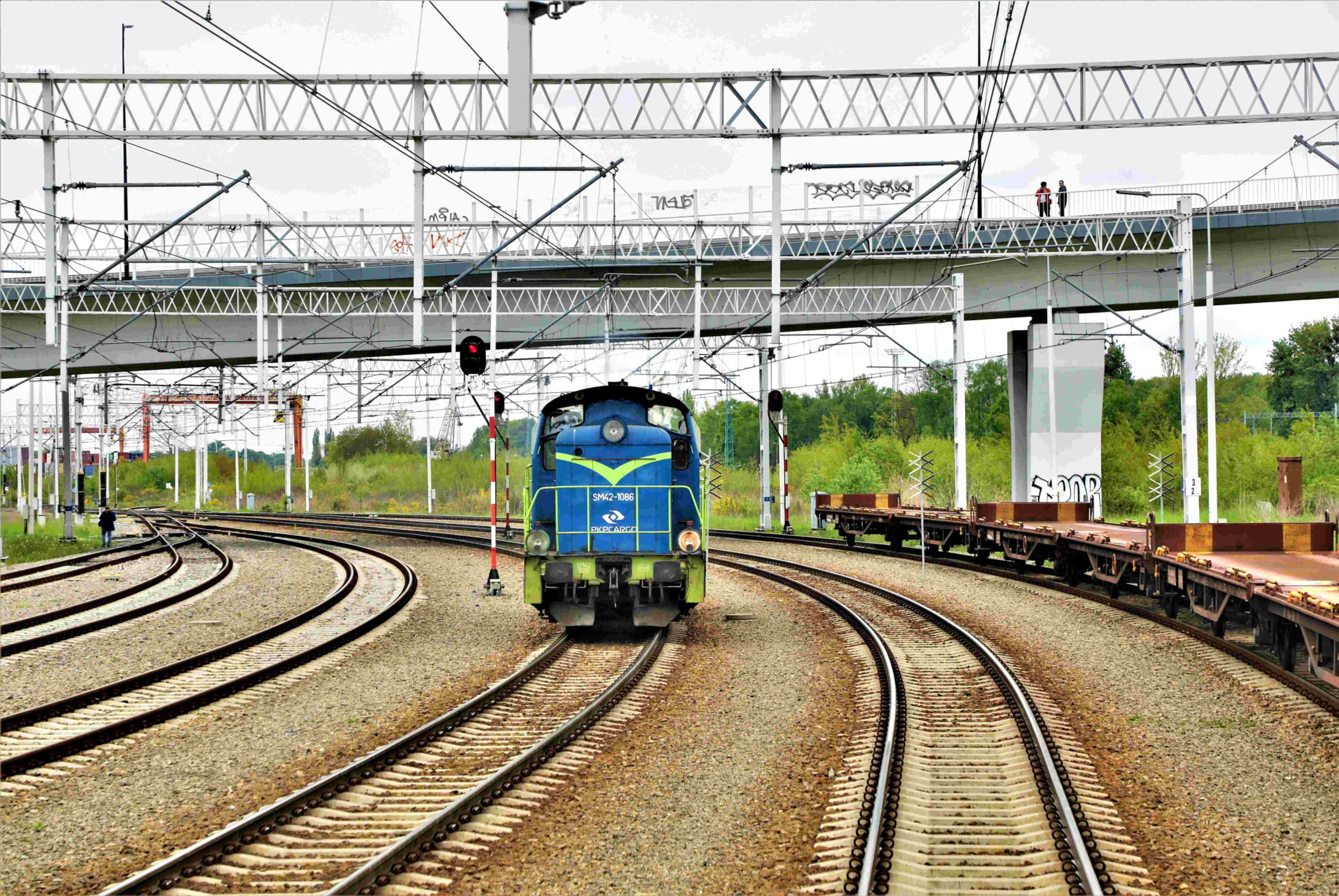
Today, Katowice Peron (Platform) 3, we even popped up on the electronic boards as a sort of 'Tourist Inter City', not unreasonably, in Polish [Turystyczny Międzymiastowy] and, ascending, found many already assembled. Today and tomorrow, we eschewed electric traction for something more modern, SM42 1086, a 800hp trip freight shunter, of which over 1,800 were manufactured in a production run lasting 25 years from 1967. This made our machine decades younger than the electric loco used the last two days. We had been due to have SM42 742 but that was unserviceable and its locum had only just been outshopped the day before; however, it was still gratifyingly claggy when notched up.
We lifted off just two minutes shy of time at 08.17, heading up the main Line 101 to podg Gottwald* to turn left onto freight Line 651 past podg Hajduki and the north to east curve onwards through the passenger station at Katowice Ligota to freight Line 142, with a sinuous run through woodland via Katowice Kostuchna to pause at Tychy. This has been the home of the Tyskie Brewery since 1629 and, on a linguistic note, however you choose to tackle this place name, it is NOT like the English for a very small thing! From here, it was off down the passenger line with its identikit stations installed on recommencement of a local commuter service in 2009. Then, bypassing Tychy Lodowisko on the loop away from the platform line, it was onto now diesel and freight only territory. [*If anyone still needs a reminder, podg = posterunek odgałęźny, literally 'separate post' or 'branch post' - a 'junction'.]
This line was once electrified and the concrete masts remain throughout to both Lędziny (closed to passengers 18 Feb 2001) and to Oświęcim, which lost its passenger service as early as 1972. We passed through flat open country mostly on embankment 11km to Bieruń Stary (Stary means 'Old'), where the extensive platform and connecting overbridges still exist. The ubiquitous broken glass crunching underfoot across the platform is a clue that the platform is also the local alfresco drinking club. Many locals turned out here to see this unusual sight but also, today, photographers abounded; you can dial up videos and photos on 'YouTube' with little more effort than entering the loco's number.
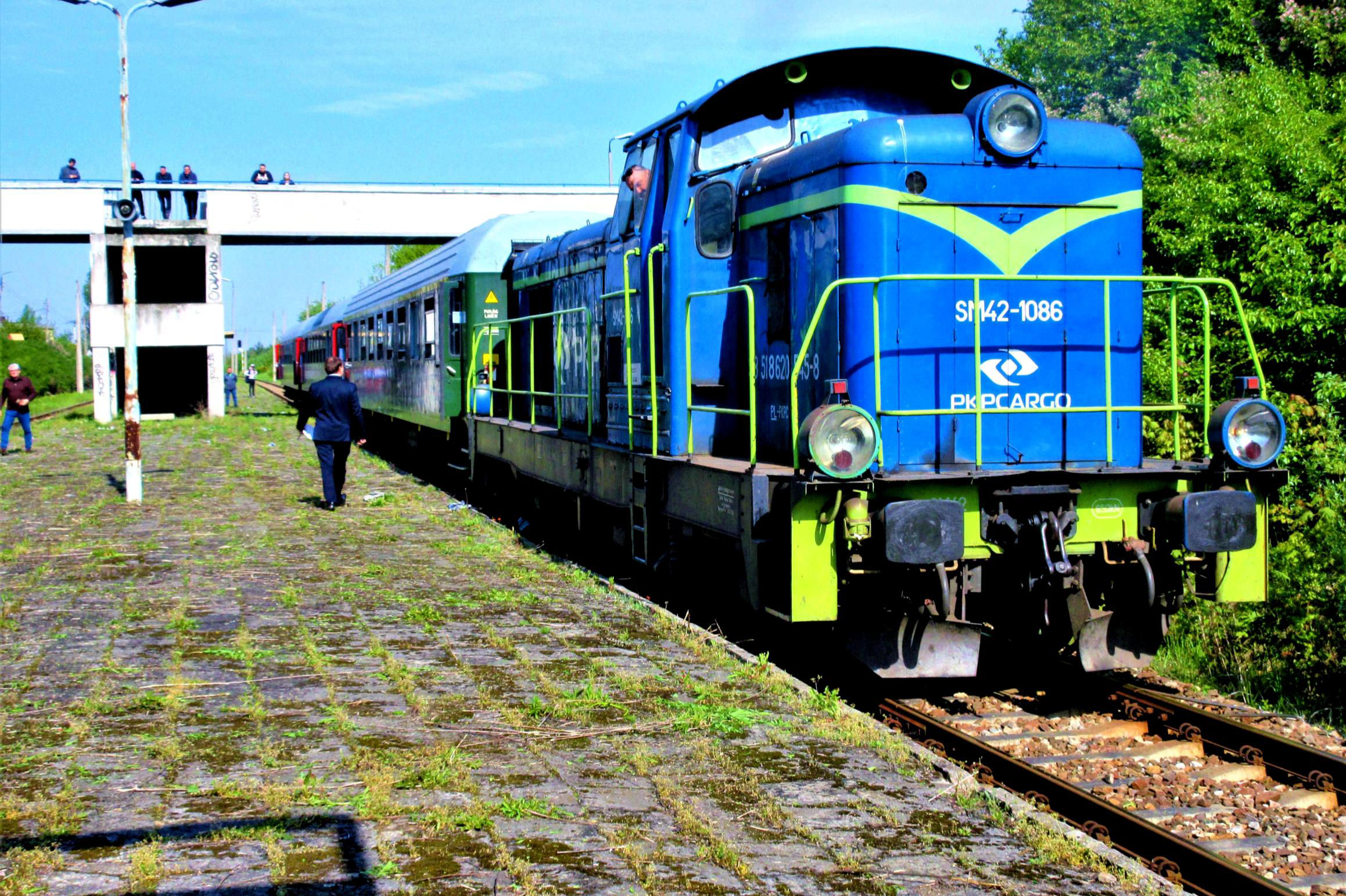
Bieruń Stary (Stary means 'Old'), before running round, the platform was strew in broken glass (Bier glasses perhaps?).
[© Simon Mortimer 2023]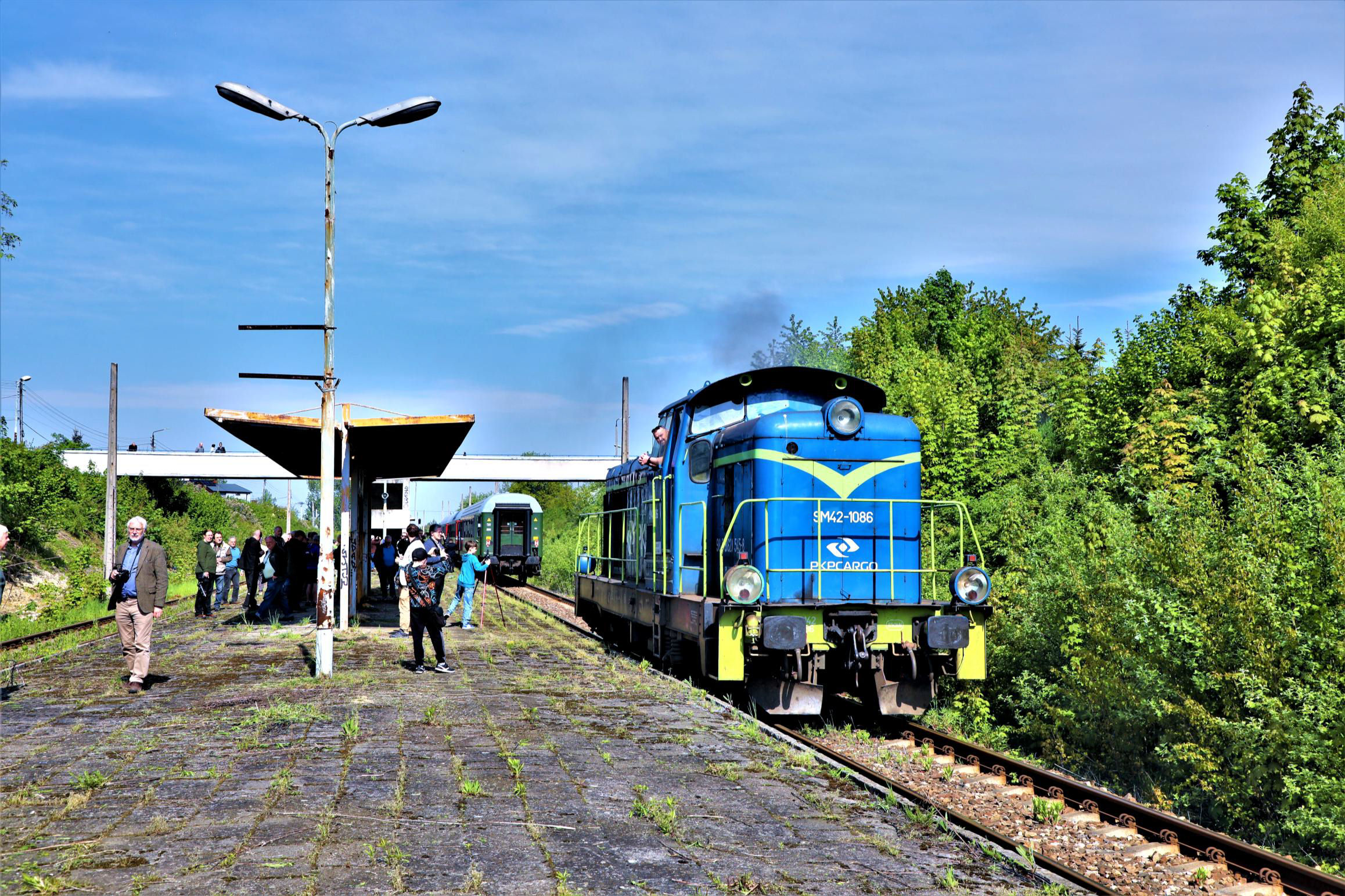
Another view of the same location during the run round.
[© Iain Scotchman 2023]We retraced our tracks from today and yesterday back to Katowice to swap some TurKol participants. Then we headed east through Mysłowice, veering left on Line 134 to Sosnowiec Jęzor and podg Długoszyn for Line 667 to Sosnowiec Maczki, continuing along Line 163 as far as Sosnowiec Kazimierz. Then it was Line 62 to Dąbrowa Górnicza Strzemieszyce, picking up Line 171 near Dąbrowa Górnicza Wschodnia as far as podg Kozioł, to take a long arcing outside curve of a large grade separated junction around 180o into Dąbrowa Górnicza Towarowa Yard (partly jungle). It is a large freight transfer point for the massive Huta Katowice (Steel) Works beyond and some other terminals scattered over a wide area. One yard had at least twelve tracks all full of stored redundant wagons.
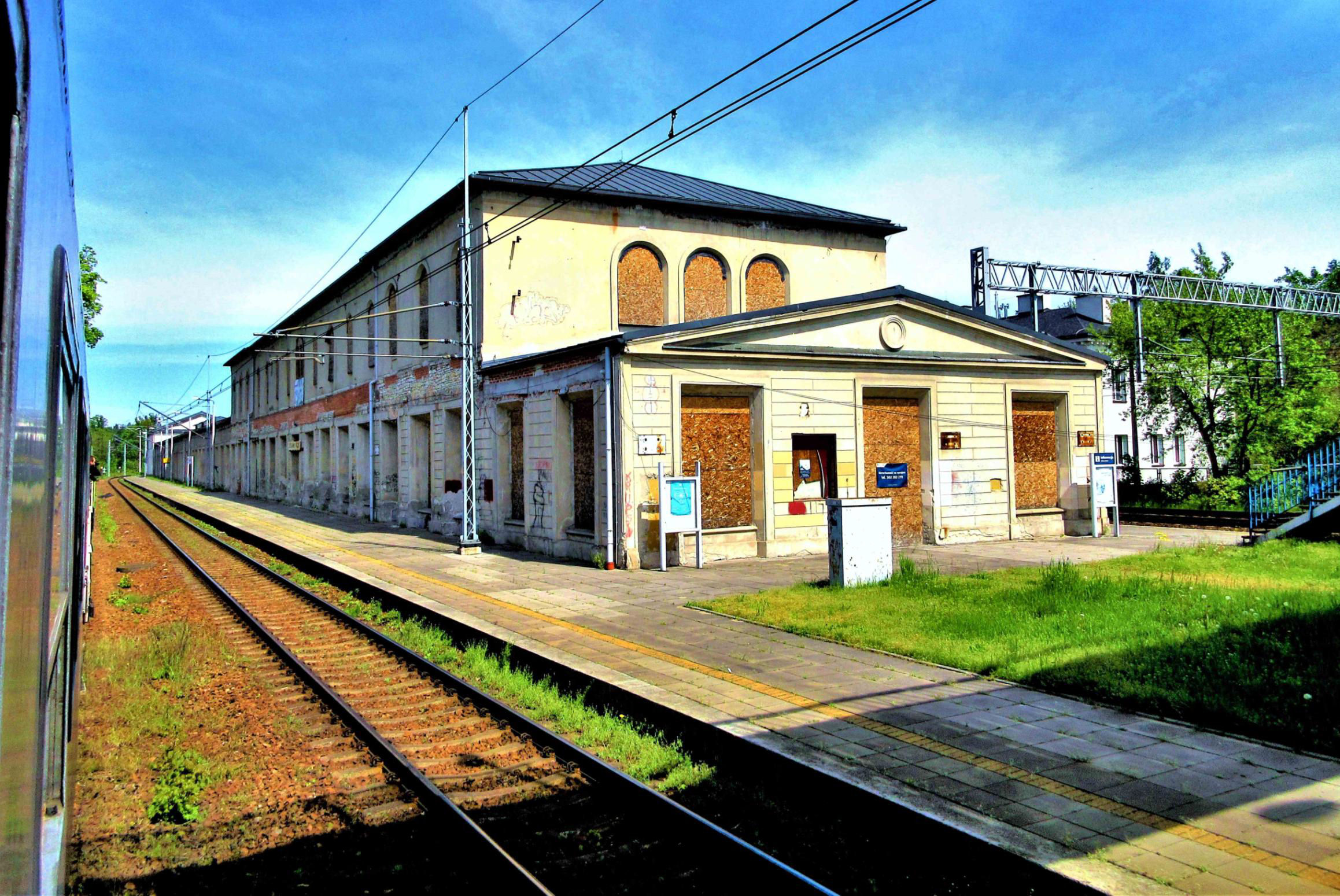
Sosnowiec Maczki, the former border station between the Congress of Poland and Austria, from the adjacent Goods lines, heading north.
[© Simon Mortimer 2023]On reversal here (is anyone still counting?), our railtour swung north, still all on freight only metals built in the mid-1970s, Line 154, to obtain the main passenger line at Wiesiółka on the lower flying junction route. This was followed by successive crossovers over the next 4km, on Lines 186 and 160, to bring our train into Łazy (No! it's pronounced 'Wazi') on the northbound platform, to run round
We did not leave on the rather disparate Goods or Slow Lines 154 despite this appearing operationally more convenient, so 35 late we headed off on Line 101, took the crossovers to 140 before Dąbrowa Górnicza Ząbkowice and departed passing the west side of the Huta Katowice Works, left on Line 133 via Dąbrowa Górnicza Południowa. We had now encircled this on a grand orbit heading back via podg Dorota (Dorothy Jn …wonder who she was?) and an EGTRE [Enthusiast's Guide to Travelling the Railways of Europe - linked from our website 'More options'] listed variant of a diversionary route via Line 180, through Line 4 yard road at Sosnowiec Jęzor and Mysłowice. With a twist this time, we ran via the pair of goods lines the east side of the small ex-colliery sorting sidings instead of the main line.
Again, some eagle eyed participants had noticed that one of two possible onwards options from here was unavailable with Line 654 flagged out of use, so, to the approval of some seasoned PKP (Polskie Koleje Państwowe = Polish State Railways) line collectors, we crossed the main line to join what in effect would be the wrong side of a grade separated junction if worked normally. However, it was clearly a bidirectionally signalled move as well to Line 658 and then the latter part of Line 657. At a mere 466m long, Line 658 must be one of the shortest designated lines in Poland, most yard roads would be longer. These lines and the Katowice Avoider (Line 161) stretching 12Km to Chorzów Stary (literally Old Chorzów) were built in 1868 by the Rechte Oder-Ufer Eisenbahn, loosely meaning The Right Bank of the Oder Railway; they certainly knew how to name railways in those days!
Lunchtime! The agony of choice, I didn't want to have the filet or nuggets of the last two days, so the chicken fingers then, just to ring the changes. Is the beer cold? No, I can put some in the fridge for you. What's in the fridge? Errr, nothing. Why not put some beer in the fridge then? Sauerkraut? No; OK, chicken and spuds it was then ... before my life forces dwindled even further.
Having regained the main, but currently closed, Katowice to Bytom passenger route, we headed into something of a moonscape of reconstruction. Now it should be said when we reconstruct a route ... think West Coast Main Line modernisation ... this usually means a bit of fettling, a smattering of new crossovers, taking out other trackwork in the cause of rationalisation that usually in the following ten years appears to be a bit of a faux pas and clearing out those drains we haven't got around to for ages.
When the Poles say they are going to reconstruct/refurbish a route, this amounts to typically the removal of all traces of the old track, structures and earthworks to a point of near obliteration, then eliminate all level crossings, complete track renewal, new signalling and stations. [This is happening with East West Rail.] This can mean some Polish routes are closed for years on end but they often have alternatives. At Bytom they have not quite removed the entire infrastructure; rather Bytom station itself which has something like eight through platforms is now an overall roof spanning no tracks at all.
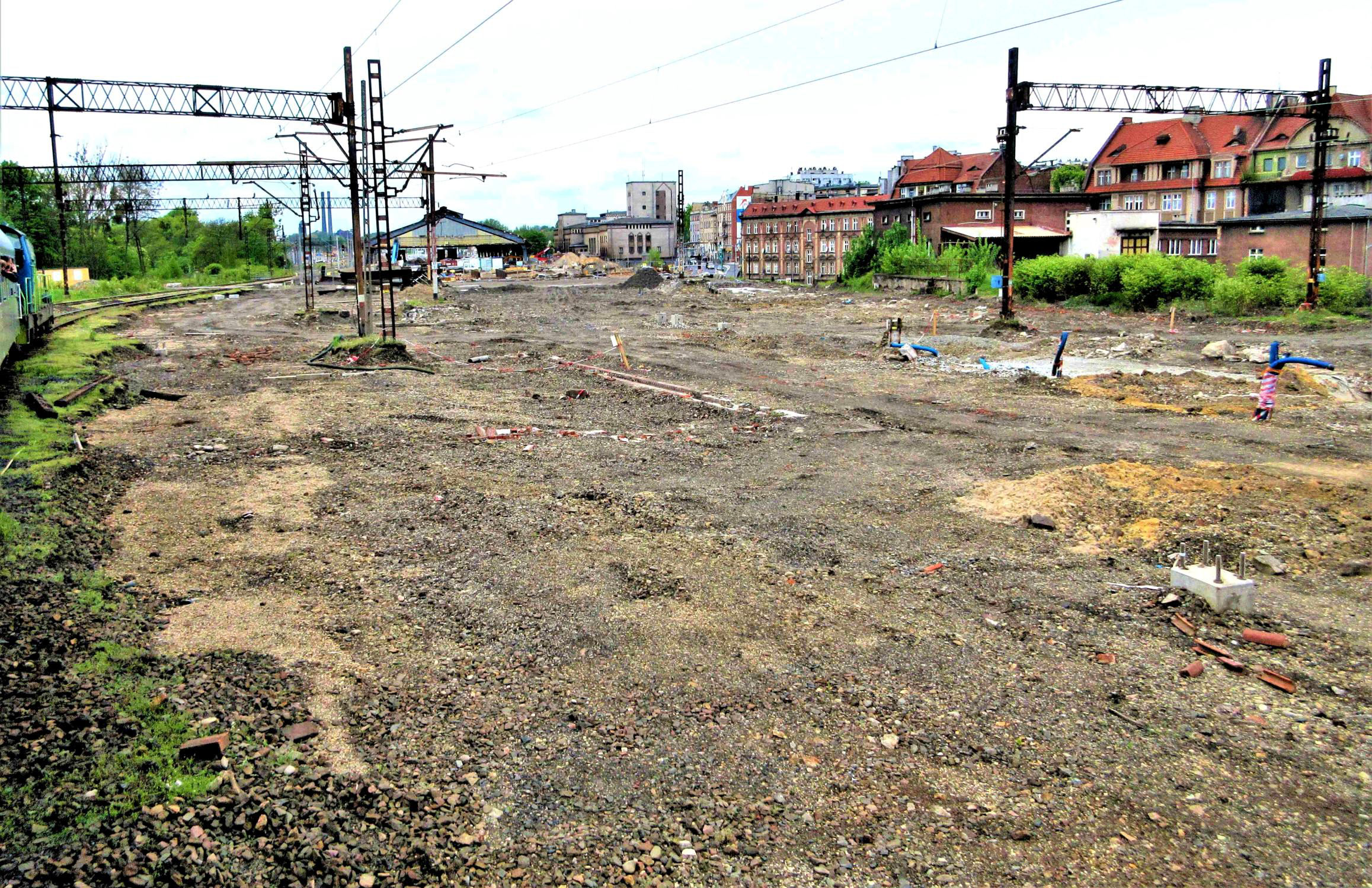
Not a disused railway that has been lifted but one that is being reconstructed. Bytom, the apparent wasteland that was the complex approach tracks (and will be again) as our tour totters passes on the only remaining one.
[© Simon Mortimer 2023]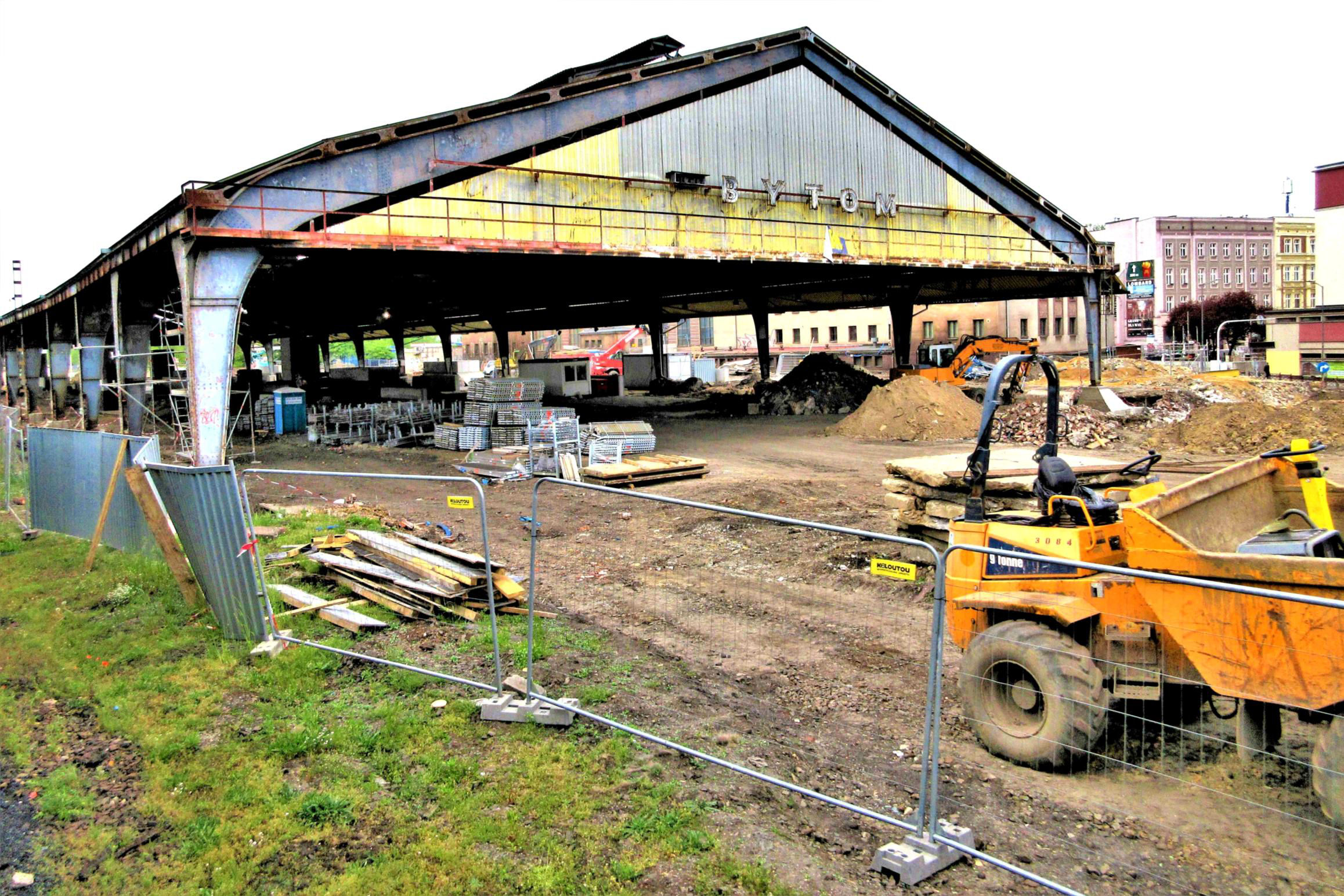
Bytom station during the reconstruction, passing the station canopy on what are normally the Goods Lines.
[© Simon Mortimer 2023]Outside the train shed weaves one solitary operational track, a last thread preserving the through route for freight, as the only passenger service until at least December is the shuttle between Bytom and Gliwice. This obviously cannot access the trackless station, so uses a temporary platform in the yard (Platform 5, Track 22 no less), access to which was deemed sufficiently separate from normal passenger track here that some participants had already visited before the tour (or would after).
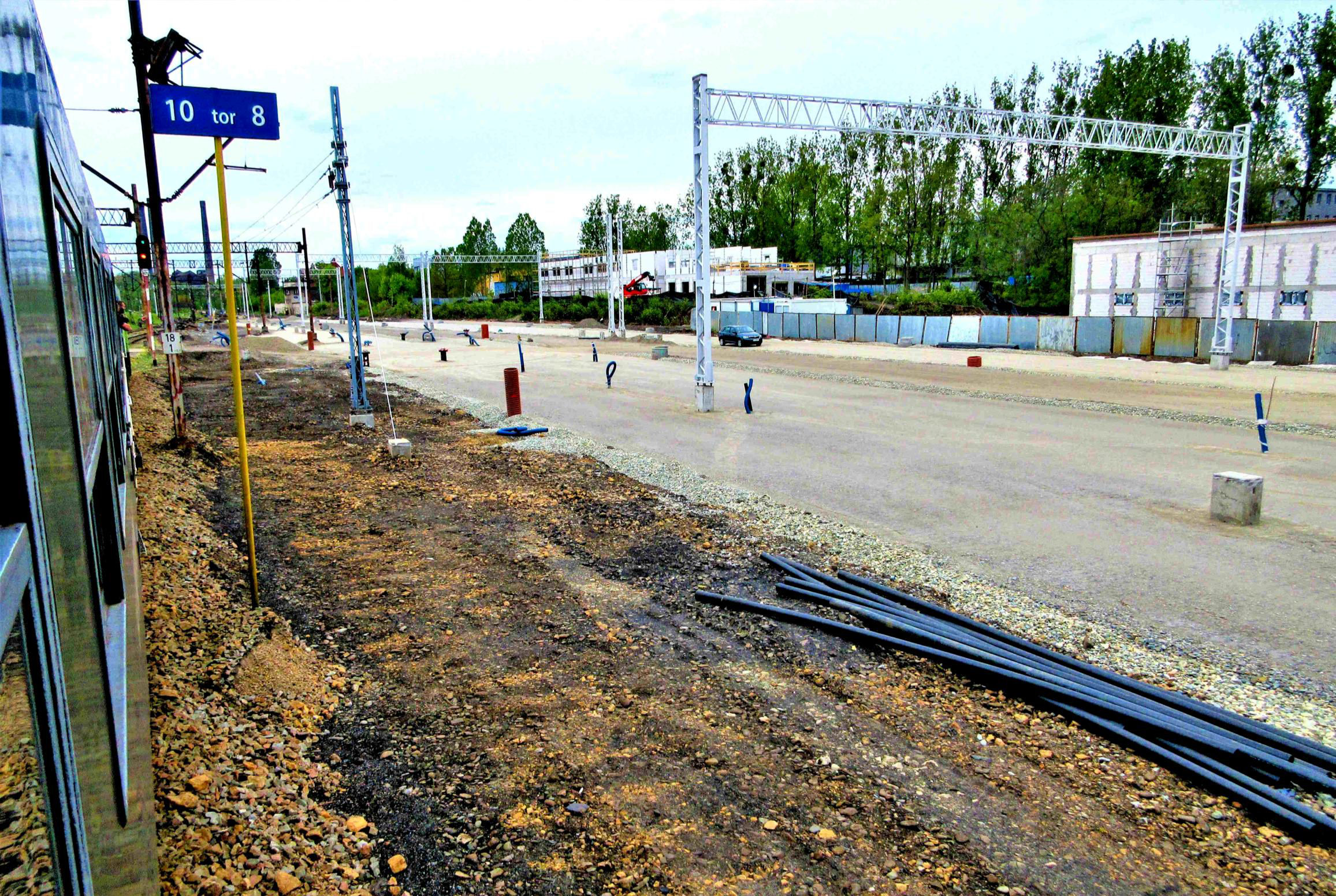
Bytom north, the new track formation is taking shape, note the very helpful track numbering post widely provided by PKP!
[© Simon Mortimer 2023]We escaped from this area of scorched earth unscathed (it is always fascinating to go back and see it finished afterwards!) to emerge at Bytom Bobrek on Line 132 for a pick up at Gliwice via Line 200. En route we passed under two of an increasingly rare breed, still functioning signal boxes built over operational tracks. We then picked up some local TurKol people, including a few family groups who immediately descended on the buffet for tea, black of course, not a PG Tips cuppa in sight here. In fact, I think if you asked for milk they might assume you had brought your pet cat. [For those unaware the PG in PG Tips stands for Pre-Gestee, to suggest that it could be consumed before food was digested.]
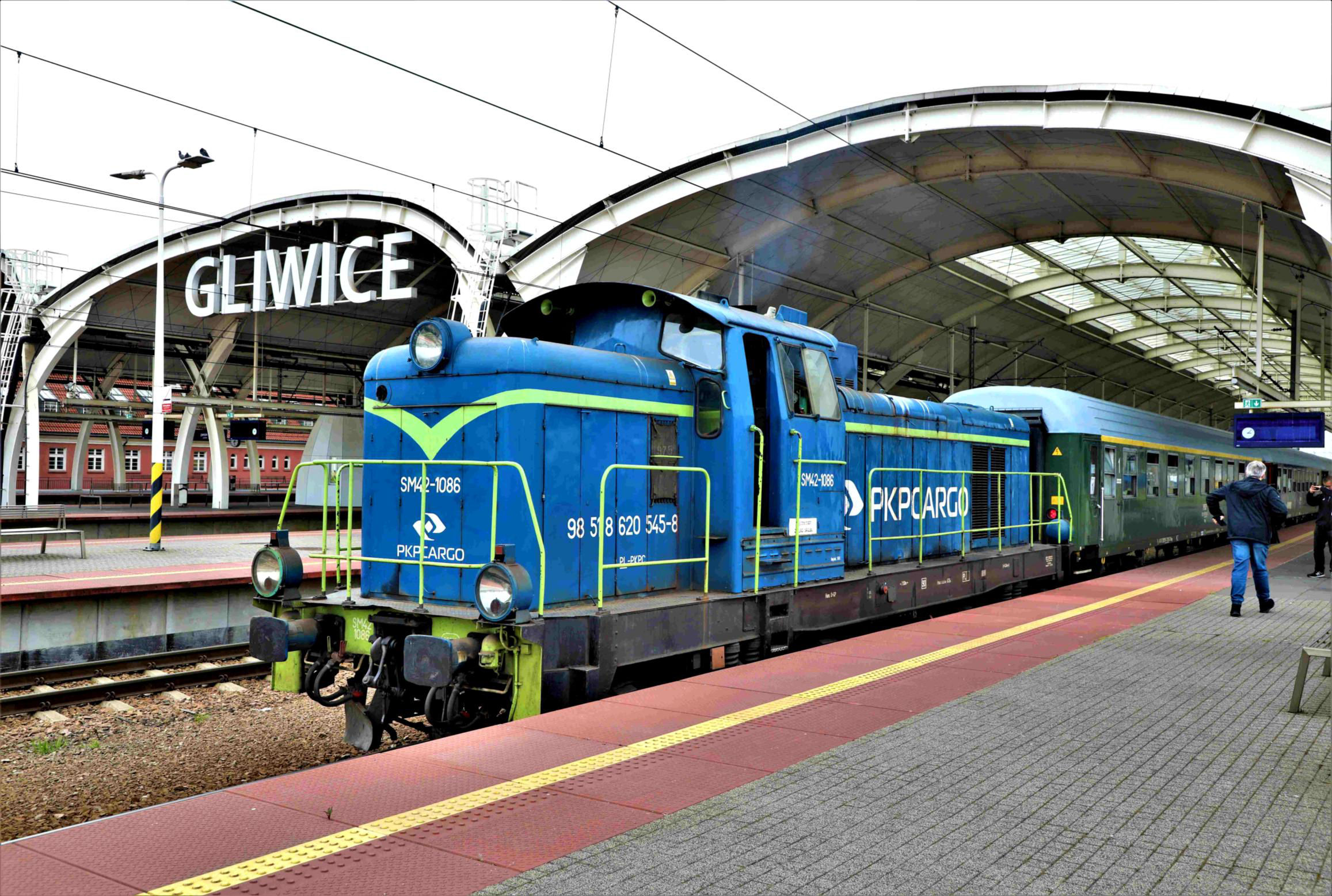
Gliwice (no surprise there).
[© Iain Scotchman 2023]We descended off the westbound freight pair on non-electrified Line 167, dived under the main lines and entered the Transfer Yard to run round at Gliwice Port PKP limit. This is the biggest inland port in Poland; a boat can reach (initially via the 39km Odra Canal) Świnoujście on the Baltic Sea or even, if required, half of Western Europe on the river and ship canal systems. The port was built in the mid-1930s and The Deutsche Reichsbahn (DR - German Reich Railways) opened the rail links in 1936.
Running round at Gliwice Port Reception Yard.
[© Iain Scotchman 2023]Pleasingly, our tour departed on the electrified alternate Line 675 back up to Gliwice, where some locals aspired to alight, having had their trip - except we were on the freight line one away from the platform. Nil desperandum, this was Poland not the UK! With a cheeky glance, came the touching sight of a whole family, small children in hand, plop down from the train onto the ballast, cross the line and clamber up the platform; seeing them on their way home, no one seemed to give it a second thought.
We left as we had arrived, on Line 200 through Gliwice Yards but then dived under our inbound route onwards past podg Gliwice Sośnica Signal Box A. The train then took Line 141 and the third side of the triangle approaching Zabrze Makoszowy, where we met up with an earlier traversal on this tour as Line 149 from Knurów trailed in right. We reiterated this southern freight line around Katowice, but after Ruda Kochłowice veered left on a bit of a roller coaster section of line that made our SM42 clag nicely, pulling away up the stiff grade onto Line 164 which, partly, rectified the freight train failure induced omission on Day 1. Unfortunately, we switched to line 651 at Hajduki, again onto Curve 713 towards Katowice Główny [Główny = main (station)] to P4. Here a run round, more TurKol swaps and a quick flit down the stairs to grab a couple of McFlurrys for my fellow buffet stool squatter and self.
We left Katowice at 16.47 just 13 down and proceeded towards Zabrze which might appear quite a regular move until realising that part of the Bytom Works also stretch to Charzów Batory. Here there was only one line over the flyover which we took and then ran 'wrong road' to the trailing crossover just short of Ruda Chebzie where we regained 'right' line (in both senses of the word) to Zabrze. Here, to facilitate our run round, we took the facing crossover into the southbound platform, meaning two southbound trains scored the Gliwice end facing and Katowice end trailing crossovers to weave around us … right place at right time or what! After our run round, we simply returned to Ruda Chebzie and into the adjacent yard, where we ran round again. This was all necessary as there is no facing pointwork allowing access to our next line from Katowice, although this will have to change in due course as it is an approved Kolej Plus reopening. Kolej Plus includes 34 rail investments to put towns with over 10,000 inhabitants on the rail network, revitalise closed existing infrastructure or upgrade that which can't be used by passenger trains. By 2029, with a budget of €2.8bn, it will benefit over 1.5M people with 315km of railway (10 projects) 'revitalised', 516km (14 projects) reconstructed or extended and 189km of brand new lines (7 projects). It all sounds like very good value for money; it's a shame that they don't have a branch office in Portishead, and would they like to take over HS2?
Meanwhile, we waited for the signal lights to illuminate allowing us to depart but, despite no obvious conflict, nothing happened. Finally, rather than giving a clear aspect all the lights at the end of the yard went off - completely, nothing was lit at all! At this point the driver (presumably having been given verbal authority to proceed) tooted the horn and we left! This exercise was to access Line 189, a bit of an oddity as a through route but an island of 6km of non-electrified track in a region where practically everything is wired. Internet sources can only seem to narrow its construction down to between 1859 and 1899! It lost its passenger service in 1966, an era when a passenger closure in Poland was almost unheard of. Perhaps it was not surprising as even now no one could be seen living anywhere nearby.
This line generally rose along its twisting course and we tottered along this real backwater which had attracted many local photographers, as it's rare to witness a passenger train on it. To the east could be glimpsed signs of a steelworks but there is no connection off this line to it. We were allowed about 30 minutes to traverse this line, and needed it, before finally emerging at Zabrze Biskupice. Again, we were heading along Line 147 towards Gliwice but this time took the Gliwice Avoiding Line, (No672) which brought us back to Line 141 at Zabrze Makoszowy Kopalnia and a turn back towards Katowice.
It had been hoped that we might be able to remedy the remaining omission due to the Day 1 freight train failure by doing the curve towards Chorzów Batory. However, it was confirmed as not happening when we swung across at Hajudka, committing us back to Katowice Główny, arriving bang on time.
Continued in Part 4