The Katowice & Kraków Wanderer (Poland) - Part 1
Friday 12th May 2023 to Monday 15th May 2023
Report by Simon Mortimer
with contributions from Ian Hutton, Peter Green & Iain Scotchman (organiser).
Note: This tour report necessarily contains many line numbers and place name references which will be much easier to follow using a 2022 Mały Atlas (Mały Atlas Linii Kolejowych Polski) or a Poland Railway Atlas (Mike Ball) ... promise!
By way of introduction, perhaps some background to this year's tour may be of interest. It was planned as a follow up to our 2022 tour, utilising the same set of coaching stock based at Wrocław Główny, currently used by most TurKol tours. This gave the opportunity to try to cover the sections of track around the city missed last year, including Wrocław Swiezbodzki (which was 'kicked into touch' straight way due to poor track condition and is currently due for reopening in the short term). The plan was then to head to Katowice to cover as much as possible of the remaining sections of once very extensive colliery railways and the rail network around Kraków. After getting over their initial surprise as our request via TurKol to traverse their lines (what the f*** do they want to do these for?), the coal company management appeared to look on our request favourably, that was until at the end of Jan 2023, when their legal department (bless them) pointed out the lack of any passenger safety case for their system meant the end of the story. A major re-plan of the tour ensued, heading to Short Term Planning realms, which our operator valiantly pushed through the PKP timetabling system, with many iterations! Planning of such a complex tour would not be easy with an organisation with just winter and summer timetables but PKP appears to have a constantly changing timetable, with six timetable periods each year and weekly, perhaps almost daily changes within them. Engineering work planning seems very short term so track available one week may not be available the next. With added security concerns due to the situation in Ukraine, which lost two key branches serving power stations at late, short notice, in hindsight it is perhaps surprising that the tour was as successful as it was!
Day 1 Friday 12 May: Ding Ding … Round Two! In what really felt like an experience of pure déjà vu on walking into McDonald's at Wrocław Główny, an English voice rang out: 'How do' Another tour participant was already sipping a coffee, followed only moments later by one intent on his Bacon and Egg McMuffin before the Grands Départs. We all then walked instinctively to Peron (Platform) 6 on the extreme periphery of Wrocław Główny where, ascending in the small lift, our tour organiser Iain Scotchman and a few other PKP (Polskie Koleje Państwowe = Polish State Railways which dates back to 1918) cognoscenti were already chatting in the sunshine and sort of confirmed our guess this would be our platform. As we stood awaiting developments, others appeared on P5 (admittedly a good outside bet) but, on seeing those already assembled across the tracks, clearly decided to put their chips on P6. Meanwhile a litany of familiar faces kept appearing up the stairs and the small lift, practically all present last year as far as I could tell without overlaying the two manifests, adding to the overall feeling of having been here before … because we almost all had!
Patryk (= Patrick, surprise, surprise) the TurKol Szef z Zadanie [Google, appropriately, translates this as 'Boss with Task'] appeared. TurKol (Turystyka Kolejowa) https://turkol.pl/ is a small but very active organisation that run trains all over Poland often with local enthusiast groups and even for 'normals'. They operated the tour for us with PKP Intercity providing the locos and train staff; WrocÅ‚aw Railway Society (Klub Sympatyków Kolei we Wrocławiu) https://kskwroclaw.pl/ ran the buffet/bar car.
Patryk further confirmed our platform choice but said that, despite being told the ECS would appear around 07.30 and then about 07.45, a local departure at 07.59 meant it would actually be after then. This was moderately heroic considering our booked departure was 08.04. EP05-23 appeared on load 3 eventually (after 08.04) but, slightly incongruously, arrived into P3‽ Had we all lost our bets on the very first spin of the wheel? No! Just as a few were about to leg it round to jump on, a swift propelling move back out of the station guided by the shunter in the rear coach brought it to a distant stand and then into P6. Then the traditional bail on to get into our desired groups, nominally four per Compo, ensued. Given the BLS contingent total was about 36 then with nine compartments, it just happened to work out exactly. However, on Days 1 and 4 we were welcome to splurge out into the Second Class coach that would host TurKol attendees on Days 2 & 3. Pay attention there will be a test at the end!
Our loco EP05-23 is a sole survivor, at least in operational condition, having been built as an EU05 along with 26 others by Skoda Plzen in 1957-1960. They are descended from the CSD Class 499.1, which was also built in numbers for the Soviet Union and (North) Korea, where one allegedly persists in service to this day. The EU05 was a 120kph (kilometres per hour) 2,720hp machine built in the 1970s PKP needed higher speed locos and found that these could be safely re-geared to offer regular 160kph operation. By 1977 all had been so re-engineered and repainted in orange, their livery to this day.
Our three coach train on the drawbar went almost unnoticed by such a machine despite its age and we left Wrocław Główny at 08.23 onto Line 753 and accelerated to line speed out towards and through Wrocław Gądów Yard to the first of our reversals. (There were so many reversals, I can't bring myself to count.) This was at Leśnica, famous for its castle, where we had also reversed on our 2022 tour.
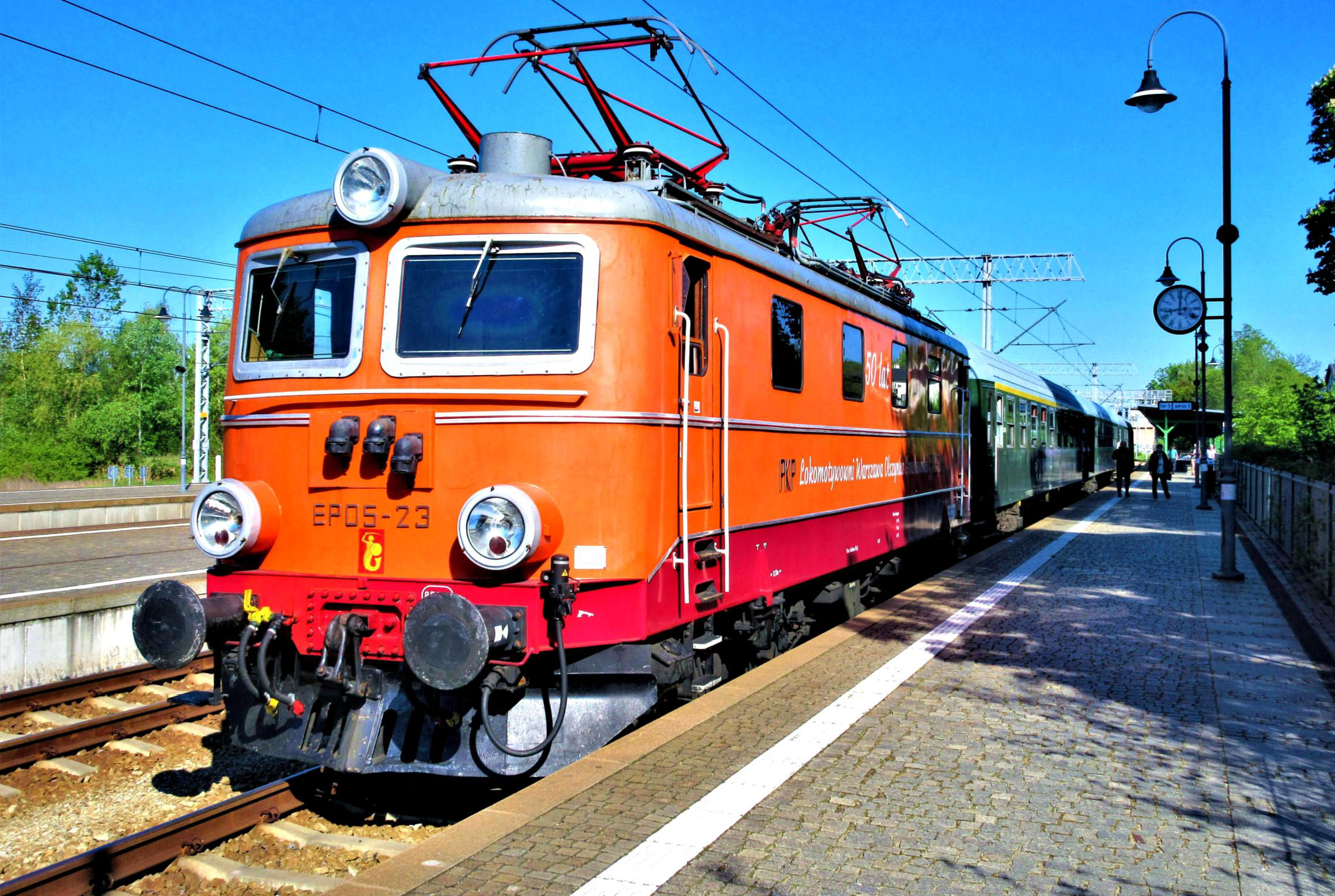
Wrocław Leśnica; after running round veteran loco EP05-23 awaits departure back into the Wrocław complex.
[© Simon Mortimer 2023]During our sojourn here, we heard the 'tap tap tap tap' of a Woodpecker in the adjacent woodland and our resident ornithological expert said there are three species in Poland but you can't differentiate by the tapping noise or the pattern of tapping noises. 'Woodpecker' it is then. The purpose was then to return south over Lines 273 and 758 but, compounding our 19 min late departure, we arrived 20 down and managed to lose more on the run round, departing 29 late at 09.11. We duly completed these routes not covered last year to Wrocław Brochów, where we took a track one to the left of that done in 2022 (past the station right and at a lower level), before reversing at Siechnice. One wag came around asking us NOT to use the toilets here (where we temporarily lost a participant in a Portaloo last year). Our tour arrived 38 down and left 40 down (without casualties), heading for Żórawina.
It is nowhere special but getting there was, as, after returning this time around the back of Brochów Yard on Line 349, we ran via the lengthy grade separated side of Line 765 not included last time. The train weaved across to the Yard Road adjacent to the Main Lines at Żórawina, where the loco ran round. Here we were treated to some top flight PKP strimming ... one man (the strimmer), er ... strimmed and another kept a look out for any train which might curtail his colleague's strimming. Given the preponderance of grass and more substantial vegetation across the PKP estate, it was difficult to divine the criteria or necessity for this man to strim. However, strim he did, scything down the grass to a neat border keeping the avenues of Polish commerce free of grass, at least a metre or two from the running line or a platform which otherwise might have fluttered quite vigorously with a passing train or in turn not at all with a passing passenger. To think that NR let entire trees grow from masonry structures besides running lines without a rapidly rotating length of plastic twine in sight!
Departure from Żórawina was 50 minutes down and, upon arrival at our reversal point at Brochów, we were stood in a queue of freights awaiting line clearance due to a trespasser (or more likely in Poland an actual collision with a trespasser). Trespassing on the railway is practically a national sport, with points for artistic merit. Given the ever mounting delays, we were faced with the decision, to drop the reversal to head back towards traversal of flying junction elements not covered last year at Kuźniki or simply continue forward almost in path. Given we were already likely to have the end of the day curtailed anyway, it was a reluctant but correct decision to cut out the run to and from Kuźniki.
So now it was on to Opole, a small compensation was that we stayed on freight Line 349 behind the platforms at Święta Katarzyna (which translates as Saint Catherine, a small village) and, 'Polishing' up the microgricing, crossed to the Main Lines at the very end of the loop and the facing crossover. So, with not a lot on for 45 min, it was lunchtime! We wended our way next door to the spacious buffet restaurant vehicle where we perused the menu. Now when I say perused, I should say that in a world where many things are in flux and confused, where even the concept of Up and Down is open to interpretation, the TurKol menu sits like a rock in that maelstrom. It is a datum point of infinite consistency, a compendium of culinary choice untrammelled by the fickle hand of foodie fashion, untainted by innovation or imagination ... in summary, it's chicken! Is the beer cold? Yes ... result!
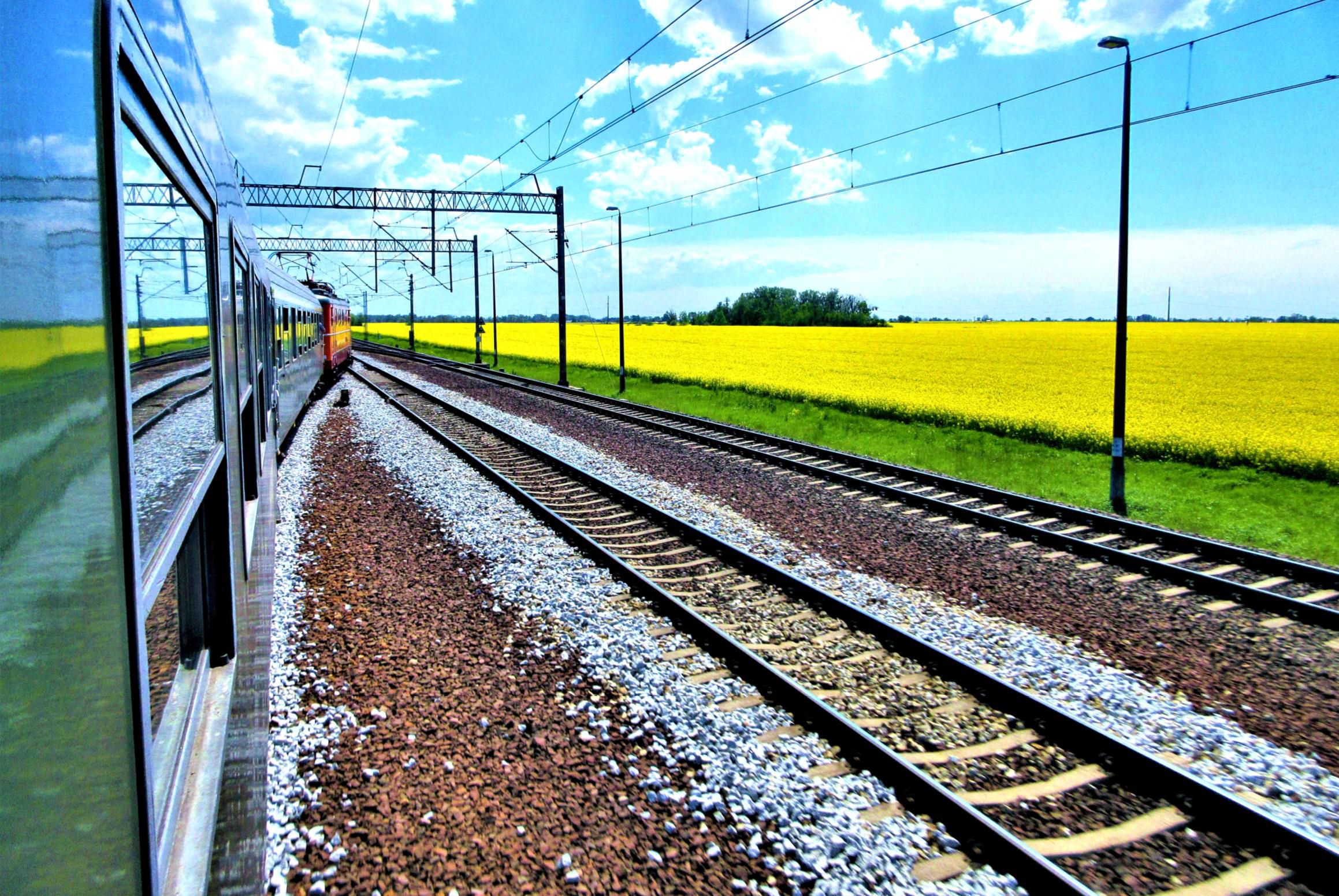
Święta Katarzyna; view forward right as our tour crosses from the freight lines to the southbound passenger line right.
[© Simon Mortimer 2023]At Opole last year, we saw the early stages of a new bridge construction on what appeared a new alignment for the whole railway. Passing the site now some eleven months later revealed a completed new (shiny white) single track bridge on the southbound track but still with Single Line Working over the old original (shabby green) bridge. Ah well, there is always 2024. Track works were well advanced on the new alignment, with freshly ballasted sleepers and track. It turns out the reason for this activity is that the original twin track bridge was found to be in such a poor state it was allegedly assessed that if two trains crossed it simultaneously, it might very well collapse! (Perhaps there is potential for some sort of twinning ceremony with Nuneham Viaduct‽) Construction of a new bridge commenced quickly as this corridor carries dense traffic. Once southbound traffic transfers to the new bridge the old one will just carry the single northbound line immediately, meaning only 50% of any potential loading.
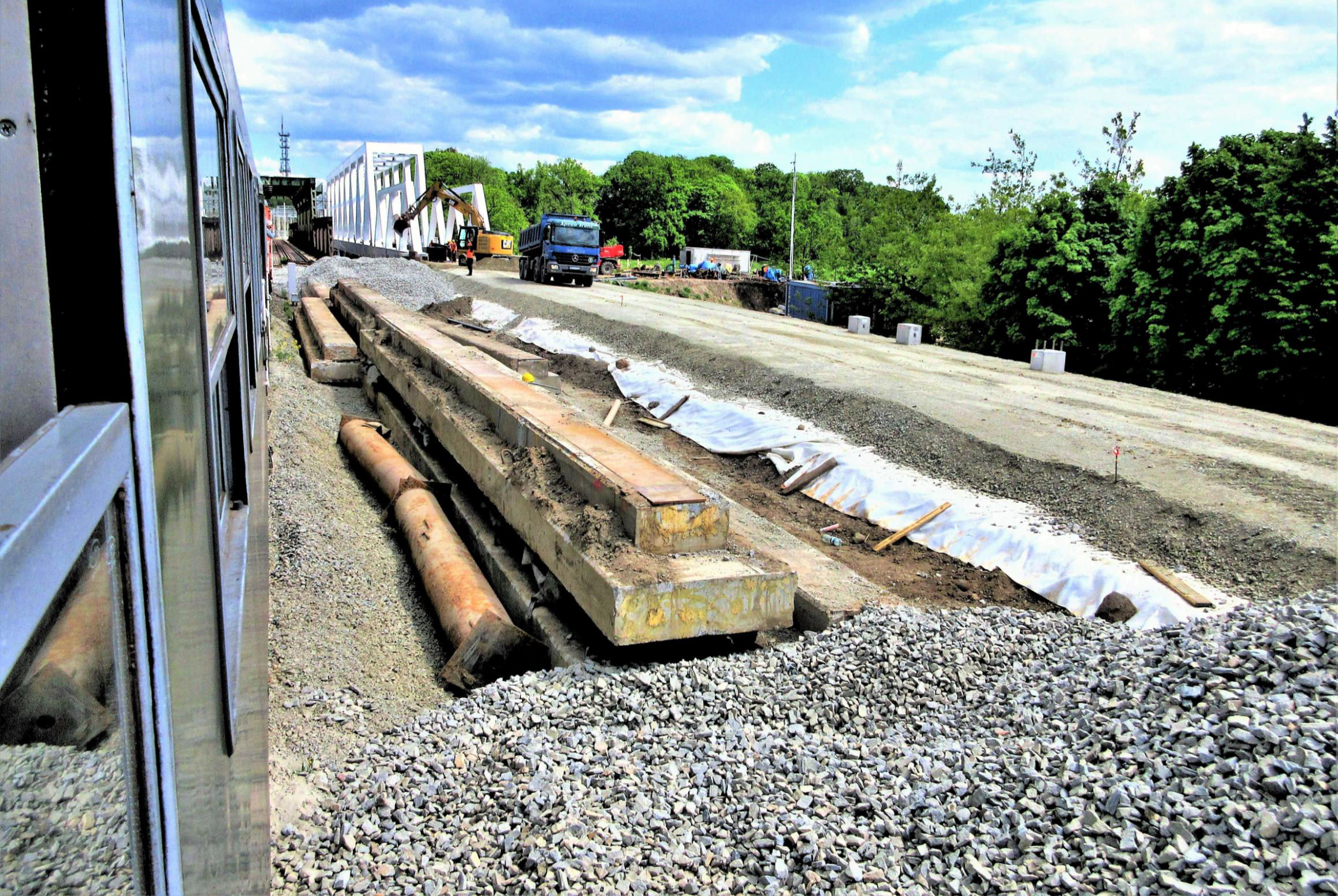
Opole; approaching the original twin track bridge (under Single Line Working) with the new single track bridge under construction right.
[© Simon Mortimer 2023]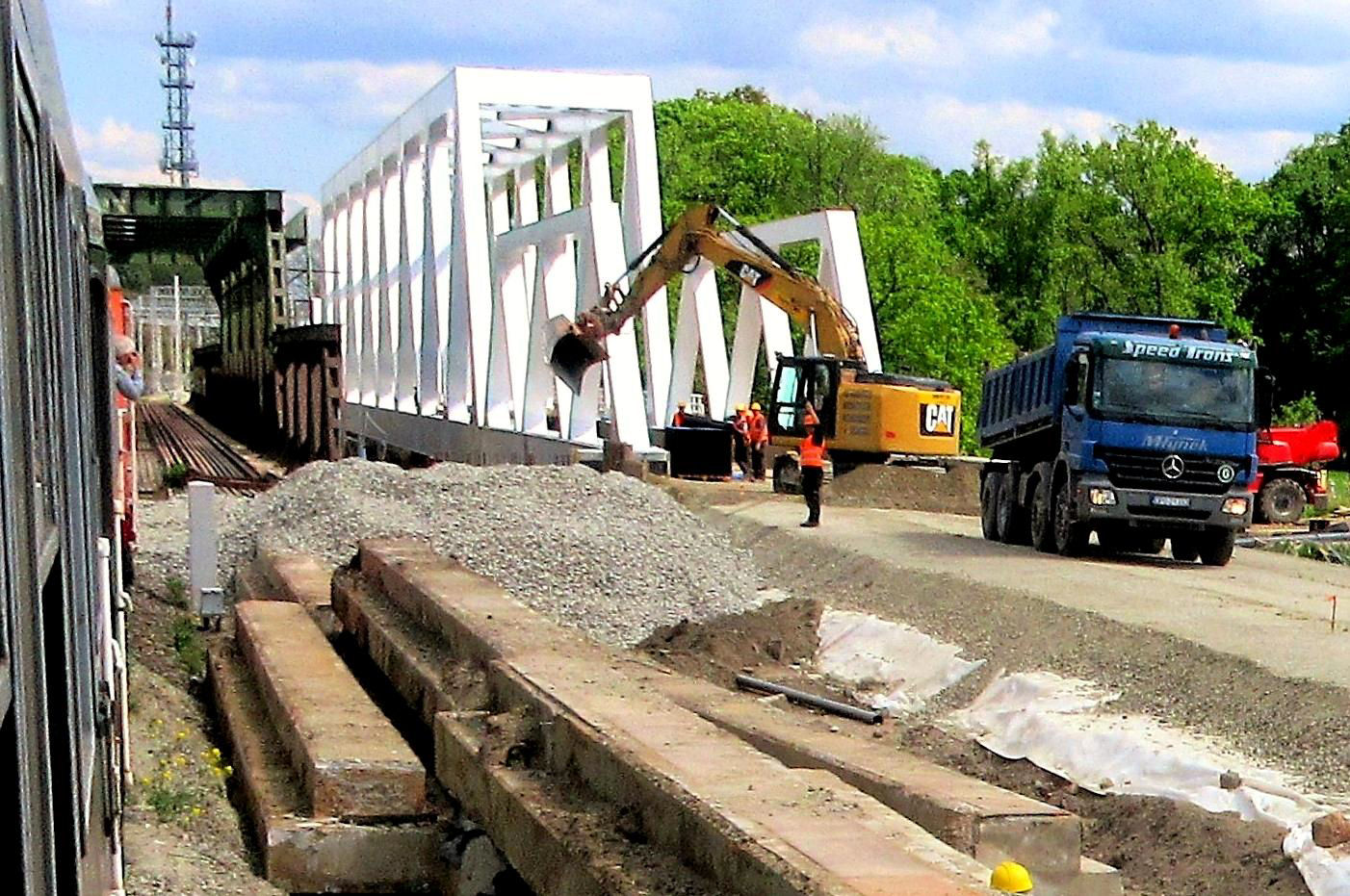
Close up of the new bridge.
[© Simon Mortimer 2023]Alas, the aspiration to transit freight Line 280 connecting the yards between Line 277 used last year off the secondary route via Jelcz-Laskowice and the standard main Line 220 was not to be. For reasons unknown, its omission from timings since the outset had been repeatedly queried without success or explanation. However, as it is only accessible through the adjacent freight yard, a lack of capacity due to the aforementioned bridge replacement works was the most likely cause. We travelled straight through Opole Główne station noting, left, that the new bay platform connecting line we managed to persuade the local staff to agree to our reversal into last year was now blocked off by a chained sleeper across the track! Did they knew we were passing through again this year‽ En route to Gliwice down the main line, we reached Błotnica Strezelecka where our train pulled up very smartly.
Looking out, it could be seen with the level crossing warblers clearly audible that the barriers were down on one side and not the other! After a few minutes they did descend and we accelerated away again … until podg. Szobiszowice, little more than one kilometre out of Gliwice, where we glided to a halt. [podg. is an abbreviation for posterunek odgałęźny literally 'separate post' or 'branch post' effectively a 'junction' - remember that, as it pops up quite a bit. Strictly it should be 'p.odg.' but 'podg.' appears on many junction signal boxes, PKP Timings and the Mały Atlas.] All quiet, had the loco blown a proverbial fuse? No, the problem was at the local substation, all traffic stopped! Eventually someone put a Zloty in the Sloty and we moved off again 45 shy, having got back to within 10 late through Opole but for once ran round in less time than allocated, so left Gliwice only 36 late.
This was to gain Line 153 by way of a reversal at Toszek Północ, which we had traversed the other way last year, but this transit obtained the 1.4km long flying junction towards Rudziniec, generally required by most on board, including some who have worn out at least one red ballpoint inking in Poland. This was a last minute request from Patryk to make up for refusals elsewhere, even our Organiser didn't know until it magically appeared in the final timings! This line only opened in 1975 for freight but the flyover had been put out of use some years ago and only reinstated recently. At Rudzinec, we reversed again. I hope someone is keeping count (!) on what appeared to be reversing sidings between main routes 199 and 137. Our tour continued through Gliwice on an again recently reinstated, south side connection - not in the 2011 Mały Atlas (but in the 2022 version). Line 141 was used to access the freight route towards Knurów via Curve 677 opened by the Deutsche Reichsbahn (DR) - German National Railway - in 1942. Next, Line 149 opened in stages by 1924 and now has an all year weekend pair of trains plus, in recent years, a summer overnight. Here, the 10 minute timing to run round took 18. (Keep that name Knurów in mind it will appear again.) We returned via the other side of the triangle at the Line 141 junction (at Zabrze Malkoszowy) and proceeded through the mix of silver birch forest and industrial wasteland towards Ruda Bileszowice, passing south of the yards then stopped!
After an interval filled with more idle speculation as to the reason for our notably lengthy stationary posture, it turned out PKP had managed to fail a freight on our route ahead (ultimately via a rare curve to Chorzow Batóry) with such precision that even the relatively simple work around of using the adjacent line and crossing back at podg Hajdula ['branch post' or junction remember] was blocked, so a total kibosh. There was no option but to run directly and unexcitingly to Katowice Ligota, where we arrived a disagreeable 15 min early! After reversal, we tripped into Katowice station 12 early.
Continued in Part 2