I once received a marketing email: Treat yourself to a weekend in Widnes. Not a completely random suggestion from Booking.com as between railway trips and following my sports teams, I end up staying in places well off the tourist trail. It was a Thursday night rugby match that resulted in me staying a night in Widnes Travelodge (sorry, Booking.com, you lost out). I caught the train from London to Runcorn, then the bus across the Mersey to Widnes; they are almost twin towns. That was my one and only previous experience of Runcorn but I was back again; a Tuesday night, not quite Widnes, but it was a treat.
I started the day in Manchester, with a Freedom of the North West Rover burning a hole in my pocket. After buying some new trousers, I went to Southport to cross off some platforms, then via Manchester to Chester to red pen a bay platform (as you do) with some bonus crossovers on the way. At Chester I ran into another Society member by the infamous hole in the roof and we made our way to this fixture together. It involved a rather full TfW train from Chester to Runcorn East, then a 15 minute walk.
Google Maps proved essential for the last stage; it started simply enough (on the pavement parallel to the busway). Then we had to veer off through one of those 1970's housing estates where the roads are separated from the walkways with no 90o turns. [Classic new town syndrome.] I only took us down one wrong turn, so not too bad… Soon we were in Town Park, where the Halton Miniature Railway is located, an extensive, semi-wild country park in a moderately hilly area; the railway is at the south.
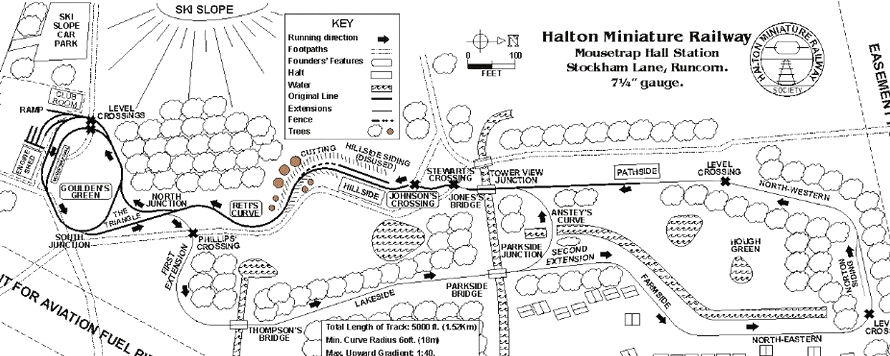
May 2016 plan of the Halton Miniature Railway (MR p13, in Cheshire)
Soon, useful landmarks came into view: the railway's storage sheds, some 7¼'' gauge track and our General Secretary (who organised the visit). There were no other miniature members in sight and it was 30 min until the fixture was due to start; we must be the first to arrive. You are almost the last to arrive said the GS, everyone else is at the café having an ice cream. Soon we were with the rest of the group at the foot of the dry ski slope. This is operated by the same man as the miniature railway, John Doyle, our host for the day. In fact, he had to do the whole thing himself as his volunteers had gone down with Covid. Despite this, John ran the whole thing cheerfully, efficiently and with a clear understanding of what we wanted. Many thanks to John for an excellent evening of entertainment. Our visit illustrated why the railway has been altered over the years so it can be one man operated.
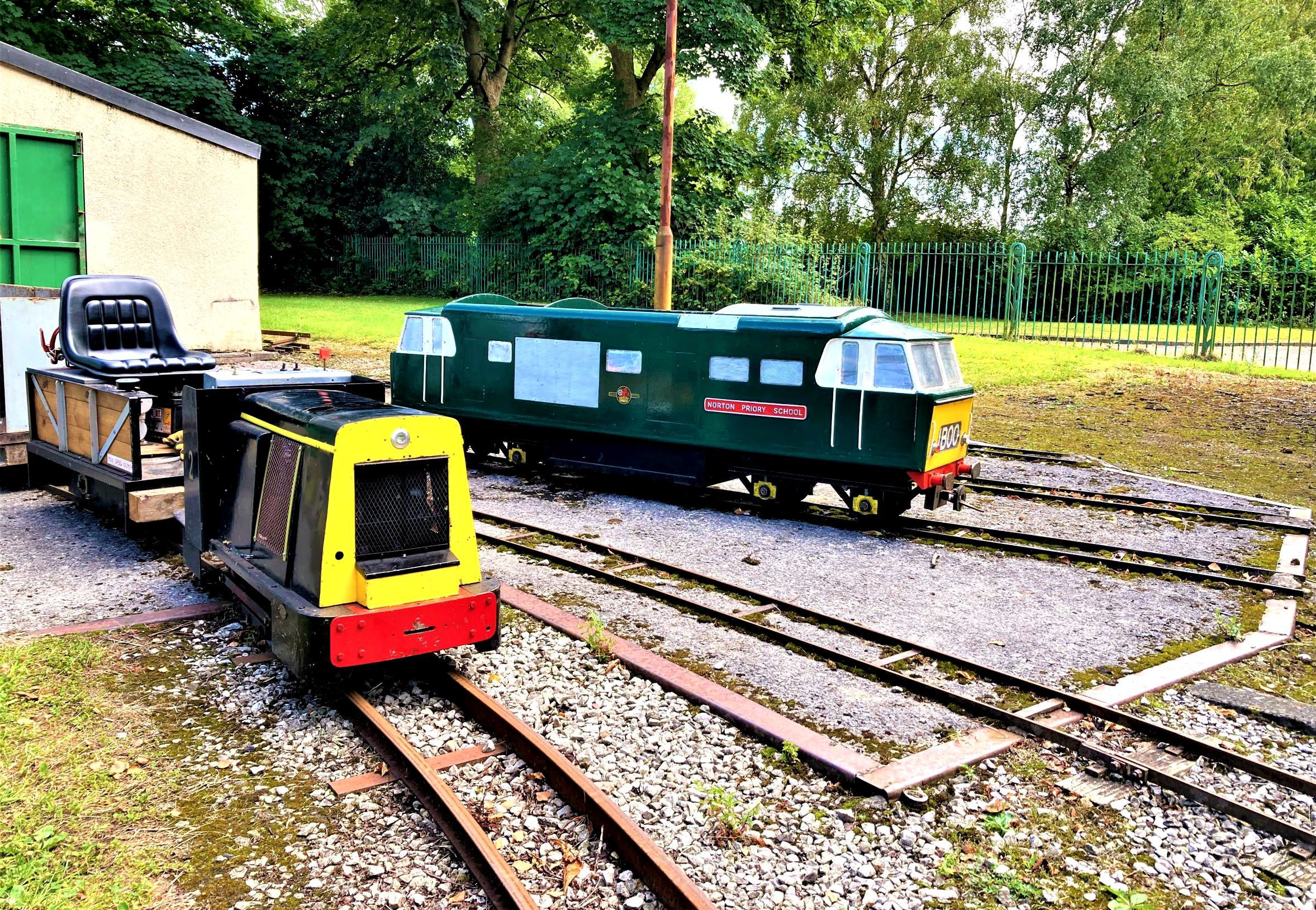
No2 & 'Norton Priory School' at the shed awaiting the Baker's dozen of miniature members to arrive. (Note: Track is not in Baker or Quail.)
[© James Beal 2022]I enquired if anyone in the party needed the ski slope for slippage. Our BLN editor enquired after my attempts to visit the Orchid Line on the IOM two days before (unfortunately, third time unsuccessful but that is another story). This helps to explain the date of this fixture. We had run a very successful series of miniature and narrow gauge fixtures on the IOM the previous weekend and INTERCITY had a Crewe to Stranraer charter the next day, so it was expected that many members would be in the area. It is certainly why I was there. Unfortunately, the charter was postponed with just over a week's notice due to an RMT strike. But here we were on a Tue teatime, perambulating round a park in shirt sleeves.
Waiting for public running to end, we started on time. The first task was to back out of the shed over the traverser. It was soon realised that three sit-astride coaches was not quite enough for 13 miniature members so a fourth was soon added. Next, the public run of almost a mile; much appreciated by me as I had never been here before. Petrol hydraulic 'Geraldine' coped well with a load that may have been slightly more than she was used to. The public run is a long oval but slightly pinched together at a point near the end with the main station (Mousetrap Hall). It is in this pinch point that some of the rare track sits.
After the public run, we ran non-stop through the main platform at Mousetrap Hall (the inside loop), before coming to a brief halt on the 'tramway' section just beyond; here the track is set in the tarmac of one of the wide park paths for a few metres. This was for John to set the points at South Jn to take us on to the Not Regularly Used (NRU) curve. It allows a much shorter circuit to be taken, pretty much a circle round the play park. The curve had a brief moment in the sun just after Lockdown 1, when it was used to keep the queue moving while also maintaining social distancing. This was also the original run when the railway first opened in 1979 but the public normally do not get to do it nowadays.
We ran through the main platform for a third time, again coming to a halt on the 'tramway' for points to be set. This was for a reversal through the platform avoiding line. The railway refers to this as P2; although not marked as such on our plans, there was a strip of raised concrete between the track and the shed, possibly too narrow to be used as a platform normally. Beyond the platforms and the station throat there is a crossover between the two through roads, we took the outer route for a reversal beyond the throat. Running forwards again, we went through the main platform, round the NRU curve again, then through the station using the crossover. That was the entire station area track scratched but there was a final task for our four coach train. We headed out to the far end of the public run but, on returning to the pinch point, we took the long crossover at North Jn, another NRU move. This turned the run into an elongated balloon instead of a circuit, so we ran 'bang road' through South Jn, the 'tramway' and into the avoiding line. John invited us to alight via 'P2' as not marked on our plans.
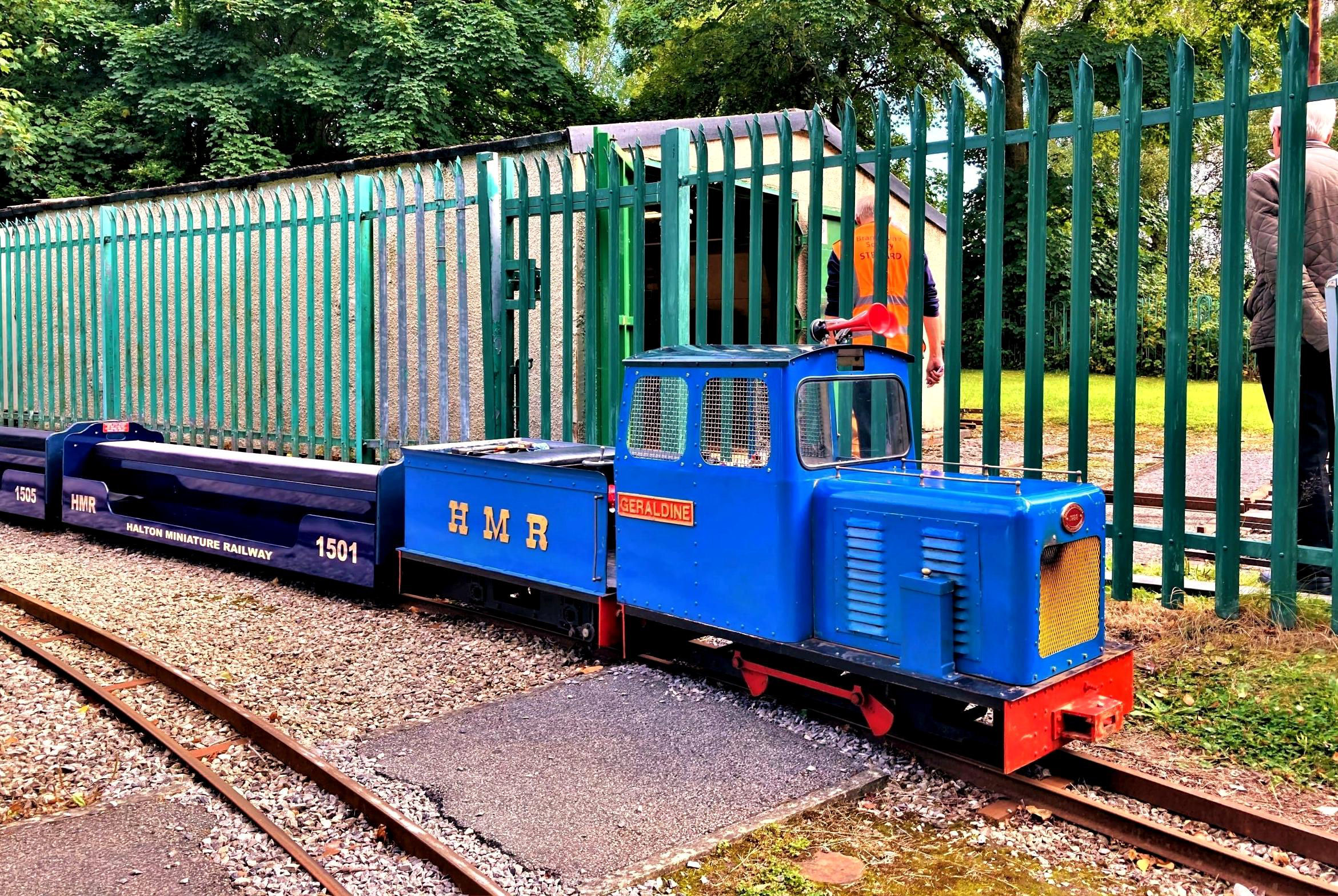
'Geraldine', in the platform bypass road ('P2') at Mousetrap Hall station having run 'bang road' through the tramway section following use of the rare connection at North Jn. Whodunnit? All 13 members who attended are suspected to have, the shed yard and GS are behind the railings.
[© James Beal 2022]It is a good sign when the train formation shrinks during a minor railway fixture and when the traction is changed over. Both happened at this point. The party was split in two and a two coach train set out behind battery electric 'Halton Castle' (ex-Conwy Valley Railway Museum). This was a public run plus shunts into the two lines out in the country park and a departure from, or arrival into, the shed area (depending on the group). Norton Siding was simple enough; formerly a loop for recessing trains but the facing points had been removed. A quick count down, a kiss of the buffers and we were off again.
Anstey's Curve was next. At one time, there was a plan to create a figure of 8 layout within the main circuit by adding two triangular junctions which would have almost touched each other. However, one side of each triangle was not built. The parts that were built form parts of the public run and also what was originally a cut-off for a shorter run - Anstey's Curve. John wasn't sure that the curve had ever been in public use and the facing points were later plain lined. The website says that the cut off was intended to be used for Santa specials and to shorten the run in very cold weather. The railway now plans to bring the curve into use and half of it has been relaid. We reversed slowly to a point just past halfway, where the un-relaid track was visibly inferior. It wasn't safe to go further, maybe someday...
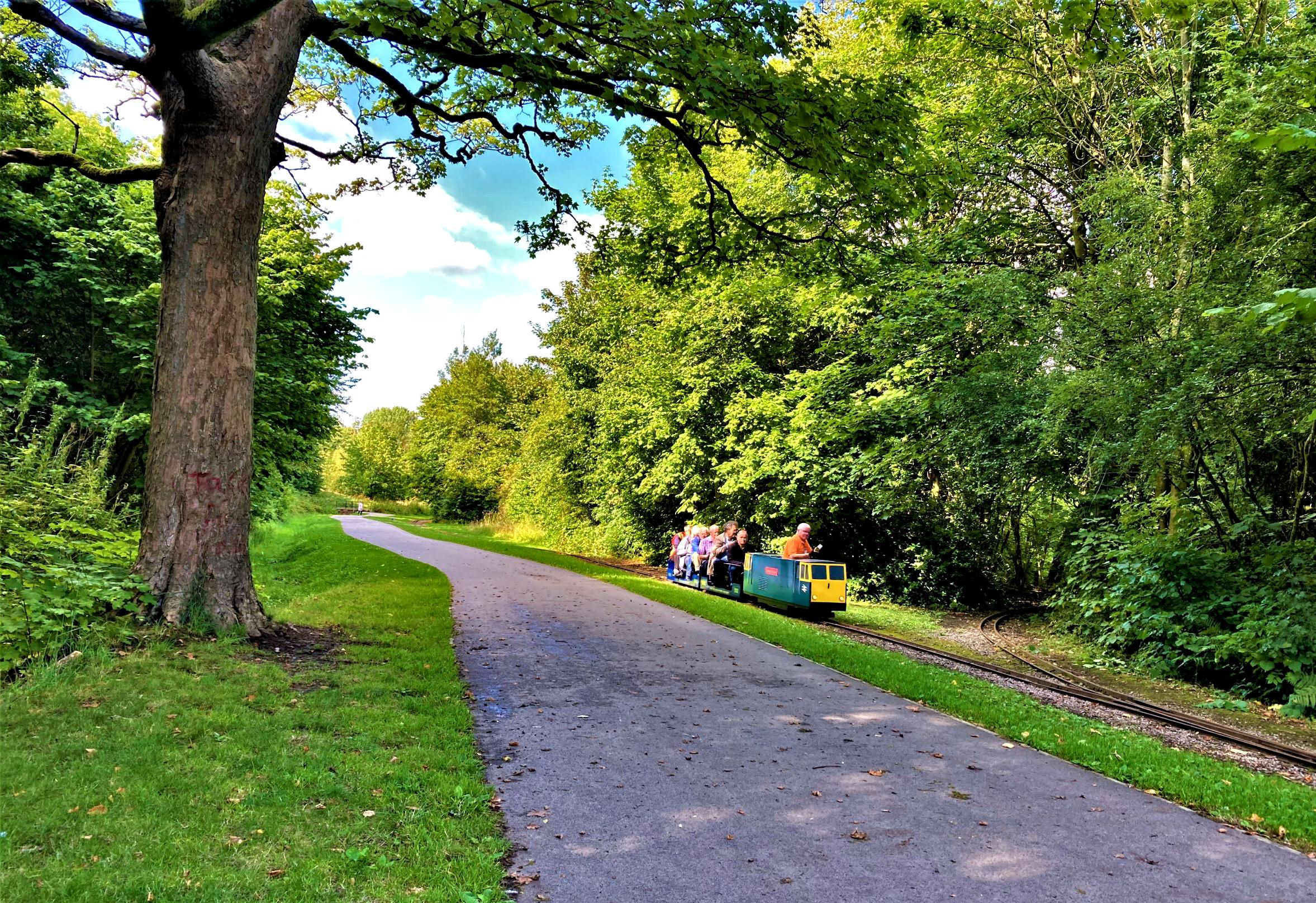
What better way to spend a lovely summer evening than in this lovely park? Battery Electric loco 'Halton Castle' takes half of the party round the north side of the main circuit. The train had been to the buffer stops in Norton Siding and was about to propel around Anstey's Curve at Tower View Jn (bottom right). Our convivial host John Doyle is driving.
[© James Beal 2022]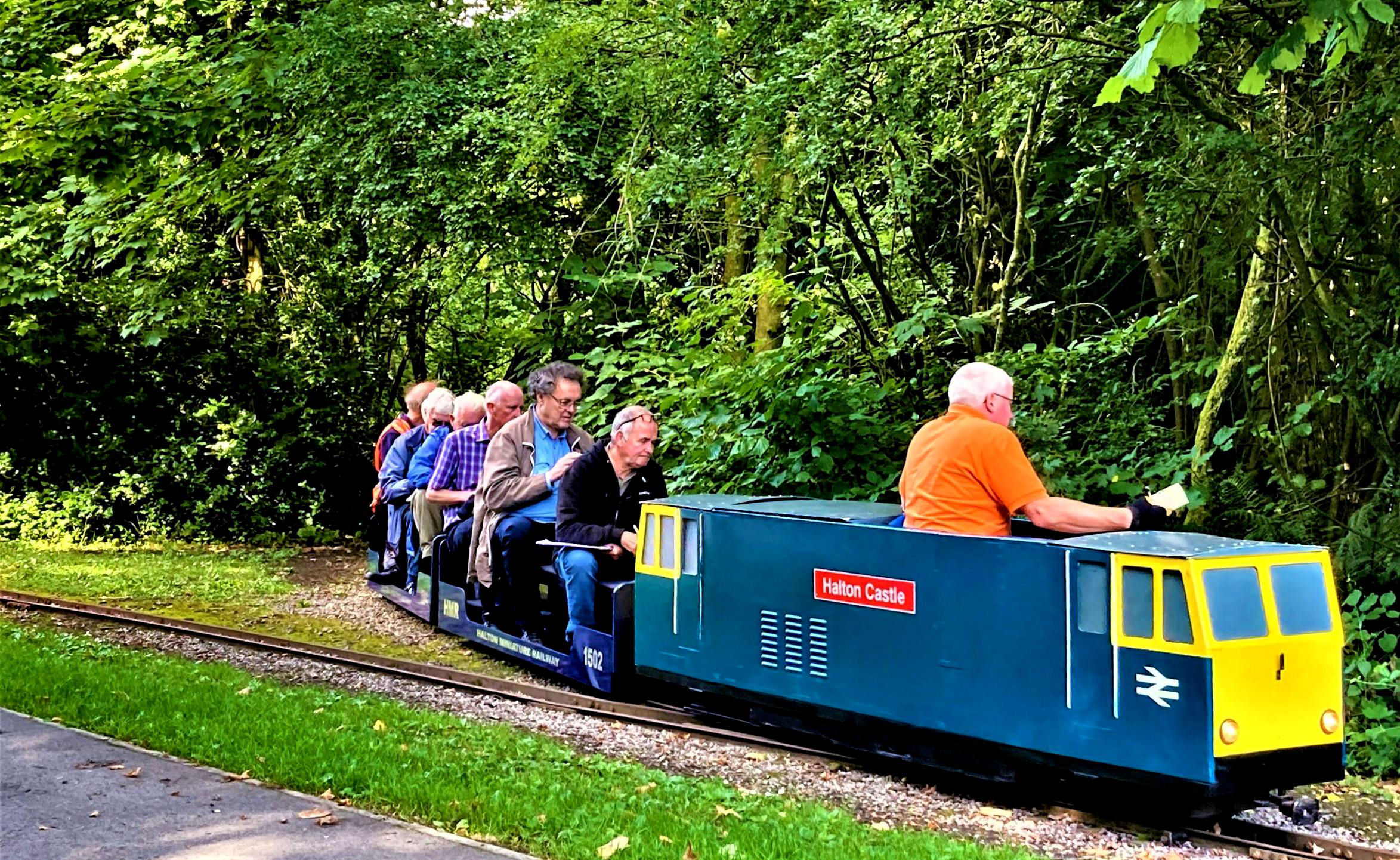
Battery Electric loco 'Halton Castle' propels around Anstey's Curve at Tower View Jn
[© James Beal 2022]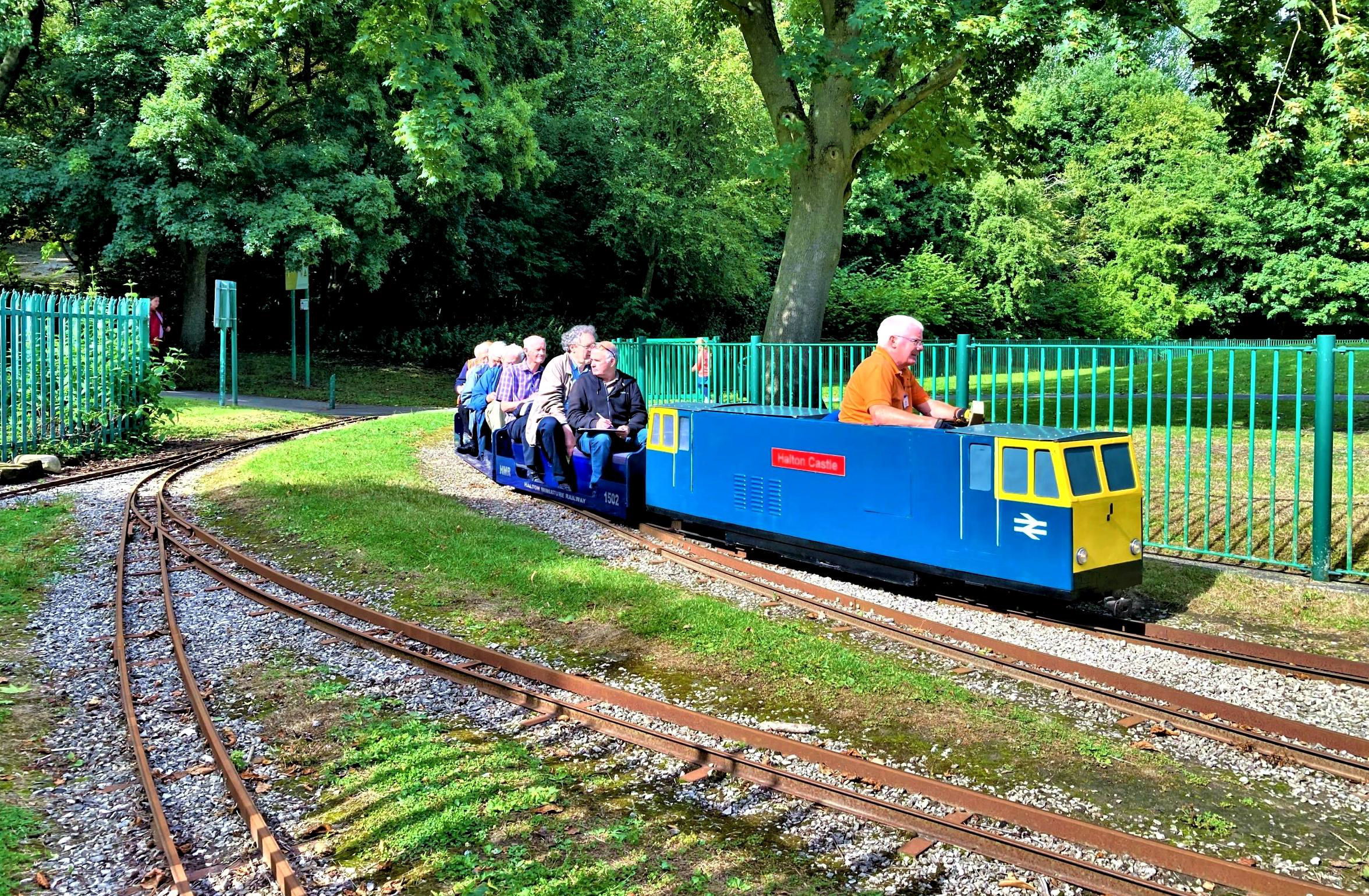
'Halton Castle' takes half the miniature members through the station throat at Mousetrap Hall. Left to right, the tracks are: Two access lines to the shed, the platform bypass line and the long crossover between the running lines and the platform line. All members who attended 'cleared' the throat.
[© James Beal 2022]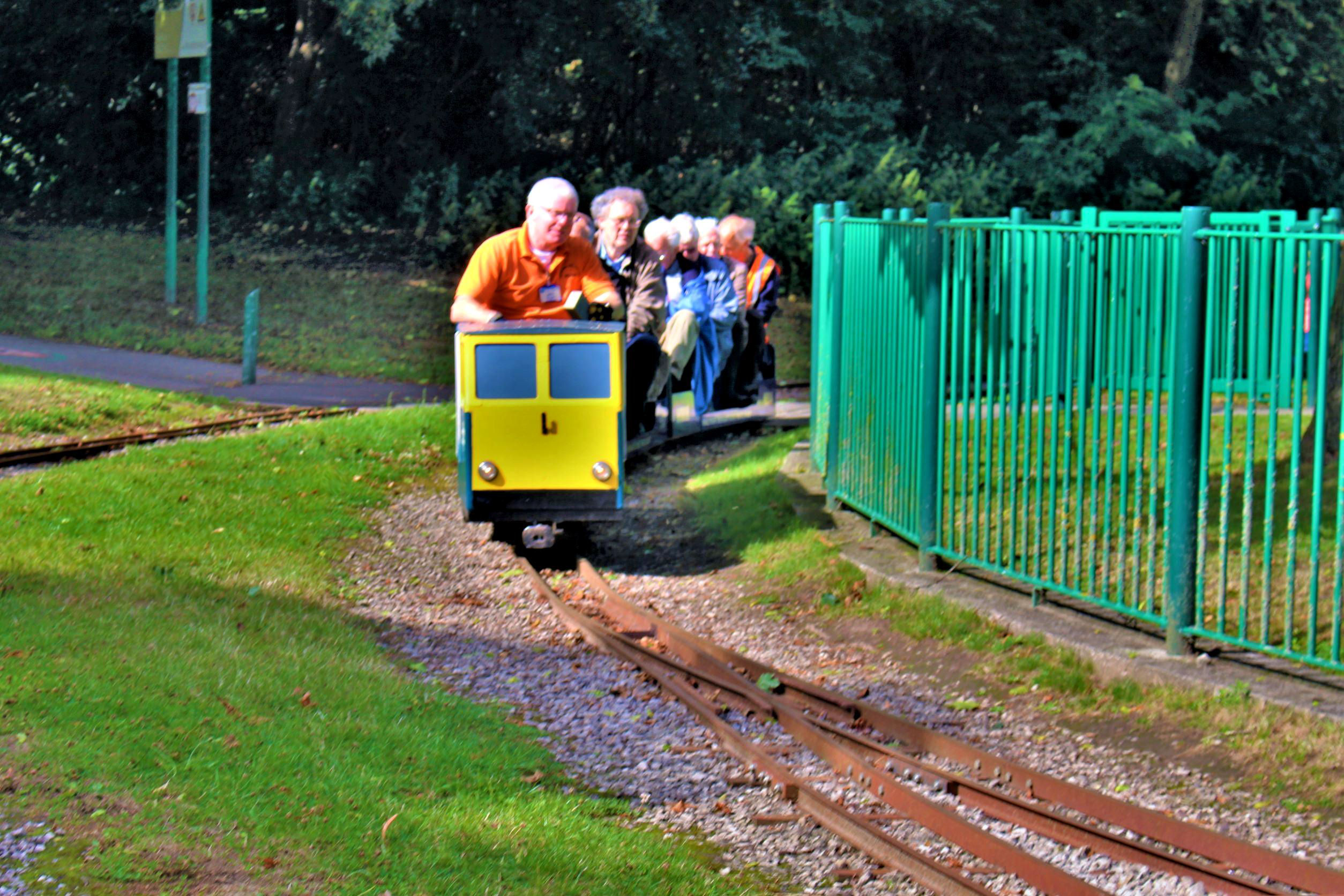
Approaching Mousetrap Hall station travelling in what, nowadays, is the normal direction of travel.
[© Stuart Gomersall 2022]After a run back to the shed, and after the other half of the party had visited the distant sidings, it was time for the serious stuff - the shed roads. The stock we had used so far was left in the station and other stock was cleared out of the shed to allow us to reach the end of the lines, or as near as possible. The traction was changed repeatedly, so we all had a small amount of haulage from a Hymek lookalike 'Norton Priory School', tram engine No7 and Ruston lookalike No2. The only road we couldn't do at all was that with a curve and interlaced track at the traverser end, as it ran under a long low work bench. An interesting feature of these moves was that as stock was removed from shed roads, it revealed yet more stock under benches and in other dark corners, an Aladdin's cave for miniature spotters.
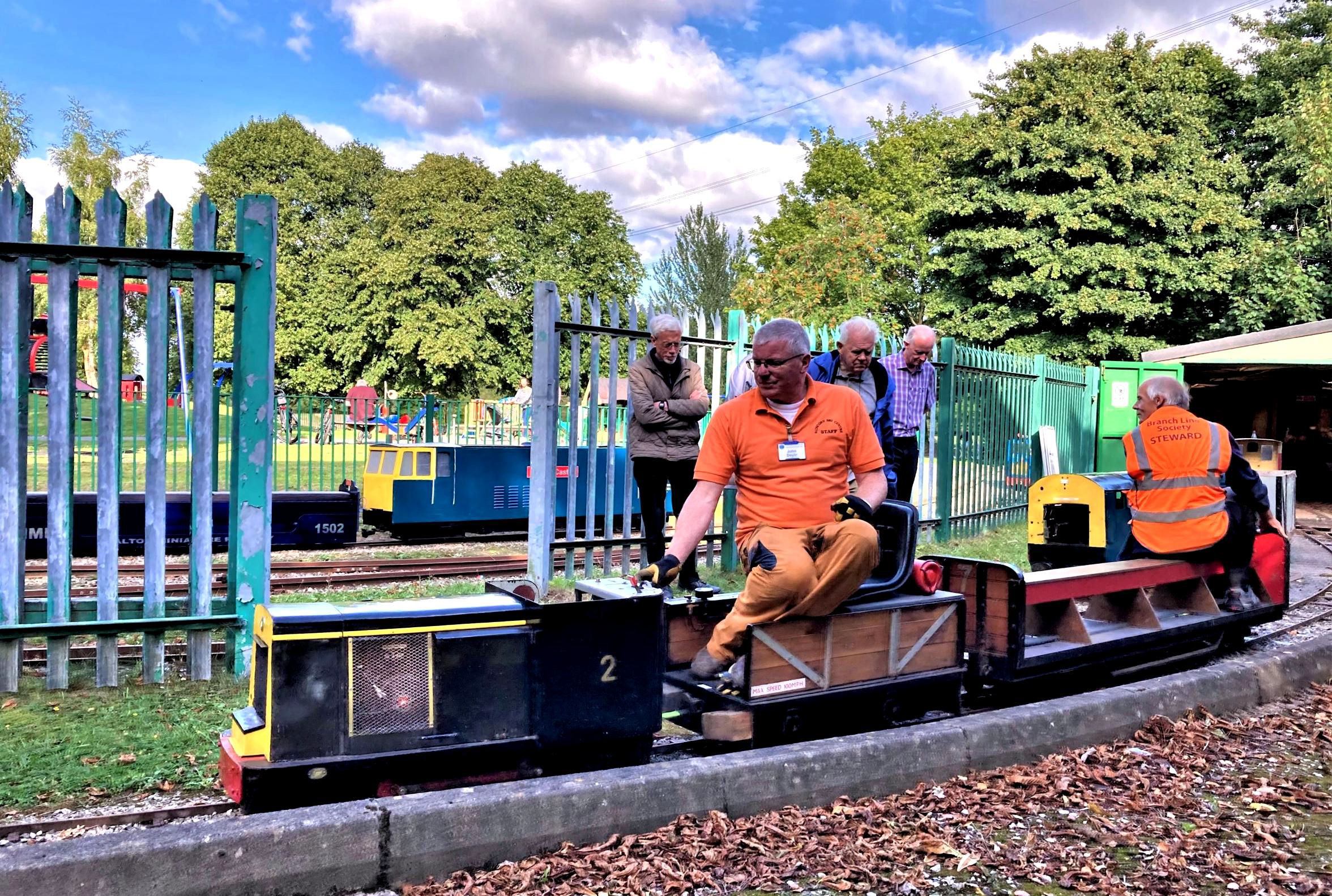
Your GS (who organised this superb event) supervises stock movements to allow members to clear the shed roads. The station is behind the railings.
[© James Beal 2022]We then did the stub roads outside the shed. The formation was reduced again, to one coach, and the traction changed to people power (none of us had painted numbers, perhaps disappointing to some, although we all have membership numbers). An omnidirectional member or two enjoyed sideways travel on the traverser. Lastly, we tackled the loading ramp road. I haven't done this line myself, said John. Ah, yes, that's exactly what we like to hear. Thanks again John (and to Tim W), you really were spot on with the excellent arrangements. For reassurance, no mice were caught during this fixture.
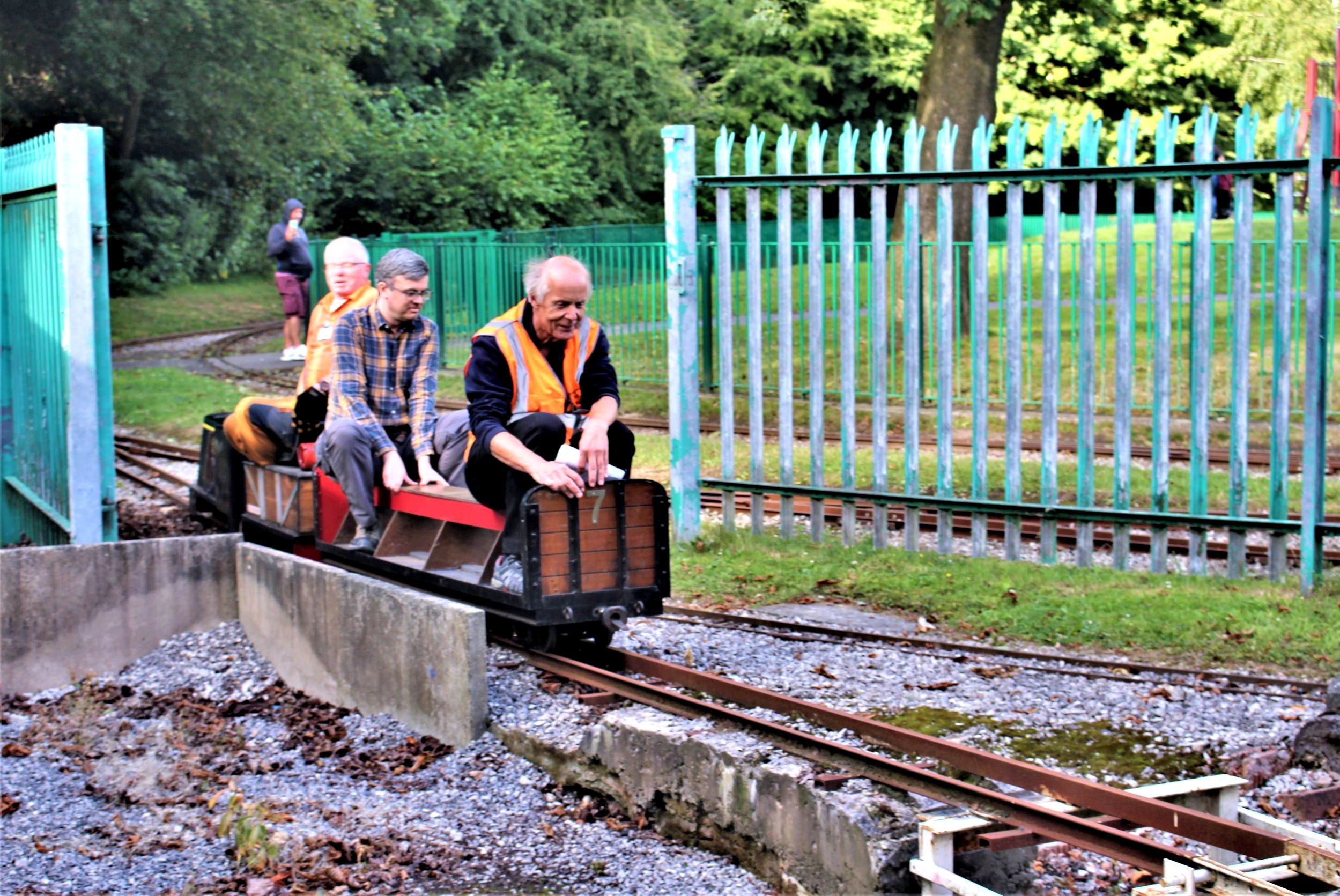
The 'highlight' was the loading/unloading ramp - every was 'inclined' to agree, including John Doyle. Our reporter, James Beal, is the one with glasses.
[© Stuart Gomersall 2022]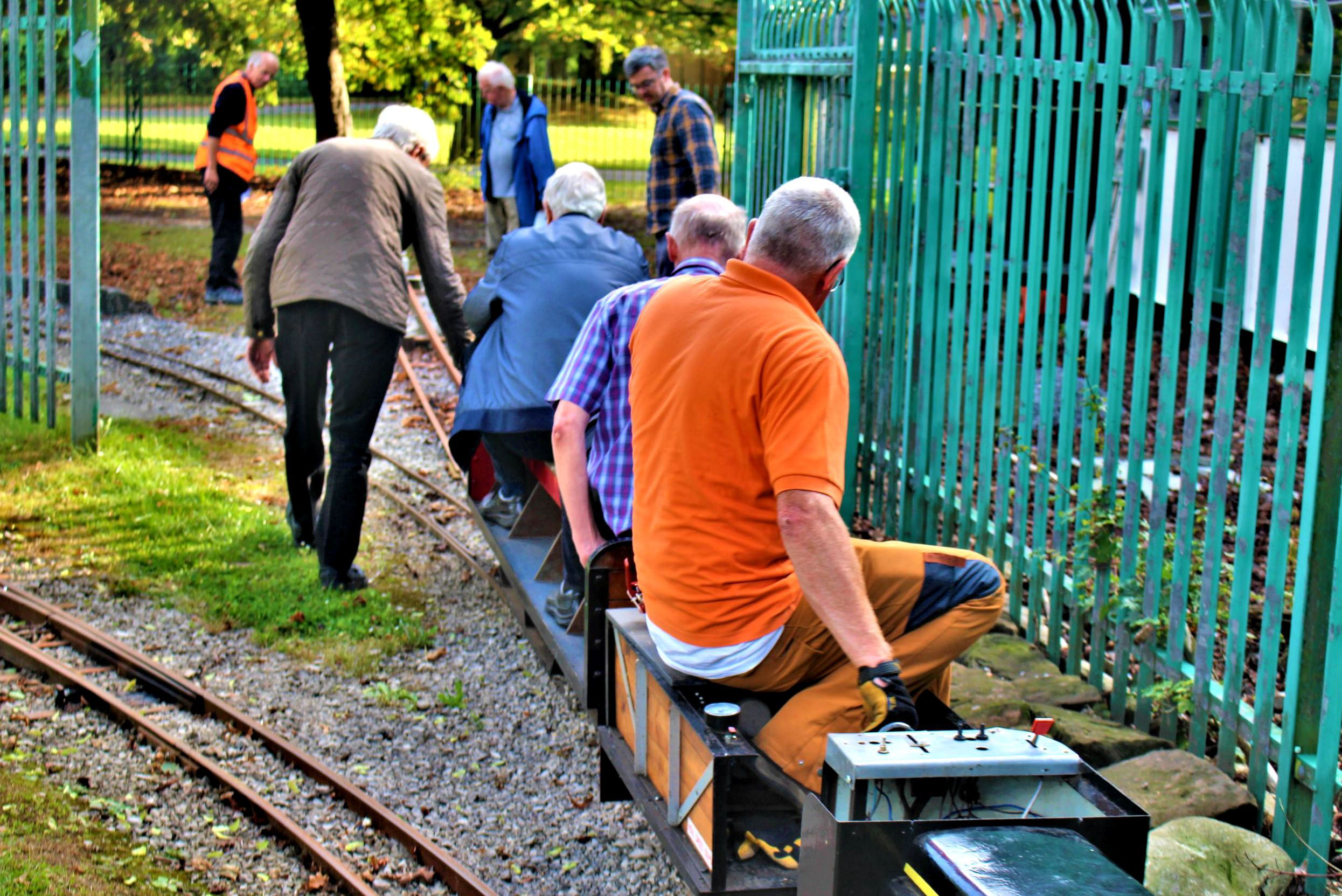
Ramping up the excitement - Peter Green (front) and Nick Porter (behind) - it was the final piece of track done, then participants sloped off...
[© Stuart Gomersall 2022]I could list the track that we covered but it is easier to say what we didn't cover: half of Anstey's Curve, the interlaced workbench covered shed road and about a coach length at the back of another shed road where the track was dubious. It was that comprehensive. A short note on the track itself. The main line and most of the sidings were laid with 'C' section rails, open sides facing outwards. The 'C' section must be perfect for berthing stock but a few of the sidings had much lighter flat metal rails, laid on their ends. Anstey's Curve was half of each. The rail in the shed initially looked like it was set into the concrete base but turned out to be just strips of metal screwed direct to the floor. This unusual arrangement worked perfectly well but possibly not for much longer as the shed is set for replacement in the near future. This sets the scene for a potential future visit, when the new shed is in place. If you have a chance, I urge you to treat yourself. The railway does not charge for rides, it is all by donation and this is much appreciated by the local population and Council who are very supportive. It is surprising how much the railway has changed over the years (even the normal direction of travel). At one stretch on the circuit, the railway has been realigned away from perimeter tree encroachment.
After the visit, it was a brisk walk to Runcorn East and a straightforward run to Manchester Piccadilly. I reached my hotel just in time to watch England beat Sweden in the Women's European football championship. The following day was a leisurely tram grice, as a substitute for the re-dated railtour, and the day after featured (amongst other things) a visit to Whitehaven bay platform. Then it was back home to Yorkshire and reality after an entire week (starting at the IOM) messing about on trains.