Aug Bank Holiday weekend approached - it must be time for a trip to Scunthorpe. Unusually this year, our tour took place on a Sunday with the later start of the train service meaning that all of our participants either arrived by road or stayed locally on the Saturday night. The drive across from Doncaster, on an almost completely deserted A18, was very pleasant in the early morning sun and arrival was in good time. In an exciting and most unusual development, Scunthorpe's finest - 'Janus' No1 - was heard heading up the bank towards Frodingham platform by 09.00, for the 09.30 scheduled departure!! On arrival there were just the three former British Rail (BR) brakevans in tow, the 'Shark' having had to be taken out of service shortly before the tour with a fault; this led to the three vans being a bit busier than normal. There was plenty of time for photographs and members all found their way onto their allocated designated van, either on a veranda or inside.
[Early bookers had their choice of accommodation and late bookers did where that was possible.]
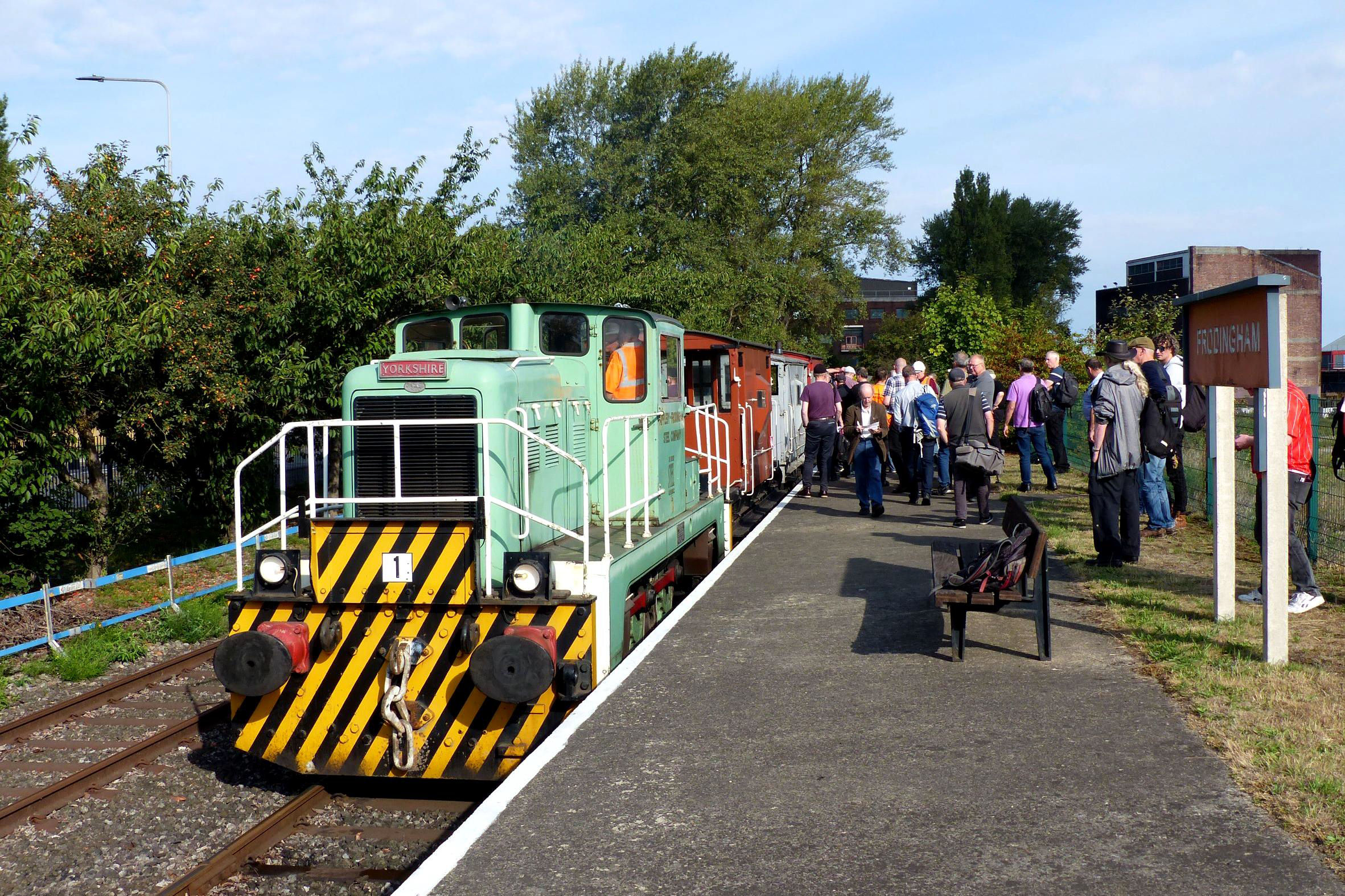
Members wait to join out tour, Frodingham platform at 09.20, looking towards the buffer stops.
[© John Cowburn 2022]All aboard, we departed pretty much on time and headed out past Appleby platform and the AFRPS (Appleby Frodingham Railway Preservation Society) shed, passing Winn's Sidings which contained Di8 No8.712 (NSB* red/yellow) apparently dumped and the ever present and long out of use '81' (the ex-BR Class 20, 20056). The original and replacement cabs fabricated for 'Janus' No29 - the former removed before but the latter never fitted after the Di8s arrived - were stored on a wagon. There was also a short rake of smartly painted (and loaded) internal four wheel scrap carrying 'yard [internal] wagons' over the back. We were briefly checked at the confluence of lines down to a single track at Dawes Lane underbridge, also referred to as 'Bottleneck Junction'. Once three tracks, if anything happened here it would be a big problem. Di8s 8.702 (CargoNet grey) and 8.704 (NSB red/yellow) took a train of internal bogie wagons loaded with sections rolled at the Rail & Section Mill into Redbourn stocking area. [*NSB = the former Norges Statsbaner - literally 'Norway's state owned railway enterprise'.]
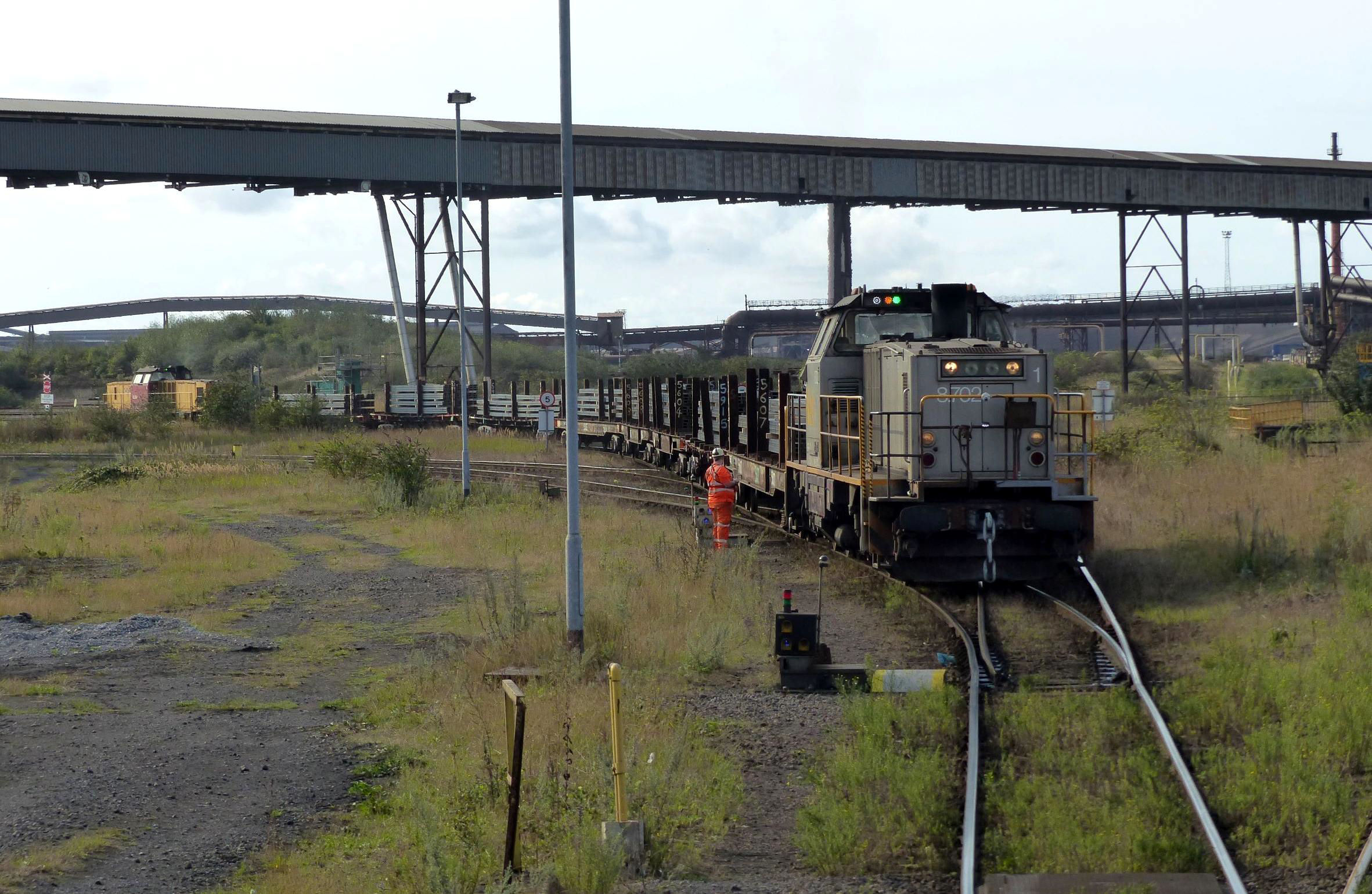
Di8s 8.702 (CargoNet grey) and, far end, 8.704 (NSB red/yellow) take a train of internal bogie wagons with sections rolled at the Rail & Section Mill into Redbourn stocking area 'C'. That overhead conveyor is part of a lengthy system originating at the Coal Handling Plant on the other side of the main line.
[© John Cowburn 2022]We continued, reversing and propelling up, towards the Rail Service Centre where we found Di8 No817 (SSI - Sahaviriya Steel Industries - red) parked in front of Bay 3 Entrance 1 but the fan of sidings shown on the map as Corus Rail Sidings was unusually empty. The opportunity was taken to traverse Roads 2 & 3 up to the buffer stops, which involved hooking up to a rake of rail carriers on Road 3 and shunting them out of the way. Before leaving the area, we ran right up to the door on RDL (Redpath Dorman Long) Road 4, which looked to have seen little recent use. This achieved, at the Rail Service Centre we ran up to the barrier at 2 Bay Despatch Area on the east line and to the entrance of 6 Bay West. The service centre was quiet; those in the end van could see that most of the lights were off with 'Daisy' (the remote control loco based here) stabled at the far end of the building on the east line.
No Scunthorpe brakevan tour would be complete without a visit to Redbourn stocking area and, with the Di8s seen earlier now out of the way, this was the time. We returned to Dawes Lane and reversed, propelling first into Road B1 up to the internal wagons loaded with sections seen arriving earlier. B2 was full of bogie flats without stanchions so couldn't be visited. Next, we shunted to 'D' Sidings, where we did all three lines apart from the stretches up to the final turnout and headshunt. An empty rake of 'Tango' internal bloom carriers and a short rake of bogie internals loaded with long length scrap were standing on those two roads. Finally, a visit was paid to 'C' Sidings where 'C2' was clear and traversed right to the blocks.
At Redbourn stocking ground 'C3' was part occupied by a rake of elderly empty main line BDA and BEA bogie bolsters and 'C1' had a short rake of main line international bloom carriers at the far end but the clear sections of each road were duly covered. Redbourn 'A' roads are disconnected and mostly lifted.
There have been some changes to the use of the Redbourn stocking area, with ISO [International Organization for Standardization (sic)] containers now loaded at a new terminal on the site of the demolished Plate Mill. The former Redbourn container terminal and other parts of this area are now used to store sections of various sizes, some of which had clearly been there for some time, given the rust. The area between 'B' and 'C' Sidings was being used to stock semi-finished blooms. However, the scene is still surveyed by the classic (brutalist style?) Redbourn office block, a remarkable survivor.
Retreating to Dawes Lane bridge, our Janus propelled us first, briefly, onto the short clear section of the line to the Appleby Coke Ovens coke car line, before shunting back out and running through the Coke Oven Weighbridge Loop. The blast furnaces High Line approach ramp was not on the menu today as there was a stop board in the four foot. We continued south along 66 Road, passing the line of increasingly dilapidated out of use locos dumped in the siding served by Points 527 adjacent to the ramp. Since the author's previous visit, the year before, Janus 94 has been added to the north end of the line, which also contained Hunslet 80, Januses [Jani perhaps?] 92, 95 & 44, High Line 4, Januses 91 & 90 and Steelman locos 63 & 61 (unnumbered) in that order. We continued, propelling along 66 Road, diverging left down Plate Pit Hill but there was no activity at the actual Plate Pits. Hunslet locos 72 & 75 were heading two empty torpedo ladles back to the blast furnaces along the higher level lines.
Approaching the BOS (Basic Oxygen Steelmaking) and Concast (Continuous Casting) area, it was apparent that very significant changes had been made to the track layout. The old Permanent Way Yard had gone* and, in its place is a new semi-finished steel stocking area, with extra unloading tracks and a run round loop. Significant tonnages of recently cast blooms were laid out in the stocking areas. We diverged left at the new Points 325 then methodically covered all the new lines, except the slightly realigned track closest to the former Mould Shop (the Mill Shop Running Road on the plan). For most this was the highlight of the tour. [*Not so permanent then‽ The new Permanent Way Yard is on part of the former Plate Mill car park, near where the Class 20 20056 Loco '81' is stabled in Winn's Sidings.]
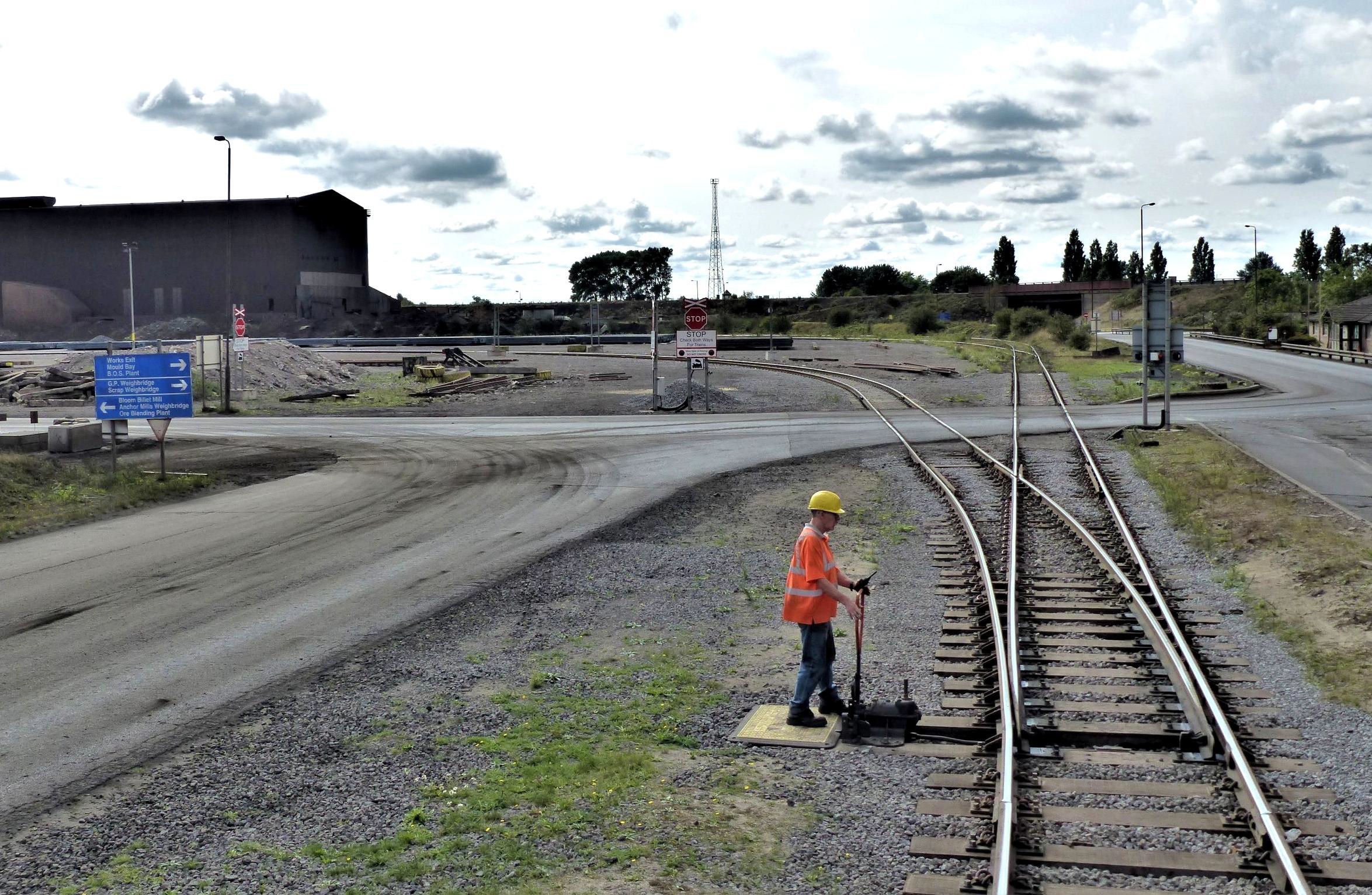
Points 325 where a new line goes off left (which the tour is about to do) to the new stocking ground at the site of the former P'Way Depot. Upper left is the former Mould Shop, the lines to the BOS Plant (off left) run on the embanakment across the background, Bridge 44 is ahead. Looking south.
[© John Cowburn 2022]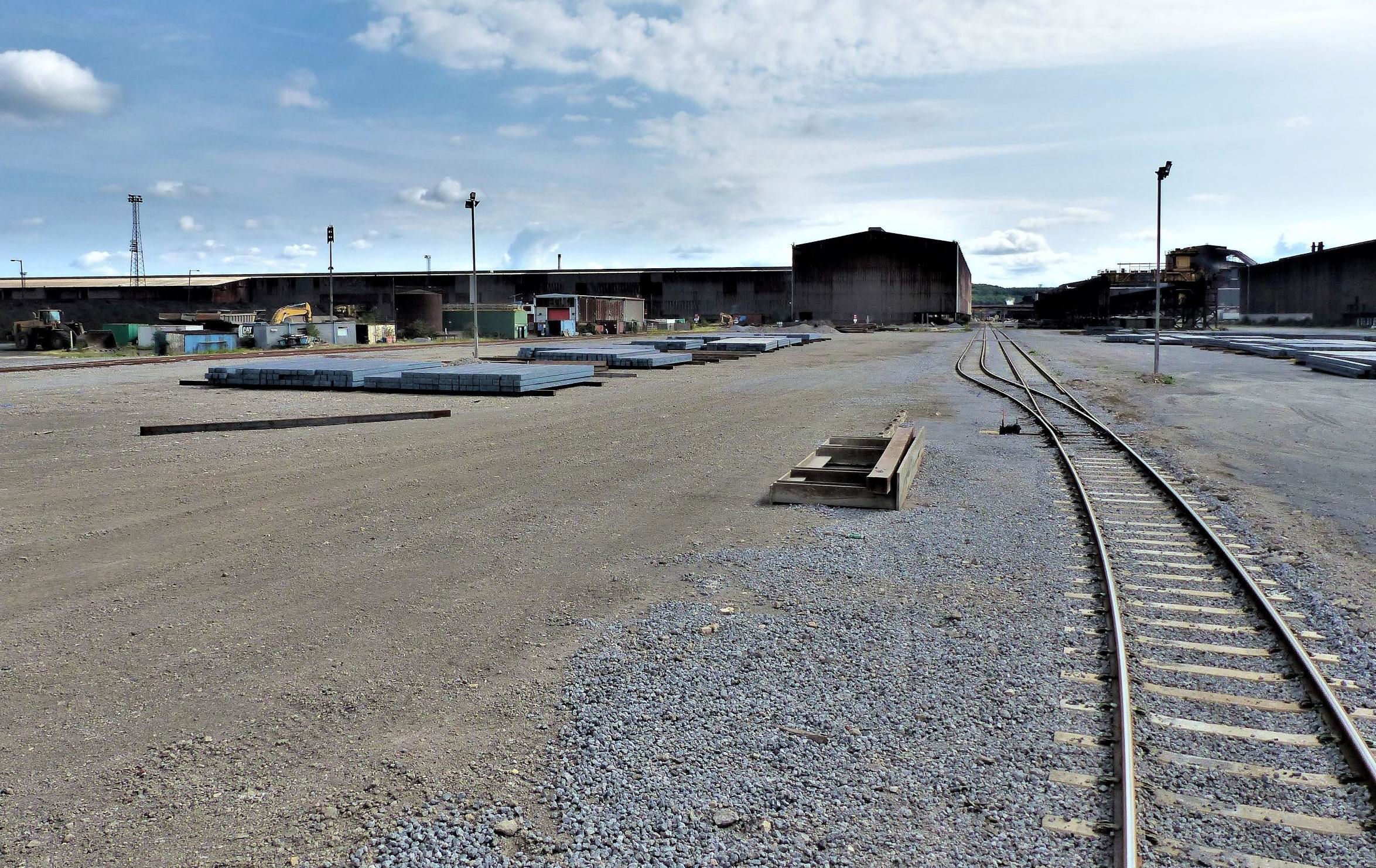
Continuing round the new infrastructure, now facing east, Points 324 are ahead. Ahead is the former Soakers building which continues, far left, as the former Bloom and Billet Mill. Far right is the former Mould Shop and ahead in the far distance is the BOS Yard (BOS = Basic Oxygen Steel Making).
[© John Cowburn 2022]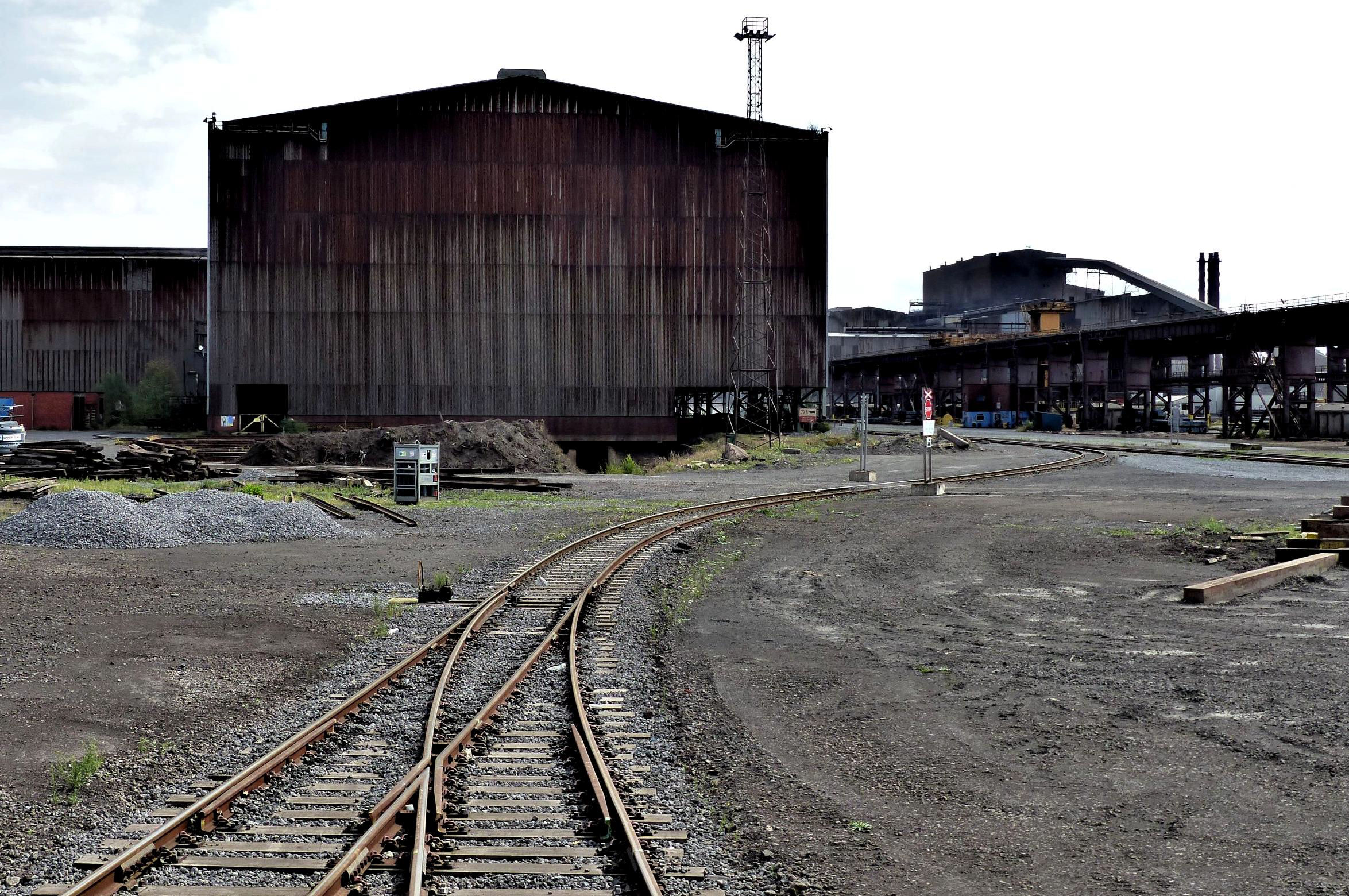
Continuing on new track, with the former Soakers building ahead again, Points 320 are in front (new loop) and Points 321 are middle right.
[© John Cowburn 2022]Di8 Nos8.702 & 8.708 (CargoNet grey) were initially noted moving around light as we headed into the Concast area, with 8.719 and 8.701 (both NSB red/yellow) parked in the short loop between Points 317 and 318 a little way to the north. Returning to Points 325 to traverse the extended and realigned 5 Bay Loop, we had to wait for 8.708 and 8.704 to clear the points as they headed a set of recently cast blooms on Tango wagons from Caster 4 towards Plate Pit Hill, no doubt for Redbourn stocking area. By the time we then reached Caster 4 at the west end of the Concast, Roads 2, 3 & 4 had been set up with empty Tangos and loading of blooms was in progress on Road 3. We continued towards the Caster 5 loading area, noting that all tracks in the area of the Billet Caster had been lifted with work happening in the area - hopefully relaying or remodelling rather than removal. In the distance Caster 5 loading sidings had a mix of empty wagon types, including some former plate mill 57XX series.
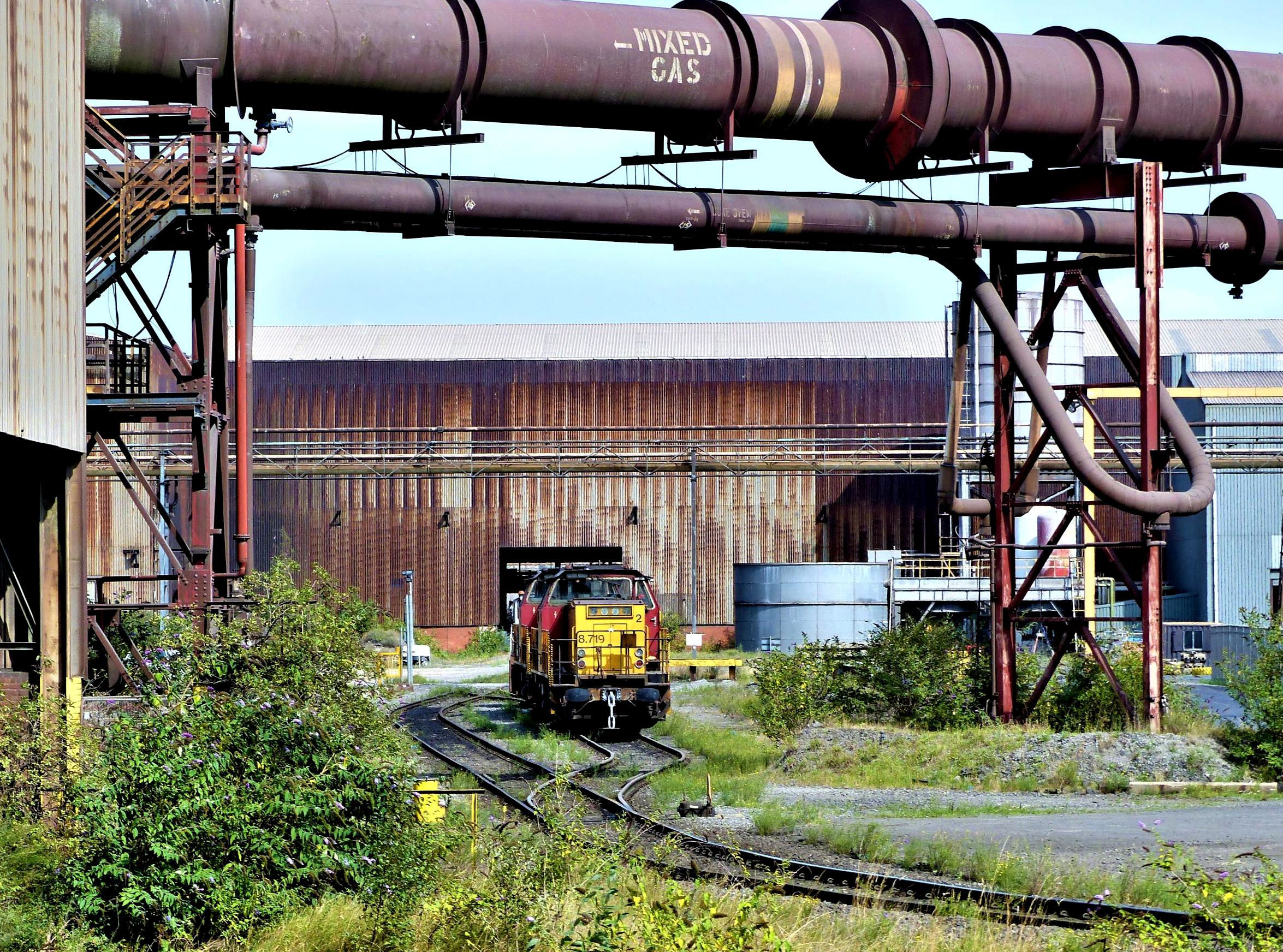
Di8s 8.719 & 8.701 are stabled in the short loop between Points 317 (this end) and 318; the former Bloom and Billet Mill is ahead.
[© John Cowburn 2022]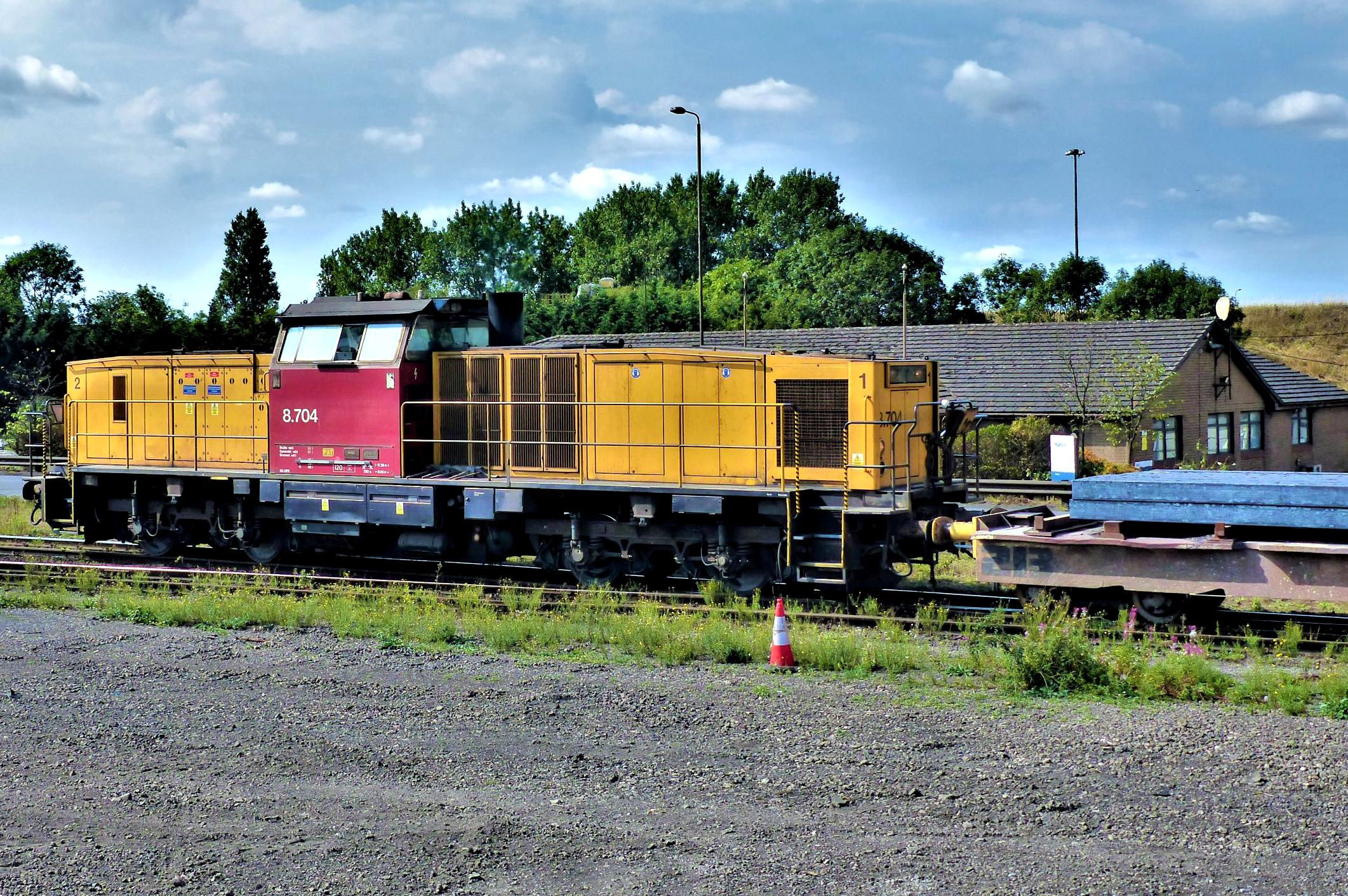
Di8 8.704
[© John Cowburn 2022]We didn't get very far and reversed at Points 314, our loco then hauling us north onto the perimeter line before almost immediately stopping past Points 312, then propelling us to the buffer stops on the unusually empty loading line on the north side of the Slab Stockyard. [These tours take opportunities as they arise.] Then it was time to head north again along the perimeter line and through the Welfare Loop as the main line was blocked by bogie internal wagons loaded with long length scrap. We took Road 10 through Mills Exchange Sidings and over the weighbridge by '9 Control' building. We had a short pause to wait for 8.704 and 8.708 to emerge, separately, light engine from under the Foreign Ore Branch, presumably after dropping their train of Tangos at Redbourn stockyard for unloading, before continuing anticlockwise around the perimeter. We took 'The Angle' around to Dawes Lane (again!) and back past Winn's Sidings to shunt onto the AFRPS Appleby platform at 13.00 for lunch.
Punters rapidly detrained to the toilets or the buffet car for lunch as appropriate! With it being summer, the steam heat to the buffet car wasn't required. Is this the last rail vehicle on the planet where it is possible to be steam heated by a shore supply in the winter? Answers to the Editor please.
After an hour to eat, drink, be merry and inspect AFRPS's Hunslet No58, parked in front of the shed, it was time to resume. We headed back out towards Frodingham platform beyond Points 501, reversed and propelled towards the Stores Road, noting from a distance Hunslet locos 71, 74 & 75 poised for action to the west of the blast furnaces on the South Melting Shop Running Road and its spurs.
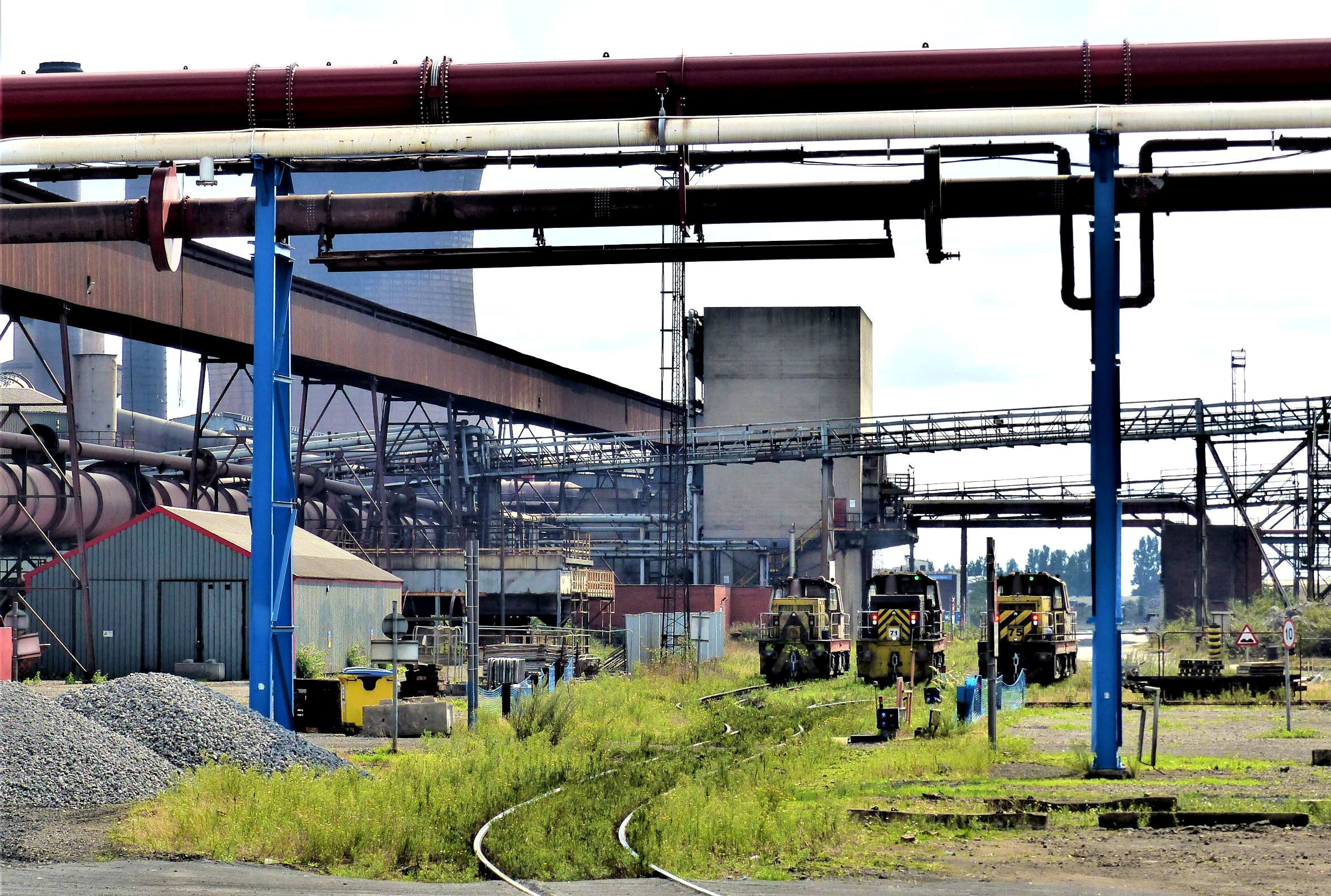
Hunslet locos 71, 74 & 75 lined up for their next jobs to the west of the blast furnaces on the South Melting Shop Running Road and its spurs.
[© John Cowburn 2022]From the Stores Road we diverged right at Points 117 onto the lines which run along the east side of the four blast furnaces. These are rarely visited as public tours are not permitted to access the hot metal (molten iron) loading areas, even on the 'bypass line' which is the easterly of the lines through the area. [Hot metal suits etc are required.] We stopped after less than 200 yards on Points 119, some distance short of the long out of use loading spouts for end blast furnace 'Mary'. Before a quick retreat those on the end veranda were treated to a rare and brief glimpse right through the stygian gloom of this area to the torpedo ladles which were set for loading under 'Anne' or 'Victoria' in the distance.
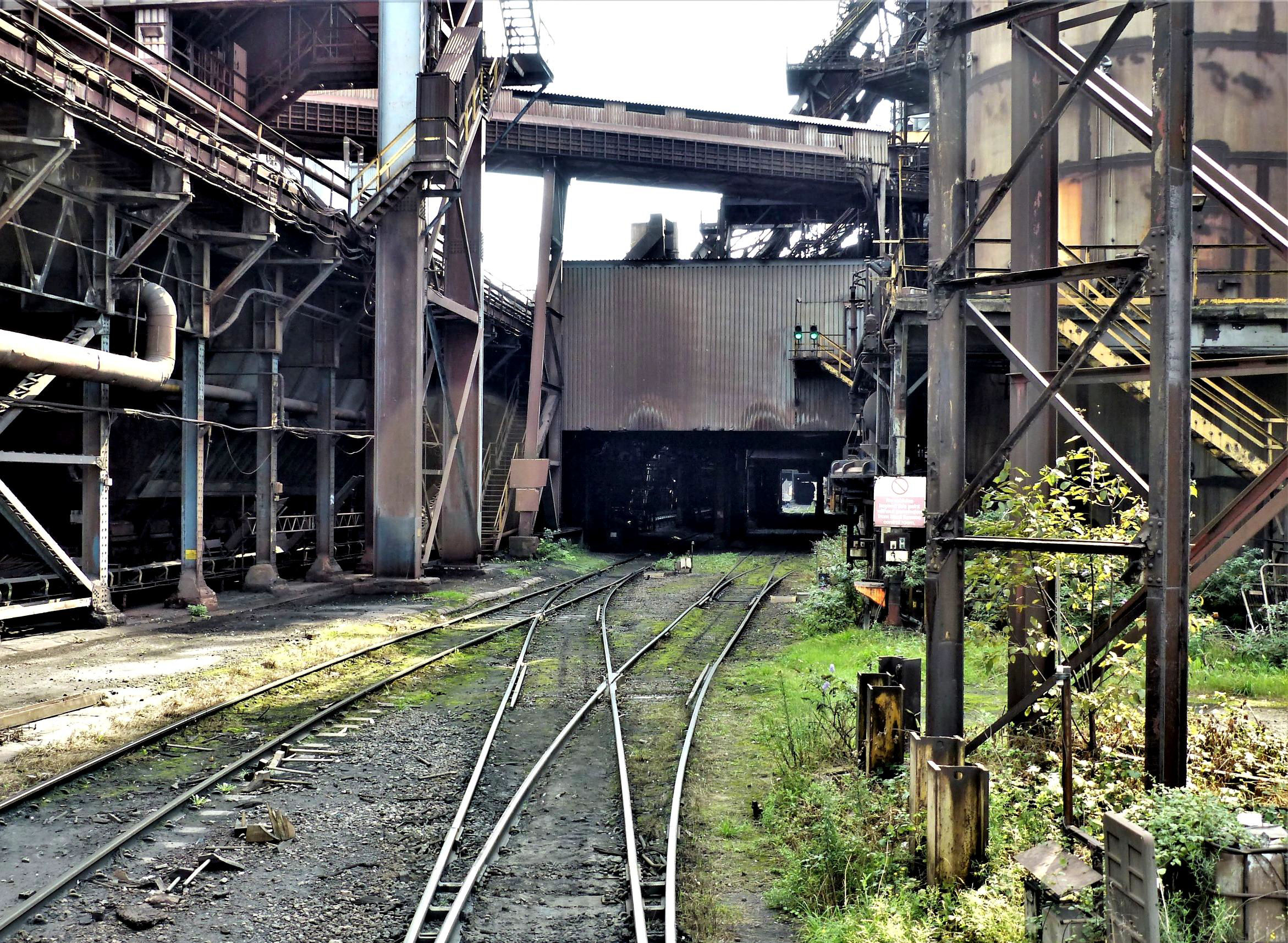
Queen Mary's bottom (the disused 1938 vintage blast furnace this end that is) looking south beneath the four blast furnaces.
[© John Cowburn 2022]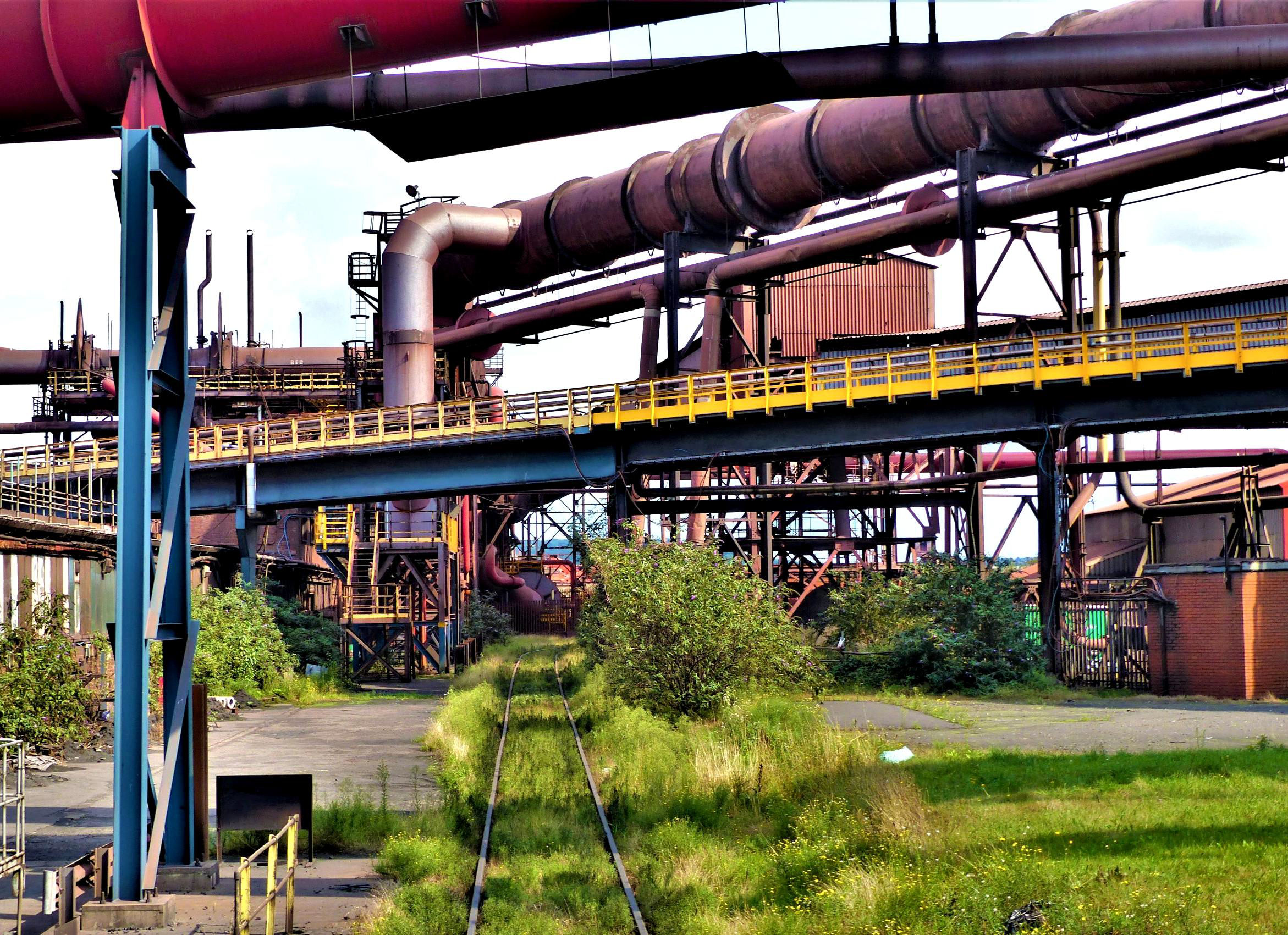
The Stores Road line which passes beneath the refurbished High Line, serving the top of the blast furnaces, ahead.
[© John Cowburn 2022]Regaining the Stores Road, we resumed propelling and, after passing under the viaduct carrying the High Line ramp, briefly digressed via Points 166 into the empty portion of the short siding housing some internal flats and an old High Line coke car. As ever, a number of blast furnace charging skips of different dimensions were present here. No1 hauled us back out onto the Stores Road and we were then propelled along 65 Road, continuing right though to Points 156 where 65 Road joins 66 Road. We passed the former Hot Metal Control building and headed for the BOS Gantry along the Up line, crossing over at Points 147 to come to a stand on Points 160, alongside a rake of (hot) empty torpedo ladles and, for safety reasons, well short of the hot metal pouring pits at BOS Reception.
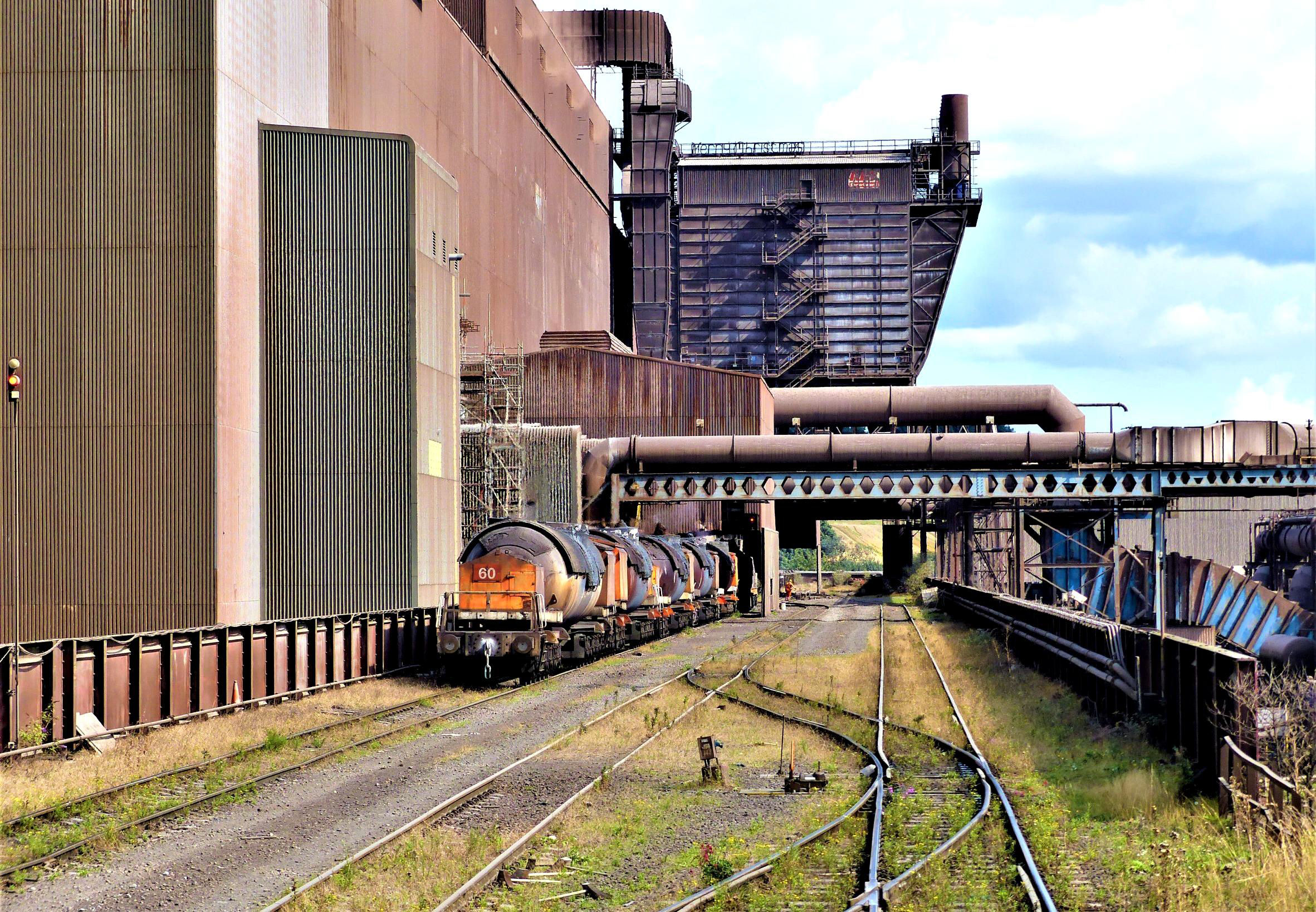
The BOS Gantry, looking towards end of line, empty hot metal torpedoes this end and loaded ones waiting to be emptied are at the far end.
[© John Cowburn 2022]The loco leading, we headed for the Rod Mill, on the western edge of the Scunthorpe site, taking the right hand road then the left hand side of the loop. Reversal was close to entrance Door RM14 and, on our return, we took the other sides of loop and double track, as well as running up to the entrance door 'Caparo Gate 7' of the Liberty (formerly Caparo) Bar Mill. With also covering the short siding opposite, this area was fully 'inked in' for first time visitors. The tour propelled back out over Bridge 44 onto the perimeter line, anticlockwise round the corner on the left hand (inner) track with flanges squealing. Down the hill, we diverged left towards the BOS Scrap Bay, always an entertaining visit.
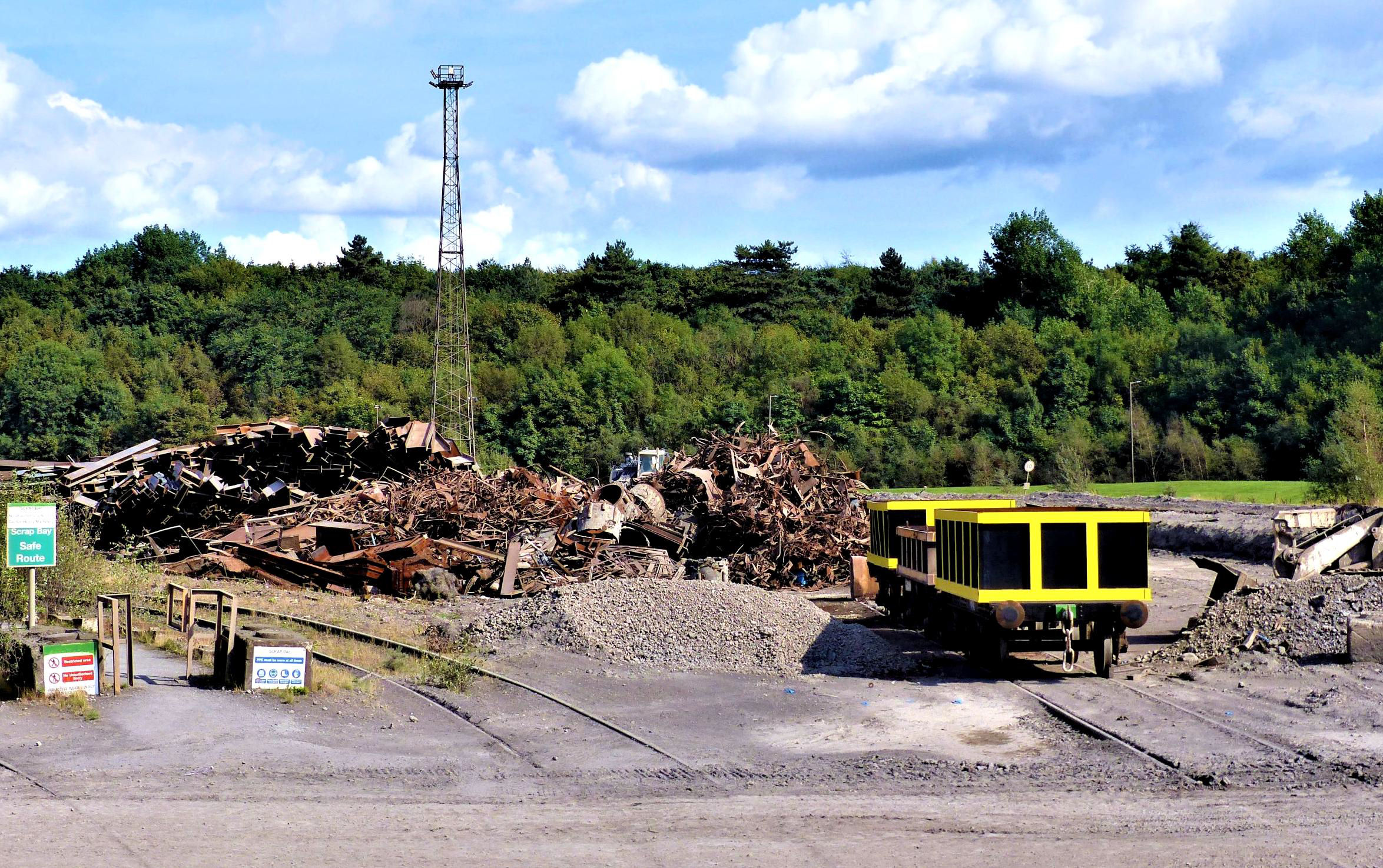
Looking east, the Scrap Bay line (round to the left) - single journeys only perhaps? East Bank siding is right.
[© John Cowburn 2022]Internal yard wagon 8107 was noted parked very neatly (and with an immaculate coat of paint) at the side of the BOS Approach Road (of the tarmacked variety) but, off the rails, perpendicular to and some distance from the railway! This could have been a 'gate guardian' but seemed more likely to be a less planned state of affairs. We took the 'Scrap Main' line and, after crossing the second roadway very cautiously, without having to clear the flangeways, visited the entrances to first the left hand and then right hand Scrap Bay unloading lines, before escaping through the 'Scrap Loop' line. The view from the right hand entrance gave a very welcome look along the full length of the bay, which was full of scrap, and each unloading line had a good complement of yard wagons present. It was very good to see the internal movement of scrap in these vehicles to be in an apparently good state of health. Indeed, the short 'East Bank' siding here contained three particularly smart yard (ie internal) wagons; these may have been cripples but could equally have been in use for a very short distance flow of scrap from the scrap burning area, where it is cut up, into the Scrap Bay. The other line not traversed here was the Dead End Road, occupied by a rake of bogie internals loaded with long length scrap.
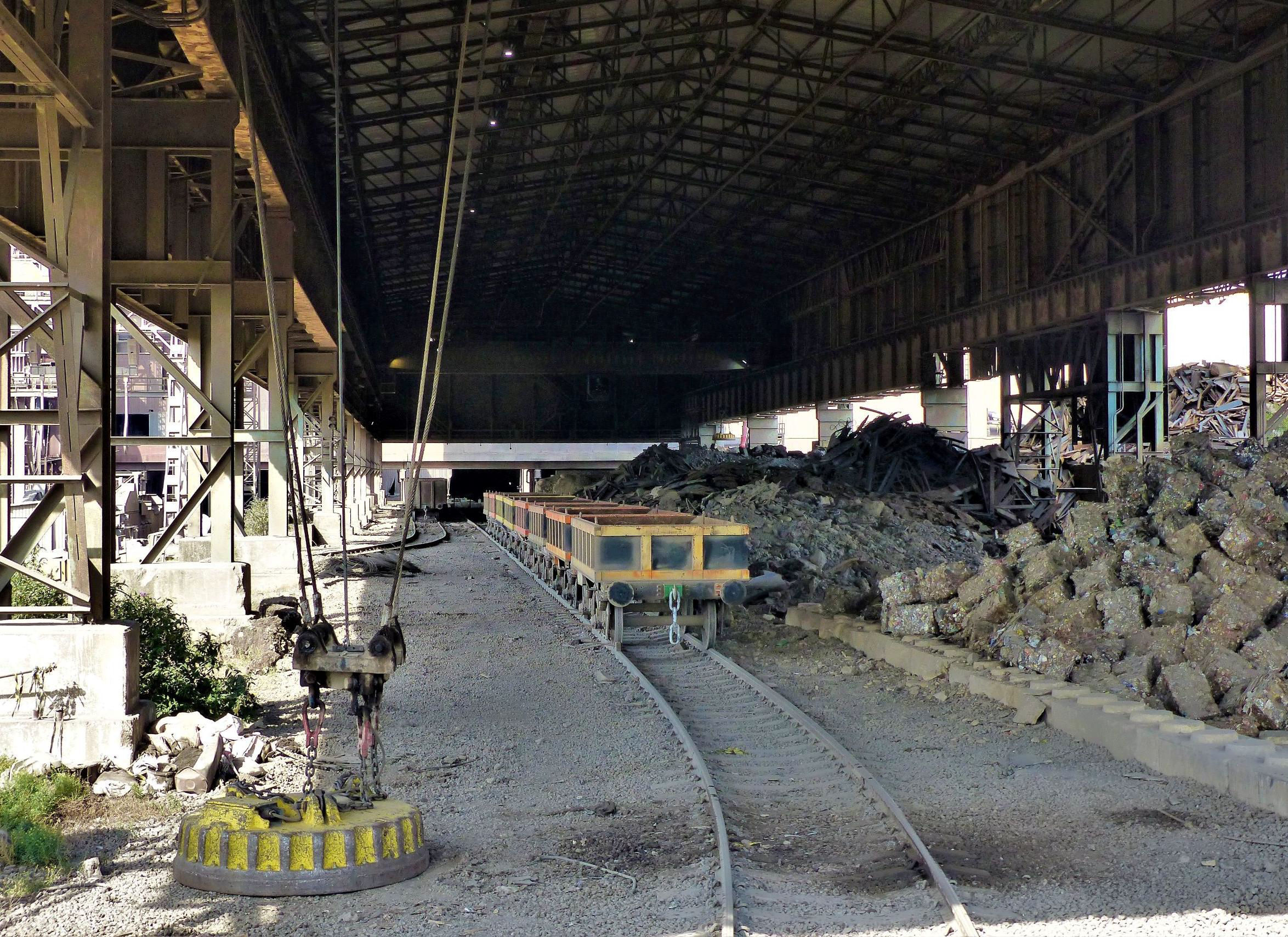
The Scrap Bay
[© John Cowburn 2022]No1 pulled us out onto the perimeter line again and we continued our anticlockwise circuit, passing Caster 5 where some of the aforementioned old plate mill wagons had been loaded with blooms. As ever, we found the 'New Loop' on the south side of the Slab Stockyard full of wagons (main line type being loaded with slabs). The other north side loading line, traversed earlier (you have to do them when you can), was now also full of external wagons being loaded with slabs. We continued propelling around the perimeter again via the Welfare Loop and soon found ourselves back at Mills Exchange Sidings. On our approach, 8.702 was busy shunting a rake of empty internal flats and, in a most unusual piece of Groundhog Day theatre, we took the same Road 10 through Mills Exchange Sidings.
We continued propelling north along the left hand (inner) perimeter line to Anchor Exchange Sidings up to the NR boundary along Road 5, returning the same way to Brick Shed Jn. A second traversal of the (quite full) sidings took us along Road 13 to the NR boundary beyond Points 475 before returning along Road 15. Roads 11 & 14 held sets of main line BBA wagons loaded with outbound slabs, while a set of MBA 'monster box' wagons was probably bringing in imported slag for local distribution. This complete, we were unexpectedly hauled back south along the (now left hand) outer perimeter line, crossing to the right hand line at Points 447, just before Mills Exchange Sidings. Why? Read on...
Continued in Part 2