Day 1 Fri 24 Jun:
The first day dawned, fully daylight by 04.30, the plague had left town and finally we were poised to er... explore Silesia! But no nature ramble this; a sojourn through the cultural highlights of the Silesian Lowlands? Not that either, but something MUCH better; a five day track and traction bash, 12 hours a day (16 hours optional). It took in the wonderfully convoluted, complex network of lines practically encircling Wrocław with a web of flying junctions that appeared to considerably benefit from the Deutsche Reichsbahn interwar modernisations around Breslau, right down to single rivulets of steel threading through the ubiquitous silver birch forests, this tour had it all in prospect. Another theme in Poland is the issue of 'Which bit are we in?' because, possibly unlike any other country on earth, Poland has expanded and contracted in every direction for over a thousand years including a century here and there when it disappeared altogether! Wrocław is a classic case in point, if you hung around here from about 1000 onwards you would start in the Duchy of Bohemia (where the name Vratislava originates) then Poland, (mostly) for 200 years; then the Duchy of Silesia. It was even invaded by Mongols in 1241, after which Germans began to dominate when Breslau appeared.
Next it joined the Hanseatic League in 1387, but still managed a stint of twenty odd years in the Kingdom of Hungary from 1469! The Polish language emerged in written text here in 1475 and it was occupied by Swedish Troops during the 30 years' war from 1618, and by 1740 was annexed by the Kingdom of Prussia then, during Napoleonic Times, occupied by the Confederation of the Rhine.
Now at this point all this toing and froing began to bear fruit as the levelling of the city's fortifications allowed it to expand, become an industrial centre and eventually... a railway hub! Despite various uprisings the Prussians maintained their presence when Poland didn't exist; other parts of the country were in Russia and Austria/Hungary. Upon the Unification of Germany in 1871 it became the sixth largest city of the Empire, its main station one of the biggest in all of Germany. After WWI it was part of the Weimar Republic and before WWII was the largest German city anywhere in the east of the country with over 600,000 inhabitants. WWII hardly touched Breslau until the very end when it was declared a 'Festung' or fortress city, during which half the buildings were destroyed... Breslau was actually the last city to surrender after Berlin, only two days before WWII ended. The Yalta Conference in 1945 awarded the whole of Lower Silesia to Poland (in lieu of annexed Eastern Territories) and Wrocław emerged. Phew! There are echoes of the past everywhere as we saw in the days ahead...
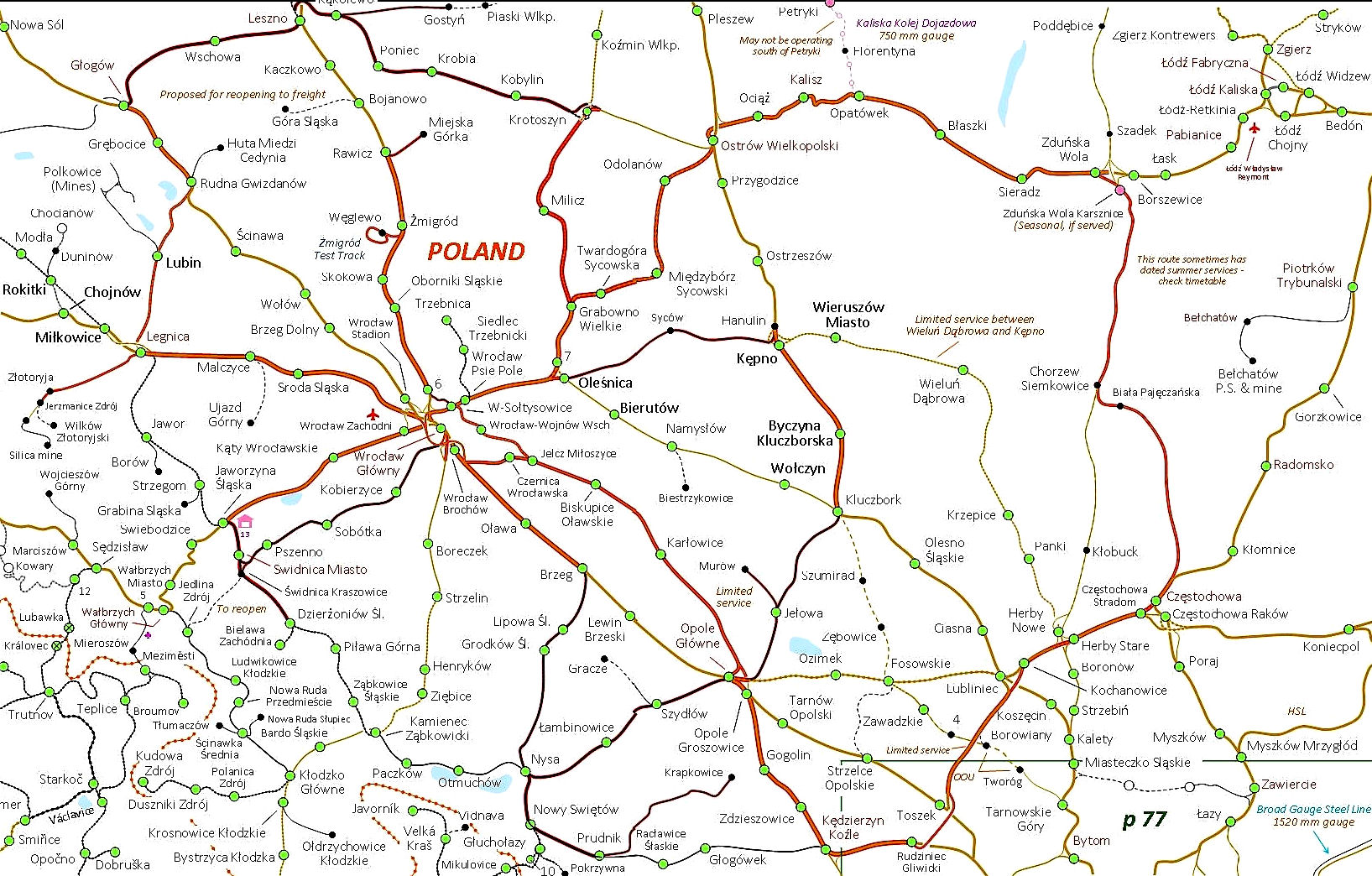
This map is thanks to Mike Ball, his European railway atlases are available from: https://europeanrailwayatlas.com/
[© Mike Ball 2022]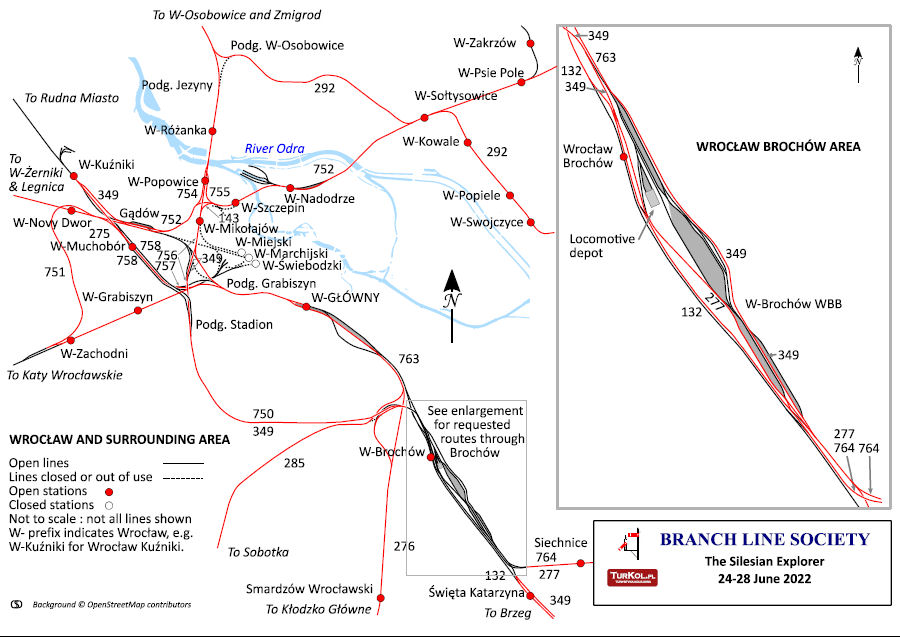
Wrocław and Surrounding area, marked up map (for the whole tour) with thanks to Dave Cromarty.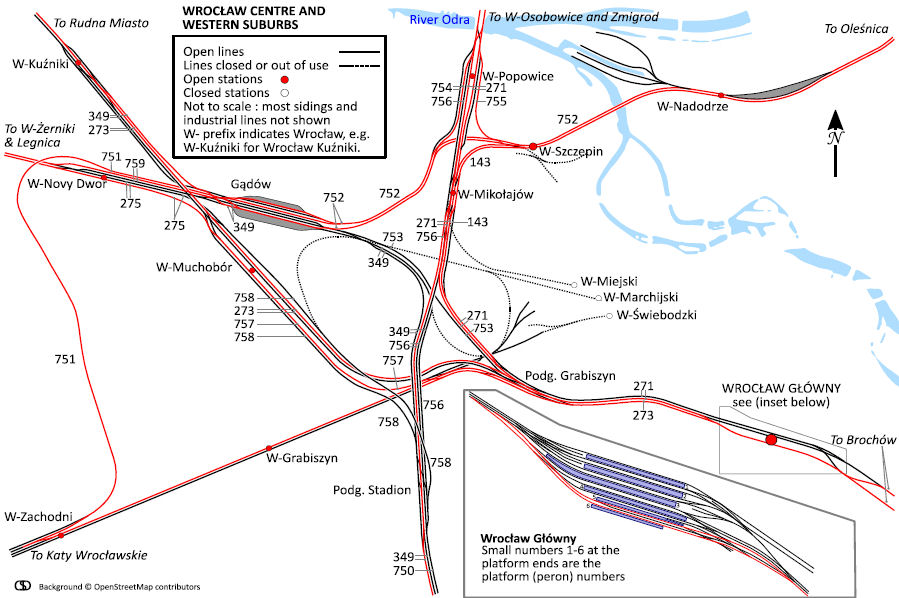
Wrocław Centre and Western Suburbs marked up map (for the whole tour) with thanks to Dave Cromarty.Sauntering over from my room, just five minutes from the magnificent edifice that is Wrocław Główny station, for an 08.20 start, it was a case of spot a familiar face and find which platform... as the Passenger Information Systems ignored us (almost) throughout! Spotting said familiar faces, P5 was suggested - outside the overall canopy - but P6 proved to be our departure platform as it was where various Turkol people were seen. Turkol (Turystyka Kolejowa)
https://turkol.pl/ is a small but very active organisation that operate trains for enthusiasts and 'normals' all over Poland often with local enthusiast groups. Turkol operated the train for us with Wrocław Railway Society (Klub Sympatyków Kolei we Wrocławiu)
https://kskwroclaw.pl/ who managed and ran the train, including the buffet/bar car. Before the appointed hour of departure Lotus Rail 6DG181 or SM42 2656 in old money rolled in with three coaches consisting a buffet/bar car 'sandwiched' [how appropriate] between one Second Class compo and one First Class compo. The 60 participants mostly from UK (BLS) with a smattering of German, Czech and Dutch, all filed on, spreading themselves in self-appointed groups across the compos and we were off. I was in a group of four, all from UK albeit one exiled (for work) in Belgium.
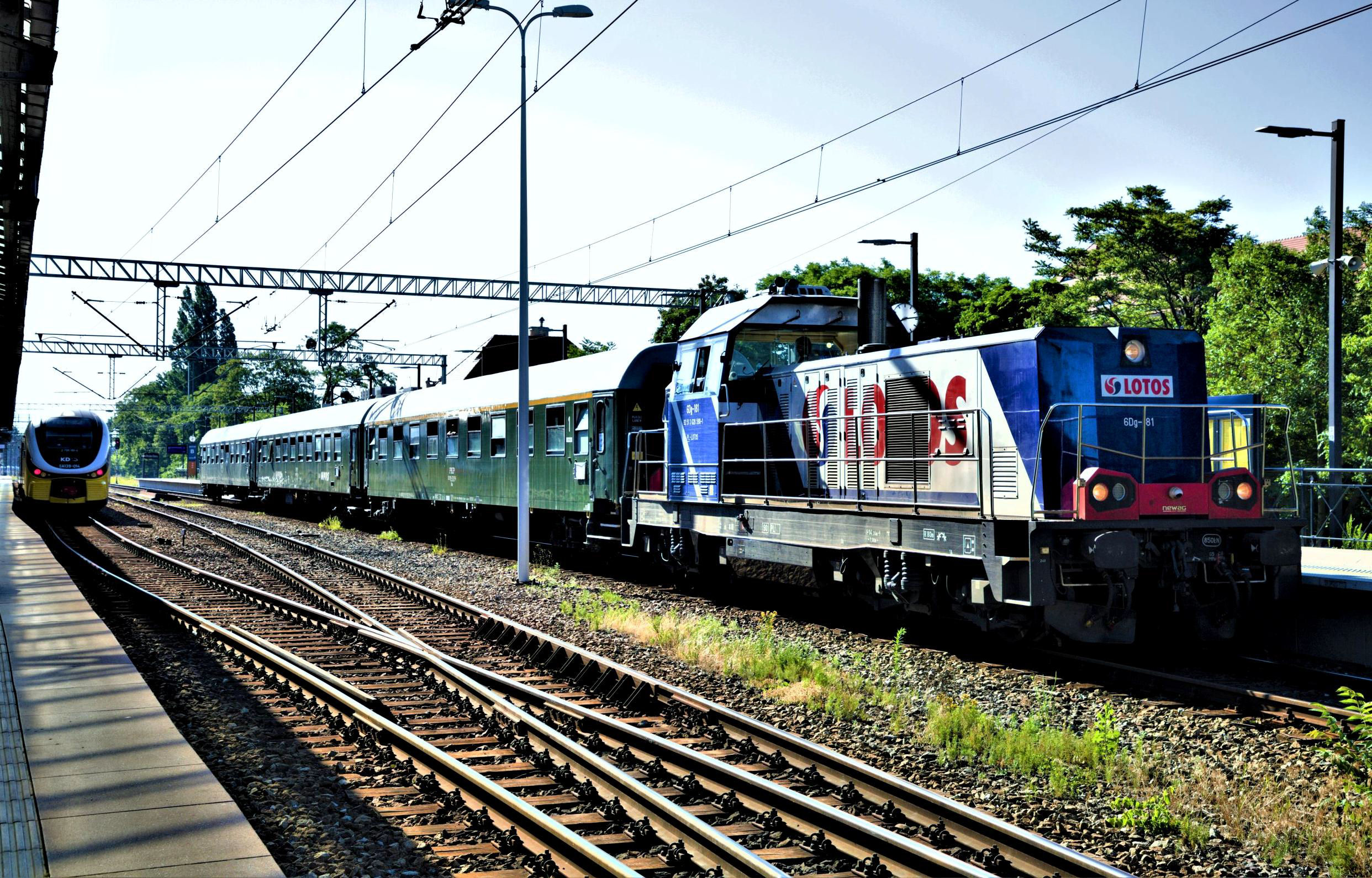
Lotos 6Dg-181 (620 590-1) in Wrocław Główny Peron (Platform) 6 with BLS 'Silesian Explorer' Railtour.
[© Iain Scotchman 2022]We began to describe a horseshoe route through Wrocław Mikołajów, taking a right onto Line 752 through Wrocław Nadodrze and right again onto the recently reopened line dotted with new identical wayside stations along Line 292. Then our tour converged with the classic passenger route (two train pairs a day) at Jelcz Miłoszyce, currently closed towards Wrocław for major bridge refurbishments.
The route south eastwards towards Opole is effectively a freight relief route. We frequently weaved between the double tracks (a treat for Microgricers), sometimes to avoid stretches undergoing, or planned to undergo, rehabilitation and sometimes to bypass freight trains before approaching the Opole Główne Avoiding Line at Opole Wschodnie. This was duly traversed, regaining the main passenger line just south of Opole Groszowice, having essentially used the freight lines to the east of that station. We continued south towards Kędzierzyn-Koźle (but not via the requested goods line north of the station!) through the western side platforms and Line 151 via p.odg Stare Kozle to the basic wayside station of Bierawa, to run round. [p.odg is a junction, from posterunek odgalezny literally 'separate post' or roughly branch post.] Bierawa was livened up by its adjacent freight yards where various locos loitered awaiting shunting duties including ex-NS 6468, now DB loco 630 559 in NeuRot livery in contrast to some dowdy ex-PKP SM42 elsewhere. (PKP is Polskie Koleje Państwowe or Polish State Railways which dates back to 1918.) It was at this point on Day 1 that the weather began to make itself felt... it was getting HOT... very hot... and the fresh air stock... especially when stationary (so not much fresh air) was getting hotter! We found the windows tended to spring up, so initially almost anything to hand was jammed into these to maintain a gap... water bottles, McDonalds coffee cups, hand towels, before a technological evolution materialised in the days to come...
Having run round and surveyed the surroundings from the classic (Soviet era) concrete and wire overbridge we rejoined and started heading back north. It was midday and that meant lunch and cold beer, cue visit to our onboard buffet/bar. The menu was keenly perused and after eliminating pierogi (dumplings) and the apple (cheese) filled pancakes, we selected 'Chicken in a Set'. A set of what? I hear you ask. Well, a set including chicken in breadcrumbs with potatoes and sauerkraut (chopped pickled cabbage) garnished with a sliced gherkin... a set! Then there is yellow beer and red beer... a far simpler demarcation than wheat beer and dark beer, just go with the label (colour)! So yellow beer, cold as vitally necessary, and a set of chicken awaited. It waited until the second beer in fact and we tottered around the south to east Kędzierzyn-Koźle avoider, Line 681. The chicken (gherkin excluded!) and beer went down in a most welcome way, among very convivial company in the spacious buffet car.
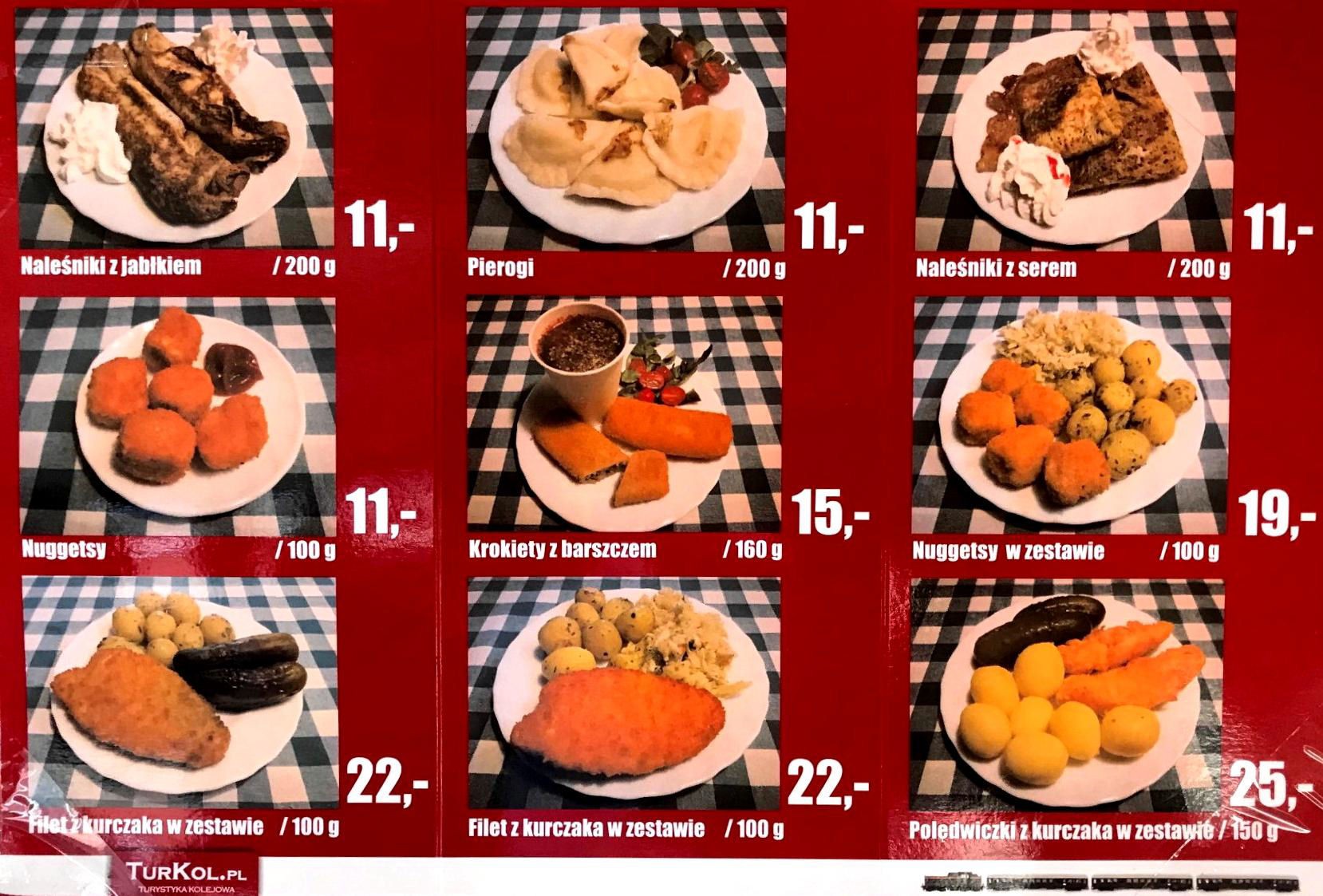
The onboard menu, all very tasty but all very similar - a grim week if you don't like chicken - note train formation bottom right.
[© Simon Mortimer 2022]From Kędzierzyn-Koźle we were unfortunately switched to the passenger Line 101 as opposed to the requested parallel Goods Lines 199 before veering right at Rudziniec Gliwicki onto, not just a freight route, but a route built for freight in 1975! After veering away right we swung northeast passing beneath Line 101 towards Katowice and latterly heading over 153 to the country junction at Toszek Pólnoc. Here our tour joined EGTRE (Enthusiast's Guide to Travelling the Railways of Europe) entry Route 152 [a PSUL] which I had traversed from Katowice previously in the dark on a dated summer overnight service, these routes have very dark skies so ZERO 'technical daylight' (a gricing term)!
One aspect of Polish lines that began to impress the participants now, if not previously, was the sheer scale and extent of flying junctions that are installed. Clearly land take is almost irrelevant in what is often seemingly an empty landscape, at least to British eyes used, as we are, to hedges and fences with buildings dotted almost everywhere. Similarly, many miles of additional track often exist on long parallel routes as PKP very rarely position junction pointwork away from stations on passenger lines.
We regained regular passenger lines after the Lubliniec Avoider (Line 685) then made for Częstochowa which always reminds your correspondent of his (Polish) wife's grandmother. Before her demise at a very advanced age recently, she reputedly listened to Radio Maria almost every waking hour and, like millions of others, regularly made donations to build a new Cathedral here. I'm not clear they ever built it but apparently it takes longer than a Pyramid or HS2/Crossrail so let's not hold our collective breath.
Far more exciting and instantly gratifying we veered left through the yard which led directly to P1 at Częstochowa Stradom. A quick check of the peron [platform] sheets confirmed no scheduled use from our unusual approach route. Here a pause seemed to open the prospect of another cold beer from a small buffet on the station but on entering it turned out to be some sort of hardware shop... I mean really... in a station. So, there was nothing for it but to retire back to our buffet/bar for another cold beer before heading north via Częstochowa main station to Wyczerpy Jn, grade separated under the line towards Radomsko and onto a 48km freight line towards Chorzew Siemkowice. Inauspiciously, this line opened just five months before WWII began; it was not really intended as a passenger route as it passes at distance from even the modest settlements en route. However, the stations did support a typically limited service until 2012. Since, a couple of overnight train pairs have run on and off so this daytime transit allowed the very consistent scenery to be enjoyed in bright sweltering sunshine.
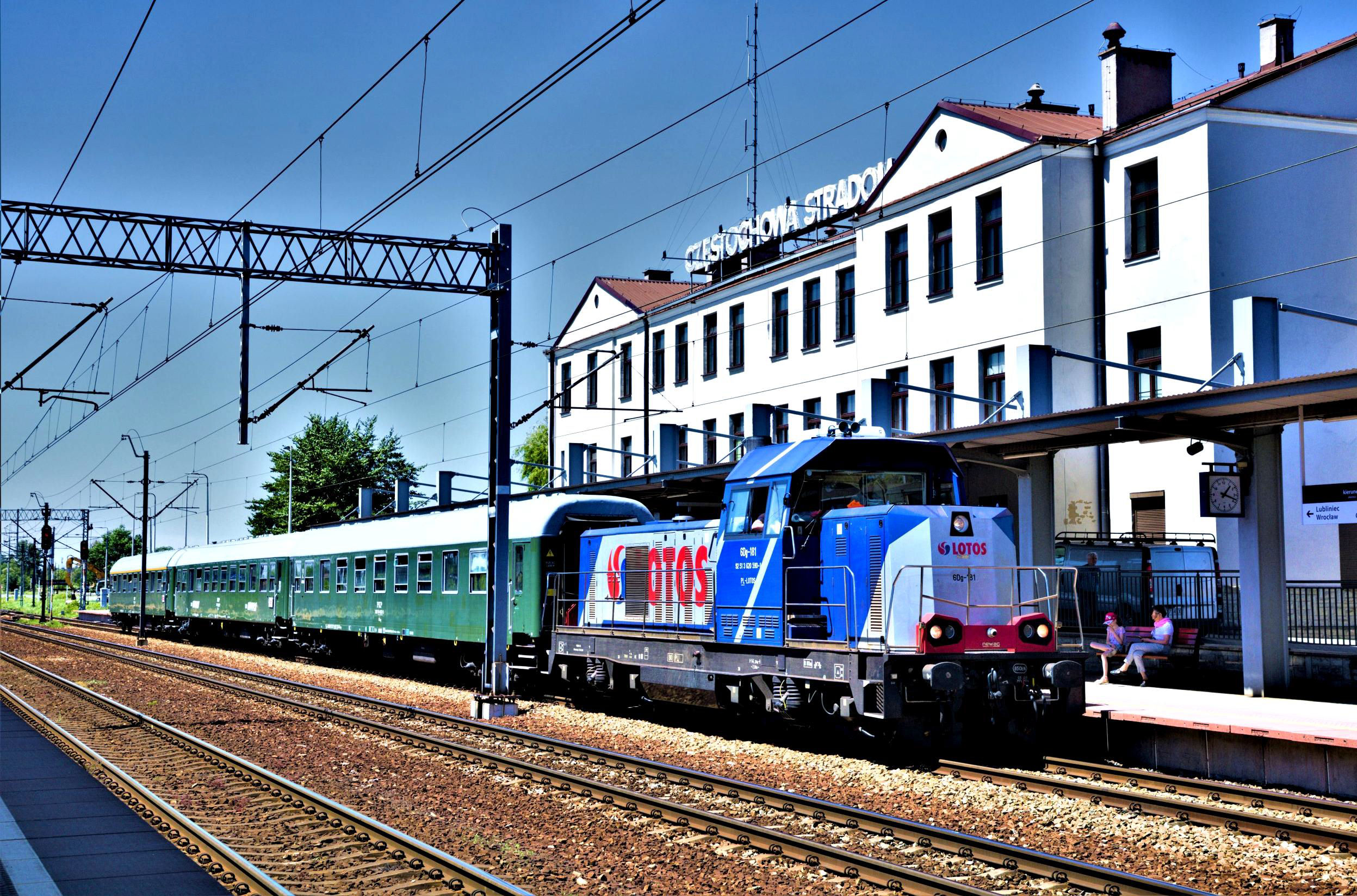
A break at Częstochowa Stradom allowed time for a visit to the station hardware shop
[© Simon Mortimer 2022]At Chorzew Siemkowice we joined the Magistrala Węglowa (= Coal Trunk Line) main north south line completed in 1930, mostly to take coal to the then newly constructed Baltic port of Gdynia. This was because, post-WWI, the creation of Poland left the new country without a Baltic port. The strategic, former German port city of Danzig (now Gdansk) was from 1920-1939 a semi-autonomous city-state. Although nominally a 'free-state', the majority German population ensured that it remained German controlled in practice. To resolve this unacceptable situation, the Polish government developed the adjacent Polish town of Gdynia as a replacement Baltic port, with new rail link that avoided Danzig.
Freight is still very dominant with passenger use limited to mostly summer dated train pairs running on/off this route, often at night. A surprise was seeing full height platform reconstruction work underway with new footbridges at all closed stations north of Chorzew Siemkowice. This is assumed to be linked with the successful Kolej (Rail) Plus* bid for a new line from there to Więluń for services to Łódź. *This 'Program for Supplementing Local and Regional Railway Infrastructure' aims to improve the rail network with rail connections in towns with a population of over 10,000 who do not have connections to capital cities or existing connections require improvement. [Good idea, DfT please note, and by the way Ilfracombe has 15,000 inhabitants, Wisbech 34,000 and Gosport over 85,000!]
We reached Zduńska Wola with (to British eyes) its extraordinarily lavish provision of a grand junction in tramway parlance connecting the E-W and N-S crossing of lines. As it is lopsided, we initially turned east before our taken curve turned to go west... Some kilometres further we ran past the overgrown, engulfed remains of the narrow gauge system at Opatówek (Wask). Our railtour then paused at the Prussian border, ok a bit over a hundred years too late for a no doubt impressive passport stamp from a Teutonically uniformed suitably moustached official. However, the vast (and now vastly too big) station at Nowe Skalmierzyce (Neu Skalmierschütz) still sits as testament to a time when Poland did not exist. At least it lies dormant awaiting another turn of the historical wheel. Here that turn of the wheel was provided by WWI and subsequent uprisings; war memorials in UK typically say 1914-1918; in Poland more often 1914-1922 as these include various wars that led to the state's independent resurgence, having fought on the 'wrong' side with Napoleon over a hundred years earlier.
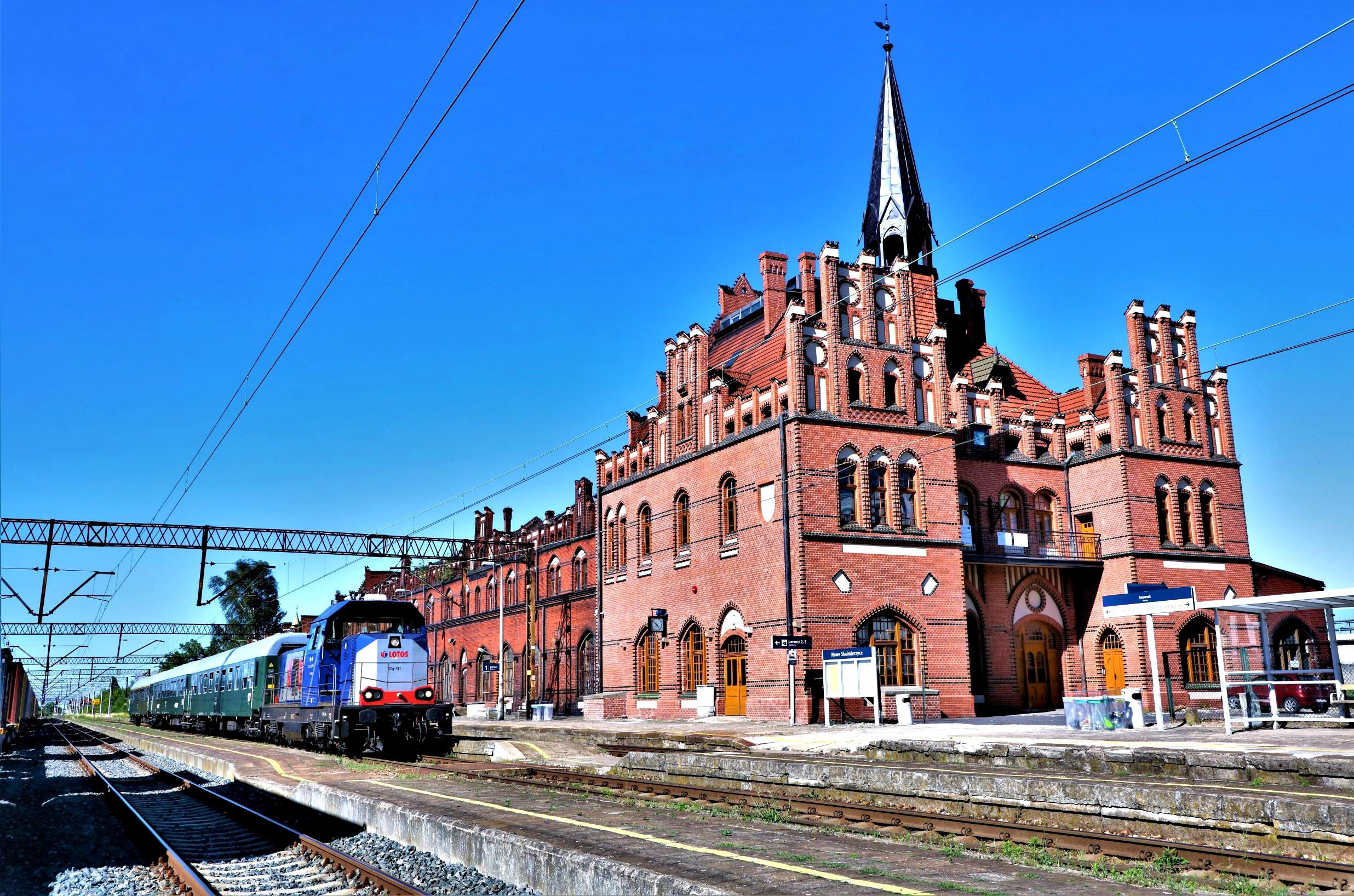
The vast (and now vastly too big) station at Nowe Skalmierzyce (Neu Skalmierschütz) once a Prussian border station.
[© Iain Scotchman 2022]Advancing over a century and a few km towards Ostrów Wlkp, we veered south towards Ostrzeszów, noting on the maps there was a branch back northeast towards Namyslaki. No one was sure if it still existed so we all watched carefully and, in the forest, we were able to trace the branch with track on it until it veered away. This is very typical in Poland; lines almost never seem to be lifted unless their route is simply obliterated by some major external development. They retreat into the grass, then the trees and the forest but they slumber on, making resuscitation much easier even if the track has to be relaid as the trackbed and structures remain. If only a similar philosophy had existed in the UK!
Next Kępno where a route had been requested, but the issued timetable, not for the first or last time, showed otherwise. We aspired to take the north to west chord 814 down from the high level line but took the EGTRE entry outside Curve 812 and before Kępno low level slipped onto the non-platform freight lines adjacent to the platform. Our 6-digit reporting number confused the Red Cap (the station master who, as across much of Europe, wears .... a red cap) into thinking we were a freight train apparently and he was surprised to find a passenger train (normally 5-digit) sat on his Goods Lines.
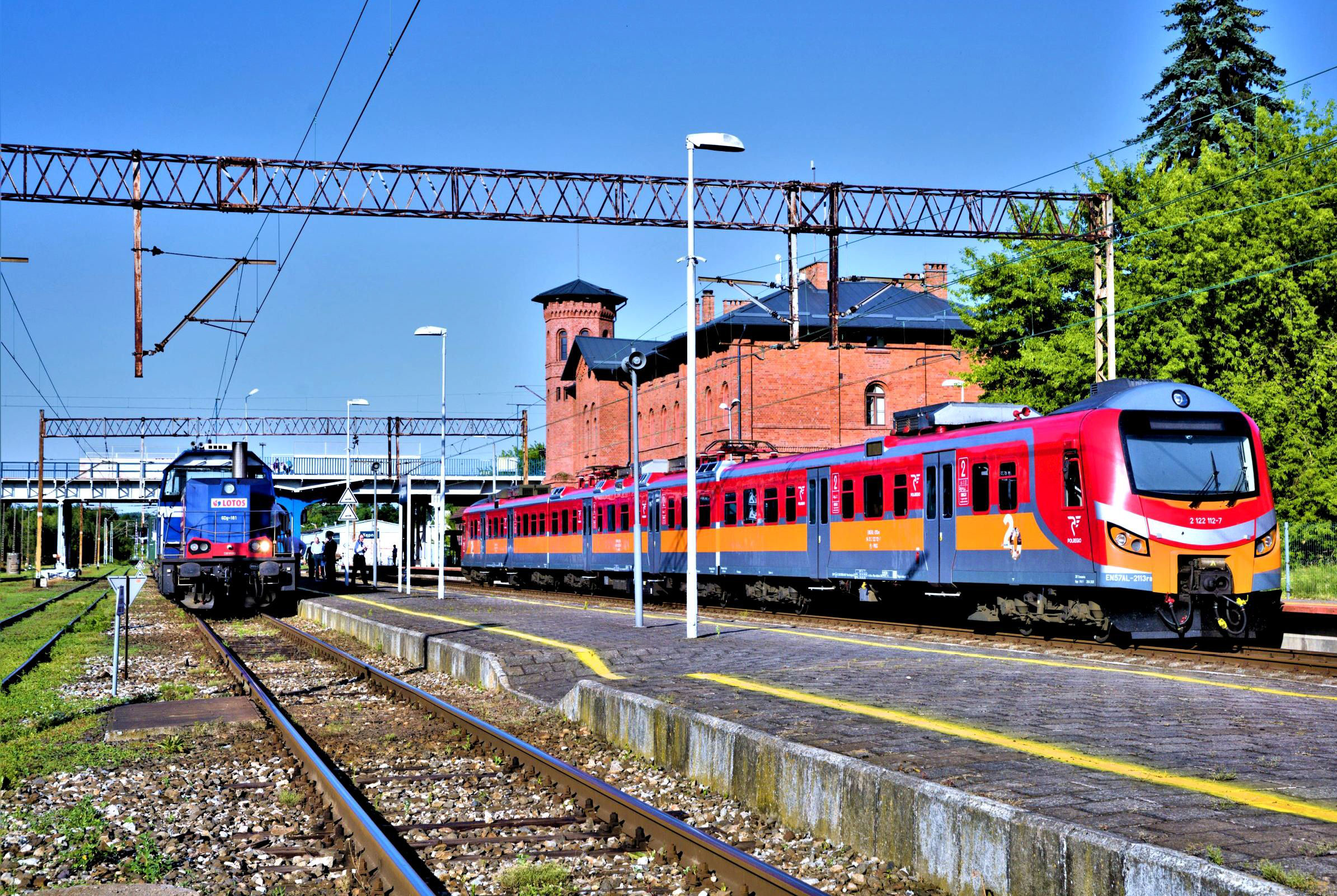
Kępno low level (like Tamworth), the high level line and platforms cross over at a right angle in the distance.
[© Iain Scotchman 2022]Additionally there are two Inter City services a day through the low level platforms and we managed to coincide with one! Passengers were noted joining and alighting. Once authorised, we drew forward east of the station and propelled back into the platform. This was probably much to the bemusement of car and other drivers waiting at the road crossing watching us trundle past, stop on the crossing and go back. Undoubtedly, they embraced the chance to watch a SM42 rebuild in action on load three?
Continued in Part 2