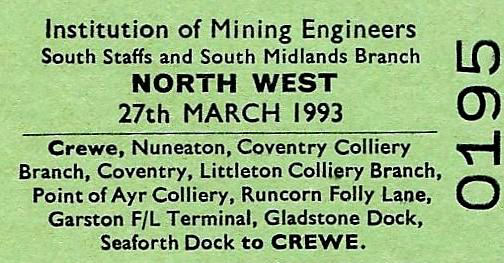
Institution of Mining Engineers - North West Tour
Saturday 27th March 1993
Report by Ian Mortimer
See https://bit.ly/3nf1Mgw There was another year's break between the 10th (or even the 11th, depending upon how the two part 1989 tour is treated) and this final tour. The title was a little misleading as none of the three collieries visited were in the North West, two were in the Midlands and the other in North Wales. This railtour was notable for the fact that two of the colliery branches covered were normally only used by British Coal locomotives, and it was also unusual in that it started at Crewe and finished at Nuneaton.
An early 07.18 start [late by modern standards!] from Crewe preceded a run up the West Coast Main Line to Nuneaton, where there was a pick up. Taking the Coventry line, the tour ran to Three Spires Jn, where it reversed to access the Coventry Colliery branch. This had served two installations firstly Coventry Colliery, which at the time of the tour had been 'mothballed' by British Coal for 16 months.
Despite £45M of investment it had lost £40M over five years. The last shift was on 1 Nov 1991 just 13 days after closure was announced - 1,300 jobs went. However, in Sep 1994 it was reopened by Coal Investments along with Annesley/Bentinck (connected underground), Markham Main at Doncaster, Silverdale, Hem Heath & Cwmgwili collieries. Coventry Colliery then closed for good on 23 Aug 1996 as it failed to survive the bankruptcy of Coal Investments. 40M tonnes of coal reserves were left.
The second facility served by this branch was the adjacent Keresley Homefire Plant (smokeless fuel). Once a local landmark from the M6 motorway, it opened in 1967 and was still operating at the time of the tour, surviving until 2000. Interestingly Coventry Colliery coal was unsuitable for it and went to power stations! Normally main line locos only ran into the exchange sidings at Three Spires Jn, from where British Coal engines would take over. However, on this occasion the tour and its locos (47300 & 47821) were able to run nearly two miles up the double track branch to a point just short of the curve where the lines split into the separate two installations; tight curvature prevented further progress.
The site is now Prologis Park, a 300 acre distribution centre. It is still in theory rail connected and has a complex layout but with the branch now single track (TRACKmaps 4 p14B Dec 2018). On 27 Jul 2001 a 'demonstration' train ran, but commercial traffic (imported bottled Evian water from France) did not start until 5 Feb 2007. This ended in Nov 2009 and unfortunately the branch has been OOU since.
Returning to Three Spires Jn, the tour continued on to Coventry, then through Stechford, Bescot and Bushbury Jn for a reversal at Littleton Colliery Shunt Frame (22m 74ch) just south of Penkridge on the Up side. The two exchange sidings (each accommodating half a merry-go-round set so trains had to be split inward and out) were next to the main line. Interestingly they were both electrified although it is unlikely that an electrically hauled coal train ever ran! As at Coventry Colliery we had permission to proceed nearly 3 miles up the lengthy branch, crossing over the Staffordshire & Worcestershire Canal, under the M6, and passing some sidings that formerly ran to the canal before they were cut back to build the motorway. The tour stopped just short of the B5012 road bridge, about a mile before the colliery, where clearance problems prevented further progress. Littleton Colliery was the final pit in the once extensive Cannock Chase coalfield. It was extensively modernised, designated a core pit at the end of 1992 and produced over 1M tonnes a year, but closed 3 Dec 1993 with the loss of 800 jobs.
Back on the main line the tour ran north through Stafford to Crewe arriving 11 Mins early! After a 20-minute pause, it carried on through Chester and along the North Wales coast to Talacre. Here the train reversed on the old Up Slow line (from four track days) then the 'Neck Line', a headshunt, to access the 850yd branch to Point of Ayr Colliery, where it ran to a 'point' about a loco length short of the bunker. It wasn't possible to proceed any further, as trains were propelled through the bunker because there was insufficient clearance for locos. Situated at the most northerly point of mainland Wales, Point of Ayr Colliery was the last remaining deep pit in North Wales, closing in Aug 1996. Coal was mined from beneath the River Dee Estuary and proven reserves of over 20M tonnes were left.
After running back to Chester we passed through Helsby before taking the then unidirectional line from Frodsham Jn to Halton Jn. Now at last in the North West, at Runcorn Jn the train turned left onto the Folly Lane branch, which had salt traffic and occasional oil trains in 1993. We reversed short of the first level crossing (Barlow Way) on the branch, which the writer's notes say was at the end of the exchange sidings and just short of Runcorn Town football ground, off to the left. Nowadays this is where the branch ends (1m 21ch); the road on that former level crossing now accesses the incinerator energy from waste facility. At one time the branch continued 1⅔ mile further on to a power station.
Folly Lane had had to be omitted from one of the 1991 tours, so it was pleasing to claw this one back. Unusually, the branch is busier today than it was then, as it now sees up to four trains per day, six days a week, of compacted waste from various Manchester area terminals for incineration.
Returning to, and reversing at, Runcorn Jn, the tour headed to Garston. It was originally planned to go into Garston Docks Coal Sidings (export) but unfortunately these had recently closed, so instead it ran to the end of the holding siding for the Freightliner Terminal, alongside the fenced off coal sidings. Traffic to the coal terminal was still passing in 1989, and it had been upgraded for MGR traffic in 1981, but we could clearly see from the tour train that the sidings were out of use. On departure the third side of the triangle was taken from Garston Jn round to Allerton East Jn - double track in 1993.
Continuing towards Liverpool, we reversed in Edge Hill station, before taking the curve from Bootle Branch Jn to Edge Lane Jn and the Bootle Branch on to ... ... ... Bootle Jn. From here the tour ran under the electrified Southport line then crossed Regent Road to enter the Mersey Docks & Harbour Co site, to cover two branches. The first was to Gladstone Dock Coal Terminal, reopened in 1988 for imported coal. Taking a temporary alignment to the left of a new bunker that was under construction, we ran to just short of the headshunt points at the line end, level with south side of Gladstone North Dock (No1).
Retracing our steps to the junction at Strand Road, we reversed in Alexandra Dock Tunnel to the last branch of the final IME tour, to Seaforth Container Terminal. Most satisfactorily, the train ran into the terminal, again reaching the final set of points before the branch run round headshunt. The end of line, known as 'Freightliner Dead End' is 7m 22ch from Bootle Branch Jn. The last leg of the tour involved a second reversal at Edge Hill. The Edge Lane Jn to Olive Mount Jn curve CG/A 21 Jan 1987 due to a fire that day at Edge Lane Jn signal box and was subsequently lifted. It was relaid with single track and ROG 15 Dec 2008. A run along the West Coast Main Line to Crewe and Nuneaton followed.
Chris Boyle gave a delightful miniature (three inches tall) miner's lamp with 'IOME/FOUNDED 1889' round the crest, or real full sized ones, to each person who had helped with these tours in some way.
Although this series of truly ground breaking series tours had finished, and Chris Boyle's attentions had turned more to foreign travel, he continued to play a significant role in the organisation of some excellent Society tours, eventually bowing out with the Bo'ness Traveller in Aug 1996 which, for the writer at least, signalled the end of the golden age of British track railtours which had started in 1989! Sadly, Chris passed away in 2002 while on his way home from a weekend's railtouring in Germany.
The writer is again grateful to David Palmer and, particularly, Paul Stewart for their time and effort in providing useful additional information as well as offering corrections and amendments. Finally, as before, much use has been made of the itineraries, so thanks to the late Dr Angus McDougall, Geoff Blyth & Chris Tennant, and again to the two excellent cartographers, Rodger Wilkinson & David Mellor.
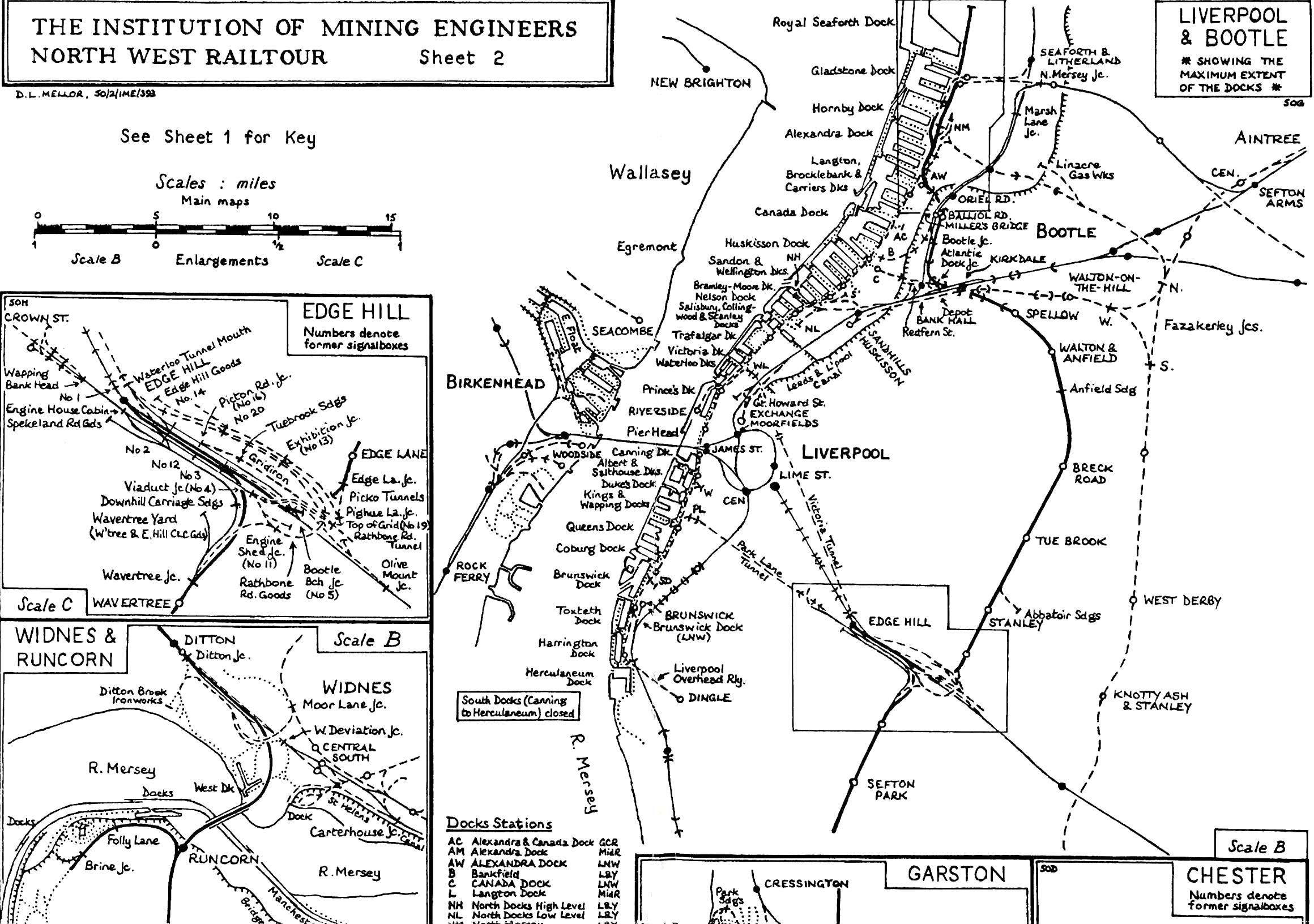
Railtour map drawn by our member Dave Mellor.
[© Dave Mellor 1993]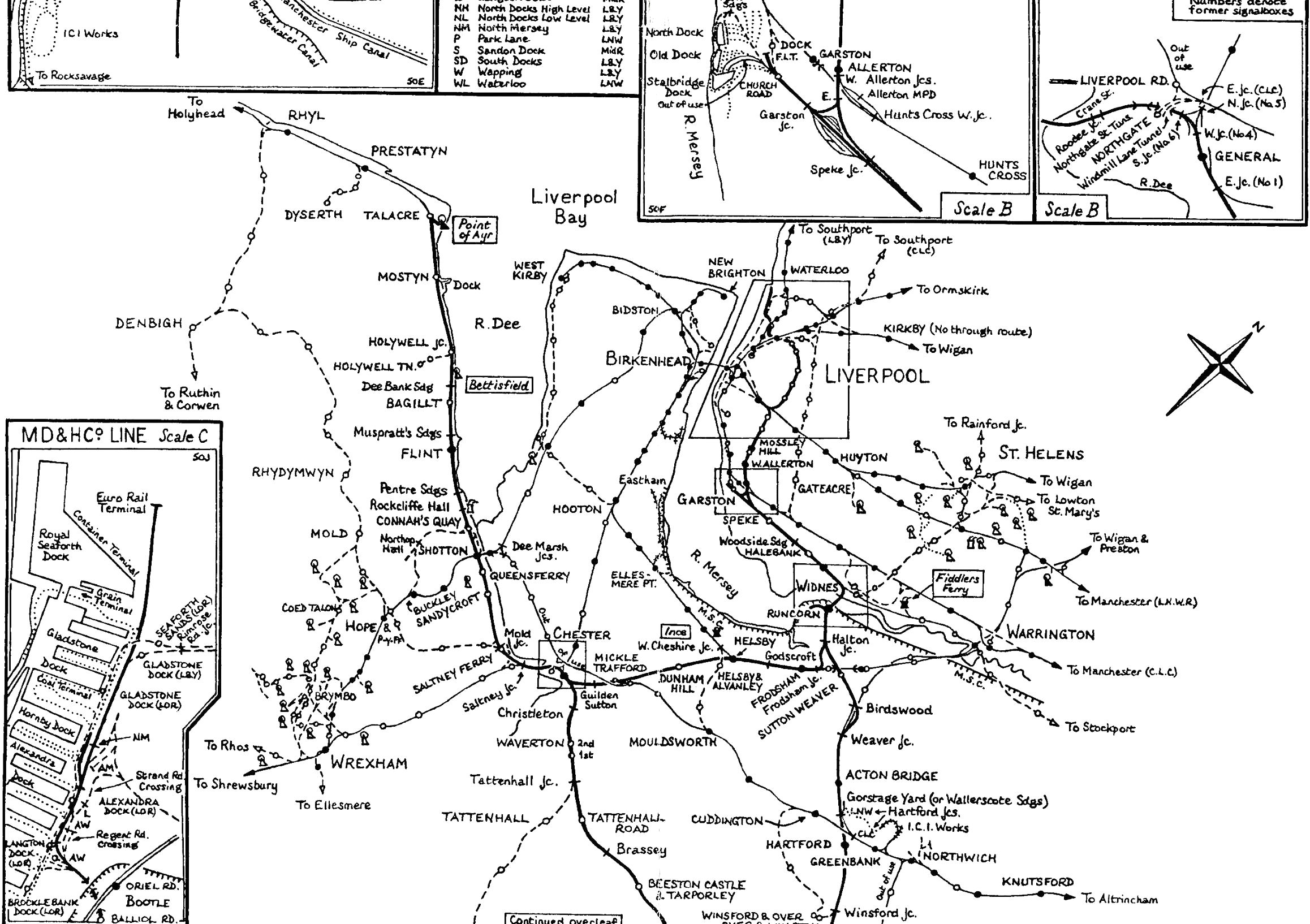
Railtour map drawn by our member Dave Mellor.
[© Dave Mellor 1993]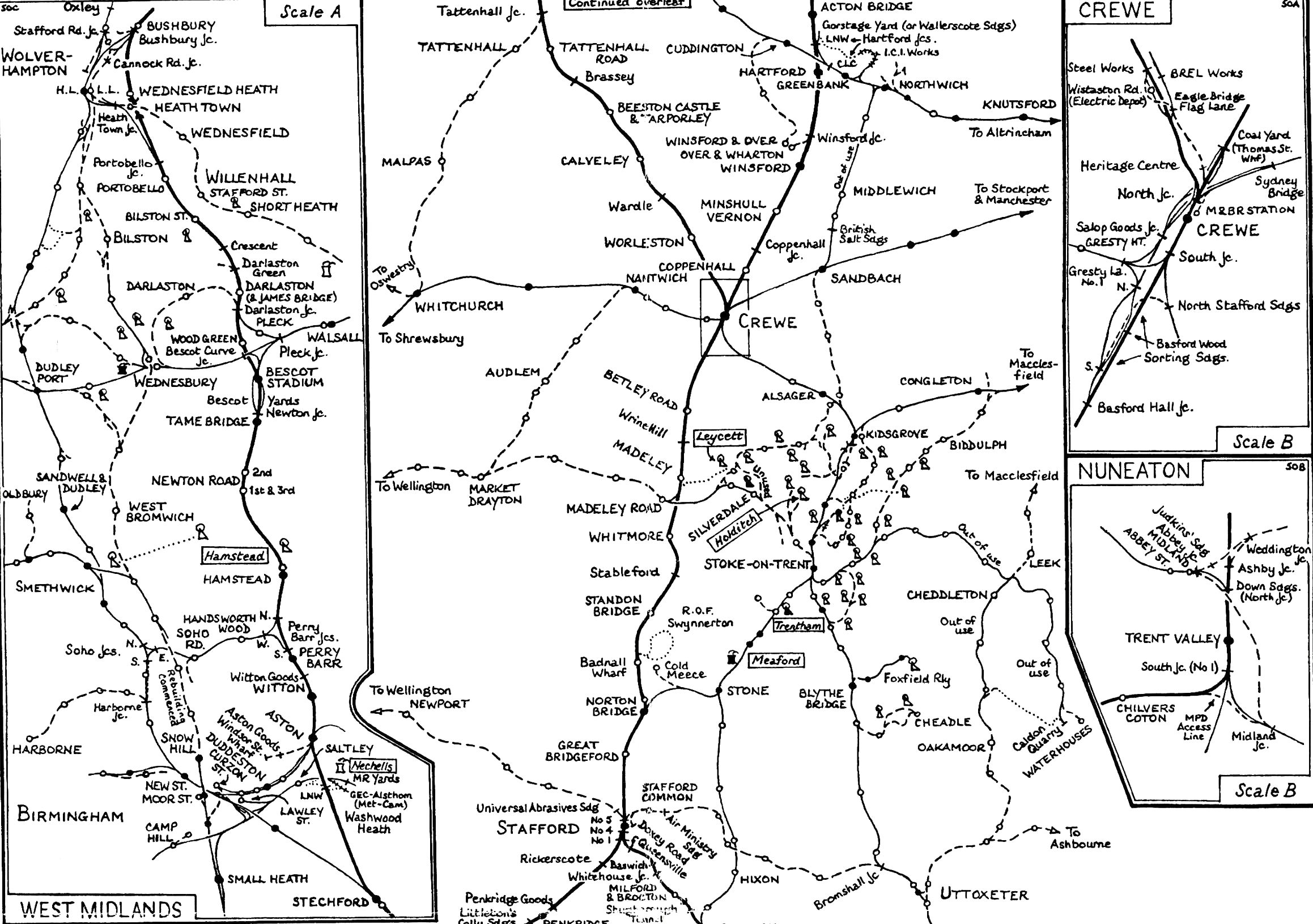
Railtour map drawn by our member Dave Mellor.
[© Dave Mellor 1993]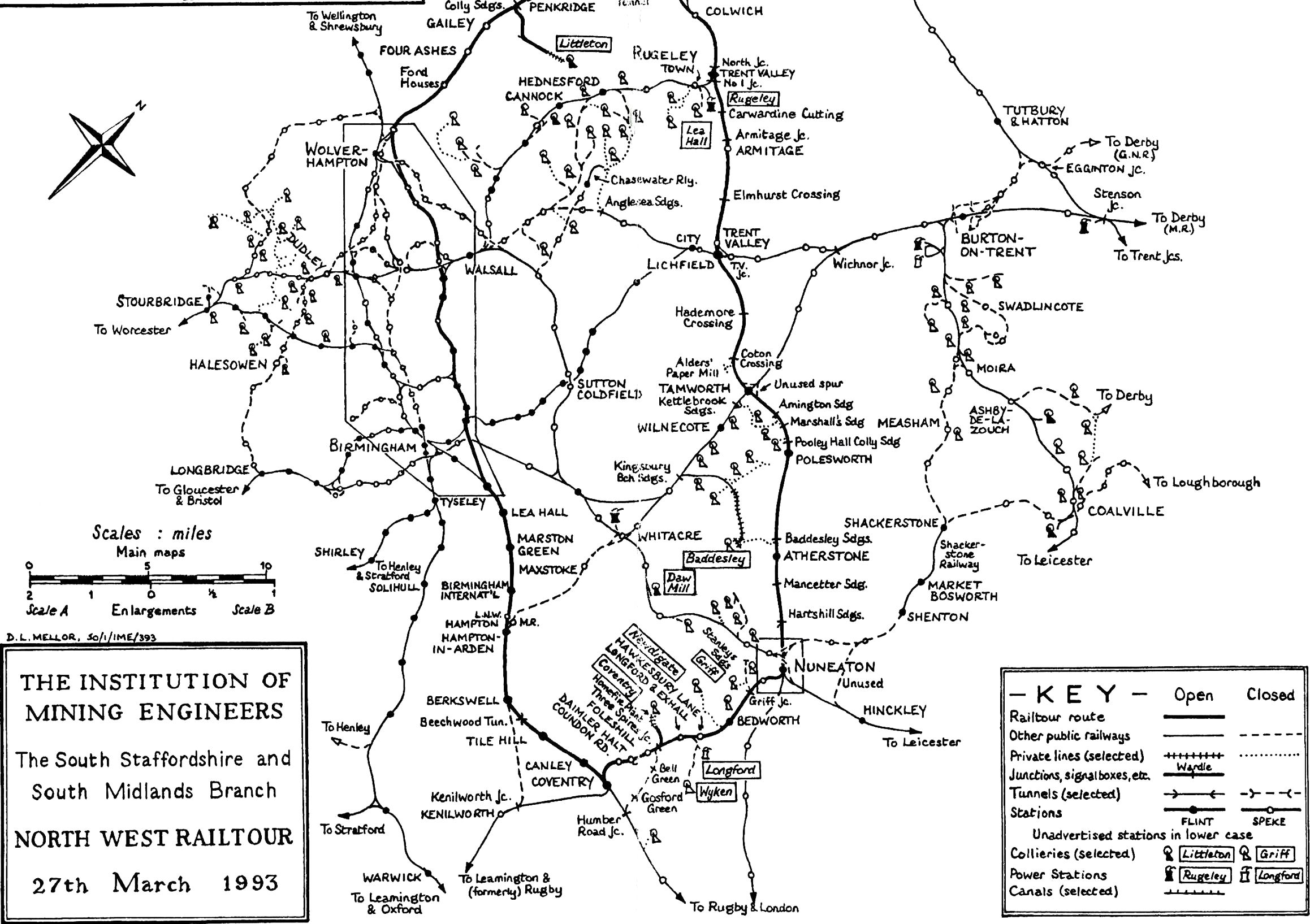
Railtour map drawn by our member Dave Mellor.
[© Dave Mellor 1993]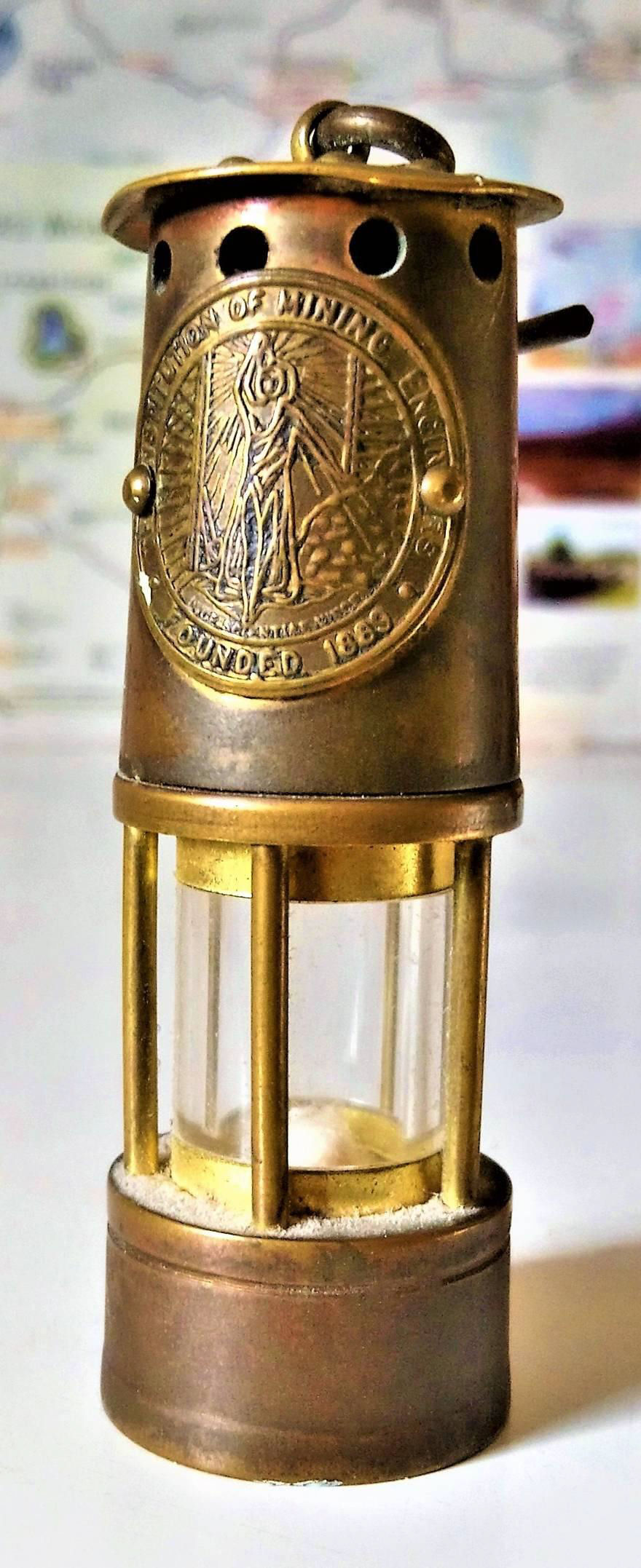
Chris Boyle gave a delightful miniature (actually just three inches tall) miner's lamp with 'IOME' and 'FOUNDED 1889' round the crest, or a real full sized lamp, to each person who had helped with these tours in some way.
[© Don Kennedy 1993]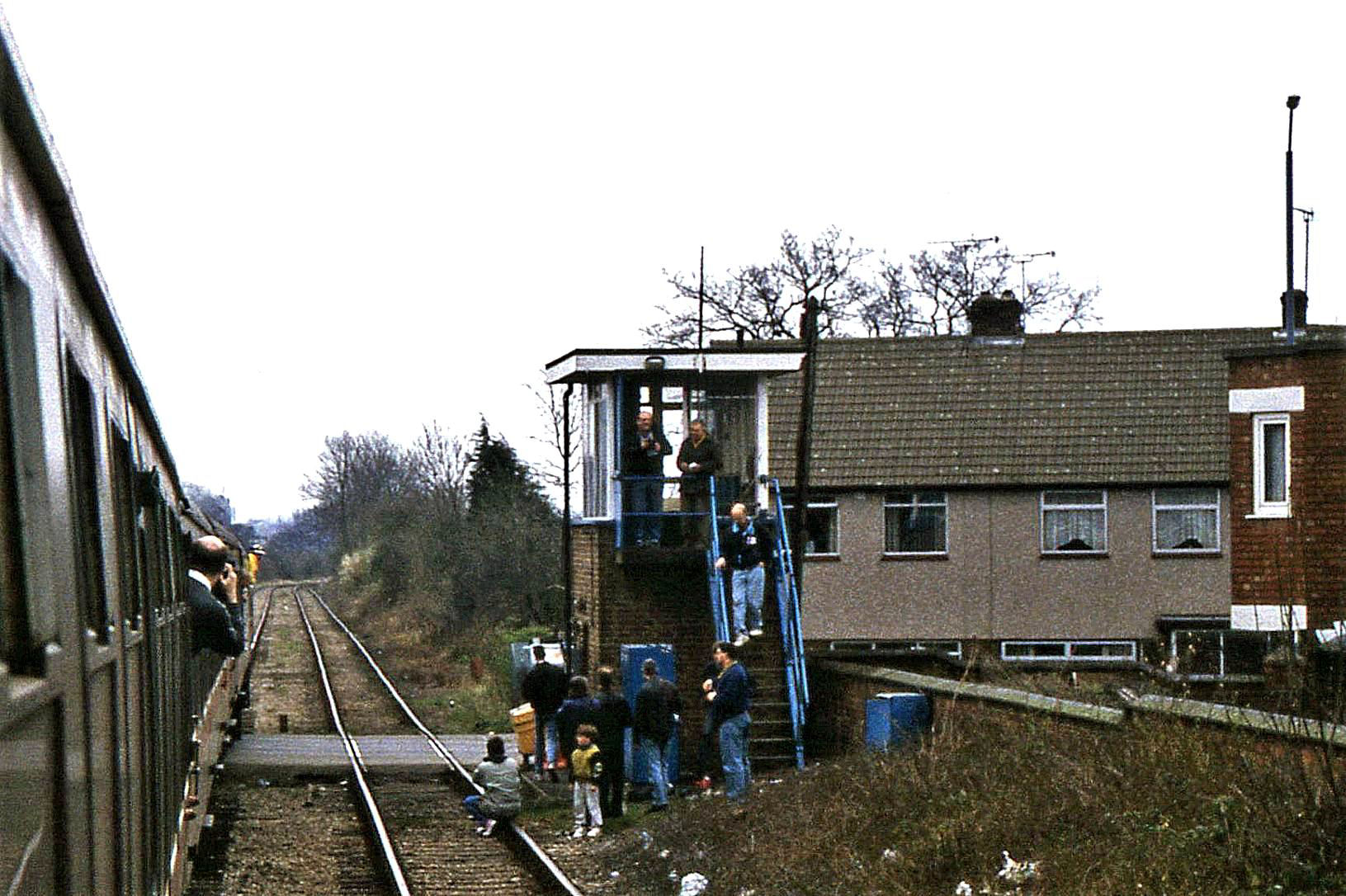
Wheelwright Lane Level Crossing on the Coventry Colliery branch from the 1993 railtour.
[© Ian Mortimer 1993]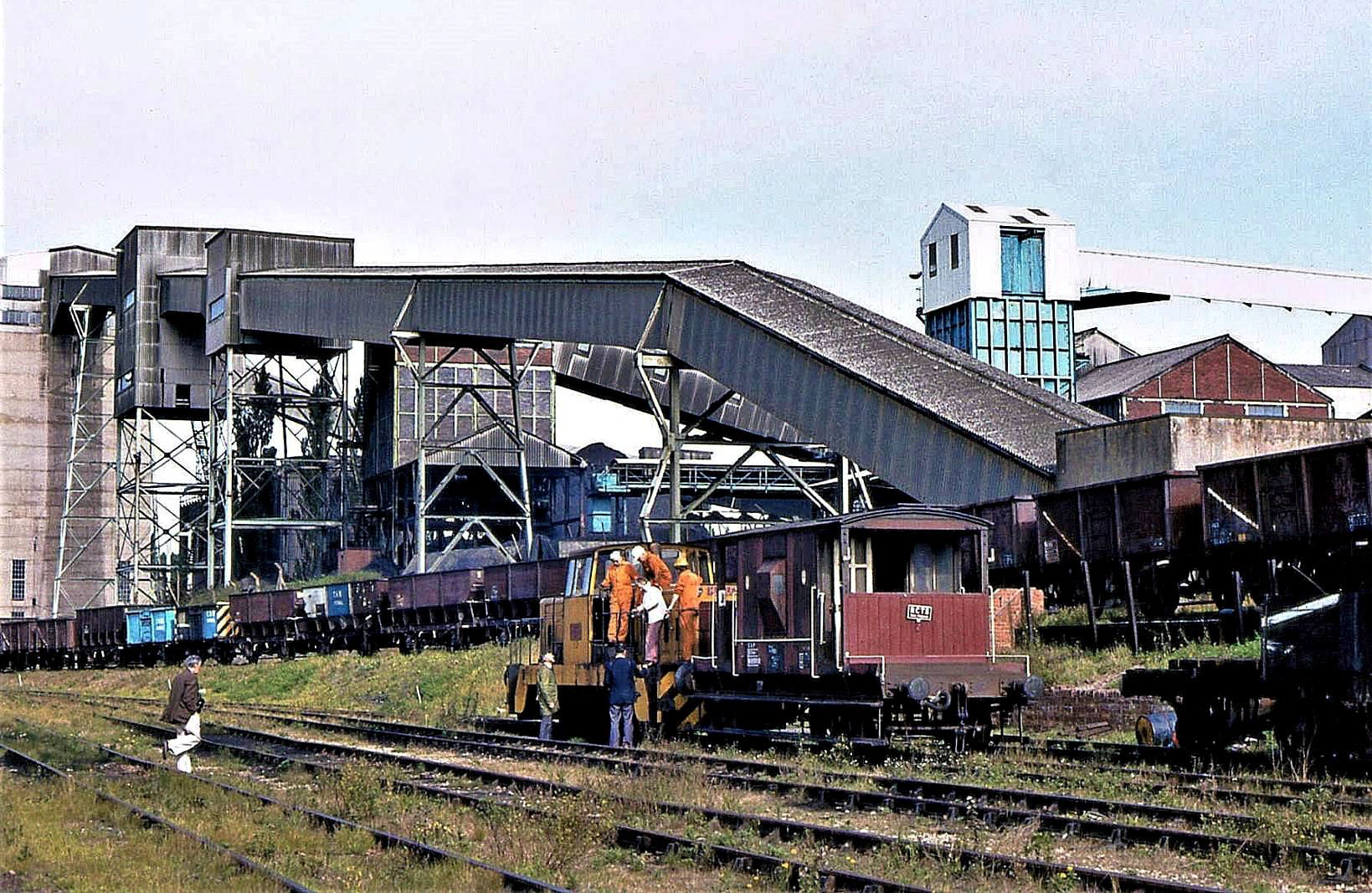
RCTS 11 Sep 1982 brakevan trip at Keresley Homefire Plant; an interesting selection of wagons.
[© Ian Mortimer 1982]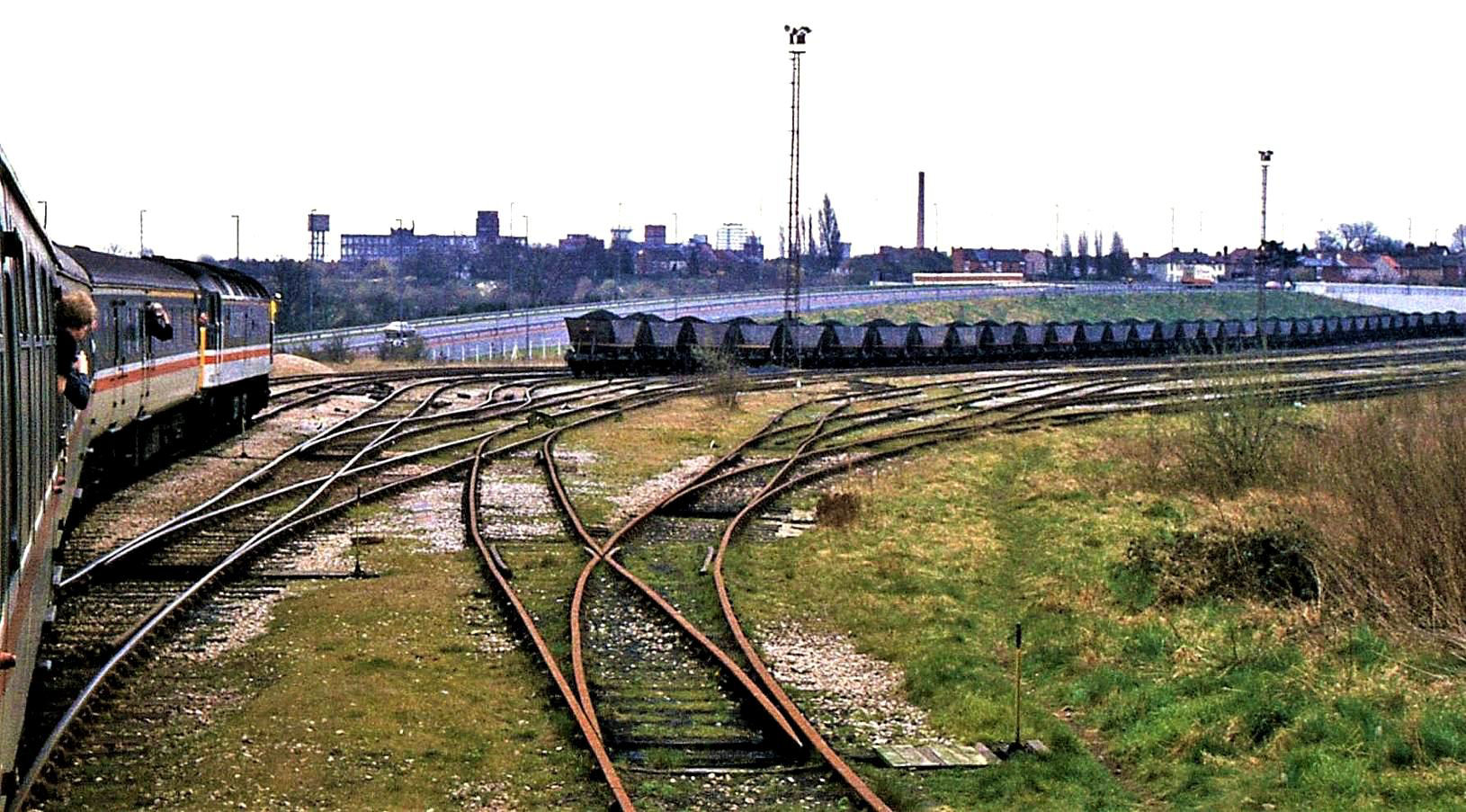
The tour curving round, and approaching, Three Spires Jn off the Keresley Homefire Plant branch. The 34 loaded merry-go-round wagons (total 1,122 tonne of coal) will be for the Homefire Plant. 11,162 of these silver wagons were built in total for British Rail and each held 33 tonnes of coal - quite 'revolutionary' (!) when they were introduced. In the background is the A444 (Jimmy Hill Way).
[© Ian Mortimer 1993]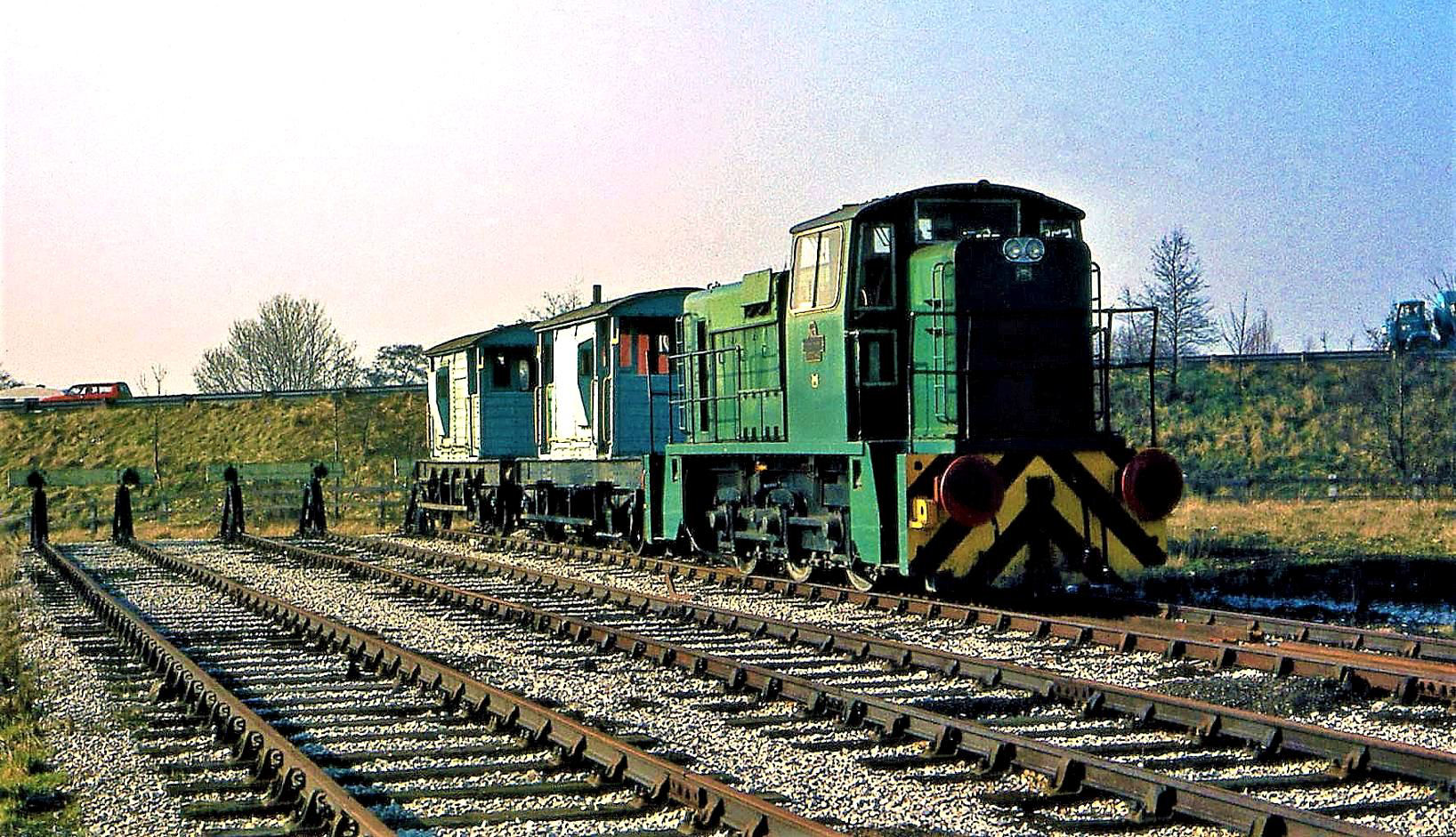
A Society brake tour of Littleton Colliery and its branch on 17 Feb 1981 included a visit to Canal Wharf Sidings which, as the name suggests, were on the stub of what was a branch to the Staffordshire & Worcestershire Canal. In the background is the M6 - the canal is on its other side. This excellent trip was arranged by Ian Mortimer and followed a ride on the 'fireless' steam loco at Four Ashes Croda Chemical Works nearby, alongside the WCML, earlier that day arranged by your Editor.
[© Ian Mortimer 1981]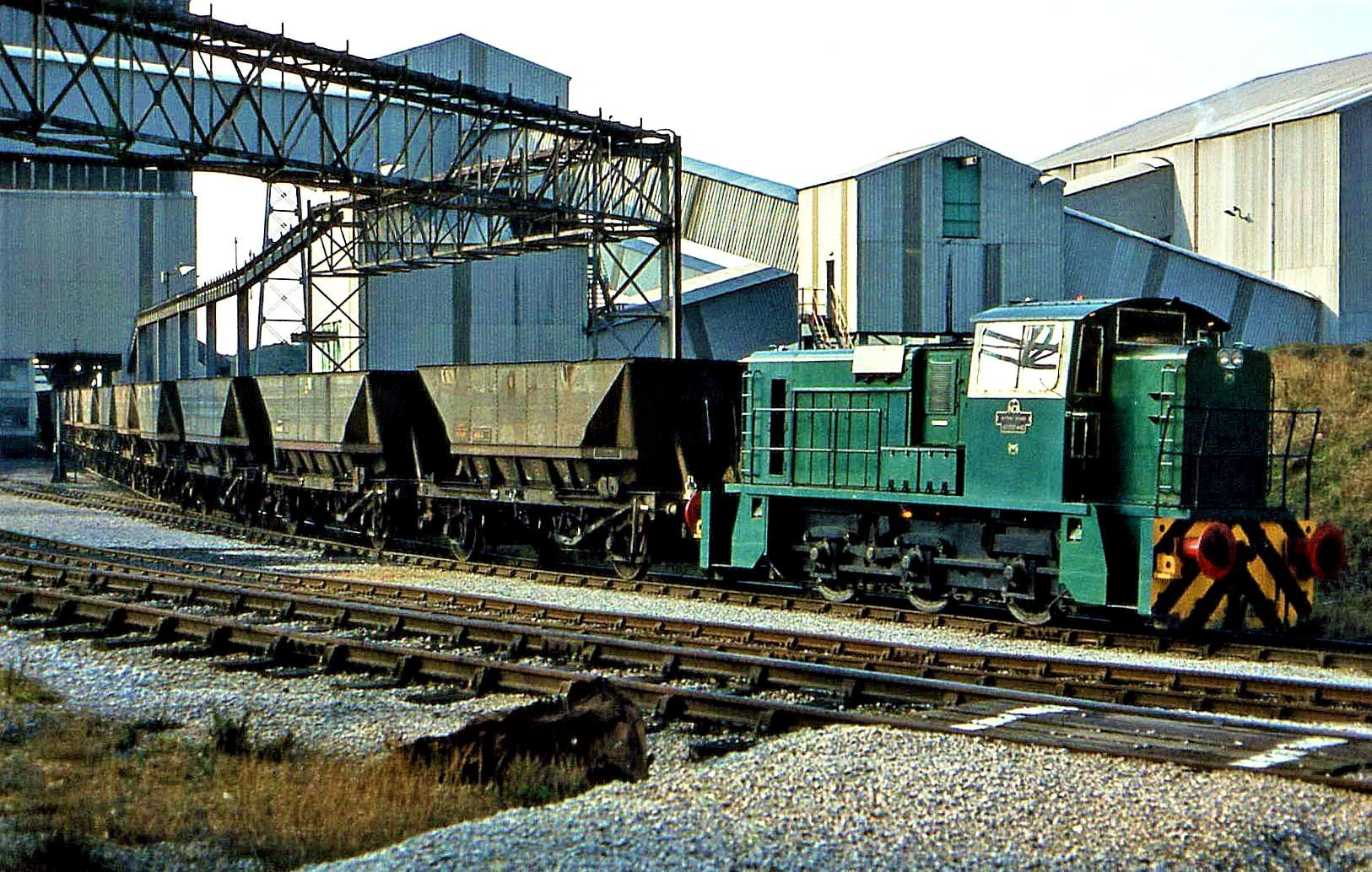
Taken during the same 17 Feb 1981 tour, a colliery loco hauling a set of MGR wagons through the loading bunker at Littleton Colliery. Note how new everything looked then!
[© Ian Mortimer 1981]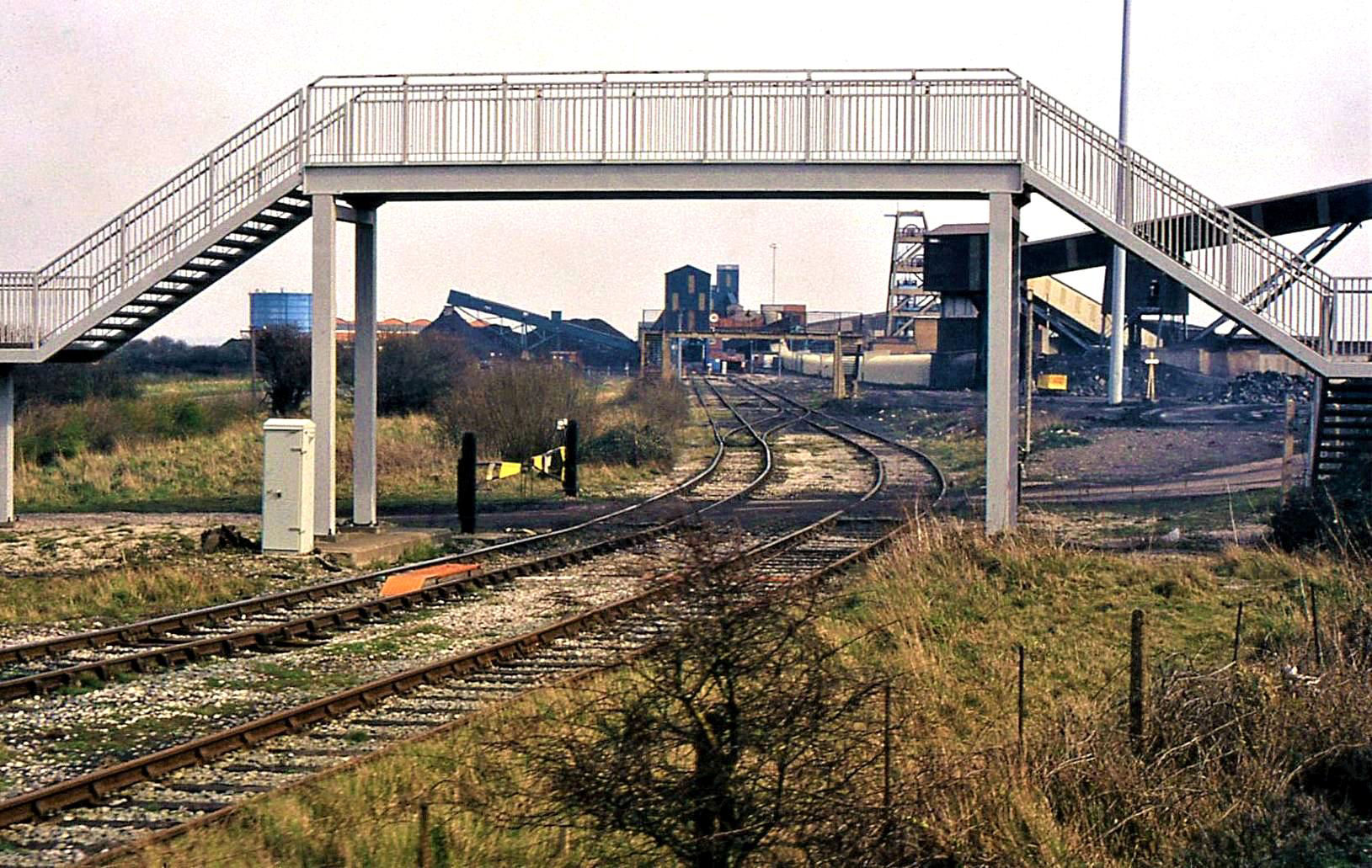
The Point of Ayr Colliery branch looking east, the Dee Estuary is behind the buildings.
Taken from the tour train as it was leaving the branch headshunt (left) to rejoin the main line (right).
[© Ian Mortimer 1993]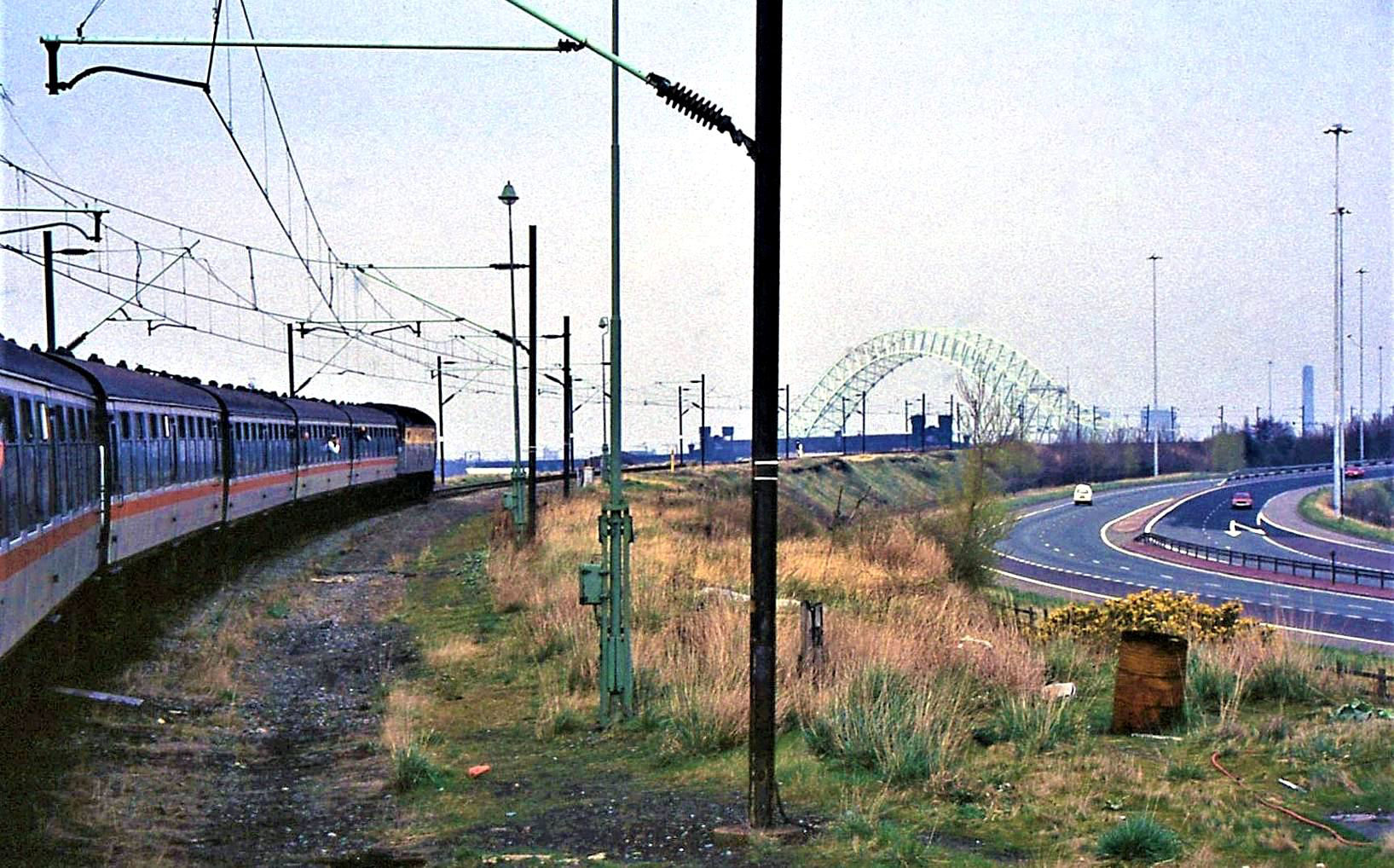
The 1993 tour is returning from Folly Lane to Runcorn Jn with the distinctive road bridge in the background, the rail bridge is in front to the left. Fiddlers Ferry Power Station is far right middle in the distance the other side of the Mersey. The Folly Lane branch was once double track and electrified.
[© Ian Mortimer 1993]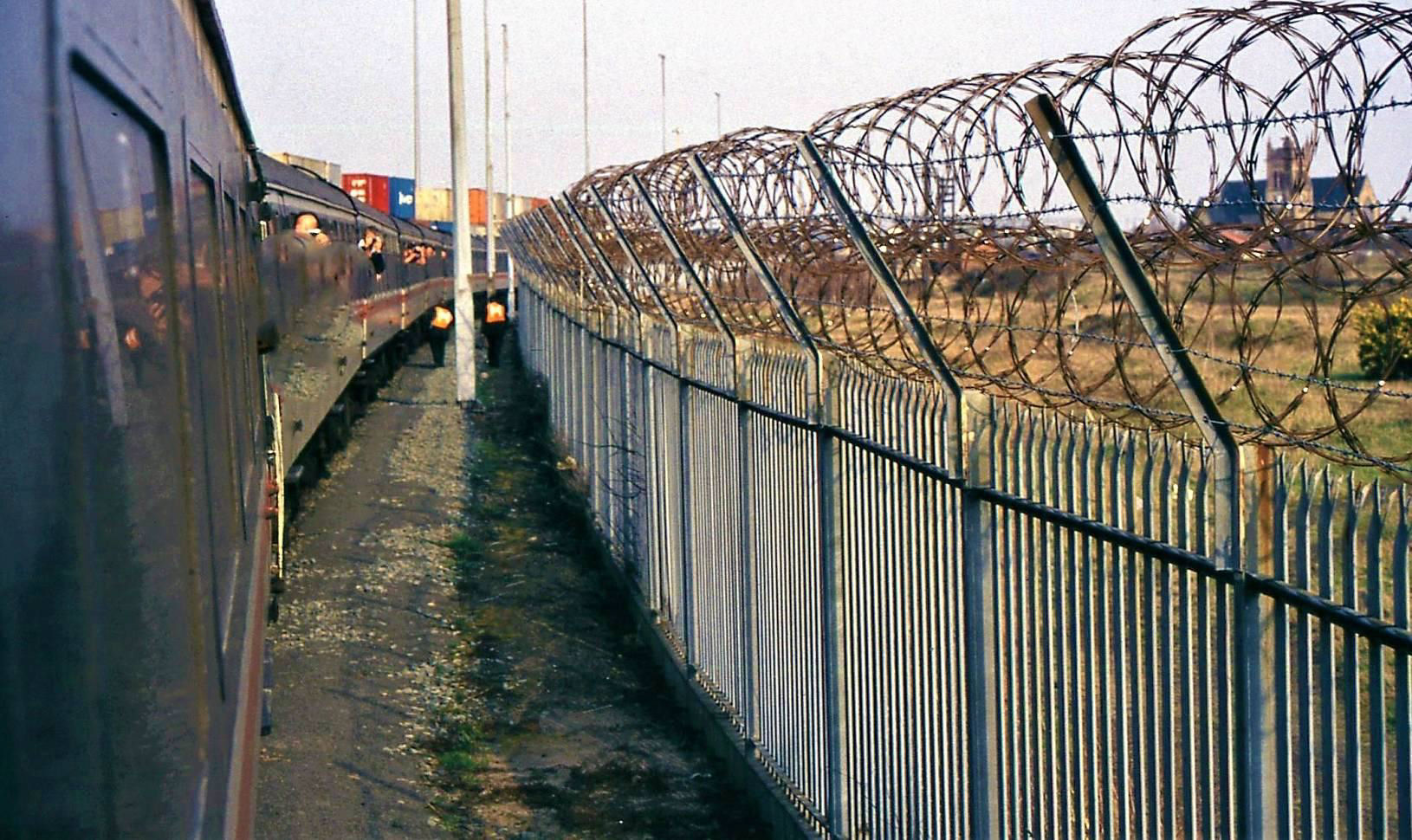
Welcome to Garston Holding Siding (TRACKmaps 4 p38A Dec 2018) in Garston Freightliner Terminal (as they were then); looking east and back towards the entrance, the former coal export sidings were to the right of this fence. Upper right is St Michael's Church of 'Church Road' fame.
[© Ian Mortimer 1993]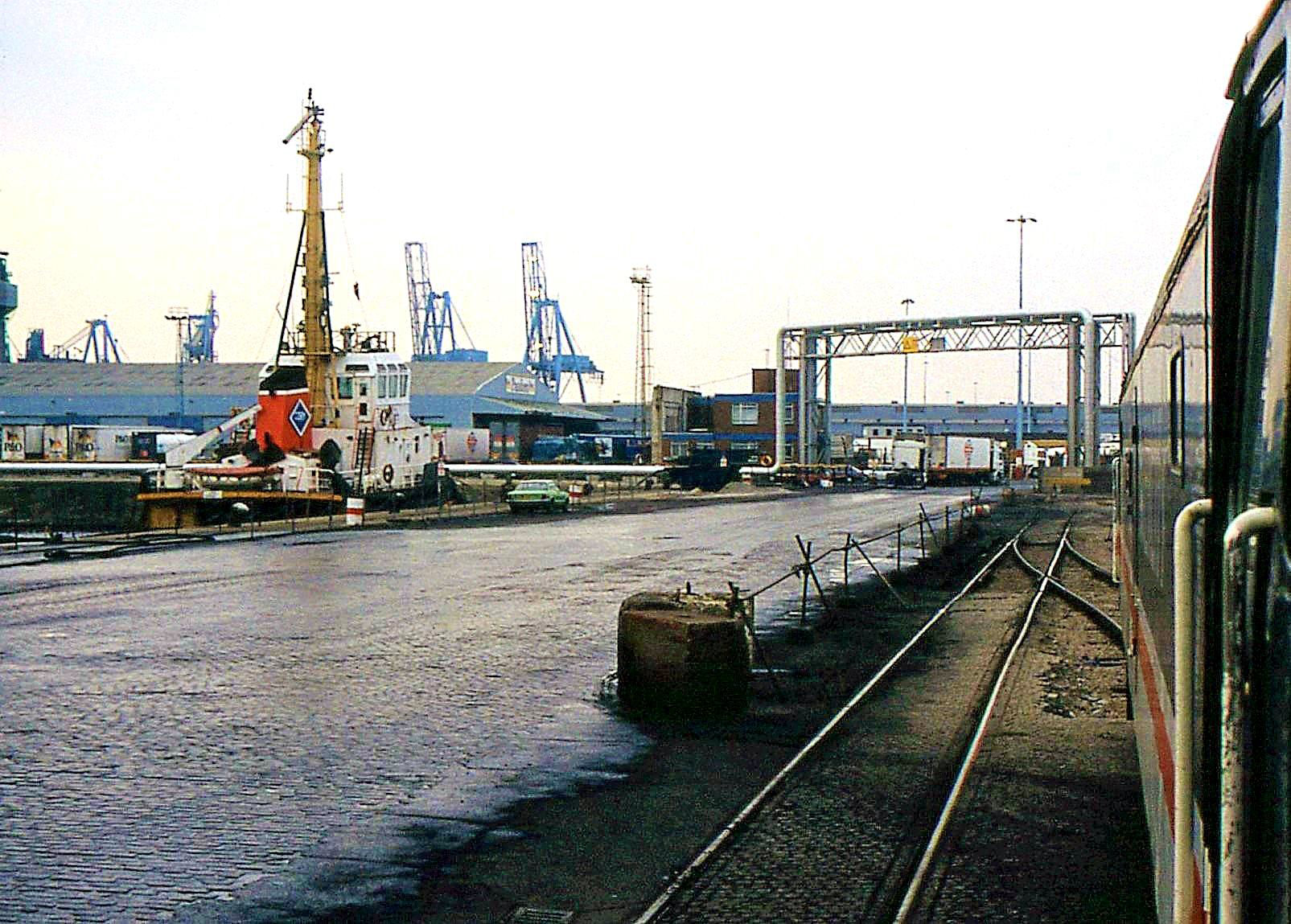
The front of the tour near Gladstone Dock Coal Pad stop blocks, the train is parallel to the River Mersey at right angles to the dock itself (left) looking northwest. This area is now part of Liverpool Bulk Terminal (mainly biomass). The quay line between Gladstone Dock No1 & No2 Docks, done by the Mersey Weaver II tour on 14 Jan 2017, curves off left at a right angle behind the photographer before this location.
[© Ian Mortimer 1993]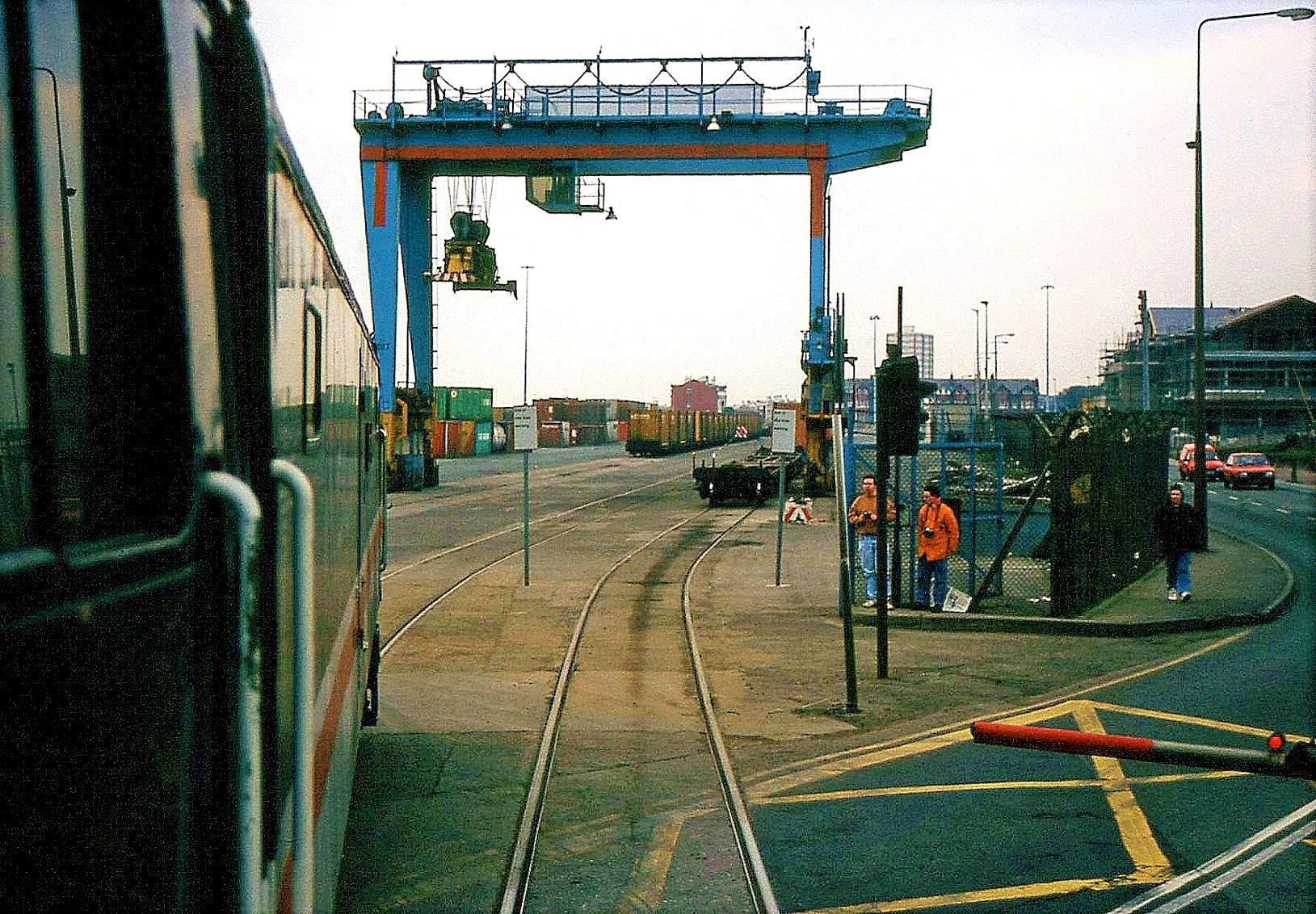
The tour enters the Royal Seaforth Container Terminal, possibly
the only tour to go past the gate. It about to pass under the gantry crane ahead.
[© Ian Mortimer 1993]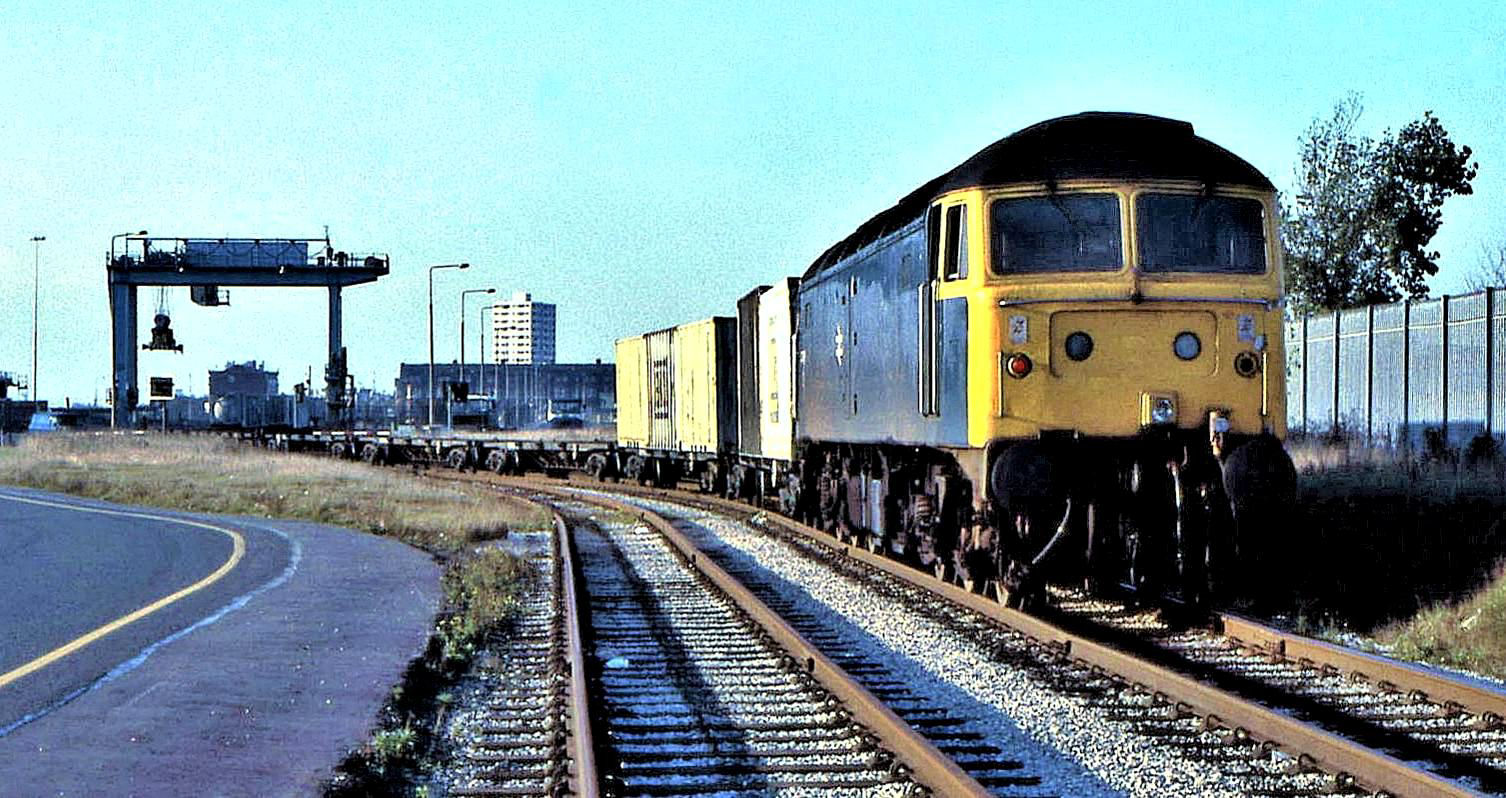
In Oct 1986 a container train is leaving Seaforth terminal; the gantry
crane in the background is the same one as in the previous picture.
[© Ian Mortimer 1986]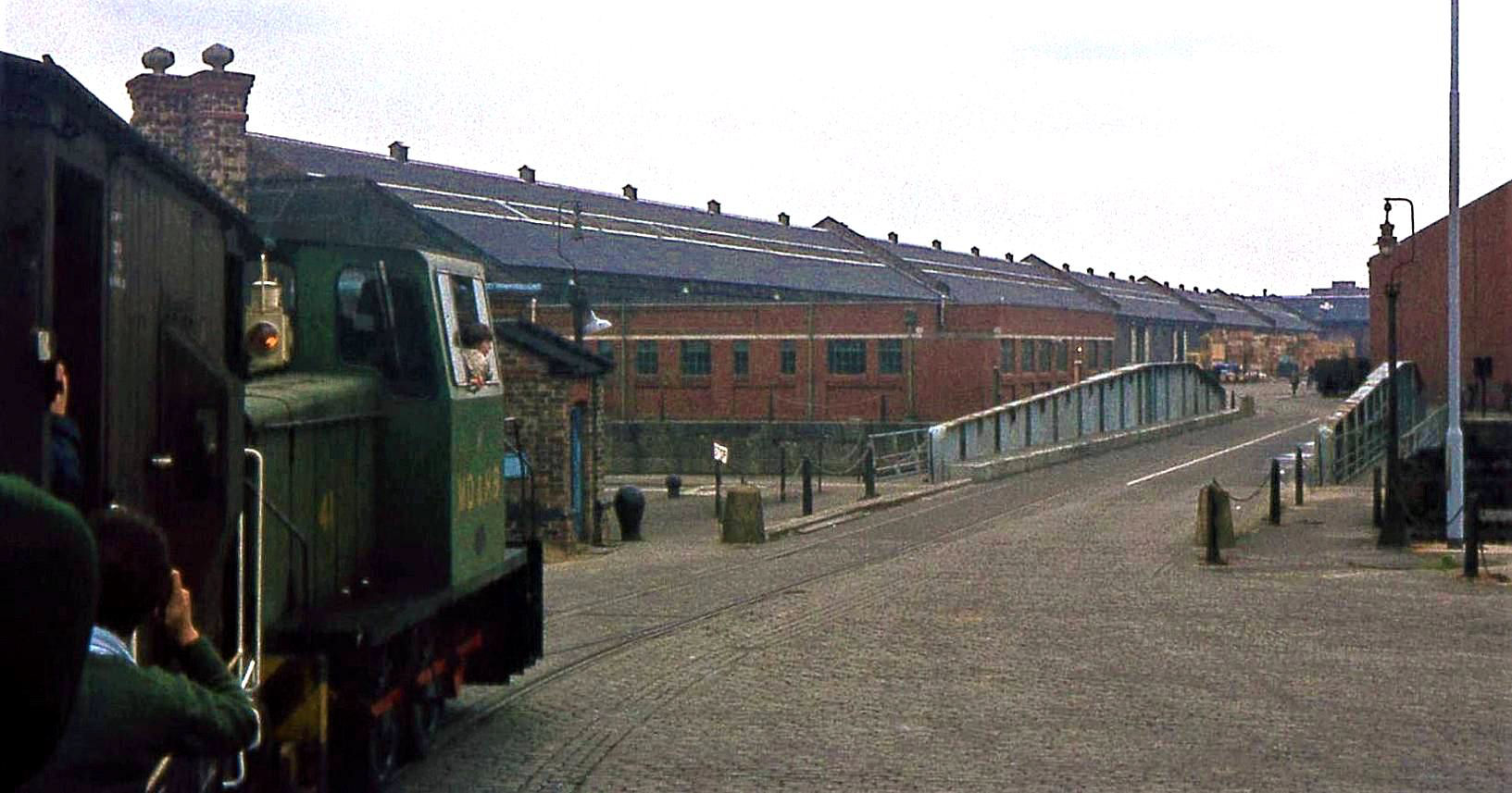
The final picture is from a different era. The Wirral Railway Circle ran a brakevan tour on 11 Aug 1973, covering much of the Mersey Docks & Harbour Company Liverpool Docks system, shortly before its closure later that year. This view shows the train approaching one of the swing bridges.
[© Ian Mortimer 1973]