Institution of Mining Engineers - North Tyne Tour
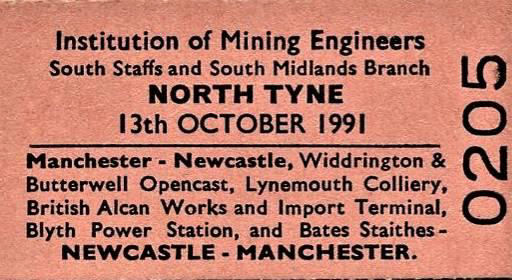
Sunday 13th October 1991
Report by Ian Mortimer & Paul Stewart
See https://bit.ly/3hQE9qM The third tour of 1991, with 47625 (and 56114 from Widdrington until final departure from Newsham North Jn in 'top & tail' formation'), started from Manchester Victoria on a Sunday at 07.55 revisiting a part of the country covered by the very first IMinE railtour. A late change meant that it ran to Leeds via Bradford Interchange rather than through Huddersfield and Mirfield, causing a delay of around 30 minutes. This continued all day including arrival back in Manchester Victoria at 20.20 after 378¼ miles and 14 reversals. From Leeds it was an uneventful run to Newcastle, where the tour proper started.
Continuing down the East Coast Main Line the train reached Widdrington North Jn (now known as Widdrington Sidings) north of the passenger station - it is a facing junction into the south end of the exchange sidings. After running into No1 (closest to the main line) and reversing, the end of the line was reached at Widdrington Opencast Disposal Point itself, further than the itinerary had indicated.
Apart from this bonus, the branch from the exchange sidings was normally only worked by the internal locomotives, so going down it at all was notable. Widdrington was a washery, processing coal that arrived by road from nearby opencast sites. It was located on the site of the long closed Widdrington Isabella and Six Pits Collieries. The final coal sent out from here was to Wilton (ICI) Power Station in Mar 2010 and then the internal locos went. The nearby Aln Valley Railway has 12088, an LMS/BR Class 11 0-6-0 DE built at Derby in 1951. Peak Rail has BR Class 06 loco D2420, 06003, 97804 0-4-0DM built Andrew Barclay Wks No435 (1959). In Jul 2003 this replaced EEV D1205 which moved away from Widdrington that month. In addition 31 EEV D1205 0-4-0DH of 1967 left Widdrington and went to Saint Gobain Pipelines, Stanton Works, Stanton-by-Dale, Ilkeston, Derbyshire and was subsequently scrapped by TJ Thomson at their Stockton-on-Tees Scrapyard in Feb 2007.
Today the branch is theoretically available but heavily overgrown. Widdrington was famous for 'Big Geordie' which arrived at Radar Open Cast Site in 1969, then the biggest walking dragline excavator in Europe at 3,000 tonnes. The fully extended job went 260ft scraping the overburden off the coal; the bucket held 100 tonnes and progress was rapid! It was replaced by 'The Ace of Spades' in 1993 which, although weighing 4,000 tonnes, had the same size bucket. Big Geordie was cut up for scrap in 2014.
Both were impressive sights, attracting visitors from all over the world. See https://bit.ly/3hYOctU & https://bit.ly/2Httk1l (short videos). They 'walked' at 2 metres per minute on giant pontoon feet that lifted the body off the ground before lowering it a few feet ahead - sometimes for miles between sites.
From Widdrington the tour returned to Butterwell Jn, where it followed the route of the 1989 first IMinE tour but went through Butterwell Disposal Point Bunker - the previous tour had bypassed the bunker line. Opened in 1977, Butterwell was the loading point for a nearby opencast site, at the time the largest man-made hole in Europe! Again it went along the private Butterwell Light Railway (which became disused in 1999 after repeated vandalism) to Ashington. Here a ticketless passenger was removed from the train into the waiting arms of the local constabulary. After reversing, we passed the British Rail boundary at 4m 14ch and once more visited Lynemouth Colliery bunker line.
However, this time on our return journey we reversed at Alcan Jn (5m 32ch) and took the 1¼ mile branch to the Alcan Aluminium Smelter, running through the works on the right hand of the two roads (the run round line) to about 50m before the end of line. The smelter closed in May 2012.
Returning to Ashington the tour carried on to Marcheys House Jn where it took the direct north to east curve to Winning Crossing Jn (currently with no regular traffic). It passed the once busy Cambois Depot, which closed in 1994, and West Blyth Staiths (which had already closed 31 Dec 1989 but only had sporadic traffic latterly). The train eventually reached the level crossing after North Blyth Loop, just before North Blyth Alcan Import Terminal. This still has regular trains of Alumina each week to Fort William; at the time of the tour they also ran to Lynemouth Smelter. After retracing its tracks to Freemans Signal Box, another reversal accessed the Blyth (or Cambois) 'A' Power Station branch - the one on the west side (and not the 'B' station branch as shown on the tour map and in the itinerary which had a merry-go-round wagon unloading hopper). The two power stations were separate units.
At full commissioning in 1966 Blyth 'A' & 'B' stations were, for a short time, the largest single electricity generation site in England at 1,730MW (previously it had been Drakelow 'A', 'B' & 'C') commissioning of Ferrybridge 'C' later that year removed the title. In 1989, Blyth 'A' set a new world record (noted in the Guinness Book of Records) for total running hours in a plant of its size, when all four generating units achieved 200,000 running hours. The older 'A' station closed in 1999 and 'B' on 31 Jan 2001, at which time it was the oldest and least efficient coal fired power station still operating in Britain(when new it was the most efficient!). Demolition of the distinctive landmarks for miles around followed in 2003/4.
After returning to Winning Crossing Jn, the east to south curve was taken to West Sleekburn Jn, rejoining the Blyth & Tyne (B&T) line, to Newsham North Jn. Another reversal there accessed the branch (then only recently reopened in Apr 1991 with a test train on 5th and the first coal for export (!) on 8th) to Blyth Bates British Coal Terminal. The line, 2⅓ miles long, initially followed the former double track Blyth passenger branch (CP 2 Nov 1964 along with the B&T) before curving left to the site of Isabella Colliery, which closed in 1966. Until traffic to Bates Colliery and the adjacent staiths ceased in 1984 (the colliery closed in 1986), there were exchange sidings here; the line beyond was worked only by National Coal Board (NCB) locos. On reopening in Apr 1991 to serve the coal terminal, British Rail locos worked the entire branch. Running through the site of Bates Colliery, the tour ran to a train length beyond the unloading hopper, just short of the final curve leading to the loop headshunt.
This facility was short lived with few coal trains or tours, was disused by the end of the decade, taken OOU in Mar 2006 and has long been lifted. There are plans to convert at least part to a foot/cycle path.
Returning to Newsham North Jn, the Blyth & Tyne line was taken south, passing Holywell, where the branch to Burradon Colliery (closed in 1975) had converged. This NCB owned branch was notable for crossing one of the Backworth Colliery system lines on the level. From here the tour ran to Newcastle, then retraced its outward route to Leeds, before running via Huddersfield to Manchester Victoria.
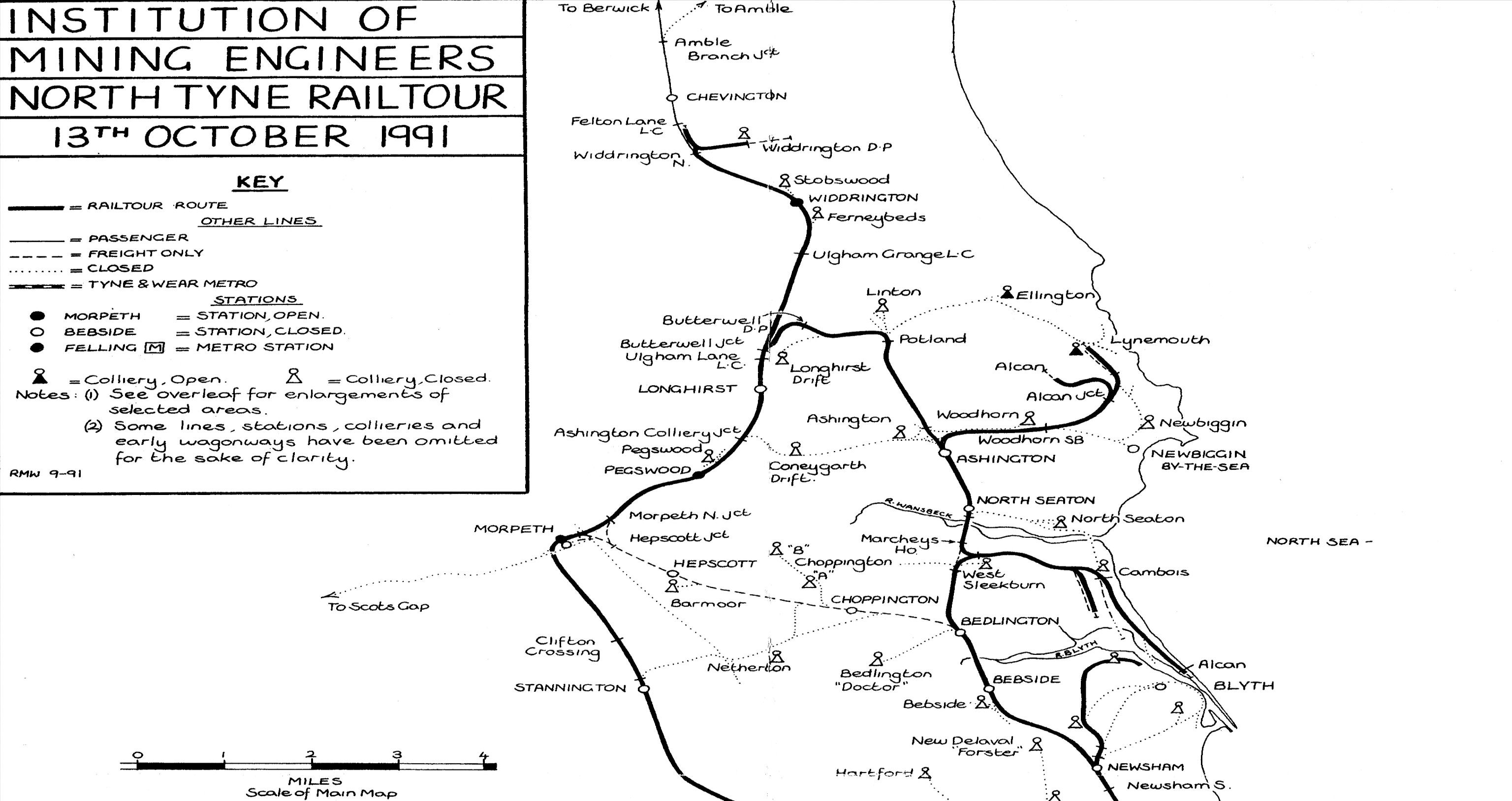
Railtour map drawn by our member Rodger Wilkinson.
Note that at Blyth Power Station the west branch was done by the tour, not the east as shown.
[© Rodger Wilkinson 1991]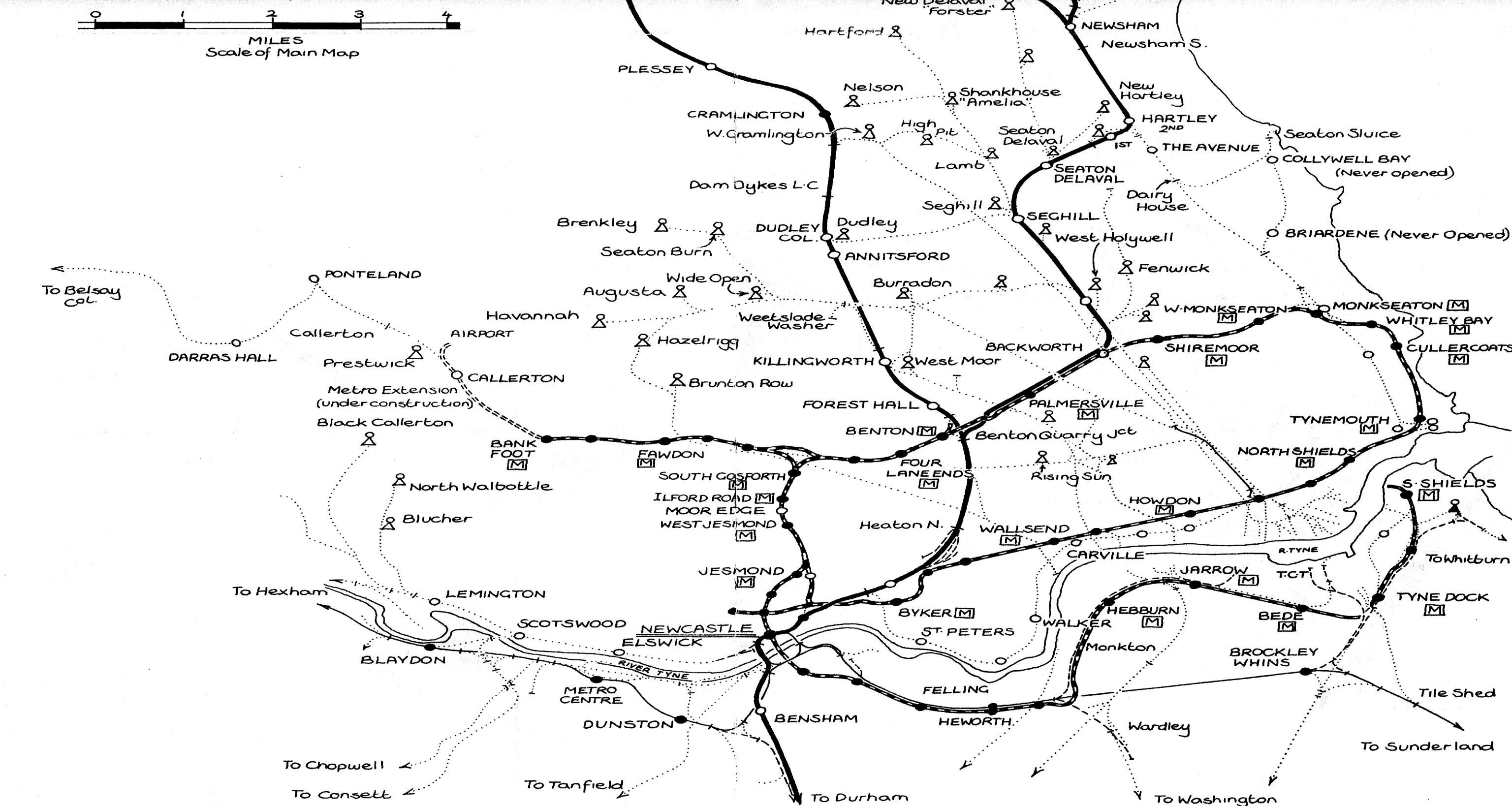
Railtour map drawn by our member Rodger Wilkinson.
[© Rodger Wilkinson 1991]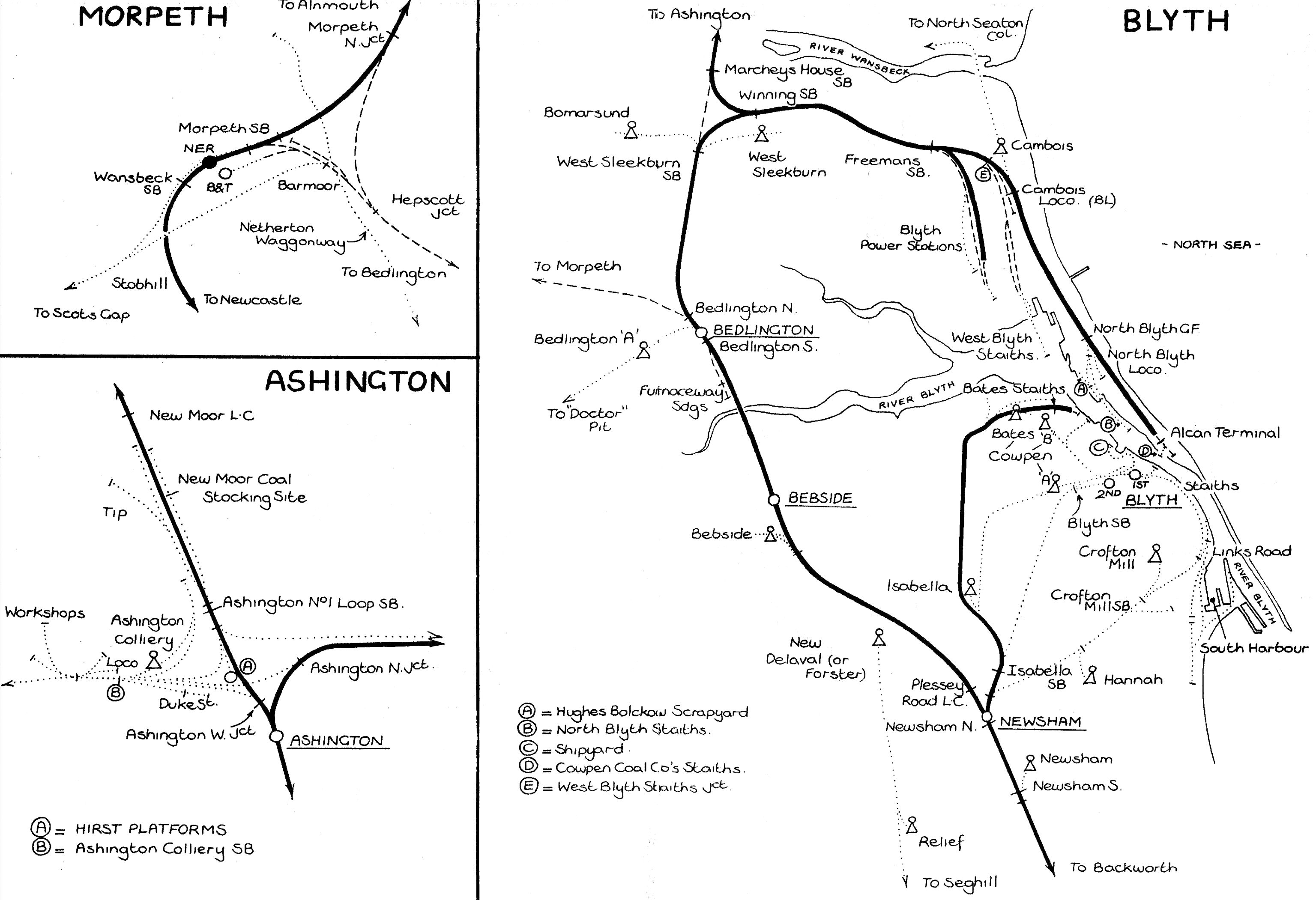
Railtour map drawn by our member Rodger Wilkinson.
Note that at Blyth Power Station the west branch was done by the tour, not the east as shown.
[© Rodger Wilkinson 1991]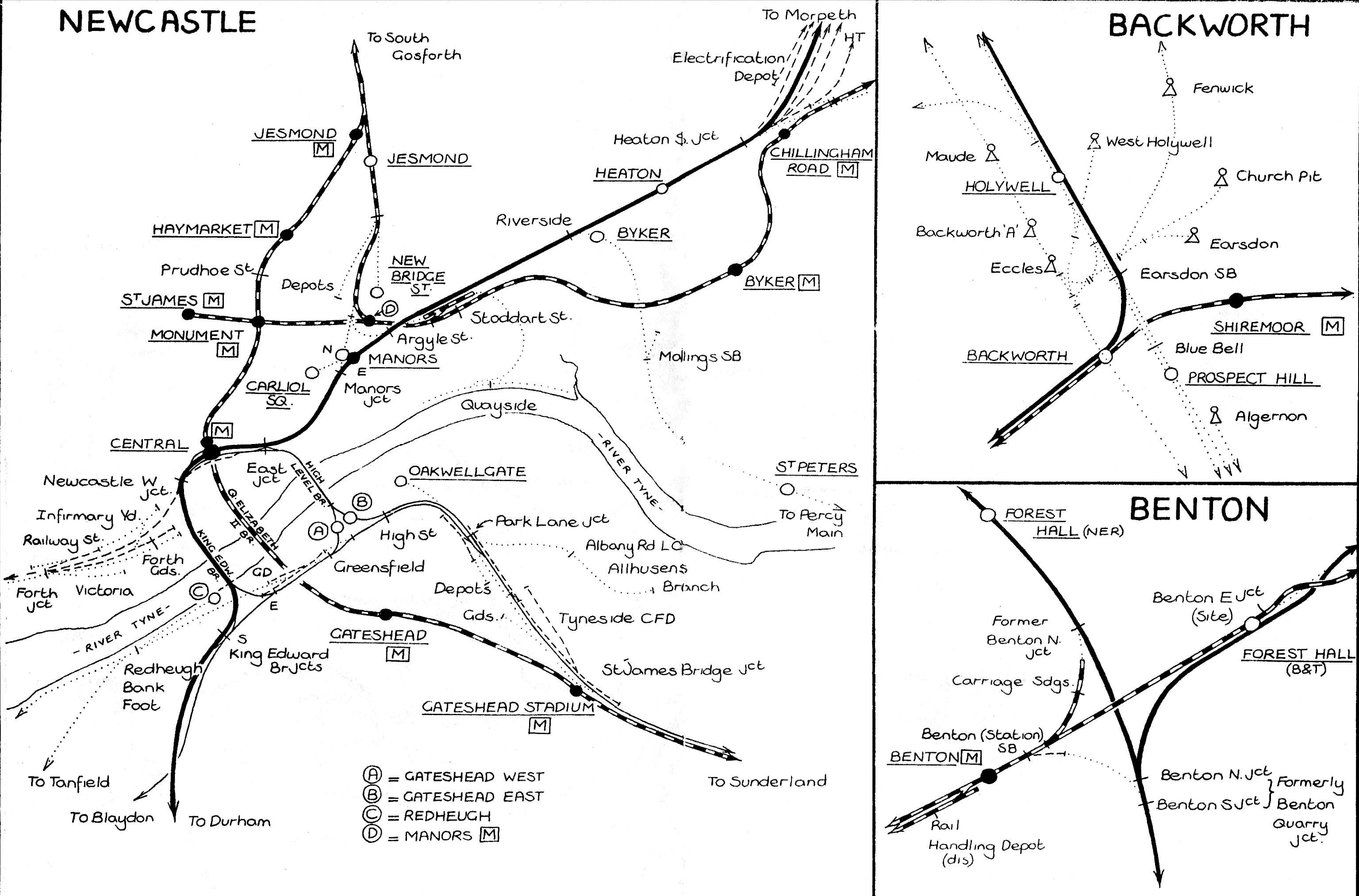
Railtour map drawn by our member Rodger Wilkinson.
[© Rodger Wilkinson 1991]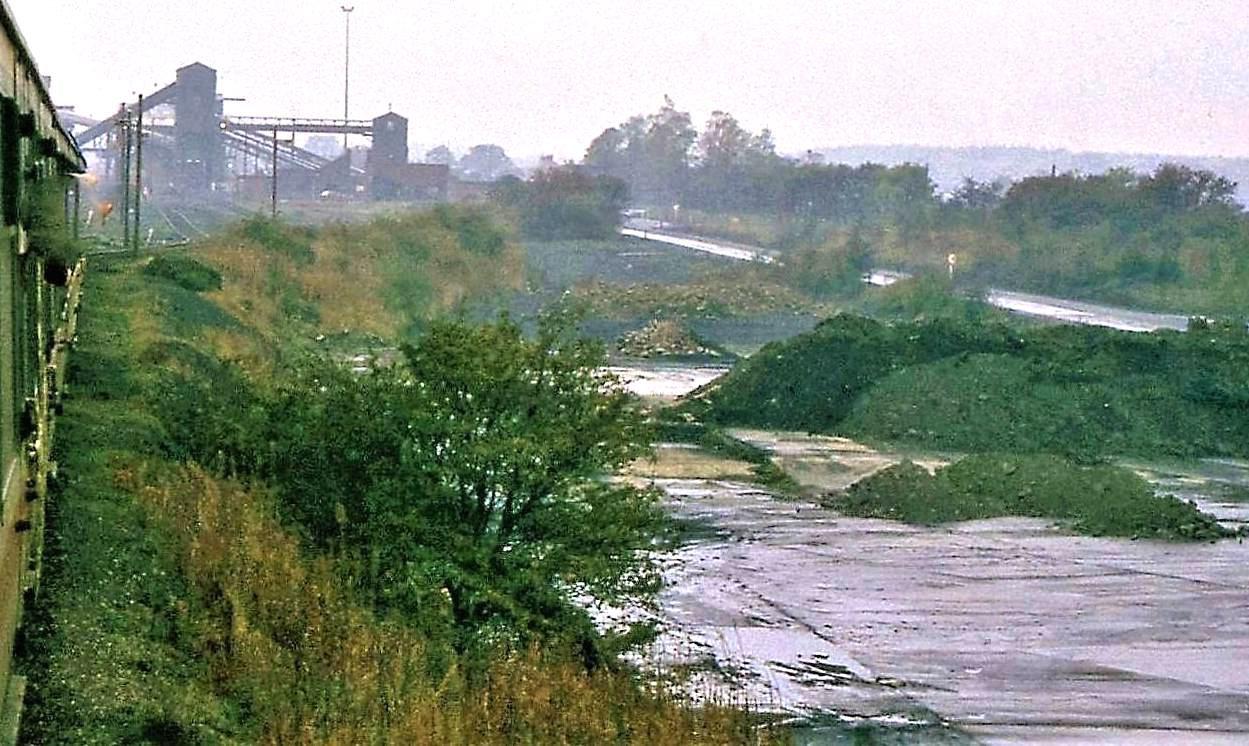
Widdrington from the front of the tour at the end of line, looking back towards the loading bunker that it had run past. Unfortunately the weather on the day wasn't great for photography.
[© Ian Mortimer 1991]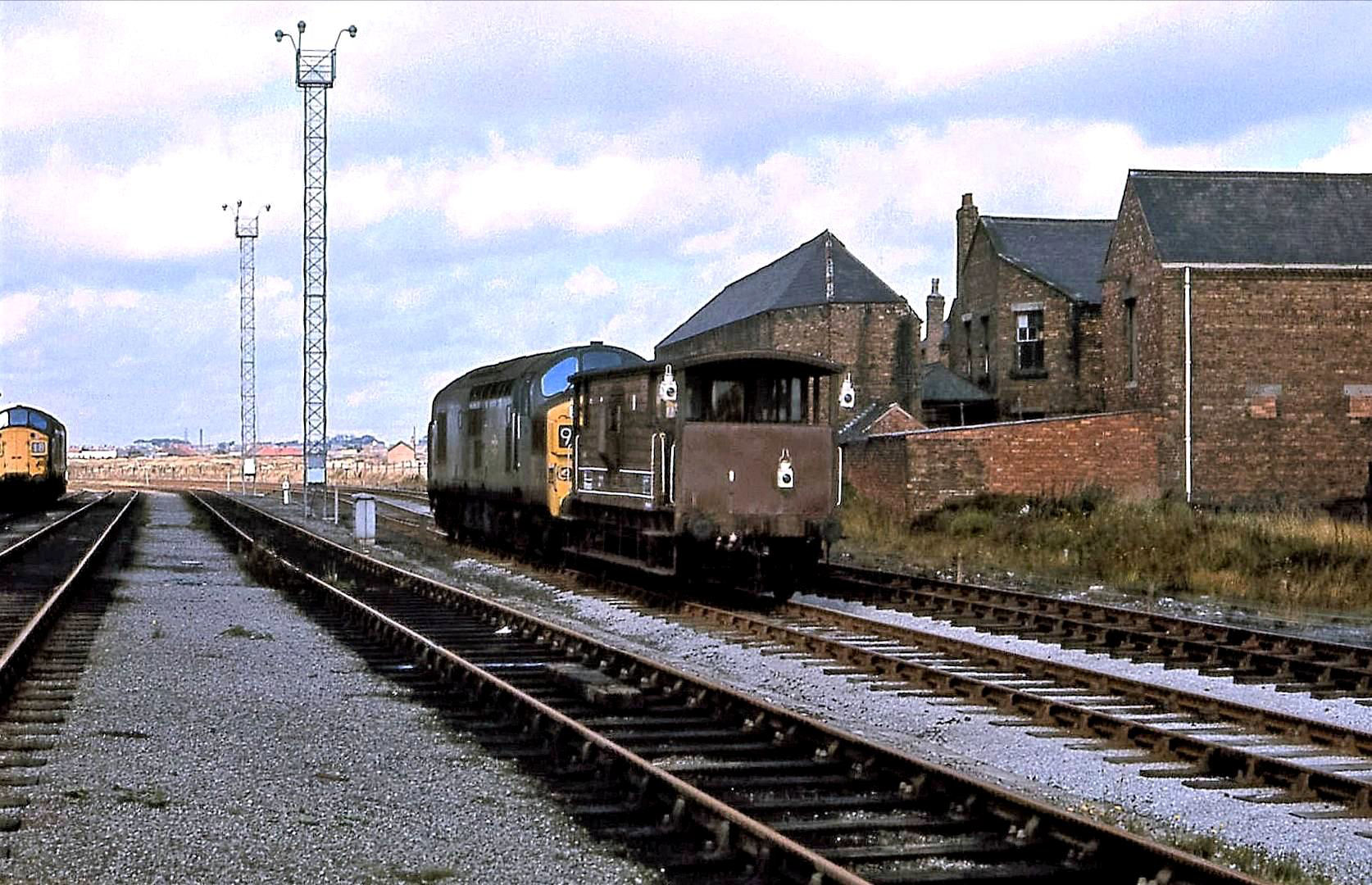
37093 and a LMS brakevan at Cambois Depot on 13 Sep 1974. The brakevan had been used on the Alcan service, unfitted wagons then. The traffic between North Blyth Import Terminal and Lynemouth Smelter was alumina and coke for the smelting process.
[© Ian Mortimer 1974]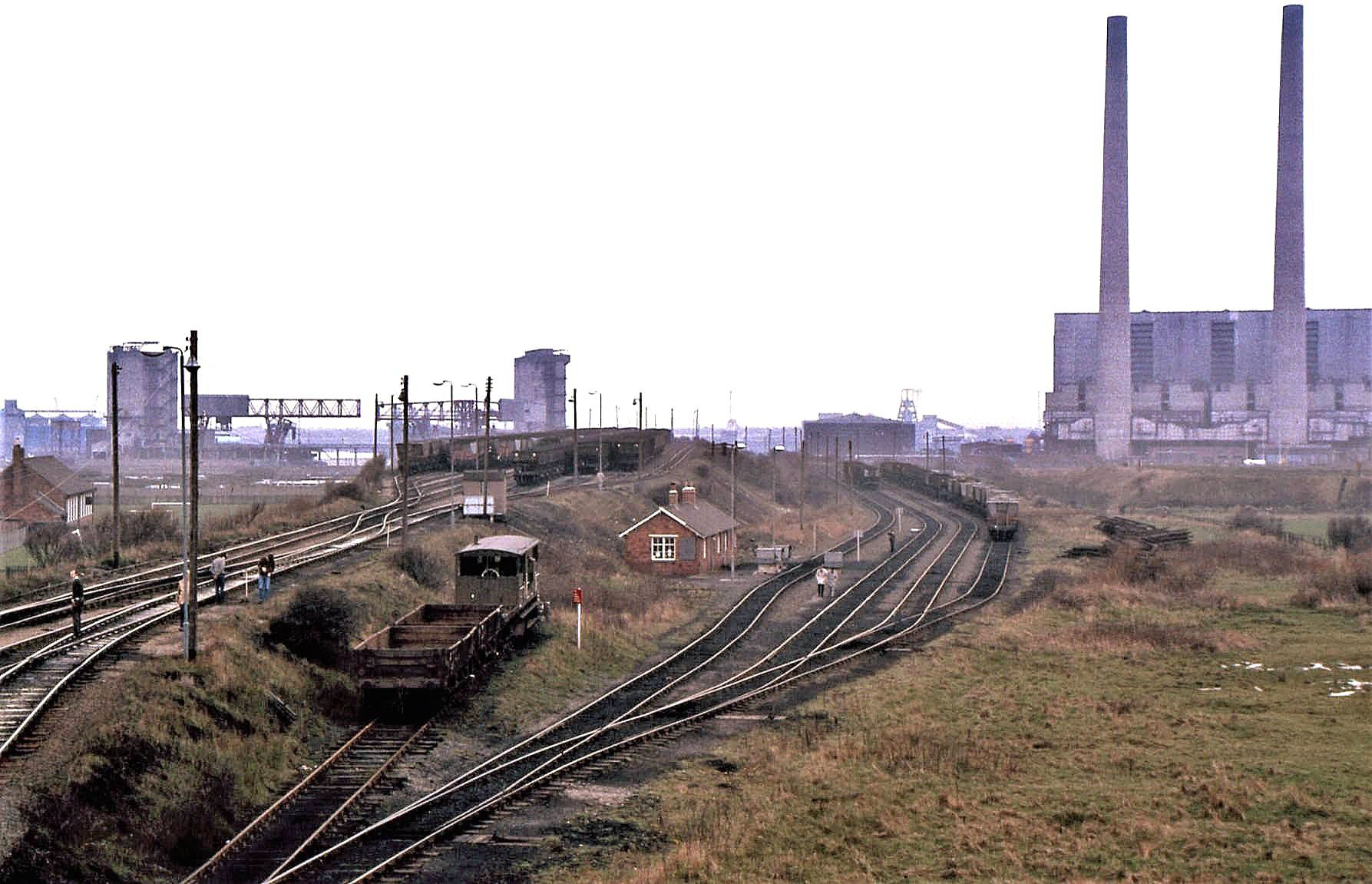
From near Cambois Depot looking south towards West Blyth Staiths, Apr 1986. The high-level loaded wagon sidings are left. Wagons were shunted ahead on to the staiths for unloading then ran back to the low-level empty wagons sidings, right. Blyth 'B' Power Station is right with its twin chimneys. Bates Colliery is in the distance, just to left of the power station and across the River Blyth.
[© Ian Mortimer 1986]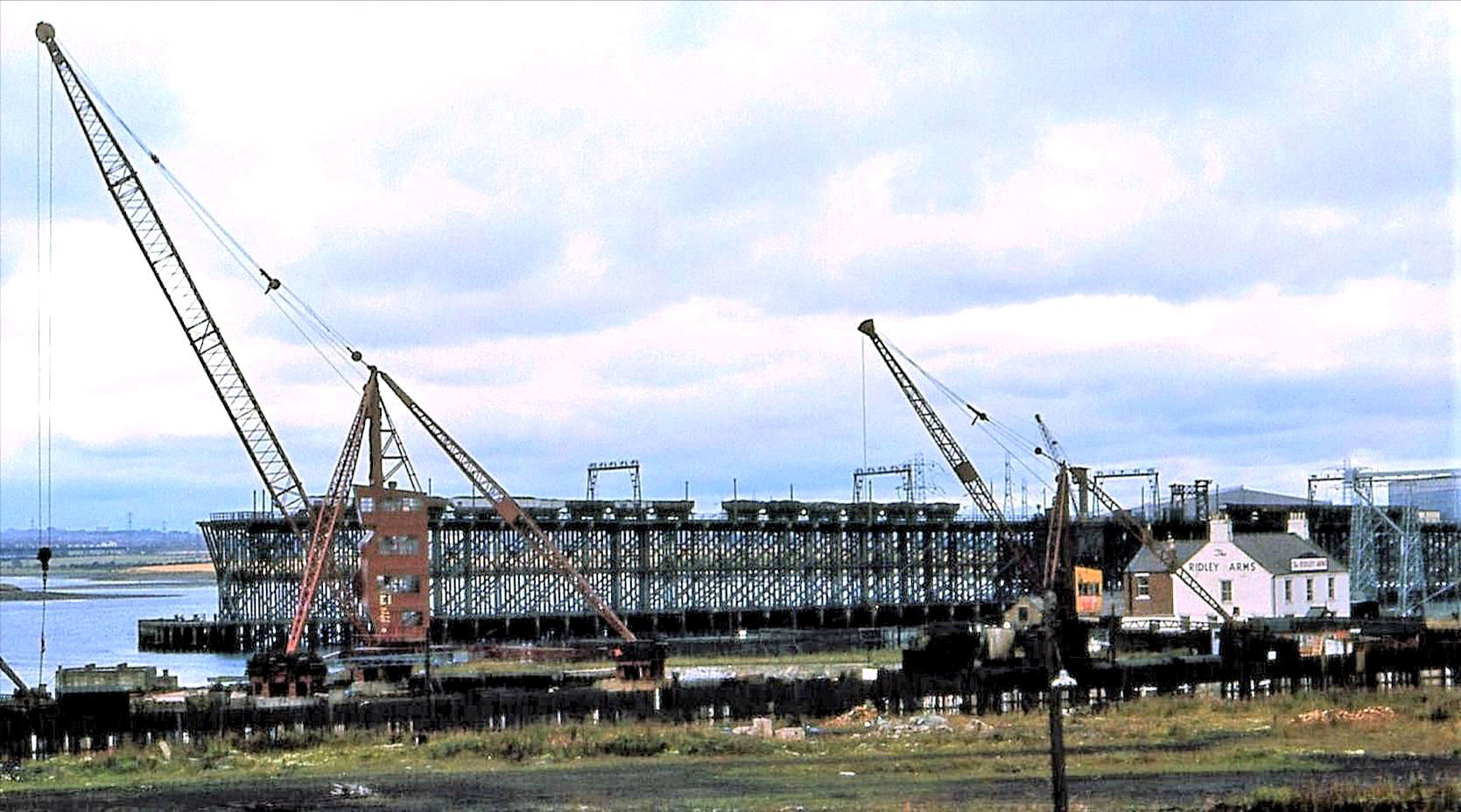
West Blyth Staiths which closed 31 Dec 1989, from the southeast (the aforementioned LMS brakevan en route to North Blyth Alcan Import Terminal). Once a common sight in the North East, you had to be lucky to have a trip, with a boat in or a driver who would take you down light engine.
[© Ian Mortimer 1974]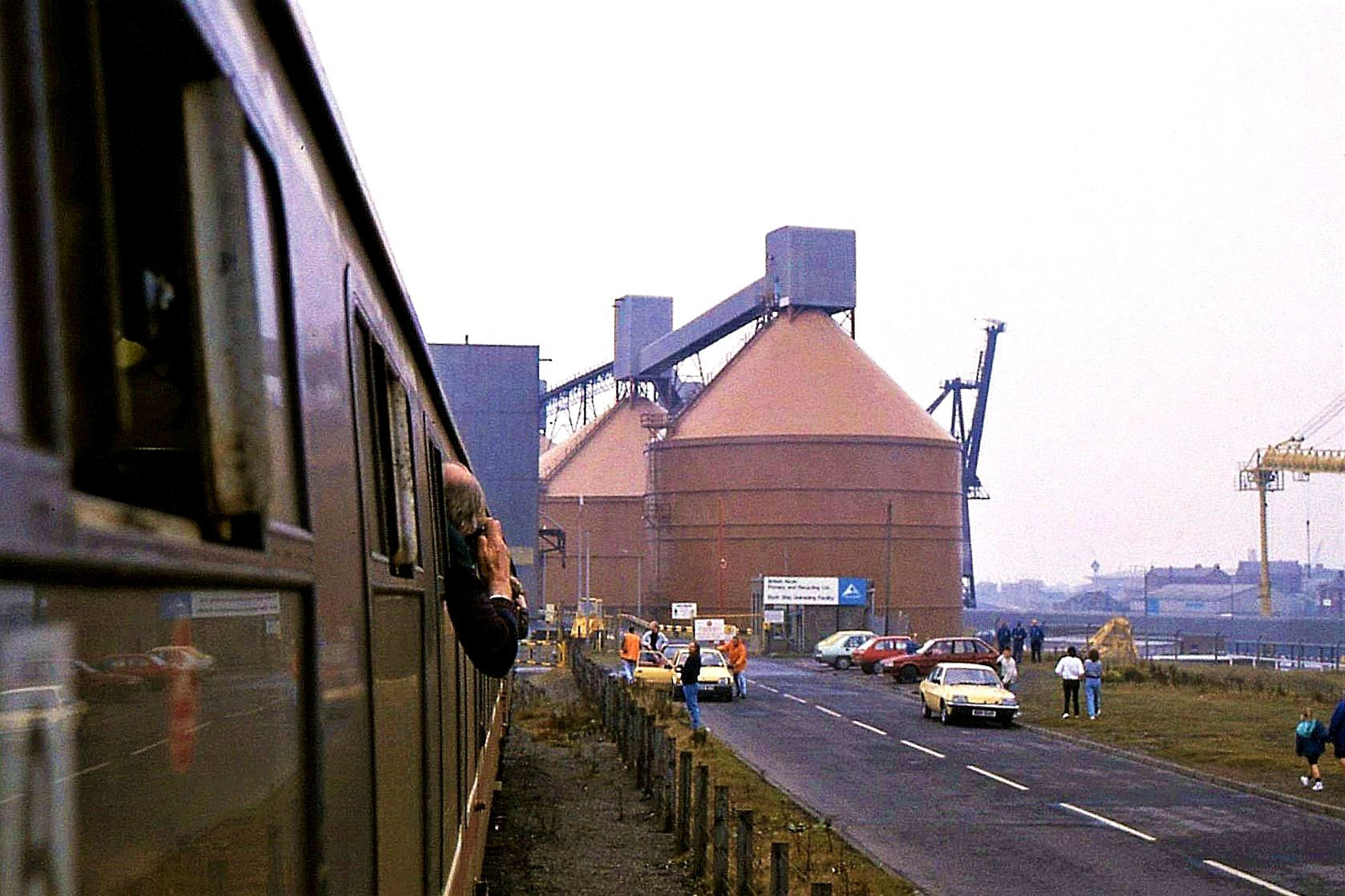
A sight familiar to modern railtourers; North Blyth Import Terminal, with the 13 Oct 1991 tour stopped at crossing just short of the terminal. The main thing that has changed in 29 years is the cars!
[© Ian Mortimer 1991]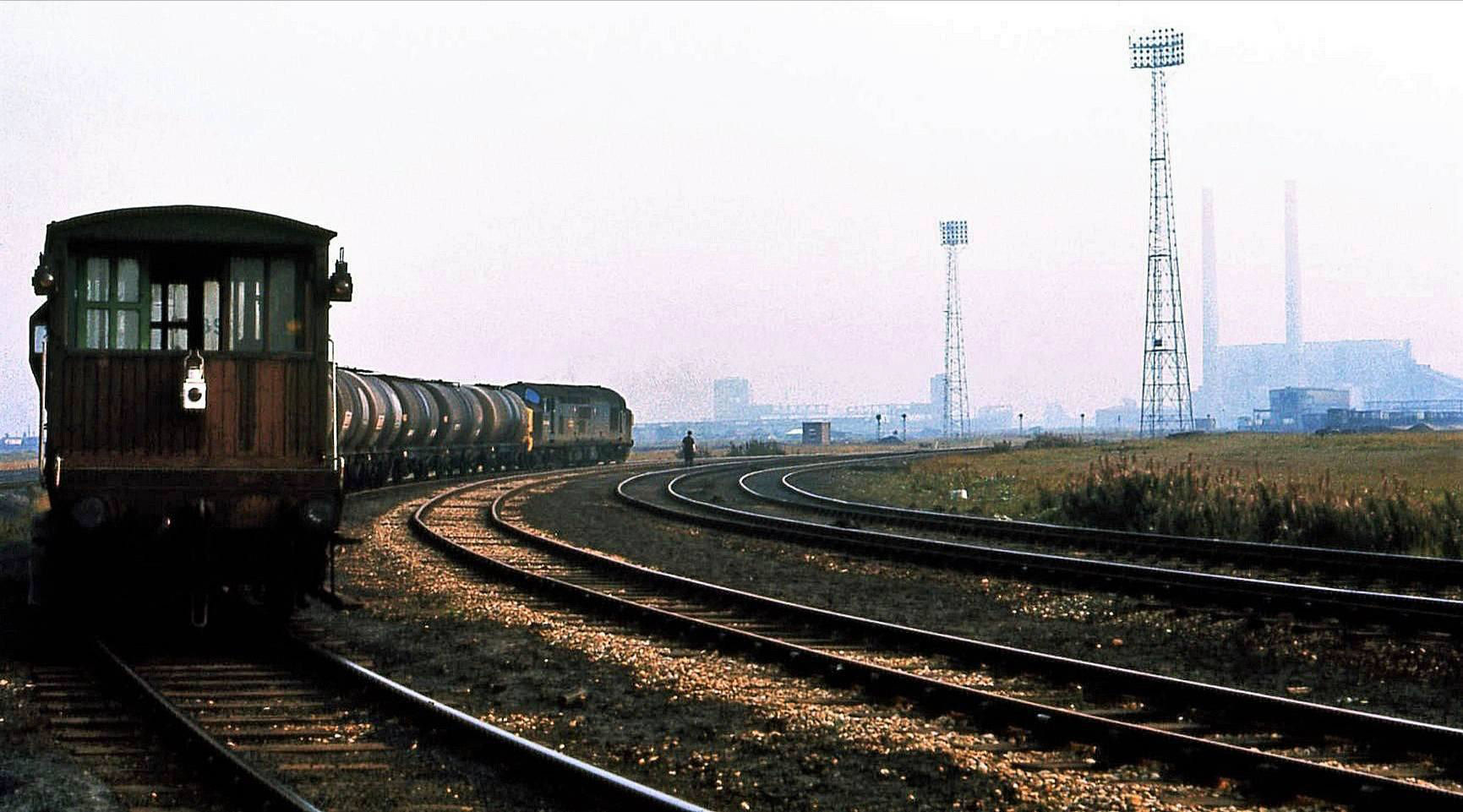
37046 at Blyth Power Station ('B' station a spooky silhouette right); an oil train from Esso Percy Main on 12 Sep 1974. This was the last leg of what was, for the writer, one of his best brake van trips ever. A local Cambois Depot trip working with no fixed route (like most), it had visited Burradon Colliery, Bates Colliery exchange sidings, Whitehill Point (very sporadic traffic) and Percy Main Yard.
[© Ian Mortimer 1974]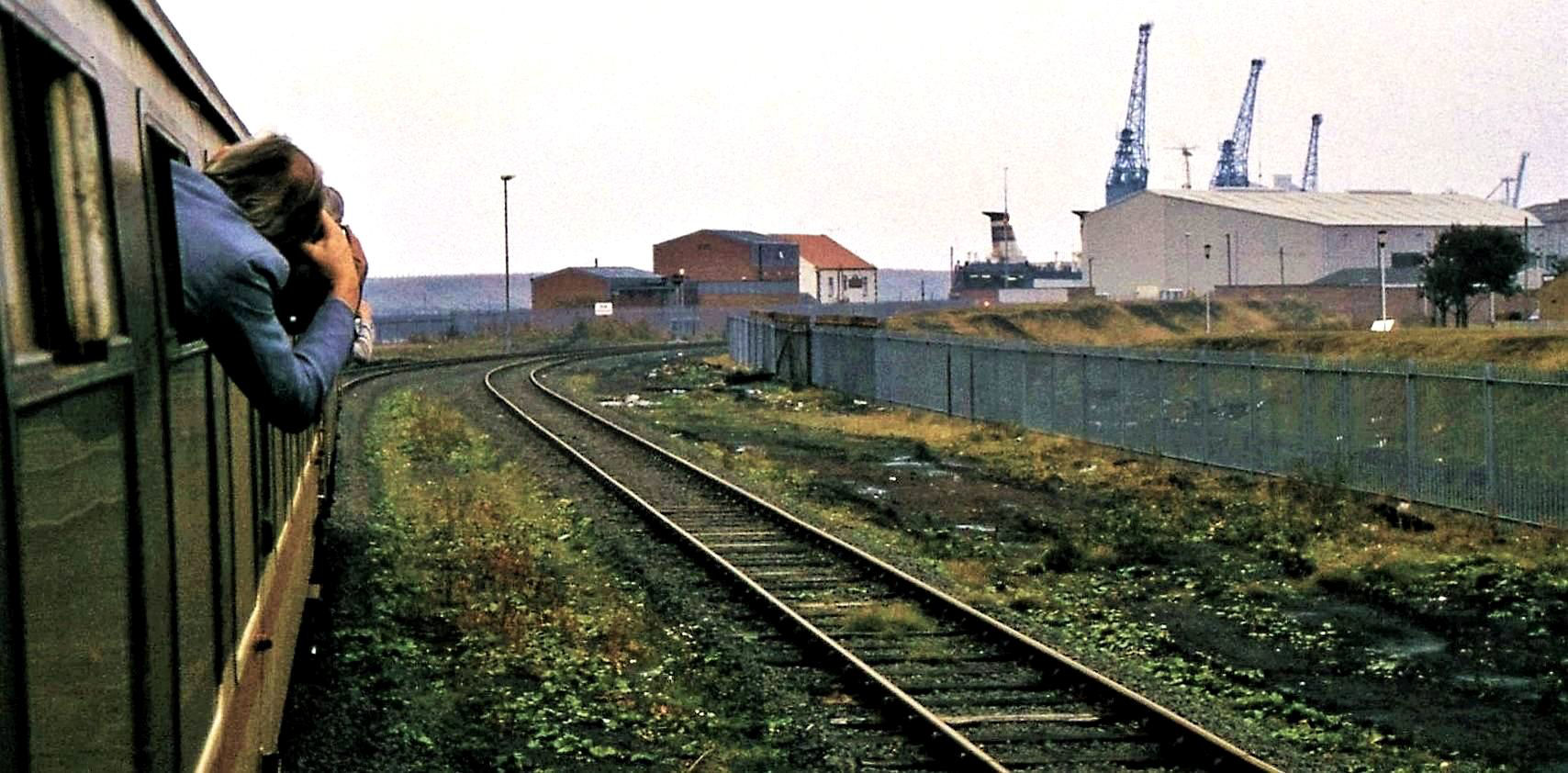
From the front of the tour, the limit of working on the Bates branch, with the buffer stops just out of sight around the curve. As can be seen in various pictures the train exterior was rather dirty.
[© Ian Mortimer 1991]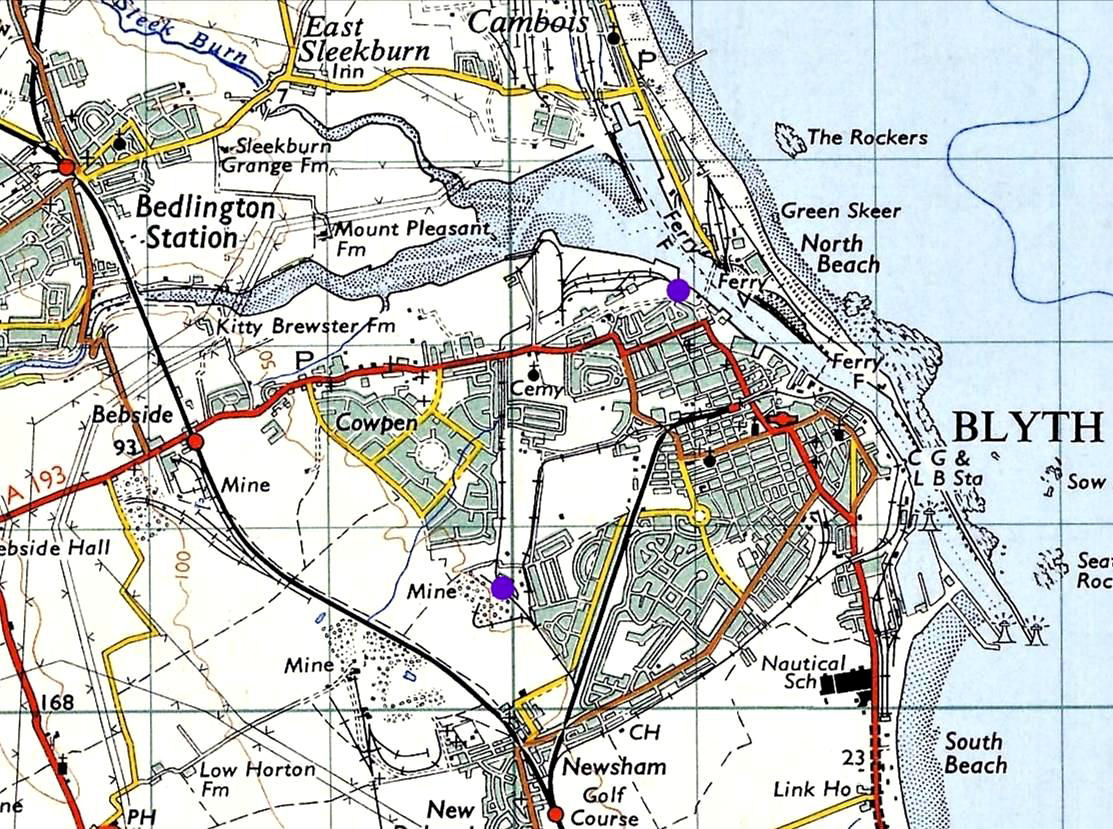
1958 map 1" inch scale; Newsham North Jn is bottom centre. Blyth terminal station with two platforms is shown as a 'principal' station (rectangular). The lower centre spot was Isabella Colliery on the Bates Colliery branch. The upper spot further right is the 1991 Coal Export Terminal end of line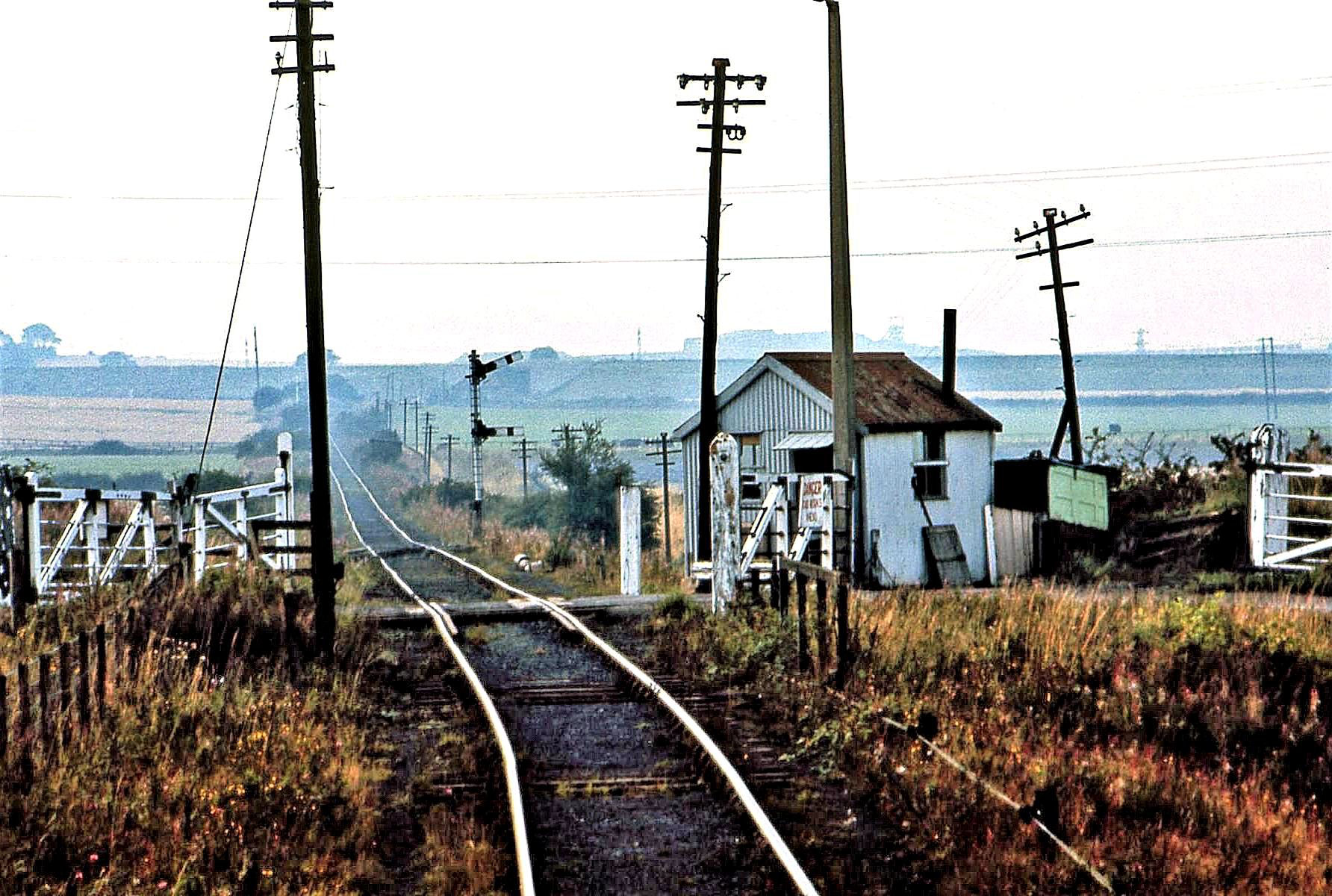
Fisher Lane Level Crossing on the Burradon Colliery branch from the rear of the same brake van returning to Holywell. Just beyond the road and immediately in front of the unusual signal, the track of the Backworth Colliery line can just be seen crossing on the level at a skew. (12 Sep 1974.)
[© Ian Mortimer 1974]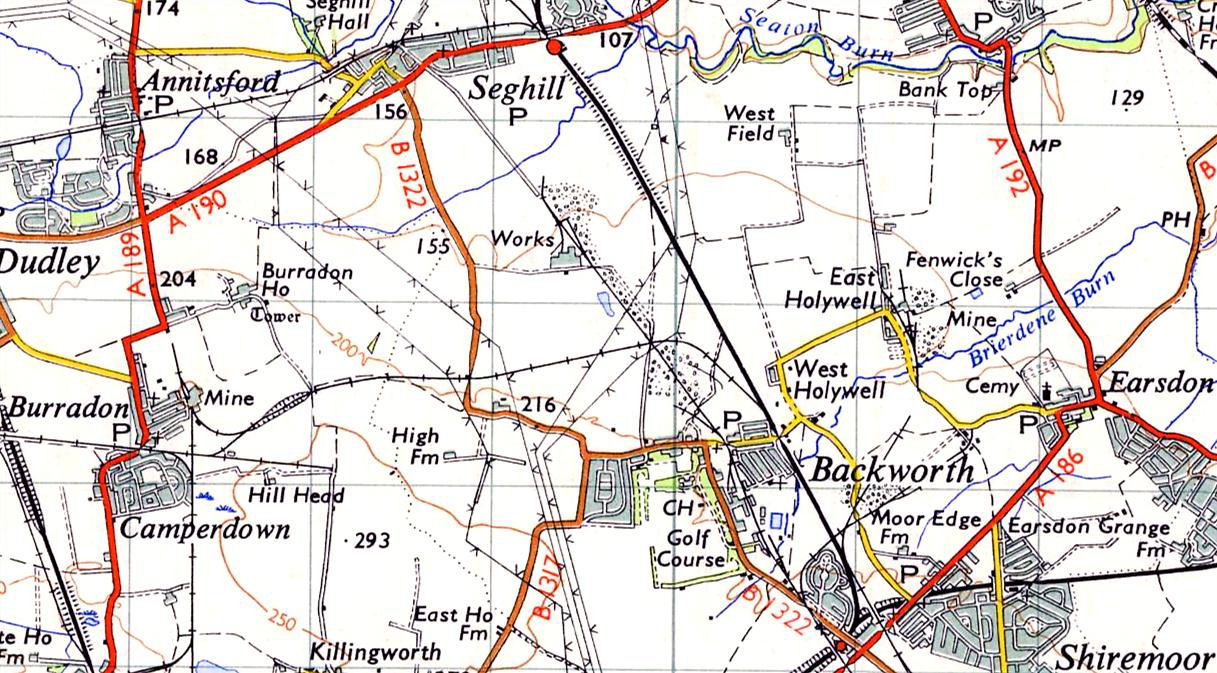
(1958 map) Burradon Colliery is middle left, the branch runs east to the centre, then crosses the Backworth Colliery system line on the level at Fisher Lane Level crossing (power cables overhead for good measure), turns sharply south and joins the (still open) Blyth & Tyne Line at West Holywell.