Institution of Mining Engineers - North West Tour
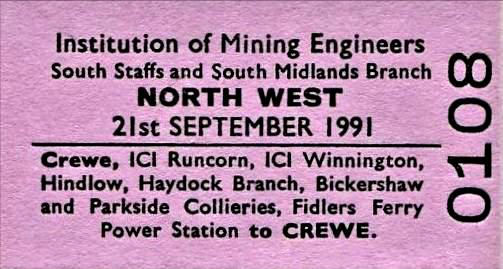
Saturday 21st September 1991
Report by Ian Mortimer with additional material by Paul Stewart.
See https://bit.ly/3idBFUp The North West was an area not visited by the 1989 tours, so the main objectives were the last two deep mines in the Lancashire coalfield, Bickershaw and Parkside. Late changes to the route meant that the tickets, map and itinerary were incorrect; the Folly Lane branch had to be omitted (it was visited later) and the route between Parkside Colliery and Fiddlers Ferry was via Edge Hill and Garston Church Road rather than Warrington BQ and Latchford.
Leaving Crewe 07.42 on a Saturday (the 1989 tours had all been on Sundays) 'top & tailed' with 37706 & 47479 and running north on the West Coast Main Line (WCML), the first reversal was at Earlestown West Jn. This was a late replacement for Folly Lane, to cover the then freight only Earlestown west curve (which was, however, regularly used by diverted trains). On returning back along the WCML, the tour passed the then recently lifted ICI exchange sidings at Gorstage (the end of the Wallerscote Light Railway) on the Up (left) side - see next map. It then took the curve left from Hartford (LNWR) Jn to Hartford CLC Jn and Greenbank turning left at Hartford West Jn, onto the ICI Winnington branch.
After passing Hartford North Jn (where the east curve trails in right to make a triangular junction), the train ran through Oakleigh Sidings before taking the line past the limestone unloading plant. It stopped just before the ICI transport offices but past the British Rail (BR) boundary. At the time of the tour the branch was very busy, the main traffic was frequent trainloads of limestone from ICI Tunstead Quarry, seven days a week. The 1½ mile ICI owned and run Wallerscote Light Railway OG Feb 1953, between Winnington and Gorstage (above). The tour brought back memories of our Society's four trips over that railway, the first on 4 Oct 1978 and the last on 23 Nov 1990 - 54 members participated. BLN 654 reports that it was lifted by Mar 1991 but we do not have a closure date (if anyone knows?).
The last limestone train ran to Winnington on Sun 2 Feb 2014 when the Soda Ash plant closed with production concentrated at the nearby Lostock Works, Northwich. The branch and triangular junction remained in situ but disused. The next known train was the UK Railtours 1 Jun 2019 'Curvey Weaver', when the branch was fenced off at Winnington Lane (A533) overbridge, just short of Oakleigh Sidings.
Returning to Hartford North Jn, the aforementioned curve to Hartford East Jn was taken, before the tour ran via Altrincham then from Deansgate Jn on the line to Stockport (only reopened to passengers on 15 May 1989) and into Manchester Piccadilly, where it reversed. Running back through Stockport, the train then took the line through Hazel Grove to Buxton No1 Jn, where it turned left, went through the 514yd Hindlow Tunnel before reaching what was, and still is, the highest point on the English main line operational system (1,267ft above sea level, 4m 30ch from the junction), then on to Briggs Sidings Ground Frame (4m 43ch) at Hindlow. Here it reversed, although the ex-L&NWR line to Ashbourne and Uttoxeter continued south almost another mile to 5m 39ch, just beyond the site of Dowlow Halt.
Returning to Stockport, with a double reversal via Buxton Access Road ('XYZ' Sidings') then again in P2 at the former L&NWR terminus station, to access the Down Line, the tour carried on through Reddish South and Ashton Moss North Jn round to Manchester Victoria, where there was a four minute pause. From here it was on to Wigan North Western via Parkside Jn for a further reversal.
Returning down the West Coast Main Line the railtour reached Haydock Branch Jn, before taking the 1968 connection to (Golborne North) Edge Green Jn, where the former Great Central branch from Lowton St Marys to St Helens Central was joined. The line beyond here had served Haydock Oil Terminal (which used to run on a Saturday morning - a future Story that can now be told...) until its closure in Feb 1987 but a short stretch was still retained to provide a headshunt for the Kelbit bitumen works branch which was taken right through to the line end in the works. This was despite it not being shown on the map or in the itinerary (nowadays referred to as an 'on the day Adlam extra') as part of our route with a very sharp curve - particularly for main line stock. [The rear of the train was at 90o to the front and the vestibule connections were rather askew ..!] After periods of disuse, the branch, over ¾ mile long, now has regular aggregate trains but has not been railtoured since this 1991 tour.
Retracing our steps to the WCML, the train ran via the Bamfurlong goods lines diveunder to Springs Branch Jn, where a further reversal preceded a visit to the first colliery of the day, Bickershaw. By the time of our visit in 1991 the internal railway system had gone and all that was left was a single line branch of over three miles through a rapid loading bunker, which was taken to the end. Interestingly locos on merry-go-round (MGR) trains had to propel along the branch as there was no runround loop and they were not allowed through the loading bunker (so the tour did better than the loco on coal trains would have). As recently as 1983 a National Coal Board Austerity 0-6-0 steam loco was still used here to trip portions (!) of MGR coal trains between the colliery and exchange sidings. Regular steam traction use resulted in many photographers there. Bickershaw was linked underground to Golborne and Parsonage collieries, with all coal being wound and processed at Bickershaw, known as a 'super pit' and able to produce over 1M tonnes a year, but this didn't prevent it closing on 13 Mar 1992.
After another reversal at Springs Branch Jn, Bamfurlong diveunder followed again; we left the WCML at Lowton Jn via the curve to Newton-le-Willows. A reversal accessed the short branch to Parkside Colliery, reaching the end of line. The last deep pit in the Lancashire coalfield to close, Parkside was one of the newest and most modern, with very large reserves, sunk in 1957; production began in 1964. It was 'mothballed' after 23 Oct 1992, the last day of production, and formal closure came in Apr 1993.
As mentioned earlier, a late change of route meant that we ran through St Helens Junction, passing under the St Helens to Ditton line which had served Sutton Manor Colliery. This colliery, on a short branch from a triangular junction at Clock Face (from which this line took its informal name) closed on 24 May 1991, so we had just missed it by four months. By the time of the pit's closure, the Clock Face (through) line had closed south of here so only the colliery north curve was then used. This pit has some significance for the writer who, as a trainee accountant in the early 1970s, visited it to carry out a check on the stock of coal. As can be imagined, it was straightforward to verify that a pile of coal existed, but confirming that it weighed 5,000 tonnes was impossible, but a box had to be ticked!
Continuing on towards Liverpool, we passed Huyton Jn, from where a branch to Cronton Colliery had closed in 1984, and arrived at Edge Hill. After a reversal here we proceeded to Allerton East Jn where the tour took the curve to Garston Jn before reversing again short of Garston Church Road. From here it was on to Ditton Jn and Fiddlers Ferry Power Station (which closed on 31 Mar 2020 after generating big financial losses), for reversal at its junction to run round the loop. Leaving here the train ran on to Warrington Latchford Sidings for a final reversal - the 20th of the day (!) - to regain the WCML for the run back to Crewe. Arrival was at 19.48 after just over 12 hours and 251½ miles of railtouring. David Mellor's original tour maps show the large number of collieries there once were in the area.
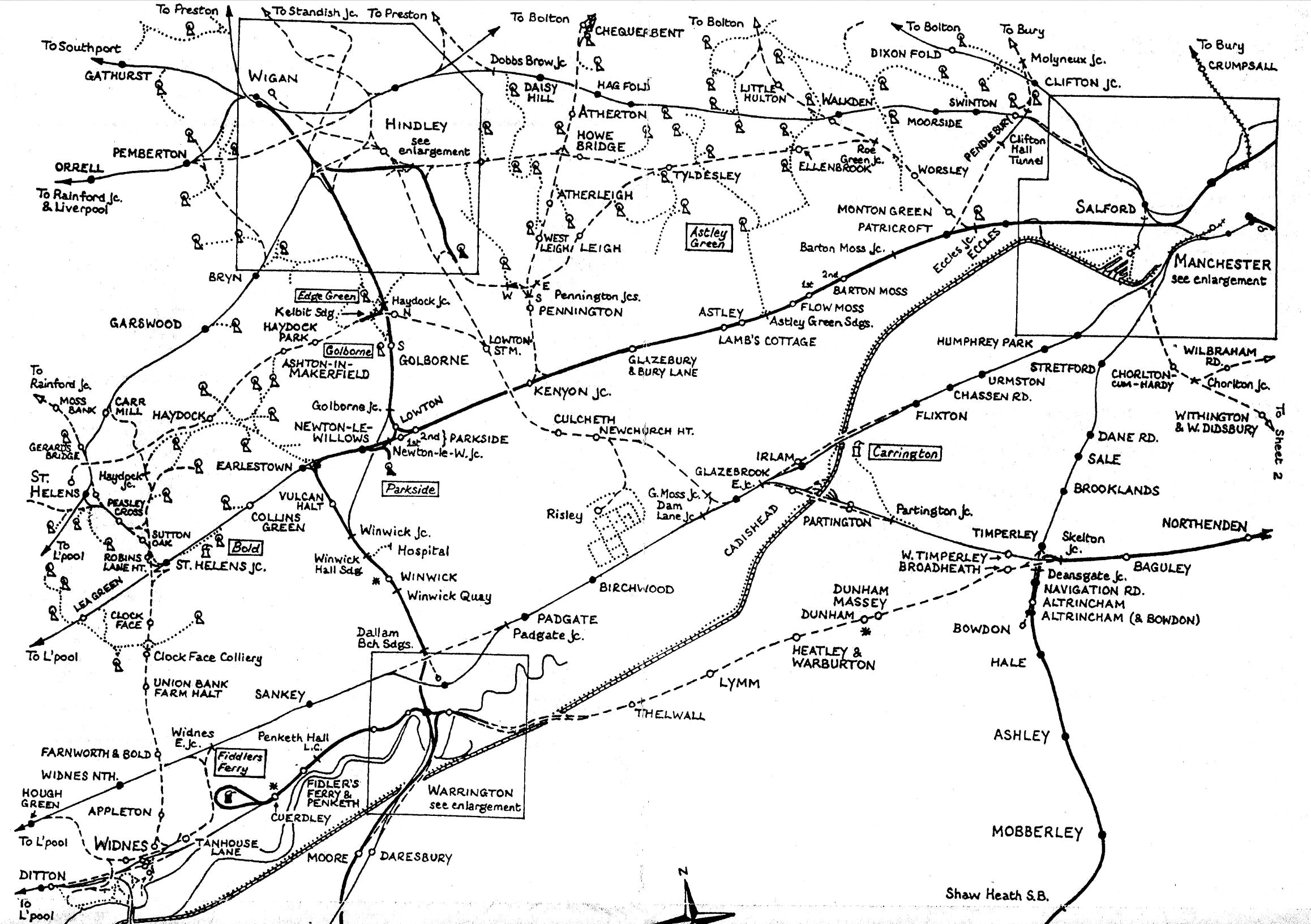
Railtour map drawn by our member Dave Mellor.
[© Dave Mellor 1991]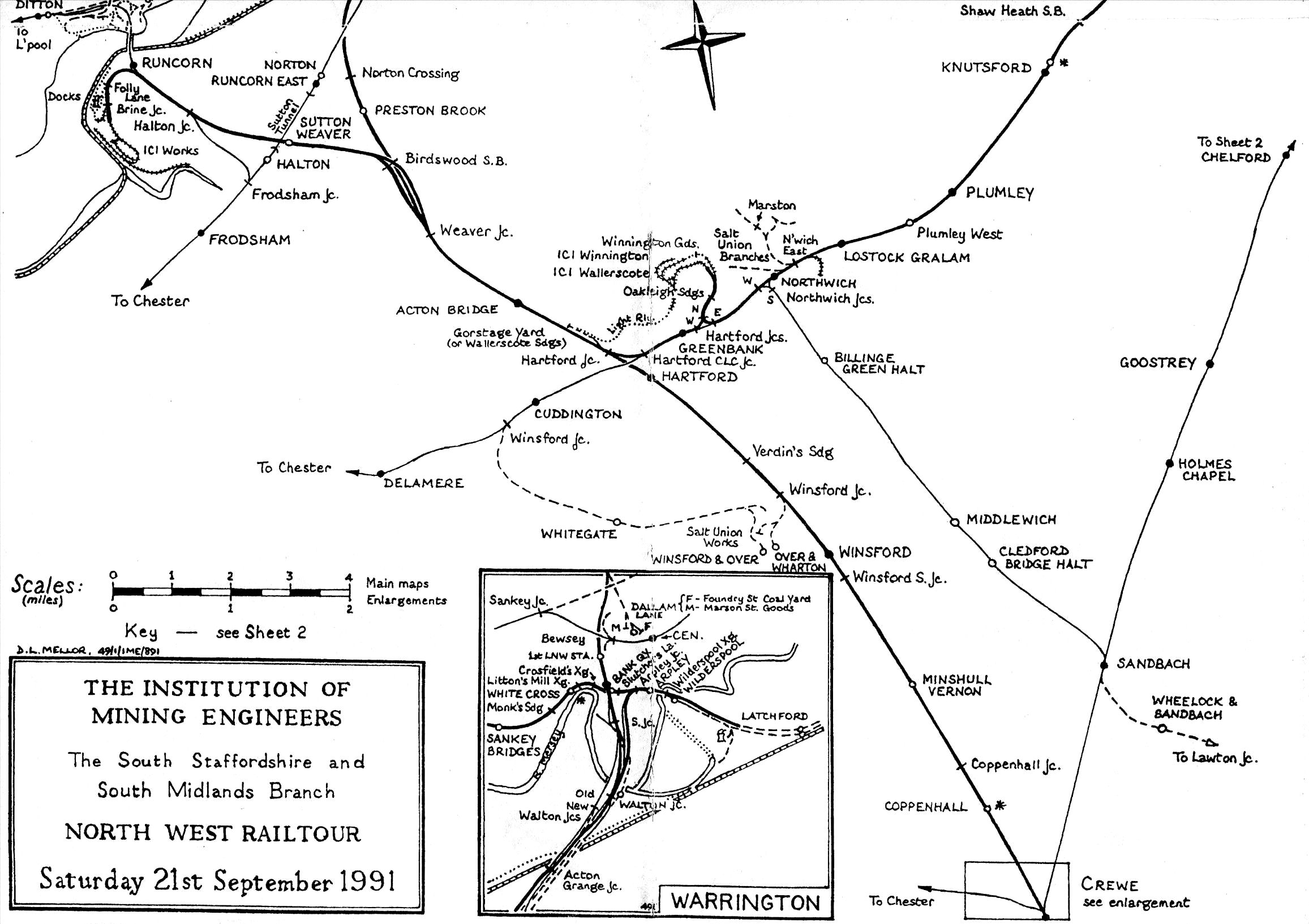
Railtour map drawn by our member Dave Mellor.
[© Dave Mellor 1991]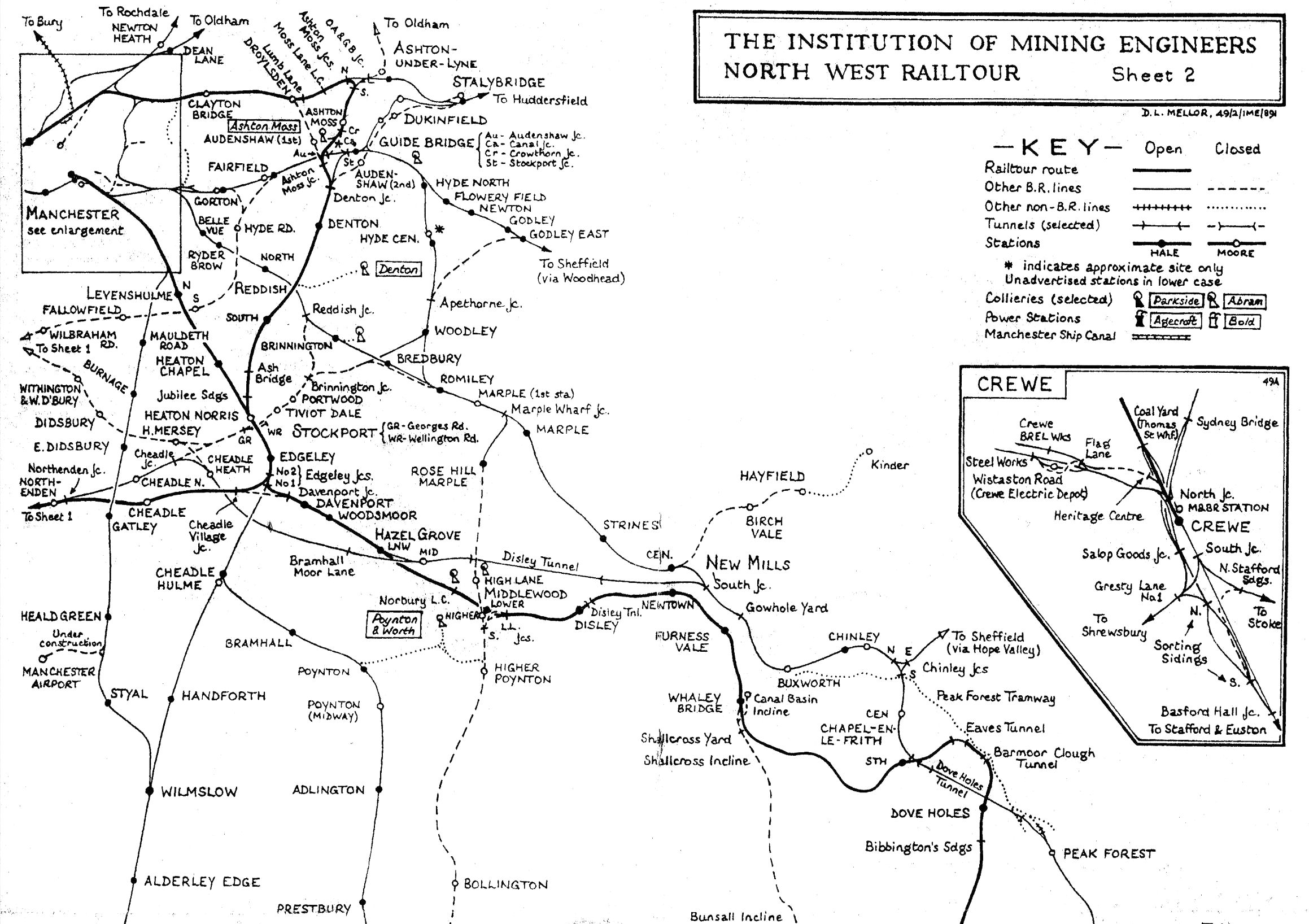
Railtour map drawn by our member Dave Mellor.
[© Dave Mellor 1991]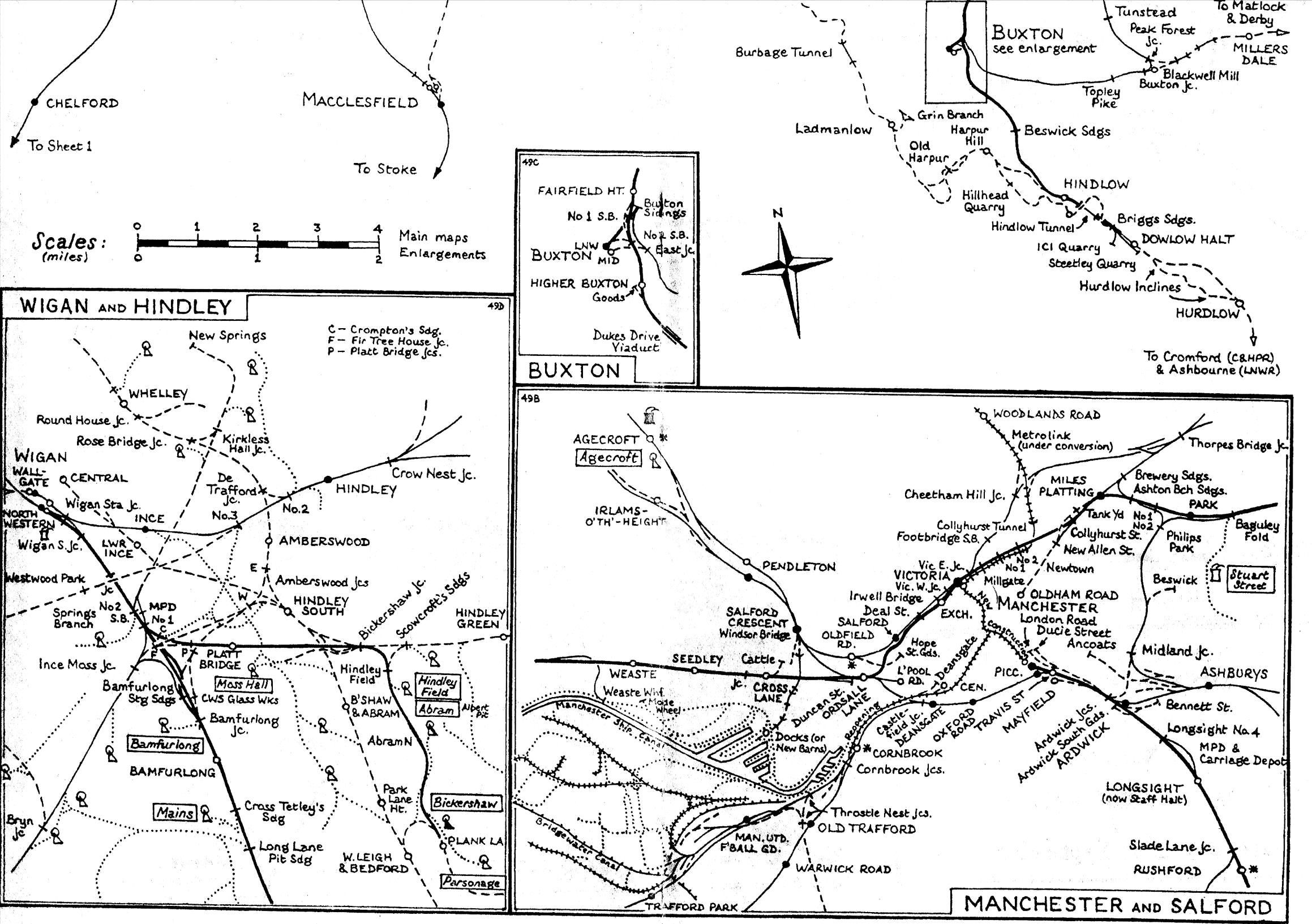
Railtour map drawn by our member Dave Mellor.
[© Dave Mellor 1991]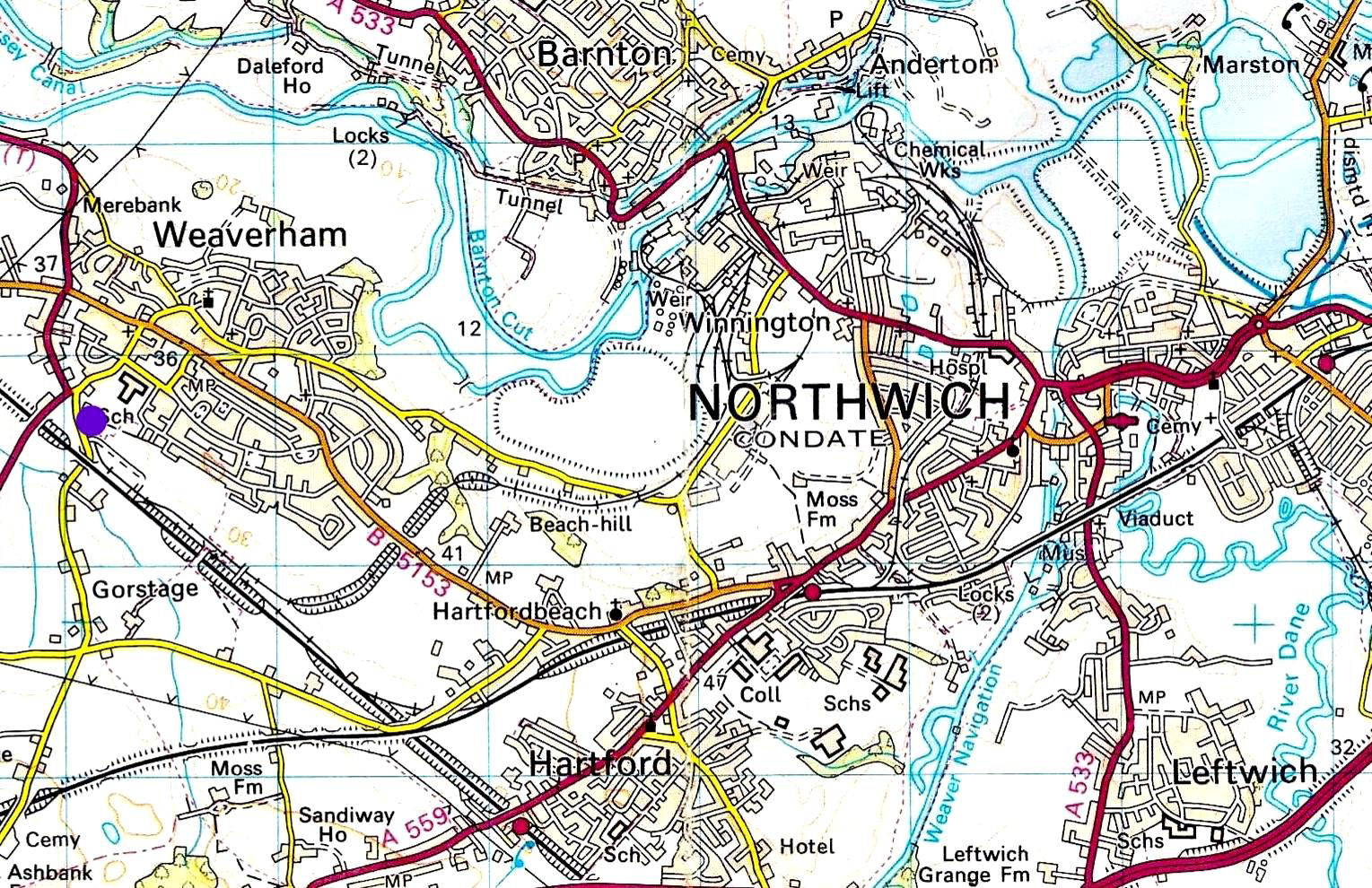
1986 map 1:50,000. The WCML to Liverpool/Preston is off middle left with Hartford station bottom centre and to Crewe. The Mid-Cheshire line to Chester is lower left corner and to Altrincham and Stockport upper right (Northwich station). Lostock Soda Ash works is beyond. The triangular junction, far right middle is for the Middlewich and Sandbach line. Greenbank is the third station (lower centre right); just east is Hartford West Jn, then East Jn with North Jn at the apex. The 'spot' is the far end of the Wallerscote Light Railway headshunt (the other end is Winnington).The Winnington branch is now fenced off past the A533 overbridge (the main road above the 'pl' in 'Hospl') above the 'ICH' in NORTHWICH. The unusual Anderton Canal Lift is top middle right (worth a visit).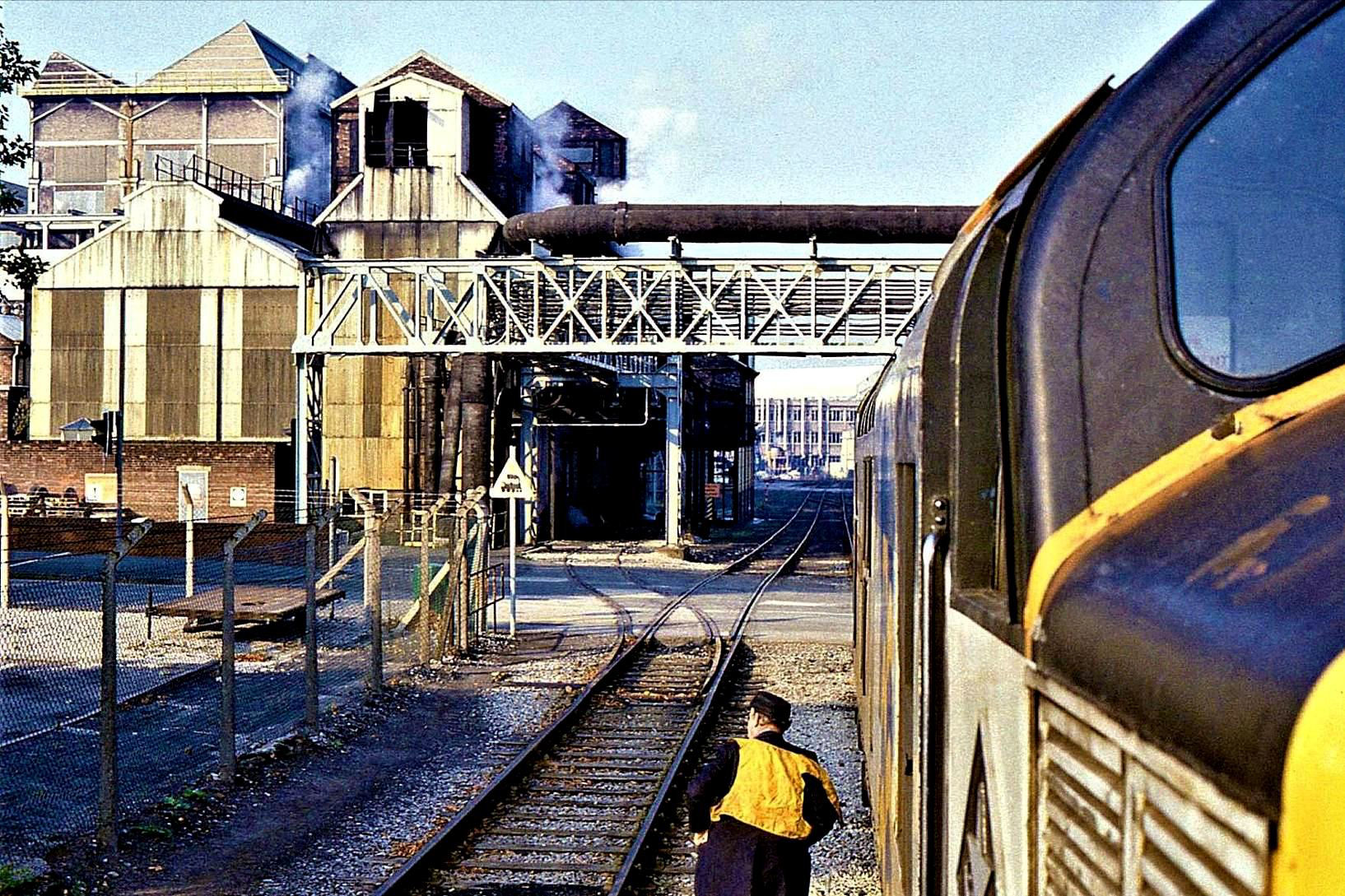
The front of the tour at ICI Winnington; ahead is the Wallerscote Light Railway to Gorstage Yard (Wallerscote Sidings) by the West Coast Main Line.
[© Ian Mortimer 1991]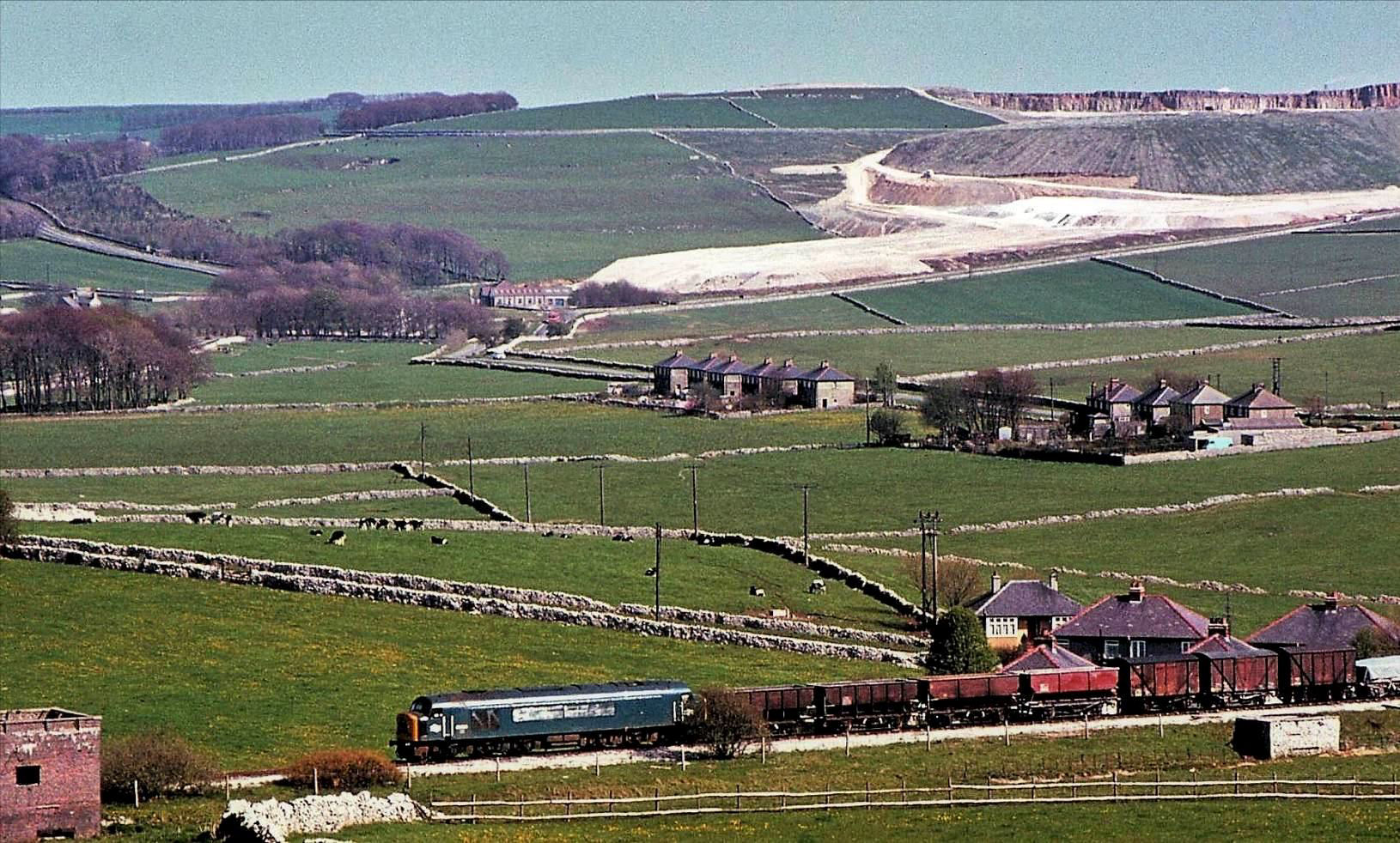
A May 1977 picture with a Class 45 on a mixed freight approaching Harpur Hill on its way to Buxton. The scenery is typical of this rather bleak (and at times cold) part of the Peak District.
[© Ian Mortimer 1977]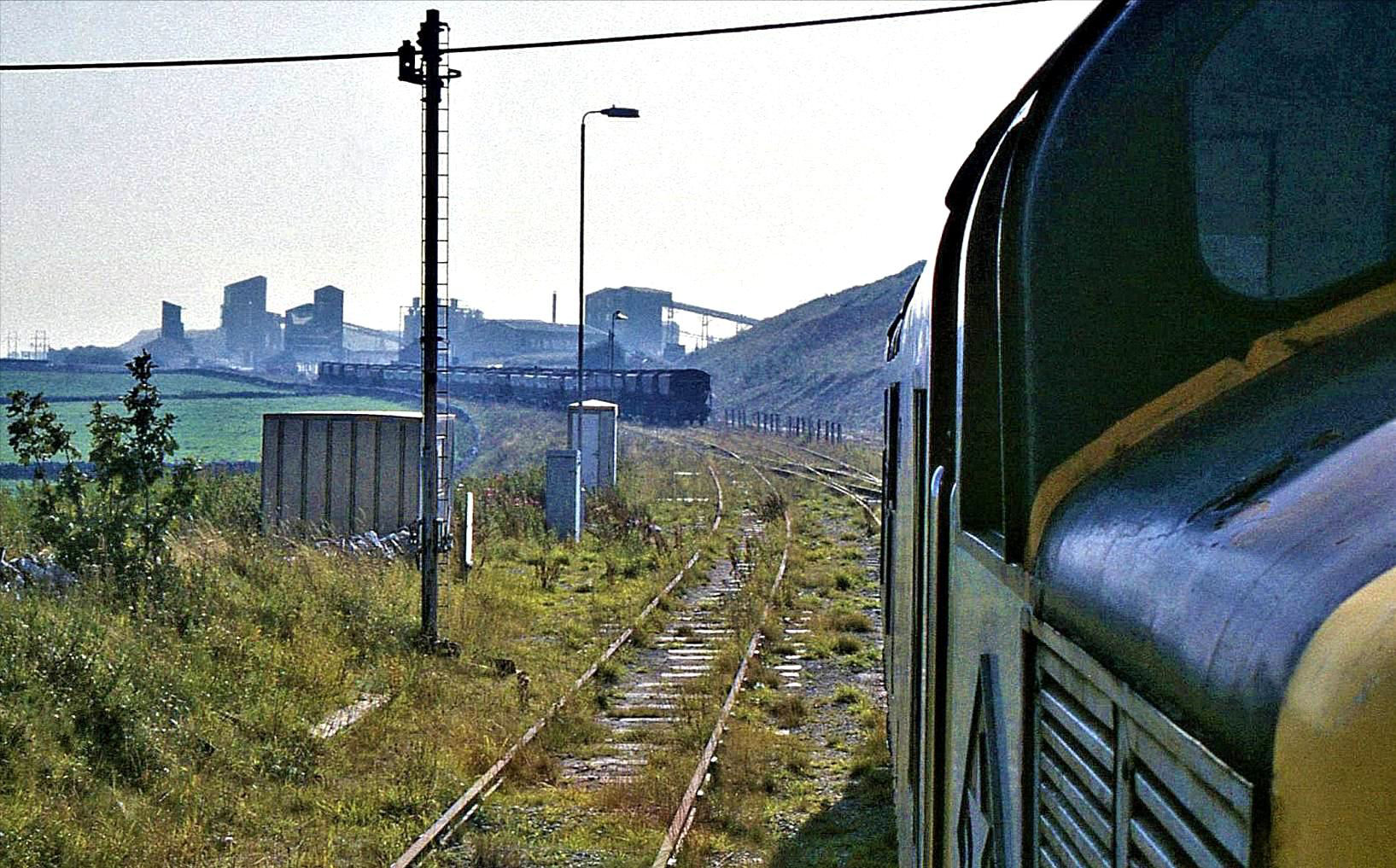
Briggs Sidings, the tour is reversing here short of the complex pointwork ahead.
The line continuing on to Dowlow was eventually covered by our 'Caldon Peak' tour on 14 Apr 1994.
[© Ian Mortimer 1991]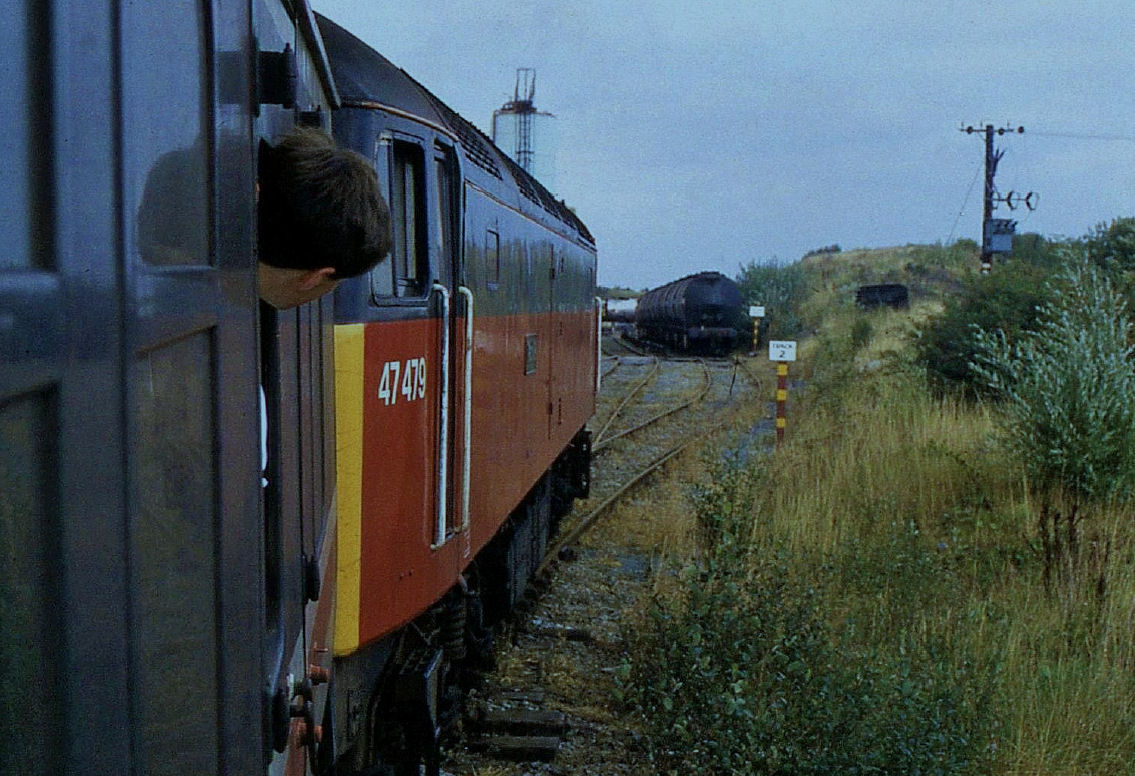
The other end of the tour train at Kelbit Bitumen Sidings as they were in 1991.
[© Ian Mortimer 1991]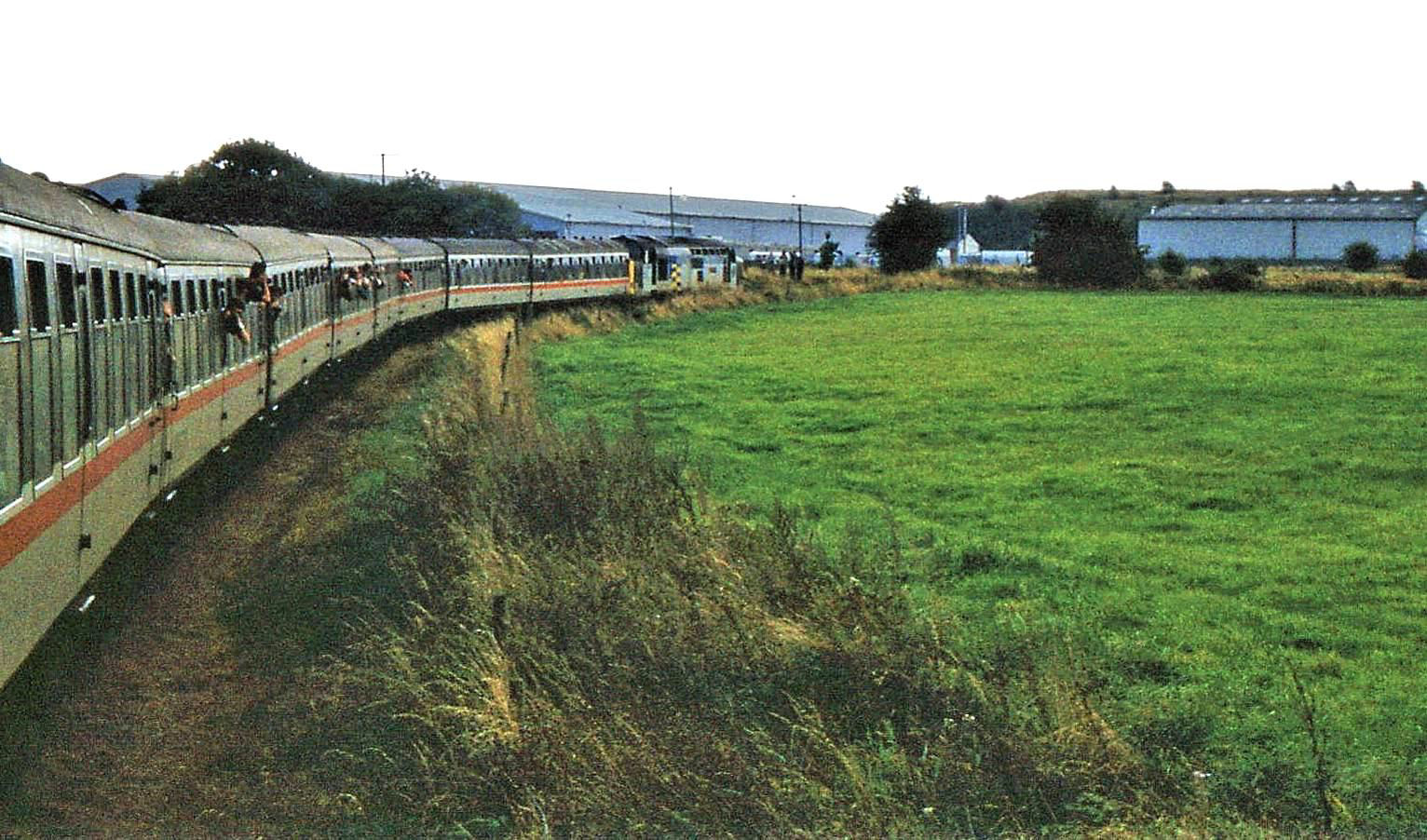
On the sharply curving Kelbit branch.
[© Ian Mortimer 1991]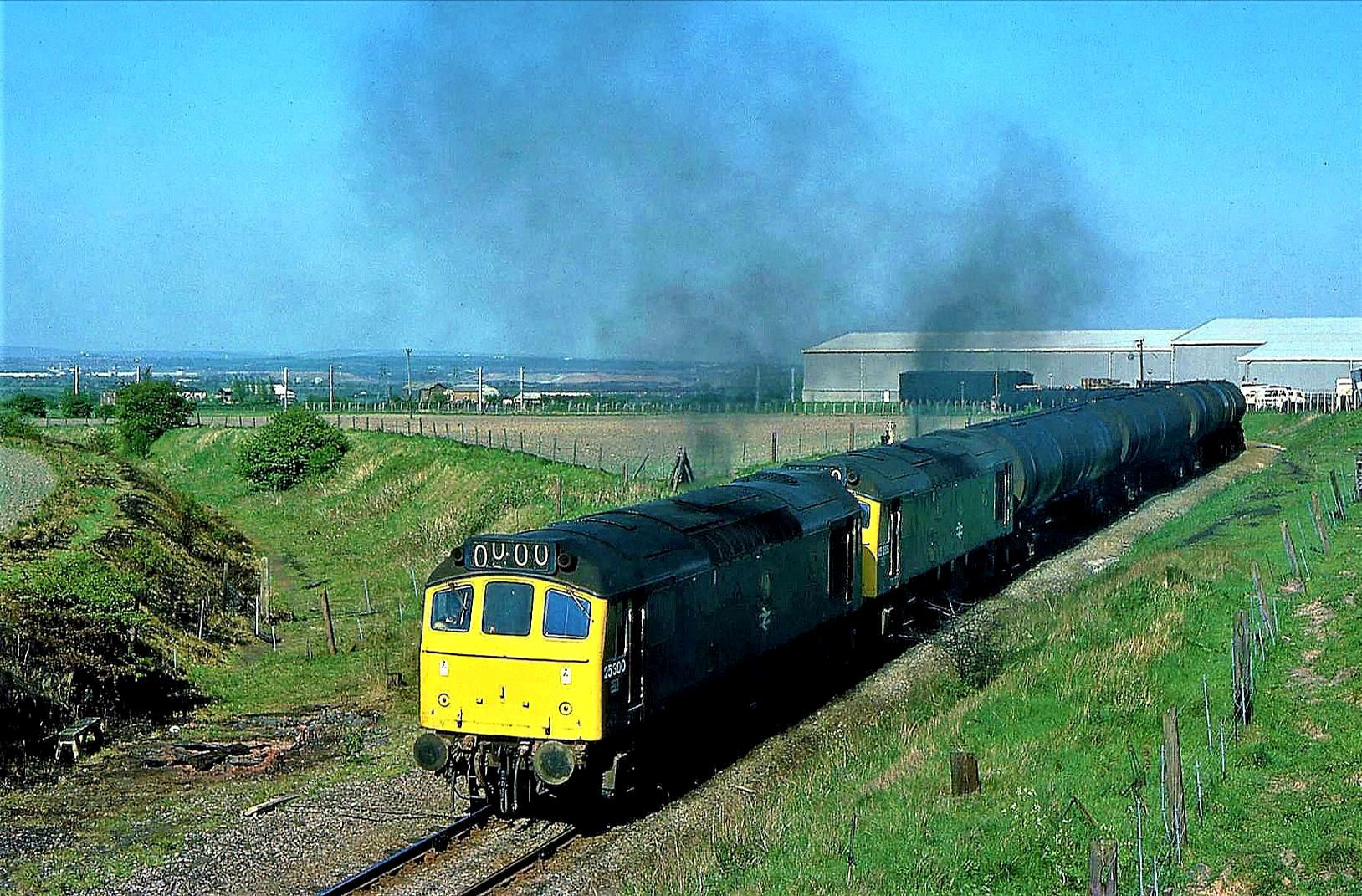
In May 1977 a pair of Class 25s (common on this working) with a train of oil tanks on the 1968 connection from the West Coast Main Line, passing Edge Green Jn, going to Haydock Oil Terminal. The former Great Central Railway line to Glazebrook went off the right but no trace remains. The formation (left) curving to the left by the front loco is the Edge Green Colliery branch. It was relaid 10 years later in 1987 to serve Kelbit Bitumen works.
[© Ian Mortimer 1977]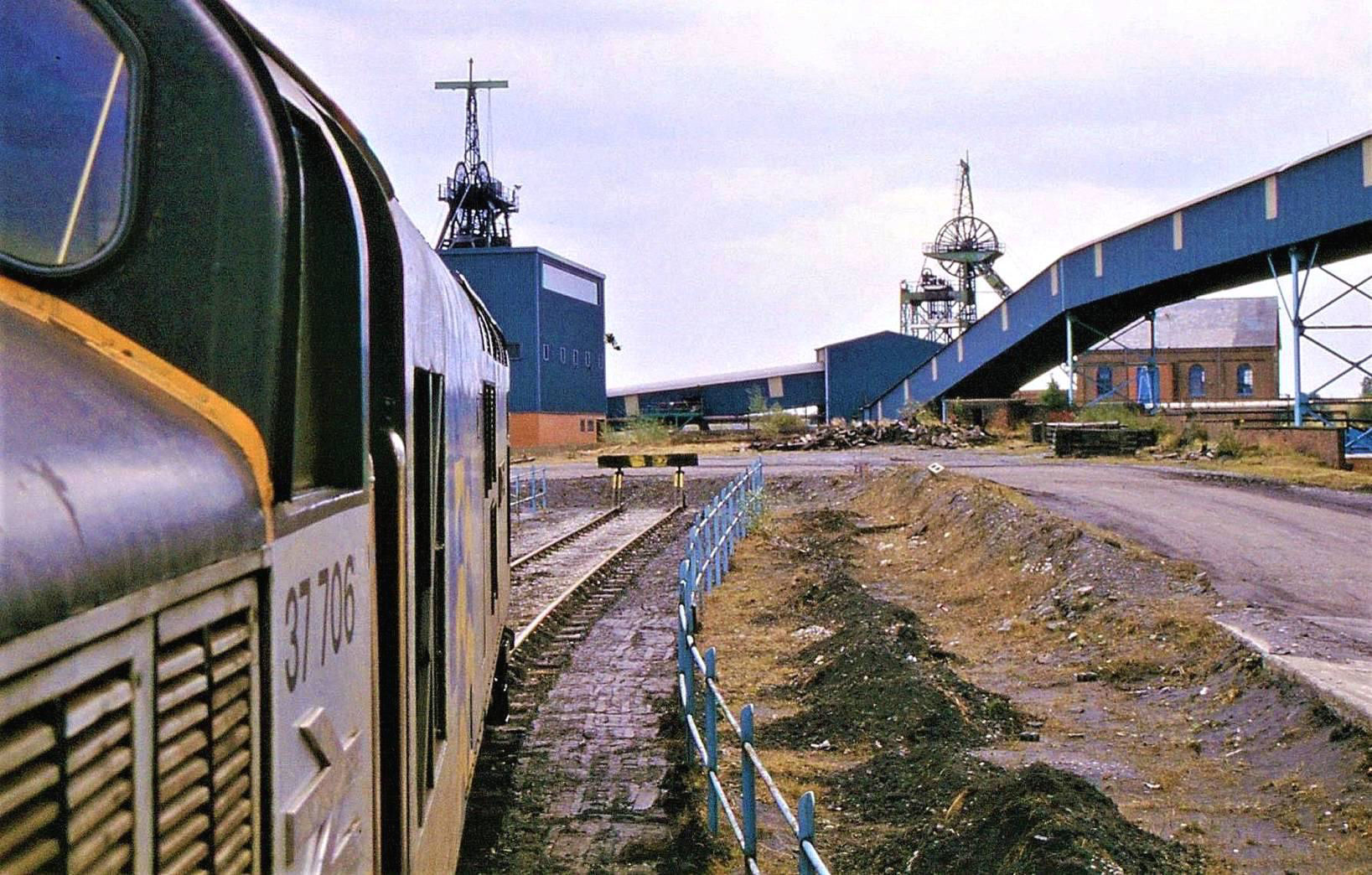
37706 at Bickershaw Colliery end of line with the tour - if you did the branch in the cab of a coal train you would have been a whole train length from here as they propelled in due to there being no run round facility.
[© Ian Mortimer 1991]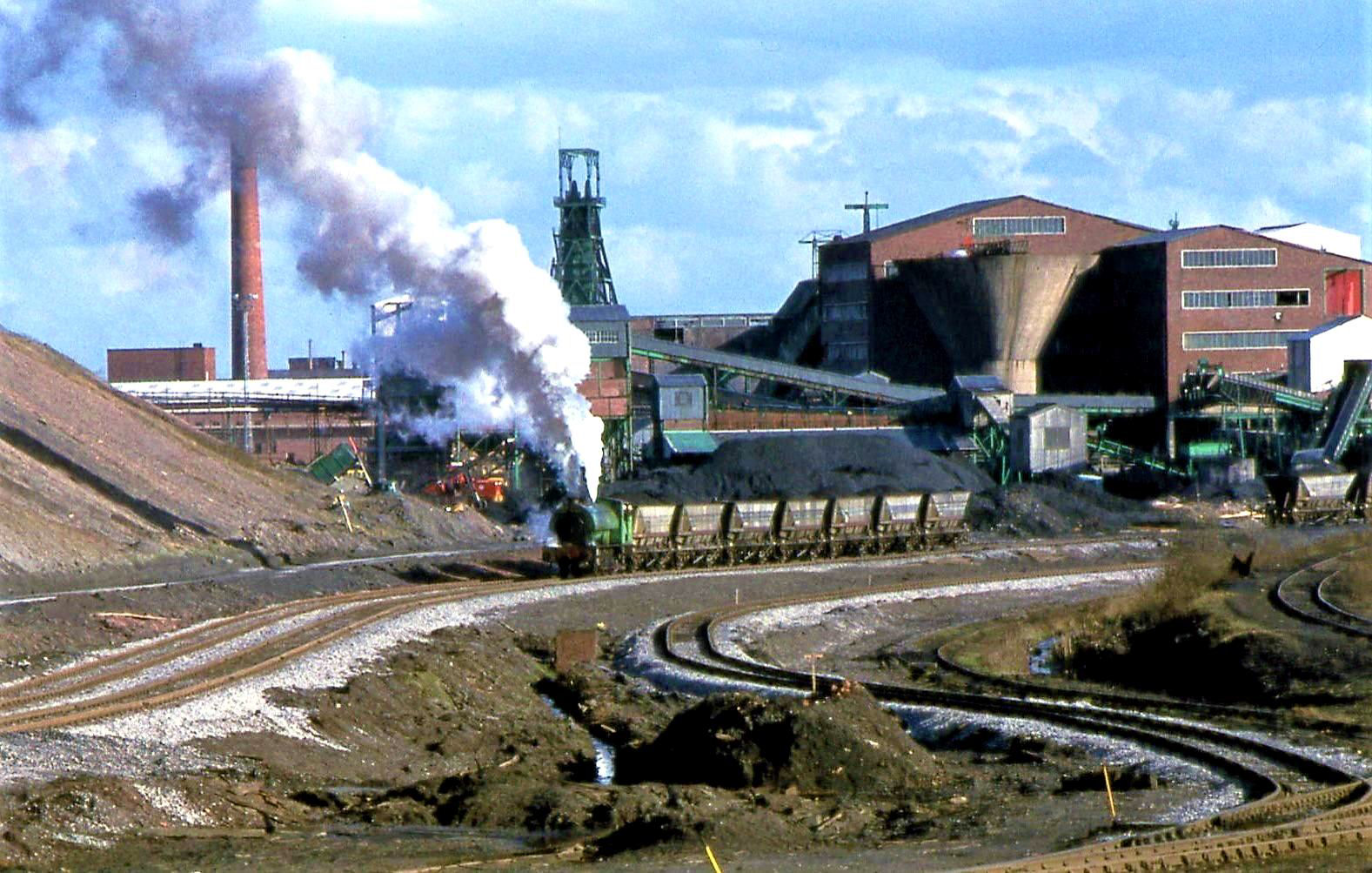
Mar 1978. NCB steam locos were in use until the early 1980s and MGR trains were split! Loaded wagons on the steeply graded line from the colliery to the exchange sidings.
[© Ian Mortimer 1978]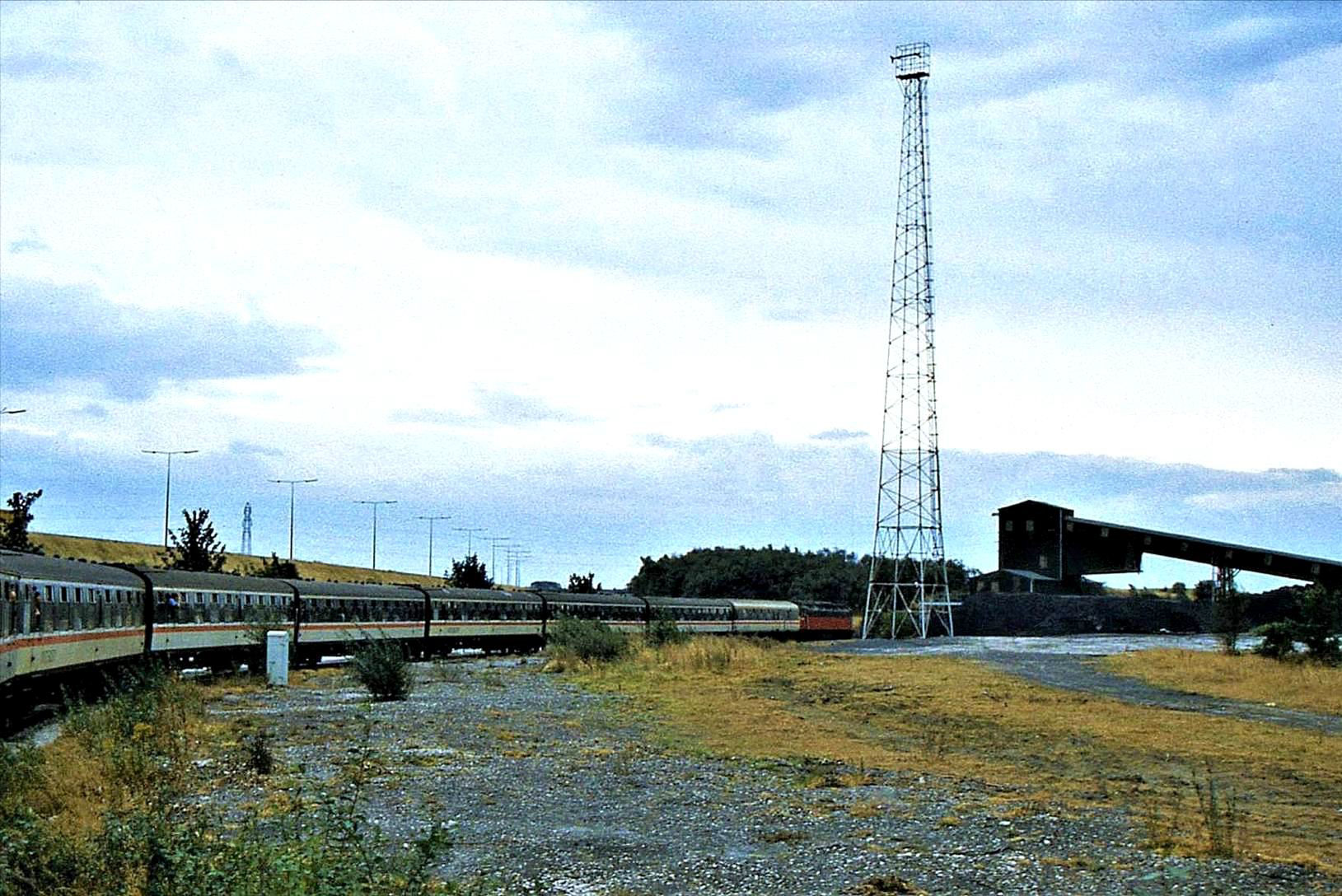
Looking back from the front of the train leaving Parkside Colliery for the main line.
[© Ian Mortimer 1991]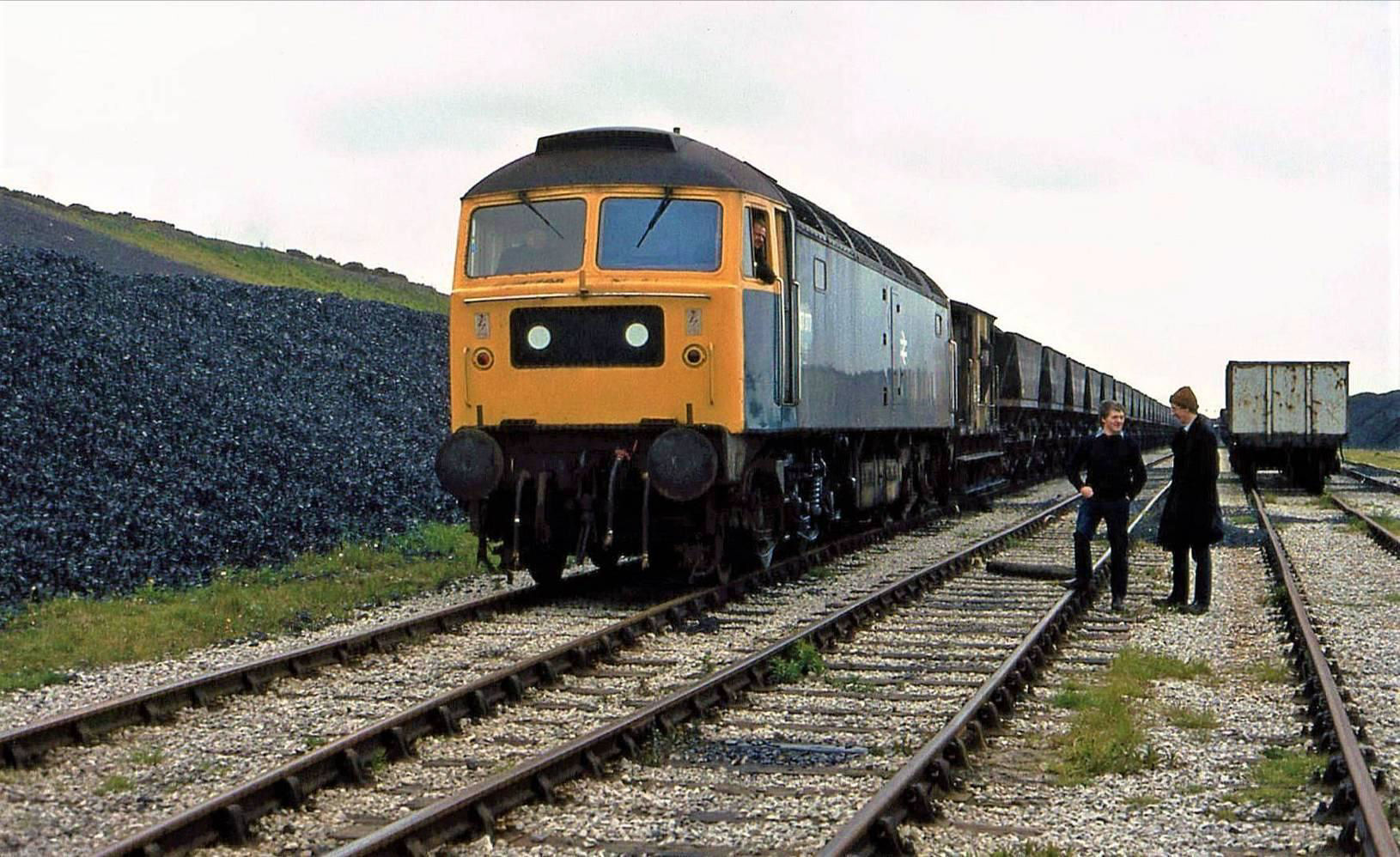
The tour passed close to a couple of Lancashire pits that had already closed. On 30 Apr 1981 a Class 47 hauled MGR train awaiting departure from Sutton Manor Colliery - including a brakevan!
On the right is our member David Clark (from Derby) - a Story that can now be told we suspect...?
[© Ian Mortimer 1981]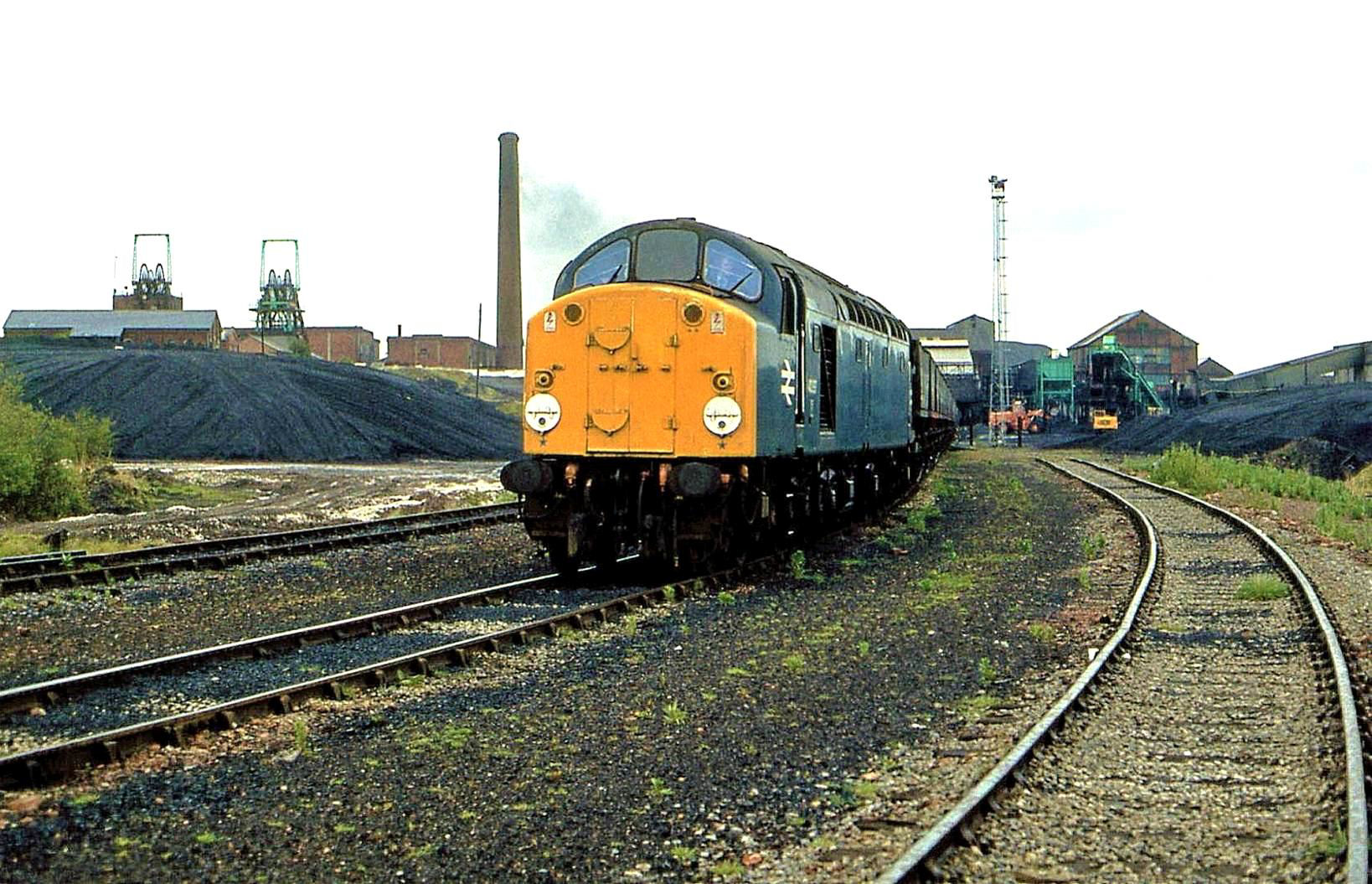
Also on 30 Apr 1981, a Class 40 awaiting departure from Cronton Colliery on an MGR train.
[© Ian Mortimer 1981]