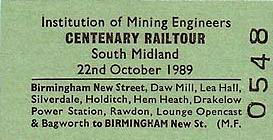
Institution of Mining Engineers - South Midland Tour
Sunday 22nd October 1989
Report by Ian Mortimer with extra material by Paul Stewart.
See https://bit.ly/30Sh7sW A travel weary but still keen group of enthusiasts assembled for the third Sunday in a row, this time at Birmingham New Street, for what was to have been the final IMinE tour of the year. The fully booked 8-car DMU was due to visit a number of installations spread around Derbyshire, Warwickshire, Leicestershire and Staffordshire. It set off east on time at 08.40, through Water Orton, and soon reached Daw Mill West Jn (2m 05ch from Whitacre West Jn) for Daw Mill Reception/Departure Lines.
Daw Mill Colliery was sunk in 1958/69; production began in 1965 and No2 shaft was sunk in 1968/70. It was the first mine in the country to produce 1M tonnes in 12 months (5 tonnes per man shift) and was the final one in the West Midlands, closing in 2013 after a major underground fire. The tour ran past the bank of eight Speedlink (through) Sidings to the left, over the weighbridge and past the MGR (merry-go-round) bunker - the line ended 75ch from Daw Mill West Jn. The train then set back to Reception/Departure Line 1 next to the main line, reversed and left via Daw Mill East Jn (2m 36ch).
Three reversals, at Nuneaton, Rugeley North Jn & Brereton Sidings (at Rugeley Town; ROP 2 Jun 1997) brought us over a since removed trailing crossover (13m 34ch), done later again on our return, to our next destination, Lea Hall Colliery. This was the first one opened by the National Coal Board, in 1954, and it closed in 1990. The itinerary had indicated that we would stop at the British Rail limit of working, short of the conveyor belt taking coal directly to the adjacent Rugeley 'A' Power Station - still operational then (the 'B' Power Station could not burn coal from Lea Hall as the quality was too good, (!) as well as its high chlorine content). On the day the tour actually ran through the reception sidings and finally stopped at a set of points just short of the last headshunt, a further 700 yards on!
Reversing twice to regain the West Coast Main Line, our DMU continued on north through Stafford to Madeley Jn. A further three reversals followed, the first here at Madeley Jn and then at Madeley Road - the headshunt to the west, once part of a North Staffordshire Railway through line between Market Drayton and Stoke-on-Trent. The tour then passed Silverdale Colliery (3m 45ch from Cockshute Jn at Stoke) to the left with an MGR bunker on the adjacent line; it was the final deep mine in the North Staffordshire Coalfield, surviving until Sep 1998. The third reversal took place at Apedale Jn (2m 01ch), where we took the Apedale Branch past the former Knutton Gate Jn and to Holditch Colliery 1½ miles from Apedale Jn. Past Knutton Gate Jn to Apedale had closed in 1967; the Apedale Light Railway runs on part of the branch. For many, Holditch was the highlight of the day, as the colliery (the biggest in the area once with 1,309 men) closed three months earlier in Jul 1989 and the last coal train had run.
The weather deteriorated during the day and by now it was raining heavily, but the DMUs soldiered on through the exchange sidings to the end of Holditch empty sidings (they were empty too!), just short of the final headshunt. As an added bonus, on the return journey we ventured right to the end of line at Madeley Road (8m 14ch), a lengthy headshunt almost to the former passenger station (CP 1931). Incidentally, according to Quick, this was not 'Liverpool Road Halt' as Six Bells Junction suggests it was.
Returning to Stafford, the next target was Hem Heath Colliery but we never made it, as the train failed short of Stone and, following a lengthy delay from 14.40 to 16.04 blocking the line, limped back to Stafford. Here, after a 37 min wait, a replacement set of DMUs arrived, but only to return participants to Birmingham New Street, arriving 17.47 (91 minutes earlier than the original booked time of 19.17).
This appeared to be a very disappointing end, as various installations on the Coalville line were also missed that were due to be visited after Hem Heath, but it turned out that there was more to come...
Addendum: This tour was the final train past Silverdale to Holditch Colliery, three months after the last coal train had left. A member comments that it was a good job that the DMU failed after that section rather than before because track lifting began using road equipment on Mon 23 Oct 1989 - the day after the tour. Anyone would think it was planned!
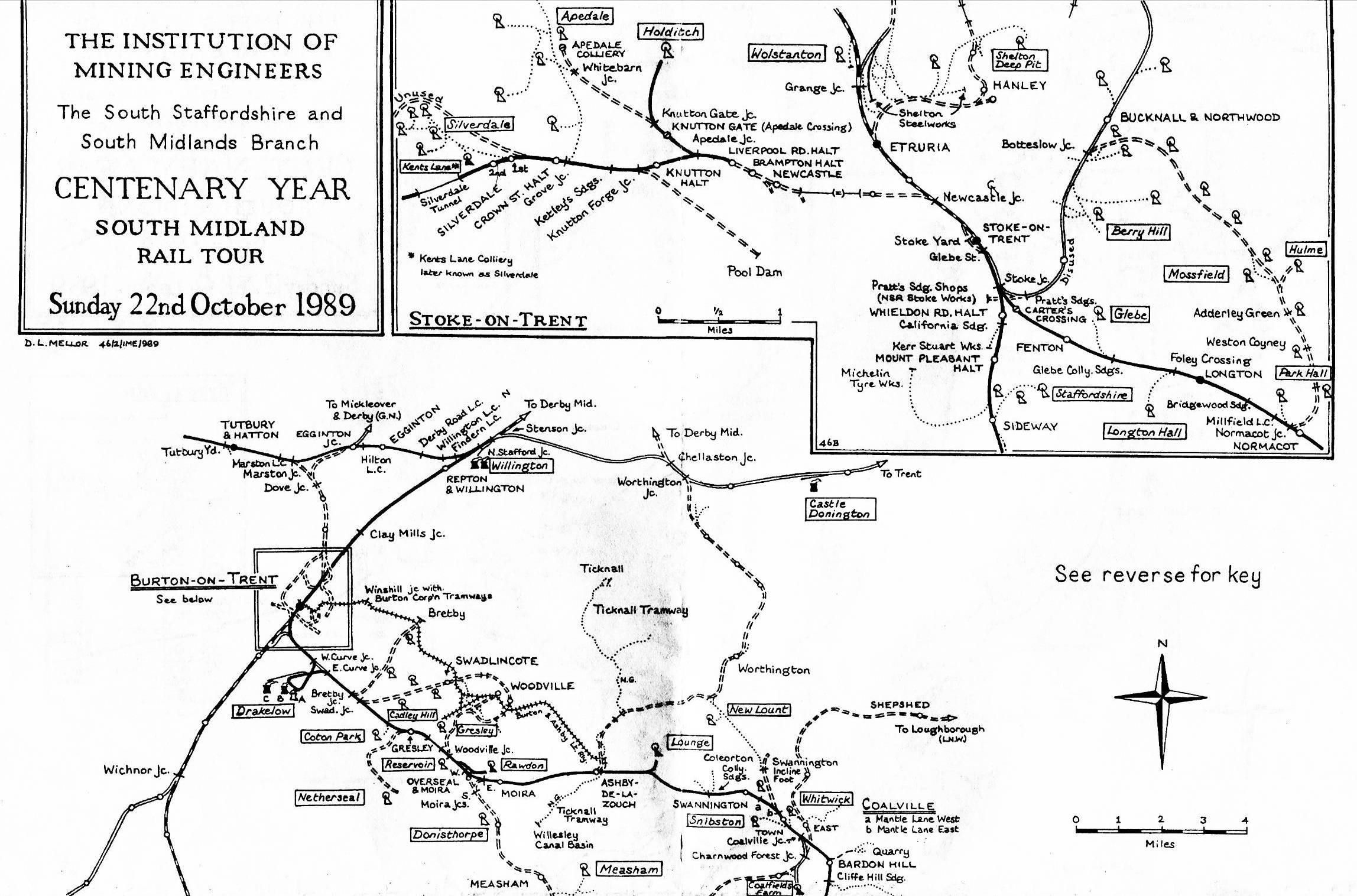
Railtour map drawn by our member Dave Mellor.
[© Dave Mellor 1989]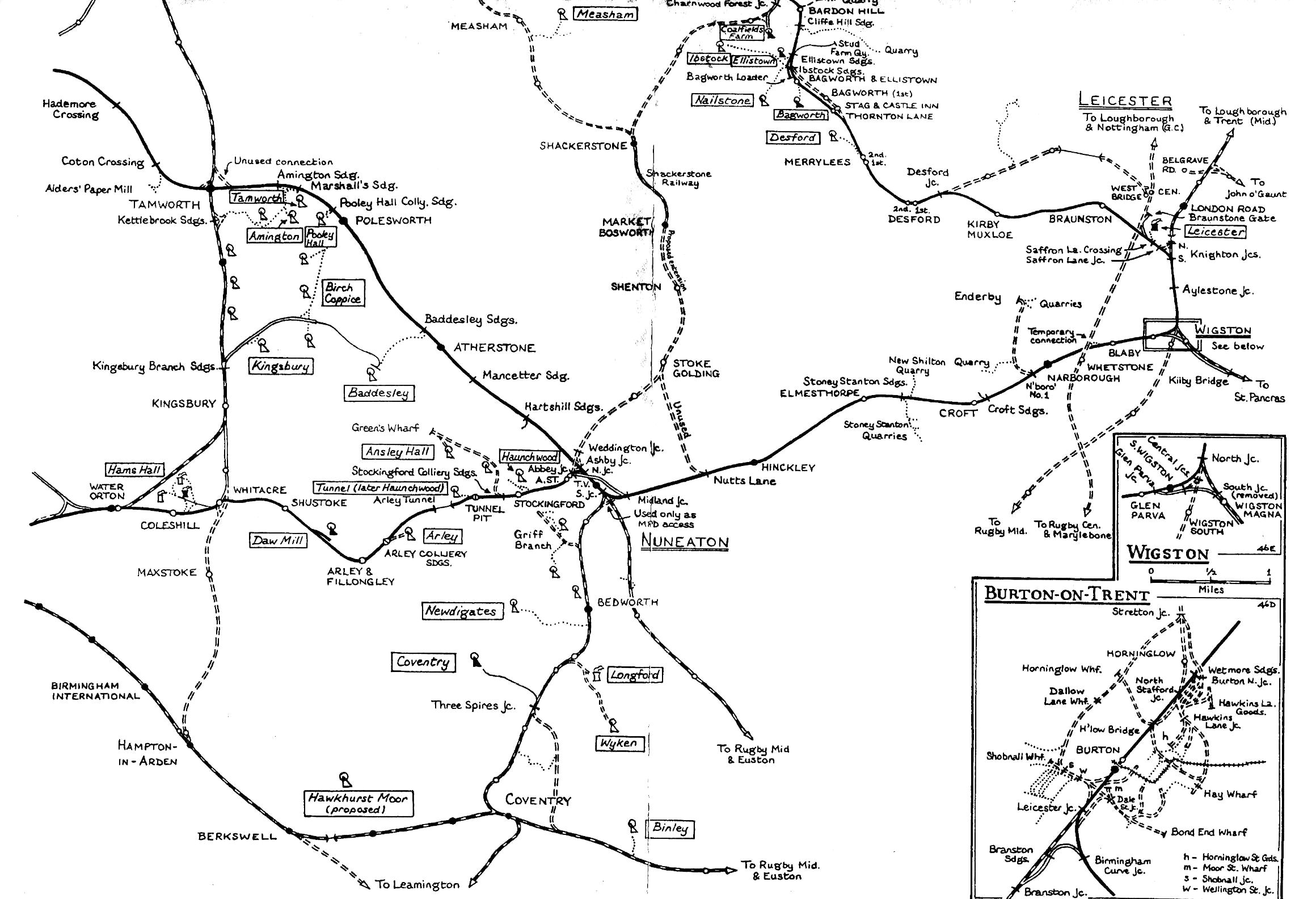
Railtour map drawn by our member Dave Mellor.
[© Dave Mellor 1989]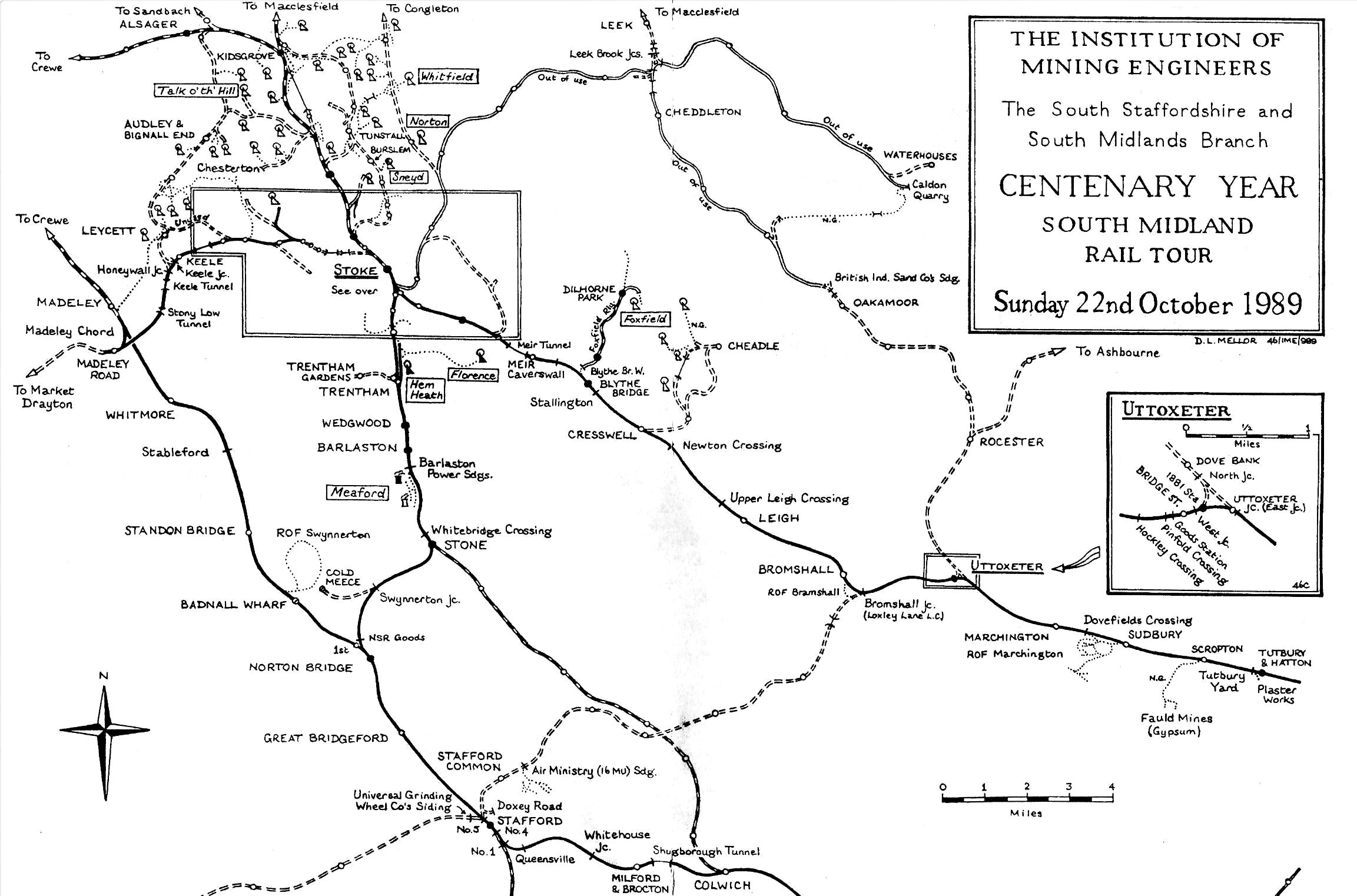
Railtour map drawn by our member Dave Mellor.
[© Dave Mellor 1989]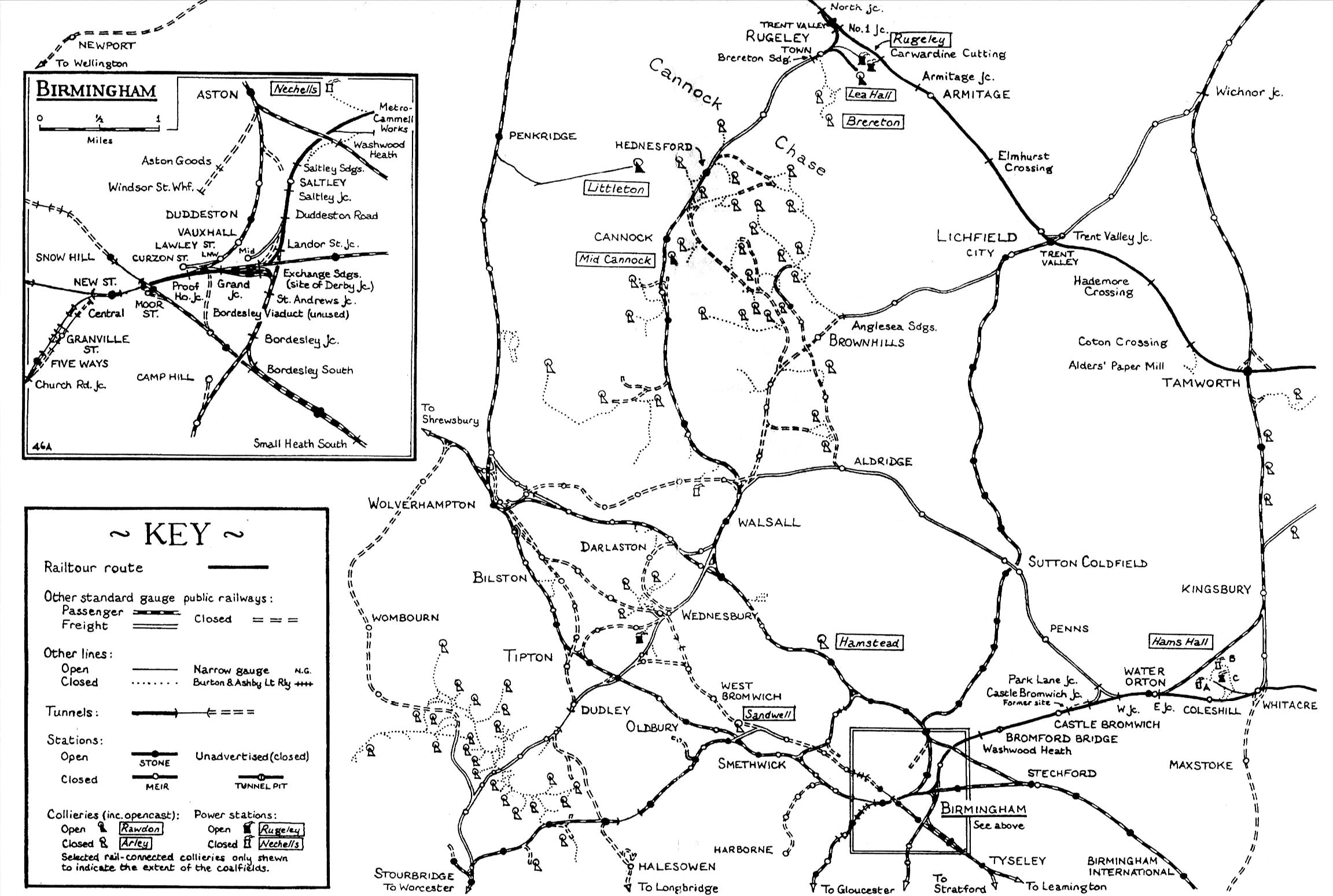
Railtour map drawn by our member Dave Mellor.
[© Dave Mellor 1989]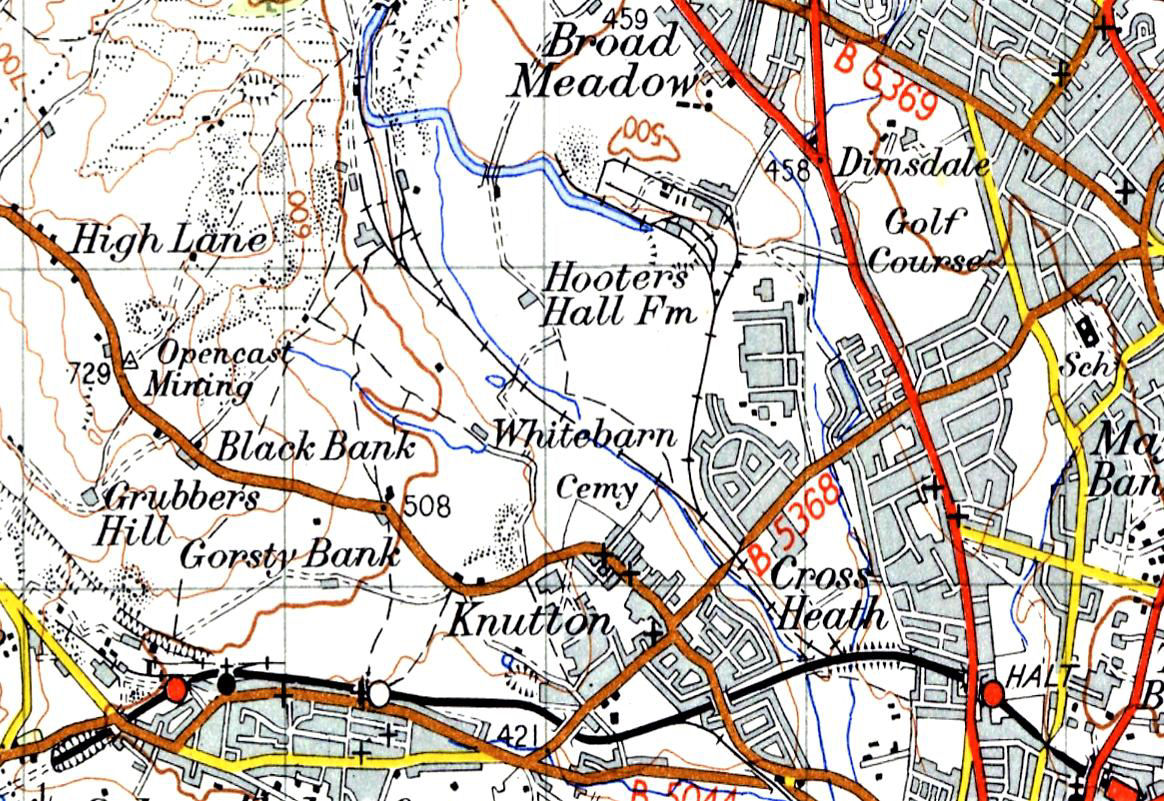
1956 - Silverdale Colliery is bottom left (Madeley Jn off left); Stoke off right. Apedale Jn is below 'Cross Heath' the Apedale Branch runs NW to where the Apedale Light Railway is - Apedale Colliery site is off map beyond. Holditch Colliery is upper right centre (branch from Knutton Gate Jn).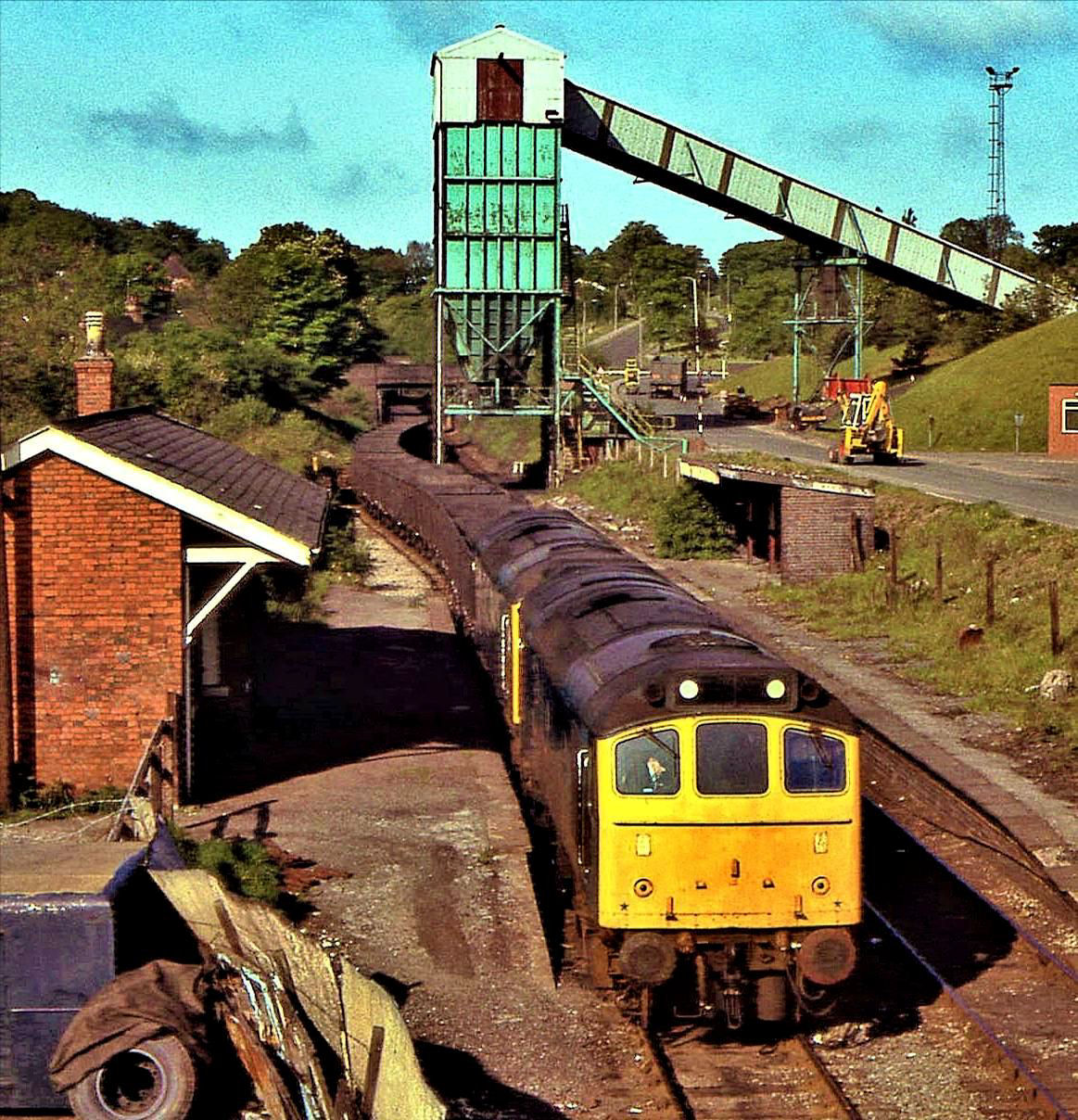
May 1982, Silverdale rapid loading bunker, the colliery was off to the right. It closed in 1993, but was reopened the following year under private ownership and lasted until 1998. Looking west to Madeley Jn/Market Drayton. A pair of Class 25s (the usual motive power) brings wagons from Crewe Sorting Sidings South for Holditch Colliery; most of its output went to Shotton Steel Works. This section of the line from Stoke-on-Trent was once double track; Silverdale station here CP 2 Mar 1964.
[© Ian Mortimer 1982]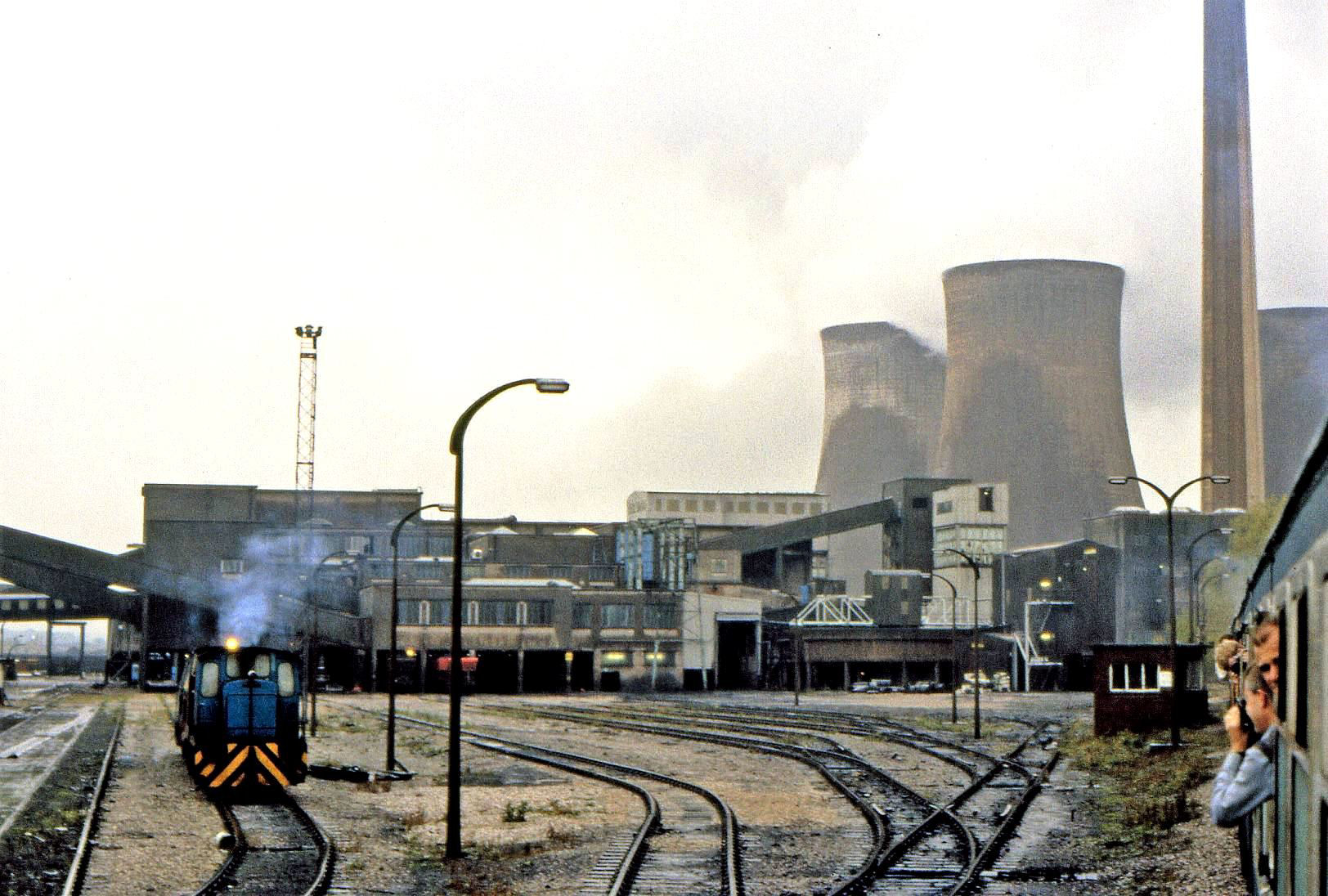
Lea Hall Colliery - the tour reversal point; the adjacent Rugeley 'A' Power Station was in steam.
[© Ian Mortimer 1989]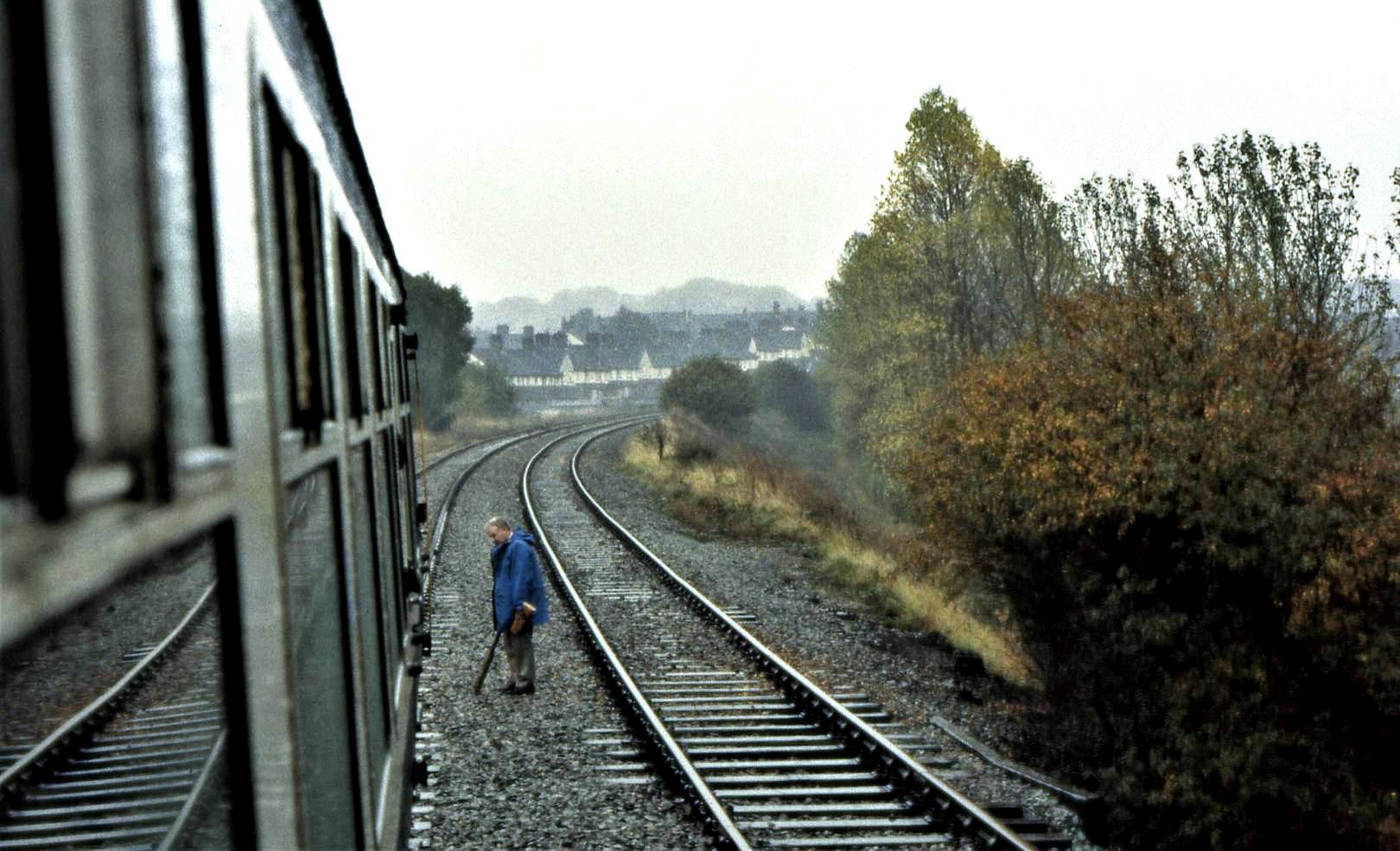
The tour organiser, Chris Boyle, inspects the points at Apedale Jn as they had not been used for three months. This was the run round loop for trains reversing here to and from Holditch Colliery.
[© Ian Mortimer 1989]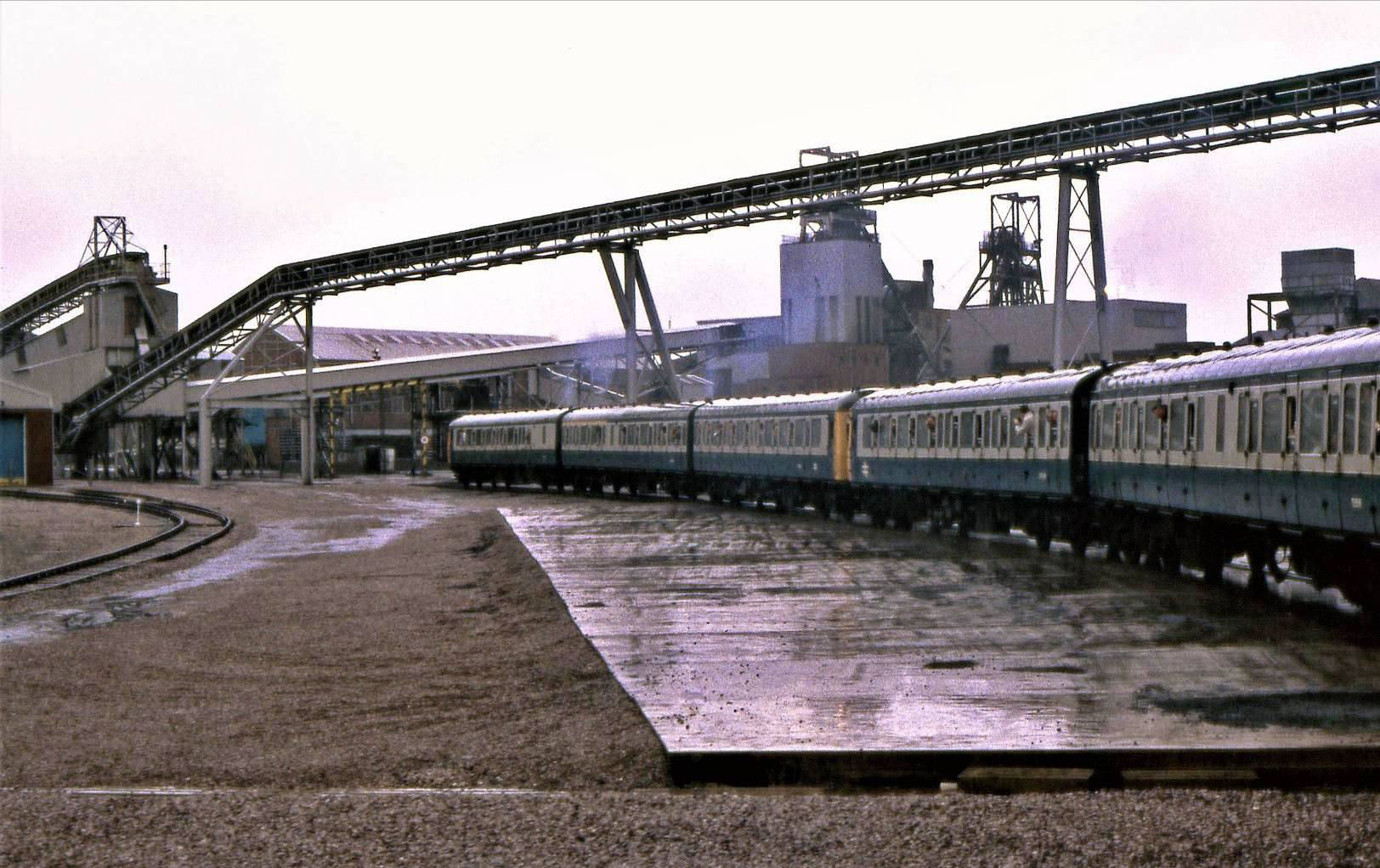
The tour entering Holditch Colliery in poor weather conditions, (from the rear of the train).
[© Ian Mortimer 1989]