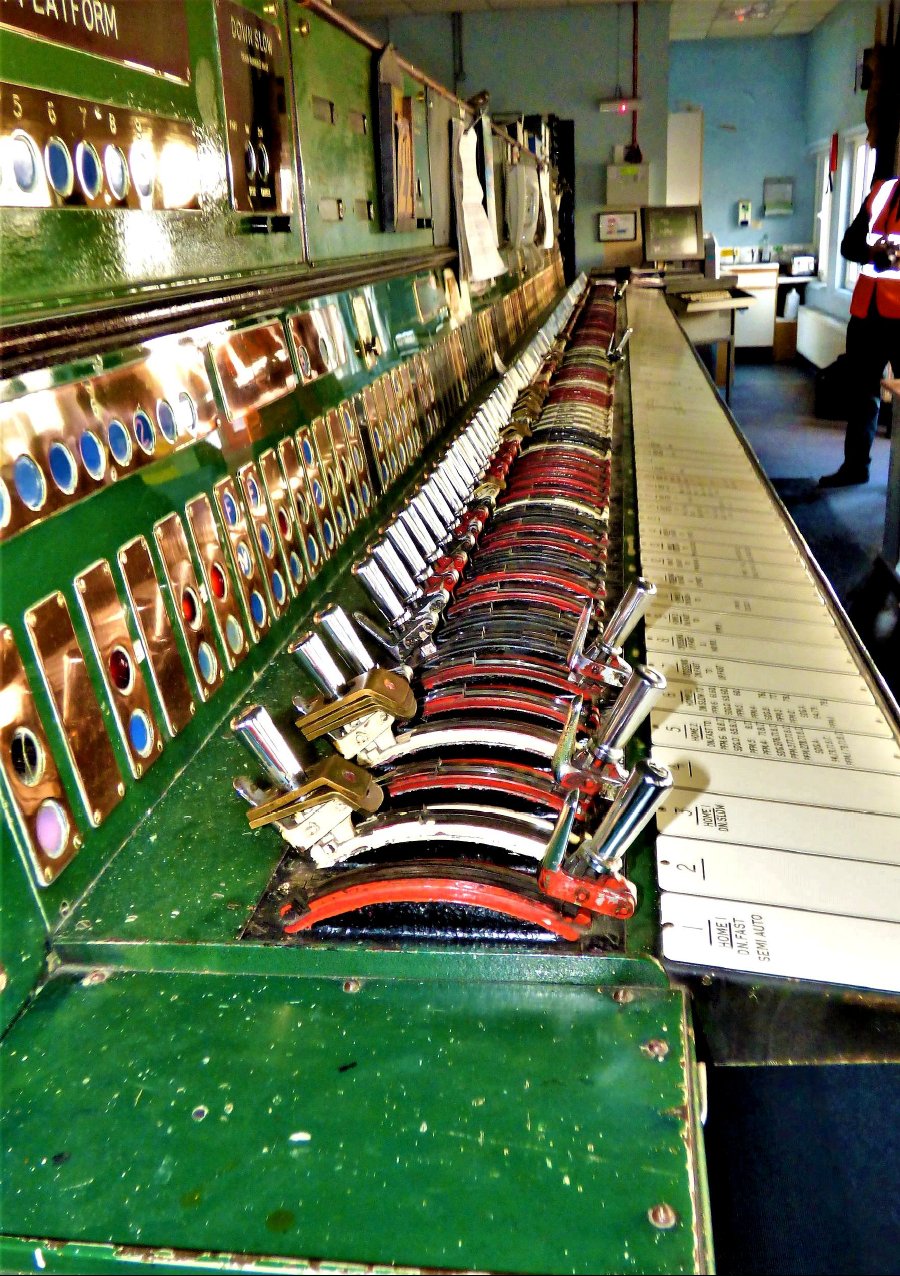
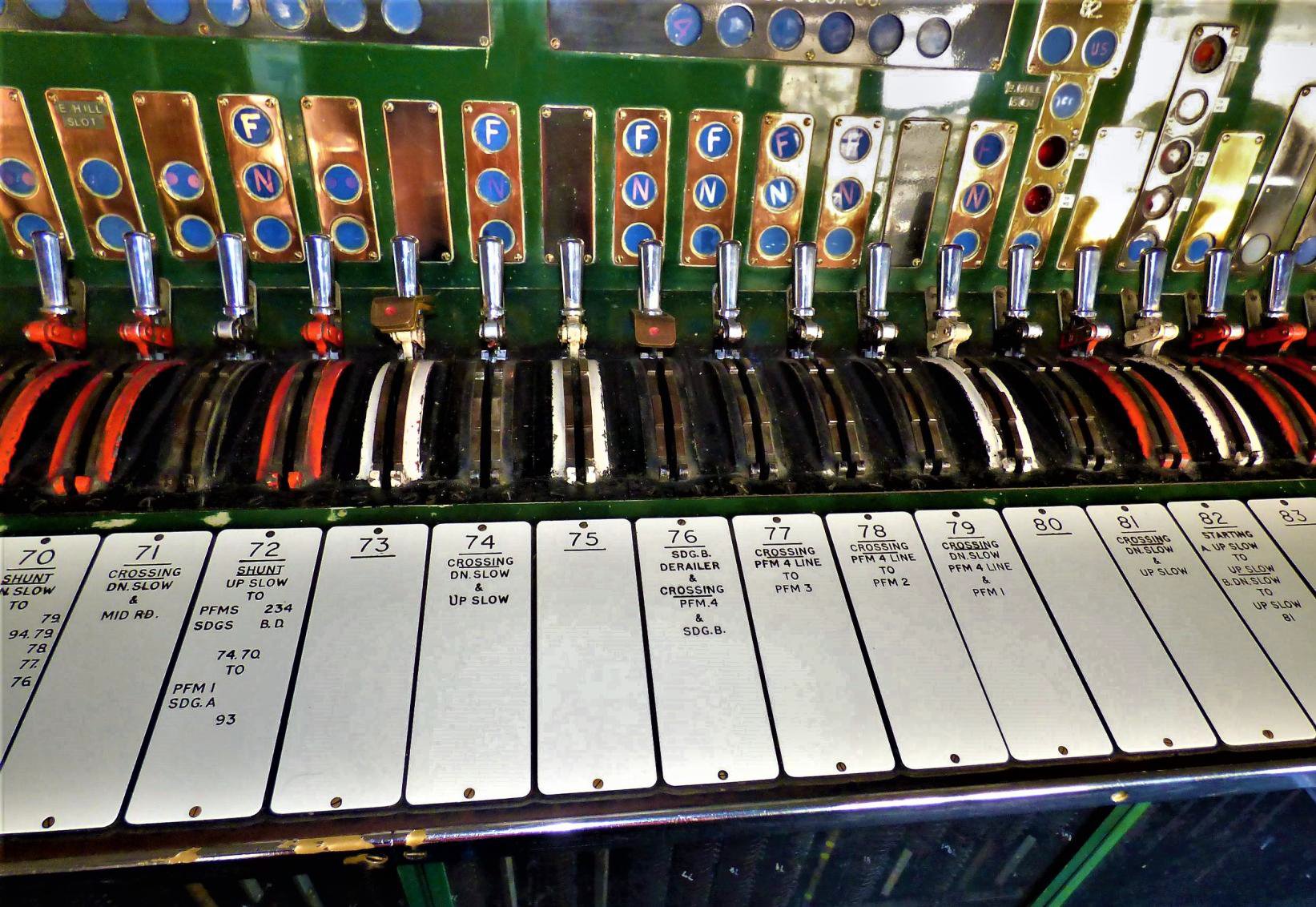
Twenty members in five groups of four visited, at 45 minute intervals, this brick built flat roofed signalbox, situated on the south side of the Lime Street station throat. The box dates from 1948, but is essentially of an LMS design (Signalling Record Society type 13) intended for wartime installations (having to some extent reinforced construction). There are others of essentially the same general type operational at Crewe Coal Yard, Runcorn, Thornhill and Wigan Wallgate, with disused ones still existing at Broom West (visible from the A46 to the east) and Cold Meece. It has a Westinghouse 'L' power frame with 95 miniature levers (24 spare). Locking is unusual, being electric, with rotating spindles below the console. Lime Street is one of only two miniature lever frames remaining on Network Rail (the second is Maidstone East signalbox), although there are others in Britain, for example on LUL, and in the new box at Porthmadog Ffestiniog Railway.
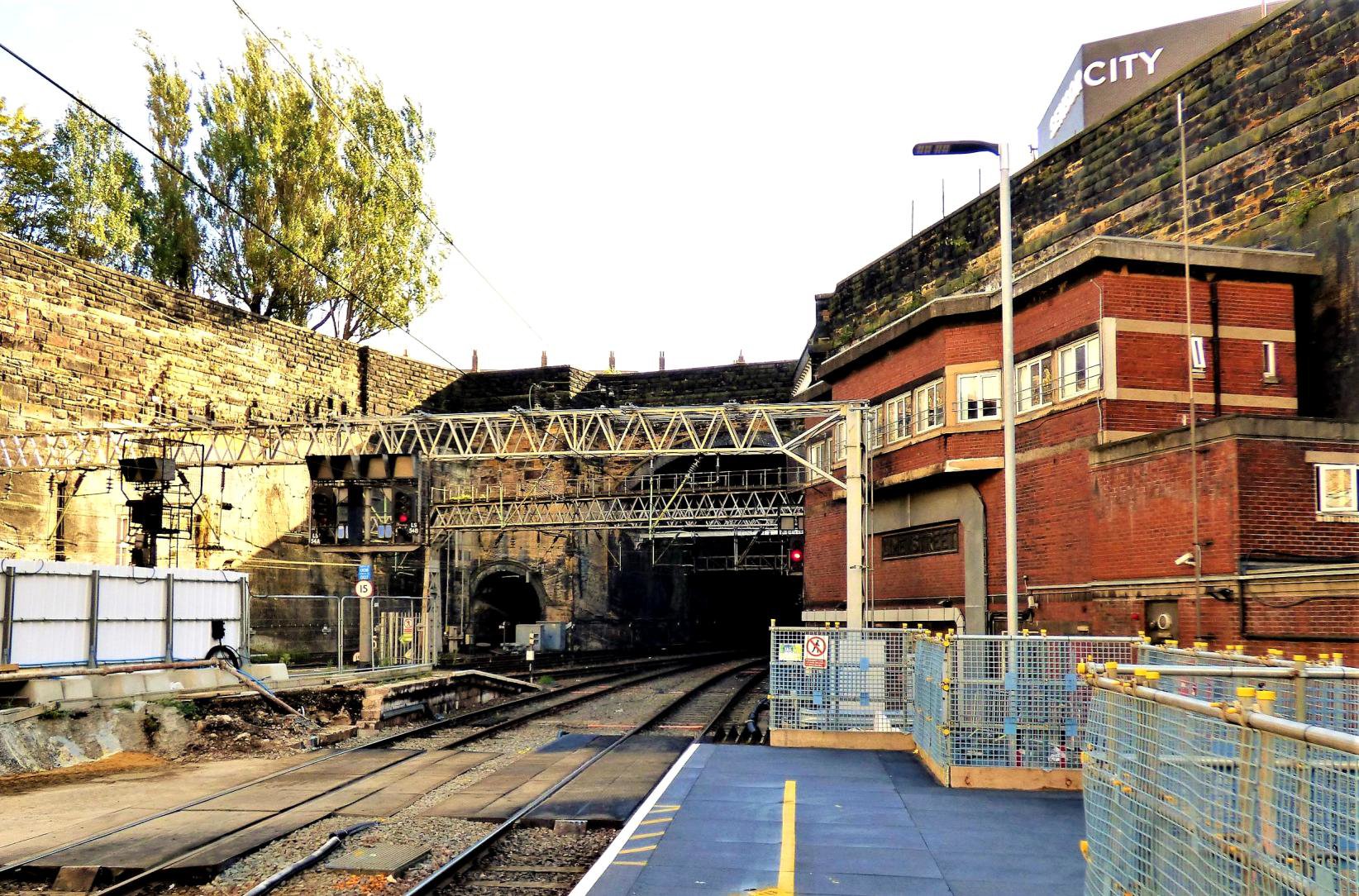
[© Nick Jones 2017]The box controls a relatively small area, simply the four track route to Edge Hill, which is operated on the track circuit block system. Communication with Edge Hill Power Signal Box is by train describer. All signals are colour lights and all points (except one) have clamp locks. Levers 5 and 6 control the fast and slow 'Home 2' signals, and those signals show the platform destination according to the lie of the various points. A row of lights above the levers concerned show which route has been set (by indicating the appropriate platform number). A slightly similar arrangement applies to the various platform starting signals, which although controlled by one of several levers, clear according again to the lie of the points. In this case also there are rows of lights to indicate the platform concerned.
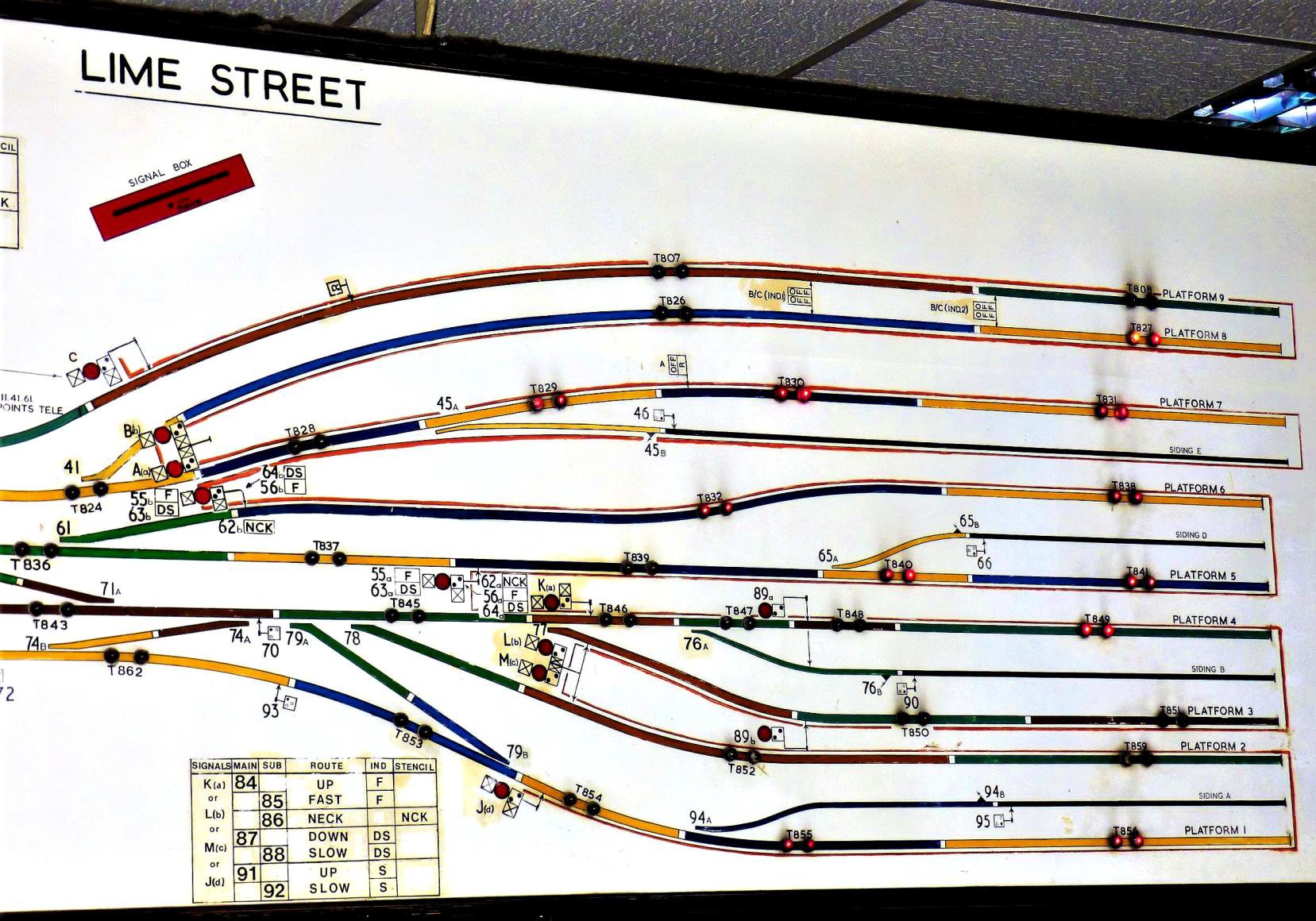
[© Nick Jones 2017]There are some other unusual features, such as two 'train running away' indicators, one for the Down Fast and one for the Down Slow, activated when approaching trains pass signals at danger. This is a significant possibility since the line from Edge Hill descends at a maximum gradient of 1 in 83. (From opening in August 1863 to 1870 locomotives detached at Edge Hill and the coaches gravitated down to Lime Street with brakesmen. A stationary steam engine at Edge Hill hauled the carriages 'up' by rope.)
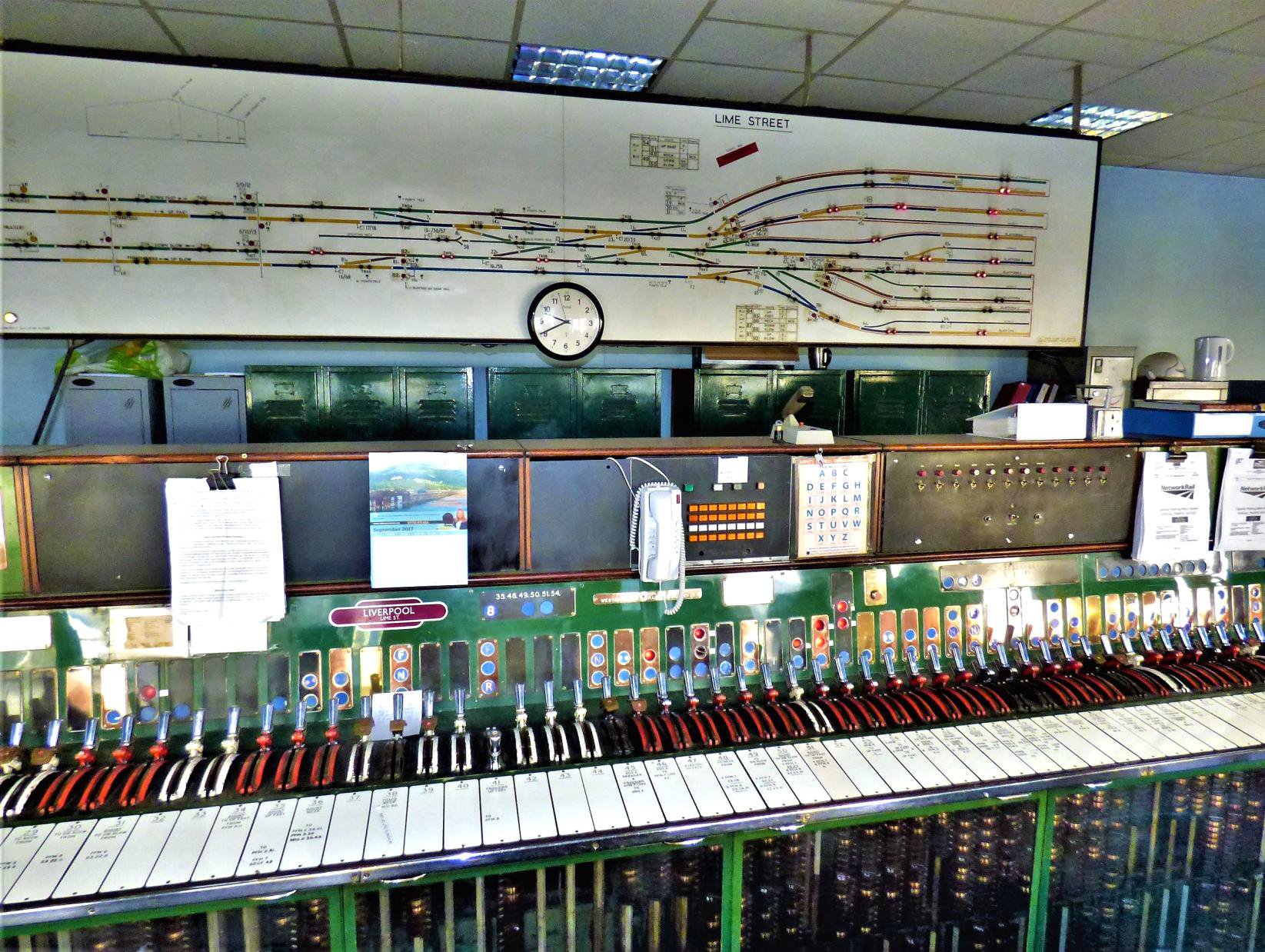
[© Nick Jones 2017]There is a shunting neck between the pairs of running lines. This is at present out of use, and two press buttons are provided on the panel to operate a shunting horn (also no longer in use) to alert drivers of trains or locomotives on that line. More conventionally there are two 'ready to leave' indicators (operated from the platforms and showing which one is involved).
[© Nick Jones 2017]It was a most interesting and enjoyable occasion; we are grateful to our guide, Andy Gwynne (from Manchester ROC, which should take over Lime Street in July 2018 after a second engineering closure), Bernard, the signaller on duty, and of course Barney Clark for the arrangements.
[© Nick Jones 2017]