North Staffs Signal Boxes
Thursday 6th October 2016
See https://goo.gl/RcyKsV for pictures. Six members, a full party, visited all 8 boxes on the former North Staffordshire Railway (NSR) between North Stafford Jn and Stoke Jn (convenient for our Cliffe Hopper railtour the next day which called at Stoke). Only two at a time were allowed in each so visits were carefully staggered. Hilton Crossing with a steady flow of road traffic across it is 420yd east of and within sight of Egginton Junction box. The metal hand operated gates are locked from the single lever frame; the crossing keeper's hut is a small modern portable cabin. Local bell-codes are used between crossing keepers and Egginton Junction signallers.
The box is just short of the west end of the former Egginton Junction station (CP 5 Mar 1962). Two double track lines once left the Derby to Stoke line here. Firstly from the Derby direction and heading south was the Great Northern Railway (GNR) spur that, at Dove Jn joined the NSR branch from Marston Jn (further west from the Stoke direction) to Burton-on-Trent. To the north was the GNR line to Derby Friargate, Nottingham and beyond, part of which was the Derby Research Centre Mickleover test track until 9 Jul 1990 when Egginton ceased to be a junction. It is now a pleasant trackbed walk taken on 19 Jul this year by a Society group of 21. The 1877 NSR Egginton Junction box is taller than average with a brick base and wooden upper section, probably to give a clear view of the station and both junctions. A good selection of pictures https://goo.gl/3jcQHQ etc. Changes include galvanised steel access steps and UPVC window frames. It retains a verandah; instructions state that this is not to be used under any circumstances! It fringes with the East Midlands Control Centre, (Derby). Trains from Derby show on the Train Describer VDU and are then offered on to the next box….
Tutbury Crossing box is west of the road it protects with the staggered platforms of Tutbury & Hatton station (ROP 3 Apr 1989) either side. It is within sight and very definite smell of a Nestlé Coffee factory. It has also been modernised with galvanised steel steps and UPVC window frames; but the bolts securing the wooden top half of the signal box to the brick base are prominent on the internal wooden window sill. There is an orange painted but now empty box for detonators. The electric barriers have a bell to warn road users when they will be lowered rather than the almost universal sirens elsewhere.
Further east is Scropton on a small road terminating at some houses just beyond the crossing; road traffic is light. The metal crossing gates both hang on posts at the east end of the crossing and overlap when across the railway. The box retains wooden steps and window frames. Its crossover is OOU and the Up Main point has recently been plain lined. The bell code 1-2-1 train approaching is used, as at some of the other boxes on the line, as many of the sections are too short to allow signals to be cleared in time. Scropton like Sudbury, has more surviving NSR features than the other boxes visited.
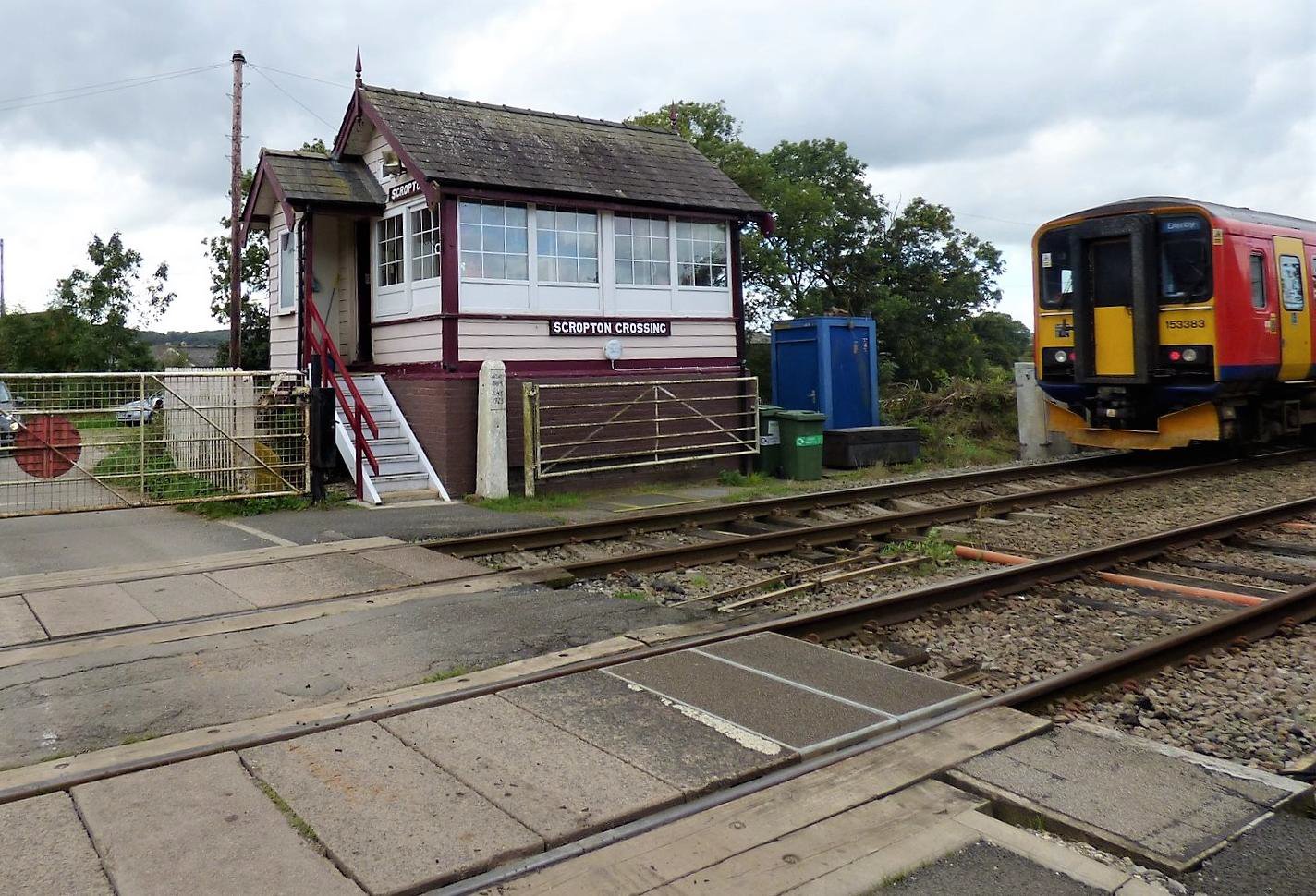
A Derby to Crewe service passes Scropton.
[Nick Jones]
(The 'other') Sudbury 1885 signal box with 25 levers has wooden steps and is very close to the adjacent semi-detached houses. A separate modern toilet is at the bottom of the steps between the signal box and a large corrugated shed that was perhaps a lamp hut or store. The group was able to visit the locking room here. Sudbury, like Scropton and Foley, has a McKenzie & Holland 'Hook, Cam and Soldier' frame. These are believed to be the only three of this type remaining in use on NR.
Uttoxeter, the largest and most recent (1981) box on the line, (between Pinfold level crossing and the Down Goods Loop west of the station), is a standard BR London Midland Region design. It had a refit five years ago and has UPVC window frames and radiators (metal!) rather than the original gas fires. It controls several different crossings and has a motor assisted 40 lever frame.
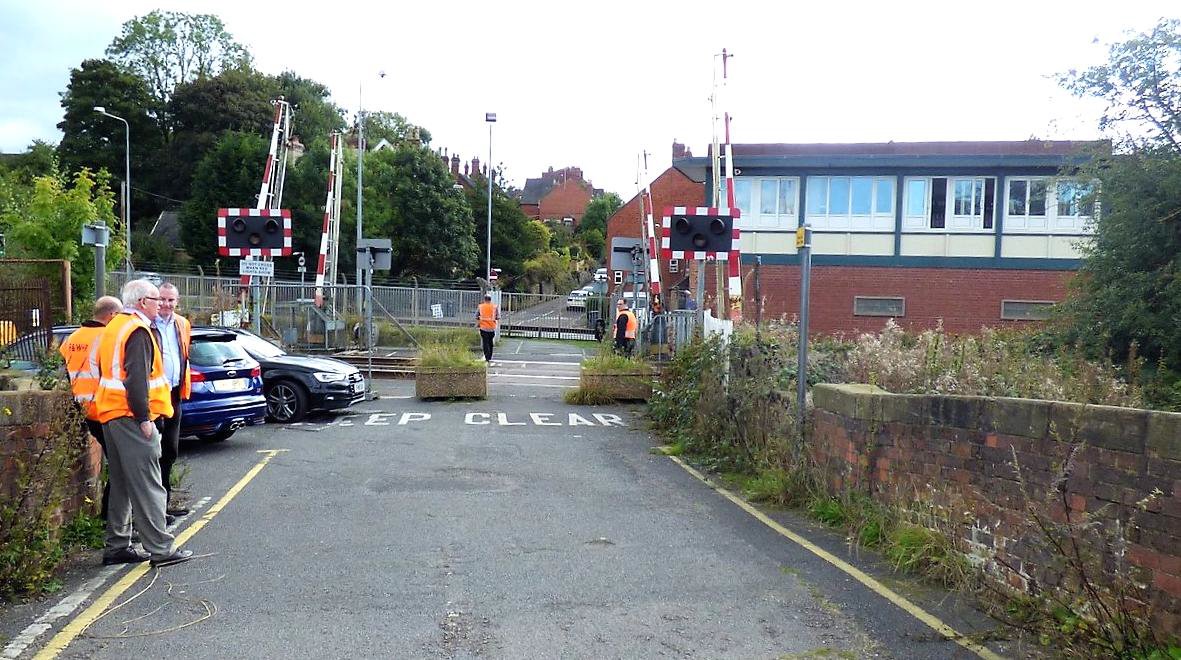
Some BLS signal box experts loitering with intent; … intent to visit Uttoxeter signal box.
[Nick Jones]
Caverswall https://goo.gl/p5sAbO controls a long section and works several lifting barrier crossings by CCTV monitoring, so annunciators frequently sound as trains approach them. The very rarely used Up and Down goods loops are east of the box. The former was covered on our EMT 27 Feb tour. Most of the 35 levers are in use and there were many lever collars on the shelf. Many boxes on this line have original NSR lever collars (for display only - more modern ones are used). This is a long section and in contrast to several of the other signal boxes trains are not offered on to the next signal box as soon as they were received by Caverswall. There is a tail lamp camera at signal 29 on the Down Main at Stallington Crossing.
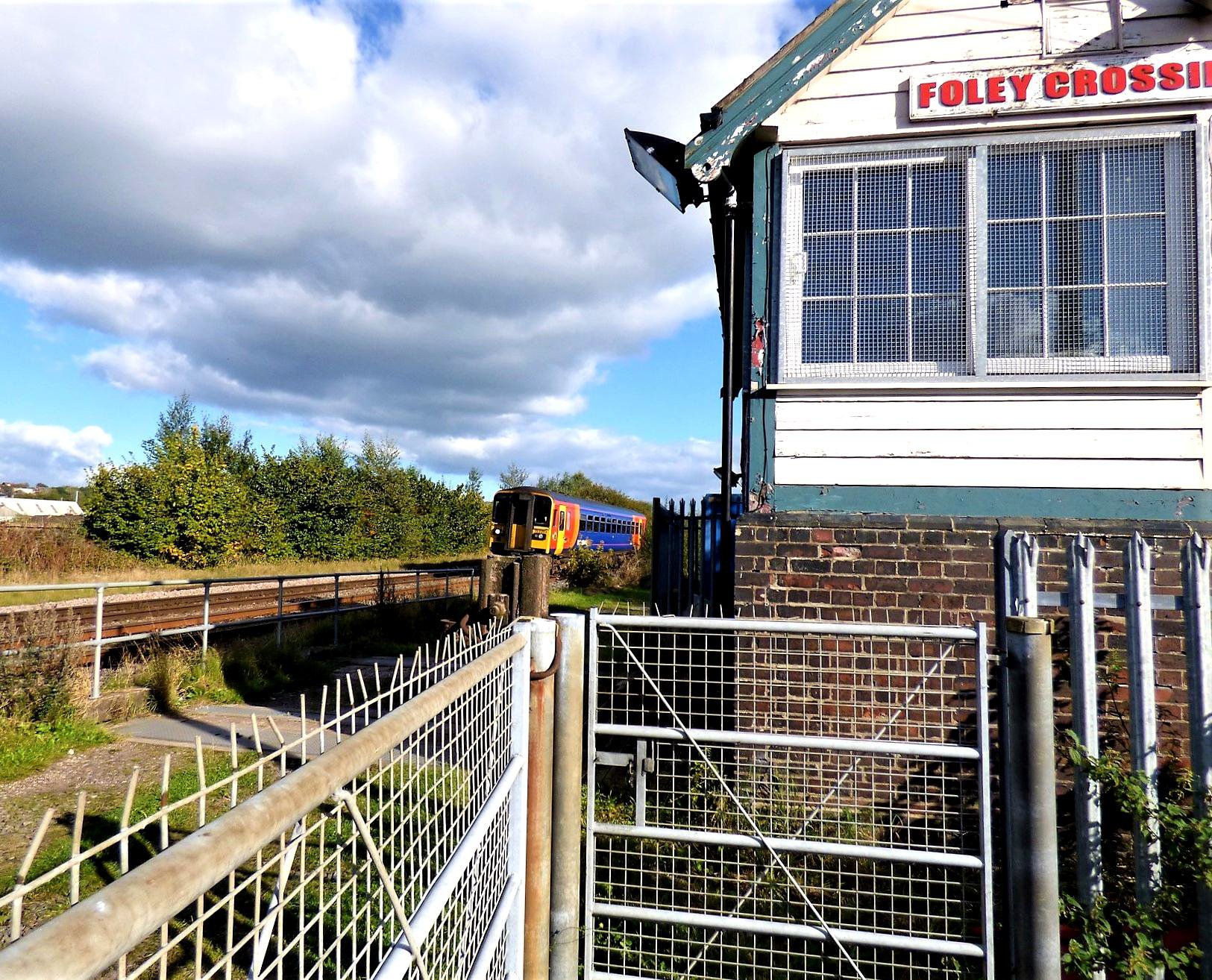
Foley Crossing Box, a Derby to Crewe train which has just left Longton is approaching.
[Nick Jones]
The 1899 built Foley Crossing box (Longton) has had persistent vandalism problems; the windows are covered with mesh, an outer steel door protects the UPVC inner door and the whole site is surrounded by palisade fencing. The box has sunk at one end giving a noticeable slope to the floor. It is a block post fringing with Stoke Signalling Control Centre and operates the pedestrian crossing gates sited to the east. Here we were also able to see the locking room though much of the 37 lever frame is out of use.
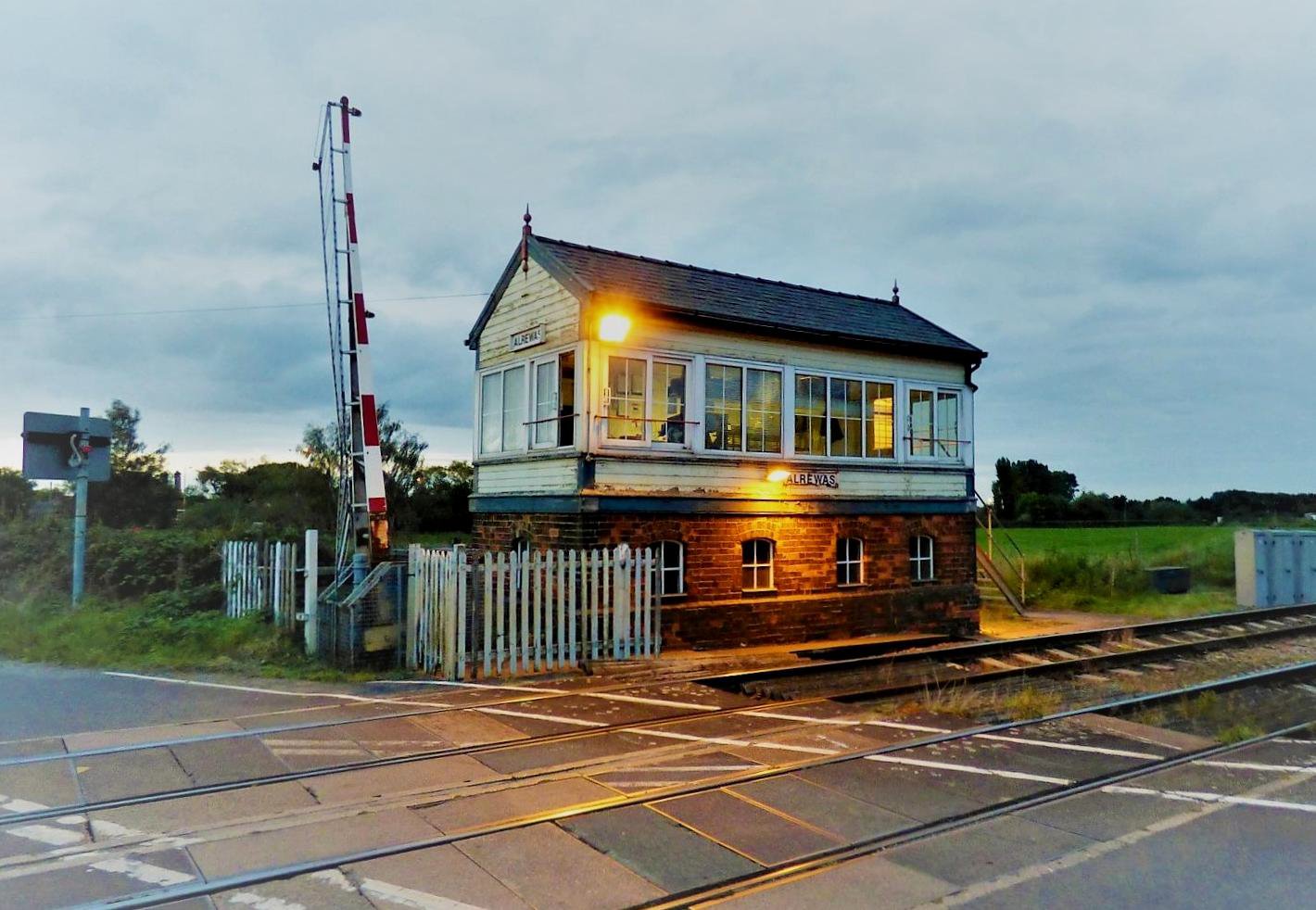
Alrewas box on the Lichfield to Wichnor Jn line.
[Nick Jones]
At short notice, an on the day bonus, permission was kindly given to visit the 1899 built LNWR Alrewas box on the Lichfield to Wichnor Jn line. Unfortunately, some became lost and never made it! The box was repaired and refurbished after a fire on 23 Oct 2005 and now has a panel with individual function switches to control the crossover and signals. There are two locally worked manual level crossings and reminders hang on the block instrument to contact the crossing keepers. An emergency replacement switch is used to hold the down distant signal at yellow.
As a first time signal box visitor our reporter was struck by the mix of 19th century 'technology' with modern CCTV and computers and how every train movement is still recorded manually in the register. It was also a revelation to see the mix of domestic and work furniture with comfy armchairs, once part of someone's three piece suite, mixed with stools and desks that probably dated back to when the boxes were built. The group were most grateful to Grant Burton, Local Operations Manager and the signalers who were enthusiastic and made us most welcome. £150 was collected for Barnados as a result of the visits. Finally, thanks to member Nick Jones for the organisation and help with the report.